IS THE CATHOLIC CHURCH SIMPLY THE RELIGIOUS WING OF NAMBLA?

09 FEB 02:
IS THE CATHOLIC CHURCH SIMPLY THE RELIGIOUS WING OF NAMBLA?

From the LATimes:

Reports of Priests’ Abuse
Enrage Boston Catholics


By ELIZABETH MEHREN, TIMES
STAFF WRITER

BOSTON — Among Catholics
here, the floodgates of rage and disappointment poured open this week.


    On radio
talk shows, in chatter at convenience stores and in emergency “listening
sessions” convened hastily by the Archdiocese of Boston, the faithful vented
anger and frustration over daily disclosures that scores of pedophile priests
worked in the region with the full knowledge of church officials.


    As the
number of implicated clergy members soared to 80, the crisis grew so deep
that nearly half the Roman Catholics polled said Cardinal Bernard Law should
resign. The turmoil over what church officials knew, when they knew it
and what they did or did not do to protect themselves and their parishioners
has rocked a region that is more than 50% Catholic.


    “This
is our Sept. 11,” Boston College professor Thomas H. Groome said Friday.


By week’s end, the archdiocese had given law enforcement authorities the
names of at least 80 priests accused of sexual misconduct with minors over
the last 20 or more years.

    The archdiocese
also announced Thursday that six more priests had been suspended. Earlier
in the week, the archdiocese relieved two other priests of duties, also
following accusations that they had sexual relations with children.


    Both
actions came days after Law publicly insisted that all priests in his jurisdiction
who were suspected of sexually abusing children had been removed from their
duties…


    The survey
found that 64% said church leaders care more about protecting the accused
priests than helping the victims.


    “I think
for a long time people have known that the church has been aware of these
problems and has not acted expeditiously,” said Lisa Cahill, a professor
of moral theology at Boston College, a Jesuit institution.


    “Part
of what’s appalling,” she continued, “is the extensiveness of the problem,
based just on the number of these priests that keep surfacing in New England.
Every day, you hear about six more cases.”


Recently, the archdiocese said it had settled so many child sexual abuse
claims against it that a multimillion-dollar insurance fund was running
dry.


    Scandals
involving pedophile priests have hit parishes across America–and indeed,
around the world–in recent decades. Thousands of adults have come forward
to say they were abused as children and many priests have been sent to
jail.


    At first,
accusations against Father James Geoghan seemed no different. The 66-year-old
defrocked priest was charged in three separate criminal sexual abuse cases
dating from the 1980s and 1990s. More than 130 people have claimed they
were fondled or molested by Geoghan, who also is a defendant in 84 civil
lawsuits.


    But in
the course of the Geoghan investigation, Law was forced to tell prosecutors
that the priest’s pattern of pedophilia was no secret in the local Catholic
hierarchy.


    Law abruptly
promised to supply law enforcement agencies with names of priests suspected
of such behavior. He organized a panel including medical experts to look
into sexual abuse within the church. The cardinal also appealed for public
understanding, urging Catholics to pray for him as he faced this difficult
situation.


    On Jan.
25, he vowed, “There is no priest, or former priest, working in this archdiocese
in any assignment whom we know to have been responsible for sexual abuse.”

    Days
later, he removed two more priests for alleged child molestation.


    The archdiocese
did not respond to requests Friday for an interview with the cardinal.
However, after returning from the Vatican, Law told local reporters at
Logan International Airport: “Our intent is to do everything we possibly
can to ensure the protection of children.”


    Around
the archdiocese, the scope of the scandal–and its growing momentum–continued
to shock Catholics, who expressed grief, outrage and, most of all, a sense
of betrayal.


    “You
have an organization that is based on faith, and part of that faith derives
from your confidence in the institution that houses that faith,” said Paul
Nace, a real estate developer in Newton who was raised Catholic.


    “When
events happen that call into question that institution, at a very basic
and moral level it also calls into question your faith,” Nace said.


    As horrific
as the spiraling number of clergy sexual abuse cases might be, “the most
disturbing part is that it appears that decisions were made to protect
the institution at the expense of the victims,” Nace said. “You’ve got
a head-on, loggerhead collision with everything that institution is supposed
to stand for.”

    Groome,
a former priest and author of a new book called “What Makes Us Catholic,”
said that to Catholics, the church represents a vastly more important institution
than in some other denominations.


    “We have
obviously exaggerated the importance of the institution,” he said. “Everybody
has a priesthood, and everybody invests in their priesthood, but nobody
in the Western world has invested in their priesthood the way Catholics
have. This is why all of this is so desperately shattering.”


    Mitchell
Garabedian, an attorney representing 84 plaintiffs in civil suits against
Geoghan, said his clients have had their faith ravaged by their experiences.


    “They
cannot seek spiritual relief anywhere because of what has happened to them,”
Garabedian said. “The very entity they want to
turn to has in a sense helped them to be molested. It is mind-boggling.”


    Some
of the claims he has looked into involving the Boston archdiocese date
back more than 40 years, Garabedian said. Far from surprised that so many
names of alleged predator priests have been put forward by the church,
“I’d be surprised if more names were not revealed,” he said.

    “There
is a serious problem within the Archdiocese of Boston,” Garabedian went
on. “For decades they have been imprisoned by pedophiles and shackled by
their own denial.”


    The troubles
at the archdiocese took a new turn late in the week when a family in which
both a father and son were abused by priests filed a suit against Cardinal
Law. The latest legal action–the first directed at the cardinal himself–claims
Law “intentionally” and “recklessly” inflicted emotional damage on Thomas
and Christopher Fulchino by knowingly assigning a pedophile priest to their
parish.

THE DEMOLISHER OF MCDONALD'S

07 FEB 02: THE DEMOLISHER
OF MCDONALD’S

ABOVE: French farmer
Jose Bove has some French bread, cheese and wine after he was freed from
the Villeneuve les Maguelonne jail in the south of France, Tuesday, September
7, 1999. Bove, leader of a radical farmers’ union, was jailed for nearly
three weeks for vandalizing McDonald’s restaurant property. The small Farmers’
Confederation has made McDonald’s the main target in a wave of sometimes
violent protests, decrying the fast-food chain as a symbol of American
trade “hegemony” and economic globalization.(AP Photo/Christophe Ena).

from New
Left Review 12, November-December 2001

JOSÉ BOVÉ

The demolisher of McDonald‚s
explains his personal background, the history of


the Peasants‚ Confederation
in France, and the international objectives of Via


Campesina. Struggles in
the countryside of the Massif Central or Karnataka as

spear-points in the anti-globalization
movement.

You founded the Confédération
Paysanne in 1987. What is its project?


JOSE BOVE: Firstly, it‚s
a defence of the interests of peasants as workers. We‚re


exploited, too˜by the banks,
by the companies who buy our produce, by the firms


who sell us equipment, fertilizers,
seeds and animal feed. Secondly, it‚s a


struggle against the whole
intensive-farming system. The goals of the


multinationals who run it
are minimum employment and maximum, export-oriented


production˜with no regard
for the environment or food quality. Take the

calf-rearing system. First
the young calf is separated from its mother. Then


it‚s fed on milk that‚s
been machine-extracted, transported to a factory,


pasteurized, de-creamed,
dried, reconstituted, packaged and then, finally,


re-transported to the farms˜with
huge subsidies from the EU to ensure that the


processed milk actually
works out cheaper than the stuff the calves could have


suckled for themselves.
It‚s this sort of economic and ecological madness,


together with the health
risks that intensive farming involves, that have given


the impetus to an alternative
approach.


    …We‚re
committed

to developing forms of sustainable
agriculture, which respect the need for


environmental protection,
for healthy food, for labour rights. Any farmer can


join the Confédération
Paysanne. It‚s not limited to those using organic methods


or working a certain acreage.
You just have to adhere to the basic project.


There are around 40,000
members now. In the Chambres d‚Agriculture elections


this year we won 28 per
cent of the vote overall˜and much more in some


départements. It
was 44 per cent in Aveyron, and 46 per cent in La Manche.

How did this come to pit
you against the junk-food industry˜most famously,


dismantling the McDonald‚s
in Millau?


During the eighties we built
up a big campaign in France against the pressures


on veal farmers to feed
growth hormones to their calves. There was a strong


boycott movement, and a
lot of publicity about the health risks. Successive


Ministers of Agriculture
were forced to impose restrictions, despite heavy


lobbying from the pharmaceutical
industry. At the end of the eighties the EU


banned their use in livestock-rearing,
but it has been wriggling about on the


question ever since. In
1996, the US submitted a complaint to the WTO about

Europe‚s refusal to import
American hormone-treated beef˜exploiting the results


of a scientific conference,
organized by EU Commissioner Franz Fischler, that


had concluded, scandalously,
that five of the hormones were perfectly safe. But


there was so much popular
opposition, linked to people‚s growing anxieties about


what was happening in the
food chain˜mad cow disease, Belgian chickens poisoned


with benzodioxin, salmonella
scares, GMOs˜that the European Parliament actually


held firm. When the WTO
deadline expired in the summer of 1999, the US slapped a


retaliatory 100 per cent
surcharge on a long list of European products˜Roquefort


cheese among them. This
was a huge question locally˜not just for the sheep‚s

milk producers, but for
the whole Larzac region.


    When
we said we would protest by dismantling the half-built McDonald‚s in our


town, everyone understood
why˜the symbolism was so strong. It was for proper


food against malbouffe,
agricultural workers against multinationals. The actual


structure was incredibly
flimsy. We piled the door-frames and partitions on to


our tractor trailers and
drove them through the town. The extreme Right and


other nationalists tried
to make out it was anti-Americanism, but the vast


majority understood it was
no such thing. It was a protest against a form of

food production that wants
to dominate the world. I saw the international


support for us building
up, after my arrest, watching TV in prison. Lots of


American farmers and environmentalists
sent in cheques.

…What were your demands
at Seattle?


Firstly, all countries should
have the right to impose their own tariffs, to


protect their own farming
and food resources and maintain a balance between town


and countryside. People
have a fundamental right to produce the food they need


in the area where they
live.
That means opposing the current relocation of

American and European agribusiness˜chicken
and pig farms, and greenhouse


vegetables˜to countries
with cheap labour and no environmental regulation. These


firms don‚t feed the local
people: on the contrary, they destroy the local


agriculture, forcing small
peasant-farming families off the land, as in Brazil.


Secondly, we have to take
measures to end the multinationals‚ dumping practice.


It‚s a well-established
tactic used to sweep a local agriculture out of the way.


They flood a country with
very cheap, poor-quality produce, subsidized by


massive handouts in export
aid and other help from big financial interests. Then


they raise prices again,
once the small farmers have been destroyed. In

sub-Saharan Africa, livestock
herds have been halved as a result of the big


European meat companies
flooding in heavily subsidized frozen carcasses. The


abolition of all export
aid would be a first step towards fair trading. The


world market would then
reflect the real cost of production for the exporting


countries.

    Thirdly,
we absolutely refuse the right of the multinationals to impose patents


on living things. It‚s bio-piracy,
the grossest form of expropriation on the


planet. Patents are supposed
to protect a new invention or a new technique, not

a natural resource. Here,
it‚s not even the technique but the products, the


genetically modified seeds
themselves, that are Œpatented‚ by half-a-dozen


chemical companies, violating
farmers‚ universally recognized right to gather


seed for the next year‚s
harvest. The multinationals‚ GM programme has also been


a ferocious attack on biodiversity.
For instance, something like 140,000 types


of rice have been cultivated
in Asia, over the centuries. They‚ve been adapted


to particular local tastes
and growing conditions˜long-grain, short-grain,


variations in height, taste,
texture, tolerance of humidity and temperatures,


and so on. The food companies
are working on five or six strains, genetically

modified for intensive,
low-labour cultivation, and imposing them in areas of


traditional subsistence
farming. In some Asian countries˜the Philippines and


China are the worst cases˜these
half-dozen varieties now cover two-thirds of


rice-growing land.

    …The
Marrakesh accords were supposed to be subject to a balance sheet at


Seattle˜of course, this
never came. Not that we need an official report to know


that the countries of the
South have been the biggest losers: opening their


borders has invited a direct
attack on the subsistence agriculture there. For

example, South Korea and
the Philippines used to be self-sufficient in rice


production. Now they‚re
compelled to import lower-grade rice at a cheaper price


than the local crops, decimating
their own paddy production. India and Pakistan


are being forced to import
textile fibres, which is having a devastating effect


on small cotton farmers.
In Brazil˜a major agricultural exporter˜a growing


percentage of the population
is suffering from actual malnutrition. The


multinationals are taking
over, denying large numbers of farming families access


to the land and the possibility
of feeding themselves.

na

06 FEB 02:

from Der
Spiegel
, by way of the always-interesting Babelfish Translator Device:

 Daniel and Manuela Ruda: Kiss after
the judgement


JUDGEMENT DURING THE SATANISTEN
PROCESS

Grinsen in the face

Grinsend and smirking received
the two Satanisten Manuela and Daniel Ruda the judgement, which will bring
them for long time into a closed psychiatric hospital. Before the Bochumer
regional court they were condemned for the murder at a 33-jaehrigen acquaintance
to detentions by 13 or 15 years.

Bochum – after the message
of the judges the Rudas must spend indefinite time in a closed psychiatric
institute. A chance, from the measure execution in such a way specified
dismisses to become, exists only, if consultants classified the patients
as harmless. The defender said after in relation to the judgement the ARD:
” the two are bekloppt, if you permit me the printout. ” Also Manuela and
Daniel Ruda are still felsenfest convinced a half year after the murder
at the 33-Jaehrigen of the fact that the devil would have given them personally
the job to the blood act.


    During
the process several consultants had come to the judgement that the married
couple could due to their personality disturbances and the act insight
lacking at any time again murders. Experts had explained that a handling
could take clearly more than ten years up. It is not to be excluded however
that a therapy fails completely. The married people are momentary not even
able to develop debt feelings.


    The pair
had brutally murdered the acquaintance with 66 meter passes and hammer
blows after own confession in July 2001. However had the accused abgestritten
that it concerned murder – finally they would have received the job from
Satan. A voice from the underworld instructed it: ” kill! Bring victims!
Bring souls! ” Also Daniel Ruda, which had wanted original to state during
the process, explained: ” if one someone with the auto over-driven, is
accused also not the auto. “


    ” it
did not concern Satanismus, but around a crime of two disturbed humans
“, the chairman Richter of the court of assizes chamber, explained Arnjo
Kerstingtombroke in his in-hour grounds. ” the Satanismus was a Popanz,
it before itself moved over. ” The criminally liableness was so substantially
reduced that a lifelong detention was out of the question. To the accused
he said. ” with the production is now conclusion. Now the grey Einerlei
of the psychiatry comes for long time. “


    For Daniel
Ruda did not detect the judges milderungsgruende on. Because of murder
in the status of reduced criminally liableness he got the maximum penalty
of 15 years. Since its wife did not take the original initiative to the
act, so the grounds, were reduced their imprisonment by two years. The
pair killed, continued to tighten the completely badless victim insidiously
and from low motives the court.


    With
the message the judges still go beyond the demands of the public prosecutor’s
office, which had required 14 years for the accused and for its wife detention
of twelve years. Both public prosecutor’s office and the defenders had
expressed themselves in their final speech on Monday to accommodate the
married people in a closed psychiatric institute. Both pages had pleaded
for reduced criminally liableness.

    The lawyers
still announced in the court room revision against the judgement. ” the
judgement is too hard, and the Satanismus played very probably a role “,
said attorney Reinhard Benneken.

THE LEOPARD MAN OF SKYE AND THE GERMAN SATANISTS

05 FEB 02: THE LEOPARD
MAN OF SKYE AND THE GERMAN SATANISTS

FROM http://www.ananova.com/news/story/sm_435810.html?menu=news.quirkies

Leopard man shuns society for hut on
Isle of Skye

A tattooed hermit known as
the Leopard Man of Skye lives in a hut made of sticks and stones and bathes
in a river.


    Tom Leppard
dropped out of society years ago after spending £5,500 to have his
body covered in spots. Once a week, the ex-soldier goes by canoe to buy
supplies and pick up his pension.

    Mr Leppard
told Grampian Television: “I spent too long in the forces, 28 years. I
couldn’t mix with ordinary people. I decided I wanted to be the biggest
of something, the only one of something. It had to be a tattoo, one tattoo.
This is one tattoo.”


    Mr Leppard,
who also has a set of fangs, is recognised by the Guinness Book of Records
as the most tattooed man on earth.


    He says
he would be plagued by “interfering busybodies” and children throwing stones
at his window if he went back to civilisation.

Blood-drinking devil worshippers face
life for ritual Satanic killing


Murder trial reveals sinister link
to British vampire groups


John Hooper in Berlin

Friday February 1, 2002

The Guardian

A young married couple who
admitted to a ritual Satanic killing were yesterday told they could spend
the rest of their lives in a secure psychiatric unit after a trial which
has raised the spectre of bizarre underground occult groups in Britain.


    Manuela
Ruda, aged 23, who told a German court she had become a vampire in London,
and her husband, Daniel, aged 26, were given prison sentences of 13 and
15 years respectively after admitting to the hacking to death of a friend
in their flat in Witten, in the Ruhr valley.


    The victim,
a 33-year-old colleague of Daniel’s, Frank Hackert, was targeted as suitable
prey for his mild temperament and love of The Beatles, and was lured to
their apartment where he was attacked repeatedly with a hammer.


    Manuela
Ruda told the court: “Then my knife started to glow and I heard the command
to stab him in the heart.”


    The couple
stabbed Hackert 66 times, carving an occult pentagram on his chest and
collecting his blood in a bowl and then drinking it.


    When
police broke into the flat they found a scalpel still embedded in his stomach
with his body lying beneath a banner saying “When Satan Lives”.

    They
also found imitation human skulls and a coffin in which Manuela slept during
the day.


    The judge
in the case, which has led to disturbing scenes in court, coupled their
jail terms with an order that they be held indefinitely for psychiatric
treatment.


    Neither
of the two self-styled devil worshippers showed the slightest emotion as
the sentences were read out to a courtroom dotted with supporters and admirers
of the bizarre couple, many dressed in black and holding roses.


    Throughout
the trial in the western town of Bochum, the couple had remained defiant,
making rude gestures, rolling their eyes maniacally, sticking their tongues
out and flashing smiles at journalists.


    Manuela
had told the court how, after working in the Scottish Highlands, she had
headed for north London where she se cured a job in a gothic club. It is
here she made her first forays into the world of bloodsucking. In the words
of her lugubriously bizarre testimony, it was frequented “by both vampires
and human beings”.


    Returning
to Germany she began to give substance to her sinister fantasies. She started
to mix with people who went to graveyards at night where they would “have
a perfectly normal chat and drink some blood”. The blood came from donors
contacted on the internet.

    She also
learned how to suck blood from another person’s neck without penetrating
the artery. And she had two of her teeth removed and replaced with long
animal fangs.


    A psychologist
said she appeared to have been unable to develop any feeling of self-worth.
Born into a working-class family, she was selected to attend a gymnasium,
the German equivalent of a grammar school, intended to groom its pupils
for university. But she dropped out at the age of 14, at about the same
time as she tried to kill herself with an overdose.


    When
she was on the stand, Manuela’s lawyer asked her if she had actually signed
over her soul to the devil. “That was two-and-a-half years ago, on the
night before Halloween,” she replied, adding in quasi-Biblical language:
“That was when I placed myself in, and swore myself, to, the service of
our Lord, his will to perform.”


    Her Lord,
though, was Satan, and he had come to play a big role too in the life of
Daniel, the car parts salesman she met through an advert he placed in a
heavy metal magazine in August 2000. “Pitch-black vampire seeks princess
of darkness who hates everything and everyone,” he wrote.


    She and
her husband were arrested after being spotted at a petrol station after
a nationwide manhunt. Police found a list in their flat of their intended
future victims. There were 16 names on it.


    Manuela,
in verbal testimony, and Daniel, in a statement read to the court, both
denied murder on the grounds that they were acting on a command from a
higher authority. “I got the order to sacrifice a human for Satan,” Daniel
insisted.


Tour of Britain’s bizarre underworld

Vikram Dodd

Friday February 1, 2002

The Guardian

Manuela Ruda’s obsession
with Satanism brought her to Britain where her tour of this nation’s bizarre
underbelly took her to the Isle of Skye.There
she met Tom Leppard, in his 60s, who lives in a cave and with whom she
corresponded while awaiting her trial.


    Mr Leppard
said she had told him what she had done, but not the reason why.


    He told
Sky News: “I said you can’t just hate, you’ve got to have something to
hate. You can’t hate this, or hate that without a reason. And she never
answered the question.”

    Ruda
told German police they had visited the UK twice, touring Scotland for
five months in 1996 and in February 1997 visiting London.


    Manuela
said: “I was in England and Scotland, met people and vampires in London.
We went out at night, to cemeteries, in ruins and in the woods.


    The so-called
Leopard Man of Skye has told in the past how Ruda visited him four times
in August 2000 as he worked in a Kyleakin hotel bar and said she seemed
fascinated by his way of life. A colourful eccentric, Mr Leppard is in
the Guinness Book of Records for having his body covered in a leopard tattoo.


    Satanism
in this country is secretive and underground, and there is no hard evidence
pointing to the number of Satanists.


    Iain
Taylor, of the Evangelical Alliance, puts it in the thousands, although
critics accuse evangelists of hyping up the threat as it suits their own
agenda.


    One estimate
puts the number of committed Satanists in Britain at just 100.

    Mr Taylor
said: “There is increasing anecdotal evidence of people becoming involved
in satanism, especially children.”


    Two years
ago a UK branch of the American Church of Satan was set up, merging groups
trying to recruit Satanists here, such as the Church of the Nine Angels
and the UK Temple of Set.


CATWOMAN MAKES AN APPEARANCE IN SHASTA LAKE

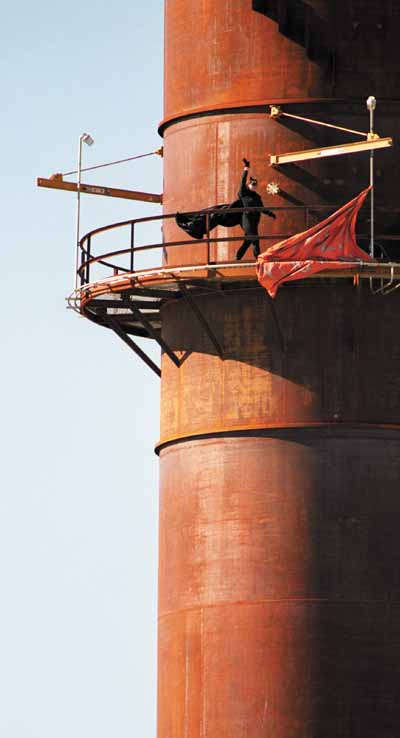
Anti-Knauf protester Celeste Draisner, 27, of Mountain Gate walks around a catwalk on the fiberglass manufacturer’s 199-foot smokestack in Shasta Lake Wednesday.

(ABOVE: Celeste Draisner, 27, of Mountain Gate, Calif., walks around a catwalk on Knauf’s 199-foot smokestack in Shasta Lake, Calif., on Wednesday. She was protesting the new fiberglass manufacturer
plant.)

http://www.sacbee.com/state_wire/story/1555794p-1632269c.html

Cat Woman protester arrested in Shasta Lake after climbing smokestack

Published 12:00 a.m. PST Thursday, Jan. 31, 2002

SHASTA LAKE, Calif. (AP) – A environmental protestor dressed in a Catwoman suit was arrested Wednesday after spending close to seven hours perched 125-feet above ground on fiberglass manufacturing plant smokestack.

Celeste Draisner, 27, of Mountain Gate said she was protesting health dangers she claims are posed by
the fiber glass plant.


Draisner was dressed in full Catwoman gear, donning a mask, cape, over-sized ears and a tail similar
to those worn by the Batman comic book character of
Gotham City fame.

The Knauf Fiber Glass plant in Shasta Lake employs about 140 people, but has been closed for years amid concerns over emissions and water use. It could open within a week.

Draisner snuck up the smokestack at about 5 a.m., stayed there for awhile and told negotiators she would come down “when she was good and ready,” said Shasta County sheriff’s Lt. Harry Bishop.

Good and ready turned out to be about noon when Draisner walked down from the perch and was arrested, handcuffed and taken to jail. She later posted $1,000 and was been released. Her attorney says her choice of protest attire was a mystery.

“The Catwoman risked her life to save the lives of others,” said Draisner’s lawyer Eric Berg.

Berg said those opposed to the plant want an environmental study conducted before the U.S. Bureau of
Reclamation grants Shasta Lake’s request for water to
serve the fiberglass plant.

Knauf Fiber Glass is a member of the family of building materials companies owned by the Knauf family of Iphofen, Germany.

MAPPALUJO

03 FEB 02: MAPPALUJO

MAPPALUJO:
A writing game devised by Jeff Noon and Steve Beard

“Night falls softly on the Theatre of Creatures…

“Welcome. Lujo is a world a short distance
from your own, and a few days adrift. It is a land filled with restless
ghosts, and haunted stories. Travellers are invited to pass through the
gateway. Here they will encounter the various domains and cultures of this
realm; its rituals, maps, technicians, modified organisms, and media archetypes.
These singular entities reveal themselves through a collection of narratives,
songs, programmes, reports, poems and other documents, all taken from the
spell book of Mama Lujo, the operational deity of the world.”

[CONTINUED]

MOMUS

“It seems clear to me that this song ‘came’ to me complete and finished. I didn’t need to work on it. I didn’t compose
it, it just arrived ‘from another realm’. Musicians often say this. In an interview in today’s Japan Times entitled ‘Melody of the Inexpressible’, Kazu of Blonde Redhead says: ‘It’s not so much in your control. You never feel like it’s your creation. You happened to walk by and pick it up.’…”

More: http://imomus.com/thought220102.html

“Post-autistic economics”

from the New Statesman: Monday 21st January 2002

The storming of the accountants

David Boyle

It began as a small revolt at the Sorbonne in Paris, but may yet develop into a worldwide movement against the tyranny of numbers. David Boyle reports


“It may work fine in practice,” goes a joke that the French make at their own expense. “The trouble is, it just doesn’t
work in theory.”

So it is strange that Paris has become the birthplace of a revolt against the pre-eminence of theory
over practice, of economic abstraction over reality, and statistics over real life. Called “post-autistic economics”
– “autistic” is intended to imply an
obsessive preoccupation with numbers – the revolt began with a website petition
in June 2000 from students at the Sorbonne (see [http://www.paecon.net]). They were protesting against the dogmatic teaching of neoclassical economics and the “uncontrolled use” of mathematics as “an end in itself”.

Within weeks, the call was taken up by students across France. Le Monde launched a public debate, and Jack Lang, the education minister, appointed the respected economist Jean-Paul Fitoussi to head an inquiry. Fitoussi reported last
September, backing many of the rebels’ points and recommending sweeping changes in the way economics is taught in French universities. The movement has had a worldwide impact, with Cambridge students drawing up their own petition – although most were too scared for their future careers to put their names to it.

Could this episode prove the beginning of the end for the whole cult of measurement, statistics, targets and indicators
that has become such a feature
of modern life, not just in the Blair government, but around the world?

The phrase “post-autistic” has a touch of Gallic cruelty about it, but there is a sense in which we have been cut off
from reality by the plethora of targets
and indicators. It’s like the 18th-century mathematical prodigy Jedediah Buxton,
who, asked if he had enjoyed a performance of Richard III, could say only that the actors had spoken 12,445 words.

Over the past decade or so – boosted by added enthusiasm from new Labour – we have been plunged into what Professor Michael Power of the London School of Economics calls “the audit culture . . . a gigantic experiment in public management”. We can see the results everywhere. The government introduced about 8,000 targets or numerical indicators of success during its first term of office. We have NHS targets, school league tables, environmental indicators – 150 of them at last count – and measurements covering almost every area of professional life or government, all in the name of openness, accountability and democracy.

Nor is this just happening in the public services. The Japanese multinational Matsushita has developed a “smart” toilet
that measures your weight, fat ratio,
temperature, protein and glucose every time you give it something to work on.
Then it sends these figures automatically to your doctor.

Accountancy firms cream off 10 per cent of British graduates to do all this counting. Whole armies of number-crunchers are out there, adding to the budgets of public transport, the NHS and social services.

We have been here before – especially in periods of great social hope such as the 1830s, when the followers of Jeremy Bentham rushed across the country in stagecoaches, armed with great bundles of tabular data and measuring everything they thought important: the number of cesspits (which they saw as an indicator of ill health), or pubs (an indicator of immorality), or the number of hymns that children could recite from memory.

Then as now, the problem is that what really needs measuring is not countable.

“So-called efficiency,” says Richard Scase, professor of organisational behaviour at the University of Kent at Canterbury, “takes the place of effectiveness, quantity of quality. The means become an end in themselves.” As anyone in local government will tell you, these numerical indicators are about management at a distance, and they will always miss the point: school league tables make teachers concentrate on borderline pupils at the expense of their weaker classmates; waiting-list targets persuade NHS managers to treat those with the quick, simple problems at the
expense of everyone else.


It is a dream from the world of management consultancy, encapsulated in the McKinsey slogan that “everything can be
measured and what gets measured gets
managed”. It is no accident that Nick Lovegrove, a partner at McKinsey & Co, is advising Gordon Brown on productivity and Tessa Jowell on IT strategy. Another McKinsey recruit has been appointed to advise No 10 on transport policy.

The problem is that people are now expected to do what the targets tell them, rather than what is actually necessary.
Hospitals are ordering more expensive
trolleys and reclassifying them as “mobile beds”, to sidestep the target that no
patient should stay on a hospital trolley for more than four hours. I also know of at least one local authority that achieves government targets for separating waste – at great expense – but then simply mixes it all up again in landfill.

Scotland Yard figures that showed it had recruited 218 people from ethnic minorities between April and September
2000 turned out to include Irish, New
Zealanders and Australians. The useful figure was four.

The consequences of pinning down the wrong thing are severe. All your resources will be focused on achieving something you did not intend, as the Pentagon discovered in the Vietnam war, when it audited the success of military units by their body counts. Result: terrible loss of life among the Vietnamese, but no US victory.

The Blair government’s dilemma is that if ministers measure the things over which they have direct control, they simply measure the activity of bureaucrats. If they measure real effects – for instance, the looming and probably unreachable targets for school attainment in English, maths and truancy – they risk detonating a political time bomb when they fail to meet them.

The first signs of disenchantment are appearing. The Health Secretary, Alan Milburn, apologised to anyone who had
suffered because of the government’s
waiting-list targets, and promised to give priority to patients with the most serious conditions. The school league tables have been scrapped in Northern Ireland after three-quarters of the responses to a consultation urged that they go.

Meanwhile, in the United States – where the National Commission on Testing and Public Policy estimates that compulsory school tests take up 20 million school days and cost anything up to $900m – pupils in Massachusetts and Denver refused to take their tests. Louisiana parents went to court to prevent them taking place at all.

Even conventional accountancy has problems. “I believe there is a crisis of confidence in our profession,” Joseph Berardino, the chief executive of Arthur Andersen, told the US Congress last month, after the unexpected bankruptcy of one of Andersen’s clients, Enron, whose accounts it had signed and to which it had also been giving consultancy advice.
It is well known that staff in the UK public services are impatient with the measuring culture because it ignores their
professional knowledge and judgement
– those aspects of their job that can’t be reduced to figures. But there is also a suggestion that it was borrowing this measurement culture – of very narrow bottom lines, financial and otherwise
– that is behind the failure of so many
privatised businesses to show the imagination and verve that had been expected of them.

Charles Saumarez Smith, the director of the National Portrait Gallery, argues that measuring fever actually causes inefficiency – by “aping the form rather than the content” of the private sector, and “assuming that measurement is what is important, and not intelligence and achievement”. He characterises the modern public sector as embodying “a belief that the system is more important than the individual, that accountability is more important than intelligence or creativity, with the result that the public sector is likely to continue to limp along impotently and inefficiently as
long as it holds a low sense of its own
political valuation and public esteem”.

Accountability is important, and the auditing culture was in part a response to the crudity of measuring success by the financial bottom line. But measurement of this kind may be more about empire. It is about the idea that everything can
be controlled from the centre, every job broken down into measurable parts – a Taylorist fantasy of time and motion –
with every decision taken in full view of
the auditors and the public.

It is hard to imagine a revolt spreading beyond French economics students unless the movement comes up with a coherent alternative, but also possible to glimpse what that might look like. It would be about decentralising power, giving more hands-on experience to teachers, managers and civil servants, and creating smaller, human-scale institutions. It would mean more face-to-face management, nurturing responsibility and creativity – in short, all the things that new Labour finds hardest.   

A friend of mine with a hefty government grant, negotiating with civil servants over his annual targets, tells me he quoted the old Scottish proverb: “You don’t make sheep any fatter by weighing them.” They looked at him with complete incomprehension. There is clearly a long way to go.

David Boyle’s The Tyranny of Numbers is published in paperback this month by Flamingo (£8.99)

The Influence of Coffee on Kabbalistic All-Night and Midnight Vigils

from http://www.jewishgates.org/history/jewhis/coffee.stm

The Influence of Coffee on Kabbalistic All-Night and Midnight Vigils

One of the innovations of Lurianic Kabbalah was the creation of a variety of rituals which took place late at night. Joseph Karo is credited with the creation of the all-night study session on the eve of Shavuot, called Tikkun Leil Shavuot.

The Ari himself emphasized the importance of prayer and meditation late at night (called Tikkun Chatzot or Tikkun Rachel) and early in the morning (called Tikkun Leah). These times connected the individual with the daily creations of light and darkness. It also was an ideal time (according to the Zohar) to mourn the banishment of the Shechinah from Jerusalem. It also connected the individual with King David, who was said to have created the Psalms at midnight. The powerful image that the gates of Heaven are most available for prayer late at night was thus concretized in Tzfat in the late 16th century. Ironically, it didn’t catch on in Jerusalem at the same time even though Jerusalem mystics were certainly aware of the Zohar’s emphasis on midnight and all-night vigils. Jerusalem’s mystics focused on pre-dawn rituals instead.

Elliott Horowitz provides us with a fascinating thesis about the creation and development of late-night and all-night rituals as opposed to early morning rituals in 17th-18th century Jewish mystical circles. He notes that coffee arrived in Tzfat in 1528, and the first coffee house appeared in Tzfat in 1580.

None came to Jerusalem. The use of coffee as a stimulant might have encouraged the mystics of Tzfat to focus more on all-night and late-night rituals because they couldn’t sleep anyway. Karo’s Tikkun Leil Shavuot appeared two or three years after the introduction of coffee to Tzfat. Horowitz quotes the following description of Tzfat in 1587: (Abraham haLevi Beruchim) would rise at midnight and walk through all the streets, raising his voice and shouting bitterly, “Arise in honor of the Lord…for the Shechinah is in exile and our Temple has been burnt.” And he would call each scholar by his name, not departing until he saw that he had left his bed. Within an hour the city was full of the sounds of study: Mishnah and Zohar and midrashim of the rabbis and Psalms and Prophets, as well as hymns, dirges, and supplicatory prayers.”

By 1673, Tikkun Chatzot had become the known ritual for the vast majority of Palestinian Jewry, and Italian Jewry knew that most Palestinian Jews drank coffee before prayers. Coffee had not yet arrived in Italy.

In the late 1570’s, Italian mystics created their own pre-dawn rituals. They called themselves Shomrim LaBoker, the Guardians of the Morning. These rituals were apparently initiated by kabbalists who were familiar with the midnight and all-night devotions of the Jews of Tzfat. They acknowledged that midnight was the best time for prayer “when God amused Himself with the righteous in the Garden of Eden,” but they were not willing to maintain the midnight tradition. Instead, they slept through the night and woke before dawn for their early prayers. At least seven editions of predawn liturgies were published indicating their popularity.

Coffee arrived in Venice in 1615. The first coffee house (making coffee available to the masses) opened in 1640. In 1655, a liturgy for Tikkun Chatzot was published in Italy and a Chatzot group was formed. In that same year (for the first time), Italian Jews accepted Joseph Karo’s ritual of Tikkun Leil Shavuot. However, coffee was not as popular in Venice as it was in Tzfat. By 1683, there was still only one coffee house in Venice, and there were few Jews drinking the exotic drink. By 1759, coffee-drinking had soared in Italy. There were more than 200 coffee houses in Venice, including two in the ghetto. Jews in Mantua were making a fortune in the coffee industry. A scandal resulted in a ruling that “women could not enter coffee houses whether by day or night.”

The popularity of Tikkun Chatzot also rose impressively. By 1755, most pre-dawn prayer groups in Verona had become midnight and all-night prayer groups. The same thing happened in Mantua. The same thing happened in Modena and Venice. Coffee arrived in Worms Germany in 1728. By 1763 mystic circles were regularly celebrating midnight and all-night vigils for the first time.

In short, although the Zohar and kabbalistic works had always emphasized the special significance of midnight, ongoing prayers and all-night vigils did not become an important part of Kabbalistic life until the introduction of coffee into each Kabbalistic community. Today, midnight and all-night prayers remain an important part of Kabbalistic ritual, and many Jews continue to stay up all night on Shavuot and meet for supplication prayers at midnight on Selichot. Our level of caffeine stimulation makes our participation in such all-night rituals much easier.