


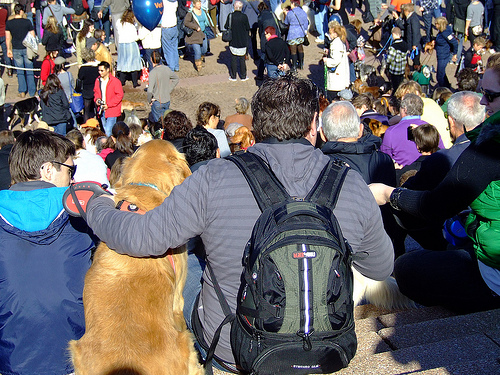
Laurie Anderson’s free concert for dogs…
From Associated Press:
SYDNEY – …Laurie Anderson debuted her original “Music for Dogs” composition outside the Sydney Opera House on Saturday.
Hundreds of dogs and their owners bounced around as Anderson entertained them with 20 minutes of thumping beats, whale calls, whistles and a few high-pitched electronic sounds imperceptible to human ears.
“Let’s hear it from the medium dogs!” Anderson called out from the stage, as a few dogs yipped in return. “You can do better than that — come on mediums! Whoo! WHOOOOOO!”
The performance was part of the city’s Vivid art and music festival, which is being co-curated by Anderson and her husband, rock legend Lou Reed.
Anderson — who often plays music for her rat terrier Lollabelle — said the idea originated during a chat with cellist Yo-Yo Ma while the two were waiting backstage at a graduation ceremony.
“We thought, ‘Wouldn’t it be great if you’re playing a concert and you look out and everyone’s a dog?'” Anderson said. “So I thought if I ever get a chance to do that, I’m gonna do it. And today was it. So this is like a highlight of my life.”
The music had varying effects on the pooches, with a series of high-pitched whale sounds working several into a frenzy. Many wagged their tails and barked in apparent encouragement, while others stared at the stage with glazed eyes.
“Yo!” Anderson shouted from behind her keyboard. “Beautiful work, dogs!”
Not all of the pups were thrilled. Oliver, a Jack Russell terrier who tends to have issues with high-pitched noises, folded his ears back and exploded into a barrage of frantic barks as he lunged toward the stage, dragging owner Jacqui Bonner along with him.
Others appeared entranced. April Robinson giggled as her small dog Spot swiveled his head toward the stage, ears perked high.
“He loves it!” she squealed while Spot stared wide-eyed at Anderson.
The concert was originally billed as a performance for dogs’ ears only, and was going to be largely limited to electronic noises played at a frequency too high for human ears. But Anderson changed things up when she decided she wanted people to have some fun, too.
“We didn’t want to do something that humans couldn’t hear,” she said. “We brought the octaves down into our hearing range so we could all have the experience.”
Anderson, who turned 63 Saturday, said the crowd was one of the best-behaved she’s ever played for, and considered the whole event a howling success.
“That was the most amazing concert I’ve ever, ever gotten to give!” she said with a grin. “It’s really a dream.”
Recently came across this piece, originally published in Musician No. 45, July, 1982…
Coffee and Chocolates for Two Guitars
by Robert Fripp
Weather shut England and delayed the jammed flight to Paris by three hours, so I landed at 1:30 pm. A mad taxi driver helped to make up the lost time by driving like a mad taxi driver (the only madder ones than Paris’ are in Milan). This guy only hit one car but we nearly collected a second-a young Parisian jumped the light so we took it kinda personal, sped up and aimed. He backed down when he sized the opposition. Then we drove through the No Entry sign to John’s street; his number was inconveniently at the wrong end. I got out at the front door of the quintessentially French apartment building, in what looked suspiciously like a pedestrian zone, a small back lane of one of my two favorite cities in the world.
John McLaughlin should need no introduction, but I suppose editorial etiquette necessitates an exposition of the highlights of his extraordinary career. John probably would be equally admired had there been no Mahavishnu Orchestra
Both before and after Mahavishnu, McLaughlin quietly established his jazz credentials as a band leader in a more subdued but more personally expressive medium with such brilliant albums as Extrapolation, My Goals Beyond
I am warmly greeted by John and his attractive roommate (and the keyboard player in Belo Horizonte), Katia LeBeque. Katia and her sister are a classical music duo with a four-hands piano rendition of Gershwin’s Rhapsody in Blue selling modestly in Europe. John is a dapper dresser; today he’s in grey: flannels and pullover, shirt and tie not quite matching and just enough so that either you knew that he knew, or maybe he knew you didn’t. This subtlety of stressing the discontinuities, some exquisite Basque confectionery placed between us, the charm of the apartment—in mellowed pink, the ceiling veeing into the roof, spiral stairs—hinted at an intermezzo between the acts of flying. John is straightforward, friendly, and a gentleman. He speaks softly in a curious mix of Scottish, Indian, and French accents. We discussed the several occasions we had previously met for a time, and then I assumed a more journalistic role.
Fripp: Why do you think you became a musician?
McLaughlin: Happily, my mother was an amateur musician; she was a violinist and there was always music going on in the house. We got a gramophone one day, and someone had Beethoven’s Ninth, and on the last record, which is at the end of the symphony, there’s a vocal quartet in which the writing is extraordinary…the voices and the harmonies. I must have been about six or seven when I distinctly remember hearing it for the first time. I suppose that’s when I started to listen. Because when you’re young, you’re not paying attention. What do you know when you’re a kid? It was unbelievable, what it was doing to me was tremendous. I began to listen consciously to music and I started taking piano lessons when I was nine and went on to guitar at eleven…
Fripp: Did anything trigger the guitar in particular?
McLaughlin: Yeah, it was the D major chord. My brother showed it to me on the guitar, and I had this feeling of the guitar against my whole body…
Fripp: Did you have the F# on the bottom string?
McLaughlin: No, no. I was playing full-note chords. Eleven years old…what are you going to do? You have a small hand and, you know…What about you? Did you have a similar experience?
Fripp: I was ten. Definitely no sense of rhythm, and I spent a long time wonderting why it was that such an unlikely candidate would become a professional musician. But I knew right away that I was going to earn a living from it. Thinking about it over the years, I think music has a desire to be heard, such a kind of compulsion to be heard that it picks on unlikely candidates to give it voice.
McLaughlin: Yeah, I think that it basically comes from love. I mean, the kind of attraction that you have when you listen to it when you’re young. It’s inexplicable in a way.
Fripp: It’s a direct vocabulary…
McLaughlin: Exactly. Perhaps what you say is truth insofar as the music itself chooses, but it’s not a one-way street from music’s point of view. In a sense, you know, we fall in love with the muse and the muse falls in love with its prospective voices.
Fripp: The sentence I would add is that the music needed me to give it a voice, but in a feeble way. I needed music more, far more than music needed me.
McLaughlin: The most difficult thing, I think, in being a musician is to get out of the way.
Fripp: How do you get out of the way? Do you have specific techniques or regimens that you use? Can you just get yourself out of the way without thinking about it?
McLaughlin: If I’m thinking about it, I’m in the way. You have to forget, to forget everything. The minute we forget everything is when we’re finally found.

Diamanda Galas writes:
It has come to my attention over the last years that the stage reviews of many of my colleagues are prefaced by the words,”Although now 45, he is still a strong performer,” or “Looking older than we last saw him, he still manages to convince.” It is time now for me to say the following words to the anemic cretins who write these desktop reviews of virtuosos: “Stick to reviewing plant life and leave the Witches alone.”
A true performer, like Liszt, like Horowitz, like Birgit Nilsson, often has an extremely long career span—and will be performing long after your life is diminished from tripping over your child’s bicycle and impaling upon yourself upon the Christmas tree of your wife.
A great performer is a vampire. We have trained to be thus. We have trained to enter the Pantheon. Of course we are punished for this, but no longer by the Gods, who have retired forever in despair—so dim is their reflection upon the humans they once challenged—but by the tiny minds of paralyzed voyeurs, who are incapable of discussing our work on any level, never literal, and now not even figurative.
If a performer appears upon the stage bald or with white hair after you have not seen him for ten years, this is not commentary for a musical review. I will quote Gregory Sandow who wrote that whether or not Charlie Parker performed only in his underwear was immaterial to how he played.
Liszt performed with long white hair, the master of the piano, and not less so for his age. Vladimir Horowitz, Arthur Rubinstein and Mary Lou Williams were masters only days before they died. Sonny Rollins cannot be condemned to the grave which is inhabited by small minds who lurk like worms awaiting a fresh kill. It is to escape these worms that we choose to be cremated.
…The witch’s focus is upon the production of a new turn of phrase, a new twist of the song, a new fight, the immolation of a lie if it takes the creation of a masterpiece to do it. The great witch Maryanne Amacher,who was felled only by a freak accident,had a house filled to the rooftops of unparalleled work and she slept on the floors of every studio to which she was invited worldwide—and created more bizarre work through the years.
The vampire knows that only new blood will sustain her. New blood, new research, new language study, and willful deconstruction and reconstruction, new meter, new arrangements, new writing, difficult performances—which later become great ones—through perseverance.
You who wait for the ticking of the clock so that you might one day proclaim that one of us is approaching our dotage should imagine instead your own life, which is is fading behind you, like a reflection of your netherparts, wretched, hanging, like the flanks of a tethered animal, too long unfed,alone, and unloved…
Read on: diamandagalas.com
Map of Heaven by Malachi Ward — click to enlarge
Available as a 21″ x 15″ + half inch white border, high quality print on heavy archival paper for $15 from malachiward.blogspot.com

http://humanresourcesla.com/rats-jarrett-silberman-lady-no/
Image: ripped from Rebecca Horn, Einhorn (“Unicorn”) (1972)
Longtime Arthur contributor Trinie Dalton sent this over…

Homunculi
Matt Greene, Allison Schulnik, Ruby Neri and Matthew Ronay
curated by Trinie DaltonJune 4 – July 11, 2010
Opening Reception: Friday, June 4th from 6 – 8:30 PM
Canada New YorkWhile Charles sat there in a thoughtless, vegetative stupor, completely surrendered to circulation, respiration, and the deep pulsation of his natural juices, there formed inside his perspiring body an unknown, unformulated future, like a terrible growth, pushing forth in an unknown direction.
—Bruno Schulz, Mr. Charles.If monsters are metaphors, then we now think of the little man that Paracelsus brewed by beaker as a pocket of thought deep in the recesses of the scientist’s unconsciousness. In alchemical magic, homunculi were diminutive men under twelve inches tall who, like goat kids who pop out as walking, whinnying critters, were birthed fully-formed through the mystical transformation of sperm. Their embryonic recipe consisted of bones, sperm, skin chunks and animal hair steeped for a month in horse manure. In slightly more modern science, homunculi represent the conscious parts of our brains. But as one website essay reiterates, “homuncular arguments fall into an infinite regress, with the consciousness of each homunculus explained by ever smaller homunculini, nested like Russian dolls.” At the very root of creativity is the desire to tame, harness, and generate art made of this miniature circus material, parading through our minds like a migrant herd of wildebeests.
The artists in this show make figurative work that feels like primordial, barely changed representations of their inner-homunculi. But actually, it is their artwork itself that is a labored, half alive thing with its own life. Their art is the homunculus. Their blobby, witchy monsters are sprung forth onto canvases like the homunculus concocted to chat with Mephisto by Faust’s assistant, Wagner. Like golems, some are even sculpted out of clay. Their figures pile up, fornicate, dance, rest in awkwardly yogic poses, and generally exude respect for charmed, ancient ritual. While these works are not made on diminutive scales, each artist here makes large works that incorporate miniscule elements to express a fascination with microscopic aspects of hybrid human forms.
Allison Schulnik’s chunked out paint application compliments her studies of hoboes, clowns, gnomes, and other tricksters. As a Claymation animator, too, she gets deep into golem territory, to create an overall body of work that pays homage to James Ensor but is more playful than plagued.
Matt Greene makes drawings and paintings reveling in his own female fantasies that transform sexuality into a magical symbolism. His works become talismanic portrayals of beings that, like Hindu gods and goddesses, incorporate myriad aspects of self into unified, all-powerful forms that fuse gender, species, and archetypal character into his own sexpot ideal.
Ruby Neri could have fallen off a wagon pulled by Der Blaue Rieter group. Her visionary paintings are reconstitutions out of Bay Area funk and early twentieth century Fauvism. There is a brute physicality in her work; these are figure paintings with the bones left in. Unnatural color and form stains us with the spirit world, they are paintings to die for.
Matthew Ronay’s sculptures, videos, and installations commingle tribal, indigenous, and modern formalist aesthetics to invent new mysticisms and Jungian-inspired things. Whether fictionalized or real, his objects and images seem borne from an infinite well of psychological chaos. Enduring extreme costuming and physical trials, Ronay has recently begun using himself in his sculptures to return to the ritualistic purposes inherent to sacred art. In this, he is the ultimate homunculus manikin.
CANADA is located at 55 Chrystie Street between Hester and Canal Streets in New York City. Gallery hours are Wednesday through Sunday, 12 to 6 p.m. For more information, please contact the gallery at 212-925-4631or at gallery@canadanewyork.com.
A full page ad from Daredevil #38 (Marvel Comics, March 1968):

From the May 31, 2010 New York Times, “Job Outlook for Teenagers Worsens”:
The unemployment rate for the 16-to-24 age group reached a record 19.6 percent in April, double the national average. For those job seekers, said Heidi Shierholz, an economist at the Economic Policy Institute, “This is the worst year, definitely since the early ’80s recession and very likely since the Great Depression.”
Or as researchers at Northeastern University, who issued a report in April on youth unemployment, put it, “The summer job outlook does not appear to be very bright in the absence of a massive new summer jobs intervention.”
Still, the poor numbers this year are not solely a symptom of the continued weak economy. For generations, government data shows, at least half of all teenagers were in the labor force in June, July and August. Starting this decade, though, the number of employed teenagers began to drop, and by 2009, less than a third of teenagers had jobs. This year, the number could fall below 30 percent.
That is a stark contrast to the job market for recent college graduates seeking full-time employment — a market where this is actually a slight increase from this time last year.
There is no simple explanation for the large drop-off in summer jobs this decade, though experts say that more high school students are choosing to volunteer and do internships to burnish their college applications. But the Northeastern researchers said a large number of youths had been left out of the work force and wanted to get back in.
The forecast for this summer is so dire that high school students took to the streets this year in Washington, Boston and New York to push lawmakers to come up with money for summer youth jobs programs as Congress did last year, allocating $1.2 billion for a program for low-income youths.
On Friday, the House passed a measure that included the summer jobs provision, though its future in the Senate this week is uncertain.
The Northeastern researchers estimated that an additional $1 billion federal infusion would create some 300,000 job slots this summer, barely putting a dent in the demand for jobs.
Read the whole article: New York Times
Bruce Vilanch still has his hair, as far as we know… but Willie Nelson cut his pigtails? Hmm. Well, every follicle counts in mopping up this BP mess.
Also counting is this emergency benefit concert going down tonight, WEDNESDAY, JUNE 2 at Shea Stadium in Brooklyn, pulled together with care and attention by Solid PR.
More info on all the bands, the cause and the beneficiaries follow.
Do Earth a solid and attend if you can. It will be CATHARTIC. Transport by bicycle is encouraged. T-shirts and posters will be available for benefit purchase, courtesy Enemy Ink.
And if you can’t attend, do your own. Cuz there are a whole lotta victims, and it’s gonna get even worse when the Gulf of Mexico catches fire, like the Cuyahoga used to in Cleveland…

Who: Zs / Child Abuse / Controlled Bleeding / Cellular Chaos / DJ 1000TimesYes
What: A benefit to help the victims of the Gulf oil spill disaster
Where: Shea Stadium (20 Meadow St) Brooklyn, NY
When: Wednesday, June 2nd, 8pm
How much: $8
ALL AGES ALL AGES ALL AGES
Over the past few weeks, Solid PR has been saddened to hear of the devastation brought on by the recent oil spill disaster in the Gulf of Mexico, and have tried to think of ways we could help those affected and shine a brighter light on the situation as a whole.
It’s been reported that to date more that 30 million gallons of oil have spilled into the Gulf affecting an area of more than 4,900 square miles, and leaking at a rate speculated at being hundreds of thousands, to millions of barrels of oil per day. It’s also reported that there is a likelihood of the oil making its way into the “loop current” taking the spill from the Gulf, around the Florida Keys and Miami, and up the East Coast. Just today, yet another major news source reported the size of the slick to be that of a small country, currently threatening Louisiana’s fishing and coastal tourism industries, in addition to destroying its various nature reserves, and possibly affecting the state’s fragile marshes for decades.
We at Solid PR care about the delicate ecosystem of our planet and have decided to put together a last minute event to help raise awareness and help those affected by the Gulf oil spill disaster. All proceeds from this event will go to The Greater New Orleans Foundation put in place to offer assistance to those in need of help. If you’re interested in learning more, please visit http://www.gnof.org. More information on The Greater New Orleans Foundation below.
* This event is being presented in conjunction with our friends at Arthur Magazine.
Please feel free to spread the word and we look forward to seeing you.
About the bands:
Zs
Brooklyn’s veteran avant-garde band Zs have been causing quite a stir and raising a ton of eyebrows as of late with its brand of jazz-fusion, prog, industrial, punk, no wave, and drone stylings, most recently catching the attention of The NY Times who said of the band’s new album, “These pieces are all brain-benders; they’re conceptual art objects that set form and content against each other – like, say, a perfect birthday cake made out of sawdust, or a perfect hammer made out of bird feathers.” – Zs latest album, “New Slaves,” is out now on The Social Registry.
myspace.com/zstheband
Child Abuse
New York’s Child Abuse have just released their latest album, “Cut and Run,” on Lovepump United (currently home to the likes of Health and Clipd Beaks, and run in part by Genghis Tron frontman Mookie Singerman) to wild accolades. The band plays a completely twisted and manic form of industrial-strength grindcore and put on one of the most brutally unreal live shows around. Child Abuse is a definite must see each and every time they take the stage.
myspace.com/childabuse
Controlled Bleeding
Dating back to 1987, New York’s Controlled Bleeding are probably best known as being one of the earliest pioneers in the industrial and noise scenes, which included their appearance on the legendary Wax Trax “Black Box” box set alongside bands like Coil, Ministry, Clock DVA and others; although, as stated on the band’s Wikipedia page, “Controlled Bleeding’s sound is confusingly varied from album to album and has contained elements of dub, free jazz, noise, prog, sacred music, dark ambient, classical and musique concrète. To their own detriment, the group has never cared much about generating or maintaining an audience, but just sort of does whatever inspires them in the moment.” We have a feeling we’re all going to be treated to something extra special as the band is recently back together and performing as a duo for the first time.
myspace.com/controlledbleeding
Weasel Walter’s Cellular Chaos
Very little is known about the latest project from experimental hero Weasel Walter, dubbed Cellular Chaos, but if Mr. Walter is involved you can pretty much guarantee mind-blowing great times are in your future. The band has already performed alongside the likes of Liturgy and White Mice, and we hear the material shreds, so needless to say we’re very excited.
About The Greater New Orleans Foundation
The Greater New Orleans Foundation is one of the oldest and largest philanthropic organizations in the region. Every day, the Foundation joins other foundations, nonprofit organizations, community leaders, and government officials to address the needs of the community and build consensus for solutions. Together with our family of donors, the Foundation has invested over $100 million in our region since it opened its doors over 25 years ago to respond to community needs. The ultimate goal of the Greater New Orleans Foundation is to create a resilient, sustainable, vibrant community in which individuals and families flourish and in which the special character of the New Orleans region and its people is preserved, celebrated, and given the means to develop. We believe the Foundation has a critical role to play in attaining this goal, as community leader and convener; as champion of civil society; and as supporter of effective nonprofit leaders and organizations. By serving as a philanthropic partner to members of the donor community, we can help add meaning and value to the giving of individuals, families and institutions, increasing the effectiveness of their philanthropy and connecting them with the very best nonprofit work in Greater New Orleans and surrounding regions.
gnof.org
For more information, visit:
www.solidpr.com

 Arthur Magazine