
<img src="http://www.danzettwoch.com/images/zettwoch_homepage_01.gif" width=480
A Witnessing: David Katznelson guides us through BROTHER JT’s vast and beguiling career (Arthur, 2004)
A Witnessing: David Katznelson guides us through BROTHER JT’s vast and beguiling career.
Originally published in Arthur No. 8 (January, 2004) as sidebar to an interview with Brother JT by Jay Babcock.
For the past twenty years Brother JT has made records that exemplify the “freeness” and dark-green/blood-red hazy warmth of true psychedelia. As a songwriter, he is so proficient that no one takes notice; as a guitar player, he subtly outshines any slinger around (besides the Cheaterslicks’ Dave Shannon) with riffs, leads and solos that are consistently bewildering; as a rock star…well, he was just born for the job, regardless if anyone ever figures it out. He writes one-liner bits of philosophy that are as memorable as those of Yogi Berra, H. L. Mencken, or Will Rogers. JT is, in short, the most hidden of greatest treasures.
I have been a big fan of the music and vision of Brother JT since first hearing seminal, mind-altering tour-de-force Meshes In the Afternoon in the early ’90s. As I am prone to do, I have since collected his entire output…carrying my fanaticism so far as to release a record of his on my own label. If you are able to find a Brother JT record in a store–and it can be difficult (see bottom of page for record-location people who can help you)–know that it will most certainly do all the things you assume it will do: it will move you, it will rock you and it will uplift you. You will be swept away to a cloudy island where ideologies of a time long past are channeled through a devout soul whose musical prowess and ability to create a perfect melody welcome all and conquer all.
The following spew examines the mind-blowing, intolerably under-appreciated recorded output of Brother JT. Please note that it does not include the great recordings of his band The Original Sins, who deserve their own, separate celebration.
Descent
Brother JT
(1991, Twisted Village)
JT’s solo debut was a standard-setter for the mighty Twisted Village label and a good launching place for our now-Original Sins-less psychedelic hero. Beautifully packaged in a Folkways-meets-Impulse handmade black-and-white homage to John Coltrane’s Ascension, this platter features two sidelong drones. The Spacemen 3 called such constructions ‘ecstasy symphonies,’ but these two are dirtier and much less calm inducing.
"A lot of people did not look three years out" says oopsy Mayor ("Towns Rethink Laws Against Illegal Immigrants" – New York Times)
The New York Times – September 26, 2007
Towns Rethink Laws Against Illegal Immigrants
By KEN BELSON and JILL P. CAPUZZO
RIVERSIDE, N.J., Sept. 25 — A little more than a year ago, the Township Committee in this faded factory town became the first municipality in New Jersey to enact legislation penalizing anyone who employed or rented to an illegal immigrant.
Within months, hundreds, if not thousands, of recent immigrants from Brazil and other Latin American countries had fled. The noise, crowding and traffic that had accompanied their arrival over the past decade abated.
The law had worked. Perhaps, some said, too well.
With the departure of so many people, the local economy suffered. Hair salons, restaurants and corner shops that catered to the immigrants saw business plummet; several closed. Once-boarded-up storefronts downtown were boarded up again.
Meanwhile, the town was hit with two lawsuits challenging the law. Legal bills began to pile up, straining the town’s already tight budget. Suddenly, many people — including some who originally favored the law — started having second thoughts.
So last week, the town rescinded the ordinance, joining a small but growing list of municipalities nationwide that have begun rethinking such laws as their legal and economic consequences have become clearer.
“I don’t think people knew there would be such an economic burden,” said Mayor George Conard, who voted for the original ordinance. “A lot of people did not look three years out.”
In the past two years, more than 30 towns nationwide have enacted laws intended to address problems attributed to illegal immigration, from overcrowded housing and schools to overextended police forces. Most of those laws, like Riverside’s, called for fines and even jail sentences for people who knowingly rented apartments to illegal immigrants or who gave them jobs.
In some places, business owners have objected to crackdowns that have driven away immigrant customers. And in many, ordinances have come under legal assault by immigration groups and the American Civil Liberties Union.
In June, a federal judge issued a preliminary injunction against a housing ordinance in Farmers Branch, Tex., that would have imposed fines against landlords who rented to illegal immigrants. In July, the city of Valley Park, Mo., repealed a similar ordinance, after an earlier version was struck down by a state judge and a revision brought new challenges. A week later, a federal judge struck down ordinances in Hazleton, Pa., the first town to enact laws barring illegal immigrants from working or renting homes there.
Muzaffar A. Chishti, director of the New York office of the Migration Policy Institute, a nonprofit group, said Riverside’s decision to repeal its law — which was never enforced — was clearly influenced by the Hazleton ruling, and he predicted that other towns would follow suit.
“People in many towns are now weighing the social, economic and legal costs of pursuing these ordinances,” he said.
Indeed, Riverside, a town of 8,000 nestled across the Delaware River from Philadelphia, has already spent $82,000 defending its ordinance, and it risked having to pay the plaintiffs’ legal fees if it lost in court. The legal battle forced the town to delay road paving projects, the purchase of a dump truck and repairs to town hall, officials said. But while Riverside’s about-face may repair its budget, it may take years to mend the emotional scars that formed when the ordinance “put us on the national map in a bad way,” Mr. Conard said.
Rival advocacy groups in the immigration debate turned this otherwise sleepy town into a litmus test for their causes. As the television cameras rolled, Riverside was branded, in turns, a racist enclave and a town fighting for American values.
Some residents who backed the ban last year were reluctant to discuss their stance now, though they uniformly blamed outsiders for misrepresenting their motives. By and large, they said the ordinance was a success because it drove out illegal immigrants, even if it hurt the town’s economy.
“It changed the face of Riverside a little bit,” said Charles Hilton, the former mayor who pushed for the ordinance. (He was voted out of office last fall but said it was not because he had supported the law.)
“The business district is fairly vacant now, but it’s not the legitimate businesses that are gone,” he said. “It’s all the ones that were supporting the illegal immigrants, or, as I like to call them, the criminal aliens.”
Many businesses that remain are having a hard time. Angelina Guedes, a Brazilian-born beautician, opened A Touch From Brazil, a hair and nail salon, on Scott Street two years ago to cater to the immigrant population. At one point, she had 10 workers.
Business quickly dried up after the law against illegal immigrants. Last week, on what would usually be a busy Thursday afternoon, Ms. Guedes ate a salad and gave a friend a manicure, while the five black stylist chairs sat empty.
“Now I only have myself,” said Ms. Guedes, 41, speaking a mixture of Spanish and Portuguese. “They all left. I also want to leave but it’s not possible because no one wants to buy my business.”
Numerous storefronts on Scott Street are boarded up or are empty, with For Sale by Owner signs in the windows. Business is down by half at Luis Ordonez’s River Dance Music Store, which sells Western Union wire transfers, cellphones and perfume. Next door, his restaurant, the Scott Street Family Cafe, which has a multiethnic menu in English, Spanish and Portuguese, was empty at lunchtime.
“I came here looking for an opportunity to open a business and I found it, and the people also needed the service,” said Mr. Ordonez, who is from Ecuador. “It was crowded and everybody was trying to do their best to support their families.”
Some have adapted better than others. Bruce Behmke opened the R & B Laundromat in 2003 after he saw immigrants hauling trash bags full of clothing to a laundry a mile away. Sales took off at his small shop, where want ads in Portuguese are pinned to a corkboard and copies of the Brazilian Voice sit near the door.
When sales plummeted last year, Mr. Behmke started a wash-and-fold delivery service for young professionals.
“It became a ghost town here,” he said.
Immigration is not new to Riverside. Once a summer resort for Philadelphians, the town became a magnet a century ago for European immigrants drawn to its factories, including the Philadelphia Watch Case Company, whose empty hulk still looms over town. Until the 1930s, the minutes of the school board meetings were recorded in German and English.
“There’s always got to be some scapegoats,” said Regina Collinsgru, who runs The Positive Press, a local newspaper, and whose husband was among a wave of Portuguese immigrants who came here in the 1960s. “The Germans were first, there were problems when the Italians came, then the Polish came. That’s the nature of a lot of small towns.”
Immigrants from Latin America began arriving around 2000. The majority were Brazilians attracted not only by construction jobs in the booming housing market but also by the presence of Portuguese-speaking businesses in town. Between 2000 and 2006, local business owners and officials estimate, more than 3,000 immigrants arrived. There are no authoritative figures about the number of immigrants who were — or were not — in the country legally.
Like those waves of earlier immigrants, the Brazilians and Latinos triggered conflicting reactions. Some shopkeepers loved the extra dollars spent on Scott and Pavilion Streets, the modest thoroughfares that anchor downtown. Yet some residents steered clear of stores where Portuguese and Spanish were plainly the language of choice. A few contractors benefited from the new pool of cheap labor. Others begrudged being undercut by rivals who hired undocumented workers.
On the town’s leafy side streets, some residents admired the pluck of newcomers who often worked six days a week, and a few even took up Capoeira, the Brazilian martial art. Yet many neighbors loathed the white vans with out-of-state plates and ladders on top parked in spots they had long considered their own. The Brazilian flags that flew at several houses rankled more than a few longtime residents.
It is unclear whether the Brazilian and Latino immigrants who left will now return to Riverside. With the housing market slowing, there may be little reason to come back. But if they do, some residents say they may spark new tensions.
Mr. Hilton, the former mayor, said some of the illegal immigrants have already begun filtering back into town. “It’s not the Wild West like it was,” he said, “but it may return to that.”
Instead of spending a fortune getting rid of graffiti, why don't we just give it marks out of 10?
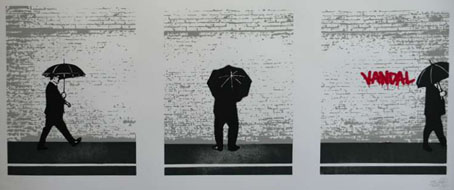
Vandal by Nick Walker.
Germaine Greer
Monday September 24, 2007
The Guardian
Thirty-five years ago I bought a dilapidated house in North Kensington, London. One of the reasons I bought it was that it sported a magnificent graffito. In those days, graffiti were usually texts, some of them, it was said, written by the poet Christopher Logue. This one spelt out, in foot-high block capitals, the undeniable truth that “Boredom is counter-revolutionary”. When the house was done up, the graffito disappeared. Over the years, the neighbourhood lost all its graffiti one by one, as the pestiferous warren of flats and bedsits was regentrified. The wall that had the one word “Scream” written its full length was repainted, and the grim prediction “This too will burn” was removed from a pillar under the Westway.
Aerosol art is not the same thing at all. Although Banksy is as likely to be arrested as the defacers of those days, what he does is jokey, wry, fundamentally civilised. In a message that’s been sloshed up by a couple of four-inch brushes loaded with red and black gloss paint rather than sprayed through a stencil, you see not good humour and self-deprecation, but honest-to-goodness grief and rage.
For months I thought about restoring my graffito, maybe cleaning the new cream stone-textured paint from off the letters or even painting them again; but eventually I realised that for the owner of a house to scribble on it is just pathetic and downright disrespectful, like Foxtons the estate agent having the name Foxtons painted on the side of its fleet of Minis in graffito script. You’ve got to be working full-tilt, hanging head downward off a motorway bridge with your mates holding you by the feet, writing . . . what? Probably your tag in blocky letters outlined in contrasting trim. Nearly all graffiti are just annoying, but you have to put up with the millions of naff ones if you want the occasional brilliant one. A great graffito is not simply an arresting design; it is a once-in-a-lifetime coincidence of work, place and space. Would anyone now dare to sandblast the murals of loyalists and republicans from the walls of Belfast? Now old IRA wall paintings are being touched up and recycled with messages in Arabic signifying solidarity for the Palestinians. And Banksy has done his best work on the West Bank Barrier.
Most aerosol art, like most other art, is feeble and bad. If bad art was a crime, some of our most respected citizens would have been banged up years ago. Wall art, whether brilliant or ordinary, is a crime so serious that it is to be treated with zero tolerance: fortunes are spent in tackling the graffiti scourge; in Berlin low-flying aircraft are used to scan the streets with infra-red cameras to catch the spray painters at work. Oceans of highly toxic solvents are being sluiced over walls and hoardings to wash the paint into the sewers and eventually into the water table. Wildly illiberal proposals are coming from all quarters: possession of spray paint and selling of spray paint will become crimes; taggers will have their driving licences withdrawn and be fined huge amounts on the spot. In England two young men known in art as Krek and Mers, who haven’t done a graffito in two years, have been sent to prison for 12 months and 15 months respectively – though one of them was due to start an art course at university, his mother had offered to pay for the damage, and 500 people signed a Facebook petition. Needless to say, making an example of them will be the opposite of a deterrent; tagging is now heroic protest. Expect to see the names Krek and Mers on every railway bridge.
Graffiti cost Londoners £100m a year, and the country as a whole more than a billion, we are told; what is actually costing is not the art, which is free, but its destruction. The engine driving this colossal expenditure is Encams, mastermind of the Keep Britain Tidy Campaign, which implores us not to drop litter or chewing gum, dump cars or rubbish, make lots of noise, or leave our dogs’ shit on the pavement. Major mess-makers they leave well alone. Apparently graffiti and fly-posting can fill people with a feeling of unease or fear, because they associate both with crime. As fear of crime is already way out of proportion to the actual incidence of crime, loathing of graffiti must be equally, if not more irrational. We should not pander to it.
Walls don’t look much better after their graffiti have been washed off than they did before, so we might as well stop doing it. In environmental terms, the washing-off makes a worse mess than the painting ever did. The wall-painters themselves will paint over each other’s work, especially if they consider it feeble. A far less costly option is for us all to make our own stencils giving the defacers marks out of 10, to remind the artists that there are people out there who have eyes to see, and as much right to say what they think as the artists. The work then becomes a palimpsest, a dialogue between artists and public. Most tags deserve the single-word comment “prat”.
Whether at Lascaux 17,000 years ago or in Western Arnhem Land 50,000 years ago, art began on a wall. If the sandblasters had been around in either place, we would have lost a precious inheritance.
For a regular dose of great street art, check Wooster Collective.
Jim Woodring on Glendale, LSD and Salvia Divinorum
"Hollywood Effects Prepare Sailors for Deployment"
Because death and crippling wounds are not exciting enough….
from Navy News 9/12/07
NORFOLK (NNS) — Navy Expeditionary Combat Command (NECC) introduced a new aspect of combat life-saving training to many predeploying Sailors during the two-week NECC-centric exercise Comet ’07, which ended Sept. 13.
NECC hired special effects company, Strategic Operations (StratOps), to conduct “hyper-realistic” medical training and to simulate a tactical combat environment.
According to NECC Force Medical Master Chief (DSW/SS) Dennis Polli, the primary goal of “hyper-realistic” training is to mentally prepare Sailors for situations that could over-stress them.
“Most Navy training is didactic; classrooms, text books and then maybe you buddy up with someone and practice putting on bandages or a tourniquet. During Comet, non-medically trained Sailors will have to treat people with major trauma injuries, while under fire.”
Using Hollywood-trained special effects, make-up artists and actors, many of whom are amputees, StratOps is able to present Sailors with one-of-a-kind training scenarios.
During the first week of Comet ’07, Sailors attended a basic combat life-saving class. After they discussed theory for several hours, two Sailors at a time were led from the classroom and taken outside.
They were then prepped for their practical exercise, according to Constructionman Jonathan Lewis of Riverine Squadron (RIVRON) 2.
“They had us sprint 100 meters and then crank out a bunch of pushups to get our heart rates up,” said Lewis. “Then they told us to enter a building and take a right. As soon as we got in, we saw a Sailor on the ground with both his legs blown off in a huge pool of blood. Apart from telling us to help him, they didn’t give us any instruction. It was the most realistic training we’ve been through.”
“When you actually have a guy who’s missing limbs covered in blood and acting as though he was in shock, it’s amazing,” said Gunner’s Mate 3rd Class James Soden, RIVRON 2.
One of the objectives of this course is to force the Sailor to calm down and assess the situation.
“In a way, it’s just like any other training, you want to build mental and muscle memory,” said Polli. “Once someone has seen something for the first time, they have a chance to get used to it, and the next time they’re in a similar situation they won’t hesitate to act.”
StratOps Special Effects Artist Alisha Saunders, said she’s had a lot of positive feedback from Marines who’ve gone through the training and returned from deployments in theater.
“A lot of people tend to freeze up when they see the wounds we create. From what we’ve been told, this is really helping prevent shock when out in the field,” said Saunders. “Plus, they learn to wrap wounds that are covered in blood, which is a lot harder than wrapping clean skin during regular medical training.”
Carie Helm, a makeup artist with StratOps, said there’s a lot of job satisfaction turning someone into a blood-spewing medical nightmare.
This is the best job in the world. We get to create our favorite things, horrible bloody wounds and work with Sailors and Marines. But seriously, if we can help prepare someone that’s getting deployed, that means a lot to us.”
Comet ’07 was conducted in three locations – Fort Pickett, Naval Weapons Station Yorktown Cheatham Annex and Naval Amphibious Base Little Creek, all in Virginia. The exercise involves nearly 1,000 active-duty and reserve Sailors from various NECC commands including Maritime Expeditionary Security Force, Explosive Ordnance Disposal, Seabees, Maritime Civil Affairs and Riverine.
Additionally from the San Diego Union Tribune regarding the founding of San Diego Based Strategic Operations
After the Sept. 11 terrorist attack in 2001, Segall’s studio experienced a slowdown, but he soon found a way to put the excess studio capacity to good use, said Kit Lavell, executive vice president of Segall’s Strategic Operations Inc. ….
Around the same time, Lavell said, agents with the Drug Enforcement Agency, which is headquartered nearby, showed up at the studio because they’d heard shooting. A tour of the grounds led to that agency training there, and, as word spread, other agencies as well.
In September 2002, Segall incorporated Strategic Operations, which provides tactical training to the military, complete with “hyper-realistic” special effects, pyrotechnics, medical makeup and actors to stage attacks, sucking chest wounds and traumatic amputations.
The company, which offers a range of programs, can charge up to “a couple hundred thousand dollars” to train 1,000 marines for 10 days at the studio, Lavell said.
For further reading check out Paul Virilio’s War and Cinema
Par(king) Day is today
Plop your monies in a meter and build a park

The first annual Park[ing] Day LA, which will be on Friday, September 21st will bring together a diverse constituency of community groups, neighborhood councils, design & architecture firms, professional organizations, non-profits, cyclists & pedestrian advocates as they work together to transform numerous parking spaces & parking lots located throughout LA into ephemeral parks for the day. By occupying a parking spot and feeding the meter, volunteers will enhance the street with a sustainably designed pocket-park.

Events planned in LA and across the United and Overpaved States!.
Original concept (and photo) courtesy of Rebar.
Al-Naafiysh (The Soul) by Hashim
RUSHKOFF on 9/11 conspiracy theorists
CONSPIRACIES OF DUNCES
by Douglas Rushkoff
(from Arthur No. 26)
I have to admit that I do this with some trepidation. I can already feel the assault on my inbox. But after a good long think about potential time and energy being lost by our entire community to senseless and ultimately inconsequential musings, I have to come out and say it: the alternative theories about 9-11 are wrong. Worse, the endless theorizing and speculation about trajectories, explosives, military tests, fake airplane parts and remote control navigation actually distracts some of our best potential activists from addressing the more substantive matters at hand.
Yes, I believe that 9-11 theorizing debilitates the counterculture. It robs us of some potentially creative thinkers. It replaces truly important questions with trivial ones. It marginalizes more constructive investigation of American participation in the development of Al Qaeda as well as its subsequent aggravation. And perhaps worst of all, it is precisely the sort of activity that government disinformation specialists would want us to be involved with.
9-11 theorists are unwittingly performing as the unpaid minions of the administration’s propaganda wing. (At least most of them are unpaid; no doubt, some of the loudest are working as contractors for the same agencies whose activities they pretend to deconstruct.) That’s why, instead of nodding along with their long-winded, preposterous yarns under the false belief that any critique is better than no critique, we—the informed, intelligent, and reasonable members of the war resistance—must instead disassociate ourselves from this drivel. In other words, we must draw the line between the kind of analysis done by Greg Palast and that done by Pilots for Truth. If we don’t apply discipline to our thinking, we risk falling into the trap that even some of our best intellectuals have—like Harper’s editor Lewis Lapham, who on reading a bit too much 9-11 conspiracy, has concluded that it all has some merit.
I’m all for supposing. It’s how the best science fiction gets written, the best science gets speculated, the best innovations get developed, and the wildest thoughts get hatched. But forensics is a different beast. As any detective will tell you, the most straightforward solution is usually the right one. As one NYPD detective explained to me, “Nineteen hijackers took four planes and crashed them at different places: WTC 1, 2, the Pentagon and a field in PA. These accounts broadly correspond to all that was observed and heard that day, who was on the flight manifests, where they came from and what they claimed to want to do, and yet do not involve vast US government conspiracies and do not need the coordinated, perfect lying of tens of thousands of people about the mass murder of their fellow citizens and those they gave their oath to spend their careers protecting.”
True enough, these huge incidents have produced many unexpected details. The plane in Pennsylvania scattered its parts differently than we might have expected it to. Lamp posts near the Pentagon got knocked over when we wouldn’t have thought were vulnerable given the altitude of the approaching plane. Building number 7 fell hours later, even though it was never directly hit by a plane. Video photography of the collapses show the towers falling quite neatly, as if in a planned detonation.
But strange and unexpected details don’t necessarily point to the fallacy of the central premise—especially when the alternative involves the active coordination of thousands, if not tens of thousands of citizens in a conspiracy to attack the United States. We must look at what each intriguing detail or inconsistency actually says about how the crime took place. Again, in the words of my favorite member of the NYPD, “These explanations are principally based on the fatally flawed idea that any confusion or misinterpretation or differing accounts in times of crisis must be the product of purposeful lies. They neglect the idea that in crises, and when there is mass confusion, people do not have specific recollections, only general ones that are highly subjective, such as what direction a plane sounded like it was coming from. Their stories seek to poke holes in prevailing truth, yet offer no alternative that could be seen as remotely plausible.”
For example, the Pilots for 911 Truth website explains: “Why was Capt. Burlingame, a retired Military Officer with training in anti-terrorism, reported to have given up his airplane to 5 foot nothing. 100 and nothing Hani Hanjour holding a “boxcutter”. (Exaggeration added for size of Hani, he was tiny, lets just put it that way). We at pilotsfor911truth.org feel the same as his family in that Capt. Burlingame would not have given up his airplane unlike what is reported in this linked article from CNN.”
What, exactly, is this supposed to mean? Was Captain Burlingame murdered? Or was he the willing participant in the government’s effort to sell the invasion of Iraq to America—so much so that he chose to enter into a suicidal pact? Or was the hijacker bigger than his passport suggests? Or is it implausible that a small dark man from an undeveloped country was able to overpower a big, trained, white man from a Superpower?
And that’s where I suspect all this theorizing really takes us: to the heart of a racist jingoism worse even than the triumphalism justifying our foreign policy to begin with. They can’t bring themselves to accept that our big bad government can really be so swiftly outfoxed by a dozen relatively untrained Arab guys. And rather than go there, they’d prefer to maintain the myth of American hegemony. On a certain level, it feels better to believe that we are only vulnerable by our leaders’ sick choice—not by our adversarsies’ increasing strength and prowess.
But maintaining this comforting illusion comes at a price. It paralyzes our ability to do the real work necessary to parse what is going on. I mean, on a certain level, what does it matter whether Osama Bin Laden, a CIA-trained former ally is currently acting on his own or as an operative of some covert semi-governmental organization or corporation? We can’t even begin to ask these questions when the people who might be most qualified to look into them are instead crippled by their own ethnocentrism.
The cultivation of a critically aware public is too important right now for us to entertain this silliness any longer. When a full 40 percent of the American public believes that Saddam Hussein was responsible for 9-11, we can’t afford the luxury of this delusional behavior. We are the alternative to the FoxNews version of events, and we must strive to present a more responsible alternative to Karl Rove’s disinformation.
The war profiteers are absolutely delighted that so many of us are still distracted by this phantom menace. And they delight in our belief that the central government is really powerful enough to pull something like this off. I’ve been interacting with intelligence people for the past three years, going to conferences and writing articles promoting an open-source approach to national security. After these encounters, I can assure you—anyone who knows anything about our government knows that a conspiracy on this order is well beyond their capabilities. Hell, the administration couldn’t even “find” weapons of mass destruction in Iraq. They can’t even reveal a Valerie Plame or fire the few remaining honest US attorneys without a complete backfire. Conspiracy is not what these folks are good at.
Our government excels at doing its really bad stuff out in the open. They break laws in order to spy on citizens, and refuse to acknowledge objections from lawmakers or justice. They take taxpayers money and give it to the companies they run. They acknowledge the many billions of dollars that go missing, and offer not even a shrug. They put the people who formerly lobbied on behalf of industries in positions running the agencies that are supposed to be regulating them.
By looking under the rug for what isn’t even there, we neglect the horror show that is in plain view. In the process, we make it even easier for the criminals running our government to perpetuate their illegal, unethical and un-American activities.
In fact, the most logical conclusion I can draw from the existing evidence is that 9-11 theorists are themselves covert government operatives, dedicated to confusing the public, distracting activists from their tasks, equating all dissent with the lunatic fringe, and provoking the counterculture’s misplaced belief in the competency of its foes.
That’s the real conspiracy.
"Like Omigoshh! After I do my hair, I'll Kill some Iraqis!"
FUCK YOU MTV for Selling the OC’s Precious Children to the Meat-Machine.

Infinite justice will rain down like peroxide blondes and little jerks- future service members in uncle sams shit pile.
SANTA ANA, Calif. (NNS) — Navy Recruiting Station Santa Ana got a little bit of the Hollywood treatment June 8 when a film crew from MTV was on site to film an episode of its reality TV show “Laguna Beach.”
This rare opportunity gave the station a chance to help spread the Navy message to the Navy’s target recruitment audience on a national level when one of the show’s participants, Grant Newman, expresses an interest in the SEAL program.
Newman, joined by show mate Allie Stockton, was greeted by Navy recruiter Yeoman 1st Class (SW/AW) Thomas Jackson as the cameras rolled. After an exchange of friendly handshakes, Jackson gave Newman a rundown of some of the opportunities and benefits the Navy has to offer. Benefits such as educational opportunities, travel and job security, which would appeal to many young adults in the same age group as Newman.
“This is the perfect opportunity for us to spread Navy awareness to a wide range of people nationwide,” said Jackson. “It’s a chance for us to take away any misconceptions some people may have about the U.S. Navy in a positive light on MTV, a nationally televised network.”
“It’s a great chance for us to tell the story about the Navy,” said Lt. Erik Reynolds, of Navy Office of Information.
Laguna Beach is a show that a lot of young people watch and this gives us a chance to put out information about the Navy they may not have been aware of.”
Laguna Beach is a reality TV show which documents the lives of several teenagers living in Laguna Beach, a community located in Orange County, Calif.
for a different reality on military and college service check this out..
 Arthur Magazine