PORTLAND MERCURY talks to Jason Leivian of Floating World Comics about his role in Arthur’s return to print

From The Portland Mercury:

Arthur Magazine Raised from the Dead, with Help from Floating World
Posted by Ned Lannamann on Thu, Nov 15, 2012 at 3:44 PM

The news spread quickly this morning that late, lamented Arthur Magazine has been resurrected. Arthur was a free, bimonthly music and culture publication that also dabbled in incisive political commentary, and when it departed the physical plane—it ceased publication in 2008 and existed on the web for a few years, before publisher Jay Babcock officially pronounced it dead in 2011—a gaping, literate hole was left in the landscape of music discourse. (That last, terrible sentence reminds us of why Arthur was so important.)

Now Arthur is back! (Arthur 2: On the Rocks, perhaps?… hello?) It ain’t free anymore ($5), and it will be on newsprint instead of sleek, paper-cutty magazine stock, and its publication costs will be predominantly reliant on the purchase price rather than advertisers to stay afloat. The new version of Arthur is due in large part to a new partnership forged with Portland’s own Floating World Comics and its proprietor Jason Leivian. We asked Leivian about the new Arthur, and how both he and Portland will be involved in the new incarnation.

The new Arthur (Issue No. 33) will be available December 22, and can be pre-ordered now. (UPDATE) There will be a First Thursday release party for the new issue at Floating World Comics (400 NW Couch) on Thursday, January 3 at 6-10 pm. Leivian says Babcock may fly up to make an appearance, although that is not yet confirmed. [I can’t be there, unfortunately! —Jay]


MERCURY: How did you get involved?
JASON LEIVIAN: I am really excited about Arthur’s comeback. It was such an influential and important magazine to me when I used to find them at Jackpot Records (usually) back in the day.

It’s interesting for me to recall the steps that brought Floating World and Arthur together. I discovered this bizarre Steve Aylett project ‘The Caterer’ in the pages of Arthur. I went on to reprint that comic. I was publishing a newsprint anthology called Diamond. I submitted an issue to Bull Tongue and they reviewed it. I was so stoked! So Jay knew who I was just from those two projects.

When the magazine was online only I took over as the comics editor for Arthur Magazine. That was how I first started working with Jay. That was a fun gig. It led to more publishing on my end and I think Jay was looking at the newspapers I was publishing as a potential format for Arthur’s resurrection.

MERCURY: Will Arthur be markedly different from its first incarnation?
JASON LEIVIAN: The first few issues of Arthur were on newsprint, so this is a return to that form in some ways. Although you’ll see the dimensions and format of the new issue are larger and laid out differently. I haven’t seen the Indesign files yet but I imagine it’ll be more like a daily newspaper, the way it folds over, etc… I believe this issue that we’re releasing was actually in production before Arthur went on hiatus before. [It’s a different & fresh animal, actually. — Jay] So it will probably have a similar feel to the previous run, but with an all new layout. Anticipate that the next issue after that will be built fresh from the ground up. Jay’s handling all the editorial but I suspect I’ll be sharing suggestions like “Hey Jay, have you heard this new Psychic Ills record? Hint hint.” I want to think of something cool for new comics content.

MERCURY: Will it be published in Portland? Do you know if there will eventually be Arthur CDs/DVDs as well, or other supplements?
JASON LEIVIAN: I’m using a web press printer in Oregon, the same printers that I’ve worked with on most of the newspapers I’ve published. I’ll be handling the distribution from Floating World. Jay and I definitely hope to do more, but we’ll have to review the sustainability after this issue hits the stands. If we can find a magazine or book distributor to help us with shipping and handling I feel like that would take a huge load off my shoulders.

NEW YORK TIMES ON ARTHUR’S IMMINENT RETURN TO PRINT

November 15, 2012, 1:45 pm

A Counterculture Totem to Return as a Leaner Magazine

By BEN SISARIO

From 2002 to 2008, Arthur was music’s version of a literary-minded “little magazine.” Distributed free in record stores and coffee shops, it celebrated underground culture of all kinds and attracted writers like Alan Moore (“Watchmen”), Douglas Rushkoff and even Thurston Moore of Sonic Youth, who wrote a reviews column with the critic Byron Coley.

Like magazines of all sizes in the digital age, however, Arthur struggled to stay in print. It briefly suspended publication, and then resumed it, in 2007 before disappearing completely the next year.

Now Arthur is back, with what its publisher and founding editor, Jay Babcock, says is a more stable business model. It will cost $5 an issue and be published on newsprint, with ads only on the back covers of its two sections, a move intended to shield the magazine from fluctuations in the economy and the ad market…

Read more: New York Times

ARTHUR RETURNS TO LIFE DECEMBER 22, 2012

After a four-year sabbatical (faked death?), your beloved revolutionary sweetheart Arthur returns to print, renewed, refreshed, reinvigorated and in a bold new format: pages as tall and wide as a daily newspaper, printed in color and black and white on compostable newsprint, with ads only on the back cover(s). Amazing!

In partnership with Portland, Oregon’s Floating World Comics, Arthur’s gang of goofs, know-it-alls and village explainers are back, from Bull Tonguers Byron Coley and Thurston Moore to radical ecologist Nance Klehm to trickster activists Center for Tactical Magic to Defend Brooklyn‘s socio-political commentator Dave Reeves to a host of new, fresh-faced troublemakers, edited by ol’ fool Jay Babcock and art directed by Yasmin Khan. You want a peek at the contents? Sorry, compadre. That would be saying too much, too soon. Wait ’til Dec. 22, 2012: that’s right—THE DAY AFTER THE NON-END OF THE WORLD!

Please keep in mind… Arthur is no longer distributed for free anywhere. Those days are (sadly) long gone. Now you gotta buy Arthur or you won’t see it. Our price: Five bucks cheeeeeep!

Arthur No. 33

Broadsheet newspaper, 15″ x 22.75″

Available Dec. 22, 2012

NOW YOU MAY PRE-ORDER ARTHUR NO. 33 HERE.

Retailers: Contact us for the information you require on ordering mass quantities.

Advertisers: Contact us for the information you require. Please note that our terms are strict.

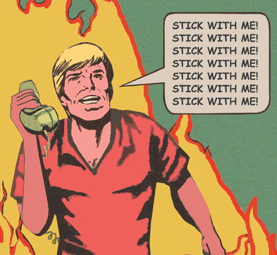
Illustration by Arik Roper.

“The Rolling Jubilee is a genius move for several reasons…”

Why Occupy’s Plan To Cancel Consumer Debts Is Brilliant
Charles Eisenstein, The Guardian | Nov. 12, 2012, 6:02 AM | 11,309 | 69

A new initiative is re-energising the Occupy movement. Called the Rolling Jubilee, it is a plan to use money from donations to buy distressed consumer debt from lenders at a marked down price, just as debt collection agencies normally would. But instead of hounding debtors for payments, it will simply cancel the debts. The hope is that the liberated debtors will themselves contribute to the fund, “rolling” the jubilee forward.

The Rolling Jubilee is a genius move for several reasons. First, debt relief is a transpartisan message that eludes conventional political categorisation. As such, it returns Occupy to its origins as an advocate for the wellbeing of ordinary people, neither leftwing nor rightwing. The Rolling Jubilee says, non-threateningly, “We just want to help people in this unfair system.”

But despite its non-threatening appearance, the Rolling Jubilee has significant transformative potential. Two pillars uphold the present debt regime: the moral legitimacy of debt in society’s eyes, ie, the idea that a person “should” pay back what he owes; and the coercive mechanisms that enforce repayment, such as harassment, seizure of assets, garnishment of wages, denial of employment or housing, and even imprisonment. The Rolling Jubilee erodes both. It destigmatises debt by saying, “we’re all in this together, we believe your situation is unfair, not shameful, so we’re going to help you out”. And it lessens the severity of the consequences of default. If defaulting means you might get bailed out, why keep paying?

For this reason, we might expect lenders to balk at co-operating with the Rolling Jubilee, perhaps by refusing to sell loans to anyone who doesn’t agree to seek collection. So here is a third reason why the idea is so brilliant: if the lenders block debt cancellation even when it comes at no cost to themselves (as they would have sold it at the same price to a collection agency), they appear as a bunch of greedy, vindictive Scrooges. Given their current vulnerability, banks might not want to incite hostility by preventing people from helping each other out.

Accordingly, it is important that the Jubilee organisers continue to frame it in precisely that way: people helping each other out of hardship. Yes, they might understand that its political significance runs deeper, but if they portray it as a political ploy then it will be met as such by the banks or other authorities. Public opinion might also not be as sympathetic.

This also goes for the way the organisers portray it to themselves. In a political system that is lost in a maelstrom of hype, spin and messaging, we crave authenticity in others and in ourselves. Let the Rolling Jubilee stay grounded in the simple goal of freeing people from debt. The political effect will be greater, not less, when it comes from a place of sincerity.

The Rolling Jubilee could influence economic policy as a model for a very different kind of bailout in response to the next financial crisis. The problem of unpayable debts bedevils every corner of our financial system – public, corporate, and personal. So far, the response of the monetary and fiscal authorities to nearly every financial crisis has been to bail out the creditors but not the debtors. Governments and central banks purchase all kinds of shoddy loans from the private sector, but rather than reduce interest or principal on those loans, they merely become the new creditor. The underwater homeowner, the indebted university graduate, the laid-off worker juggling credit cards … they get no relief at all.

The Rolling Jubilee brings a different kind of solution into the public consciousness. The next time a systemic crisis breaks, central banks can rescue the banking system by once again buying the delinquent loans – and then cancel them or reduce the amount borrowers owe. Central banks, with their unlimited capacity to print money, have the power to do this at no cost to the taxpayer. The result would be a release of pent-up consumer purchasing power that had been stuck in debt service. Rising demand would fuel employment, wages, and a broad-based economic expansion.

Would this solution be inflationary? Yes. But a little inflation isn’t necessarily a bad thing, as long as wages rise as fast as prices. Then it is an equalizer of wealth, as the relative value of hoarded wealth shrinks.

Debt cancellation, whether a “people’s bailout” or government policy, is only part of the solution to our economic woes. Deep systemic reforms are necessary, especially given the reality that we are operating a growth-dependent system on a finite planet. But right now, debt is the issue staring us in the face. As always, the most innovative solutions rise from the margins. The Rolling Jubilee may be showing us a glimpse of what is to come.

This article originally appeared on guardian.co.uk

ROLLING JUBILEE: THEY CANCEL DEBT

http://rollingjubilee.org/

A bailout of the people by the people.
We buy debt for pennies on the dollar, but instead of collecting it, we abolish it. We cannot buy specific individuals’ debt – instead, we help liberate debtors at random through a campaign of mutual support, good will, and collective refusal.
The Jubilee begins November 15 with “The People’s Bailout,” a variety show and telethon in New York City.
All proceeds will go directly to buying people’s debt and cancelling it.