''How many years in a row do you see this before you start raising your eyebrows?'

Warmer Waters Disrupt Pacific Food Chain

By THE ASSOCIATED PRESS
Published: July 22, 2006
Filed at 3:46 p.m. ET

FARALLON NATIONAL WILDLIFE REFUGE, Calif. (AP) — On these craggy, remote islands west of San Francisco, the largest seabird colony in the contiguous United States throbs with life. Seagulls swarm so thick that visitors must yell to be heard above their cries. Pelicans glide.

But the steep decline of one bird species for the second straight year has rekindled scientists’ fears that global warming could be undermining the coastal food supply, threatening not just the Farallones but entire marine ecosystems.

Tiny Cassin’s auklets live much of their lives on the open ocean. But in spring, these gray-and-white relatives of the puffin venture to isolated Pacific outposts like the Farallones to dig deep burrows and lay their eggs.

Adult auklets usually feed their chicks with krill, the minuscule shrimp-like crustaceans that anchor the ocean’s complex food web.

But not this year. Almost none of the 20,000 pairs of Cassin’s auklets nesting in the Farallones will raise a chick that lives more than a few days, a repeat of last year’s ”unprecedented” breeding failure, according to Russ Bradley, a seabird biologist with the Point Reyes Bird Observatory who monitors the birds on the islands.

Scientists blame changes in West Coast climate patterns for a delay in the seasonal upwelling of cold, nutrient-rich waters from the ocean’s depths for the second year in a row. Weak winds and faltering currents have left the Gulf of the Farallones without krill, on which Cassin’s auklets and a variety of other seabirds, fish and mammals depend for food.

”The seas are warmer. And the number of krill being produced is lower,” said Bradley as he held a Cassin’s auklet chick, the only one from a study of 400 nests he expected to survive.

”Normally we would have hundreds,” he said.

The failure of last year’s Pacific upwelling killed seabirds from California to British Columbia. Scientists had hoped the change was just a natural temperature fluctuation in what is known as the California Current.

But the return of higher ocean temperatures and scarce food resources this year has scientists wondering whether last year’s erratic weather was not a fluke but the emergence of a troubling trend.

”How many years in a row do you see this before you start raising your eyebrows?” said Frank Schwing, an oceanographer with the National Oceanic and Atmospheric Administration in Pacific Grove.

Climatologists describe global warming as a worldwide rise in temperatures caused by the buildup of carbon dioxide and other greenhouse gasses thought to trap heat in the atmosphere. Predictions of global warming’s effects include rising sea levels, fiercer storms, more wildfires and warmer oceans.

Without long-term data, scientists have so far found it difficult to make direct links between specific natural events and global warming.

But the Farallones present a special case. Researchers have kept Cassin’s auklet counts there every day since 1967. Never before have they seen such a drop-off in numbers. That decline comes as California ocean temperatures hover three to five degrees above average.

”One of the things that the climate models predict is that we’re going to have unpredictable weather, extreme weather, that the whole seasonal cycle of events will not be what we expect,” said Bill Peterson, a NOAA oceanographer in Newport, Ore. ”We aren’t seeing normal patterns.”

Perhaps nowhere is this ecological disruption felt more than here on the Farallones, a 200-acre island chain often described as California’s Galapagos. The U.S. Fish and Wildlife Service keeps the national wildlife refuge closed to visitors except for a small group of scientists and volunteers who live there year-round.

The krill-dependent whales and salmon that inhabit the surrounding waters have not appeared to suffer from the changes in food supply. But during a visit to the islands this summer, scientists pointed to other species feeling the consequences.

The absence of krill has led to a collapse of the juvenile rockfish population. This is the main food source for young of the common murre, a bird that resembles a flying penguin. Though the murre has made a dramatic comeback recently, with about 200,000 adults nesting on the islands this year, nearly three-quarters of murres breeding this year are not expected to raise chicks that survive.

”At this point it’s way too late in the season for the birds to initiate another attempt at breeding,” said Peter Warzybok, a Farallones-based biologist with the Point Reyes Bird Observatory. ”They’ll just have to wait around for next year and hope that it’s better.”

Significant drops in murre and Cassin’s auklet numbers occurred during the El Nino years of 1983 and 1992, when warmer Pacific waters near the equator upset weather patterns worldwide.

A January conference of more than 40 climatologists, oceanographers, and wildlife biologists issued a report describing last year’s altered coastal climate as El Nino-like conditions in a non-El Nino year. Some researchers have given the new climate shift its own name: ”El Coyote.”

The report said a ”ridge” of winter air blocking winds from the Gulf of Alaska lingered more than two months longer than normal in 2005, which delayed the upwelling until well past the birds’ breeding seasons.

”It’s not just a local effect,” Schwing said. ”It’s related to global-scale changes in atmospheric circulation.”

But it could take researchers another decade to determine whether global warming caused those changes. Some climatologists warn against drawing overly broad conclusions from only two years of unusual weather.

Definitive results are ”not around the corner,” said Nick Bond, a research meteorologist the University of Washington who has studied the upwelling’s failure.

”We just don’t know how much the deck is stacked” by the effects of global climate change, Bond said. ”It’s hard to tell from just a deal or two.”

But whatever the cause, the ecological outcome if the trend continues is already clear, according to scientists.

The Cassin’s auklet is unlikely to adapt to the sudden loss of its main food source. And other animals could follow, Schwing said.

In the worst case, he said, ”we could see a great depression of the entire ecosystem.”

The Arthur Magazine Email Bulletin No. 0043

“COMMAND PERFORMANCE”

The Arthur Magazine Email Bulletin

No. 0043

July 19, 2006

Website:

http://www.arthurmag.com

Comments:

editor@arthurmag.com

FROM ARTHUR CONTRIBUTING EDITOR DANIEL CHAMBERLIN:

Last summer I went traveling with my brother Paul in Egypt, Lebanon and Syria. The result was “Dr. Moustache and The Egyptian Gentleman,”  a three-part series in the November 2005 and January 2006 issues of Arthur.

Paul returned to Damascus this summer to refine his Arabic and

research his thesis – he’s getting a Ph.D. in diplomatic history at 

Ohio State University – in Syria’s governmental archives.

The first sign that my brother’s tour of Syrian libraries might not go

as planned came on June 25 when Palestinian guerillas linked to the

Hamas government kidnapped an Israeli soldier and killed two others. 

The ensuing conflict with Israel was escalated on July 12 when some

Hezbollah guys sneaked from Lebanon into Israel, killing eight

soldiers and kidnapping two others, prompting Israel to start dropping

bombs all over Lebanon, destroying the country’s infrastructure to the 

tune of several billion dollars and killing over 200 civilians as of

July 18. Hezbollah shot more of their wildly inaccurate rockets back

into Israel, killing some 13 civilians.

Paul is living in Damascus though, not Beirut, Haifa or Gaza City. But 

Khaled Meshal, the exiled leader of Hamas, also lives in Damascus with

the permission of the government– he moved there after Israeli Mossad

agents tried to assassinate him in Jordan in 1997 by putting poison in 

his ear. Israel expressed its discontent at this arrangement by having

fighter jets buzz Syrian President Bashir Asad’s summer pad in Latakia

shortly after things started getting bloody in Gaza.

As for Hezbollah, they do their own thing–whether it’s firing 

Katyushas into Israeli settlements, selling keychains in the gift

shops on the Israeli border that Paul and I visited last summer or

serving as members of Lebanon’s parliament – but they receive support

from both Syria and Iran. The U.S. and Israeli governments have

indicated they hold Syria responsible for the actions of both

Hezbollah and Hamas. In an interview with Charlie Rose, the Israeli

representative to the United Nations characterized this as not only 

part of the “War on Terror,” but went so far as to say that it was one

of the early chapters of World War III. Tehran and Damascus, it should

be mentioned, have agreed to back the other should Israel or the U.S. 

decide to attack.

Paul and I talk frequently via e-mail, and the following is his daily

journal of what life in Damascus has been like lately.

Daniel Chamberlin

Los Angeles

July 18, 2006

LETTERS FROM DAMASCUS by Paul Chamberlin

*** Friday 14 July***

Tonight we met a man who fought in the Syrian army in the Golan during

the 1973 war. He seemed considerably less concerned about the

situation here than us, explaining that the people here could sense 

when a war was coming, and everything was fine.

***Saturday 15 July***

Things got worse today. I went to the internet cafe this morning to

find my inbox full of emails from the United States urging me to

evacuate Damascus immediately. My advisor at Ohio State–a historian

of U.S.-Israeli relations–is suggesting that it might not be a bad

idea to get out of the region as soon as possible while my friend

Steve in Beirut recommends that I might consider heading north to 

Turkey. Apparently he’s heard from a contact in the State Department

that the situation could escalate to conflict with Syria in the very

near future. Rumor has it that the Israeli fleet is massing off of

Tripoli in preparation to begin bombing the northern highways to 

Syria. Apparently he hasn’t heard anything from the U.S. Embassy in

Beirut even though the city has been under Israeli attack for two

days. To make matters worse, I find another email from my friend

Mariam, also in Beirut, relating her plans to head to Damascus via the 

same northern roads that the Israelis are planning to attack. I send a

cautionary email to her, convinced that it won’t reach her in time to

make any difference.

I run into Steve online a bit later. He’s received the warden message 

from the U.S. Embassy recommending that all Americans consider leaving

Lebanon but warning that current tensions might make evacuation

impossible. However, the message continues, the embassy is considering

the possibility of using U.S. Navy ships to evacuate American citizens

to Cyprus. Evacuees will be required to sign promissory notes as this

evacuation won’t be free. I’m struck by the absurdity of the Americans

currently besieged in Beirut. Their tax dollars have paid for the 

Israeli bombs hitting Beirut and the American ships which may or may

not be used to evacuate them, but they’ll still have to pay one last

time to get out of the city.

Though my immediate instinct is to beat a hasty retreat to either 

Jordan or Turkey, the fact remains that the Israelis have yet to hit

anything in Syria. All the same, Iran has pledged to come to Syria’s

aid should the Israelis make a move against Damascus and President

Bush is urging Israel to turn its attention away from the Lebanese 

government and focus on Syria. Everyone is waiting for a statement

from President Assad and wondering what the hell the Israelis are

thinking, given their previous experiences in Lebanon.

An article in al-Hayat is claiming that Israel has issued Syria a 

72-hour ultimatum demanding information leading to the return of the

captured Israeli soldiers or else the Israeli air force will begin

attacking Syrian installations. So far none of the wire services have

picked up the story, so we’re skeptical, but still a bit worried. From 

where we sit, the notion that Damascus controls Hezbollah seems

completely absurd. We’re all hoping that this isn’t the pretext

Washington has been waiting for to go after Iran’s nuclear program.

I’ve also read reports that the Israelis have hit several minivans 

full of refugees fleeing Beirut on their way to Syria.

Later in the day I get word from Mariam that she’s made it to Damascus

and we make plans to meet up at 8 o’clock. We talk over beers at a

cafe overlooking Bab Touma, one of the medieval gates in the Old City 

wall. She’s spent the entire day in a service taxi flying down

secondary roads. Israeli airplanes have taken out most of the major

highways and bridges leading out of Lebanon. She tells me that the

taxi driver decided to take the back roads after they drove by a 

recent bomb site. Oddly, she seems more concerned with the mundane

details of the trip–the bitchy Lebanese woman sitting in the front

seat complaining that her arm was getting burnt by the sun, the cost

of changing her ticket back to California, etc.–than the fact that 

she’s just escaped a war zone. I suppose it’s only those of us who’ve

spent the day in quiet, stable Damascus have the luxury of worrying

about the international ramifications of the conflict.

I have dinner at large restaurant in Old Damascus with some American 

students surrounded by Syrian families some of whom seem to be

celebrating a birthday while we worry about the next Mideast war.

Halfway through dinner the lights flicker out and the entire

restaurant instantly falls silent. The electricity returns a moment 

later, but the building is noticeably quieter. After dinner I go back

to the internet cafe and chat with Steve, who’s still in Beirut.

Apparently the electricity is out in his apartment and the landlord is

running the generator from 7pm until lights-out at 11. He says he can 

her the sound of explosions and Israeli jets and he’s planning to

evacuate with the U.S. Navy to Cyprus. At this point there’s nothing

left to do but go home, try to sleep, and wait until morning to find

out the night’s news from Lebanon. It’s amazing how fast all this is 

happening.

***Sunday 16 July***

I talked to Mariam online this morning. She’s somehow managed to

change her plane ticket and she’ll be leaving tomorrow. “They bombed

the lighthouse near where I lived in Beirut,” she tells me, “and I’m 

afraid that I’ll have to watch the same thing happen here.” The owner

of the internet cafe is playing his favorite mix tape: Kansas, Celine

Dion, the Eagles, and Chicago.

***Monday 17 July***

We had trouble catching a bus to the university this morning because a 

number had been diverted to ferry people to and from the large public

demonstration in support of Lebanon this morning. At the university I

find that my classmates are more worried than ever about the

situation. Most are dealing with worried parents, Arabic exams, and 

the stress of living in a country that could turn into the center of a

major war in the next few days. My Arabic instructor–a Syrian

woman–says she’s more sad than worried. She explains that classes

will continue as long as we show up. Even so, a number of the 

university’s facilities remain closed for the day; the people with the

keys can’t make it to campus because of the demonstrations in the

center of the city.

We walked through the Muslim section of the Old City this evening and 

were surprised to find new decorations flying from many storefronts.

The yellow and green Hezbollah flags are out. I see one large flag

that has been patched together from a Lebanese, Syrian, and Hezbollah

flag hanging from a bread shop off the main street. If nothing else, 

Israel has managed to galvanize support behind Hezbollah. The other

thing I notice are a number of kids wearing New York Yankees hats. I

sat next to two of them on the bus home from the university today and

I notice another walking along the southern wall of the Ummayad mosque 

this evening. The internet cafe is packed for the second night as I

wait for a computer. Most of the new faces are probably refugees from

Beirut; rich kids with nothing better to do in boring-old Damascus

than spend their time chatting online with friends. 

***Tuesday 18 July***

We woke up to an email from our Ohio State saying that they recommend

that we return on the first possible flight to the United States.

Never mind that tensions here seem to be leveling off a bit. 

Unfortunately, the message remained vague on the details regarding the

financial and academic repercussions of our premature departure, so we

really don’t know what to think. One of my classmates left Damascus at 

2am this morning and a number of other students in our program didn’t

bother to show up. We’ve also heard a rumor that Washington believes

that “Syria is not/will not be a safe place in the near future.” There

will also be a large anti-U.S. rally in Damascus this weekend. At this

point there are too many unknown variable for us to make an informed

decision and ironically, the military situation in the region has

taken a backseat to our worries about what’s happening at home. 

***Wednesday 19 July***

As usual I wake up a bit more optimistic today. While we’re

considering heading to Egypt via Jordan and the Gulf of Aqaba,

everything seemed a bit better this morning and I’d thought of staying 

in Damascus for another month. It seems that Ohio State is really

getting our backs on this one and they’re willing to help us get out

whenever and however we choose.

Opening my email dispels this sense of optimism. Yesterday’s rumor 

that Syria was about to turn into a very dangerous place apparently

referred to a potential Israeli airstrike, the threat of which seems to

have subsided. According to the rumor mill, however, things are

bound to get worse before they get better.President Bush is now

arguing that Syria is orchestrating Hezbollah’s actions,

explaining that Damascus is trying to destabilize Lebanon in

order to reestablish its presence in the country. From Damascus, it 

seems that the Israelis are doing most of the destabilization in

Lebanon, but perhaps that’s just our warped perspective. The city

continues to fill with refugees from Lebanon while those not lucky

enough to make it to Syria are apparently stuck in the bombed out 

ruins of Beirut. The more we see the more it looks like it may be time

to be getting out.

Another student in our program has decided to go home. She’s spent the

last two days crying, not out of fear, but because she’s been trying 

to explain to her host family — who will, of course, be staying —

that she’s leaving because her American university has decided that

the situation is too dangerous in Syria. The people here seem to be

especially interested in our anxiety / decisions to depart. Part of 

this comes from concern for us, our feelings, and our safety, but

surely, the sight of so many frightened Americans evacuating the city

must seem ominous to them.

We see two large red banners in the souq today, one in English and 

French, one in Arabic. They’re pledging Syrian support to Lebanon and

Hezbollah and decrying Israeli “terrorism that kills women and

children that is funded by America.” Still, no one I’ve spoken with

has experienced any sort of hostility. There’s been a marked increase 

in the number of Syrian troops and armed men on the streets. While the

people we talk to still claim to be unconcerned, the city feels tense.

Walking down the street today I see a woman, pushing her baby in a 

stroller, singing the Barney “I love you, you love me…” song.

Tonight I’ll sit on the roof of my friend’s house, drink Syrian beer,

and look at lights of Damascus. The mosques have green fluorescent

lights, the church’s lights are blue. 

LETTERS FROM DAMASCUS by Paul Chamberlin

Updated daily * archived * comments at

http://www.arthurmag.com/magpie/?p=1357

What are we gonna do about it, 

Arthur Magazine

Los Angeles / Philadelphia / New York City

Baghdad is on the verge of total collapse.

Times of London – July 13, 2006

Baghdad starts to collapse as its people flee a life of death

By James Hider, of The Times, from Baghdad

As I hung up the phone, I wondered if I would ever see my friend Ali alive again. Ali, The Times translator for the past three years, lives in west Baghdad, an area that is now in meltdown as a bitter civil war rages between Sunni insurgents and Shia militias. It is, quite simply, out of control.

I returned to Baghdad on Monday after a break of several months, during which I too was guilty of glazing over every time I read another story of Iraqi violence. But two nights on the telephone, listening to my lost and frightened Iraqi staff facing death at any moment, persuaded me that Baghdad is now verging on total collapse.

Ali phoned me on Tuesday night, about 10.30pm. There were cars full of gunmen prowling his mixed neighbourhood, he said. He and his neighbours were frantically exchanging information, trying to identify the gunmen.

Were they the Mahdi Army, the Shia militia blamed for drilling holes in their victims’ eyes and limbs before executing them by the dozen? Or were they Sunni insurgents hunting down Shias to avenge last Sunday’s massacre, when Shia gunmen rampaged through an area called Jihad, pulling people from their cars and homes and shooting them in the streets?

Ali has a surname that could easily pass for Shia. His brother-in-law has an unmistakably Sunni name. They agreed that if they could determine that the gunmen were Shia, Ali would answer the door. If they were Sunnis, his brother-in-law would go.

Whoever didn’t answer the door would hide in the dog kennel on the roof.

Their Plan B was simpler: to dash 50 yards to their neighbours’ house — home to a dozen brothers. All Iraqi homes are awash with guns for self-defence in these merciless times. Together they would shoot it out with the gunmen — one of a dozen unsung Alamos now being fought nightly on Iraq’s blacked-out streets.

“We just have to wait and see what our fate is,” Ali told me. It was the first time in three years of bombs, battles and kidnappings that I had heard this stocky, very physical young man sounding scared, but there was nothing I could do to help.

The previous night I had had a similar conversation with my driver, a Shia who lives in another part of west Baghdad. He phoned at 11pm to say that there was a battle raging outside his house and that his family were sheltering in the windowless bathroom.

Marauding Mahdi gunmen, seeking to drive all Sunnis from the area, were fighting Sunni Mujahidin for control of a nearby strategic position. I could hear the gunfire blazing over the phone.

We phoned the US military trainer attached to Iraqi security forces in the area. He said there was nothing to be done: “There’s always shooting at night here. It’s like chasing ghosts.”

In fact the US military generally responds only to request for support from Iraqi security forces. But as many of those forces are at best turning a blind eye to the Shia death squads, and at worst colluding with them, calling the Americans is literally the last thing they do.

West Baghdad is no stranger to bombings and killings, but in the past few days all restraint has vanished in an orgy of ethnic cleansing.

Shia gunmen are seeking to drive out the once-dominant Sunni minority and the Sunnis are forming neighbourhood posses to retaliate. Mosques are being attacked. Scores of innocent civilians have been killed, their bodies left lying in the streets.

Hundreds — Sunni and Shia — are abandoning their homes. My driver said all his neighbours had now fled, their abandoned houses bullet-pocked and locked up. On a nearby mosque, competing Sunni and Shiite graffiti had been scrawled on the walls.

A senior nurse at Yarmouk hospital on the fringes of west Baghdad’s war zone said that he was close to being overwhelmed. “On Tuesday we received 35 bodies in one day, 16 from Al-Furat district alone. All of them were killed execution-style,” he said. “I thought it was the end of the city. I packed my bags at once and got ready to leave because they could storm the hospital at any moment.”

In just 24 hours before noon yesterday, as parliament convened for another emergency session, 87 bodies were brought to Baghdad city morgue, 63 of them unidentified. Since Sunday’s massacre in Jihad, more than 160 people have been killed, making a total of at least 1,600 since Iraq’s Government of national unity came to power six weeks ago. Another 2,500 have been wounded.

In early June, Nouri al-Maliki, the new Prime Minister, flooded Baghdad’s streets with tens of thousands of soldiers and police in an effort to restore order to the capital.

More recently, he announced a national reconciliation plan, which promised an amnesty to Sunni insurgents and the disbandment of Shia militias. Both initiatives are now in tatters.

“The country is sliding fast towards civil war,” Ali Adib, a Shia MP, told the Iraqi parliament this week. “Security has deteriorated in a serious and unprecedented way,” said Saadi Barzanji, a Kurdish MP.

Mr al-Maliki told parliament: “We all have a last chance to reconcile and agree among each other on avoiding conflict and blood. If we fail, God knows what the fate of Iraq will be.”

Joseph Biden, the senior Democrat on the US Senate’s Foreign Relations Committee, described Baghdad after a recent visit as a city in the throes of “nascent civil war”.

Most Iraqis believe that it is already here. “There is a campaign to eradicate all Sunnis from Baghdad,” said Sheikh Omar al-Jebouri, of the Iraqi Islamic Party, a Sunni parliamentary group. He said that it was organised by the Shia-dominated Interior Ministry and its police special commandos, with Shia militias, and aimed to destroy Mr al-Maliki’s plans to rebuild Iraq’s security forces along national, rather than sectarian, lines.

Ahmed Abu Mustafa, a resident of the Sunni district of Amariyah in western Baghdad, was stunned to see two police car pick-ups speed up to his local mosque with cars full of gunmen on Tuesday evening and open fire on it with their government-issued machineguns.

Immediately, Sunni gunmen materialised from side streets and a battle started. “I’d heard about this happening but this was the first time I’d seen police shooting at a mosque,” he said. “I was amazed by how quickly the local gunmen deployed. I ran for my life.”

Yesterday, General George Casey, the most senior US commander in Iraq, said that the US might deploy more American troops in Baghdad. He said that al-Qaeda, to show that it was still relevant, had stepped up its attacks in Baghdad following the killing last month of its leader, Abu Musab al-Zarqawi. “What we are seeing now as a counter to that is death squads, primarily from Shia extremist groups, that are retaliating against civilians.”

A local journalist told me bitterly this week that Iraqis find it ironic that Saddam Hussein is on trial for killing 148 people 24 years ago, while militias loyal to political parties now in government kill that many people every few days. But it is not an irony that anyone here has time to laugh about. They are too busy packing their bags and wondering how they can get out alive.

My driver and his extended family are now refugees living in The Times offices in central Baghdad.

Ali is also trying to persuade his stubborn family to leave home and move into our hotel.

Those that can are leaving the country. At Baghdad airport, throngs of Iraqis jostle for places on the flights out — testimony to the breakdown in Iraqi society.

One woman said that she and her three children were fleeing Mansour, once the most stylish part of the capital. “Every day there is fighting and killing,” she said as she boarded a plane for Damascus in Syria to sit out the horrors of Baghdad.

A neurologist, who was heading to Jordan with his wife, said that he would seek work abroad and hoped that he would never have to return. “We were so happy on April 9, 2003 when the Americans came. But I’ve given up. Iraq isn’t ready for democracy,” he said, sitting in a chair with a view of the airport runway.

Fares al-Mufti, an official with the Iraqi Airways booking office, told The Times that the national carrier had had to lay on an extra flight a day, all fully booked. Flights to Damascus have gone up from three a week to eight to cope with the panicked exodus.

Muhammad al-Ani, who runs fleets of Suburban cars to Jordan, said that the service to Amman was so oversubscribed that that prices had rocketed from $200 (£108) to $750 per trip in the past two weeks.

Despite the huge risks of driving through the Sunni Triangle, the number of buses to Jordan has mushroomed from 2 a day to as many as 40 or 50.

Abu Ahmed, a Sunni who was leaving Ghazaliya with his family and belongings, said that he was ready to pay the exorbitant prices being charged because his wife had received a death threat at the hospital in a Shia area where she worked.

“We can’t cope, we have to take the children out for a while,” he said.

In one of the few comprehensive surveys of how many Iraqis have fled their country since the US invasion, the US Committee for Refugees and Immigrants said last month that there were 644,500 refugees in Syria and Jordan in 2005 — about 2.5 per cent of Iraq’s population. In total, 889,000 Iraqis had moved abroad, creating “the biggest new flow of refugees in the world”, according to Lavinia Limon, the committee’s president.

And the exodus may only just be starting.

LETTERS FROM DAMASCUS by Paul Chamberlin – ARCHIVE


Last summer I went traveling with my brother Paul in Egypt, Lebanon
and Syria. The result was “Dr. Moustache and The Egyptian Gentleman,”
a three-part series in the November 2005 and January 2006 issues of
Arthur. (Read Parts 1 and 2 online here. Read Part 3 online here.)

Paul returned to Damascus this summer to refine his Arabic and
research his thesis – he’s getting a Ph.D. in diplomatic history at
Ohio State University – in Syria’s governmental archives.

The first sign that my brother’s tour of Syrian libraries might not go
as planned came on June 25 when Palestinian guerillas linked to the
Hamas government kidnapped an Israeli soldier and killed two others.
The ensuing conflict with Israel was escalated on July 12 when some
Hezbollah guys sneaked from Lebanon into Israel, killing eight
soldiers and kidnapping two others, prompting Israel to start dropping
bombs all over Lebanon, destroying the country’s infrastructure to the
tune of several billion dollars and killing over 200 civilians as of
July 18. Hezbollah shot more of their wildly inaccurate rockets back
into Israel, killing some 13 civilians.

Paul is living in Damascus though, not Beirut, Haifa or Gaza City. But
Khaled Meshal, the exiled leader of Hamas, also lives in Damascus with
the permission of the government– he moved there after Israeli Mossad
agents tried to assassinate him in Jordan in 1997 by putting poison in
his ear. Israel expressed its discontent at this arrangement by having
fighter jets buzz Syrian President Bashir Asad’s summer pad in Latakia
shortly after things started getting bloody in Gaza.

As for Hezbollah, they do their own thing–whether it’s firing
Katyushas into Israeli settlements, selling keychains in the gift
shops on the Israeli border that Paul and I visited last summer or
serving as members of Lebanon’s parliament – but they receive support
from both Syria and Iran. The U.S. and Israeli governments have
indicated they hold Syria responsible for the actions of both
Hezbollah and Hamas. In an interview with Charlie Rose, the Israeli
representative to the United Nations characterized this as not only
part of the “War on Terror,” but went so far as to say that it was one
of the early chapters of World War III. Tehran and Damascus, it should
be mentioned, have agreed to back the other should Israel or the U.S.
decide to attack.

Paul and I talk frequently via e-mail, and the following is his daily
journal of what life in Damascus has been like lately.

Daniel Chamberlin
Los Angeles
July 18, 2006

Friday 14 July
Tonight we met a man who fought in the Syrian army in the Golan during
the 1973 war. He seemed considerably less concerned about the
situation here than us, explaining that the people here could sense
when a war was coming, and everything was fine.

Saturday 15 July
Things got worse today. I went to the internet cafe this morning to
find my inbox full of emails from the United States urging me to
evacuate Damascus immediately. My advisor at Ohio State–a historian
of U.S.-Israeli relations–is suggesting that it might not be a bad
idea to get out of the region as soon as possible while my friend
Steve in Beirut recommends that I might consider heading north to
Turkey. Apparently he’s heard from a contact in the State Department
that the situation could escalate to conflict with Syria in the very
near future. Rumor has it that the Israeli fleet is massing off of
Tripoli in preparation to begin bombing the northern highways to
Syria. Apparently he hasn’t heard anything from the U.S. Embassy in
Beirut even though the city has been under Israeli attack for two
days. To make matters worse, I find another email from my friend
Mariam, also in Beirut, relating her plans to head to Damascus via the
same northern roads that the Israelis are planning to attack. I send a
cautionary email to her, convinced that it won’t reach her in time to
make any difference.

I run into Steve online a bit later. He’s received the warden message
from the U.S. Embassy recommending that all Americans consider leaving
Lebanon but warning that current tensions might make evacuation
impossible. However, the message continues, the embassy is considering
the possibility of using U.S. Navy ships to evacuate American citizens
to Cyprus. Evacuees will be required to sign promissory notes as this
evacuation won’t be free. I’m struck by the absurdity of the Americans
currently besieged in Beirut. Their tax dollars have paid for the
Israeli bombs hitting Beirut and the American ships which may or may
not be used to evacuate them, but they’ll still have to pay one last
time to get out of the city.

Though my immediate instinct is to beat a hasty retreat to either
Jordan or Turkey, the fact remains that the Israelis have yet to hit
anything in Syria. All the same, Iran has pledged to come to Syria’s
aid should the Israelis make a move against Damascus and President
Bush is urging Israel to turn its attention away from the Lebanese
government and focus on Syria. Everyone is waiting for a statement
from President Assad and wondering what the hell the Israelis are
thinking, given their previous experiences in Lebanon.

An article in al-Hayat is claiming that Israel has issued Syria a
72-hour ultimatum demanding information leading to the return of the
captured Israeli soldiers or else the Israeli air force will begin
attacking Syrian installations. So far none of the wire services have
picked up the story, so we’re skeptical, but still a bit worried. From
where we sit, the notion that Damascus controls Hezbollah seems
completely absurd. We’re all hoping that this isn’t the pretext
Washington has been waiting for to go after Iran’s nuclear program.
I’ve also read reports that the Israelis have hit several minivans
full of refugees fleeing Beirut on their way to Syria.

Later in the day I get word from Mariam that she’s made it to Damascus
and we make plans to meet up at 8 o’clock. We talk over beers at a
cafe overlooking Bab Touma, one of the medieval gates in the Old City
wall. She’s spent the entire day in a service taxi flying down
secondary roads. Israeli airplanes have taken out most of the major
highways and bridges leading out of Lebanon. She tells me that the
taxi driver decided to take the back roads after they drove by a
recent bomb site. Oddly, she seems more concerned with the mundane
details of the trip–the bitchy Lebanese woman sitting in the front
seat complaining that her arm was getting burnt by the sun, the cost
of changing her ticket back to California, etc.–than the fact that
she’s just escaped a war zone. I suppose it’s only those of us who’ve
spent the day in quiet, stable Damascus have the luxury of worrying
about the international ramifications of the conflict.

I have dinner at large restaurant in Old Damascus with some American
students surrounded by Syrian families some of whom seem to be
celebrating a birthday while we worry about the next Mideast war.
Halfway through dinner the lights flicker out and the entire
restaurant instantly falls silent. The electricity returns a moment
later, but the building is noticeably quieter. After dinner I go back
to the internet cafe and chat with Steve, who’s still in Beirut.
Apparently the electricity is out in his apartment and the landlord is
running the generator from 7pm until lights-out at 11. He says he can
her the sound of explosions and Israeli jets and he’s planning to
evacuate with the U.S. Navy to Cyprus. At this point there’s nothing
left to do but go home, try to sleep, and wait until morning to find
out the night’s news from Lebanon. It’s amazing how fast all this is
happening.

Sunday 16 July
I talked to Mariam online this morning. She’s somehow managed to
change her plane ticket and she’ll be leaving tomorrow. “They bombed
the lighthouse near where I lived in Beirut,” she tells me, “and I’m
afraid that I’ll have to watch the same thing happen here.” The owner
of the internet cafe is playing his favorite mix tape: Kansas, Celine
Dion, the Eagles, and Chicago.

Monday 17 July
We had trouble catching a bus to the university this morning because a
number had been diverted to ferry people to and from the large public
demonstration in support of Lebanon this morning. At the university I
find that my classmates are more worried than ever about the
situation. Most are dealing with worried parents, Arabic exams, and
the stress of living in a country that could turn into the center of a
major war in the next few days. My Arabic instructor–a Syrian
woman–says she’s more sad than worried. She explains that classes
will continue as long as we show up. Even so, a number of the
university’s facilities remain closed for the day; the people with the
keys can’t make it to campus because of the demonstrations in the
center of the city.

We walked through the Muslim section of the Old City this evening and
were surprised to find new decorations flying from many storefronts.
The yellow and green Hezbollah flags are out. I see one large flag
that has been patched together from a Lebanese, Syrian, and Hezbollah
flag hanging from a bread shop off the main street. If nothing else,
Israel has managed to galvanize support behind Hezbollah. The other
thing I notice are a number of kids wearing New York Yankees hats. I
sat next to two of them on the bus home from the university today and
I notice another walking along the southern wall of the Ummayad mosque
this evening. The internet cafe is packed for the second night as I
wait for a computer. Most of the new faces are probably refugees from
Beirut; rich kids with nothing better to do in boring-old Damascus
than spend their time chatting online with friends.

Tuesday 18 July
We woke up to an email from our Ohio State saying that they recommend
that we return on the first possible flight to the United States.
Never mind that tensions here seem to be leveling off a bit.
Unfortunately, the message remained vague on the details regarding the
financial and academic repercussions of our premature departure, so we
really don’t know what to think. One of my classmates left Damascus at
2am this morning and a number of other students in our program didn’t
bother to show up. We’ve also heard a rumor that Washington believes
that “Syria is not/will not be a safe place in the near future.” There
will also be a large anti-U.S. rally in Damascus this weekend. At this
point there are too many unknown variable for us to make an informed
decision and ironically, the military situation in the region has
taken a backseat to our worries about what’s happening at home.

Wednesday 19 July
As usual I wake up a bit more optimistic today. While we’re
considering heading to Egypt via Jordan and the Gulf of Aqaba,
everything seemed a bit better this morning and I’d thought of staying
in Damascus for another month. It seems that Ohio State is really
getting our backs on this one and they’re willing to help us get out
whenever and however we choose.

Opening my email dispels this sense of optimism. Yesterday’s rumor
that Syria was about to turn into a very dangerous place apparently
referred to a potential Israeli airstrike, the threat of which seems to
have subsided. According to the rumor mill, however, things are
bound to get worse before they get better.President Bush is now
arguing that Syria is orchestrating Hezbollah’s actions,
explaining that Damascus is trying to destabilize Lebanon in
order to reestablish its presence in the country. From Damascus, it
seems that the Israelis are doing most of the destabilization in
Lebanon, but perhaps that’s just our warped perspective. The city
continues to fill with refugees from Lebanon while those not lucky
enough to make it to Syria are apparently stuck in the bombed out
ruins of Beirut. The more we see the more it looks like it may be time
to be getting out.

Another student in our program has decided to go home. She’s spent the
last two days crying, not out of fear, but because she’s been trying
to explain to her host family — who will, of course, be staying —
that she’s leaving because her American university has decided that
the situation is too dangerous in Syria. The people here seem to be
especially interested in our anxiety / decisions to depart. Part of
this comes from concern for us, our feelings, and our safety, but
surely, the sight of so many frightened Americans evacuating the city
must seem ominous to them.

We see two large red banners in the souq today, one in English and
French, one in Arabic. They’re pledging Syrian support to Lebanon and
Hezbollah and decrying Israeli “terrorism that kills women and
children that is funded by America.” Still, no one I’ve spoken with
has experienced any sort of hostility. There’s been a marked increase
in the number of Syrian troops and armed men on the streets. While the
people we talk to still claim to be unconcerned, the city feels tense.

Walking down the street today I see a woman, pushing her baby in a
stroller, singing the Barney “I love you, you love me…” song.
Tonight I’ll sit on the roof of my friend’s house, drink Syrian beer,
and look at lights of Damascus. The mosques have green fluorescent
lights, the church’s lights are blue.

Thursday 20 July
The Arabic program here is falling apart. About four people showed up
today and the university has started canceling classes. Most of us are
trying to arrange departure from Syria, which seems to be getting
harder every day. Hearing a rumor that cheap flights to Cairo were
available from EgyptAir, we went by the office today, only to find the
lobby full of people crowding up to the ticket counters, trying to get
out of the country. After about a half an hour, we managed to push our
way up to one attendant who smiled sympathetically, and told us that
flights were sold out through the end of the month. I notice that,
though many of the passports are Egyptian, the group beside us is
sporting Canadian documents. It seems like everyone is trying to get
out of the city.

The decision to leave has been a difficult one. As much as I’d like to
stay and wait to see if something happens, I’m not willing to stick
around if bombs start dropping, so waiting around would just make me
another body trying to squeeze out of Syria should something go wrong.
As is, I’ll be leaving a couple weeks ahead of schedule — and making
them up in Cairo, not a bad trade as far as I’m concerned. I have a
week to wrap things up here before my plane leaves (somehow we managed
to get tickets through a US travel agency).

While I still feel completely safe here, things continue to get more
and more tense. My friend tells me that he saw a fist-fight break out
between two drivers trying to get down the same street. I also walked
by two kids — maybe 10 or 11 years old — sitting in a doorway and
brandishing some sort of combat shotgun. Though they didn’t pay me
much mind, and surely had no intention of threatening me with the gun
(which probably wasn’t loaded anyway), the whole scene was a little
unsettling and contributes the weird vibe coming from the city lately.
We’re hearing that there are large anti-U.S. demonstrations in the
city tonight and people that know what they’re talking about are
telling us to keep a low profile. That all seems pretty far away
though. Tonight’s the weekend and that means weddings, which usually
degenerate into lots of cars honking and good times all around.

I told my host-mother that I’d be leaving and she started crying. I
tried to explain that it wasn’t because I was afraid of Syria or
Syrians … that I was afraid of President Bush and the Israeli
military. She just told me the Bush needed to come to Syria, then he
wouldn’t have so many bad things to say. Then she started talking
about a prime minister that came to Damascus — from somewhere, I’m
not sure where, my Arabic still has a ways to go — and he was very
nice and very fat. It’s going to be hard to leave.

Saturday 22 July
Things have been pretty quiet here the last couple of days. The slow
trickle of American students out of Damascus has begun with people
flying back to Europe and heading north overland to Turkey. The
Syrians in our neighborhood have started to notice. Today I talked to
my friend who works at shop around the corner from my house. He says
he’s worried, so he hasn’t been watching the news. It’s probably the
first time that I’ve spoken with a Syrian who will admit to being
worried about the situation in Lebanon coming to Damascus. We ran into
a man last night who spoke fluent French. When he asked, one of my
companions lied and said that we were from Canada–something I’ve
never done before. He started going off on Israel and the
international community for not doing anything about what’s happening
in Lebanon. I told him in my mangled French (my French prepositions
are losing out to their Arabic counterparts, which leads to some
confusion) that President Bush was holding up all the proposed
ceasefires, but he didn’t seem terribly interested in talking about
America.

We’re also starting to get some press back in the Ohio — there’s a
large contingent of Ohio State students here. So far everything we’ve
read has been pretty alarmist, talking about how we’re all fearing for
our lives. The sensationalist stories are making life difficult for
people with wives, girlfriends, and boyfriends back home. I’ve also
been amazed at the refusal of people back home to let go of this idea
that we face some sort of grave danger from Syrians and Hezbollah, as
if the people here were stalking the streets just waiting to kidnap
some unwitting American. No matter what we say, everyone keeps
bringing this up.

Sunday 23 July
In addition to the Ummayad mosque, the spectacular Old City, Bashar
al-Assad, and about five million Syrians, Damascus is home to the
french fry sandwich: A bun filled with coleslaw, mayonnaise, and fried
potato slices that hits the spot (and stays there) any day of the
week. We were enjoying one of these fine treats the other day in a
snack shop just south of Straight Street, the street that divides the
old city into the right and wrong side of the tracks, so to speak. Not
that Damascus really has a wrong side of the tracks (people don’t
really feel it necessary to use bike locks here, for example), rather
this is simply the side of town that you’re more likely to get funny
looks if you are obviously not Syrian. In any case, as we were trying
to finish off Syria’s answer to low cholesterol the owner of the shop
switched on Hezbollah’s al-Manar TV, which seems to run Hezbollah’s
theme song to videos of guys jumping around in the woods and shooting
guns every hour on the hour. So now that’s in my head, it really is
rather catchy.

We also found a pirated copy of First Blood the other night at a kiosk
in the new city. Someone had recorded it with Arabic subtitles off
satellite TV. It wasn’t long before we were all sipping Syrian beers
(Barada, after the river) and watching Rambo on an Egyptian DVD
player.

We went to a juice bar today to study and enjoy fresh strawberry
juice. One of the guys hanging out in the bar was an ex-commando in
the Syrian army. Everyone laughed when George Bush came on al-Jazeera.
The UN is suggesting that Israel’s attacks on Beirut might qualify as
war crimes (mass graves, whole families killed), Secretary Rice is
pledging to block ceasefires, Israel is massing troops and armour on
the Lebanese border, and the Syrian papers have picked up the story of
Washington sending more laser-guided bombs to Israel. At least people
here have kept their sense of humor.

Monday 24 July
Last night while waiting for a friend in the shadow of the Ummayad
Mosque, we ended up getting pulled into a conversation with a young
man selling rugs and Damascene souvenirs to tourists. “You’re not
rednecks, are you?” he asks. “There are a lot of rednecks around
here.” As it turns out, he knows a couple of the girls from Ohio State
that came here last summer. It’s a small world.

Unfortunately the rumors of anti-Americanism that we’ve been hearing
bear some truth. We’re seeing more Hezbollah flags and pictures of
Nasrallah everyday, and I’d swear that we’re getting more glares as
the crisis in Lebanon continues. A couple of my fellow students got
into it with a vendor in the souq yesterday. “Fuck you Americans,” he
told them. At the same time, we’re seeing more westerners in Damascus
than ever due to the situation in Lebanon. Many of those who left
Beirut have ended up here, ironically, making it increasingly
difficult to keep a low profile. On that note, my host family rented
my room out today. My replacement — a student from Seattle who was
studying in Beirut — moves in on Friday.

I spent the day waiting around for DHL to deliver our paper tickets
for the flight from Damascus to Cairo. Later, we found out that
they’re still in Ohio and we should expect them to arrive no later
than Wednesday, the day before we fly out. We’ve also heard that
EgyptAir is trying to cancel our tickets out of Damascus. They’ve
oversold the flights and are looking for seats to cancel. Getting out
early has been a giant hassle, I can’t imagine what it would be like
if something actually went wrong.

Wednesday 26 July
I ended up hanging out last night with a group of Syrian teenagers on a roof in
the Old City last night smoking sheesha. One of them was sporting a
big t-shirt that had the word “THUG” scrawled across it. In between
your typical adolescent “Ahmed is gay” and “Your mom is my girlfriend”
jokes I talked with them a bit about the situation in Lebanon. Most of
them were Christian but they all had great things to say about
Nasrallah and Hezbollah. They weren’t worried, they said, because they
knew that Russia and Iran were on their side. This business about the
Shi’ite crescent doesn’t seem to make much sense in Damascus, where
Christians and Sunnis join with Shi’ites in professing support and
admiration for Hezbollah. Hezbollah flags and pictures of Nasrallah
are everywhere now. We’re seeing a lot of glossy posters with the
three faces of Hafez al-Assad, Bashar al-Assad, and Hassan Nasrallah
against a Syrian flag. My friend in Cairo suggests that Nasrallah is
becoming the new Nasser, the face of pan-Arab resistance, with
Israel’s help. So far, I haven’t spoken with anyone who has much of
anything bad to say about him.

We had a taxi driver last night who asked if we were Russians; he got
angry when he found out we were Americans and started venting about
President Bush. Apparently Clinton is cool, Powell is okay, but Bush
and this Condoleeza Rice character are no good.

We finally figured out what was going on with our tickets to Cairo.
Apparently, the paper tickets were intercepted by the Department of
Homeland Security, which is stopping most packages coming to Syria.
Thus, while we sit in Damascus amid anti-American demonstrations and
rising support for Hezbollah, the U.S. Government his holding our
tickets out of the country. Luckily, we were able to purchase
replacement tickets from EgyptAir. Now all we have to worry about is
getting a refund from the airline, but the money we paid to have the
tickets shipped to Damascus is gone.

Monday 31 July
We’ve made it to Cairo despite the combined efforts of Egypt Air, the
Department of Homeland Security, and Egyptian Customs. It really has
felt as if the best efforts of Washington, Israel, Damascus, and
finally Cairo have been massed against us. Upon arrival in Cairo we
were stopped by customs officials who discovered three carpets and
numerous tablecloths amongst my companion’s belongings. Still not
savvy enough to bribe our way out of our predicament, we resorted to
arguing with the officials until 1:30 in the morning whereupon we
agreed to leave the carpets in the airport (so that we couldn’t sell
them in Egypt, which we weren’t planning to do in any case) for a fee
of around $10. Upon settling the matter, we broke out smokes and
enjoyed French cigarettes from Syria with the Egyptian customs
officials underneath a No Smoking sign in the Cairo Airport.

Though we’ve left the specter of Israeli bombardment and Hezbollah
demonstrations in Damascus, Cairo has its own demons. Lines of
black-clad riot police encircle the Journalist’s Syndicate and
white-uniformed Tourist Police perch on nearly every street corner,
AK-47’s with attached bayonets hoisted over their backs. The tensions
here come not from Israel but from the deep discontent in Egyptian
society. The ubiquitous pictures of Nasrallah and Hezbollah flags are
replaced with the ramped-up military presence. Cairo exhibits glaring
extremes between the rich and poor, government and Islamists, and
European colonial past and uncertain future.

On Friday we manage to get an invitation to a small get-together
hosted by the daughter of the U.S. Ambassador at his residence inside
the American embassy in Garden City. The embassy itself is a fortress,
surrounded by 12-ft concrete walls and army officers, and cordoned off
from motorized traffic — Egypt is, if memory serves me, the world’s
second largest recipient of U.S. aid, behind Israel. My friend sets
off the metal detector, but the sole guard inside makes no move to
stop us. We cross a spotlessly clean courtyard underneath a large
American flag and make our way inside the residence. Inside, we’re
confronted with an oddly Americanized residence complete with bacon
and Roy Orbison cds. The ambassador’s daughter has turned the
oversized American-flag magnet on the refrigerator upside-down “until
the Lebanese invasion ends,” she jokes, and then turns it right-side
up again. We go swimming later and I enjoy screwdrivers and beer in
the Ambassador’s pool; Egypt really is a lovely place.

Nevertheless, it feels as if things have changed since I was here last
summer. My expat friend (with whom we’re staying) says he’s seen a
growing anger in Egyptian society and mounting resentment of the
United States. While Cairo still lets off a certain exuberance, it
seems as if people are less happy to hear that we’re Americans. Then
again, it could just be my imagination, or nostalgia for my previous
summer at AUC. While I’d like to be able to say that this summer has
left me with a clearer sense of what’s really going on in the “Middle
East,” I find myself less certain than ever, and more cynical in
regards to all the parties involved.

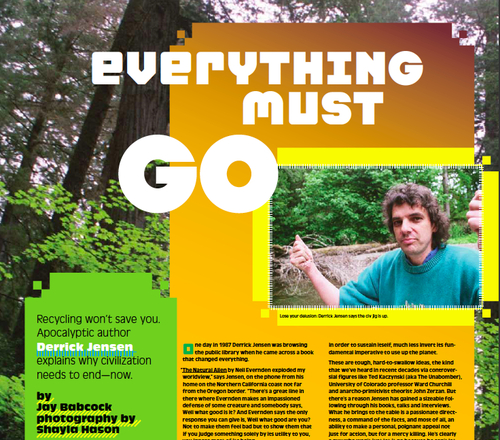
"Everything Must Go": Q & A with Derrick Jensen (2006)

From Arthur 23/July 2006.

One day in 1987 Derrick Jensen was browsing the public library when he came across a book that changed everything.

The Natural Alien by Neil Evernden exploded my worldview,” says Jensen, on the phone from his home on the Northern California coast not far from the Oregon border. “There’s a great line in there where Evernden makes an impassioned defense of some creature and somebody says, Well what good is it? And Evernden says the only response you can give is, Well what good are you? Not to make them feel bad but to show them that if you judge something solely by its utility to you, you ignore most of its being.

“It was the first book I ever read that talked about the basic stupidity of the utilitarian worldview.”

In his new book Endgame, Jensen argues that civilization—the utilitarian worldview put into practice—is not only stupid, it’s terminal. All forms of human civilization have historically worked to steadily exhaust the planet’s non-renewable resources, he says; therefore, no amount of technological ingenuity, no amount of political reform, no amount of Al Gore documentaries or carpool lanes or farmers’ markets or solar credits or biodiesel vehicles or Daryl Hannah in a tree will ever adequately replace what civilization has consumed in order to sustain itself, much less invert its fundamental imperative to use up the planet.

These are tough, hard-to-swallow ideas, the kind that we’ve heard in recent decades via controversial figures like Ted Kaczynski (aka The Unabomber), University of Colorado professor Ward Churchill and anarcho-primitivist theorist John Zerzan. But there’s a reason Jensen has gained a sizable following through his books, talks and interviews. What he brings to the table is a passionate directness, a command of the facts, and most of all, an ability to make a personal, poignant appeal not just for action, but for a mercy killing. He’s clearly a guy who won’t just let it go because he can’t let it go; he’s stayed up all night, doing some serious heavy lifting on all the inconvenient truths—the hopeless doomsday statistics, the possibility of imminent system crash—that the rest of us try to forget as we stumble to bed.

Of course he could’ve saved himself some of the trouble; at 900-plus pages, Endgame is far too long and rambling to be the definitive anarcho-primitivist text that its title and scope suggest. Still, it’s packed with provocative ideas that can explode your worldview, and so, in late April, I talked with Derrick about the ideas in Endgame that had provoked the most discussion around the Arthur office.

ARTHUR: Why does civilization need to be brought down now?

DERRICK JENSEN: A few years ago, I began to feel pretty apocalyptic but I didn’t want to use that word because it’s so loaded. And then a friend, George Draffan, said, ‘So Derrick, what’s it gonna take for you to finally use that word? Give me a specific threshold, Derrick, a specific point at which you’ll finally use that word. Will it take global warming? The ozone hole? The reduction of krill populations off Antarctica by 90 percent? How about the end of the great coral reefs? The extirpation of 200 species per day? 400? 600? Will it take the death of the salmon?’ And I thought about that. Salmon were once so thick around here that you couldn’t see the bottom of the river. You could hear the runs coming from miles before you’d see them. People were afraid to put their boats in the water for fear they’d capsize. And now, when I go out to Mill Creek, I start crying because I see two salmon spawning.

This civilization is killing the planet. They say that one sign of intelligence is the ability to recognize patterns. I’m gonna lay out a pattern here and let’s see if we can recognize it in less than 6,000 years. When you think of the hills and plains of Iraq, do you normally think of cedar forests so thick the sunlight never touches the ground? That’s how it was before. The first written myth of this culture is that of Gilgamesh deforesting that area to make cities. Plato complained that deforestation was drying up springs and destroying the water quality in Greece. The forests of North Africa went down to make the Phoenician and Egyptian navies. We can go north and ask, Where are the lions who were in Greece? Where are the indigenous of Europe? They’ve been massacred, or assimilated—in any case, genocide was perpetrated against them by definition because they’re no longer there.

If you start asking questions, the questions just keep moving back and back and back. This is a pattern that’s been going on for a long, long time. This culture has been unsustainable from the beginning. On a finite planet, you would think that we would think about that. You can’t exploit a planet and live on it too. At this stage, since there are no new frontiers to exploit, the planet’s falling apart.

So you genuinely believe the planet is nearing death?

Well, what measure do you want to use to determine the planet’s health? The climate is changing. 90% of the large fish in the oceans are gone. Phytoplankton populations are collapsing. Each summer a dead zone covers 8000 square miles in the Gulf of Mexico. Another blankets Chesapeake Bay. Another the Baltic Sea. Altogether, there are almost 150 dead zones, places where the water contains too little oxygen to sustain life. This number has doubled each decade since the 1960s. The cause? Industrial agriculture. Seabird populations are collapsing off the UK. American chestnuts are gone. The cod are effectively gone. Passenger pigeons used to fly in flocks so large they darkened the sky for days at a time. Same with Eskimo curlews. They’re gone. And do you know why there are no penguins in the northern hemisphere? Because they were eradicated. The great auk. Prior to the arrival of this culture they were present in unimaginable numbers. One of the early French explorers commented that you could fill every ship in France with them and it wouldn’t make a dent. The last one was killed in the nineteenth century.The grizzly bears that are on the California state flag, they’re essentially gone. I mean, somebody could certainly say, There’s still a tree standing, obviously things are okay. But that’s obviously an insane position. Nonetheless people keep taking it. That’s why I keep saying, Give me a threshold. At what point will you finally say that the oceans are getting hammered. If it’s not 90% of the large fish gone, is it 93%? 95?% 100%? How acidified does it have to get? What percent of the coral reefs have to die before we admit there’s a problem, and more importantly, do something about it? Give me a threshold.

We can choose whatever measure we want, and we find that stuff is falling apart. That shouldn’t surprise us. It’s just like any other relationship. If you have a girlfriend, do you believe you can sort of mercilessly exploit her and beat the hell out of her and cut her up and then expect for her to be able to maintain a relationship? Of course, given the rates of domestic violence, there are a lot of men who believe this too.

Why is it bad that certain species go extinct? Is it because all species have an inherent value and right to existence, or is it because they are useful to the ecosystem, and it’s their utility that we’re losing?

Well, it’s all of those. First, obviously salmon and sturgeon and smelt and migratory songbirds, they all… It’s simply WRONG to exterminate them. They are beautiful and wonderful beings on their own. The purpose of salmon is to be salmon. The purpose of forests is to be forests. That’s really critical. Second, forests suffer tremendously without the existence of salmon. Salmon provide a tremendous influx of nutrients into the forest. They put on about 95 percent of their weight in the ocean, and carry this weight into the forest and die. When the salmon come in, it’s time for a feast. In the Pacific Northwest, 66 different vertebrates eat salmon. Between industrial fishing, dams, industrial forestry, and the other ways the civilized torment and destroy salmon, and rivers in the Northwest starve: they only receive about six percent of the nutrients they did a century ago. Natural communities can only undergo so much stress. After that they collapse.

And yet civilization keeps chugging along, despite the deforestation and extinctions. People seem to believe that everything will work out via new technology or the system balancing itself out, even if they don’t know exactly how.

There’s something called carrying capacity, which is the number of any given species that a certain area can support permanently. Certainly populations can overshoot carrying capacity—you can have an island that can support a thousand deer forever but if you put 10,000 deer on it they’re gonna eat too much vegetation, they’re gonna cause erosion, they’re gonna permanently reduce carrying capacity. You can temporarily exceed carrying capacity, which is clearly what’s happening here.

There’s a machine image that Paul Ehrlich or somebody was using about how you have this airplane and you have rivets popping off the airplane. You keep saying I’m not worried about it. Well, eventually enough rivets are gonna come off that the wing’s gonna fall off and the plane is going to go down.

This way of thinking, that if we just ignore the problems, things are going to be okay, is really really easy, and it’s one of the things the Nazis used to great effect. At every step of the way, it was in the Jews’ rational self-interest not to resist. Because they kept pretending that things couldn’t get worse. So, would you rather get an ID card, or resist and possibly get killed? Do you want to get on a cattle car or do you want to resist and possibly get killed? Do you want to take a shower, or resist and possibly get killed? At every step of the way they could talk themselves into not resisting. Zygmund Baumann has this great line, this is a direct quote, that “rational people will quietly meekly go into gas chambers if only you allow them to believe they’re bathrooms.” It’s the same thing. Rational people will go quietly and meekly to the end of the world if you’ll only allow them to believe that the salmon don’t matter.

So your argument is that the sooner civilization falls, the better—not just for animals and plants, but for humans.

If someone had brought down civilization, whatever that means, 200 years ago, people who live in the eastern US could still eat passenger pigeons and Eskimo curlews. People in the West, in the Northwest, could still eat salmon. I live on Tolowa land. The Tolowa Indians lived where I live now for at least 12,500 years if you believe the myths of science. If you believe the myths of the Tolowa, they’ve lived here since the beginning of time. When this culture arrived here a couple hundred years ago, the area was, as was true of so much of this continent, just ridiculously fecund. The indigenous peoples could have lived here essentially forever, so far as we know—12,500 years is long enough for me to call it ‘sustainable.’ If civilization had come down 200 years ago, the people who live here would still be able to support themselves. But if it comes down in another 30 years, 50 years, 60 years, a hundred years, 10 years, whatever, the people who live here —who live in this place right here—won’t be able to eat salmon. At some point the current system is going to crash, and there are going to be people sitting along the banks of the Columbia, which will be glowing from the radiation at Hanford, and they will be saying, “I’m starving to death because you didn’t remove the dams that were killing salmon. God damn you.”

So, even from the purely selfish human perspective, yeah, it would be good for civilization to end. The sooner this civilization goes the better, because there’ll be more left.

Can you honestly tell Joe and Jane Sixpack that they’d be better off if this civilization were suddenly gone?

My audience is generally people who recognize that the system is really messing things up, and I want to push them harder, as some people have pushed me harder. That said, I guess it depends on how “Joe Sixpack” defines himself. I used to have this habit of asking people if they liked their jobs. About 90% say no. Most people work jobs they don’t love to buy stuff they don’t want to live lives that are pretty unhappy, etc etc. This culture is killing the planet, and it isn’t even making most of us happy. Also, I often ask people at my talks, How many of you have had someone you love die of cancer? Usually about 70-80% say yes. The air in Los Angeles is so toxic that children born there inhale more carcinogenic pollutants in the first two weeks of their lives than the EPA (which routinely understates risks so as not to impede economic production) considers safe for a lifetime. In San Francisco it takes about three weeks.

Of course cancer is a disease of civilization, made far worse by the toxification of our entire environment. I have Crohn’s disease, which is a disease of civilization. I know people who have MS, which is a disease of civilization. My mom has diabetes. That’s another part of my argument against civilization: it’s toxifying our own bodies. There’s dioxin in every mother’s breast milk. It’s not just salmon. It’s all of us.

Yes, but couldn’t you say the same civilization gives us medicine and modern, miracle-working health care? Don’t civilized peoples, on balance, come out ahead of pre-industrial hunter-gatherer societies?

I have a bunch of responses. The first is that modern medicine—available to the rich, not the global poor—is horribly ironic, in that industrial health care is one of the most toxic industries on earth. It produces PVC medical devices to treat someone’s cancer, then puts them in the hospital incinerator to send back out and give someone else cancer. Or uses mercury in thermometers in the hospital, then send that up the incinerator to be deposited in fish and to eventually give more children—human and nonhuman—brain damage. Where does this make sense? Modern industrial medicine cures the cancer of some rich American who became sick because of the toxification of the total environment, and these processes lead to even more toxification, causing yet more poor people—and nonhumans—to die. The real wonder of modern medicine is that the poor buy into this at all.

There’s also some sleight-of-hand there. Part of that is there’s a really high infant mortality among wild humans, as there is among a lot of wild creatures. If you make it to 4-5 years old in the wild, you make it a long way. Read Health and the Rise of Civilization by Mark Nathan Cohen, a forensic archaeologist.

Thirdly, people who think bringing down civilization would bring mass misery are ignoring that this is what’s already happening! It’s just that most of us don’t see it. There are people dying right now, starving to death in India, now, because of the global economy. Seventy-eight percent of the countries reporting child malnutrition export food. During the much-publicized famine in Ethiopia during the 1980s, that country exported green beans to Europe. During the infamous potato famine, Ireland exported grain to England (and part of the reason the potato blight took hold in the first place was that the Irish were pushed to the poorest land). The famines come a lot of the time because a) people have been dispossessed, b) the land they were on is now used for cash crops for export and c), the water’s been stolen for semiconductor plants or aluminum smelters or whatever. The current system is already enslaving them and exploiting them. Several years ago I asked Anuradha Mittal, former executive director of Food First, if the people of India be better off if the world economy disappeared tomorrow. She laughed and said, Of course. One of the examples she gave is there are former granaries in India that now export dog food and tulips to Europe. These are people who are dying right now.

Water is a great example of the world economy killing people. People say the world’s running out of water? The thing is, 90% of the planet’s drinkable water is used for agriculture and industry. People are dying of thirst in India right now because the groundwater is being used to make Coca-Cola. This whole lifestyle is based on exploitation.

So what I’m really talking about when I’m talking about bringing down civilization is depriving the rich of their ability to steal from the poor, and depriving the powerful of their ability to destroy the planet. I don’t think there’s many people who would not be behind that. Then everything else is just tactics, you know? The question becomes one of targeting.

In Endgame, you talk about specific actions that can be taken by individuals or small groups that could bring civilization down immediately. You discuss E-bombs: devices that destroy electronics, cause no harm to humans and, according to the September 2001 issue of Popular Mechanics, can be built for $400. Are you really advocating the use of these weapons?

Before we go there, I have to say that my emphasis is not on technologies or on particular tactics or actions. My point is that we need to recognize that this way of life is killing life on the planet, and we need to stop it. After that it’s kind of like the old line by JFK about those who make nonviolent revolution impossible make violent revolution inevitable. Let’s stop this by the most peaceful means possible. But in the end let’s stop this, because there is nothing worse than planetary murder. Nothing.

We also need to recognize that those in power are not going to give up their stranglehold because we ask nicely. They won’t stop exploiting the poor and deforesting because we circulate an online petition. We need to recognize that. And we need to recognize that Harriet Tubman carried a gun. Now that she’s long dead she can be a hero, but if she were alive now she’s be wanted for theft (“stealing” slaves) and terrorism. Geronimo had a gun. Tecumseh had a gun.

I’m not saying that people should willy-nilly pick up guns or that everyone should go drop E-bombs everywhere. I’m saying we need to have our seriousness called into question. What do we want? Do we want smaller clearcuts, kinder clearcuts, fewer clearcuts? Do we want the Giants to win the World Series and oh, by the way, it would be nice if we still have a world? Do we want to keep our cars and computers and lawns and grocery stores even at the expense of life on the planet? More to the point, do we want to allow others to keep their cars and computers and lawns and grocery stores even at the expense of life on the planet, which of course includes at the expense of poor humans? Even more to the point, do we want to allow those in power to perpetuate this system at the expense of the poor and life on the planet.

Bringing down civilization is not a monolithic act. It’s a billion different acts done by a billion different people. First, it’s recognizing that this culture is killing the planet. Next it’s realizing we can do something to stop it. Next it’s finding what you love. And next, it’s determining to act to defend your beloved. Everything after that is tactics.

And every different action has a different morality. It would be outrageously immoral to set off an E-bomb at a hospital. But on the other hand I think it’s almost impossible to make a moral case against taking out cell phone towers, which kill between five and 50 million migratory songbirds every year. If one cares about migratory songbirds—or if you care about not having the jerk at the next table yammer on about his latest financial conquest while you’re trying to eat, or if you care about the EMF waves which might or might not be dangerous—then it’s impossible to make a moral case against taking out those towers.

If E-bombs are so easy to make, why hasn’t one been detonated since Popular Mechanics put them on their cover?

I have no idea. That’s a good question. Except of course they have been detonated: by the US military, which tests and produces them.

I wonder that about a lot of things. Years ago—and before I say this I have to make absolutely clear that in no way am I even in the slightest advocating this—I was talking to a genetic engineer who said it’s really a piece of cake to make genetically modified diseases—all you really needed was three graduate students and a $100,000 laboratory, which is no big deal. He was stunned that it hadn’t happened yet. Once again, both of us are opposed to this, and were surprised no one has done it yet.

Another important thing to say about taking down civilization is that even before we get to the E-bomb stage there is a lot of other work to be done. And a lot of this work is not tremendously dramatic. A guy at one of my talks said, “I wanna go to China and take out a dam but I can’t do that ’cause it’ll kill villagers below.” Of course that comment ignores the villages destroyed by the erection of the dams. I responded, “Look before we even talk about this, of the two million dams in the United States, probably three-quarters of a million of them are tiny, illegal, not serving any economic function, and the only reason they’re standing is because of inertia. Nobody’s bothered to take them out. If you want to take out a dam, go take out one of these. Not even the cops will care.” The point is that we can get all excited about doing underground illegal stuff, but there’s a tremendous amount of entirely legal work we’re not doing.

The whole reform vs revolution question is bullshit. I used to teach creative writing at Pelican Bay, which is a Supermax security prison. I fully recognized that every time I walked in to that prison that I was participating in the biggest, most racist gulag on the planet. You can’t get much more reformist than teaching creative writing there. But at the same time many of my students said that the only thing that was keeping them sane was our classes. So in that moment any sort of belief I had in reform vs revolution question just fell apart, because once again: we need it all. That’s one of the great things about everything being so fucked up, that no matter where you look there’s great work to be done. If your call, if where your heart leads you is to work for battered woman’s shelters, wonderful. Wonderful, wonderful. If it calls you to write for Arthur and to push a perspective that is anti-authoritarian or whatever: wonderful, wonderful, wonderful. If it pushes you to do a timber sales appeal: wonderful also. We need it all.

But your book is about bringing down civilization—it’s not about filing timber sales appeals.

True, but I don’t exclude that by any means. I talk about the military strategy of hammer and anvil, a strategy used by Lee at the battle of Chancellorsville, where you keep a large part of your army back as an anvil, as a defensive force, and you send the rest of your army around to act as a hammer, an offensive force. Defensive work is incredibly important because if we all wait for the great glorious revolution, there’s not going to be anything worth saving left anyway. But at the same time if all we do is this defensive work, this culture is gonna just keep grinding away at everything, and there’ll be nothing left then either.

It’s like any revolution. The Black Panthers said this, the Zapatistas said this: 95% of any revolution is non-violent. A lot of it is education. A lot of it is this other stuff. And yes, of course the situation is desperately urgent, and yeah, dramatic stuff needs to be done. But I don’t even see, for the most part, people doing the less dramatic stuff. That’s what I find the most horrifying.

Having said this, that’s not an attack on most people because I understand… I’ve got friends who have two kids and are working jobs that they and their partner are making seven bucks an hour and they’re trying to raise two kids: “What, you actually want me to do something for the fairy shrimp in addition? Are you out of your mind?” I’m not judging my friends or other people for that but I also know that a tremendous amount of time is wasted watching television. I’m not saying anything against downtime either. I like to play online poker or whatever. I’m not saying that we need to spend every waking moment pushing and pushing. But we need to start doing the work. And we need to start doing it soon.

I kind of make fun of ‘fair trade’ but I gotta tell you, I think ‘fair trade’ is way better than ‘slave trade.’ But the problem I have is that’s not sufficient. Timber sales appeals aren’t sufficient. Working at battered women’s shelters isn’t sufficient. That’s really the whole point: what we’re doing isn’t sufficient.

You’re just talking about re-prioritizing.

Thank you! End of interview, you know? Every cell in my body wants for us to have a voluntary transformation to a sustainable way of living, where we would voluntarily have a softer landing, where we would recognize that we’ve overshot carrying capacity, that our way of living, which is based on the use of nonrenewable resources, won’t last. But I don’t think that’s going to happen.

If your concern is for the well-being of the humans who will be alive during and immediately after the crash, then what you need to do is start preparing people for the crash. Because it’s gonna come anyway. And if you don’t believe it’s gonna come, then we really honestly have nothing to say to each other. We can talk about what do you think about JD Drew for the Dodgers this year. What the hell’s wrong with the Angels? But if you do believe that a) there’s going to be a crash and b) it’s going to be messy and c) the current economic system is dismantling the ecological infrastructure of the planet, which means the longer it takes, the worse things are going to be, what that means is what you need to do is to start finding out what local plants can be used for antibiotics. What are local water purification systems you’ll be able to use. How are you going to build shelters. How will you pull up parking lots to make gardens. Learning self-defense and forming committees to deal with the additional violence that might (or might not) break out. Getting to know your neighbors, both human and nonhuman. How’s that for a start?

In the end, I think the primary measure by which we will be judged by those who come after will be the health of the landbase. Everything else builds from there. The people who come after aren’t going to give a shit as to whether we voted Democrat, Republican, Green, anarchist, or none of the above. They’re not going to give a shit about whether we were pacifists or not pacifists. They’re not going to give a shit about whether we signed or didn’t sign online petitions. They’re not going to give a shit about how hard we tried. It’s no good to live in a groovy eco-socialist utopia with free love if the planet is toxified. Those who come after are going to care about whether they can breathe the air, whether they can drink the water, whether the land can support them. Everything else comes from that. This seems so obvious I’m embarrassed to have to say it, but this culture is so insane it needs to be said. And it needs to be lived.

(From Arthur 23/July 2006..)

YOUR CIVILIZATION SUCKS.


In what has become a common summer camp drill, nurses dispense medication at Camp Echo in New York.

July 16, 2006 New York Times

Checklist for Camp: Bug Spray. Sunscreen. Pills.

By JANE GROSS
BURLINGHAM, N.Y., July 15 — The breakfast buffet at Camp Echo starts at a picnic table covered in gingham-patterned oil cloth. Here, children jostle for their morning medications: Zoloft for depression, Abilify for bipolar disorder, Guanfacine for twitchy eyes and a host of medications for attention deficit disorder.

A quick gulp of water, a greeting from the nurse, and the youngsters move on to the next table for orange juice, Special K and chocolate chip pancakes. The dispensing of pills and pancakes is over in minutes, all part of a typical day at a typical sleep-away camp in the Catskills.

The medication lines like the one at Camp Echo were unheard of a generation ago but have become fixtures at residential camps across the country. Between a quarter and half of the youngsters at any given summer camp take daily prescription medications, experts say. Allergy and asthma drugs top the list, but behavior management and psychiatric medications are now so common that nurses who dispense them no longer try to avoid stigma by pretending they are vitamins.

“All my best friends take something,” said David Ehrenreich, 12, who has Tourette’s syndrome yet feels at home here because boys with hyperactivity, mood disorders, learning disabilities and facial tics line up just as he does for their daily “meds.”

With campers far from home, family and pediatricians, the job of safely and efficiently dispensing medications falls to infirmaries and nurses whose stock in trade used to be calamine lotion and cough syrup. Three times a day, at mealtimes, is the norm, with some campers also requiring a sleep aid at bedtime to counteract the effect of their daytime medications.

“This is the American standard now,” said Rodger Popkin, an owner of Blue Stars Camps in Hendersonville, N.C. “It’s not limited by education level, race, socioeconomics, geography, gender or any of those filters.”

Peg L. Smith, the chief executive officer of the American Camp Association, a trade group with 2,600 member camps and three million campers, says about a quarter of the children at its camps are medicated for attention deficit disorder, psychiatric problems or mood disorders.

Many parents welcome the anonymity that comes when a lot of children take this, that or the other drug, so none stand out from the crowd.

“It’s nobody’s business who’s taking what,” said one parent of an Echo camper whose child is medicated for A.D.D. and who asked not to be named for privacy reasons. “It could be an allergy pill. The way they do it now, he feels comfortable. He just goes up with everybody else, gets it and then carries on with his day.”

Increasingly popular is a service offered by a private company called CampMeds, which provides a summer’s worth of prepackaged pills to 6,000 children at 100 camps. The company’s founder, Dana Godel, said 40 percent of the children regularly took one or more prescription medications, compared with 30 percent four years ago. Eight percent used attention deficit medications last year; 5 percent took psychiatric drugs.

Borrowing technology developed for nursing homes, CampMeds distributes pills in shrink-wrapped packets marked with a name, date and time. Camp nurses simply tear each packet along the dotted line, sparing them the labor-intensive task of counting pills and reducing the risk of error and thus liability.

The proliferation of children on stimulants for attention deficit disorder, antidepressants or antipsychotic drugs — or on cocktails of all three — is not peculiar to the camp setting. Rather it is the extension of an increasingly common year-round regimen that has also had an impact on schools, although a lesser one, since most medications are taken at home.

Exacting diagnoses and proper treatments enable some children to go to camp who otherwise could not function in that environment, said Dr. David Fassler, a child and adolescent psychiatrist and a professor at the University of Vermont College of Medicine.

Dr. Fassler said that children with one behavioral or mood disorder often “have a second or even a third diagnosis.” A child with A.D.D. may also be depressed and anxious, he said, a combination of symptoms that can make such children pariahs in the close quarters of a summer camp cabin without the proper combination of remedies.

Some camp owners question the trend, however. Mr. Popkin, the camp owner in North Carolina, is among them. “It’s universal, and nobody really knows if it’s appropriate or safe,” he said.

And many experts say family doctors who do not have expertise in psychopharmacology sometimes prescribe drugs for anxiety disorders and depression to children without rigorous evaluation, just as they do for adults.

“There is no doubt that kids are more medicated than they used to be,” said Dr. Edward A. Walton, an assistant professor of pediatrics at the University of Michigan and an expert on camp medicine for the American Academy of Pediatrics. “And we know that the people prescribing these drugs are not that precise about diagnosis. So the percentage of kids on these meds is probably higher than it needs to be.”

A few medicines growing in popularity, like Abilify and Risperdal, are used for a grab bag of mood disorders. But according to the Physicians’ Desk Reference, the encyclopedia of prescription medications, they can have troublesome side effects in children and teenagers, including elevated blood sugar or the tendency toward heat exhaustion, which requires vigilance by counselors in long, hot days on the ball fields.

Some doctors, nurses and camp directors are uneasy about giving children so-called off-label drugs like Lexapro and Luvox. Such medications are used for depression and anxiety, and have been tested only on adults but can legally be prescribed to children. Clonidine is approved as a medication for high blood pressure but is routinely used for behavioral and emotional problems in children.

“That doesn’t mean they are inappropriate or unsafe,” Dr. Fassler said, adding that camp nurses should be able to call the physician when they have questions, but that not all parents welcome that.

Few camp directors risk discussions with parents about behavioral or psychiatric drugs. “We don’t make these judgments for families,” said Marla Coleman, an owner of Camp Echo and a past president of the American Camp Association.

Figuring out how to distribute all this medicine has taken some trial and error, beginning with supervision by the nurses, who watch the children take their pills.

Some camps do it in the mess hall, citing informality to put campers at ease and the convenience of having everyone assembled in one place.

Other camps prefer the infirmary, to provide more privacy. Camp Pontiac in Copake, N.Y., built a special medication wing with its own entrance and a porch where campers wait their turn.

In Fishkill, N.Y., at a Fresh Air Fund camp for underprivileged children, one nurse in the infirmary deals with bug bites and skinned knees and the other dispenses Strattera and Zoloft, the first for attention deficit disorder and the second for depression, social anxiety or obsessive compulsive disorder. Children at the camp take a comparable amount of medication for behavioral and psychological problems as their more privileged counterparts, but more of them suffer from asthma and fewer from seasonal allergies.

The potential for drug interactions is compounded by the widespread use of allergy and asthma medications. Tofranil, an antidepressant for adults that is used for bed-wetting in children, is not recommended in combination with Allegra, for seasonal allergies, Advair, an asthma drug, or epinephrine, the injectable antidote to deadly allergic reactions to bee stings, insect bites and certain foods, primarily peanuts.

Despite a tenfold increase in childhood allergies over the last decade, some camp doctors think daily medication is overused. The owners of Camp Pontiac, Ken and Rick Etra, brothers who are ear, nose and throat doctors, urge parents to forgo prescription remedies for seasonal allergies when occasional over-the-counter antihistamines are sufficient. Their summer camp does not overlap with the height of the pollen and grass season, the Etras say.

They also discourage bed-wetting medications, which can leave a youngster groggy. “They don’t pee, but they’re zombies,” said Mimi Burcham, Pontiac’s head nurse. Instead, camp directors train counselors to wake certain children at midnight for a trip to the bathroom and replace soiled linens with identical sheets to avoid embarrassment.

CampMeds charges $40 per child for any length of stay or for any regimen, a cost that most camps pass along to families. The Fresh Air Fund camps do not use CampMeds, but not because of cost, said Jenny Morgenthau, the fund’s executive director. Rather, Ms. Morgenthau said, many of the families are too disorganized — some in shelters or in prison — to do the preparatory paperwork.

So Fresh Air’s campers arrive with an array of unmarked bags and bottles that cannot be used under state regulations, and without some of their essential medications. Susan Powers and Leticia Diaz, who run the infirmary at the girls’ camp, are accustomed to children bringing their brother’s expired asthma inhaler or their grandmother’s sleeping pills in a perfume bottle. Sometimes the medications are missing because they have been sold on the street or used by adults, Ms. Powers and Ms. Diaz said. It takes a few days to unscramble.

The nurses at high-end camps have the opposite problem, with parents who try to involve themselves in all aspects of their children’s lives. Some, for instance, may view the daily photographs posted on the camp Web site, see their child is sunburned and call the camp director to ask for more diligent application of sunscreen. That mind-set may produce ceaseless efforts to help the child, but it has the potential to lead to overmedication, many camp owners and doctors say.

Ms. Burcham, a special-education nurse during the school year, said she often worried about her unfamiliarity with some of the drugs. She often turns to the Physicians’ Desk Reference for guidance, or sometimes calls her father, a psychiatrist.

Unpacking the shipment of medicine at Pontiac in mid-June, she tried to make sense of a packet from CampMeds for an 11-year-old who, for the first time, would be taking Concerta, for attention deficit disorder, along with Clonidine and Wellbutrin, both mood disorder drugs.

“I’m not a specialist, and that’s very disturbing sometimes,” Ms. Burcham said. “How do I know if we’re really getting it right?”

Then she carefully placed the medications in a plastic bin marked with the camper’s name.

Devendra talks about his festival…

L.A. Alternative Press

Freak Fest
Five fitful days in the head, heart and record collection of avant-folkist Devendra Banhart.
by Lesley Bargar

The term “festival” is an incredibly loose one. In Los Angeles, it can signify everything from a breakfast special at IHOP, to a jump castle free-for-all, to a soy-celebrating street fair, to 100-ish musicians declaring Fuck Yeah!!! on the streets of Echo Park. Most recently, the word “festival” has been pinned onto what L.A.-based eccentric freak-folk overlord/event curator Devendra Banhart has termed Hypnorituals and Mesmemusical Miracles Hanging in the Sky. “It was all about putting words together that all link together and can flow like honey,” he explains.

…Well, despite that—for the sake of clarity, let’s say—we’re calling the five day event taking place this week arguably one of the most unique, diverse and noteworthy convergences of unconventional musicians and artists to take place in Los Angeles in the last five years. Honey indeed.

The event, curated by Banhart, features musical acts ranging from ’60s psychedelic legends to Vermont multi-instrumental collectives to local nouveaux hip-hop pioneers to first-time performers. “The curating thing is something that’s always interested me,” says Banhart. “Me playing a show is exciting and I love it, but it’s not as thrilling as choosing a show and hearing the music that you love live.”

The inspiration for the festival, as he tells it, was watching his friend Jonathan Wilson—who had previously only played in bands—get up at Tangiers and play his solo debut. “It was the first time I was seeing him play alone on this stage with these beautiful songs. I started thinking that I’d love to do a sort of mellow fest, a mini fest. That’s the idea of putting together this festival: It’s a lot of these people’s first shows ever—and that doesn’t mean that they haven’t been playing for years and years.”

To clarify, we asked Banhart to point out some of the Hypnoritual Mesmemusical highlights, and explain how and why these particular artists nestled their way into the heart of Devendra and onto the tiny, appropriately flamenco-frequented stage of the El Cid.

Entrance: For Entrance, the new record that just came out is like a new start. It feels like something so new. The only band I can compare Entrance to at this moment is Brightblack [Morning Light]. The way that Brightblack sounds is like how Entrance sounds, except Brightblack is on downers and Entrance is on uppers. (Tuesday, July 18)

Ruthann Friedman: She had a hit song [“Windy” by the Association]. She used to live with David Crosby. She can tell these stories! She has this recording of her jamming with Bukowski on the drums. I heard it at her house; it’s amazing. Ruthann lives about 10 blocks from me, so I went over and I said, “Do you want to play a show?” and she said, “Sure!” But she has some really big issues with the joints in her hands. She’s had to have some therapy and re-learn the guitar. So in some ways it is like a first show after that. (Wednesday, July 19)

Adam Tullie and Friends: This is Adam’s first show ever. I’ve known him for a long time. He runs a clothing company called Cavern. His music is just his recordings at home, and I’m the only person who has heard them. And I like it. So I’m like, “Adam, please, play a couple tunes!” I had to convince him. (Wednesday, July 19)

Nobody and the Mystic Chords of Memory: When I first moved to California when I was 13, my favorite band was Strictly Ballroom. I hadn’t heard music like that. Then I was hip to the Beachwood Sparks stuff, and All Night Radio, and all these little branches. It’s amazing. So Mystic Chords of Memory with Nobody is so good, and for me, being a super fan of their first band, to have them play was amazing. But in no way is it selfish, though. I mean, every song is pure pop pleasure. (Playing Thursday, July 20)

Subtitle: I found out about Subtitle from a bootleg tape, and I totally fell in love with it years and years ago. And I know Gino from Aron’s Records, and he instantly treated me fucking amazingly—with love, with respect. I fell in love with him. He’s just such an incredible human being. Being around him is so inspiring, it really is, you know? Gino is an amazing, amazing, amazing performer and lyricist and songwriter. He’s an amazing songwriter. Stuff like bubbles out, flows out. (Thursday, July 20)

Hecuba: No one has heard Hecuba, and they make the weirdest music I’ve heard in a long time. But it’s not weird in that it’s un-listenable or conceptual or cerebral. It’s weird in the way that it’s like jazz meets Beyonce meets Iggy Pop. It’s all these pop things thrown in the weirdest way together, and just barely joined together. Actually, another way to describe it is very Iggy Pop and Annie, the musical. I was like, “Please, would you play?” And they were like, “We’ve never played before, so this is the first show for us.” It worked perfectly for the festival. (Friday, July 21)

Michael Hurley: His history is legendary. The first album he ever made was made on the same machine that Leadbelly made his last album. From then on he’s been making records and records and records, but he’s always stayed way under the radar. Those who know him have all his records, and those that don’t, don’t. He’s someone to me that needs to play more and more and more and that people need to get hip to. He’s a legend, and a very special example of American uniqueness. An example of paving your own way, your own road, your own world. Incredible. And he’s so funny too, I love that. (Saturday, July 22)

Sir Richard Bishop: Sir Richard Bishop is legendary for Sun City Girls. On his own he’s done a lot of touring and done a lot of stuff, and made a couple records on Vanguard and all that, but he is someone who watching him live is a fucking mind-blowing experience. So good. So good! People need to see more of him, I want to see more of him. (Saturday, July 22)

Stuart and Caan: This is their first show in America ever. These cats are from the UK, but lived in India for a long time, and now they live in a bus in Spain, studying flamenco. And this is their first show ever in America. (Saturday, July 22)

Hypnorituals and Mesmemusical Miracles Hanging in the Sky takes place July 18-21 at El Cid. 4212 Sunset Blvd., Silver Lake. $10 per night. http://www.foldsilverlake.com

MARI KONO OPENING AT PETALS.

The Artwork of Mari Kono featured at Petals!

The walls of Petals Nail Salon are now adorned by the artistry of Mari Kono!

Join us on Sunday, July 16th between the hours of 2-5 pm for a viewing of her original artwork.
Don’t miss this opportunity to meet Mari and learn about what inspires her beautiful images.
All artwork will also be available for purchase. Please RSVP at (213) 620-9960.

We will be serving light refreshments catered by Grill Lyon.

About Mari Kono:
Mari Kono is a collage artist born and raised in Los Angeles, California. She has exhibited her work at museums and galleries across the U.S., including the Honolulu Academy of Arts, the San Jose Museum of Contemporary Art, Spirit Square in Charlotte, North Carolina and Intersection for the Arts in San Francisco, California.

About the Art:
“Inspired by psychedelic art of the1960s, Japanese design and fantasy illustrations from Faerie-tale books, my collages are intended to release more love, understanding and compassion into the world. My palette includes self generated digital images, in combination with materials gathered from books and magazines, found scraps, wrapping paper, glitter, paint, rubber stamps and dimensional objects. As I work, I pray that my collages might instill a sense of mystical pleasure in all who encounter them.” –Mari Kono

For more information about Mari and her artwork, please visit her website at http://www.marikono.com

Petals Nail Salon
Honda Plaza in Little Tokyo
408 E. 2nd Street
Los Angeles, CA 90012

(213) 620-9960
http://www.petalsnailsalon.com

Appointments highly recomended

New Hours of Service (starting July 10th):

Tuesday thru Friday: 11am to 7pm
Saturday: 10am to 5pm
Sundays: By Appointment Only (must be made by the previous Thursday)

*************
Digital and Paper Collage Art!
http://www.marikono.com

WHO THEY'RE BOMBING…

ARTHUR GOES TO LEBANON, SYRIA AND EGYPT.

“Dr. Moustache and The Egyptian Gentleman (Pts. I & II)”: American journalist/photographer Daniel Chamberlin spent three weeks traveling through the Middle East this summer. Part I of II chronicles adventures in Egypt and Lebanon, from Cairo’s Cities of the Dead to the Hezbollah gift shoppes at the Israeli border. From the November 2005 issue of Arthur.

“The Further Adventures of Dr. Moustache and the Egyptian Gentleman (Pt. III)”: An American traveler spends three weeks in Egypt, Lebanon and Syria. Reporting and photography by Daniel Chamberlin. From the January 2006 issue of Arthur.