

OUR MAN IN GERMANY…

ARTHUR/BASTET TO RELEASE JOSEPHINE FOSTER-CURATED ALBUM ON AUG. 1, 2006 TO BENEFIT ANTI-MILITARY RECRUITING CAMPAIGNS

“So Much Fire to Roast Human Flesh”
a benefit album curated by Josephine Foster
“All profits from sales of this compilation will be distributed to specific counter-military recruitment and pacifist organizations and programs. We hope to assist them in their efforts promoting peace and non-militarism in the United States.
“All of the musicians represented here are US citizens. Our voices join with many others across this land that freely question and openly oppose war.” –Josephine Foster
Track listing:
THE CHERRY BLOSSOMS – “Dragonfly” (live)
FEATHERS – “Dust”
MICHAEL HURLEY – “A Little Bit of Love for You”
MEG BAIRD – “Western Red Lily (Nunavut Diamond Dream)”
ANDREW BAR – “Don’t Trust That Man”
GOATGIRL – “President Combed His Hair”
DEVENDRA BANHART – “I Know Some Souls” (demo)
KATH BLOOM – “Baby Let It Come Down On Me”
CHARLIE NOTHING – “Fuck You and Your Stupid Wars”
DIANE CLUCK – “A Phoenix and Doves”
JOHN ALLINGHAM & ANN TILEY – “Big War”
JOSEPHINE FOSTER – “Would You Pave the Road?”
ANGELS OF LIGHT – “Destroyer”
RACHEL MASON – “The War Clerk’s Lament”
PAJO – “War Is Dead”
MVEE – “Powderfinger”
KATHLEEN BAIRD – “Prayer for Silence”
LAY ALL OVER IT – “A Place”
Cover artwork by Fred Tomaselli
Available August 1. $12US/14Can/17World postpaid.
If you would like to pre-order a copy:
1. PAYPAL
USA – $12 postpaid
Canada – $14 postpaid
World – $17 airmail
2. CHECK OR MONEY ORDER
Payable to LIME PUBLISHING
Order will not ship until check clears.
Send your order to:
Lime Publishing
13104 Colton Lane
Gaithersburg, MD 20878
Mt. Misery and Ballintober: Where Rumsfeld & Cheney spend their weekends….
Weekends With the President’s Men
By PETER T. KILBORN
ST. MICHAELS, Md.
JUST an hour and a half from Washington, across the 4.3-mile Chesapeake Bay Bridge, or less than 30 minutes in a government-issue Chinook helicopter, is the Eastern Shore of Maryland and the primly groomed waterside village of St. Michaels.
St. Michaels has begun to lure V.I.P.’s who, some boosters would have it, could propel it into the gilded realm of the Hamptons and Nantucket. But that will take a while. There’s little for the young — just a few bars and no beaches or nightclubs — and these new householders are too circumspect and perhaps too old to be showcasing their excesses, baubles and abs.
One is Vice President Dick Cheney, 65, who paid $2.67 million last September for a house that resembles a wide, squat Mount Vernon. Another is his old friend Defense Secretary Donald H. Rumsfeld, 73, who in 2003 paid $1.5 million for a brick Georgian that was last a bed-and-breakfast. Among other recognizable owners in the area are Tony Snow, President Bush’s new press secretary; Joe Trippi, Howard Dean’s presidential campaign manager in 2004; Nicholas Brady, President George H. W. Bush’s treasury secretary; and John S. D. Eisenhower, a writer and historian and the son of President Dwight D. Eisenhower.
St. Michaels, population 1,200 within the city limits and perhaps a thousand more in the same ZIP code, sits on the wrist of a peninsula that bends deep into Chesapeake Bay. With two broad clawlike fingers, spotted and wrinkled by coves and creeks that reach beyond the town and down to Tilghman Island and Nelson Point, it is a place of waterfront sunsets and white sails, of oysters and crabs, of birding, fishing and hunting, and of affluent retirees, tourists and weekenders. Most, like the Cheneys and Rumsfelds, are past 50.
With many less luminous who have made their marks in business, medicine, law, government and the military, St. Michaels is too proud and indifferent for celebrity gawking. “They’re just people living in town,” said the Hawaiian shirted bartender at the Carpenter Street Saloon, who thought giving his name would be indiscreet. “They’re not the first important people living in town, and they’re not the last. They’re just here.”
The town is beginning to contend, however, with 21st-century perils to its composure. After eight years of resistance, construction will soon start on a development that will bring around 250 new homes and swell the year-round population by about 50 percent. In summer, traffic is choking and decivilizing Talbot Street, the only road through town. Housing developments are crowding Tilghman Island, once almost exclusively home to fishermen — or watermen, as they’re called.
One morning in May, Francis Zeglen put on a khaki windbreaker and his wife, Georgia, a turquoise sweater for a shopping stroll along Talbot. They were in a crosswalk when a light-brown pickup knocked them down.
Urged not to move, they were lying there blinking, Mr. Zeglen, 76, on his back, Mrs. Zeglen, 78, on her side. The Rev. Mark Nestlehutt, a tall young sailor and the rector of Christ Episcopal Church, hurried over, not solely on a spiritual mission. He is also chairman of the town’s Advisory Committee for Traffic Planning and Pedestrian Friendly Streets — which, in a place with a speed limit of 25 miles an hour and few hot-blooded young drivers, they usually are.
The Zeglens were treated at a hospital in nearby Easton, he for a broken left arm, she for immobilizing bruises, and drove home to Philadelphia the next day. “I turned and looked,” Mr. Zeglen said when he gave his own account of the accident, “and he just kept coming.” The driver of the pickup was charged with failure to stop for a pedestrian in a crosswalk. It had been a more eventful morning than most, the first pedestrian accident in 23 years — at least the first that the town manager, Cheril S. Thomas, could recall.
In St. Michaels, you also don’t see much of the one-upping of Joneses or architectural bullying found in showier coastal resorts. The old farm families and the wealthy weekenders like the Rumsfelds and Cheneys look out over acres of lawn rolling down to the sea grass and their own private docks. But the homes are hidden down two-lane roads with cunning yellow signs on utility poles that say, menacingly and untruthfully, “No Outlet,” and then down driveways shrouded by trees and lined with thick and impenetrable hedgerows.
The houses have names. Mr. Rumsfeld’s is Mount Misery and is just across Rolles Creek from a house called Mount Pleasant. On four acres, with four bathrooms, five bedrooms and five fireplaces, built in 1804, the Rumsfeld house is just barely visible at the end of a gravel drive.
Thomas M. Crouch, a broker at the Coldwell Banker office in town, says one legend attributes the name to the original owner, said to have been a sad and doleful Englishman. His merrier brother then built a house, and to put him on, Mr. Crouch supposes, named it Mount Pleasant.
But there is some historical gravity to the name, too. By 1833, Mount Misery’s owner was Edward Covey, a farmer notorious for breaking unruly slaves for other farmers. One who wouldn’t be broken was Frederick Douglass, then 16 and later the abolitionist orator. Covey assaulted him, so Douglass beat him up and escaped. Today, where the drive begins, Mount Misery seems a congenial place, with a white mailbox with newspaper delivery sleeves attached, a big American flag fluttering from a post by a split-rail fence and a tall, one-hole birdhouse of the sort made for bluebirds — although the lens in the hole suggests another function.
Less than two miles from the Rumsfelds’, past Southwind, where the late James A. Michener wrote much of his epic novel “Chesapeake,” Church Neck Road dead-ends at private Fuller Road on the left. About a quarter-mile up, past grazing cattle and sheep and four other homes, is Vice President Cheney’s nine-acre place, Ballintober.
The house, built in 1930, is rambling and white. It has a five-car garage, a pool, stately formal gardens, a laundry chute and large, glass-walled waterside rooms for entertaining. Coldwell Banker’s real estate listing called it an “individually designed dwelling.” It is also unapproachable. “The last time I went up Fuller Road,” Katie Edmonds, an agent at Meredith Real Estate, said, “S.U.V.’s came out of the woods at me.”
Neighbors also complain about federal security agents’ shutting down Church Neck Road to let the Cheneys pass in their speeding brigades of shiny black S.U.V.’s. But they don’t complain much, because the newcomers are thought to be good for property values. If the Cheneys and Rumsfelds are willing to buy here, after all, who wouldn’t be?
St. Michaels was traditionally a center of farming, boat building, crabbing and tonging for oysters. For 100 years, it has also attracted older, upper-crust retirees from Washington, Baltimore and Philadelphia who buy waterfront sites and, more recently, century-old houses downtown.
The second-home owners cannot vote in local elections, but their needs, whimsies and appetites set the tone of the town. Approaching St. Michaels, Route 33 — the only way in or out — passes a lumberyard’s lawn full of rocking chairs. In the town itself, where 33 becomes Talbot Street, a flag hanging from one store declares, “Quilters welcome.” There are at least 20 bed-and-breakfasts downtown or nearby, no neon signs, no stoplights and, except for the plants and waist-high pink ceramic flamingos that the Acme supermarket features in front, no obstructions blocking sidewalks.
Except for the Acme, shops on Talbot cater to people with money to burn: the Calico Gallery, St. Michaels Candy Company, the Cultured Pearl, the Scented Garden, Rings & Things, Gourmet-by-the-Bay (an upscale food shop and caterer that has made Thanksgiving pies for the Rumsfelds), Justine’s ice cream parlor, Flying Fred’s Gifts for Pets. Bistro St. Michaels and 208 Talbot are expensive restaurants.
Only Big Al’s — an emphatically lowbrow seafood and souvenir shop where Joyce Rumsfeld, the secretary’s wife, comes in for bushels of cooked blue crabs — breaks with the Laura Ashley look of St. Michaels. Two small picnic tables sit out front, and the proprietor, Al Poore, offers sandwiches of crab cake for $5.95, soft crab for $6.95, oysters for $5.95 and fish for $4.95. Mr. Poore, who is 71 and about 6 foot 4 with a thicket of tousled gray hair, sinks like a ball in a catcher’s mitt into the cavernous black leather easy chair in his memento-strewn office at the rear of the store. He opened it in 1968. “When I came here,” he said, “there was one place where you could stay overnight. Now we’ve got one on every corner.”
Merchants say they’re wary of intruding on the privacy of the Cheneys and Rumsfelds, but they do it anyway. “I’m a businessman,” said Mr. Poore, a registered Democrat who voted twice for George W. Bush. “I probably mention them to customers five or six times a week. They bring a lot of prestige.”
Paul Gardner, the front office manager at the $250-to-$700-a-night Inn at Perry Cabin, a plush waterside resort at the far end of town, said, “We’ve had Rumsfeld in for dinner.” Once last year, the Cheney Chinook landed near the inn’s laundry and maintenance facility. “We’re very pleased to have them in the area,” he said.
Some people view the new neighbors less cordially. On Railroad Avenue, which the Cheneys and Rumsfelds use to reach Church Neck, Cassandra Harrison, a mother of two who waits tables and cleans houses, was resting on the stoop of her one-story white ranch house.
She is grateful that the air space above the Cheneys’ house is blocked. “It’s a no-fly zone, and that’s good,” she said. “But I’m not happy. I don’t think society’s liking them so much.” Ms. Harrison, 23, voted for the first time in 2004, she said, “just because I did not want him. I don’t think that they tell us the truth.”
But that is a minority view in Talbot County, which went 61 percent for Mr. Bush in 2000 and 58 percent in 2004. Support for the war in Iraq is waning here as it is most everywhere else. But the great majority of Mr. Nestlehutt’s 790 parishioners, he said, are “tolerant,” live-and-let-live urban Republicans, not hard-core social conservatives. Mr. Cheney and Mr. Rumsfeld, he said, seem to fit right in.
Chavez Urges Africa to Unite Against "Count Dracula"
BANJUL (Reuters) – Venezuelan President Hugo Chavez called on Africa on Saturday to forge closer ties with Latin America to combat what he called a threat of U.S. hegemony.
Chavez, whose repeated criticism of America has raised hackles in Washington, called on an African Union summit to cooperate with Latin America in everything from oil production to university education to counter “colonial” meddling in developing nations.
Citing the example of Venezuela and Bolivia, he urged Africa to seize greater control of its energy resources. He described the low royalty payments made by some foreign oil companies as “robbery.”
“We should march together, Africa and Latin America, brother continents with the same roots … Only together can we change the direction of the world,” he told the opening day of the AU summit, to applause.
“The world is threatened by the hegemony of the North American empire,” said the former paratrooper, following speeches from African leaders which had criticized colonialism.
Africa’s abundant natural resources — ranging from precious metals to iron ore and oil — should make it a wealthy continent if it were freed from outside exploitation, Chavez said.
“Africa has everything to become a pole of world power in the 21st century. Latin America and the Caribbean are equipped to become another pole,” he said.
In a nod to another outspoken opponent of U.S. foreign policy, Chavez hailed Iran’s right to develop nuclear technology for peaceful purposes.
Iranian President Mahmoud Ahmadinejad is also attending the summit in the Gambian capital Banjul.
The Venezuelan leader called for a commission to evaluate joint energy projects between Africa and Latin America, as well as a media venture dubbed Telesur (TeleSouth) and a joint bank Banco del Sur (Bank of the South).
“In Venezuela, we were tired of all our oil going to Count Dracula,” said Chavez, referring his government’s decision to raise taxes on U.S. oil companies. “Now Venezuela is free and we have recovered control over our oil.”
Venezuela is the world’s fifth largest oil exporter.
NEW SLAYER ALBUM COVER.

maya hayuk miami mural
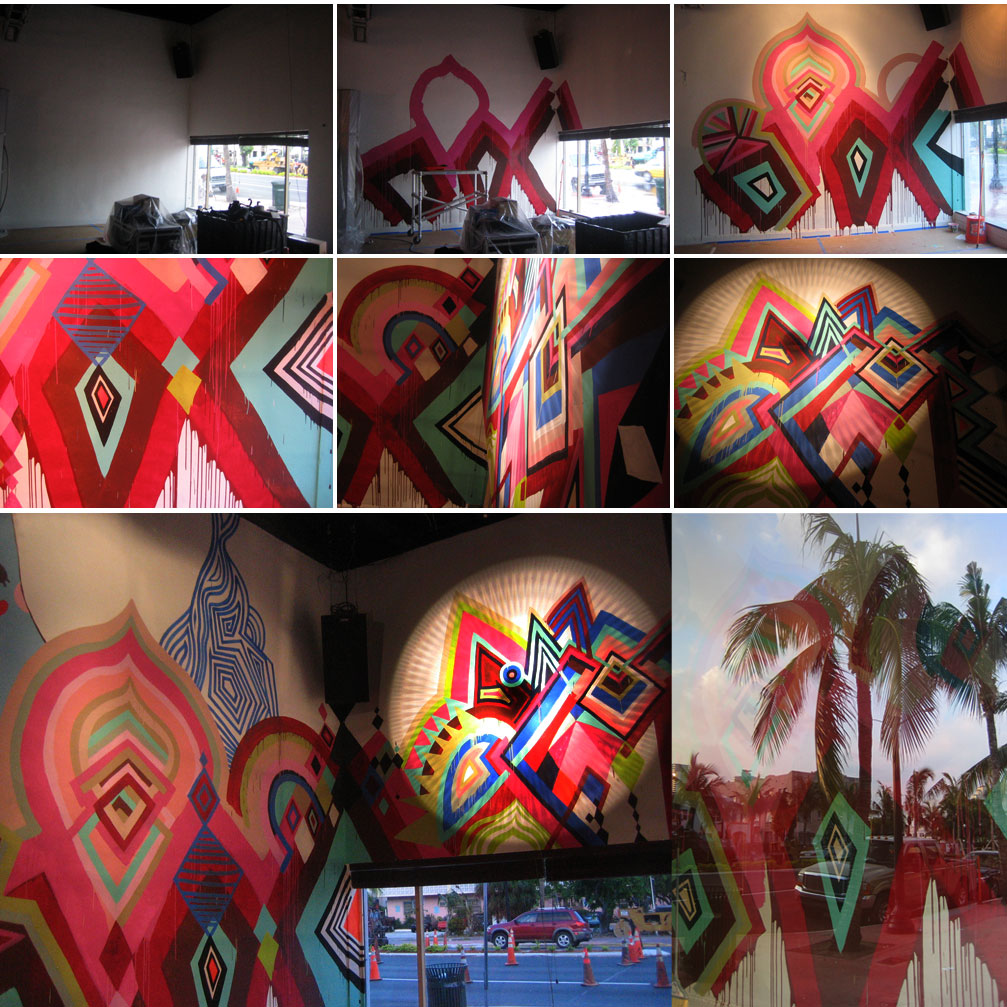
From CAMS ~ The Coalition Against Militarism In Our Schools

“As the government’s permanent resource wars continue to destroy the nations credibility and peoples lives, all across America people are starting to react with anti-war messages and themes. Graffiti art and public space reclamation for common sense messages are examples of this rebuttal of government propaganda.”

MISSION STATEMENT OF THE COALITION AGAINST MILITARISM IN THE SCHOOLS:
“To inform and educate the public, especially students, parents and school personnel about the growing militarization of our schools, and to create and present positive nonviolent alternatives which promote the value of human life, justice and equity for all persons.
We envision accomplishing this in the following ways:
By bringing together a network of organizations and individuals to oppose the growing intrusion of the military commonly present in the lives of young people throughout Southern California, and to present organizing strategies, campaigns and actions.
By sharing information, legislation, advocacy efforts, and resources in order to raise awareness and mobilize against the aggressive and deceptive tactics of the military, which especially target African American and Latino males and females.
By bringing awareness about these issues through a speakers bureau, workshops and presentations, along with written articles, media contacts, school board actions, brochures, educational curriculum (e.g. Addicted to War), online resources and multimedia.
By providing resources for youth activists and encouraging youth leadership roles and mentoring in the movement to demilitarize our schools. By facilitating the sharing of alternatives and exposing the myths and realities to militarism and war.
By collaboratively working to ensure equal access in all public school areas and spaces regarding the presence of counter recruitment literature, presentations and nonmilitary options.
By working to eliminate the Junior Reserves Officer Training Corp in our High Schools and the California Cadets in our Middle Schools, along with the school community.
By sponsoring and co-sponsoring events and activities with students, families, educators, and community/labor organizations to include conferences, teach-ins, forums and workshops.
By reinforcing and promoting through training’s and workshops the values of critical thinking, dialogue, conflict resolution and nonviolence.”
New ish of DREAM out now…

Dream Magazine #6 – 112 pages with CD
Featuring: Bridget St. John, George Kinney of The Golden
Dawn, Phil Elverum, Nick Castro, Joan La Barbara, A Hawk and a Hacksaw, Lichens,
My Cat Is An Alien, Baby Dee, Eric Matthews, Nick Bensen, Brad Rose, Six Organs
of Admittance, Windy & Carl, Steve Roden, Bob Moss, Jonathan Richman in
Belgrade in comix form by Aleksandar Zograf, Keenan Lawler, Vibracathedral
Orchestra, Alasdair Roberts, Alela Menig, Saint Joan, Current 93, Nicolette,
Adrian Crowley, Whysp, “On the Beach” by Karl Jones, “The Hitchhiker”
by George Parsons.
Hundreds of record reviews, and more.
CD includes exclusive material by: Steven Roden, Vibracathedral
Orchestra, Bridget St. John (doing Devendra Banhart’s “The Body Breaks”),
Nick Castro & the Young Elders, Donovan’s Brain, Saint Joan, Windy &
Carl, The North Sea, Alela Menig, Black Forest/Black Sea, Absalom, and a rare
track by Michael Gira.
DIY ARCHAEOLOGY: "We call Mojave a 'discovery park'"—pictographs, fire rings, white blossom jerky, etc

In the Desert, Ancient Signs
May 26, 2006 New York Times
By STEPHEN REGENOLD
ON the northern border of a vast desert preserve, halfway up a dusty hillside and overlooking a great forest of Joshua trees, David Nichols knelt to brush off a flat gray stone.
“Yep, this is one right here,” he said, motioning toward a sheet of exposed bedrock. A group of small, closely spaced stones, like tiny turrets in the sand, formed a vague ring at his feet. “These supposedly kept the rodents out.”
Mr. Nichols, one of two full-time research archaeologists employed at Mojave National Preserve, was showing off a recent discovery. On a nondescript hill, a quarter-mile off a four-wheel-drive dirt track, the remnants of a prehistoric way of life lay scattered in the sand.
Throughout Mojave National Preserve, a 1.6 million-acre park about 140 miles northeast of Los Angeles, the subtle traces of a bygone civilization are all around. Pictographs painted on cave walls, dart tips in the sand, shelters, fire rings and pottery shards are common in the area, where generations of prehistoric people lived and died. Indeed, Mojave National Preserve is an amateur archaeologist’s dream, with undocumented sites open year-round for visitors to explore in the empty, undeveloped park.
The Drying Pallet Site, as Mr. Nichols has come to call his new hillside finding, features 21 limestone slabs encircled with rocks that were carefully placed hundreds of years ago. The indigenous people, Mr. Nichols told his small tour group, used the sunny protected rock platforms to prepare Joshua tree blossoms.
“It was dried like beef jerky,” he said of the white blossoms, which each spring still daub the land below in one of the world’s largest and densest forests of Joshua trees. “Food in the desert was dried for preservation; it was the only way.”
Mr. Nichols, a 39-year-old Los Angeles native, has discovered more than 50 significant sites since coming to work for the park in 2001. The Drying Pallet Site was identified just four months ago. Dozens of others, he said, most likely pepper the preserve’s hills and canyons.
In recent years, noteworthy findings, including pictograph-packed caves, have been discovered by visiting hikers and amateur archaeologists. But while the park staff encourages people to explore the backcountry, collecting artifacts or disturbing historical sites in any way is forbidden. Take only photographs, leave only footprints, as the axiom goes.
Rangers at Mojave National Preserve do not provide directions to most documented archaeological locations, though some staff members and volunteers, including Mr. Nichols, may give clues. “We call Mojave a ‘discovery park,’ ” Mr. Nichols said of the Delaware-size preserve, which has only 30 miles of established hiking trails. “I might suggest features to look for in the hills, but people are on their own to get off trail and see what they can find.”
THE official park map is nearly devoid of references to archaeology, as is the park’s Web site. Signage is scant. Tours are limited to an occasional offering from California State University, Fullerton, which operates its research-oriented Desert Studies Center in the park.
Mr. Nichols’s recent tour was a rare occasion, as he leads fewer than 10 trips a year, primarily to educate fellow park staff members or visiting researchers. His tours are not available to the general public.
Like most activities in Mojave National Preserve, exploring the park for uncharted archaeology is a do-it-yourself adventure. Visitors coming to see petroglyphs and arrowheads need to plan ahead, researching the area’s history and culture to become educated on where to start the hunt. Visitors also need to be prepared for an immersion in the desert wilderness — snakes, scorpions, sun, heat and all.
Mojave National Preserve is the meeting place of three great North American deserts: the Great Basin, the Sonoran and its namesake Mojave. The area is a vast hinterland of dunes and cinder cones, tumbleweed plains, mesas and mountain forests. Turquoise deposits brought journeying Anasazi to the area hundreds of years ago.
Temperatures are extreme all year, with cold nights and blazing days. Elevations range from 800 feet to higher than 7,000 feet. It is exceedingly arid, with some parts of the park seeing only three inches of rain in a year.
Yet life thrives, as it has for thousands of years, among the Joshua trees and juniper. Quail, hummingbirds, mule deer, bighorn sheep, roadrunners, coyotes, badgers, rattlers, sidewinders and giant centipedes share a dry, dusty habitat. Sagebrush, creosote and yucca dot the land. Golden eagles and red-tailed hawks swoop above in the desert thermals.
Human habitation is limited to a few park staff members and a handful of land owners whose private ranches were grandfathered in when the preserve was created in October 1994. Mr. Nichols lives in a small green trailer in the middle of the park, Edward Abbey-style, with a water tank on the roof and no indoor plumbing, though with satellite Internet and HBO.
At the second stop of the day, deep in the park’s interior and not too far from Mr. Nichols’s green trailer, the small tour group walked two miles across the desert. A rocky flat-top ridge was in the distance. Barrel cactuses and yuccas grew sparsely on the red-brown landscape. Rocks and sand stretched to the horizon.
A slight hill dead-ended at a cliff, and Mr. Nichols stopped to look up. The rock wall above, a gray, disintegrating mass, held a mosaic of tiny dancing figures.
“Wow, look at these petroglyphs!” said Mary Ann Guggemos, a 48-year-old park volunteer from Buffalo. Carved in a veneer of rust-brown desert varnish were the depictions of bighorn sheep, masked human figures and male stickpeople with no necks but fingers and small phallic appendages. Concentric circles dotted the stone. Diamonds, ovals, a square, pits, grooves and other abstract images hovered nearby.
The Pinto House Site, as this find has come to be known, was inhabited by ancestral Mojaves or Chemehuevi, according to Mr. Nichols, and they lived and worshiped in the dusty dwelling. Pottery shards mixed with small stones and animal dung in the dirt. A faint ring of rocks encircled a small shrub. Eleven slick metates, worn stone pallets used for grinding piñon seeds, acorns, juniper berries and other grains, sat under the overhanging rock face. And the assemblage of petroglyphs looked down upon it all.
“The sacred and the mundane were mixed in this culture,” Mr. Nichols said, standing beside rock rings and milling stones. He said the etchings above were probably made during a ceremony, perhaps dreams manifested and scratched on a wall. “They didn’t go to a church to worship,” he said.
A hawk hovered in a wind gust above the cliff face. Petroglyph men stared down four modern-day visitors. The Pinto House Site, a bare forgotten diorama, cradled a human presence once again. Dust kicked up, and a second hawk moved into the updraft, paralleling its mate, two desert beings silhouetted and still on a pale blue sky.
 Arthur Magazine