WHO IS THE POE TOASTER?

Poe’s birthday celebrated with cognac and roses

BALTIMORE, Maryland (AP) — A small crowd gathered at the old church where Edgar Allan Poe lies buried, waiting, as they do every year, for the arrival of a stranger.

    A black-clad man arrived just before 3 a.m. Saturday, marking the poet’s birthday with the traditional graveside tribute: three red roses and a half bottle of cognac. Only this and nothing more.
    It is a rite that has been carried out by a mysterious stranger every January 19 since 1949, a century after Poe drank himself to death in Baltimore at age 40.

    This year’s birthday tribute was normal and subdued compared with last year, when the stranger left a note that enraged Baltimore Ravens fans.

    Borrowing from Poe’s “The Masque of the Red Death,” the note read: “The New York Giants. Darkness and decay and the big blue hold dominion over all.”

    Red and blue are the Giants’ colors and “the big blue” is a team nickname. The Ravens, who take their name from Poe’s most famous poem, were to meet the Giants later that month in Super Bowl XXXV. The Baltimore team ended up winning the game handily.
     “My own theory is that after the near riot that occurred last year when he insulted the Ravens, this guy thought, ‘I’ll just stick to the tradition and not cause the trouble,’ ” said Jeff Jerome, curator of the Edgar Allan Poe House and Museum. Jerome and 15 invited guests watched from inside the church.

    Jerome said the man, wearing the traditional black hat and coat, with a white scarf concealing his face, appeared to be different from last year’s so-called  Poe Toaster.

    “He appeared to be a younger man,” said Jerome, who has witnessed the ritual for 20 years. “He stood erect and walked quickly.”

    The man made no gestures, other than the secret signal he sends Jerome to show he is the genuine Poe Toaster, as he laid the tribute.

    The three roses represent Poe, his wife and his Aunt Maria Clemm, who are buried beneath the newer monument. The cognac is a mystery, Jerome has said, because there are no prominent references to it in Poe’s works.

    Poe was born in Boston and raised in Richmond, Virginia. But Baltimore, where he lived for several years during the 1830s, has adopted him as one of its own.

    A prolific poet and critic, Poe wrote comedies, detective stories and tales of the macabre, including “The Fall of the House of Usher,” “The Pit and the Pendulum” and “The Tell-Tale Heart.”

TERENCE MCKENNA: WE’RE RICH PEASANTS

TERENCE MCKENNA: “I assume that we’re all peasants, really. When was the last time you spent time with someone who formulates American foreign or social policy? I don’t spend time with those people. We’re rich peasants, of course. Don’t confuse poverty and peasantry. We’re rich peasants, but we’re totally in the dark, and the great ones come and go on their sleighs to and from the castle, and we mark their comings and going, but we have no idea what’s brewing up there. Every once in a while, they stumble, and we get LSD, or the Internet, or something else that slips through the cracks. It’s impossible to control history, and it’s wonderful that so many people are trying, because it makes for such an interesting game.”

(from a Jan 1998 interview with Charles Hayes, printed in Shaman’s Drum, Number 60)

Christian Ratsch on Pilsenkraut

PILSENKRAUT (via erowid.org)

(pilsen – imagine, to fantasize, to have a vision, kraut – plant, shrub)

[Experiment with utmost care – tropanes can be deadly when used wrong.]

On making the real pilsen, as told by Christian Ratsch

Transcribed from tape by N. Ipo

Henbane has been used for several purposes. The ancient greeks used it for divination in Delphi, the english have used it for hunting chicken (hence the henbane). The celts used it to kill old people unable to travel with the tribe. Germans used to it to make pilsener, beer. ‘What?’ you ask, ‘I thought they used hops in making beer.’ True, but this was before the Czecks invented new brewing technique in 19th century, using a special yeast and lots of hops producing beer with yellow color and bitter taste known today as pilsener. The original pilsener was brewed with henbane instead of hops, hallucinogenic plant instead of an sedative. It quite easy to brew henbane-beer – pilsen.

Pilsener

20 liters of water
1 liter of malt (Use readymade malt)
1/2 liter honey
40 grams of dried henbane leaves
yeast for beer (amount depends on the product)

Find container that’s big enough. Cook the henbane in water for 5 to 10 minutes. Dissolve the malt in couple of liters of water, dissolve the honey, add henbane leaf-water. Add yeast. It might be useful to add a little bit more yeast than recommended because the tropane-alkaloids affect the yeast. Don’t close the container, it may explode [because of the pressure, I suppose –N. Ipo]. According to Ratsch, 40 grams of dried henbane leaves is enough to kill a person,
so don’t drink all the 20 liters all by yourself. =)

Brew should start fermenting after 1 and 1/2 days and the fermentation should be finished after 4 or 5 days. Red pilsener beer is now ready. You can also bottle it, add a few drops of honey to each bottle and let ferment for another week or two. Serve on easter, eclipses and solistices, preferably chilled. Store as normal beer.

Do not use belladonna as an substitute, it contains atropine, which, according to Ratsch is, “no fun.” Henbane contains mainly scopolamine, especially if it is dried. Scopolamine might work nicely for you, or it might not – one just has to find out if one is a ‘scopolamine-person’.

Christian Ratsch lectures about the pilsener: “Well, I have to tell you some of the effects, too – [snickers, laughs] – when we drink it we usually gather with some friend, 6-8 people, and, er, then we have these big horns, you know, real drinking horns, and… er.. Its the best thing to drink from because the drinking horn, its, its like I have one like this size, very, very nice… You touch it and it feels like an erotic body or somethin very [mutter]… So you drink from this, and then you pass it around. This was actually what our ancestors did for their rituals, they had these horns, drinking it, giving, saying something, a greeting of a god or greeting to the ancestors… …And they drink so much, and it is said, in the sources, “until the gods are among them.” So, what does it mean? Its an entheogenic experience. Well, we did the same thing, and it turned out, that, ..er well, the gods weren’t there, but we were elevating to them. So, er, the effect is like, it starts to loose up your body and you feel like really smooth and really relaxed and then you have nice body sensations and nice sensations on your skin and you think and this could be nice for some erotic adventures and you close your eyes and suddenly and suddenly you stay in your red mist and you feel your body elevated. Its really beautiful, interesting feeling, and what is very amazing: you don’t get alcoholic effects from it, and this beer has about 4 to 5 percent alcohol… …I drink about 2.5-3 liters of henbane beer to get the full effect. You can drink more of course, but you may start to hallucinate badly. The hallucinations caused by nightshade plants are very unpleasant most of the time. Because – this is what I call the ‘true hallucinations’ – you see something which is just not there, you’re not aware about you’re hallucinating it. So you start to hallucinate scenes from real life. I observed an doctor under the influence of scopolamine, and he was just sitting there for four hours writing recipes and I observed a teacher and he was sitting at his table for hours and, and doing some corrections and test – but there was nothing [laughters] He was just totally… Just total hallucination. And that’s a typical sign of over-dosage – you don’t wanna do that. I found the beer the best, er, the easiest way to control the amount of tropane alkaloids you want to ingest…”

[About Henbane]
“It’s very easy to grow and it’s beautiful plant and its very unique how it looks like with its long buds and flowers. Its -if you see the plant you will know its a magic one. Its really amazing.”

[About brewing]
“Q: When you’re cooking the henbane does it matter if you boil it? [?]

Ratsch: Well I boil it for a couple of minutes, well, the tropane alkaloids will stay, they are very stable, strong molecules.
Q: [Mumble, mumble mumble]
Ratsch: No, when I figured out how to the henbane beer I started to brew mandrake beer. And, [laughs] that’s very interesting too. You can use the same recipe and instead of forty grams of dried leaves of henbane you use about forty grams of the dried root of mandrake the same way. And er thats pretty strong and interesting. I found the effect different from henbane. And the chemistry of mandrake is quite different from other nightshade plants. There has been very little experimentation done with mandrake… …I just recently did some research, literature search for personal experience with mandrake – doesn’t exist. Its really amazing…”

HORGAN MEETS CHRISTIAN RATSCH

“The Psychedelic Sorcerer” (via johnhorgan.com)

In November, 1999, I traveled to Basel, Switzerland, for a meeting called “Worlds of Consciousness,” a forum for research on altered states. At the meeting I met and interviewed scientists such as Albert Hofmann, the discoverer of LSD; the Swiss psychiatrist Franz Vollenweider, who is mapping the neural effects of psychedelics in humans with brain-scanning research; and the pharmacologist David Nichols of Purdue University, who probes the biochemistry of psychedelics with animal studies [see Chapter Eight of Rational Mysticism for an account of the meeting].

The most colorful character I met was the German anthropologist Christian Ratsch. If scientists like Hofmann, Vollenweider, and Nichols represent the rational superego of the psychedelic community, Ratsch is its id. Throughout the meeting, he was dressed in black leather: pants, hat, boots, fringed jacket. His slouch and half-lidded eyes gave him a reptilian air. His features were vaguely Asian; I learned later that his mother was Mongolian, his father German. Ratsch had reportedly never cut his waist-length, raven hair or Fu Manchu beard.

Because most of Ratsch’s books and articles are in German, he is less famous than Terence McKenna, but he is renowned among the psychedelic cognoscenti. I first heard about him from the chemist Alexander Shulgin, who praised Ratsch’s encyclopedic knowledge of the plants and fungi used in shamanic practices. Others described Ratsch as not only an expert on but also a practitioner of psychedelic shamanism, and ayahuasca shamanism in particular.

When I asked Ratsch for an interview on the first day of the conference, he eyed me suspiciously and replied in a gravelly, insinuating, German-accented voice that he was too busy; maybe later in the conference. Actually, Ratsch was busy. In spite of his stoner’s demeanor, he was a dervish of activity. As a co-organizer of the conference, he introduced speakers, led panel discussions and served as master of ceremonies during an evening homage to Albert Hofmann.

In a lecture titled “Keys to Other Worlds,” Ratsch informed us that there are an infinite number of keys—pharmacological and non-pharmacological—to the spiritual realm, and each of us must find the key for his or her individual psyche. As Ratsch spoke, he prowled around the stage caressing a “key” that looked suspiciously like a phallus.

Ratsch finally agreed to speak to me on the morning of the meeting’s last day. We sat at a small plastic table in a cafe in conference center’s lobby. Nursing a bottle of Coke, Ratsch seemed hungover, or stoned, or both. His eyes were slits, his voice a croak. Even in this brightly lit, antiseptic setting, he seemed to be peering at me through the smoke of a fire in some primeval jungle.

He expressed amusement with a kind of groan-grunt, keeping his mouth closed as if to minimize the expenditure of energy: “Hmm hmm,” or, if he was slightly more amused, “Hmm hmm hmm.” When truly merry, he laughed through a barely open mouth: “Heh heh heh.”

His demeanor made it clear that he found this interaction—me asking him questions, him responding—absurd. I felt absurd myself, preparing my tape recorder and yellow pad and pen as he drowsily watched me. I nonetheless forged ahead in my plodding, earnest fashion, and Ratsch played his part, too, giving me a view of spirituality that was as nihilistic—anti-Buddhist, anti-Christian, anti-religious—as any I had encountered yet.

He was born in 1957 in a Bohemian community in Hamburg, Germany, where he still lived. His father was an opera singer, his mother a ballet dancer. He started learning about shamanism and sacred plants at 10 and had his first drug experience at 12. He earned a doctorate in Native American cultures, and he spent three years living with a tribe in southern Mexico, investigating shamanism first-hand. He is an independent scholar, who supports himself primarily by writing and by organizing conferences such as this one. Universities “don’t pay enough, and there’s too much censorship,” he explained. “I call the universities the graveyards of science. Hmm hmm.”

When I mentioned that another scientist described him as a modern, westernized shaman, Ratsch shook his head. “I am just a researcher, nothing else,” he replied. “To be a shaman means to be called by the Gods and heal people
and help people, and that’s not my way. I’m here to translate the shamans’ work into our culture, to understand them better and maybe to protect them.”

Does he believe, I started to ask—but Ratsch cut me off.

“There is no belief involved,” he said, spitting out “belief” like an expletive. “It’s pure experience, nothing else. Belief is the forerunner of faith, and that’s religion.” He waggled his head, looking at me, then grunted approvingly: “Hmm.”

What about the claim that shamans have supernatural powers that allow them to harm and heal others? I persisted. Does Ratsch believe this? He laughed out loud. “If you start getting into shamanism,” he assured me, his eyes narrowing, “then you better believe the unbelievable and expect the unexpectable.”

What about the ghosts and spirits that shamans and others supposedly see during ayahuasca trips? I asked. Are those just in your head, or are they out there? “It’s outside. If it’s in here,” Ratsch said, pointing to his own pitch-black pate, “we’re sick.” He added that visions are truth, but “believing in ghosts is maybe not the truth.”

Ratsch distinguished between shamanic experiences and those induced by meditation.

“Meditation is the way inside,” he explained, “and shamanic traveling is to go outside.”

Ratsch has little respect for meditative paths such as Buddhism.

“I don’t think of Buddhism as a spiritual path. It’s a religion,” he said. “It’s based on very strange, paradoxical ideas. For example this notion: ‘Don’t kill.’ But then they eat meat.” The Dalai Lama “loves meat.”

Surprised, I said that I had assumed the Dalai Lama was a vegetarian.

“No. Hitler was a vegetarian.”

Ratsch also objected to Buddhism’s encouragement of monasticism and celibacy. The Dalai Lama and other Buddhists monks are “incomplete,” Ratsch said, because they deny their sexuality. “You get crazy and weird if you don’t have a partner.” Ratsch assured me that he has “a lot of sex.” (I could hardly doubt him. Although Ratsch’s wife, the anthropologist Claudia Muller-Ebeling, was at the conference, one or more young women always seemed to be orbiting around him.)

Ratsch believes in enlightenment, which he defines as “a state of complete understanding,” “total loss of ego structures,” and “just being one with everything.” The spiritual path “starts with the enlightenment, and then you can try to get this integrated into your life. It’s not the other way around.” Ratsch abhors so-called spiritual leaders who claim that enlightenment can only be achieved through decades of meditation and other spiritual practices.

“That’s such a bad lie, and an exploitation of needs,” he snarled. His cool irony had vanished; he was momentarily vehement, passionate. Then he paused, regaining his composure, his lizard-like, Mona Lisa smile. “This is my point of view.”

Enlightenment “has nothing to do with all these spiritual teachings.” It merely requires “the right molecule to hit your brain.” Enlightenment is an intrinsically transient state, like an orgasm; in fact, some Amazonian societies use their term for orgasm to describe mystical states. “You are not in a permanent state of orgasm,” Ratsch said. “It’s one peak, and then you have to recharge your batteries.”

Orgasms loom large in Ratsch’s worldview.

“We are like almost crystallized orgasms from our parents,” he said. “Hopefully, my parents had the greatest orgasm when I was conceived. Heh heh heh.”

Asked about his drug preferences, Ratsch replied that ayahuasca “is the best shamanic medicine ever discovered. And I like it—definitely not as a recreational drug. I love recreational drugs, of course.”

Ratsch enjoyed taking small doses of LSD when going to a party or the opera.

“Richard Wagner is the greatest on acid,” he said. Twilight of the Gods is “the greatest piece of art ever written, the most shamanic and mystical play ever. From Ring of the Nibulungs you can learn everything.”

Have his psychedelic experiences convinced him that there is life after death?

“I don’t know.” Ratsch shrugged. “I have a certain vision I got on a DMT trip, and it will be the most beautiful…” He smiled dreamily.

Can he be sure this will happen?

“How can I?” he replied with a snort of incredulity.

Well, I said, some Buddhists and Christians have very specific beliefs about life after death.

“That’s their problem. Hmm hmm.”

When I told Ratsch that a psychedelic trip years ago had left me with a sense that there is something fundamentally wrong with reality, or even God, he nodded.

“I have seen many people tripping. And it happens from time to time that they think everything went wrong, or they did something wrong. Because of them, they destroyed the universe, and stuff like that. That’s”—he waited a beat—”not healthy. Hmm hmm.”

I laughed too, and asked him if he had ever had such a trip. No, he had never had a bad trip. “I don’t know what that is.”

You’re very fortunate, I said.

“Yes! Definitely. Very fortunate.”

I asked him if he had any thoughts on why life is so filled with suffering.

“The universe is about life and death, and both belong to each other. It’s two poles of the same thing. And every minute we kill to live.” Buddhism attempts to deny this basic fact, or suggests that it can be altered. “That’s why Buddhism is based on a lie.”

I asked what he thought of Terence McKenna’s time-wave theory and his prediction that the apocalypse could occur in 2012. “Complete bullshit. Hmm hmm.”

Ratsch had once asked McKenna if he really believed the time-wave theory, and McKenna had answered, No, not really.

“But that is because we are good friends,” Ratsch said. “He wouldn’t admit that in the public.”

Ratsch said he has much more to learn from drugs about “the shamanic world, and the use of plants, the meaning of nature.” This search for meaning is endless, he emphasized. “If the search for knowledge stops, then you’re basically” — he paused — “dead, as a living, exploring being.” The universe “produces people like us to learn about itself.” This self-exploring process “goes on and on and on. And nobody knows where it goes and what happens. And I think that’s part of enlightenment, to understand that there is no aim.”

A waitress clearing a table beside us knocked a bottle onto the floor. Ratsch watched bemused as the bottle ponderously rumbled toward us and clanked against the base of our table.

Certain rare mortals are so cool that they seem transhuman. They appear immune to embarrassment, angst, guilt–all the negative emotions that wrack us ordinary mortals. Christian Ratsch has this quality. I believed him when he told me that he had never had a bad trip. I used to envy those who had attained transcendent coolness, but now I wonder whether it represents a deficit of feeling, of empathy. I prefer sages with hearts, like Huston Smith.

I found Ratsch’s sorcerer schtick entertaining, though. Moreover, as I went over his views of mysticism and enlightenment, I realized that they are not as outrageous as they sounded to me at first. His comparison of enlightenment to orgasm echoes the hypothesis of the brain-scientists Andrew Newberg and Eugene DAquili that our mystical capacity evolved out of our orgasmic capacity. Ratsch’s rejection of monasticism reflects that of Kabalists, who believed that only happily married men are stable enough to follow the mystical path.

Like the skeptical mystic Susan Blackmore, he does not believe in ghosts or life after death. He rejects the notion of enlightenment as a state of final knowledge, contending that if the search for knowledge ends, life ends. The point of visionary experiences is the experiences themselves, Ratsch suggests, not the knowledge or beliefs that might be gleaned from them. In the same way, the aim of life is to understand that there is no aim.

Actually, Ratsch qualified that principle somewhat at the end of our conversation. After he yawned pointedly, I said I had just one more question: What is the secret of life?

“Get high. Heh heh heh.”

PREPARING FOR OMNICORP

FROM TODAY’S NEW YORK TIMES:

The Balance of Media Power Is Poised to Change

By THE NEW YORK TIMES

Regulation: F.C.C.’s Chief Seeks to Remove Restraints

If all goes according to plan, 2003 will be the most important year in the tenure of Michael K.
Powell as head of the Federal Communications Commission.


    Mr. Powell
is preparing to unleash a set of proposals in the next few months that
will unshackle the nation’s largest broadcasters and telecommunications
conglomerates from restraints that have prevented them from growing. He
is armed with a broad deregulatory agenda and a series of court opinions
that have questioned or struck down some of the agency’s most pivotal and
longest-lasting rules.


    “This
will be the most important year for these industries and the commission
since the passage of the Telecom Act seven years ago,” said Scott C. Cleland,
the chief executive of the Precursor Group and a regulatory analyst.


    While
many of the issues before the commission defy traditional partisanship,
it does not hurt that with a Republican Congress, many of Mr. Powell’s
strongest allies now control the relevant House and Senate committees and
are likely to provide few political obstacles.

    In the
Senate, for instance, Mr. Powell will now be reporting to a commerce committee
that will be headed by Senator John McCain, the Arizona Republican who
recruited him for the job of F.C.C. commissioner in 1997. Mr. McCain replaces
Senator Ernest F. Hollings, Democrat of South Carolina, who was Mr. Powell’s
toughest critic and opposed many of his proposals.


    At
the top of Mr. Powell’s list is his plan to relax or eliminate a variety
of restraints on the size of the nation’s broadcasters and cable owners.


    The
ownership rules that the commission will reconsider restrict a newspaper
from owning a TV station in the same city. They prevent a media conglomerate
from owning two television networks. They prohibit a network from owning
stations that broadcast to more than 35 percent of the nation’s homes.
They restrict a broadcaster from owning two television stations in the
same market unless there are at least eight other competitors. They restrict
a company from owning more than eight radio stations in the same market.
And they prohibit a cable company from owning more than 30 percent of the
national market.


    The nation’s
largest local telephone companies are also expecting to win substantial
regulatory relief this year, from requirements that they provide the individual
elements of their networks to competitive startups at à la carte
prices that the phone companies say are too low.


    “This
will be a very pro-investment deregulatory decision,” said Mr. Cleland.

    “It will
encourage the incumbents to invest more because they won’t have to resell
at lower prices. It will be great news for the incumbents and for the Lucents,
Nortel and other equipment players. It will be very bad news for the competitors
who depend on regulatory subsidies.”


STEPHEN LABATON

Satellite Television:
DirecTV Is at Center of a Power Shift


After
more than two years of shifting alliances, ferocious bidding wars, and
behind-the-scenes regulatory wrangling, the media moguls Rupert Murdoch
and John C. Malone are within striking distance of acquiring control of
the satellite television service DirecTV, a strategic beachhead that could
alter the balance of power in the industry.


    With
11 million subscribers, DirecTV, part of the Hughes Electronic subsidiary
of General Motors, is the largest satellite broadcaster in the country
and the third-largest pay television service. Federal regulators recently
blocked a deal for G.M. to sell Hughes to its satellite rival EchoStar
Communications as anticompetitive, leaving Mr. Murdoch, the chairman of
the News Corporation, and Mr. Malone, the chairman of the investment company
Liberty Media, as the two remaining contenders for the business, and they
are currently bidding as partners.


    They
want DirecTV in part to help their channels. The News Corporation owns
Fox News and Fox Sports, and Liberty Media owns Starz Encore and has stakes
in Discovery, Court TV and others. A satellite system would guarantee distribution,
increasing the channels’ leverage in talks with the six major cable operators,
which together account for 80 percent of the nation’s cable subscribers.


    Both
Mr. Murdoch and Mr. Malone are old hands at using control of major pay
television systems to benefit favored channels. Mr. Murdoch operates a
satellite network that stretches from Europe to Latin America.

    Mr. Malone
built Liberty Media while he was the chief executive of Tele-Communications
Inc., which before it was sold was the largest cable company in the country;
he made investments in new pay television channels and then carried them
on his company’s systems. Owning a major satellite service would make it
easier for both companies to once again start channels, said Derek Baine,
an analyst at Kagan World Media.


    But it
may mean stiff new competition for cable companies. Analysts say that the
News Corporation can use its size to lower expenses for satellite equipment,
possibly enabling the company to set lower prices, while using its channels
to promote DirecTV. Mr. Baine said both companies are likely to make DirecTV
into a much more vigorous competitor for cable customers.


    And the
means of their competition could send ripples through the rest of the television
business: DirecTV is already wooing customers with digital video recorder
set-top boxes that make it easy for subscribers to record programs, view
them when they want, and fast-forward past the commercials. Analysts say
that they expect the new suitors to escalate the effort, an ominous possibility
for broadcasters who sell advertising.


DAVID D. KIRKPATRICK

Magazines: U.S. Publishers
Take Cues From the British


The success of Maxim, the
bawdy British-owned men’s magazine whose start-up in the United States
has taken young male readers by storm, has publishers on this side of the
Atlantic wondering whether the American way is the only way.


    The British
publishing industry is a frantic place that is driven by the whims of the
newsstand ˜ 80 percent of magazines come from single-copy sales. American
publishers have noticed that British editors know their way around a newsstand
and have been hiring them in droves. With costs escalating and advertising
slumping, American publishers are looking to reduce the expense side of
producing a magazine and maximize its impact, a formula the British seem
to have down pat.

    British
magazines may not be the qualitative equivalent of American publications,
but they seem to have no trouble meeting the needs of the magazine-buying
public. Many British magazines make do with staffs that are half the size
of their American counterparts and much less well compensated. And the
lack of layers means that there is no endless editing and reiterating of
copy until ˜ as some writers might claim ˜ most of the life dribbles out
of an idea.


    “The
age of celebrity editors and monstrous staffing are over,” said Felix Dennis,
owner of Dennis Publishing. “This is not a business of sufficient margin
to permit that kind of excess.”


    There
are some components of the British publishing environment that no one in
America is in a hurry to emulate. The dogfight at the newsstand has compelled
publishers to start using “cover-mounts,” a practice in which a consumer
product is “poly-bagged” with the magazine. That means British consumers
can get a garden trowel or a pair of thong underwear along with their magazine.


    Underwear
aside, even the quintessentially American publisher, Time Inc., is looking
to IPC Media, the British publisher the company bought last year, for new
tactics.


    “Postage
is going to continue to increase and paper will rise, so costs are going
to have to be looked at,” said Norman Pearlstine, the editor in chief of
Time Inc., a unit of AOL Time Warner. “There are differences in the market,
but I think there are some approaches in Britain that are worth thinking
about.”


DAVID CARR

THE CITY OF THE SUN

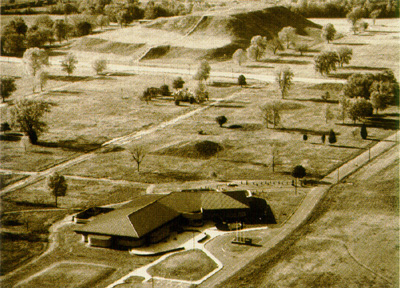
Cahokia Mounds: The CITY OF THE SUN

The remnants of the Mississippians’ central city – now known as Cahokia for the Indians who lived nearby in the late 1600s – are preserved within the 2200-acre tract that is the Cahokia Mounds State Historic Site, located just eight miles east of downtown St. Louis, Missouri, near Collinsville, Illinois.

YOU GO, DEVENDRA!

From the New York Times:

POP REVIEW | DEVENDRA BANHART

‘Dogs Are Dreaming Lovesongs,’ and That’s Not All

By KELEFA SANNEH

When you first hear Devendra Banhart’s high, braying voice, you may be tempted to laugh: the two words that spring to mind are “tiptoe” and “tulips.”

    It’s hard to say whether Mr. Banhart would be pleased to hear himself compared to Tiny Tim. But in any case, his music is too compelling and too weird to be merely a put-on.
    
On Sunday he played a short, intriguing set at Tonic, sitting cross-legged on
the stage with an acoustic guitar in his lap, singing about a world in which animals and plants act out mysterious allegories.

    Mr. Banhart, 21, just released his excellent debut album, “Oh Me Oh My . . . The Way the Day Goes By the Sun Is Setting Dogs Are Dreaming Lovesongs of the Christmas Spirit” (Young God). He tends toward verbosity, but many of his songs last little more than a minute, just long enough for him to sketch an image.

    On Sunday he was joined by Will Lemon, who sometimes played harmonica and sometimes percussion, although his only rhythm instrument was a container of roasted soybeans. Mr. Banhart usually picked broken chords on his guitar, sometimes strumming when the songs grew more forceful.

    Near the beginning of the set he played “Michigan State,” one of his longest and most memorable songs. At the beginning there was barely any music, just Mr. Banhart’s tentative voice: “My friend has my favorite teeth/They bend backwards when she breathes/And it whistles.”

    By the time the first chorus arrived, the narrator was no longer a mere observer. The delicate introduction gave way to a more insistent two-chord pattern, and Mr. Banhart’s voice got louder and plainer in the refrain, an unusual lyric of desire: “Oh, Michigan, Michigan state, how I’d love to live in
you.” In Mr. Banhart’s anthropomorphic world, states have just as much personality as teeth, or
dogs.


    The second verse of “Michigan State” is a series of not-quite-logical propositions.    

With each flight of fancy, his voice grew more urgent, which created the
impression that he was rushing toward a momentous conclusion: “The salt keeps the sea from feeling heat/And my toes have my favorite feet/If I sweat salt and the earth sweats heat. . . .”

    Mr. Banhart’s voice trailed off, as if he were overwhelmed by the possibilities, and then he sang the chorus again.

WHY JOHN WATERS LOVES CHRISTMAS

Why I Love Christmas

From Crackpot by John Waters

Being a traditionalist, I’m
a rabid sucker for Christmas. In July I’m already worried that there are
only 146 shopping days left. “What are you getting me for Christmas?” I
carp to fellow bathers who haven’t even decided what to do for Labour Day.
As each month follows, I grow more and more obsessed. Around October I
startle complete strangers by bursting into my off-key rendition of “Joy
to the World.” I’m always The Little Drummer Boy for Halloween, a grouchy
one at that, since the inconsiderate stores haven’t even put up their Christmas
decorations yet. November 1 kicks off the jubilee of consumerism, and I’m
so riddled with the holidays season that the mere mention of a stocking
stuffer sexually arouses me.


    By December
I’m deep in Xmas psychosis, and only then do I allow myself the luxury
of daydreaming my favourite childhood memory: dashing through the snow,
laughing all the way (ha-ha-ha) to Grandma’s house to find the fully decorated
tree has fallen over and pinned her underneath. My candy-coloured memories
have run through the projector of my mind so many times that they are almost
in 3-D. That awful pause before my parents rushed to free her, my own stunned
silence as I dared not ask if Granny’s gifts to us had been damaged, and
the wondrous, glories sight of the snow semi-crooked tree, with balls broken,
being begrudgingly hoisted back to its proper position of adoration. “O
Christmas tree! O Christmas tree!” I started shrieking at the top of my
lungs in an insane fit of childhood hyperventilation before being silenced
by a glare from my parents that could have stopped a train. This tableau
was never mentioned again, and my family pretended it never happened. But
I remember–boy, do I remember!


    If you
don’t have yourself a merry little Christmas, you might as well kill yourself.
Every waking second should be spent in Christmas compulsion: career, love
affairs, marriages, and all the other clutter of daily life must take a
backseat to this holiday of holidays. As December 25 fast approaches, the
anxiety and pressure to experience “happiness” are all part of the ritual.
If you can’t maintain the spirit, you’re either a rotten Communist or badly
in need of a psychiatrist. No wonder you don’t have any friends.


    Of course,
You-know-who was supposed to have been born on Christmas, but the real
Holy Trinity is God the Father, the Son and the Holy Santa Claus. You don’t
see fake Josephs and Marys in department stores asking kids what they want,
do you? Face it, mangers are downwardly mobile. True, swiping a sheep or
a wise man for your apartment from a local church is always good for a
cheap thrill and invariably gets you in the paper the next day. And Madalyn
Murray O’Hair (the publicity-crazed atheist saint) always gets a rise by
successfully demanding in court the removal of Nativity scenes from her
state capital on Christmas Eve. But we all know who the real God is, don’t
we? That’s right, the Supreme One, Santa Claus.


    But if
you think about it, Santa Claus is directly responsible for heroin addiction.
Innocent children are brainwashed into believing the first big lie their
parents ever tell them, and when the truth finally hits, they never believe
them again. All the stern warnings on the perils of drugs carry the same
credibility as flying reindeer or fat men in your chimney. But I love Santa
Claus anyway: All legends have feet of clay. Besides, he’s a boon to the
unemployed. where else can drunks and fat people get temporary work?


    Of course,
to many, Santa is an erotic figure, and fore these lucky revelers, the
Christmas season is a smorgasbord of raw sex. Some people just go for a
man in a uniform. Inventive entrepreneurs should open a leather bar called
the Pole where dominant wrinkle fetishists could dress like old St. Nick
and passive gerontophiliacs could get on all fours and take the whip like
good reindeer. Inhaling poppers and climbing down mock chimneys or opening
sticks ‘n’ stones from the red-felt master could complete the sex-drenched
atmosphere of the first S&M Xmas bar.

    You could
even get fancy about it. Why hasn’t Bloomingdale’s or Tiffany’s tried a
fancy Santa. Deathly pale, this never-too-thin-or-too-rich Kris Kringle,
dressed in head-to-toe unstructured, over-size Armani, could pose on a
throne, bored and elegant, and every so often deign to let a rich little
brat sit near his lap before dismissing his wishes with a condescending
“Oh, darling, you don’t really want that, do you?”


    Santa
has always been the ultimate movie star. Forget White Christmas, It’s a
Wonderful Life and all the other hackneyed trash. Go for the classics:
Silent Night, Bloody Night, Black Christmas or the best seasonal film of
all time Christmas Evil (“He’ll sleigh you”). This true cinematic masterpiece
only played theatrically for a few seconds, but it’s now available on videocassette
and no holiday family get-together is complete without it. I t’s about
a man completely consumed by Christmas. His neurosis first rears its ugly
head as he applies shaving cream to his face, looks in the mirror, hallucinates
a white beard and begins to imagine that he is Santa Claus. He gets a job
in a toy factory, starts snooping and spying on the neighbourhood children
and then rushes home to feverishly make notes in his big red book: “Jimmy
was a good boy today,” or “Peggy was a bad little girl.” He starts cross-dressing
as Claus and lurks around people’s roots ready to take the plunge. Finally,
he actually gets stick in a nearby chimney and awakens the family in his
struggle. Mom and Dad go insane when they find a fat lunatic in their fireplace,
but the kids are wild with glee. Santa has no choice but to kill these
Scroogelike parents with the razor-sharp star decorating the top of their
tree. As he flees a neighbourhood lynch mob, the children come to his rescue
and defy their distraught parents by forming a human ring of protection
around him. Finally, pushed to the limits of Clausmania, he leaps into
his van/sleigh and it takes off flying over the moon as he psychotically
and happily shrieks, “On Dancer! On Prancer! On Donner and Vixen!” I wish
I had kids. I’d make them watch it every year and if they didn’t like it,
they’d be punished.


    Preholiday
activities are the foreplay of Christmas. Naturally, Christmas cards are
you first duty and you must send one (with a personal, handwritten message)
to every single person you ever met, no matter how briefly. If this common
courtesy is not reciprocated, never speak to the person again. Keep computerized
records of violators and hold the grudge forever; don’t even attend their
funeral.


    Of course,
you must make your own cards by hand. “I don’t have time” you may whine,
but since the whole purpose of life is Christmas, you’d better make time,
buster. We Christmas zealots are rather demanding when it comes to the
basic requirements of holiday behaviour. “But I can’t think of anything
. . . .” is usually the next excuse, but cut those people off in mid-sentence.
It’s easy to be creative at Christmastime. One year I had a real cute idea
that was easy to design. I bought a cheap generic card of Joseph and Mary
holiday the Baby Jesus and superimposed Charles Manson’s face in the place
of the homeless infant’s. Inside I kept the message “He is born”. Everybody
told me they loved it and some even said they saved it. (For the record,
I’m against donating your cards to nursing homes after Christmas. One would
think that after all these years on earth, senior citizens would have had
a chance to make a friend or two on their own. Don’t do it!) This season,
I’m dying to produce my dream card that I’ve wanted for years. I’ll be
sitting in a Norman Rockwell-style Christmas scene, dressed in robe and
slippers, opening my gifts moments before I notice a freak fire that has
begun in the tissue paper and is licking and spreading to the tree.


    Go deeply
in debt over Christmas shopping. Always spend in exact correlation to how
much you like the recipient. Aunt Mary I love about $6.50 worth; Uncle
Jim–well, at least he got his teeth fixed–$8. If your Christmas comes
and goes without declaring bankruptcy, I feel sorry for you–you are a
person with not enough love inside.


    You can
never buy too many presents. If you said “Excuse me” to me on a transit
bus, you’re on my list. I wrap gifts for nonexistent people in case somebody
I barely know hands me a present and I’m unprepared to return this gesture.
Even though I’m the type who infuriates others by saying “Oh, I finished
my shopping months ago,” as they frantically try to make last-minute decisions.
I like to go into the stores at the height of Christmasmania. Everyone
is in a horrid mood, and you can see the overburdened, underpaid temporary
help having nervous breakdowns. I always write down their badge numbers
and report them for being grumpy.

    If you’re
a criminal, Christmas is an extra-special time for you and your family.
Shoplifting is easier and cars in parking lots are loaded with presents
for your children. Since everyone steals the checks you must leave for
the mailman and garbagemen, I like to leave little novelty items, like
letter bombs. Luckily, I live in a bad neighbourhood, so I don’t have to
worry; the muggers live in my building and go to the rich neighbourhoods
to rob. If you’re quick, you can even steal the muggers’ loot as they unload
the car. Every child in my district seems to get rollerskates for Christmas,
and it’s music to my ears to hear the sudden roar of an approaching gang
on skates, tossing back and forth like a hot potato a purse they’ve just
snatched.


    “Santa
Claus Is a Black Man” is my favourite Christmas carol, but I also like
The Chipmunks’ Christmas Album, the Barking Dogs’ “Jingle Bells” and “Frosty
the Snowman” by the Ronettes. If you’re so filled with holiday cheer you
can’t stand it, try calling your friends and going caroling yourself. Especially
if you’re old, a drug addict, an alcoholic or obviously homosexual and
have a lot of effeminate friends. Go In packs. If you are black, go to
a prissy white neighbourhood. Ring doorbells, and when the Father Knows
Best-type family answers, start screeching hostilely your favourite carol.
Watch their faces. There’s nothing they can do. It’s not illegal. Maybe
they’ll give you a present.


    Always
be prepared if someone asks you what you want for Christmas. Give brand
names, the store that sells the merchandise and, if possible, exact model
numbers so they can’t go wrong. Be the type who’s impossible to buy for
so that they have to get what you want. Here was my 1985 list and I had
checked it twice; the long-out-of-print paperback The Indiana Torture Slaying,
the one-sheet for the film I Hate Your Guts and the subscription to Corrections
Today, the trade paper for prison wardens. If you owe someone money, now
is the time to pay him back, mentioning at the same time a perfect gift
suggestion. If you expect to be receiving a Christmas stocking as a forerunner
to a present, tell the giver right off the bat that you don’t go for razor
blades, deodorants or any of the other common little sundries but anticipate
stocking stuffers that are original, esoteric and perfectly suited to you
and you alone.


    It helps
to be a collector, so the precedent is set on what to expect as a gift.
For years friends have treated me to the toy annually selected by the Consumer
Affairs Committee of Americans for Democratic Action as the “worst toy”
to give your child at Christmastime. “Gobbles, the Garbage-Eating Goat”
started my collection. “That crazy eating goat” reads the delightful package,
and in small print, “Contains: One realistic goat with head that goes up
and down. Comes complete with seven pieces of pretend garbage.” This Kenner
Discovery Time toy’s instructions are priceless. “Gobbles loves to eat
garbage when he’s hungry, and he’s ALWAYS hungry. (1) Hold Gobbles mouth
open by the beard. Stuff a piece of pretend garbage straight into his mouth
and (2) pump the tail until the garbage disappears.” It ends with an ominous
warning, “Feed Gobbles only the garbage that comes with the toy,” and in
even smaller print “If you need additional garbage, we will, as a service,
send it to you direct. For 14 pieces of garbage send $1 (check or money
order; sorry, no C.O.D.) to . . . . ” I can’t tell you the hours of fun
I’ve had with Gobbles. Sometimes when I’m very bored, Gobbles and I get
naked and play-play.


    Over
the years my collection has grown. There’s “My Puppy Puddles” (“You can
make him drink water, wet in his tray and kiss you”). “Baby Cry and Dry”
about whom the watchdog group warned: “Take her out of the box and she
smells, the odor won’t go away” and “Baby Cry for You.” (“The tears don’t
just drop out, they whoosh out in a three-foot stream.”) Of course, I still
cover the winner of the first annual prize (before my collection began)–a
guillotine for dolls. “Take that, Barbie.” “Off with your head, Betsy Wetsy!”


    No matter
what you think of your presents, each must be answered with an immediate
thank you note. Thinking of what to write can be tricky, especially for
distant relatives who send you a card with two crisp $1 bills inside. Be
honest in your reply–“Dear Uncle Walt. Thank you for the $2. I bought
a pack of Kools and then put the change in an especially disgusting peep
show, it was fun!” or “Dear Aunt Lulu, I was thrilled to receive your kind
gift of $5. I immediately bought some PCP with it. Unfortunately, I had
a bad reaction, stabbed my sister, set the house on fire and got taken
to the hospital for the criminally insane. Maybe you could come visit me?
Love, Your nephew.”

    I always
have an “office party” every year and invite my old friends, business associates
and any snappy criminals who have been recently paroled. I reinforce all
my chairs, since for some reason many of my guests are very fat, and after
a few splintered antiques, I’ve learned my lesson. I used to throw the
party on Christmas Eve, but so many guests complained of hideous hangovers
I had to move up the date. No more moaning and dry heaving under their
parents’ tree the next day as their brothers and sisters give them dirty
looks for prematurely ejaculating the Christmas spirit.


    I usually
invite about a hundred people and the guest know I expect each to get everyone
else a present. Ten thousand gifts! When they’re ripped open at midnight,
you can see Christmas dementia at its height. One thing that pushes me
off the deep end is party crashers. I’ve solved the problem by hiring a
door many who pistol-whips anyone without an invitation, but in the old
days, crashers actually got inside. How rude! At Christmas, of all times,
when visions of sugarplums are dancing orgiastically through my head. One
even brought her mother–how touching. “GET OUT!” I snarled after snatching
out of her hand the bottle of liquor that she falsely assumed would gain
her (and her goddamn mother) entry.


    I always
show a film in one room: Wedding Trough (about a man who falls in love
with a pig and then eats it) or Kitten with a Whip (Ann-Margret and John
Forsythe) or What Sex Am I? (a clinical documentary about a sex-change
operation). When it’s finally time for the guests to leave, I blatantly
get in bed and go to sleep; they know they better get home. Santa is on
his way.


    Christmas
day is like an orgasm that never stops. Happiness and good cheer should
be throbbing in your veins. Swilling eggnog, scarfing turkey and wildly
ripping open presents with your family, one must pause to savor the feeling
of inner peace. Once it’s over, you can fall apart.


    Now is
the time for suicide if you are so inclined. All sorts of neuroses are
permitted. Depression and feelings that it somehow wasn’t good enough would
be expected. There’s nothing to do! Go to a bad movie? You can’t leave
the house between now and January 1 because it’s unsafe; the national highways
are filled with drunks unwinding and frantically trying to get away from
their families. Returning gifts is not only rude but psychologically dangerous–if
you’re not careful you might glimpse the scum of the earth, cheap bastards
who shop at after-Christmas sales to save a few bucks. What can you look
forward to? January 1, the Feat of the Circumcision, perhaps the most unappetizing
High Holiday in the Catholic Church? Cleaning up that dirty, dead, expensive
Christmas tree that is now an instant out-of-season fire hazard? There
is only one escape from post-Christmas depression–the thought that in
four short weeks it’s time to start all over again. What’re ya gonna get
me?

NESTLE VS. FAMINE VICTIMS, FIRST WORLD VS. THIRD WORLD

From http://www.maketradefair.com/default.asp

Demand that Nestlé drop their claim against Ethiopia!

Take action now to stop Nestlé,
the world’s largest coffee company, demanding $6 million from a country
where 11 million people are facing famine. What are Nestlé doing
to help fight hunger in Ethiopia? They are demanding the Ethiopian Government
pay $6m in compensation for a company that was nationalised 27 years ago,
a company that they didn’t even own at the time. The CEO of Nestlé
has said that companies like his will be held to account for their part
in the fight against hunger in developing countries – so take action now
– e-mail Nestlé telling them to drop the claim for $6m from Ethiopia.

Click
here to take action now!

4 Nov 2002 press release:

THE GREAT TRADE ROBBERY

Rich world swindles millions
from the benefits of trade as global wealth divide widens to all time high

OXFAM today accused the rich
world of robbing the poor world of $100 billion a year by abusing the rules
governing world trade and denying millions of poor people their best escape
route from poverty.


    “For
every dollar we give in aid two are stolen through unfair trade, costing
the poor world $100 billion a year. Globalisation is leaving millions in
despair, creating a world more unequal than ever before, when it could
do the exact opposite. The wealth divide is at an all time high and the
anger and social tensions that accompanies such morally unacceptable inequalities
threaten us all,” warned Jeremy Hobbs, Execitive Director of Oxfam International
during the launch of Make Trade Fair, a global campaign in 18 countries
to change the rules of trade.


    The campaign
is launched as the 144 countries of the World Trade Organization start
to work on a new agenda of trade negotiations that will determine how world
trade will be regulated in the future. WTO negotiations risk widening the
global divide unless the rich world changes its approach to the concerns
of developing countries.


    In a
new report Rigged Rules and Double Standards Oxfam shows that 128 million
people could be lifted out of poverty if Africa, Latin America, East Asia
and South Asia each increased their share of world exports by just one
percent.

    However,
rich world hypocrisy and double standards stop this from happening because
the rich world is rigging global trade rules by:


· Subsidising rich
farmers $1bn a day. Over-production of agricultural surpluses is dumped
onto world markets, suppressing world prices and destroying local markets
in poor countries


· Influencing the
International Monetary Fund and the World Bank polices to prise open poor
countries’ markets with little regard to the social consequences. These
are policies the rich world has itself rejected.


· Stopping or penalising
poor countries from exporting their goods into rich world markets. Goods
from poor countries are taxed at four times the rate of goods from rich
countries.


· Being indifferent
to erratic, falling commodity prices that condemn many poor economies to
failure, while generating huge profits for big corporations.


· Allowing big corporations
to ride rough shod over internationally recognised workers rights.

The report also highlights
that while some countries appear to be successfully boosting their economies
through increased exports this has had little impact on levels of poverty.
Oxfam is calling on poor country governments to adopt policies so that
the economic benefits of trade help to alleviate poverty and do not increase
inequality.


    People
can join the campaign at a dedicated website: http://www.maketradefair.com

Where the campaign will be
launched


The campaign will be launched
in New Zealand, Australia, Hong Kong, Bangladesh, India, South Africa,
Senegal, Switzerland, Germany, The Netherlands, Belgium, Spain, Great Britain,
Ireland, Canada, United States, Mexico and Brazil.

To find out more go to http://www.maketradefair.com

Wealth divide widens

The wealth divide is
at an all time high. In the last decade the world’s poorest five per cent
lost almost a quarter of their real income while the top five per cent
gained 12 per cent.
Trade, though not exclusively, has been an important
factor in this widening gap. For every $100 generated by world exports
$97 goes to the high and middle income countries and only $3 go to low
income countries.

Double standards

Nowhere in international
relations is the rich world’s double standards and hypocrisy so blatant
as in its attitude to trade. It demands the poor world slash support for
its farmers yet subsidises its own farmers to the tune of  $1bn a
day. This leads to over production that is then dumped onto the world market,
suppressing prices which poor farmers cannot compete against.


    Topping
the rogues’ league of double standards is the European Union. It’s dumping
of surplus powdered milk on to the Jamaican economy has all but ruined
the local dairy industry. The US has done the same with dumping its subsidized
rice on Haiti forcing thousands of poor rice farmers off the land. In Haiti’s
rice growing area child malnutrition is now among the most severe in the
country.

IMF and World Bank

Through its influence at
the International Monetary Fund and the World Bank the rich world demands
the poor world open up its markets with no regard to the social consequences
yet keeps its own markets tightly shut. It has created a race where the
weakest have to jump the highest hurdles. The rich world taxes imports
from poor countries four times the rates it charges imports from industrialised
countries.

Aid debt and trade

For every dollar of aid
to the poor world two dollars are swindled out of the poor world through
unfair trade. Africa is of particular concern. A one per cent increase
in world exports for Africa is worth a staggering fives times the amount
it receives in aid and debt relief combined. Yet Africa is increasingly
sidelined from any benefits from trade.

Import tax hikes and the
commodity crisis

Many poor countries are
locked into only producing the raw food and materials we consume. The moment
they begin to process these goods, therefore getting a higher price, they
face high import taxes hikes, called tariff peaks, at rich world ports.
Fully-processed manufactured food products are subject in the EU and Japan
to import taxes twice as high as products in the first stage of processing.
In Canada, taxes on processed food are as much as 13 times higher than
those on unprocessed products. Thirty per cent of all tariff peaks applied
by the EU protect the food industry. These range from 12 to 100 per cent
and affect sugar-based products, cereals, and canned fruit. In the US,
where the food industry accounts for one-sixth of all tariff peaks, including
orange juice (30 per cent) and peanut butter (132 per cent). Forty per
cent of all Japanese peak tariffs protect the food industry, affecting
a wide range of products from cocoa powder and chocolate to canned meat
and fruit juices.


    Many
poor economies are heavily dependent upon the export of a single commodity.
Falling and erratic commodities prices are at crisis point. In 2000/01
poor countries sold nearly 20 per cent more coffee than in 1997/98, yet
they were paid 45 per cent less. Had they sold it at the 1997/98 price,
they would have been around $8 billion better off. This means less money
for farmers but also cut backs in social spending on health and education.
And this crisis is not restricted to coffee. Between 1996 and 2000 Ghana
increased cocoa production by almost a third but was paid a third less.

Corporations and workers’
rights


When poor countries attempt
to industrialise they also face many obstacles. Large trans-national corporations
(TNCs) are powerful players in the globalised economy. Two-thirds of all
trade takes place within TNCs. They are a major influence on labour standards
in poor countries. Either directly through the people they employ or more
significantly through their sub-contractors.


    The IMF
and the World Bank trumpet successful export led economic growth of star
pupils such as Mexico, Bangladesh and Honduras. However their export success
does not trickle down to the rest of the economy. Their economic growth
has been dominated by special export processing zones (EPZs). These are
low wage ghettos for simple assembly of imported parts. The wealth it generates
is spirited out of the country or left in the hands of a tiny minority.

Changing rules of the World
Trade Organisation


Many of the rules of the
World Trade Organisation (WTO), for example those on intellectual property,
protect the interests of rich countries and powerful TNCs, while imposing
huge costs on developing countries. This bias raises fundamental questions
about the legitimacy of the WTO. By including new issues like investment,
government procurement or competition rules, the new Doha trade round risks
widening the globale divide.

Women on the front line

Women workers are becoming
increasingly crucial in these EPZs as cheap labour. They are the super-exploited
in the new globalised economies. Women now make up about one-third of manufacturing
workers in developing countries but they earn about three-quarters of their
male colleagues. They may earn more money than before but they have fewer
rights, less time to care for the family and more burden. In China they
are forced to work 12-hour days in appalling conditions. In the sweatshops
of Bangladesh they are denied the right to join a union. In the flower
exporting market gardens of Colombia compulsory pregnancy testing is common
before women are granted employment contracts. Summary dismissal has become
standard practice for avoiding employer based maternity pay.

Oxfam is calling for a radical
reform of the international trading system so that trade can become the
engine for poverty reduction.

· Ending the use of
conditions attached to IMF-World Bank programmes which force poor countries
to open their markets regardless of the impact on poor people.


· Improving market
access for poor countries and ending the cycle of subsidised agricultural
over-production and export dumping by rich countries, without demanding
further concessions of developing countries.


· Creating a new
international commodities institution to raise prices to levels consistent
with a reasonable standard of living for producers, and changing corporate
practices so that companies pay fair prices.


· Establishing new
intellectual-property rules to ensure that poor countries are able to afford
new technologies and basic medicines, and that farmers are able to save,
exchange, and sell seeds.


· Prohibiting rules
that force governments to liberalise or privatise basic services that are
vital for poverty reduction.

· Enhancing the quality
of private-sector investment and employment standards.


· Democratising the
WTO to give poor countries a stronger voice.


· Changing national
policies on health, education, and governance so that people can develop
their capabilities, realise their potential, and participate in markets
on more equitable terms.