20 MAY 02: NEW DOCUPIC
FEATURING PIETHROWER NOEL GODIN


20 MAY 02: NEW DOCUPIC
FEATURING PIETHROWER NOEL GODIN

John Zorn
IAO
Released May 2002
1. Invocation
2. Sex Magick
3. Sacred Rites of the Left
Hand Path
4. The Clavicle of Solomon
5. Lucifer Rising
6. Leviathan
7. Mysteries
The name IAO is Kabbalistically identical to the Beast and his number 666. In the tradition of Zorn’s longform studio compositions Godard, Spillane, Elegy, Kristallnacht and Duras, yet completely unique in form and content, IAO is a hypnotic seven-movement suite of Alchemy, Mysticism, Metaphysics and Magic both black and white. Inspired in part by the esoteric works of Aleister Crowley and his magickal disciple, filmmaker Kenneth Anger, the seven movements range from hypnotic exotica, ritualistic percussion and death metal to ambient, electronica and a stunning piece for female chorus. As varied and listenable as The Gift and as perplexing as Songs from the Hermetic Theater, IAO is a major new work by downtown’s master of the unexpected.
with John Zorn, Cyro Baptista, Mike Patton, Bill Laswell, Jennifer Charles, Jamie Saft, Jim Pugliese,
Greg Cohen, Rebecca Moore, Beth Hatton
“You’re making a movie and
need still images. You’re starting out as a photographer and want to spread
the word. You’re teaching a course and need materials. You’ve written an
article and you want people to analyze it. You’re building a website and
need graphics. You’re a digital artist who wants to collaborate with other
artists. You’re performing a concert and need a symphony. You’ve composed
a symphony and want people to perform it.
Our initial goal is to provide
an easy way for people (like scholars, musicians, filmmakers, and authors–from
world-renowned professionals to garage-based amateurs) to announce that
their works are available for copying, modification, and redistribution.
We are building a Web-based application for dedicating copyrighted works
to the “public domain,” and for generating flexible, generous licenses
that permit copying and creative reuses of copyrighted works.
We want to make it easy for
people to find works that are in the public domain or licensed on generous
terms. We are developing a method for labeling such works with metadata
that identify their terms of use. Potential users could then search for
works (say, photos of the Empire State Building) based on the permitted
uses (say, noncommercial copying and redistribution).”
THANKS TO IAN ROGERS!

16 MAY 02: BEHIND THE
MUSIC

From wired.com:
“The spooky image of a creature
with a diabolical grin has been accidentally discovered on Aphex Twin’s
Windowlicker
EP, a 1999 hit.
The sinister face is revealed
when the song is played on a computer through special software that visualizes
sound waves. “
THANKS TO A. MORTIMER!
15 MAY 02


Is Taking Psychedelics an Act of Sedition?
Charles Hayes, Tikkun Magazine
April 23, 2002
The disturbances of Sept. 11 have sent us reeling, driving many to seek relief from anxiety and depression through socially sanctioned psychotropics such as Prozac, Xanax, and alcohol.
But some of the so-called psychedelic drugs (cannabis, LSD, peyote, psilocybin, ayahuasca, and MDMA or Ecstasy), targets of America’s deeply misguided war on drugs, could have a more profound and healthful effect, if used responsibly.
The very
idea of going off on a psychedelic “head trip” in this hour of national
crisis might be seen as self-indulgent folly, or worse, an act of cerebral
sedition. Yet a cold and sober look through the smoldering smoke of Ground
Zero leads me to believe that, depending on individual circumstances, of
course, there are now even more compelling reasons to sanction the practice
of judicious psychedelic use.
If combat
readiness is an issue, if your function is to evacuate a building in a
hurry, screen airline passengers, detect the presence of microscopic pathogens,
analyze forensic evidence that could lead to the apprehension of culpable
or would-be terrorists, or execute a commando raid on an Afghan mountain,
this is probably not the season for psychedelics.
But if
you’re not sure who the real enemy is, if you’re inclined to ask more questions
about the nature of the reality that’s just swung out into a broad new
arc, or if you’re seeking solace and healing from trauma or debilitating
stress, it could well be the time to venture out into new psychical frontiers
by means of certain time-tested plants and chemicals. In fact, for some
especially scarred, it might even be foolish not to, given that there might
not be as much time to lose as we thought we had.
Perturbing the Brain
Granted, a state of war,
or any other condition in which physical security is under threat, is not
the ideal circumstance to explore inner realms. The removal of base concerns
for food, shelter, and bodily safety has been a key factor in the evolution
of human consciousness from such immediate distractions to plans for future
(inner and outer) space exploration.
To paraphrase
Terence McKenna, the late shamanologist and outspoken champion of psychedelic
consciousness, if you remove stress and threat, add a lot of alkaloids,
and perturb the brain, it will transcend three-dimensional space and unfold
into a four-dimensional matrix. In an era in which Terror and the War Against
It are being waged, the safe and supportive setting long advanced by psychedelic
gurus and pundits would seem harder to provide.
But let
us not suppose that psychedelics are only for the serene and that their
impact on the psyche is purely pacific and unobtrusive. Because they dissolve
boundaries to cognitive, emotional, and spiritual understanding, there
is, in fact, something uniquely destructive about them, particularly the
sort that effectively “kills” the ego through a symbolic death that blows
the hatch on one’s clinging obsessions and deconstructs one’s entire perception
of reality*a nuclear fission of the psychological world with impacts not
unlike some of the far-flung effects of Sept. 11. Aldous Huxley’s proposed
invocation for psychedelic sessions includes the admonition: “Your ego
and the [fill in your name] game are about to cease.”
Deployed
with ill intent, along psychotomimetic lines (the first use of LSD and
mescaline earmarked by the scientific community), such an assault could
wreak havoc on individuals and populations. The CIA tested LSD as a weapon
for immobilizing enemies and extracting secrets from them. Conversely,
hashish was allegedly used to induce visions of paradise and thereby stoke
the courage of a secret order of Muslim guerrillas called the People of
the Old Man of the Mountain, which terrorized Christians during the Crusades
by stealthily killing their leaders; hence the term “assassins” from the
Arabic Hashshashin for “hashish smokers.” Subject to the wrong input, the
vulnerability of the psychedelicized mind can be grossly abused. History
is rife with such examples of the perversion of technology or magic.
Still,
the CIA and the Saracen assassins were onto something, albeit in the most
unwholesome of ways. Psychedelics are a weapon of war, the war of perceptions,
priorities, and values. More readily than the reverse, they can be used
to erode the will to use military force, so long as survival isn’t at stake.
How many thousands of Americans in the Sixties, tripping out on acid, grass,
mushrooms, or mescaline, got a heightened sense of the utter absurdity
of killing Vietnamese in their own country? Anti-war activists declared
openly that LSD was a guerrilla weapon of pacifist resistance, and one
that ultimately helped to end that war.
For Paul
Krassner, a cofounder of the Yippies, taking acid was a political act,
something he did on the occasion of his testifying at the Chicago Conspiracy
trial. His new book, Psychedelic Trips for the Mind (High Times Books),
celebrates the synchronicity of the crystallizing counterculture, a profusion
of spontaneous acts of elation kindled by psychedelics that helped to consolidate
the unified mind of a generation.
“The
CIA originally envisioned LSD as a means of control,” says Krassner, “but
millions of young people became explorers of their own inner space with
it instead. Acid was serving as a vehicle to help deprogram themselves
from a civilization of inhumane priorities. Rand Corporation researchers
speculated that LSD might be an antidote to political activism, but the
CIA’s scenario backfired.”
The Great Beyond
If death is another name
for the process of undoing to which all of our doings must and do lead,
then the psychedelic experience is most certainly concerned with death,
with endings that, if we could only see, become beginnings in other forms.
McKenna once wrote that psychedelics anticipate the dying process, and
just four month’s from his own passage, he told a group at Esalen, “If
psychedelics don’t prepare you for the Great Beyond, I don’t know what
really does.”
In revealing
that the emperor wears no clothes, that things fall apart, psychedelics
decrypt the death bound into things and offer us a chance to capture —
or recover — the rapture of union, to snap out of the trance that sustains
the illusion of our separateness. There is a diaphanous quality to things
seen on the psychedelic, a sympathetic blurring of the lines, an overdrape
of molecular fabric that suggests that we are a part of everything.
Such
a vision proved to be the stuff of psychic liberation for the late Israeli
Holocaust survivor Yehiel De-Nur, who tells, in Shivitti (Gateways Books
and Tapes) of a miraculous breakthrough during a 1976 LSD-assisted psychotherapy
session in Leiden, Holland with Dr. Jan Bastiaans, the psychiatrist who
identified Concentration Camp Syndrome. During the session, De-Nur relived
the hell of Auschwitz and then saw his own face over that of his tormenter,
deducing that all of humanity — including himself — was complicit in
the Nazi horror, that it could have been him on the other side of the dynamic,
herding people into the ovens, that there was a collective burden of guilt
for all to share.
Far from
being a “bad trip” in which he recoiled at identifying with a fiendish
executioner, the epiphany catalyzed a redemptive rebirth for his stricken
soul, dissolving the victim/perpetrator dichotomy.
Israeli Raves
A 30-year belief in the
power of psychedelics to confer such transformations spurred Rick Doblin,
president of the Multidisciplinary Association for Psychedelic Studies
(MAPS; see http://www.maps.org) to submit an historic protocol for MDMA-assisted
psychotherapy in the treatment of patients afflicted with chronic post-traumatic
stress disorder (PTSD) brought on by criminal deeds. The protocol, approved
by the Food and Drug Administration (FDA) on November 2, 2001, surprisingly
with no snags over the issue of neurotoxicity, will be used for the first
U.S. study ever to evaluate if MDMA can have actual mental health benefits.
The FDA
ruling may clear the way for an Israeli study of the efficacy of MDMA-assisted
psychotherapy in the treatment of PTSD caused by terrorism or war. MDMA
manufactured by Israeli syndicates is used in raves and clubs there, as
well as by a growing colony of disaffected young army veterans and other
Israeli escapists settling in Goa, India. The Drug Enforcement Administration
(DEA) suspects the Israeli mafia of being, along with dealers in Holland,
behind the spike in worldwide MDMA production, some of it smuggled as “Ecstasy”
tablets — often by Hassidic couriers — into the United States, hence
the Israelis’ hesitation to proceed with MDMA research until the United
States approved a protocol for it first.
Now,
however, according to Jorge Gleser, Deputy Director of Mental Health Services
at the Israeli Ministry of Health, the Ministry will welcome the submission
of a slightly revised version of the MAPS protocol. If approved, the study
will probably be supervised by Dr. Moshe Kotler, former chief of psychiatry
for the Israeli Defense Forces.
Doblin
was in Tel Aviv fresh from meetings with Gleser and Kotler when he learned
of the Sept. 11 attacks. News of the disaster brought home his sense of
“Zionist duty to bring psychedelics to Israel,” a nation he sees as a traumatized
society where a succession of shocks over the last century has left many
of the people “frightened and unable to trust, even when trust should be
given.” Declares Doblin, “I honestly believe that psychedelics used sensibly
and therapeutically can help bring peace to the Middle East, by reducing
both personal and social conflicts.”
Those
in power who could take hemispheric strides toward peace and accommodation
if they surrendered their armor and reactionary impulses are not likely
to use MDMA, LSD, or other psychedelics, in therapy or otherwise. But Doblin
holds out the hope that they can learn by example, by seeing that more
and more people can go through the psychedelic ego death and rebirth without
losing touch with their cultures.
Dr. Charles
Grob, a child psychiatrist at UCLA, who in 1994 conducted the first FDA-approved
study of the effects of MDMA on human volunteers, asserts that MDMA’s capacity
to promote empathy could have a powerful impact on geopolitical affairs.
“Well, you’re not going to get Sharon and Arafat to take MDMA together,”
he grants, “but let their children get together one day to do it in a medical
setting and have a mutually empathetic experience, seeing the humanity
of the other side.” Grob thinks that MDMA could have a healing effect on
Americans rocked to varying degrees by the Sept. 11 attacks, by fostering
empathy for the families of victims, and, less directly, for the bereft
and disenfranchised anywhere in the world.
MDMA
has already proven to be a bonding agent on a vast scale, within the rave
movement, which is international in scope, and pacific, empathic, and celebratory
in nature. Just as LSD was a bedrock for the Yippie ethos nearly two generations
ago, Ecstasy could well become the social glue for a new activism, should
an urgent and well-articulated need arise. MDMA dissolves boundaries for
the individual’s immersion into a communal group mind, according to author
and media theorist Douglas Rushkoff in an essay entitled “Ecstasy: Prescription
for a Cultural Renaissance” (included in Ecstasy: The Complete Guide by
Dr. Julie Holland, Inner Traditions).
“On E,
lies are inefficient,” he writes, “and the peculiarities and weaknesses
they are meant to obscure no longer seem like offenses against nature.”
Hence the doors of perception are cleansed, but without blowing them off
their hinges. MDMA is unique among so-called psychedelics for leaving the
ego unthreatened by inducing a pervasive sense of peace and trust that
enables fruitful self-inventory, therapeutic healing, and a powerful feeling
of appreciation for one’s fellows.
Ironies of the Drug War
Prior to Sept. 11, the nation
was beginning to enjoy an increasingly rich dialogue about the role of
psychoactive drugs and the impact of the War on Drugs, led most notably
by Bill Maher of ABC’s “Politically Incorrect,” whose comic quips roasting
government drug policy complemented the dignified propriety of calls for
reform by the Republican Governor of New Mexico, Gary Johnson. Nick Bromell,
author of Tomorrow Never Knows: Rock and Psychedelics in the 1960s (University
of Chicago Press), observed, optimistically, in a June 2001 essay on the
“New Cultural Assent to Drug Use” in The Chronicle of Higher Education
that “more and more Americans are unwilling to take a hard line against
drugs if that means simplistically refusing to consider why people actually
take them.”
The ironies
of the drug war are everywhere today. “If [Sept. 11 hijacker] Mohammed
Atta had been a dope dealer,” Grob complains, “we would have been on him.
Since he was only suspected of terrorism, he eluded our watch. Our preoccupation
with illegal drugs has contributed to our head being in the sand. Last
spring we gave $43 million in food aid to the Taliban for suppressing poppy
production. It’s affected our value system, our ethics, our intelligence-gathering
ability. The government could tax drugs to subsidize its war on terrorism.”
Grob,
who objects to Ecstasy use at raves and clubs, says he does not advocate
an open market for all drugs, but notes, “Controlled drugs are completely
out of control! Anybody can do them under any circumstance, whereas trained
professionals can’t. Who’s being controlled?”
Recent
trends in medicine are redrawing the map of human consciousness as an interaction
of specific biochemical agents and processes. The new study of neurotheology
is examining the causal relationship between brain chemistry and spirituality.
Dr. Rick Strassman, author of the briskly selling DMT: The Spirit Molecule
(Inner Traditions; see http://www.rickstrassman.com) focuses the search for a
biochemical catalyst for spirituality on a single endogenous compound,
DMT, the most powerful hallucinogen known.
In the
early 90s, he conducted FDA-approved research on human subjects with the
material. In his book, he posits the theory that blasts of resident DMT
from the pineal gland at key moments of stress, including birth and death,
are responsible for spiritual awakenings. Contemplation of the grisly carnage
of September 11 has strengthened his belief that upon death, bodies should
not be disturbed, so that this process is able to play out and facilitate
the soul’s transfer to a noncorporeal state.
Funnily
enough, in a May 2001 cover story that examined “How We’re Wired for Spirituality”
(“This is your brain on God”) Newsweek managed to dance around the issue
of psychedelic drugs as mediators of mystic states. The magazine’s religion
editor, Kenneth Woodward, strained reason when he wrote that the emotions
of “losing oneself in prayer * have nothing to do with how well we communicate
with God.” Such a dismissal of peak experiences is tantamount to saying
that the flush of joy felt by a child in the realization of his parents’
love could never translate into a deepened understanding and appreciation
of life.
Recently,
no less an authority on religion than Huston Smith has said, “If religion
cannot be equated with religious experiences, neither can it long survive
their absence.” As he and others, including myself, have documented, extraordinary
changes in brain chemistry induced by psychotropic substances can, under
the proper circumstances, occasion such experiences.
The going
may be rough, of course, though that, says Smith, is no reason to discount
the results. In Cleansing the Doors of Perception (Council on Spiritual
Practices; see http://www.csp.org), he points out that religious experiences in
general have fearsome properties. Those brought on by psychedelics are
no different. “The drug experience,” he writes, “can be like having forty-foot
waves crash over you for several hours while you cling desperately to a
life raft which may be swept from under you at any moment.” Thus, he refutes
the claim that the expansive relief from ordeal that some psychedelic experients
feel is an invalid path to religion, because we do, after all, accept battlefield
conversions and those made in the throes of physical crises.
Peak Experiences
Nor should we discount drug-abetted
awakenings because they’re one-time affairs. Echoing the great religion
scholar William James, Smith notes that the ephemeral nature of peak experiences
sparked by psychedelics makes them no different from any other sort of
mystic encounter with the mysterium tremendum. Such soul-rocking events
are indelible in spite of their transient nature, whether you’re a born-again
Christian or an acid mystic turned Buddhist monk. But the degree to which
they will affect you over time, and the tenacity of your newfound conviction,
depend on how well you integrate the often alien or otherly vision into
your daily life.
So long
as such stormings of heaven are outlawed and dismissed, the greater the
likelihood for relapse from the cosmic consciousness they engender to the
coarse materialist outlook that is consensus reality. It takes a prolonged
commitment to mindfulness to prevent the sort of recidivism epitomized
by Yippie Jerry Rubin’s high-profile conversion to yuppiedom, just as it
will require high vigilance and honesty to ensure that profiteering doesn’t
befoul the surging waters of heart-felt patriotism, as has already begun
to occur just weeks after Sept. 11.
With
religion-inspired hatred on the loose, many see religion itself as a culprit
for the Sept. 11 troubles, and point to psychedelics — or entheogens,
divine-generating agents — as a means of bypassing religion to get to
the wellspring of spirituality. Because they produce the primary experience
on which faith is inspired, “entheogens prove that no intermediary is necessary,”
states Clark Heinrich, author of God Without Religion (yet unpublished)
and Strange Fruit (to be published in the US by Inner Traditions), a speculative
history about the role of the Amanita muscaria mushroom in several world
religions. After his own drug-induced awakening, the late British Ecstasy
advocate, Nicholas Saunders (see http://www.ecstasy.org), surmised that religions
may very well have been invented to explain entheogenic experiences.
Still
another nondenominational yet transcendental usage seen for psychedelics
is as a tool of hyper-ratiocinative perception, a means to deconstruct
media charades and help the intellect to cope with ambiguity and uncertainty,
according to Erik Davis, author of Techgnosis: Myth, Magic + Mysticism
in the Age of Information (Three Rivers Press).
“I wouldn’t
necessarily want to trip in the aftermath of Sept. 11,” concedes Davis,
“but I can now use my psychedelic training for coping with the epistemological
cyclone of a cataclysm such as this. I grew up in the cushiest reality
in the history of the planet. Now I see demons pouring over the lip of
my existence, but I’ve learned through psychedelics how to breathe through
it and not believe its story.”
Orchestrated Cataclysm
In a subtle sense, Sept.
11 has had the effect of a virtual psychedelic experience, breaking up
the world and reorganizing it. In this respect, says Krassner, the event
was “an instant ‘trip’ for many who are now face to face with what to do
with their lives, what their concept of God is.” In the wake of the attacks,
we have witnessed that a cataclysm can have a positive outcome. A tangible
new sense of tighter community has come into being, woven from the supplest
fibers of the human spirit rebounding from the obliteration of the old
order.
For those
with the courage to trust, the psychedelic experience can orchestrate a
sort of manageable in-house cataclysm — wreaking only epistemological
havoc, not mortal carnage — and one that can heal by enlivening these
same regenerative psychical tissues. Used wisely, psychedelics can thus
open the heart to compassion and enable the mind to decouple itself from
neurotic or burdensome patterns.
Because
of this potential for unsettling the already shakable self, if only temporarily,
the tool of psychedelic consciousness is certainly not an imperative, and
not for everyone; it must be utilized, managed, and regulated skillfully.
In order to fill the sensorium with as much preternatural light as can
be metabolized, and liberate the psychedelic experience from the underworld
darkness of proscription, the practice should be sacramentalized and institutionalized
under the administration of the scientists, doctors, psychologists, and
spiritual leaders most knowledgeable about its propensities and potentials.
Psychedelic
sessions would then be structured and guided by the collective wisdom generated
from centuries of shamanic ritual, as well as from modern clinical research
and lessons learned from more informal practices. Select, certifiably pure
psychedelics could then be placed once again in the service of private
therapy for individuals, couples counseling, and the treatment of drug
or alcohol dependency, depression, and other mental maladies.
And they
could also be shared in settings for congregational worship, as the Native
American Church uses peyote and the Santo Daime and Uniao de Vegetal churches
in Brazil use ayahuasca.
On a
more massive scale, I can envision devoting a single day in the near future
on which, say, five million people worldwide took a good healthful dose
of MDMA (or hashish, psilocybin) and opened up their hearts and minds to
each other and to the universe. Such a rite of pure Dionysian grace, involving
communal song, dance, and invocations of prayer, would strum the invisible
wires of the emergent global consciousness network, striking a harmonious
chord from Chicago to Bangkok, Sydney to Sao Paolo, London to Delhi, Durban
to Tehran.
What
immediate effect this would have on our disposition toward the war would
most certainly not be a tauter clench on lethal weaponry but rather a quickened
pulse in the bond of human kinship we’ve begun to feel more acutely in
the wake of Sept. 11. Such a communal connection, kicked home by a deep,
soul-tickling intoxication with the Breath of (all, nonpartisan) Life,
would strengthen the resolve to oppose terror in all of its guises, not
just those our respective governments don’t like. The weapon that psychedelic
consciousness brings to the War on Terrorism is as a perceptual laser that
dissolves the blind rage of which it is a symptom, dispelling the rumor
of our disparateness.
By deploying
psychedelics sensibly, not for jaunts of recreational escape but for mindful
meditations, more and more people would come to appreciate the treasure
of life here and now, in a time and place of war or not — and know, as
William Blake observed, that such “gratitude is heaven itself.” Humanity’s
failure to exploit such opportunities for life’s gratuitous graces will
only prolong the condition of war.
Charles Hayes is author of
Tripping: An Anthology of True-Life Psychedelic Adventures (Penguin); see
http://www.psychedelicadventures.com. His work has appeared in Shaman’s Drum,
Oxford American, High Times, and E Magazine.
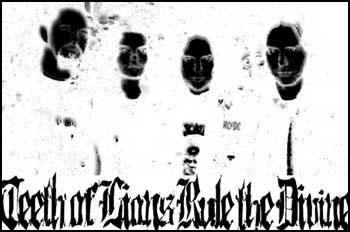
“AN UNHOLY INVOCATION OF CRIPPLING DOOM!!!!
The awaited birthing of doom architects’ morbid calling : Justin Greaves (IRON MONKEY/HARD TO SWALLOW) Greg Anderson (SUNN 0))), GOATSNAKE,THORR’S HAMMER), Lee Dorrian (CATHEDRAL, NAPALM DEATH) Stephen O’Malley (KHANATE, SUNN 0))), BURNING WITCH).
Black fumes non-verbal carnage spilled forth the unholy mines, minds and lanterns of Nottingham, UK January 2001. Souls cracked and burned, a fitting feast for low end wavetorment and high sound pressure hexing. Invocations of despair (vokills recorded) lain by Dorrian summer 2001. Six months rotting in the pits and graves to be unearthed and dissected by high necromancer Billy Anderson winter
2001. TEETH OF LIONS RULE THE DIVINE is the manifest of doomed mortality, divine suffering and flaggellation through trance and drone. In the memory of Jules Leach (R.I.P.) TOLRTD commanded forth a golem of leprosy, madness, and punishment. Prepare to be doomed.The album: “RAMPTON” by TOLRTD, will be unleased in North America by Southern Lord April 2nd 2002. It will be available in Europe through Rise Above Records 02/2002 “
The Machine
by Eduardo Galeano
Rebelion.org
April 27, 2002
[Translated by Francisco González]
Sigmund Freud had learned it from Jean-Martin Charcot: ideas can be implanted by hypnosis in the
human mind.
More than a century has gone by since then, and the technology of manipulation has made great strides.
This is a colossal machine, the size of the planet, that orders us to repeat the messages it puts inside our heads. Its a word-abusing machine.
The President of Venezuela, Hugo Chavez, had been elected, and reelected, by an overwhelming majority, in a much more transparent election than the one that put George W. Bush in power in the United States
The machine propelled the coup that tried to overthrow Chavez–not because of his messianic style,
or his tendency toward logorrhea, but because of the reforms he proposed and the heresies he committed. Chavez touched the untouchables. And the untouchables–the owners of the media and almost everything else–were outraged. With complete freedom they denounced the crushing of freedom.
Inside and outside his own country, the machine turned Chavez into a tyrant, a delirious autocrat and an enemy of democracy. Against him was the citizenry. Behind him were the mobs, which did not meet in rooms but in lairs.
The media campaign was decisive in the avalanche that lead to the coup, programmed from abroad against this ferocious dictatorship that did not have a single political prisoner. Then the Presidency was occupied by a businessman for whom nobody voted, and whose first democratic measure was to dissolve the Parliament. The stock market went up the following day, but a popular uprising returned
Chavez to his legitimate post. As Venezuelan writer Luis Britto Garcia put it, the media-engineered coup was able to generate only a virtual power, and it didnt last. Venezuelan television–a bastion of information freedom–did not get wind of the upsetting news.
Meanwhile, another voted-by-none figure who also took power by coup detat is displaying his successful
new look: General Pervez Musharraf, military dictator of Pakistan, has been transfigured by the magical kiss of the mass media. Musharraf says–and repeats–that the notion that his people could vote does not even enter his head, but he himself has given a vote of obedience to the so called “international community”, and that is the only vote that really matters in the end, at the time of reckoning.
He has come a long way indeed: only yesterday, Musharraf was the best friend of his neighbors, the Taliban. Today hes become the liberal brave leader of the modernization of Pakistan.”
And in the meantime, the slaughter of Palestinians continues. The worlds manufacturers of public
opinion call it a hunting down of terrorists. Palestinian is a synonym of “terrorist”, but this word is never used to refer to the Israeli army. The territories seized by continuous military invasions are called “disputed
territories.” And Palestinians–who are Semitic–turn out to be anti-Semitic.
For more than a century they have been condemned to atone for the sins
of European anti-Semitism, and to pay with their land and their blood for
a Holocaust they did not perpetrate.
There is a Gutlessness Competition
at the Human Rights Commission of the United Nations, which always aims
South, never North.
The commission specializes
in charging against Cuba, and this year Uruguay had the honor to lead the
pack. Nobody said: “I do it so that they buy what I sell”, or: “I do it
so they lend me what I need”, or: “I do it so they loosen the rope thats
tightening around my neck”. The art of good governing allows its practitioners
not to think what they say, but it forbids them from saying what they think.
And the media took advantage of the occasion to confirm, once again, that
the blockaded island is one of the baddies.
In the dictionary of the
machine, the bribes that politicians receive are called contributions,
and their betrayals are called pragmatism. The word security refers
not to notions of safety and protection, but to investments; and it is
in the stock exchange that these securities undergo all kinds of crises.
Where we see “the international community demands,” we should read: the
financial dictatorship imposes.
“International community”
is also the pseudonym that shelters the great powers in their military
campaigns of extermination, also called pacifying missions. The pacified
are the dead. The third war against Iraq is already in the works. As in
the two previous ones, the bombers will be called allied forces while
the bombed will be fanatic mobs serving the Butcher of Baghdad. And the
attackers will leave behind a trail of civilian corpses which will be called
collateral damages.
In order to explain this
next war, President Bush does not say: Big oil and big weapons need it
badly, and my government is a pipeline and an arsenal. Nor does he explain
his multibillion project for the militarization of space with words like:
We are going to annex the sky the way we annexed Texas. No, the explanation
is that the free world that must defend itself against the threat of terrorism,
both here on Earth and beyond, even though terrorism has demonstrated it
prefers kitchen knives to missiles, and despite the fact that the United
States is opposed–along with Iraq–to the International Criminal Court
that has been recently established to punish crimes against humanity.
In general, the words uttered
by power are not meant to express its actions, but to disguise them. More
than a century ago, at the glorious battle of Omdurman, in Sudan, where
Winston Churchill was both reporter and soldier, 48 Britons sacrificed
their lives. In addition, 27,000 savages died. The British were pushing
their colonial expansion by fire and the sword, and they justified it by
saying: We are civilizing Africa through commerce. They were not saying:
“We are commercializing Africa through civilization.” And nobody was asking
Africans their opinion on the matter.
But we are fortunate enough to live in the information age, and the giants of mass communications love
objectivity. They even allow for the point of view of the enemy to be expressed as well. During the Vietnam war, for example, the point of view of the enemy was 3% of the coverage given by ABC, CBS and NBC.
The Pentagon acknowledges that propaganda is part of the military budget, and the White House has
hired Charlotte Beers, a publicity expert who had pushed certain brands of rice and dog food in the local markets. She is now in charge of pushing the crusade against terrorism into the world market. Were selling a product, quipped Colin Powell.
Brazilian writer Millor Fernandes confirms that in order not to see reality, the ostrich sinks its head
in the television set.
The machine dictates orders, the machine stones you.
On September 11, the loudspeakers of the second twin tower in New York were also giving stunning orders, when the tower started to creak. As people ran down the stairs, the loudspeakers were ordering everyone to return to their workstations.
Those who survived, disobeyed.

