What The Heck Is Arthur Anyway?: A Quick Introduction
by Jay Babcock
Originally posted Oct 25, 2007 on Arthur’s Yahoo blog
What the heck is Arthur anyway?
Arthur is a critically acclaimed, transgenerational global counterculture magazine. We’ve been publishing it once every two months since 2002, giving it away free at record shops, used bookstores, coffeehouses, art galleries, movie theaters, shoe stores, hair salons, nightclubs, divebars, libraries, opium dens, juicerias, yoga studios, punk houses, all-ages venues, meditation spaces, ice cream trucks, colleges, food co-ops and other freak hideouts across North America. (If you haven’t seen Arthur before, you can order a hard copy from arthurmag.com. Of course if you need it NOWNOWNOW, you can download our latest issue as a PDF from our website also — but I gotta say the hard copy is really where it’s at — paper is portable, you don’t have to squint at it, the pages are designed to be viewed in a space bigger than most computer monitors anyway, and best of all, you can read magazines in the great outdoors — without using up any energy).
Arthur‘s mission is… um… Well, the main thing is it’s a labor of love. We cover what we want to cover. We write about what we want to write about. Generally speaking, we’re interested in the eternal underground, the edge of the envelope where freedom is freer, that tricky territory where new, progressive modes of art and behavior are tried out, whatever the period, whatever the mode. Kalakuta, Haight-Ashbury, Fort Thunder, Sao Paolo, Bolinas, the Lower Eastside, WhamCity: every interesting scene, or personage, is eligible. In each issue of Arthur, we gather together the best available talent — writers and photographers, artists and connoisseurs, filmmakers and video game designers, political actionists and festival organizers, ground-level poets and high-altitude observers — and let them share with us what they’ve found that is of particular interest, value, use. The idea is to bring stuff to the public’s attention — for free — that isn’t the dreary pop gunk that’s in our faces 24/7.
We’re not doing anything new, really. Just last week, The New Yorker ran a feature on the great learned historian Jacques Barzun, which included this tidbit: “In 1951, Barzun, [Lionel] Trilling, and W. H. Auden started up the Readers’ Subscription Book Club, writing monthly appreciations of books they thought the public would benefit from reading. The club lasted for eleven years, partly on the strength of the recommended books, which ranged from Kenneth Grahame’s The Wind in the Willows to Hannah Arendt’s The Human Condition and partly on the strength of the editors’ reputations.”
That’s not to suggest that Arthur‘s team of contributors is of that stature, only that we share the same general program of cultural uplift — a desire to be something of more use than the general consumer guide that masquerades as a magazine in these sad, devolving times. In the last few years, Arthur‘s contributors have included Byron Coley & Sonic Youth’s Thurston Moore, whose regular “Bull Tongue” review column has been absolutely essential reading for anyone interested in contemporary underground culture; authors Trinie Dalton, Douglas Rushkoff, Erik Davis, Brian Evenson and Daniel Pinchbeck; veteran journalists Kristine McKenna, Peter Relic, Gabe Soria, Daniel Chamberlin, Dave Reeves, Sorina Diaconescu, John Payne and Eddie Dean; photographers Melanie Pullen, Eden Batki and Susannah Howe; and countless other writers, cartoonists, photographers, poets and –of course– designers.
Has Arthur made a difference? Not as much as we’d like. A magazine’s cultural impact is always going to be hard to measure in quantitative terms. But, that said, it’s been interesting to watch how artists–and ideas–that got their first airing in a national magazine in Arthur‘s pages have subsequently entered the dim edges of the mainstream’s consciousness. Devendra Banhart? Read the first interview he ever gave anywhere in the pages of December 2002’s Arthur No. 2, or check out the cover feature on him in Arthur No. 10–which also featured the first long-form interview anywhere with Joanna Newsom, who herself would be covered in even greater depth in an award-winning piece by Erik Davis in Arthur No. 25. Ohioan blues rawkers The Black Keys, comics genius and magus Alan Moore, quixotic rock sibling duo Fiery Furnaces, drone-metal band Sunn 0))), avant-psych-pop group Animal Collective, M.I.A., West Coast psychedelic roarers Comets on Fire, the uncategorizable Six Organs of Admittance, the good ol’ Howlin’ Rain, comics genius Grant Morrison and woozy psychedelic soul nomads Brightblack Morning Light all received serious, substantial coverage in Arthur a while ago — not because we’re trendspotters or hypesmiths, but because we simply dug what they were doing while everybody else was busy covering…well, something else.
As for why the magazine is named Arthur…well, that would be telling. Have a guess in the Comments section below.
Nothing Left to Lose: What Happens When Music Becomes Worthless?
by Jay Babcock
Originally posted Oct 1, 2007 on Yahoo’s Arthur blog
In a few days Radiohead’s new album In Rainbow will be available on a pay-what-you-like basis to anyone who wishes to download it from them. Take it as a acknowledgment of what everybody already knows: in the digital world that the transnational entertainment-communications conglomerates have done so much to summon in the last 25 years, without apparent regard for the long-term consequences, recorded music—music that people used to buy—has become free. For established artists like Radiohead—or Prince, who launched his new album via a CD tacked on the front of a British Sunday newspaper, or his lordship Paul McCartney, who debuted his latest album through Starbucks, or (worst of all) the Eagles, who are releasing their new album exclusively through an anti-union discount store chain that shall remain nameless—this is all fun ‘n’ games. Like most artists, they’ve witnessed the music industry’s legendarily shady accounting practices for years, incredible feats in which record companies stayed in business yet somehow, when it came time to pay the creators, never made a dime. So it’s gotta be a big kick for all of these dudes to be able to thumb their shapely noses at those who have been screwing them for years. They ain’t gonna work on Maggie’s farm no more, and they’re telling us all about it.
Well, good for all of these guys (except the Eagles, of course). It’s hard to shed a tear for mega-corporations whose record companies are run by beancounters who are bad at math. And most of us weren’t likely to buy a new Radiohead album anyway, so “free” just means some of us will download it, listen to it and delete it. No loss there for anyone, I guess. Meanwhile, Radiohead will receive tons of applause from not just their loyal fanbase, but also the “information wants to be free” internet booster contingent. They’ll be the subject of every music-related conversation for weeks. And will rake it in at the turnstiles, as they always do, when they perform live. Though their music is now worthless, Radiohead’s value as an income-earning entity has increased. Savvy.
But hold on. What happens to those no-to-low-income artists, many of them doing signficant work, who haven’t established themselves in the pre-burn/download era? Going deeper, what happens to the entire infrastructure of artists, enthusiasts, record labels, live venues, stores and media (TV, radio, print, etc) that made Radiohead’s ability to give away their music possible in the first place? What happens to this ecology, unbalanced and out-of-whack as it already was, when its currency has become almost completely worthless?
The most immediate effect is already apparent: there are fewer and fewer mediated (or, curated) places devoted to music. In America, which has an underdeveloped commons, those places are marketplaces: in other words, record stores. And the really good record stores in this country—the ones owned and operated by knowledgeable enthusiasts, staffed by dayjobbing musicians and music freaks, local clearinghouses of art and information, where meaningful discoveries and lasting connections have historically been made—started disappearing a few years ago and extinction seems to be nearing. What’s going to replace these stores? The schools got rid of significant art appreciation and application long ago. Public libraries, our repositories of cultural knowledge, are criminally underfunded and understaffed. Publicly funded performance venues of all sizes exist all over Scandinavia and other parts of Europe, but good luck finding such spaces in the USA.
These spaces are important, because by containing elements of both chance and quality control, and by being in the real, physical, analog world, they increase the quality and complexity of communication between people. You take those away and you guaran-goddamn-tee a society of atomized, alienated consumers, disconnected cubicle people who gaze at computer screens more than each other’s faces: humans, in other words, in love with machines. Which, I guess, is what “Radiohead” means. Goodbye, art, community and communion: hello, paranoid androids.
Originally posted Dec 11, 2007 on Arthur’s Yahoo blog
Not so long ago, people could hardly wait for albums to come out, and with good reason: the album, for a time, was as good a vehicle for an artist’s ambition as a novel or a movie. The sleeve was a big-ass 12” x 12” art object you could put up on your mantle and scrutinize for days. The record itself had two sides, a formal restriction that forced artists to program their material into two sequences of songs, which meant that the artist was forced to listen to his or her material at least once before dumping it on the marketplace, and also that the artist was encouraged to consider the effect that sequence has on a group of songs. The phrase I most often yell at other motorists in Southern California, “MY WAR SIDE TWO MOTHERF***ER!!!” would have no meaning if Black Flag had not carefully integrated the three songs on that side into a single, illegal experiment in face surgery.
It’s not just because Julian Cope has taken the care to split his latest album, YOUGOTTAPROBLEMWITHME, into two discrete sides that it’s the best album I’ve heard this year, although the sequence is a beauty; to my ear it sounds like the world ends at least twice on side one. No, it’s because Cope’s record, a psychedelic polemic against monotheist religions and a psychic snapshot of the present moment, is only new album I’ve encountered this year (it says “2007 CE” right there on the spine) that fulfills the enduring promise of the New Rock Album. If your local record shop carries it — if there is a local record shop — you will sight it by its yellow, red and black cover, which reproduces a quote from Gore Vidal’s 1992 essay “Monotheism and its Discontents” in all caps and bold type, beginning “THE GREAT UNMENTIONABLE EVIL AT THE CENTER OF OUR CULTURE IS MONOTHEISM” and ending “I NOW FAVOUR AN ALL-OUT WAR ON THE MONOTHEISTS.” Beneath the text, the image of a massive, longhaired heathen rocker banging a bass drum lovingly painted with Cope’s crest (which depicts Odin’s sacrifice of his eye), ought to give you a clue to the sort of freaks you are dealing with: devoted, literate, pagan psychonauts committed to busting their guts and the chthonic Nuggets chords in the expression of Cope’s vision.
Cope’s work (records, books, web — see http://www.headheritage.co.uk) since the landmark album Peggy Suicide has elaborated a mythology and disclosed a scholarly curiosity about the world that makes him seem more and more like a genuine English visionary in the tradition of William Blake. What makes YOUGOTTAPROBLEMWITHME so remarkable is the balance Cope is able to maintain between his own obsessions and the violence of the time, so that Cope’s personal mythology enriches, rather than obscures, his imagination of the lives of different tribes of people trying to live together, or trying not to live together, all over the world. When Cope quotes the piano from the opening bars of Patti Smith’s “Gloria” at the end of the title track, or builds “Can’t Get You Out Of My Country” around the breakdown from Them’s “Gloria,” he’s reminding you that rock’n’roll has always defined the sacred as what’s right there in front of you, and drives the point home by sneering the phrase “invisiblegawwwwd” until it begins to sound like a Homeric epithet. I regret to say that the vinyl sounds like it was mastered by an agent for the casuists, as it is not nearly loud enough for my purposes. Pick up the double cd–the Arch-Drude wants you to listen to it in two “sides”–so you can let those steam-whistle post-Ubu synths get in there good and deep to dismantle your brain stem so you can properly reevaluate your cosmogony.
Originally posted Dec 7, 2007 on Arthur’s Yahoo blog
While most of the country is stumbling over each other, filling shopping bags with the latest accessories to 21st century life, we at Arthur headquarters are leisurely loading up the annual time capsule in an effort to preserve some evidence of civilization’s existence for future generations. The capsule will be launched into orbit from an undisclosed location in the high desert at exactly 11:59 pm on December 31st and is scheduled to re-enter the earth’s atmosphere, should it still exist, in 2095.
Filling the frontal lobe of the Soviet-designed, cigar-shaped capsule (Ebay score circa Y2K), are two of this past year’s standout reissue programs: the first three Leonard Cohen albums (Songs Of Leonard Cohen, Songs From A Room, Songs Of Love And Hate) and the first three Townes Van Zandt records (For The Sake Of The Song, Our Mother The Mountain, Townes Van Zandt–all available from Mississippi’s Fat Possum Records).
It was a good year to be reminded of the power of song. These collections celebrate two of this country’s finest lyrical poets; the fact that one of them is Canadian only adds to our pride. Both men have been loved and loathed, revered and scorned for their moody evocations of wandering desire, sparse and haunting arrangements, and, to some uptight ears, flat and unmusical singing voices.
While similarities between the lives of Cohen and Van Zandt also abound–the old world family money and education, the brooding depression, the mythical lifestyle of earthly excesses (Cohen: women and wine, Van Zandt: wine and women, in that order)–Cohen was city poet to Van Zandt’s country poet. Cohen sings his songs of self from the perspective of an Old Testament Prophet transplanted in Greenwich Village. You don’t listen to his songs, you enter them, through a haze of incense and cigarettes, at 3 a.m., through an unmarked door in whatever bohemian neighborhood you temporarily call home. Van Zandt may have set out for the city but never quite made it there, distracted along the way by his cowboy fantasies, tumultuous romances, and the winding backroads that lead to the isolated cabin in Tennessee where he spent much of the ’70s. As he sings on “I’ll Be Here In The Morning” from both For The Sake Of The Song and Townes VanZandt, “There’s no prettier sight than looking back at the town you left behind.”
While a finely penned lyric doesn’t seem to be first priority among today’s musical acts, in the late ’60s it must have mattered. Those big 12″ x 12″ lyric sheets were meant to be read and contemplated, preferably by candlelight while huddled around your turntable.
Recorded roughly during the same years (’67-’70) and locations (Los Angeles and Nashville), Cohen’s and Van Zandt’s first three records are each masterpieces of songwriting, modulating from simple love ballads to moral fables to surrealist (some might suggest psychedelic) visions in ways that speak in the particular vernacular of their chosen personas. The songs on these records carve out portraits of what in less cynical times was referred to as the Human Condition. Love, lust, death, demons, and loneliness wage battle among delicate arrangements of mostly acoustic instruments. The voices are deep and grounded, almost unexpressive narrators that belie the turbulent emotions boiling beneath the surface. The production treatment given to these albums is also key to their magical appeal. For both artists, the voice is always front and center, articulated, and clear, but various production anomalies make their albums less of the usual “folk singer” fare and closer to the realm of the more artistically minded “rock” album.
Cohen’s voice tends to embody both a whisper and a growl, inhabiting a rumbling frequency that seems to advance and recede from some dark reverberant tunnel. It is well known that Cohen fought to keep the arrangements minimal and drum-free on these early recordings but as we all know, the devil is in the details. The ghostly appearance of accompaniment by calliope, jew’s harp, strings, spaghetti western guitar, flutes, accordion, a children’s choir, flugel horn, and occasional percussion transport his records beyond genre and make them oddly timeless.
There is a little more variety as well as controversy in the Van Zandt catalog concerning the production that surrounds Townes’ polite East Texas drawl. Unlike Cohen, Van Zandt took a more Laissez-faire approach to the recording studio, thinking that if the songs were good enough they could withstand any producer’s meddling. His first record, For The Sake Of The Song, is almost universally criticized as overproduced, to the point that producer Cowboy Jack Clement has reportedly since apologized. The galloping percussion, droning recorders, wall-of-sound backing vocals, and waltzing harpsichord, all wrapped in a slushy reverb, certainly taint the album with a feeling of Hollywood cowboy kitsch that was probably not what Townes had in mind for 1967. At this distance though, its baroque stylings sound almost avant garde and it’s interesting to hear the energetic arrangements contrast downbeat tracks like “Waitin’ Around To Die.” By the time we get to the third album Townes Van Zandt, his re-recording of this track as well as several others from the first album, has settled into the sparse and pristine production style that would characterize most of the rest of his recordings, but flourishes of sporadic drums and the recurring harpisichord and recorder still sneak in on a few tracks. Our Mother The Mountain was the genre-defying transitional work between the two, and a shamefully underrated monument of late ‘60s musical history, with subtle atmospheric textures and gorgeous string arrangements that elegantly counterpoint Townes’ fever dream lyrics.
If the English language is eventually phased out with future generations in favor of a communication method based entirely on ringtones, the more curious members of this future society will at least be able to ponder the mysterious portraits that adorn the jackets and sleeves of these records. “Gods?,” they’ll wonder at the iconoclastic figures staring back at them. We are fortunate to still know the truth: not gods, but simply men with something to say.
Mark Frohman is Art Director of Arthur Magazine and shares Townes Van Zandt’s hometown of Houston, Texas.
Is This Not Bonkers?: Wild New Pirate Music From New Orleans
by Gabe Soria
Originally posted Dec 3, 2007 on Yahoo’s Arthur blog
Friday, November 2nd, 2007, New Orleans: The Saturn Bar on St. Claude in New Orleans, a place you’ve probably heard of, even if you’ve never been to New Orleans. T-shirts bearing its stylized planetary logo and address are ubiquitous leisurewear among certain sorts of folks in cities worldwide. Its fame is well deserved–it’s a friendly and immaculately disheveled corner watering hole, kind of like the platonic ideal of Southern urban dive bar, complete with great signage. The stretch of real estate it’s on–St. Claude Avenue between the railroad tracks near and the bridge to the Lower Ninth Ward–is unapologetically spooky after dark. Gunshots in the distance: check.
But still, it’s inviting.
The occasion tonight is the record release party by the Valparaiso Men’s Chorus, a project of local musician Alex McMurray. The wife and I haven’t heard a note of music from the record yet, though McMurray’s former outfit, the Tom Waits-esque trio Royal Fingerbowl, are a favorite around the house.
We’ve just heard compelling code words: “sea shanties” and “beer” and “Saturn Bar” and decided that attendance is mandatory. Turns out, it’s the type of show that you realize you’re going to be telling people about until the end of your days. For real.
The car is parked on the neutral ground in the middle of the avenue, directly between the Saturn Bar and the Spellcaster Lodge across the street. Entering the Saturn Bar, the mood is instantly, irrepressibly ebullient. Folks are drinking Miller High Lifes like they’re going to stop brewing them at the stroke of midnight, and more than one person is dressed like a PIRATE. Actually, the crowd is liberally sprinkled with pirates. Friends greet us with grins; some people lounge casually in booths and others jockey for position at the bar in the Saturn’s ramshackle front room. I realize that it’s been a long time since I’ve felt such an unselfconscious BUZZ before a show, like people don’t know exactly what’s going to happen and are DIGGING it. It’s like they’re on really good, really happy drugs.
Finally, the needle tips, and folks start cramming themselves in front of the nonexistent stage, located under a balcony that runs the length of three sides the Saturn’s back room. The small venue feels like a time warp, like you’re attending a rocking show in the back of a second-tier bordello in 1915. The small band has assembled, looking well lubricated: McMurray on banjo; Chaz Leary and Matt Perrine, his band mates from his primary band, the Tin Men, on washboard and sousaphone, respectively, and the addition of Jannelle Perrine on pennywhistle, and Carlo Nuccio on bass drum. And then there’s the Valparaiso Men’s Chorus themselves: at least 20 strong, maybe more of them, weird moustaches, ruddy faces, big grins, a bunch of dudes and a smattering of ladies who serve as the crew on this ship.
McMurray takes a moment to instruct the audience on the chorus of the group’s first song, “What Do You Do With a Drunken Sailor?” and the group barrels ahead. What follows is nothing short of extraordinary.
What could have come off as pure novelty (“Hey, guys! We’re going to sing a bunch of sailor’s and pirate songs!”) instead becomes a roaring thing of rough beauty. McMurray actually learned many of these songs while playing the character of Cap’n Sandy, a roving sailor minstrel at Tokyo Disney, but instead of covering the tunes, he seems to be channeling them from some alternate universe where Alejandro Jodorowsky and Werner Herzog asked him to do the soundtrack for their NC-17 version of the Pirates Of The Caribbean films. The band plays these old songs as if they were born to them, skipping reverence and piousness and going straight to their dirty hearts. It’s raw, nasty and funny; some lyrics have been changed, some have been added, but it’s all honest and kinda dirty. And the Chorus themselves… yikes. They’re howling and smiling, and the crowd picks up on their lyrics, singing and bellowing along with them. It’s the real old, weird America to paraphrase, right here in a bar in New Orleans. Strangers in the crowd link arms and sway back and forth; soon, it seems as if we’re all pitching back and forth in the hold of a ship about to go down. People are dropping beers, drinking multiple beers and forming a real (and really drunken) community around some blazing hot music. And everybody, by the time the shindig winds down, is exhausted and deliriously HAPPY.
You don’t see that too often at a show, not nowadays.
The wife and I are so happy and toasted, we forget to actually purchase Guano And Nitrates, the self-released CD from whoever’s selling them, so have to contact McMurray a couple of days later and drop by his place to purchase it directly from him on his porch. And the record itself… I’m reminded of something Jay-Z once said about R. Kelley: “Is that not bonkers?”
Recorded live at the end of 2004 at the now-shuttered Mermaid Lounge, nothing seems to have been lost in translation and the intervening years (the band itself has only played live three times). Nothing. It’s a raucous party record and folk archaeologist’s dream all at the same time. These are old songs done right. It’s the real folk sh*t: hard and hilarious and rousing. Man, it’s been awhile since I’ve heard and seen something so dirty and lovely and real.
Gabe Soria is a contributing editor to Arthur magazine.
Things That Go Swing in the Night: The Rhythmic Gambits of Joanna Newsom & Jason Spaceman
by Peter Relic
Posted Mon Nov 26, 2007 in Arthur’s Yahoo blog
“It don’t mean a thing if it ain’t got that swing,” Ella Fitzgerald once sang, but in the half-century since then popular music has accorded meaning to a wide variety of rhythmic developments, swinging and otherwise. Two recent concerts however–one by Joanna Newsom at the Frank Gehry-designed Disney Concert Hall in downtown Los Angeles, and one by Spiritualized at L.A.’s ornate Vista movie theater–brought Irving Mills’ original lyric to mind. One swung, one didn’t. And what a difference it made.
I first saw Joanna Newsom perform in 2004 at Cleveland’s Beachland Ballroom (still my favorite venue in the U.S.). Accompanied only by her own harp, Newsom rendered the songs off her then-new The Milk-Eyed Mender LP faithfully, but with one profound difference: they swung like all heck. The technical excellence of Newsom’s harp-plucking became both more limber and more muscular in person, turning tunes like “The Book Of Right-On” into virtual funk workouts. She improved upon the recorded versions of her songs by realizing their additional rhythmic potential, thus evoking late great harpist Dorothy Ashby, whose albums Afro Harping and The Rubaiyat Of Dorothy Ashby are mystical jazz-funk classics.
So it was with great interest that I went to the Disney Hall performance this November 9th. Newsom performed songs from her complex-yet-accesible Van Dyke Parks-arranged album Ys backed by not only the L.A. Philharmonic but by three members of her Ys Street Band: a violinist, a banjo player, and a barefoot bowlcut drummer. Using both drumsticks and his hands, the drummer beat ultra-luddite 4/4 beats that had a twofold effect: first, he made V.U.’s Moe Tucker sound like Rashied Ali by comparison; second, he wrung all the rhythmic complexities out of Newsom’s music. When a member of the Philharmonic took to the vibraphone, it seemed like the whole thing might start to swing, but the vibes were inaudible. After the intermission, when Newsom performed sans-Philharmonic but with her quartet, the music retained its ethereal essence yet often seemed plodding. While it’s likely that my listening experience was affected by variable factors (an unbalanced soundmix, my upper tier seat), Newsom’s unaccompanied encore underscored the fact that strictly on-the-beat drumming inhibits the rhythmic possibilities of her songs.
Admittedly this is merely a matter of taste–the thudding drumming and approximately Appalachian style of her quartet set-up drew approving whoops from the crowd. But I’d love to hear her sometime backed by a nice little jazz combo.
A few days later I had the good fortune of seeing Spiritualized play on what could’ve been called their Acoustic Mainline Gospel-With-Strings tour. Leader Jason Spaceman, who has taken the sunglasses-at-night motif into the new millenium, rearranged his songs for a group that consisted of guitar, electric piano, two violins, viola, cello, and three female backing singers. No drummer, and no need for one–the absence of a drums created a huge space of rhythmic possibility, and the swell and ebb of the strings and voices realized the implicitly syncopated nature of that potential. Songs like “Going Down Slow,” “The Straight And The Narrow” and “Anything More” — slightly jazzy in recorded form–seemed to swing more than ever in their drum-free renderings.
I can’t help but think that the extraordinary uplift that I felt at the Spiritualized show–I’d go to church every week if it felt that good–had a direct correlation to the fact that the music swung. Which is not to say that the Joanna Newsom show didn’t mean a thing. It’s just that Spiritualized meant that much more.
They were ‘60s student radicals who wanted to take down The Man by “bringing the Vietnam War home.” Documentary filmmaker Sam Green on the saga of the Weather Underground.
by Matt Luem
Originally published in Arthur No. 6 (Sept. 2003)
History has a way of distinguishing acts of political courage from acts of political suicide. The Weather Underground, a new documentary by Sam Green and Bill Siegel, is a grave demonstration of the fine line between the two: it is at once a brilliant history of an American outlaw group, and a meditation on the consequences of political action.
The Weathermen, as they were commonly known, were a splinter group of the Students for Democratic Society, a politically radical student organization focused on opposing the American war in Vietnam. Weaving together the most gripping—and violent—images of the ‘60s with a series of intimate present-day testimonials from former Weathermen, The Weather Underground takes us to the doorsteps of Americans willing to trade their families, security and precious youth to take down The Man.
The following interview was conducted by email with Sam Green on the eve of the film’s theatrical roll-out.
ARTHUR: What led you to this story?
Sam Green: I read something about the group as a teenager. I’m 36 years old and I grew up in the ‘80s. The ‘80s was a pretty bleak time, especially in East Lansing, Michigan, where I grew up. The story of the Weather Underground somehow resonated with me, in part it was a kind of adolescent fascination with the violence and the outlaw mystique of the group. At the same time, there are a lot of serious issues there too. I always did feel on some level that radical change was, and is, needed in this country.
About five years ago, I found a report by the US Senate on the group during the mid -‘70s. In this book there were a few pages with mug shots of all the Weather Underground people. They were very powerful photos, and everyone’s expressions were intense–very defiant and tough, yet at the same time, you could see a little trace of these middle-class white kids. I was floored by these images.
What’s more, as I was looking through the photos, I realized that I knew one of these people! It was a guy who lived in Oakland who was a friend of a friend. I called him up and asked, “Were you in the Weather Underground?” He said, “You found out about my secret past.” There’s really very little info on the group, anything that has been written portrays them as crazy lunatics who ruined the ‘60s. When I started going over to his house and talking to him about the story, the version that he told me was much different, more nuanced and morally ambiguous than the popular version.
So I hooked up with my old friend Bill Siegel, who lives in Chicago, and we started work on the film about five years ago.
I remember raving. I remember Ecstasy. I remember chewing on a piece of gum until it broke—until it turned into something else, something weak and viscid, its gummy properties of twang and bounce quite exhausted. Symbolic? I thought so. I remember the mad foam of chemical brotherhood. I remember insisting, deep in some woofing, thumping London club, that two people I had just met stand next to me with their heads touching mine so that I could enjoy the warmth of their nude ears (we all had very short hair). And I did it in San Francisco too, where the loonies are—a man at a ‘smart drinks’ bar, wearing an Anarchic Adjustment t-shirt, told me that in the course of his psychedelic researches he had become invisible for nearly three weeks.
I know a little bit about it, is what I’m saying, but Julie Drazen’s Rise —a movie about New Orleans rave promoter Disco Donnie—still surprised me, because guess what the kids have done now? They’ve taken raving—the most godless, pharmaceutically programmed, pseudo-spectacular trip there is—and gone and made a religion out of it. And because their minds have been weakened by drugs and flashing lights, they have christened this religion with the anaemic acronym PLUR. PLUR, for Peace Love Unity Respect, which they pronounce as a single syllable to rhyme with “purr.” Oh dear. “Jesus preached PLUR!” declares a girl with awful Ecstatic earnestness, filmed against a colourless background. The bass frequencies of an offscreen rave shimmer around her, and her jaw is lunging about like something trapped. “And he probably smoked bud too!” Her boyfriend is even worse, a drug-electrified fanatic, unable to do anything more than twitch his head in agreement. Rave as spent cultural force? Just say that word PLUR and hear the energy leaking out of you, away from that promisingly plosive beginning—the pop! of newness—into entropy, wasted breath, the heat-death of the universe etc.
Not to bash the kids: they have an absolute right to their foolishness. And if they make it through, if they don’t entirely ransack their life’s ration of serotonin and good luck, who knows, they could end up as wearily wise as me. But there does seem to be some synchrony going on here between the powers of Ecstasy and the credulousness and positivity of the American national character. British ravers, though drugged like shamans, were by and large a pasty-faced, sardonic crew. They kept it—I won’t say real, but realistic. UK rave had its cranks and ideologues of course: one thinks for example of the magnificent shaven-headed Spiral Tribe, illegal party planners and white label artists, speculating on mystical vortices, intoxicated with the number 23, bouncing grimly in churned fields and in the corners of squats. But an essential British narrowness was always part of it. This was part the distinct pleasure of the whole trip: beneath the skin of the most blazingly loved-up raver, his open arms extended zombie-like towards you, you could always discern the sunken shrewd skull-face of the morning after, the colour of an empty milk bottle. The spidery ironist Jarvis Cocker made fun of us all: and you want to call your mother and say /”Mother, I can never come home again/’cos I seem to have left an important part of my brain/ somewhere, somewhere/ in a field, in Hampshire (“Sorted For E’s and Wizz”). In America there was Timothy Leary in his robes. There was twinkling Terence McKenna, that one-man rocket-ship leaving the Ego behind. It was in America that someone actually said to me, muffled deep in an embrace, “I don’t know who you are, but I fucking love you.”
Originally published in Arthur No. 6 (Sept. 2003) as part of our Stooges “One More Cool Time” feature package
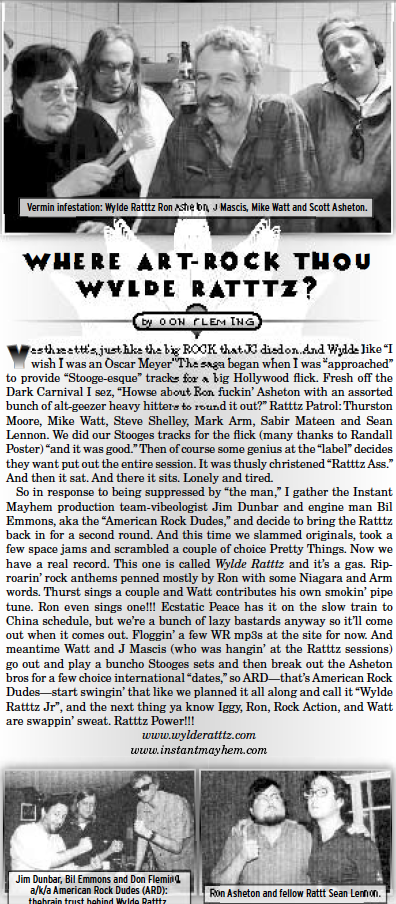
Yes three ttt’s, just like the big ROCK that JC died on. And Wylde like “I wish I was an Oscar Meyer” The saga began when I was “approached” to provide “Stooge-esque” tracks for a big Hollywood flick. Fresh off the Dark Carnival I sez, “Howse about Ron fuckin’ Asheton with an assorted bunch of alt-geezer heavy hitters to round it out?” Ratttz Patrol: Thurston Moore, Mike Watt, Steve Shelley, Mark Arm, Sabir Mateen and Sean Ono Lennon. We did our Stooges tracks for the flick (many thanks to Randell Poster) “and it was good.” Then of course some genius at the “label” decides they want put out the entire session. It was thusly christened “Ratttz Ass.” And then it sat. And there it sits. Lonely and tired.
So in response to being suppressed by “the man,” I gather the Instant Mayhem production team-vibeologist Jim Dunbar and engine man Bil Emmons, aka the “American Rock Dudes,” and decide to bring the Ratttz back in for a second round. And this time we slammed originals, took a few space jams and scrambled a couple of choice Pretty Things. Now we have a real record. This one is called “Wylde Ratttz” and it’s a gas. Rip-roarin’ rock anthems penned mostly by Ron with some Niagara and Arm words. Thurst sings a couple and Watt contributes his own smokin’ pipe tune. Ron even sings one!!! Ecstatic Peace has it on the slow train to China schedule, but we’re a bunch of lazy bastards anyway so it’ll come out when it comes out. Floggin’ a few WR mp3s at the site for now. And meantime Watt and J Mascis (who was hangin’ at the Ratttz sessions) go out and play a buncho Stooges sets and then break out the Asheton bros for a few choice international “dates”, so ARD—that’s American Rock Dudes—start swingin’ that like we planned it all along and call it “Wylde Ratttz Jr”, and the next thing ya know Iggy, Ron, Rock Action, and Watt are swappin’ sweat. Ratttz Power!!
RON & SCOTT ASHETON on their past, present and future.
by Jay Babcock
Photo by Peter G. Whitfield, art direction by W. T. Nelson
Originally published in Arthur No. 6 (Sept. 2003)
Following the second (and final) split of the Stooges in 1974, Ron and Scott “Rock Action” Asheton’s next joint effort was to form New Order, who released a single eponymous LP that gained little critical or commercial notice. Scott did some work with ex-MC5 Fred “Sonic” Smith’s band, Sonic Rendezvous, while Ron went on to work briefly with the second, post-Mike Kelley/Jim Shaw version of Destroy All Monsters, a sort-of Detroit supergroup, before forming The New Race with Stooges acolytes Deniz Tek and Rob Younger of the Australian power rock group Radio Birdman. The New Race released a single quasi-live album, in 1981, and then was no more. In the ‘90s, between taking roles in his beloved low-budge horror films (his filmography includes Hellmaster [‘92], Legion of the Night [‘95], Mosquito [‘95] and, of course, Frostbiter: Wrath of the Wendigo [‘96]), Ron recorded with a group called the Empty Set, and performed and recorded with singer/Destroy All Monsters alum Niagara in a new group called Dark Carnival.
Ron’s participation in the Wylde Ratttz sessions in ‘98 [see sidebar] eventually led to an invitation by J Mascis & the Fog to play songs live dates with his band, then featuring ex-minuteman Mike Watt on bass. Watt, who had been playing the Stooges songs for years (see “From a minuteman to a Stooge”) was the singer on the Stooges songs the band performed each night for the numbers when the group wasn’t being joined by guest vocalists, which was often. These shows attracted enough heat for Sonic Youth, curators of the 2002 All Tomorrow’s Parties, to ask Asheton, Mascis and Watt to do an all-Stooges set at the UCLA festival, with secret guest vocalists.
At this point, Scott “Rock Action” Asheton was coaxed back into the spotlight. Working on a piece for the LAWeekly to coincide with that ATP show, I caught up with Scotty down in Florida to ask him what he‘d been up to. “I’ve been playing with various musicians and bands, did some touring, did some recording with Capt. Sensible from the Damned and Sonny Vincent,” he said. “But I’ve got a daughter now, and mostly I’m just busy being a dad.”
Although Scotty had kept in contact with Iggy, his dreams of some sort of reunion of the Stooges hadn’t come to pass. “I used to call up his management and kinda bug ‘em about if there’s a chance we could get together, him and myself and my brother and do an album. He used to tell me ‘Well he’s not opposed to the idea but he’s just really busy.’ I think the people would like it, I think it would be cool if me, my brother and Iggy do some things… You know, there’s a lot of good memories and a lot of bad memories. It’s too bad that the band had to fall apart when we did, but it was due to things that were out of our control. Me and James [Williamson, the band’s second guitarist] and Iggy were having some problems, and as a result the band fell apart. I always felt bad for my brother because he kinda got the raw end of the deal. It really wasn’t his fault that things went the way they did.”
Although he was aware that the Stooges’ records had continued to win the band fans three decades after their initial release, Scotty had obviously long lost interest in contemporary rock. As I read off the names of the people he’d soon be performing with, he said, “To tell you the truth, I don’t know anything about ‘em. I was asking other people, and they were saying Well [J Mascis] is from Dinosaur Jr. And I’m going Well, sorry again, then. Never heard of them. But if Ron likes them, they gotta be good.”
They were good—it was a lineup of singers that included Watt, Sonic Youth’s Kim Gordon and Thurston Moore, Eddie Vedder and Queens of the Stone Age’s Joshua Homme—but, in the end, none of them, of course, was Iggy. (By the same token, as good as his solo work has been, Iggy has never had a band that approached the utterly primordial, shamanic genius that was the Stooges, either.)
After several months of tantalizing rumors, in February 2003 the Ashetons reunited with Iggy Pop to record some new Stooges songs for Iggy’s new solo album. The sessions, produced by Iggy at a studio near his Miami home, yielded four songs and a tentative interest in performing live as the Stooges again. I caught up with Ron—Scotty remained elusive—to find out how this all went down. The following Q & A is culled from two phone conversations with Ron—one took place just prior to the 2002 ATP show, and the other, less than a week before this issue of Arthur went to press in late July. — Jay Babcock
Arthur: So, how did this happen?
RON ASHETON: Well, Iggy called up and he goes, ‘Well hey, what’s happening?’ We did small talk for about 20 minutes and then he goes, ‘Well the reason I called was I was wondering if you’d be innerested in a project. You can say yes, or you can say no, and I don’t care, I understand. And if you say yes, you can call me back in two weeks and tell me to go fuck myself.’ [laughs] But I said right away, Yes, sounds cool to me.
I went down to Florida. My brother, who lives there part of the year, was already there. Jim—most people know him by Iggy but we call him Jim, usually—came to the hotel and he goes, Well I know a fun place to eat. So we went. I was a little nervous, I hadn’t seen him up close, shake-hand close, since 1980. He’s a guy that was one of my best friends, that I haven’t really talked to, or seen, in many years—and I’m there to work, to do music! Whoa. So I go, [mock melodramatic voice] ‘God, please make it good.’ So we talked and had dinner. The next day we went to his house and we visited for about an hour and a half and then we went to the studio. And it was easy. From then on, it’s like there was no time in between… It was great. I think I appreciate it and enjoy it more now. I like the things we talk about. And I’m proud of what he’s done.
You guys weren’t just in a band—you all lived together in the old days. That stuff doesn’t really go away, does it?
We started out with our first band house, our little summer sublet, and then we moved on to a farmhouse and then another farmhouse and then out in L.A. Not to mention all the thousands of shows on the road through the years. So we’ve got a lot of time between us.
How were the new songs written?
I had some things and I got pieces and I started workin’ on stuff. So we talked as the time was approaching to go to Miami, I had a talk with him and he goes, You know, you can bring stuff down, or you can bring pieces, or you can bring down nothing at all. So I decided to bring nothing. [laughs] But the night before I left, I’m going, Well I gotta have an icebreaker. So I came up with that thing for “Skull Ring.” And we jammed on that. That got turned into a tune. And then I said, “Well Jim, why don’t you stay at home and give me about four or five hours before you come to the studio tomorrow, and let me see what I can come up with.” Before I went to bed that night at the hotel, I’m lyin’ in bed and I got a riff stuck in my head. I started out on that the next day and it just came quickly—I wrote “Little Electric Chair” in 15 minutes. I did three things. One of ‘em didn’t make it to the record cuz we didn’t have time. So I wrote ‘em, brought my brother in, taught him the song, recorded it and then I laid a bass track on it. One hour later, I brought him back in. He goes, “Ready already? You just taught me the other one!” And I go, “Yeah well I got this other one.” And we just did that. It just was flowing out of me, cuz I was excited about doing it and I liked that studio. I felt real comfortable there. I knew that it was important, and I knew that we didn’t have a lot of time. But luckily it just worked out. The stuff just flowed right out. Then Iggy came and he goes, Yeah this is cool.
You use the same little riff on the bridge for ‘Loser’ as there is at the beginning of ‘Dead Rock Star’…
Iggy had that basic piece, and I kinda toughened it up, played into that more. I used that descending riff on ‘Dead Rock Star’ just to show him it was good. I gave him a lot of options to choose from. And he wound up going, Well I like both of ‘em. I go, Just do it man. It’s great how they cut it up. He was a little hesitant to play ’Dead Rock Star’ for us. He goes, Well I got this idea for this song but I don’t know… I go, [mock impatience] Just play it for me! And I go, No man it’s cool. I really like that. He didn’t know what he thought about it. Then he started liking it. I go, No it fits it, I really like that, cuz you got different things on our stuff. You got Stooge voice, and…you’ve got your crooning and even on the other Stooges songs, the voices are a little different. And I get a kick out of the album—[mock DJ voice] ‘It’s Iggy playing with Green Day. It’s Iggy with Sum 41.’ On the record [as a whole] he does all kinds of stuff. It’s cool.
On a couple of the songs you do a sort of prelude riff before the ‘proper‘ riff comes in, like you did on ‘1968’ and ‘Loose’ —
Yeah, we talked about this also. He goes, People are gonna expect it to be kinda like the Stooges. Cuz I’d sent him a bunch of stuff I did with the Wylde Ratttz and that was not very Stooge-y. He liked the stuff, but he was also a little worried that I might be too good. [laughs] Which, you know, in all my other songwriting with other bands they’re always going, ‘It’s a great song but you wouldn’t think that was a Stooges song.’ Well you know, I got a little better! And I’m having fun experimenting and it’s boring [to play simple stuff] as I learn more. So [getting more technically proficient] has kinda been a blessing and a curse for me. And Iggy was concerned and I also was concerned, that I needed to think primitive for this. It wasn’t as hard as I thought it was, just to go back into that feeling.
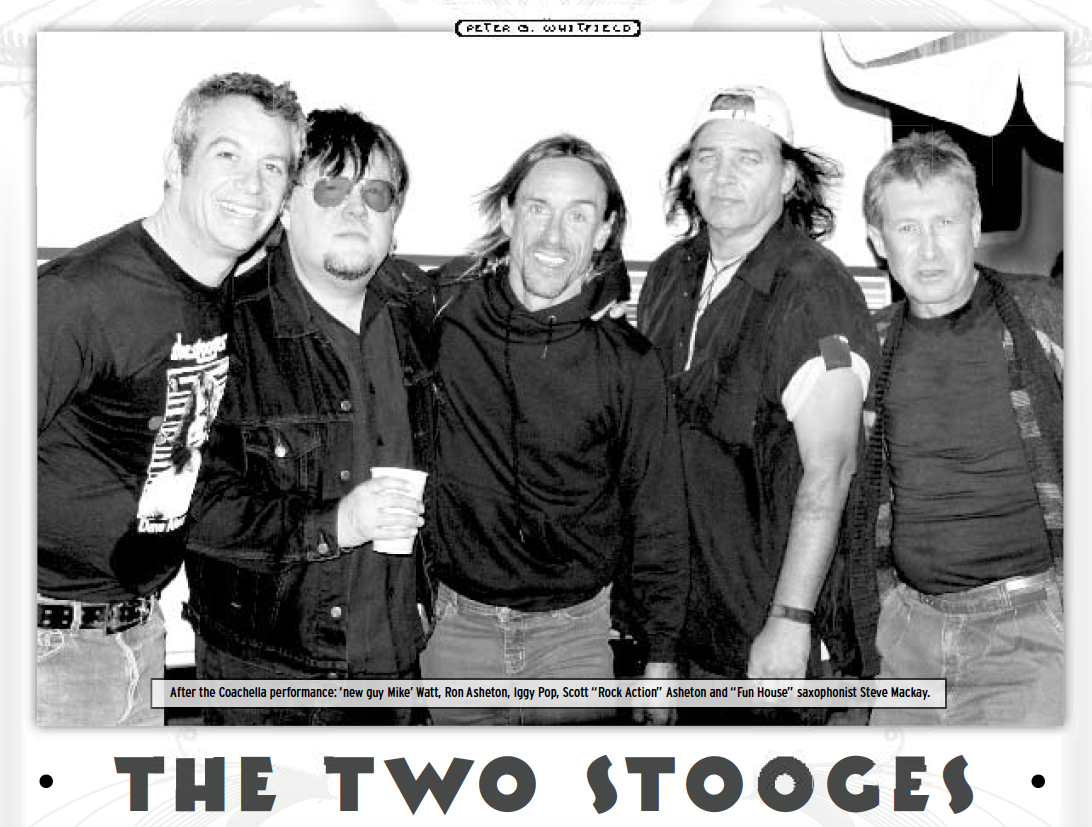
What was really amazing for me was playing at Coachella, because I was figuring, I’m a little a bit better player so maybe I’ll rip off a couple slicky riffs or something for leads, but when I started doin’ it [at rehearsal], uh oh I’m kinda stuck all of a sudden. But once I was up there onstage and doing it, it was like I switched back to primitive mode. I just started playing simpler and a lot of those old riffs came back to me. I’m going ,Well goddamn I rehearsed this, but just being up there, it made some kind of magic that brought it all back to that kind of primitive stuff.
Has it been strange, the three of you doing Stooges again and Dave Alexander not being there with you?
No… because I’d been doin’ it a bunch with others. But Dave was there with me in spirit, because…I thought about that a lot, and I talked to my brother about it. He goes, Well Dave’s right here with me now, man. That’s how we all felt, and that’s why my brother gave Mike Watt the Dave Alexander t-shirt to wear, and Watt was so into it he wore it every day at practice too. We thought about Dave. When I took breaks I would say, You know thanks to you, Dave. You were part of this, and…you should be proud. Cuz I’m so proud that you were a part of it. He was a very inneresting bass player. Watt goes ‘Man just listen to him, he was a tripped out bass player, that thing he does on TV Eye that just kinda rubber bands around your thing, that’s brilliant.’ We always miss him—I think about him every day, I always have. There isn’t a day go by that I don’t think about him a bunch. I’ve had many other bands, so I didn’t miss him in that sense. But I wish he coulda been here.
I think listeners and the audience have always thought of Iggy as being fearless and spontaneous, but you’re talking about him being uncertain about songs…
Well, for me, I like that edge for playing. I like to know that everyone knows the song, and there is a format: you got your basic song. But I enjoy what might happen within the tune. With Jim what’s amazing is he is—and we talked about this—he’s really worked hard on his stage show. He’s perfected it. He’s a better showman. He doesn’t beat the hell out of himself like he used to. If something came into his head, bam, he’d do it. But now he paces himself better. I mean, if you coulda seen some of the shows way back when, it was like, man, the guy just went out and played a whole game of football in an hour. He’d always be battered up. He always hurt himself, almost all the time. Mostly at the beginning by accident: hitting the mike stand, take a tumble, do a swan dive off the stage and people got hip to it, here he comes, they thought it was funny, the parting of the crowd sea, and I’d go, Uh oh shit, they all moved! To see him just swan dive into a bunch of folding chairs and a fuckin’ floor.
At the time, did that recklessness seem stupid to you? As in, if he hurts himself, how are we gonna do the show tomorrow?
I knew he would never really hurt himself. I’m surprised he didn’t break any bones. But he got cuts and bruises and stitches. I would have so much fun watching him—even at Coachella I was going, Oh shit, I gotta get my head back in the ball game, I’m watching Iggy. I got this smile on my face and I’m just watching him. [laughs] I never smiled in the Stooges! That’s part of my THING. I’m just supposed to stand there, no smile on my face. Which I always did, it was kind of a natural thing for me back then. That was my schtick, kind of: I was holding down the fort. But it was fun just to have enough muscle memory with the tunes at Coachella where I could kinda step out of myself for a couple seconds and see what’s goin’ on. I had a good time. [laughs] I was going, Man he’s sure knocking himself around. I’m going, Uh oh he’s not gonna really go into the crowd. And there he goes. I go, Goddamn dude. For all the things, the battering he’s taken onstage, and all the abuse he’s done to himself, he’s fared very well.
It was an extraordinary performance. A lot of us were losing it—I don’t think anyone really ever expected to get to see the Stooges again. Could you tell from onstage how astounded the audience was?
You know what, I never thought it would happen either. I’d thought Jim was pretty happy with his solo career. He’s very proud of it, and he should be. He likes being…Iggy Pop. But, this will help him also. And yeah, I could tell, I could see the faces. You know [people are in shock] when mouths are open and eyes are wide and they’re really just trying to drink it all in. It was very cool. At first I was nervous, until we started the first song and then I was fine.
And what a trip to have Steve Mackey there for “Funhouse” and “L.A. Blues”!
Yeah! He goes, ‘It’s my same horn.’ I go, ‘No way, you didn’t throw it in the San Francsico Bay or something by now‘?!? Talk about somebody who hasn’t changed! He’s the same gregarious talkative guy. It was so much fun to see him. I had played with him with J Mascis in San Francisco. That was fun.
How did you got together with all those guys?
The Wylde Ratttz thing. Don Fleming invited Mascis along for the second set of Velvet Goldmine sessions. We were sitting around, Steve Shelley, Thurston Moore, Mike Watt and Mark Arm and Don Fleming the producer goes, Well let’s just jam every Stooges song that we know. And I’m going, Oh god, I don’t want to teach those songs to those guys. But they’re going, Oh no man, we know em all! So we just jammed. I didn’t have to teach them anything. Watt and J Mascis, they know the songs inside and out. Thurston and Watt said that’s how they learned to play guitar: playing along to Stooges songs. They’re really good songs to learn guitar on, because you can tell that you’re making progress. Watt’s such an eccentric perfectionist. [In mock outrage] What! You don’t even know your own song?! And I’d go, Mike I haven’t played in 10 years. It was ‘1970.’ I knew all the other ones. And then one time we were doing ‘Loose’ and then J just didn’t play, and he stood there with this look on his face, and he goes, You forgot the whole beginning. You haven’t been playing that beginning part! And I went, Oh that’s right, I completely forgot about that E chord intro. And so I go, Well you do it! So he played it, and I knew what time to do the riff, I just came in. So those guys remember stuff… It was fun playing with J because I was always telling everyone, [mock pretentious voice] Well yes, you know the Stooges songs, they lend themselves to sorta like free-form jazz. And J goes okay and he would just take it wherever he thought was fun to take it. That was very cool. But Watt was always saying, Gee you know I love J but it’d sure be neat just to play the songs with you sometime too. So it wound up that Mike got his wish.
If anyone in the Stooges story has anything to be bitter about, it would have to be you. I mean, those guys sold your guitar for drugs!
Yeah, that was in New York. I told this roadie, I’ll take the guitars. And this roadie was like, No I’ll grab that guitar, I’ll take it back to the hotel. I knew something was up. I found out later that what happened is it went right to Harlem, right into the hands of a black guy that was gonna get em heroin. And the black guy said I’ll be right back, lemme take the guitar and he went right up the stairs and right out the back door. No heroin—and no guitar. They didn’t even score! [laughs] They got ripped! And I didn’t find out til later. They did the same old bullshit, my brother wouldn’t even fess up. The roadie goes, Oh yeah, I put it down at the gig, man, and turned my back, and it’s gone, I looked everywhere. Even though I didn’t know that’s what had happened, I was going, This is bullshit, this has never happened before. But I did right, I fired him right then and there.
I didn’t go along with the heroin bullshit. It was really hard to see the guys you hung out with, and try to build a dream with, just going down the tubes, man. To wake up everyday and see possessions missing. Wait a minute, where’s the electric piano? 6-7-800-dollar electric piano went to get 40 dollars’ worth of heroin. Bullshit like that.
How did you stay straight amidst all that stuff?
It wasn’t easy. Probably what really helped me, when they really got badly into heroin, for a good period I had my first live-in girlfriend. And pretty much, they didn’t like that. ‘Hey you’re not one of the dudes anymore, man!’ We had an apartment in the Stooge house. It was a big house that the original owners had turned into separate apartments, and we had our own apartment. And those guys, we didn’t even see them. I just hung out with her. Then Bill Cheatham [who played piano and bass with the Stooges at different point], he got into doing some heroin for a while, but he realized it was bullshit. So he really did just cold turkey. He locked himself in his room for a week, and I would take him orange juice or whatever he wanted—chocolate milk!—and he did, he just kicked. So I had him to hang with now too. Even he stayed away because it was so bad.
After Dave Alexander was fired—Iggy had fired him, I knew there was no point in arguing—James came in and played [second] guitar. James and Iggy somehow hit it off, they formed that junkie relationship. Even though things were already really in bad shape, once James came aboard, it was the total swan song. I mean, it was some of the worst times of my life, just to see everything you had done fall apart, only because of drugs. It was fun when we were smoking marijuana and hash, and we had our little acid phase, for me that was about as far as it went, then…BA-BA-BA-BOOM… Our road manager, who had been clean for those couple of years, he got back into it, and he drug those guys in, and that was like… Oh man, it was a terrible ending. ‘Cause it didn’t have to end, but the drugs killed it.
Later, for Raw Power, Iggy asked you and Scott back. Only now you were the bassist and James Williamson was the guitarist. And Iggy and James were writing the songs on their own…
Iggy said he couldn’t find a bass player or a drummer—‘we’ve auditioned a hundred people, we can’t find anybody’—and how would we like to play. I said, Well you know, cool. I had a good time playing bass then because I started out playing bass in my high school rock band, so it was fun at least to go in and do it. I enjoyed it playing it myself, just [in pretentious voice] to show the world that I can play some bass guitar.
But you won’t play these songs now.
I enjoy some of those songs, but I never played ‘em on guitar. I don’t want to learn to play ‘em. What little input I did have, you know, writing little pieces or helping a song develop, they didn’t even give me credit. I came up with just little things here and there—nothing major—but still, my feeling is, I’m not gonna play something that I didn’t write or wasn’t given any credit for. But my problem with those times was that it wasn’t a band. Iggy was signed with MainMan, it was his record deal, his management deal, and basically, in reality, we were just signed as backup people. We didn’t even see him that much a lot of times when we weren’t working. He’d already had established his whole little group of friends and cronies that were into his kind of shit. The three of us—Williamson, my brother, myself—did tend to stay together a bit more.
MainMan finally wound up dumping Iggy, and we got new management and a booking agent, but they had it so we were constantly playing! Every day, just about, on the road. And when we did come back, it was just for a week or two before we’d go back out on the road for months again. It was like some bizarre Twilight Zone: you can never get out of being in the band, your stage clothes are so dirty you don’t really have time to wash them that often, and just living out of a suitcase, it was maddening. It was like Goddamn, this isn’t fun at all, this is like some sort of weird hell—a bad dream I can’t wake up from.
Do you ever talk with James Williamson? What’s he up to now?
He works with Sony, something to do with computers. He travels a lot, he goes to Europe and Japan all the time. He’s visited a couple times, to see me and my brother and our sister. It was cool. We had such great times when the Stooges were doing well and the only drugs anyone took was smoking marijuana, basically. There was LOTS of good times.
What happens with the Stooges after you do those September shows in Europe?
We probably won’t play again cuz Jim is interested in not going out too much now… Going with the material we have now would be fun but Jim’s gotta promote his record, he’s got a whole agenda of stuff he’s gotta do, and he’s excited about doing a Stooges record. I’ve gotta come up with a lot of stuff. One of my quirks, which I’ve done well with, is when I get a deadline is when I really start cranking. But that’s just too nerve-wracking to have to come up with a whole lot… I can come up with like 10 or 12 things, but not 30. You need that much cuz you’re gonna throw half of it away. So, basically for me, after September I’ll just be writing tunes. I’ll have enough time to do it so I don’t get all jammed up. I’m hoping next year we’ll go and do some stuff.
Now, what does all this mean for your horror film career?
My buddy Gary Jones who did The Mosquito picture, eh’s partnered up with Gunnar Hanson, who was Leatherface. They’ve written a screenplay, he’s got his little company together, Gary, and we’re gonna do an independent film called The Last Horror Picture Show. It’ll be starring Gunnar Hansen, Robert Englund, who was Freddy Krueger, and Kane Hodder who was Jason. They’re gonna play evil guys, but not those particular characters. So it’s kind of an inneresting premise, it’s a horror picture WITHIN a horror picture. I’m excited about it, it’s a good story. So we’re trying to raise dough now. The producers of the film asked if the Stooges might do the theme song, and also I will do other bits of music in the film, so besides my small acting part I’ll be doing some music.
What would your character be?
I would once again be what I always play: a goofy, wacky something-or-other. It’s a small principal part, because pretty much the focus of the movie is on the three main bad guys, and then the younger people that all get offed. [laughs] In this one, I’m the loser musician…who [in mock sentimental voice] turns out to be a hero in the end.

 Arthur Magazine