
NECESSARY VIEWING

NOW COULTHART 2011 CALENDAR NOW

“A full colour calendar comprising all-new artwork in a psychedelic interpretation of Through the Looking-Glass and what Alice found there. The 1860s collide with the 1960s in lurid efflorescence!”
More: johncoulthart.com
"And that's Bez's house right there"
Brian Chippendale interview / Book tour with C.F. this weekend

Brian Chippendale and C.F. are hitting the road this weekend to do a book signing tour along the west coast for their new works, If ‘n Oof and Powr Mastrs 3. Chippendale and CF will present slide shows about their work, answer questions, and sign books. At their Portland stop here at Floating World Comics, we are also honored to welcome local writer, Matt Fraction, who will interview the artists about their work. I’m anticipating the comics crossover of the century.
I read both of the new books multiple times this past week. Powr Mastrs 3 sees C.F. taking his incredible artwork to the next level. It’s a science fiction adventure comic, but I’d probably compare it to interpretive dance before comparing it to Jack Kirby. Papa don’t take no mess.
If ‘n Oof is an 800 page! chunk of comic, literally a Picturebox. But it reads fast with lots of humor and surprises. The first time through is a visceral experience. The book almost animates itself as you turn the pages. Multiple readings reveal that the surreal story actually ties together with lots of layers and backstory.
Chippendale has had a busy weekend, getting ready for the tour, but he had time to do a quick interview with me about his new book.

Jason Leivian: I want to start with some questions about the characters and world of If ‘n Oof. Does this land have a name?
Brian Chippendale: If ‘n Oof takes place in and above a giant crater. Inside the crater is called “The C.” A mountain range separates The C from the city of Grain (now called Grave), the setting for my Ninja book and also my new comic Puke Force.
JL: There’s a huge cast of characters in the book. Many characters you only meet once and each reveals new information about the world they live in. Doctor Payne has apparently created a lot of the lifeforms in this story through his experiments. Does he have much power and influence in this world, or is he just more of a mad scientist?
BC: Doctor Payne is a major player in this book, but he is also a victim. There are more major players than him, specifically The Nine, who are actually a shattered god divided into nine pieces. Worshipped by nine different cults. This is barely, possibly not at all recognizably, referenced in the book. The Nine are also mentioned in Ninja. Doctor Payne does research for the Nine but was also wronged by them and craves vengeance. He has been populating The C with his failed creations but doesn’t have much power over these creatures after that. He’s really just a semi-successful businessman/scientist with a host of issues. But he does have power for sure.
JL: At the beginning he refers to something called Operation Dreamworld. At the end of the story, we hear about Operation Bloodworld. Are these two outcomes related?
BC: Operation Dreamworld is Doctor Payne’s plan to put all the citizens of The C and surrounding areas to sleep and use them as human batteries. Operation Bloodworld refers to a feud Payne has with a being who lives under The C, in The Ancient City. These Operations are separate, but are rooted in a greater scramble for the natural resources of The C.

JL: Is If some sort of artificial life-form?
BC: Good question. Aren’t we all?
JL: Good answer. After reading the book I started thinking that all human beings are almost clones of each other. Most of our genetic material is so similar with just slight variations here and there.
BC: Interesting train of thought. Are we all clones of Adam and Eve? I like how tech terms like “hardwired” are creeping into descriptions of people. That we are “hardwired” to be act a certain way. Will there be a discovery that we have been super advanced organic machines the whole time? At some point as technology gets smaller and crazier, will there be a difference between sentient and not?
JL: They refer to If as I-6/B and also mention that he may have a twin brother I-6/A, the failed creation from the opening scene. There’s also some other relatives like Uncle Ouch and Cousin Eek. I couldn’t quite keep it all straight. Do you have these backstories and relationships worked out in your notes?
BC: There are several “I” models in development on the SciCitadel. Uncle Ouch has a story but Eek is not really developed. There is also an Auntie Em, short for Auntie Empathy.
JL: Maybe it’s some sort of Wizard of Oz fantasy inspired by the 16 Assassins comic book, where If has a dreamlike adventure in the crater. Oof could be like his Toto?
BC: Hmmm. If Oof is Toto, perhaps If is Journey? Where is Styx? Yes. This is the kind of shit I root my stories in. Funny reference. Now just to set the record straight, there are absolutely no dream sequences in the book. It is all hard, cold reality.

JL: Good, I like that better. The pacing of the book is a lot of fun. Almost every page is a single rectangular panel and the book almost seems to animate itself as you turn the pages. These are punctuated with incredibly detailed, double spread, full bleed splash pages that are as surprising as they are fun to look at. Did you get to experience the timing of these punchlines as you drew the book?
BC: I made physical mock-ups of each chapter as I went. It took a lot of time to make each one and then I would change the chapter and have to make a whole new mock-up. I have a large pile of glue-sticked together chapter books. It had to be done so I could see if it would read correctly and really flow.
JL: Someone told me that you drew Maggots kind of like a steady drum beat. I imagine that would be a bunch of 1/16th or 1/32nd notes. If ‘n Oof definitely has a nice rhythm to it. Can you imagine a soundtrack or what kind of music would go with the chapters?
BC: I had some soundtrack ideas. In chapter 1 when IF is in the bathroom and the room next door talking to the robot guys I was listening to a lot of Raymond Scott. So it would be Soothing Sounds for Babies for that part. When the Benjo-Men show up it would like a more evil Tibetan chant. It’s mentioned that they sing a spooky song. There would be a series of ice cream truck songs for some of the boy scenes. I had some more music ideas but I have forgotten them. I would play certain stuff when drawing certain scenes to get the mood right.
JL: Did you draw the pages basically in the same order they appear in the book, from start to finish? Was it improvised or scripted out?
BC: It began utterly improvised, and some of those improvised pages landed in the second half of the book. The scenes where the Boys start appearing. After that I worked backwards to get the characters to that point and finally did the closing chapter and some additional middle scenes. Maybe halfway through I began scripting/penciling and inking much of it so I could steer the mess I had made to some sort of logical conclusion. I like brainstorming a ton of crap with no rules or plan and then quickly jumping in before I can get a grip on it. Then after a while I try to sculpt what I have started into a more recognizable form but due to the senselessness of it’s beginning it retains some elements based in what might be bad idea.
JL: Is this possibly an all-ages book? I imagined giving it to my younger self and I’m guessing it’s something I would not have understood, but would have wanted to enjoy anyway. It seems to be a cartoon adventure at heart. Oh wait nevermind, I see there’s some language in the book. I guess it would be like coming across a Bakshi cartoon as a kid.
BC: I thought about cleaning it up as I got near its finish really because it was so close to being a kid’s book. There is some violence that’s over the top I could have removed or softened, but I decided to leave it in and then add even more for chapter 8. So it’s not for kids, but it is a bit schizo in terms of it’s audience. Because it also is for kids. Kid’s these days have seen way crazier shit than what’s in If ‘n Oof. Well, teens have. I would like to make a less gruesome kid book someday. Kids will find it. You cannot stop the children.

JL: That would be great if kids found this at their public library. I think kids like finding stuff above their reading level anyway. I started reading Stephen King in 4th grade and my favorite comics were the gory ones, Tales From the Crypt and Fist of the North Star. Did you get into comics as a kid? Even before music?
BC: I got into comics I think around age 10. Before that I was probably looking at AD&D books my older sister had to see weird stuff. The comics where G.I. Joe and Marvel stuff. Nothing too gory. It was probably not until high school or late junior high that my friends and I got into watching horror movies all the time. I can’t remember my first encounter with truly shocking imagery. The Faces of Death movies? And when I was buying G.I. Joe I was listening to Van Halen. I was middle of the road all the way till 9th grade, and then my hair started getting long. I discovered Metal Edge magazine and South Street in Philadelphia.
JL: Are Master of Boys and Doctor Payne related? What about that hippie character at the end? They all seem to look similar and have moustaches or beards.
BC: No relation that I know of. Other than being gross half-poisoned adults. Don’t all adults have mustaches?

FEDS VS HEADS

Comix historian R.C Harvey reviews Gilbert Shelton’s 624-page “The Fabulous Furry Freak Brothers Omnibus” over at The Comics Journal site…
A SIMPLE SUGGESTION

From the Upriver/Downriver newsletter Number 10, circa 1991…
“Things That Really Work”
by Gary Snyder
DON’T MOVE!
Without further rhetoric or utopian scheming, I have a simple suggestion that if followed would begin to bring wilderness, farmers, people, and the economies back. That is: don’t move. Stay still. Once you find a place that feels halfway right, and it seems time, settle down with a vow not to move any more. Then, take a look at one place on earth, one circle of people, on realm of beings over time, conviviality and maintenance will improve. School boards and planning commissions will have better people on them, and larger and more widely concerned audiences will be attending. Small environmental issues will be attended to. More voters will turn out, because local issues at least make a difference, can be won—and national scale politics too might improve, with enough folks getting out there. People begin to really notice the plants, birds, stars, when they see themselves as members of a place. Not only do they begin to work the soil, they go out hiking, explore the back country or the beach, get on the Freddies’ ass for mismanaging Peoples’ land, and doing that as locals counts! Early settlers, old folks, are valued and respected, we make an effort to learn their stories and pass it on to our children, who will live here too. We look deeply back in time to the original inhabitants, and far ahead to our own descendants, in the mind of knowing a context, with its own kind of tools, boots, songs. Mainstream thinkers have overlooked it: real people stay put. And when things are coasting along ok, they can also take off and travel, there’s no delight like swapping stories downstream. Don’t Move! I’d say this really works because here on our side of the Sierra, Yuba river country, we can begin to see some fruits of a mere fifteen years’ inhabitation, it looks good.
Gary Snyder: wikipedia
From the Arthur Twitter feed…
Recent (Sun-Mon-Tue-this morning) stuff on http://twitter.com/arthurmagazine…
RC Harvey reviews “The Fabulous Furry Freak Brothers Omnibus” by Gilbert Shelton (625 pages!)
http://bit.ly/apZsSk
#ubuweb [download] Another great Queer music comp, this time a bunch of novelty records from the 60s: Queer To The Core!:
http://is.gd/hi90z
#johncoulthart New blog post: Through the Psychedelic Looking-Glass: the 2011 calendar
http://bit.ly/9fyPnj
“I think in the next three to five years, you’ll see half the bookstores in this country close.”
http://bit.ly/aS2TFT
Arik Roper’s “TUFF WIZARD” Arthur t-shirt in forest green on cactus green now available $18.95 postpaid
http://bit.ly/aV5cOr
November 16, 1938 – Albert Hofmann synthesizes LSD
http://bit.ly/982Z3D
“William S. Burroughs: A Man Within” biodoc screening sched
http://bit.ly/8ZxWMD
Bitches’ Brew ale
http://on.fb.me/9LkWbF
Soaking the Rich, Cutting the Deficit
http://nyti.ms/9wpYwd
Weird that NYT neglects to mention of EMI’s current troubles (er) with Citigroup w/r/t Beatles/iTunes
http://nyti.ms/9Q5AiC
That is, Citigroup v Terra Firma (who own EMI)
http://nyti.ms/bkAzri
Via Sean Carnage – CONCERTPAGE 1.1 arrives! Monthly one-sheet guide to LA DIY throwdowns
http://bit.ly/aQswd8
#cinefamily: DEVO! THE CRAMPS! DEAD KENNEDYS! Get in gear for our punk weekend with the URGH! A MUSIC WAR soundtrack.
http://bit.ly/c5SscM
Super news: JOSH T PEARSON (ex-LIFT TO EXPERIENCE) is releasing a new album on Mute next year. Paris rooftop performance of Woman When I’ve Raised Hell by Josh T. Pearson
http://bit.ly/a1Oezh
“Sweetheart I Ain’t Your Christ” by Josh T. Pearson
http://mysp.ac/dnhKlx
#johncoulthart: Iain Sinclair’s ‘Compass Road’ watch: British road sign design with Blake, Wells, Ballard, etc as destinations
http://bit.ly/9phmhX
#ubuweb – 35 Viennese Actionist Films (1957-1995)
http://is.gd/h7Zpy
“The apocryphal story is that this book of drawings, which form a loose narrative, is about Moebius giving up weed.”
http://bit.ly/ddLYU5
“The Sioux sometimes showed their contempt for their enemies by…displaying their genitals or buttocks”
http://nyti.ms/bwQsXS
My plan for the deficit via @nytgraphics
http://t.co/IgsvY8L
#samarov: Daniel Higgs artwork on @roundmyskull:
http://bit.ly/bsitgQ
#johncoulthart – New blog post: Weekend links: Hodgson edition
http://bit.ly/cAUbKd
#ubuweb – [download MP3] Sorry to hear about Górecki. His Symphony No. 3 w/Dawn Upshaw is still staggeringly moving
http://is.gd/gYDnM
“It is better to die on your feet than to live on your knees,” she famously exclaimed. * http://bit.ly/d1RZb4
#SirRichardB Happy Birthday Gocher! I miss you brother. Hope you are creating more havoc than ever. Stop by sometime, will be good to see you!
#SirRichardB Sun City Girls on Lebanese TV. We’ze in trouble now! @ 23:25
http://tumblr.com/xkcpnlwrm
“You say this sounds like turning the whole world into a national park? Precisely.” (Kenneth Rexroth, May 1969)
http://bit.ly/csf2g2
“I have formatted 78 of my Sixties photographs as Tarot cards”
http://bit.ly/b3eT6p
#comicsreporter – great piece on Doonesbury from the historian Garry Wills
http://is.gd/gRBGG
Eagerly awaiting the “Arrest or kill Dick Cheney and George Bush for war crimes” mission on “Call of Duty” videogame
http://nyti.ms/aRKS2f
Mike Jay on HIGH SOCIETY
“Mike Jay, the author of High Society, a history of mind-altering drugs, introduces his new book and heads to China to cover the opium wars.
“High Society explores the spectrum of drug use across the globe and throughout history, from its roots in animal intoxication to its future in designer neurochemicals.
“Designed to accompany the 2010 Wellcome Collection exhibition, the book is beautifully illustrated with rarely seen material from the museum’s collections.”
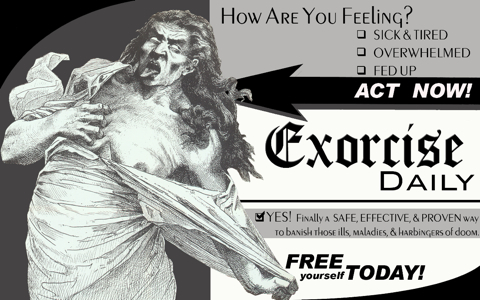
EXORCISE DAILY! (Arthur, 2008)
Vanishing Act
by the Center for Tactical Magic
from the “Applied Magic(k)” column in Arthur No. 32 (Dec 2008)
One of the oldest themes in magic(k) is that of death and resurrection. Recurring in the origin stories of numerous religions, death and resurrection also played an important role in the initiation ceremonies of early shamans across the globe. By first descending into the depths of sickness, disease, and even death itself a Siberian shaman would make allegiances with spirit allies who could be called upon to help the living. But in order to do so, the shaman would have to survive the ordeal and return to life before s/he could act as an intermediary.
Anthropologists have observed similar tendencies in shamanic initiation throughout geographically divergent cultures. Although the story of Jesus Christ is perhaps our society’s most familiar example, scholars of world religion are quick to point out that many aspects of the Christ story are reflected in earlier religious beliefs surrounding such deities as Osiris, Dionysus, and Mithras to name but a few of the more notable, regional examples. However, the list of dying-and-rising gods numbers well into the dozens and extends across the world map to include the likes of Quetzalcoatl (Aztec), Odin (Norse), Ishtar (Mesopotamia), Julunggul (Aboriginal Australian), and Travolta (Hollywood).
While Tarantino’s resurrection of Travolta might not qualify him as a “god” worthy of the aforementioned pantheon, themes of death and resurrection have long played out on the stages of popular culture and entertainment. Early performers in Native America and in ancient Egypt would amaze audiences by bringing animals back to life. While in India, fakirs performing the famed “basket trick” would stuff a child into a woven container before perforating the basket (and presumably the child) with multiple swords, only to reveal a short moment later that the child was still alive and well. More recently, magicians P.T. Selbit and Horace Goldin might not have the popular name recognition today that they once shared in the 1920’s; however, one would be hard-pressed to find someone who doesn’t recognize their famed (and misogynistic) illusion: sawing a woman in half.
A resurrection routine in theatrical magic often takes one of several forms: a transposition (in which the assistant disappears from one place and reappears somewhere else), a transformation (in which the assistant appears to change into something or someone else), or a restoration (in which the assistant is returned to normal after first being subjected to some sort of ghoulish sadism). A vanish on the other hand (in which the assistant simply disappears) is seldom used for a resurrection act because the audience is left ill-at-ease wondering what happened to the body after the magician stabbed, shot, burned, or cut it.
More commonly, vanishes are employed as a metaphorical reminder for the ephemeral and illusory nature of life. Coin vanishes are among the more familiar tricks in a conjurer’s repertoire, and audiences seem to have no trouble relating to the disappearance of money even when it happens inexplicably before their very eyes. Thurston, the great Vaudeville magician and master Mason, took the vanishing act a step further by introducing the “the vanishing Arabian steed” followed a few years later by “the vanishing automobile” along with its passengers. More than simply illustrating the technological trajectory of transportation, Thurston’s vanishes demonstrated to his audience that coins, cars, or other symbols of material wealth possess a value that is not lasting. Later magicians failed to recognize the potential for multiple levels of symbolic relevance and focused only on scale as a determining factor for their illusions by vanishing elephants and water buffalo.
However, the same cannot be said for David Copperfield’s famed vanishing of the Statue of Liberty. With 1984 looming and Ronald Reagan busy conjuring his own “voodoo economics” the disappearance of Lady Liberty probably should have spooked audiences more than it did. Clearly more prophetic than Thurston’s vanishing horse, Copperfield’s vanishing Liberty should have been regarded not as prime time entertainment but as a dire warning of politics to come. If treated as an omen, we can at least take comfort in the fact that Copperfield’s illusion is ultimately a restoration and not simply a vanish. If so, and the mystical vision holds true, we can expect the return of our civil liberties, cell phone privacy, and perhaps even the freeing of those who have been disappeared by government contracted “extraordinary rendition” aircraft and in the CIA-operated secret prisons abroad.
In stage magic, vanishes may rely on a range of methods to achieve the desired effect. The use of mirrors, trap doors, secret compartments, and doubles might be used to restore an assistant to a healthy state. While politics also utilizes no short supply of ruses, deceptions, and misdirections, it takes much more to return to a healthy state. Although we witnessed the vanishing of George Bush from the White House in January of 1993, we were left dumbstruck when a second George Bush reappeared in the Oval Office in 2001. Unlike the shamanic ascension from the underworld that affords mysterious new powers for helping treat the ailments of others, this hellish return was accompanied by two wars, an exploding national debt, a devastating economic crash, and mysterious new powers for government surveillance and the executive branch.
Thankfully the curtain call has come for that sad act. The stage has been reset and we are now eagerly awaiting the next Bush vanishing act from the halls of government. Hopefully this time it’s a permanent disappearance. And perhaps when the curtain goes up on this next act we’ll witness the resurrection of the long-dead spirit of democracy that has recently begun haunting our hopes and dreams again.
Undoubtedly, politicians and governments will continue to perform much as they have in the past. Yet, the mass mobilization around the Obama campaign has given the audience new clues in determining the outcome of the show. The close of the Obama/McCain election represented a political shift in more ways than one. For the first time in eight years (if not longer), people poured into the streets not to protest an act of government but to celebrate one. The jubilation went far beyond party politics because the triumph went not only to the Democrats. People could feel their own political power. Whether or not Obama lives up to his campaign promises and our highest expectations remains to be seen; yet, the real victory here is the empowerment of the grassroots to accomplish a major political mission. Hopefully, the next eight years brings the political utopian equivalent of unicorns and demons sharing the last slice of birthday cake under a shimmering rainbow. But if it doesn’t, we now have a road map for organizing that doesn’t just look like another weekend march with placards and puppets in the financial district of a major metropolis. On the contrary, the mobilization around Obama was widespread, sustained, contextual, and media-savvy. It utilized multiple outreach strategies, creative tactics, and a model of fundraising that accumulated millions of small donations into a mega-fund for manifesting a collective vision. And now that we see what we can accomplish, there’s no reason why we should stop there. The show must go on – locally, nationally, globally. Or else we may find ourselves sitting once again in a dark theater awaiting the resurrection of our political nightmares.
Print this out: HELPFUL “EXORCISE DAILY” PDF
 Arthur Magazine