SIMPLE GESTURES Oliver Hall raps with radical traditionalists Faun Fables.
Originally published in Arthur No. 10 (May 2004)
The airwaves are so saturated with false memories of childhood you can’t walk around without a helmet or you’ll become a legal idiot—I mean the playground loves of heartstruck emo people, the barely fetal fancies of Radiohead stillborn colder than forceps, the general irresistible reflex contractions against dilation of the idios kosmos, not to speak of Michael Jackson, Jon Benet Ramsey and her twin that lived, Britney Spears.
The urge towards the nubile has expressed itself nowhere more strongly than in folk music. Once a deeply weird idiom devoted to the mysteries of hardship, tradition, games, abundance and death, questionable politics have transformed folk music on the one hand into dead pledges of allegiance to corpses of the Stalinist left, on the other into personal confessional songwriting so banal as to make you yearn wholly and bodily for a gruesome fatal mining disaster. But there are a few musicians who have the brains and guts to struggle with the old questions, the old answers; in other words one thing you can do on a Friday night is witness the miraculous music of the Bay Area’s Faun Fables.
Mainly you should do this because Dawn McCarthy, the Faun of Faun Fables, can totally, cruelly possess an audience like no other performer I’ve ever seen except maybe Clevelanders David Thomas and Robert Kidney. Most recently I saw her do this at Spaceland in Los Angeles on Valentine’s Day, but I’d seen her do it—participated in the thrill even—seven or eight times before, in all kinds of situations. In bars throbbing with the old procreant urge, I’ve heard Dawn raise her voice to a pitch and volume no one could ignore, shutting up the whole meat market; at Faun Fables’ recent concert at downtown L. A. rockhole the Smell, she began the show walking through the audience yodeling, winning hearts and minds one by one with voice and presence. (Dawn: “If you talk about yodeling to people they laugh about it, and they go ‘Oh God, yodeling, that’s so corny and weird,’ but you just do yodeling and it does something to people. Must be a code in the DNA…”) Dawn and her collaborator Nils Frykdahl, of the heavy, funny, scary bands Idiot Flesh and Sleepytime Gorilla Museum, tour the country playing avant rock clubs, churches, high schools.
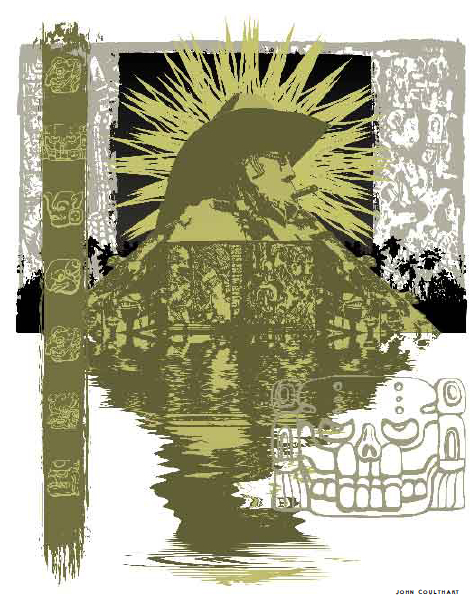
Encounter With Maximon While investigating Guatemala’s folk-magic patron saint of thieves and whores, James Marriott made a serious mistake. Illustration by John Coulthart.
The first children I asked to show me the way to the house of Maximon, Guatemala’s ‘evil saint’, turned tail and fled. The next boy I approached was unable to escape, hobbled by a pair of oversized rubber boots, and pointed me in the right direction. The building wasn’t much to look out—unpainted concrete blocks with a corrugated iron roof—but once I was in I knew I’d come to the right place.
Maximon sat at one end of a dark room, the life-sized dummy of a moustachioed white man wearing a suit, sunglasses, a felt hat and a silk scarf, with a garish handkerchief over his mouth. Candles were arrayed before him, and towards the entrance, at the opposite end of the room, tarot and palm readings were taking place. Another doorway led through to a courtyard, beyond which was a shop selling cigars, magical potions, herbs, candles and anything else the devotee might need.
There was a fire in the courtyard, around which a Mayan woman with gold teeth, a ladino woman and two boys of around six hyperventilated on huge cigars, working themselves into a sweat. The Mayan woman offered to read my palm. When I foolishly declined, she shrieked with laughter and returned to the serious business of her cigar. The ladino woman didn’t even look at me—Maximon is the patron saint of thieves and prostitutes, but I couldn’t very well ask her if either of these applied—and when the nicotine-crazed boys started to run around my legs, I went back into the main room to take a seat at the back and make myself as inconspicuous as possible.
New arrivals would walk straight past the tarot readers and into the courtyard, where they consulted with the Mayan woman before puffing on cigars and preparing themselves for a consultation with the saint. They would then approach the impassive figure and speak to him, stroking his arms and laying money and other offerings in a bowl in his lap. A smartly dressed man standing by the saint appeared to be his keeper, putting offerings of cigars in his mouth and tipping aguardiente, a fiery local spirit, down his wooden throat, or gently lashing the devotees with a bundle of herbs during a limpia, or soul cleansing.
The children came in, one looking demonic as he threatened the other with a bottle, then tied his feet together with a length of twine. The keening victim tried to hide behind me, crawling into a safe position sheltered by the gringo as the increasingly demented bully giggled and made throat-slitting gestures, the pain and anguish in his victim’s face only spurring him on to greater fury. For a terrible moment I thought that I was mistaken—they weren’t children at all, but rather stunted adults, their growth arrested by heavy nicotine use—but the pitch of the victim’s whine reassured me. As the bullying grew nastier in tone, I wondered if I should intervene, but it seemed patronizing to do anything— the only attention the other adults paid was to motion to the weaker child to be quiet. Eventually the bully left the room, and his charge fled. It seemed a fitting introduction to the world of the Judas of the Western Highlands.
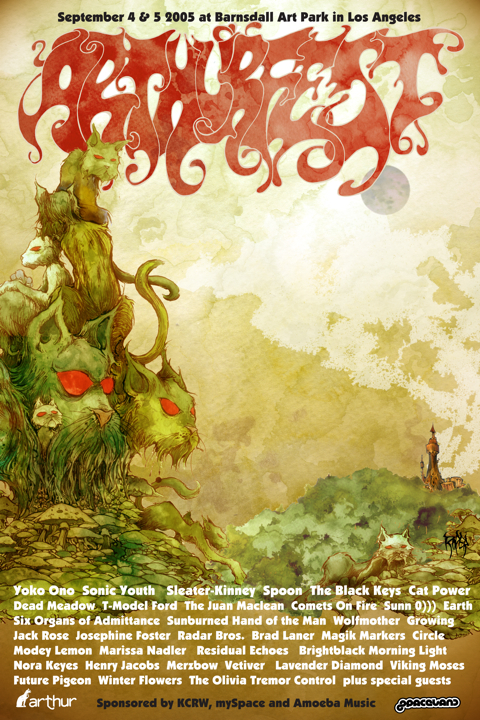
Notes: Poster artwork and design by Arik Roper. Devendra Banhart performed a set but could not be announced in promotion because he had an upcoming headlining show in the area. Pole, Dos (featuring Mike Watt and Kira), The Night Porter (featuring Carla Bozulich), Fatso Jetson, Young Jazz Giants, The Time Flys, Geronimo and poets Michael Brownstein and Charles Potts were special guests added to the program after the poster had been printed. Deejays included Brian Turner (WFMU) and Plastic Crimewave. “Film No. 5 (Smile)” by Yoko Ono starring John Lennon was screened on the main stage, as well as excerpts from Henry Jacobs’ “The Fine Art of Goofing Off.” Yoko Ono’s appearance included a performance of ONOCHORD. ArthurFest was filmed by Lance Bangs.
HEAVY AIR An Orchestra of Feedback and Humidity, Courtesy of New Orleans duo Belong
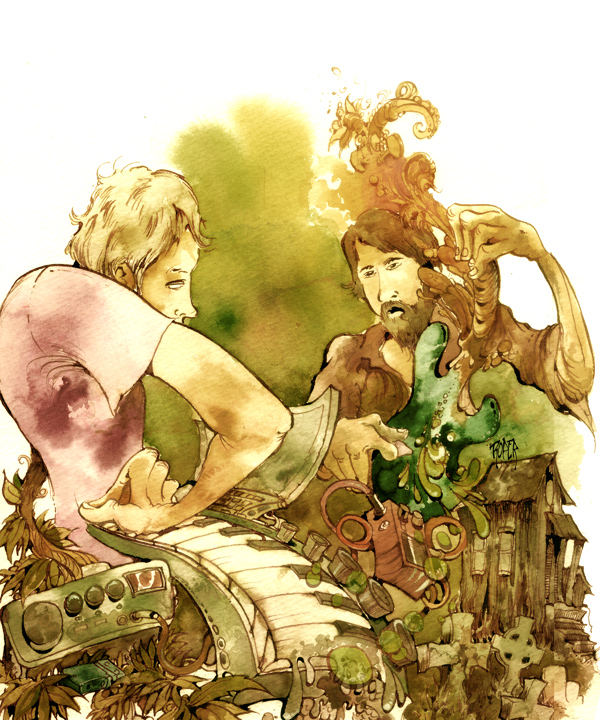
Text by Gabe Soria, illustration by Arik Moonhawk Roper
There’s a ‘round-the-clock environmental buzz everywhere in New Orleans if you’ve got the ears to hear it. It’s a deep, almost sub-sonic, earth-drone that’s especially evident during the wicked days of summer. It’s in the awesome silence of the baking, deserted streets at noontime; it’s in the deafening biological volume of the wild, tropical greenery and of bugs reproducing insanely; it’s in the groaning of the cracked sidewalks, ancient houses and crumbling cemeteries; it’s in the LSD-like intoxication produced by the common cocktail of casual drinking crossed with 100 percent humidity and three-digit thermometer readings.
October Language, the stunning debut album from New Orleans drone guitar-duo Belong, is a de facto impressionistic field recording of the ineffable and beautiful noise that permeates the city. Miles away from the jazz, funk and bounce hip-hop that defines New Orleans music to the world at large, October Language still manages to be as genius an expression of the soul of the city as Professor Longhair’s “Tipitina,” Juvenile’s “Back That Azz Up,” Dr. John’s ” Right Place, Wrong Time” or Irma Thomas’s “Ruler of My Heart.” It’s the sound of sweat, hallucination and revelation, and every cat who’s made it through a couple of New Orleans summers can dig that.
Belong is comprised of New Orleans natives Turk Dietrich, 28, and Mike Jones, 27. Dietrich—lanky and gregarious, possessor of the strange New Orleans accent that sounds strangely Southern and Brooklyn-esque at the same time—is the talker of the two. Both came back to New Orleans a few weeks after Hurricane Katrina hit the Gulf Coast, and both plan on staying for the forseeable future. Both are the type of guys who you want to knock back beers with all night with in a smelly bar, fellas you’d want to have on your side in a fight. Having heard snatches of their brilliant debut scant days before a second trip to his old habitat of New Orleans inside a month [the last being a Mardi Gras visit detailed last issue], your correspondent made a few phone calls and tracked Belong down to a bustling coffeehouse on Magazine Street for a quick talk. Decompressing from a recent U.S. tour with Ariel Pink and preparing to embark on a European tour, the band was eager to jaw about video games, the peculiar habit of some New Orleans residents of beginning evenings out at midnight, and plans to attend work parties to help Ms. Antoinette K-Doe repair the fire damaged Mother-in-Law Lounge. We also managed to talk about music a bit…
Tonight the Neighbors Spell JESUS on Their Lawn in Christmas Lights by Carrie Fountain
Walking by tonight, we’re reminded there must’ve been a first time for everything–one green shoot, a drop of bluish water, a few red cells. The letters wink at us as if they know what they’re for, and we go by, saying “Oh God, look at that,” as if we did, too.
Mornings, the lights are left on to call very palely to the large, uninterested sky. “We are all alone,” they cry. And the sky answers back by not moving an inch.
I was nine when I watched my mother cough until she couldn’t breath; I never thought that would be me. Now sixty-three, my lungs collapse and my heart is worn out; a flower fighting to survive slow murderous frost.
I long for just one more cigarette – I sit on the white bench stained with rust on the back porch and imagine the ember blazing against the last cold bite of April air. I would die to feed on the filtered tip, to feel the darkness tingle my tongue.
Instead oxygen is fed to me through a tank like a mother feeds a child.
Husbands? Who needs ‘em? I had a few, I’d be lying if I said they didn’t mean anything. I have all I need now – an oxygen tank, and a daughter who lives in my house, and brings me vodka.
I look up at my soon-to-be garden through an empty glass, vision distorted, the glass used to be filled with a vodka tonic this garden used to be filled with growth my body used to be filled with life.
In a month, “Will I make it another month?” I ask out loud, to make sure I’m still alive. Tina and I will shop for flowers to fill the space the winter cold has taken hostage: Widow’s Tears, Bleeding Hearts, German Irises, Panseys
The world lives to see another spring, everything comes back to life. Curtis, the little black boy from down the street will ride his bike to come chat with me on the back porch. Rebirth and youth come together while emphysema picks another victim to meet Death. What about the grandchildren? I promised the oldest, when she was the only, that I would live forever. She will remember this while she sits at my side…
Drag Queens, Borders, Rivers, Death and Transformation by Sonny Smith
Identity is not stable or rational, but an ever conflicting tension between id and ego, conscious and subconscious mind. -Freud
Up til about 13 me, my friends, we were whatever we wanted top be. One day skate rats, the next day kung fu, the next day new waver, next day heavy metal, surfers, baseball players, on and on it went.
High school ends that usually. The ‘group’ starts telling you who you are. If you’re into sports you’re an athlete. If you’re into studies you’re a nerd. If you’re socially awkward you’re a weirdo. When you give up on the whole scene you get called a loner!
The crowd, the community, the society, has ideas about identity. Strict ideas. If you’re outside it, it’s going be rough; you get called a misfit.
After you grow up bigger limitations come in. Careers. Jobs. What are you going to decide to be? You’ve got to pick SOMETHING. Even if you choose nothing you’ve chosen.
I could never choose… so I drifted around. I’ve had a slew of jobs. My resume doesn’t look too reliable I guess. I had a job making copper gutters for two years. One day the foreman on a job says: here comes the copper guy. I didn’t want to be a ‘copper guy’ so I lost interest.
Marriage is tough too. Any relationship is tough. You gotta be the same person day in day out. What if you wake up, you want to be someone else? Most relationships don’t allow for it.
It’s not identity crisis. It’s identity impermanence.* Who are you gonna be today? Maybe today’s the day you start being someone new. At least you’re trying. Hard to do when your job is depending on you to be the same person as yesterday… society is stacked against the new you! It’s stacked against birth! It only knows death!
* We are never just who we are in a given moment but a constantly evolving thing- Heidegger
Therefore, society is not for the living, it is for the dying. To live, to be fully alive, you must be outside society. An outlaw.
You’d think being an artist would allow for a lot of identity exploration. It does. But the art world is a big jail cell for the imagination. The art sellers and the art buyers, and all the media* in between want you to be one thing so they can organize you accordingly and stack you over with the others like you.
* buyers and sellers at the same time
The art ‘community’ is a big joke. Like any society, it believes it celebrates life but it survives on death.
Some artists capitulate to this game of narrow definition.* Or some find ways to keep their narrowed focus fresh. Then, some don’t conform. They keep breaking their own walls down. Art is elusive, evolution is mysterious…
* Their art doesn’t grow but their pocketbooks do!
Of course, one of the biggest limitations of all is what you believe. If you don’t believe in Jesus you’re in a certain stack, if you do believe then you’re in another stack, if it’s Allah, then you’re that, if it’s Buddha it’s that, democrat, republican, middle of the road, lefty…
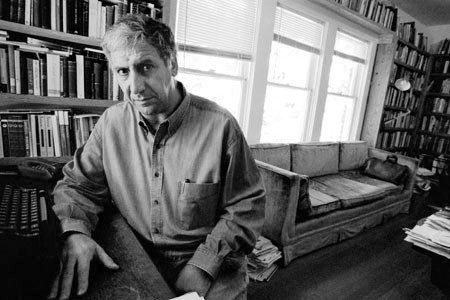
FIGHTING SHADOWS, FINDING LIGHT A close encounter with enigmatic folk adventurer BEN CHASNY of Six Organs of Admittance By Jay Babcock, with photography by Allison Watkins
Last summer Ben Chasny told me about his plans for the next record he would be making under his Six Organs of Admittance monniker. The upcoming album would be a turning point for him: it’d be the first Six Organs recordings done in a studio and his first album for his new label (Chicago indie perennial Drag City), sure, but he also wanted the record to be a creative step forward. “I told them I want to go in there and have some folky stuff, but I also want to attempt something more freaked-out and free,” he said.
School of the Flower, recorded during those August 2004 sessions with drummer Chris Corsano and released last month, is more freaked out and free than previous Six Organs albums. It’s a front-to-end lovely, beguiling work that alternates simple, emotionally reassuring campfire folk songs with expansive, occasionally ominous instrumental tracks: long, quickly fingerpicked acoustic guitar lines repeat and interlink into infinity, electric guitars toll and squall, drums skitter and bubble underneath. The record is like an owl—it sees and knows all, but is willing to communicate to others only some of what it knows. We are lucky—privileged, really–to hear its voice at all.
The following conversation was constructed from a long phone interview in early January and some follow-up elaboratory emails. Chasny and I had been in touch off and on for the previous year or so by email, mostly hipping each other to recent discoveries: books, records, films. To be honest, Chasny was doing most of the hipping, and I was struck by both his strong passion for other artists’ work and ideas, and the degree of erudition in his reading. His impulse may be towards hermithood and withdrawal, to living alone in the woods, but the reality of his life was more complex: he’s a part of a web of consciousness very much of his own making, one that stretches around the globe and involves many of the planet’s most idiosyncratic, hermetic artists. I soon realized that, just as Timothy Leary had instructed, Chasny had gone and found the others—the Japanese psych-folk group Ghost, the bizarre English goth-folk of Current 93’s David Tibet, the utterly indescribable Sun City Girls, and many more I’d never heard of. And then, in the past whirlwind year, he’d actually toured or recorded with many of them, while, at the same time, continuing to be a full-fledged member of Bay Area combo Comets On Fire, whose 2004 album Blue Cathedral was some kind of acid rock knockout masterpiece.
Here’s how it all happened, in Ben Chasny’s own voice.
Arthur: People often wonder if you’re a practicing Buddhist, because of your band’s name.
Ben Chasny: When I did the first record, I wrote “Six Organs of Admittance” on it because I had just read Road to Heaven by Bill Porter. He goes and explores a mountain range in China, encountering for Buddhist and Taoist hermits. One hermit was such a damn hermit that during the conversation with the author, he stopped and asked, Who’s this Chairman Mao you keep referring to? That’s amazing. And in that book I came across the “six organs” phrase—the five senses and the soul make up the six organs of admittance—and it struck me. I thought it’d look really good on the record cover. I put it out, without saying who was on the record or anything. Later, when I decided to put out more records, I figured I’d just take that name.
Talk a little about where you grew up.
I was born in L.A. My dad was sick of the city, so he moved us way up in the middle of nowhere with redwood trees and chickens and bunnies. It was me, my mom and my sister. I grew up in Elk River Valley, a little south of McKinleyville. My dad was always playing shit on the stereo, pretty good popular stuff from the ‘60s. A lot of good folk too, Nick Drake and stuff, and even some weird experimental records like Tonto’s Expanding Head Band. That was how I lived until I was 13 or 14. Then we moved into the city—well, Eureka’s not really a city, it’s just a little dirty town, or a dirty old town, to give it a Pogues description. After school, there was only ever one other kid around, and I had to hike over a hill and go find him to make tree forts. That’s probably why I’m interested in hermits, because I lived that way for a while. Hermits seem to appear in a lot of the literature that I read; when I come across them, it really sticks out in my head. Like Gaston Bachelard says: “The Hermit’s hut is a theme that needs no variation, for at the slightest mention of it, phenomenological reverberations obliterate all mediocre resonance.”
You talk a lot about writers, quoting them on CD sleeves and such. I know you dig the writing of Peter Lamborn Wilson, aka Hakim Bey.
Yeah. His ideas are not 100% original, but he makes such a beautiful synthesis out of anarchism, surrealism, chaos theory, Sufism and such. He has this essay about how in certain societies, musicians are the scum of the earth. They’re there to serve a purpose, to do music, to give that, sure, but they’re not elevated like stars. And when you think about it, in that situation, only somebody who really believes in the art itself–not about becoming cool or popular or making money–will actually want to make music. So he talks about the importance of art as art, not as buying, not as putting into museums—not that art can’t be sold, but that art in itself is very, very important, just on the basis of giving to somebody else as a gift. It’s not about selling your paintings for $300 at the coffeeshop: it’s for creating this subversive community – that is the way to start looking at this stuff, as subversion.
What did you study in college?
I didn’t go to college. I’m not really that well read or learned—certain books just really grab me, and I become obsessed with certain authors. I have a few people who I like to read who inform my world. And almost everything I listen to or read translates into music in some way, or a reason to not do music. When I play music, that’s just what comes out: it’s the shit of all the books that are the food.
So you’ve been playing acoustic guitar for a long time, since the mid-‘90s. Why not electric guitar? How did you get started down this acid-folk path?
The first three notes of the first Nick Drake record hit pretty heavy, and made me think I should really think about acoustic guitar and put down the electric bass guitar I’d been playing. That opened me up to Leo Kottke, and later, John Fahey. The music just meant more than getting up there and being silly. At the same time I started to get into Fushitusha and Rudolph Grey and KK Null: really noisy electric guitar bands.
Who’s Rudolph Grey?
Rudolph Grey developed action guitar, which is pure extreme playing. It’s not free jazz. I mean, he’s played with free jazz drummers before, and jazz musicians, but I think his music is more accurately described as action guitar. It stems from no-wave and free jazz. HE is the guy who blew my mind. I got this Rudolph Grey record called Mask of Light and I’m thinking I know stuff about music, I’ve heard experimental music, whatever, and I put that on and he just CLEANED the slate. Anything’s possible. It cleared my mind of everything. Then I could listen to folk music, NEW. Any kind of music. Suddenly, Keiji Haino made sense to me. And Leo Kottke as well. Rudolph Grey: no note is more important than any other note. It has a correlation with a lot of kinds of music, but it’s ACTION GUITAR. Now, Keiji Haino is one of my favorite musicans of all time. Pure sound. Pure emotion. Kan Mikami is an absolute hero of mine: he once said that the only true musician is the musician who has been forsaken by God.
Anyways, I didn’t really know how to put together the rock n roll aspect I liked with folk music. So I started listening to acid folk music, which melts the two together: Ghost were a really huge inspiration to me to start playing folk music, and there’s that one Amon Duul record that’s heavily acoustic. Through the Forced Exposure catalog, I found out that PSF [a Japanese record label] had these compilations called Tokyo Flashback, and on the third one, there’s a picture of the guy sitting in what I guessed were the PSF offices, and there’s records stacked to the ceiling, a total mess, with this box in the front that’s labelled “acid folk.” I remember thinking, I don’t know what’s in that box, and I don’t exactly know what it would sound like, but whatever it is, it’s probably really great. I want to make music that you could put in that box.
So I just made what I was looking for. I’m trying to shed it lately, though, trying to go for the folk thing, a more natural song thing. There’s too many traps in trying to do ‘acid folk.’
So it’s more about songwriting at this point?
Kind of. But I’m not even that good of a songwriter. I figure that I’m kind of good at a bunch of stuff. I’m not really that amazing at one thing. I’m kind of good. That’s enough for me. The first step in overcoming one’s mediocrity is to be aware of it. Hopefully at some point I can overcome it. Artists like Tomokawa Kazuki and Kan Mikami play folk music like it is a beautiful knife (and not coincidentally were part of their own political resistance!). I always return to those two when I am in doubt about music. They are fire and a thousand hurricanes and the beautiful mist and the blooming garden. Folk is not some trend for them, but then again, their brand of folk is more volatile than any rock band I can think of. That is something to aspire to: to find the dirt in a melody and a flower in the chaos. I think I am about a million miles away from that. But I hope I can get closer, everyday, to be that strong.
Judging from your facility with the acoustic guitar, I assume you practice a lot…
Not anymore. Ten years ago, when I started getting into acoustic guitar, I was really studying the guitar, learning things about it. I was only working two days a week. That went on for like three years. Then I realized if I studied any more, this is gonna be bullshit. I’m going to make music that’s not interesting to anybody but guitarists. That’s when I realized I better start working on actually communicating—writing songs and all that. At that time I was playing with this violinist who’d been playing since she was four. We’d duet, that’s where I learned a lot of finger picking techniques. (Finger picking is using your right hand to play the strings and usually using your thumb to play the bass strings in different patterns.) But after that, it wasn’t very interesting to me at all. There are other people out there who are really good guitarists and are doing really good things with guitar, pushing it out. But it just doesn’t interest me. I’d rather become good at playing rocks. I’d like to be a fucking virtuoso of stone playing; knowing the right stones that resonate, how big, where to play them, things like that. That’s much more interesting than guitar. I don’t respect the guitar the way guitarists do. You can ask Ethan. [laughs] Even my new acoustic that I just bought now has a big crack in it from me putting my fist into it.
You know, I was talking with Stephen O’Malley [guitarist in SUNNO))) and Khanate] a few months ago about how there was a time when the acoustic guitar was an instrument of resistance. I don’t mean in the naive ‘60s, when to most people resistance meant putting up a picture of a Hindu god, smoking some grass and singing about getting it together. That wasn’t the real musical resistance of the ‘60s (though the folks singing about getting it together really were resistant to a fucked war. I’m talking about a resistance of culture rather than a resistance of political stupidity and death). The resistance was in feedback and a wall of destruction from rock ‘n’ roll, the very simulacrum of resistance today. But sometime in the late ‘90s, for me anyway, the acoustic guitar was a part of the culture of resistance, even against a resistant culture. Tomokawa Kazuki, Kan Mikami, and Ghost were right up there as my heroes. At the time, everyone was making noise records and noise from Masonna, Solmania, Hijokaidan ruled the underground. A lot of them were great, like the aforementioned and Michael Morley and Rudolph Grey and A.N.P. But like any trend, there became more and more derivative versions of it all. And so even though I loved Bob Banister and the Noggin records, I didn’t want to join the pack, and I knew that my version would just be a derivative of a copy of a notion of wanting acceptance. To resist, I picked up the acoustic guitar. And that’s it! That’s the origin of it all. Now, years later, everything is flowing the other way. It makes me want to make that noise guitar record I always wanted to make, and I will.
And that’s what I love about John Fahey. He was a man of resistance, even against himself. I could give a fuck about his finger picking or melody. I love his writing more than his playing. If you can’t understand that his world was one of absolute hurt and resistance you will never understand any part of how beautiful his music was. He would burn it all, in his memory, again and again. That is a personal resistance.
You seem simultaneously attracted to these resistant individuals, who are almost like modern hermits, and also to the idea of a community, which necessarily involves others.
I’d like to have a place to live where I lived all by myself somewhere, but…I’ve realized I need friends. Hanging out, community, is really good. I don’t think I couldn’t live all by myself, I’d get pretty depressed. All we have is our friends, and giving, and making things as our hope. I may be making records for a few people to listen to, but you better know that there are things going on that are much more important. Like dinners and gatherings against all the bullshit of the world. Like a letter for one. If it doesn’t hold a trace of possibility, it is worthless. That is how I judge what is made, whether for the public or private. Because it is all worthless when it comes down to it. There is only inspiration—which is our analogue for the WANT TO LIVE in Eastern thinking—and there is Nothing, which we will all be faced with at some point. So hold on to your friends and laughter and family and hope. Nothing else exists.
You’ve told me before that you considered your records to be dark records but that you always tried to put a hint of light in there. The new record, though, doesn’t seem as dark to me, overall.
The new one isn’t dark in that way, and that’s why—I think—I was able to explore musical ideas on School of the Flower that I wasn’t able to explore before. Because before I was dealing with emotional ideas and emotions, trying to wrestle with this or that. When I did Dark Noontide, I was really inspired by Current 93. I was listening to Thunder Perfect Mind pretty religiously for a while. They’re always pegged as gothic, especially cuz [Current 93’s] David Tibet’s earlier life is influenced by Crowley, which he has totally renounced since then… Thunder Perfect Mind is the record where he started talking about more personal things. When I first heard it, I was really disappointed. His delivery was a little too dramatic for me at the time. I didn’t get into it for a full year. Then I went through a super bad space where I quit my job, because I really couldn’t communicate, I had this really bad bout of depression, and Thunder Perfect Mind was pretty much the only kind of music I could listen to for some reason…I kind of just suddenly got it. It was as if his vocals where a veil to keep the listener away, and once the veil was lifted, his vocals became AMAZING to me. To me, it’s not about magic or the gothic side or anything that a lot of people peg him as, but like, inside of all of that, inside of the darkest time, he’s always looking for some little fraction of light. So when I started listening to it I felt pretty close to that.
About the same time I started getting into Current 93, I made the pinnacle of the crazy, emotional records that I’ve done is Nightly Trembling. It’s called that because that’s what was happening. Originally it came out in an edition of 33, just on lathe cut. (It was recently reissued on Time-Lag Records. We only did 500 of them. Eventually it’ll be available.) The reasoning was… You know how when you have to take a piss really bad while driving a car, your consciousness focuses on one point, and you’re not aware of much else? It’s the same thing when you’re depressed: your consciousness focuses on one point and it becomes a feedback loop, and it’s really hard to get out of that. Which is really similar to what Bruce Kapferer talks about in Feast of the Sorcerer, which is about Sri Lankan Buddhist sorcery and anti-sorcery. When you’re under a sorcery attack, you get this feedback loop that you can’t get out of. So, they have these anti-sorcery rites that allow people to break out in certain ways. The ritual is called a Suniyama and it encompasses theater and music as well as the destruction and exhaustion of wealth, much like a potlatch. I thought that was what I needed to do. So I made this record. It was based on that book, and also on Marcel Mauss’ The Gift, which is about potlatches: you know how certain cultures in the South Pacific islands, instead of warring, they give gifts! That idea—the power of the gift—and Hakim Bey is always talking about that—this project was totally based on all that. I made 33 of these records and I handpainted all of them. I got this beautiful paper from China. Every one had handwritten liner notes. The same liner notes, but on a whole page. Wrote out all the liner notes, painted them, and then just gave every single one of them away to different points that I knew where people were: one in Australia, Germany, London, New Zealand. If I had had friends at the poles I would have sent them there! The idea was to set up this web of consciousness around the world in order to reverse my own consciousness loop. And that’s a kind of reverse—well, Anthony Braxton talks about creating webs of consciousness around the world. For good, not for your own personal bullshit like I was doing. He talks about doing particular concerts at particular places to create a web of consciousness. So I did sort of a reverse Anthony Braxton-style thing. But what happened was, it helped!
There’s a certain person that kind of triggered all of this. I wasn’t talking to them at the time—now we’re best friends—but years later, they told me that they’d figured out that at that exact same time that record was released, they’d actually suffered a pretty bad, pretty weird breakdown: they’d started suffering from all the same things I was suffering from—couldn’t go out of the house, couldn’t talk to anybody, bed-ridden, they had to go into therapy for a while. Maybe that’s coincidence, I don’t know. [laughs] It was pretty weird shit. I’m never gonna do that again. That’s one of the reasons I reissued it was to make those records a lot less powerful – reverse a lot of the power. That project was definitely the pinnacle of the depression.
But I’ve been feeling really good lately. Between that and going into a studio, I was able to do stuff that I’ve always wanted to do on the new album. Like that long song.
Still, some things stay the same for Six Organs, live: you always play solo acoustic guitar…
That’s going to change. The new record has more elecric guitar. Live, I want to loop the acoustic guitar and then pick up the electric guitar.
And you’ve always sat down.
That might change too! Cuz my girlfriend just got me a strap for my acoustic guitar…
Next thing you’ll have a harmonica set-up like Dylan…
The strap and the acoustic guitar is a tricky thing, because you could end up looking like Ani di Franco—or you could end up looking like Neil Young. It’s tricky. I usually prefer to sit so people can’t see me at all.
Live it seems like you’re on a tightrope… I can never tell what you’re going to do next.
I rarely go up with a setlist. I just don’t want it to get boring. I come up with setlists if I know there’s going to be a lot of people out there, and I want a safety net, you know? But I think things are gonna change a little bit. I want it to be interesting for me, too—I’ve always been looking at performance from an improvisor’s point of view. It could fail, but when it’s great, it’s amazing—you really break through something, you really feel something you wouldn’t’ve done if you knew exactly what was happening. Mark Twain, when he had to go out on the lecture circuit, he just hated it. He only did it to make money. He was still great, just because his natural stuff was good, but he wasn’t trying to improvise, to search inside of himself. The time for that was sitting at the table, writing something. I don’t know. I’m not the most emotionally stable person, so I can get really bummed out onstage. Somewhere down South I just broke down and had this attack. That was my most shameful show, ever. Sometimes weird things happen when I play. I stopped playing and I told the audience that what they’d heard was NOTHING, it was NO GOOD. Just preaching nihilism and death. It was just horrible. Sometimes things get ahold of me. This year I’ve realized that there are shadows. Sometimes the shadows are really intense, they can take up a lot of space. Sometimes I’m fighting shadows… Sometimes the room is filled with shadows. I can’t describe it, really. Once when I played in L.A., I don’t mean to be all hocus pocus, but really, I was playing and there was only a few people there and I swear to God there were weird shadow entities, non-friendly shadows there, and I started to get super-freaked out.
Are you able to meditate at all?
I don’t meditate — I drink. [laughs] But, by the time I was playing in San Francisco, on that tour last year with Ghost, I wasn’t agitated at all. Everything was so peaceful and quiet. I wasn’t stomping. Ghost have this internal peace within them. I would talk to Batoh after shows and he would ask me why I was so agitated on stage [laughs], he’d tell me that I should try and calm down. He taught me a lot about being peaceful onstage. Then of course a week after that I played with Sun City Girls and they just destroyed all of that. I’d see them just TAKE it. It was THEIR stage. You’re gonna have a good time, and if not, man, you’re gonna get fucked with. They taught me that it’s war on stage. Which I knew it was. [laughs] Once Ghost left the country, I felt like my parents had gone and I could party it up. But of course Sun City Girls have a kind of self-confidence that I’m lacking.
How’s it going playing with Comets On Fire? That allows you to do something different.
It’s hard to divide my time between Six Organs and Comets. If I had my way I’d just tour with both of them, non-stop. We’re all strong personalities, we don’t write a whole lot of music. We’d rather jam out bar band songs and drink beers.
You were working on a free-noise thing with Noel Harmonson thing the other day.
It’s fun to do that. It’s really important. It’s important to be aware of sound as music, rather than music as a nominal and deterministic exercise or science. For me anyway. All things must be possible, at all times. Otherwise, what magic could music even hold? If I want a bunch of laws and rules, I’ll go stand in line at the Oakland DMV! But…I think we should have some sort of disclaimer here to let the folks know that I don’t think anything I say has really much of an importance to anyone. It’s just bullshit. But at least I recognize that. During the day I like to listen to Sun Ra, drink coffee and read about chaos linguistics. And at night I get drunk, and start raging and getting pissed off. And listen to Tomokawa Kazuki or Townes Van Zandt. For the last couple of years, Townes Van Zandt, he’s just my buddy. He feels like my brother. I don’t have a brother, but… I mean, he got really depressed. You listen to his studio records—they’re super-happy! But he was dealing with a lot of stuff. On a music level I like him because, even today, I’ve listened to this one song for years, and just today I figured out these two lines and how fucking brilliant they were “mother was a golden girl, slit her throat just to get her pearls, cast myself into a world, before a bunch of swine” from “Dollar Bill Blues”—and they’d just passed me by because he speaks this language that isn’t flowery. He’s speaking everyday language but then a couple years later, you go, Holy fuck I get it, I can’t believe he put those two words together. He’s absolutely brilliant—anyone can listen to him and get more and more into him. Anytime I hear any music, I’m thinking about it in terms of, Oh that’s a good idea, that’s a bad idea, how does this relate to anything I do. Townes is the only person where I never, ever do that. He’s the only musician I just listen to.
Originally published in Arthur No. 15 (March 2005)
Artwork by John Coulthart
KILLING THE MADMAN What does meditation have to do with activism? Plenty, says poet Michael Brownstein
I’ve been a Buddhist for many years, and I am also an activist, committed to overturning the profit-driven monoculture which is destroying our health, our Earth, and our soul. How are these two forms of awareness—awareness of what’s taking place in the outside world, and awareness of our internal processes—related? Can each aid the other in creating a sane, sustainable and just world?
Let’s look at activism in terms of the negative emotions generated—indignation and rage, but also frustration, sorrow, resignation. These are negative emotions because of the effect they have on us, the people who experience them. Not on the object of our emotions, whether it be the World Trade Organization, Monsanto, or George Bush. Negative emotions are reactive. Their only impact is on us. What difference does it make to Monsanto that you’re seething with indignation at something it has done or said? What difference does it make to the Pacific Lumber Company when you come upon a clear-cut old-growth forest in California and feel devastated?
Staying present with our emotions—anger, for example—means remaining aware of what we’re experiencing without becoming lost in reactivity. It means liberating the energy generated by anger from the object that calls it forth. In other words, it is a form of meditation. Then, the possibility exists to work with the situation from a place of clarity, rather than be submerged in confusion.
So, the first revolutionary act—or fact—about meditation is that it puts you in touch with what you’re feeling and thinking at this very moment. It puts you in touch with presence. Then you realize that you are the source of your emotions—not Monsanto or McDonald’s. This does not imply that we shouldn’t have these responses, but that we have to use them rather than be used by them. And the only way to do that is to become aware of their nature.




 Arthur Magazine