Next time you stand at the foot of a spiral stair, look straight up, into the dome, owned by the gold and green brothers, Polaris and Sirius. And there, you’ll see the dove and the raven, the flood birds, entwined, in the pupil of a god’s eye, and the god’s double tongues—one of leather, one of steel— carving silver peacocks into the backs of liars and other faithless. They fill the streets with their gunpowder cries, but intrepid, you kick past their glittering, bottled hollers, approaching the mossy queen with tiny lions climbing from her open collar. Your fresh supplications, awkward and skinless, hover near the queen’s feet, until the twin cubs devour them and run. You must chase them, without wheels or engines or bullets this time; only your untried calves and thighs and lungs, only your untested heart. And you chase them, every midnight and midmorning, past the tribes of the hopeful tending St. John’s fires, and camping at the ocean’s fingertips.
T.M. Göttl, a member of the Buffalo ZEF Creative Arts Community, has won a Wayne College Regional Writing Award and a Franklin-Christoph Poetry Prize. She won first place on the first time she ever competed in a poetry performance competition. She travels throughout the state of Ohio, writing and performing her poetry, and her work has appeared online and in print, in places such as Deep Cleveland, The Poet’s Haven, The Mill, The Hessler Street Fair Anthology, and a bilingual poetry collection to benefit victims of the Sichuan Earthquake in China in 2008. Her first collection, Stretching the Window, was published in February 2008.
New Riders of the Purple Sage, live at Fillmore East, April 29, 1971. Click here for the setlist, or to download the whole thing as MP3s
Dilettantes dabbling in the genre of country music have always had a hard time, from hippies like Gram Parsons to his modern day alt-country hipster inheritors. There’s almost always an inevitable anxiety over class privileges and the fetishization of working class experience by cultural elites. That combines with the classic rural versus urban divide and adds up to an awkward night sitting in a bar in Silver Lake listening to delicate, good-looking dudes in fancy vintage Western shirts singing about CB radios and old pickup trucks. It’s airless tribute at best, unaware cowboy drag at worst.
John “Marmaduke” Dawson was the lead singer and main songwriter for The New Riders of the Purple Sage, the best of the hippie country bands that emerged from the West Coast psychedelic rock and rustic folk scenes, and one of the only bands — along with Commander Cody, Doug Sahm and Asleep At The Wheel [thanks for reminding me, Michael!] — that managed to merge roper with doper without apologies to either camp. He died on Tuesday in San Miguel de Allende, Mexico, where he’d been teaching English as part of the city’s established community of American expatriates. He was 64, and stomach cancer was the culprit.
Travel to Mexico is the subject of one of the New Riders best-known songs, “Henry.” Marmaduke often dedicated live performances of the song to anyone in the audience who “smuggles dope for a living,” and given that most of the New Riders best shows were during the early ’70s opening for the Grateful Dead, there were no doubt plenty of audience members who appreciated such recognition.
“Henry” is about the titular drug runner on his way down to Acapulco to find out why all the marijuana has stopped flowing to the United States. After navigating a series of twisty mountain roads, he finds his supplier’s farm and proceeds to get thoroughly obliterated on freshly trimmed crops. The song is about the drive back, as told from the perspective of an unnamed passenger, who is continually beseeching the seriously faded Henry to keep the brakes on as they careen through the mountain passes.
It’s a song that, like so many New Riders tunes, conveys a distinctly hippie experience using the language of country music. The band was an outgrowth of Jerry Garcia’s pre-Dead unit, the wacky bluegrass band Mother McCree’s Uptown Jug Champions. The Dead did plenty of country-leaning material, but Garcia still wanted an outlet for his pedal steel licks, and thus the New Riders of the Purple Sage came to be.
A Deeper Shade of Doom How do the drone-metal bands Earth and Sunno))) get something out of nothingness?
By Brian Evenson Photography and layout by W. T. Nelson
Originally published in Arthur No. 20 (Dec 2005)
EARTH: BLACKING OUT In 1993 the Olympia, Washington-based band Earth released their second album, Earth 2. No drums, no voices, two guitars, nothing else. It was ambient music done by a demon on downers—highly lugubrious, with slowed-down underwater metal riffs. Earth 2 traded in the glam, stagy evil of classic heavy metal for a brooding darkness, simultaneously a descent into hell and a sort Buddhist chant pushing you toward either Nirvana or nothingness (you choose). It was the kind of wandering super-vibrating music that makes your leg tingle where you’d broken it ten years before. Not only was it something you couldn’t dance to, it was something you couldn’t move to. It slowly shut you down. And with each of its three tracks over fifteen minutes long, by the time you’d finished the album you felt like you’d never start back up again.
Earth 2 is the ur-album of drone metal (it’s probably not a coincidence that their name is the same one originally used by Black Sabbath). It’s nothing at all like the grunge stuff—Nirvana and Mudhoney for instance—that their then-label Sub Pop was putting out then. But after Earth 2, the band—really just guitarist Dylan Carlson and whoever he wanted to partner with at the time—moved in different directions. Phase 3: Thrones and Dominions, a hard-to-find album from 1995 that you can pick up on disk for around $90 (or at itunes for $9), added one more guitarist and, for one track, a drummer. 1996’s Pentastar (In the Style of Demons) was still drone-y but just a hair away from being a rock album: cleaner sound, drums on all the tracks, deliberate shapes to the songs (most of which ran around five minutes), and even some vocals.
Originally published in Arthur No. 22 (April 2006)
The Best Condiment by Molly Frances, “New Herbalist” columnist
In February, Mrs. Susie Potts Gibson of Tuscumbia, Alabama, passed away at a youthful 115, the third oldest person on the planet at the time. Mrs. Gibson was by all accounts a spirited and healthy SuperCentenarian who lived on her own until she was 106. So what did Mrs. Gibson attribute her extended stay on the big blue marble to?
Vinegar.
That’s right young’uns: the “sour wine” just may be what flows from the fountain of youth. Not only has vinegar been revered for thousands of years for its life-extending property, but also as a remedy for a host of ailments: arthritis, digestive disorders, high blood pressure, weight control, laryngitis, migraines, chronic fatigue, warts, acid-reflex and sore throat. Hippocrates, ancient Egyptians, Babylonians, Julius Caesar, Christopher Columbus and Japanese samurai warriors all made use of its awesome tonic properties.
Longevity’s not your bag, you say? Then how about a little spring cleaning? Not only is vinegar a naturally-occurring antibiotic that heals your insides, it is also an antiseptic that will spruce you up on the outside too. It fights germs, bacteria, mold and viruses. Hot date coming up? Surprise your lady with a mold-free shower, sparkling faucets and streak-free mirrors and windows. A 50/50 combo of vinegar and water administered through a spray bottle beats any industrial cleaning product hands down and keeps you from trudging down the least savory supermarkets aisles. By using vinegar as your prime cleaning agent you are also saving money and reducing the amount of unnecessary chemicals in our water supply.
If you’re feeling dull and down, ditch the coffee and booze and reach for a glass of apple cider vinegar instead. This potassium and enzyme-rich concoction made from fermented apples is the nutritive powerhouse of the vinegars and the primary variety for internal use and personal hygiene. Dry skin, fungal infections, ear infections, poison ivy, shingles, varicose veins, insect bites, sunburn and gray hair are all at your mercy when armed with nature’s tangy nectar. Susie Potts Gibson knew this; not only did she splash it on everything she ate, but according to her granddaughter, she applied it topically to chase away those meddlesome aches and pains. So go ahead and ask for that vinegar massage you’ve always wanted. It also makes an excellent de-toxifier when added to a hot bath, or a reinvigorating shampoo. Lord Byron consumed loads of the stuff to maintain the pale complexion that drove the ladies, as well as the boys, hog wild.
Every science nerd knows that vinegar is the essential ingredient in any homemade volcano, but did you know that a splash of vinegar followed by a quick dust of baking soda makes an unbeatable homespun, non-Alzheimer’s-causing underarm deodorant? Just be aware of the possibility that in addition to long-lasting, non-toxic odor protection, you may also experience the aforementioned “volcano effect.” Do not panic. This is normal.
If you can’t be bothered with using vinegar out of vanity, do it for the animals! A few teaspoons slipped into their water bowl will send the fleas and parasites in search of a new host. Your old dog may finally muster up the energy to learn a new trick or two.
What kind of vinegar should you buy? As you know, the industrial powers-that-be have found devious ways to produce visually appealing products while robbing them of their inherent benefits. Vinegar has not escaped this fate. The most common form of commercially produced vinegar is distilled, a process that destroys the spongey cobweb-like particles—known as “Mother” in vinegar lore—that linger in properly fermented vinegar. Don’t be afraid of Mother. Mother is good for you. So do your part to crush the dominant paradigm, and embrace your Mother. Go for the cloudiest, most particle-ridden vinegar brew you can find. This will usually require a trip to your local health food store or farmer’s market, or find it online at bragg.com.
You can drink two teaspoons daily of apple cider vinegar straight up, add honey and water to make a healing elixir, or just drizzle it generously over your veggies. It also makes a mean salad dressing when paired with olive oil and fresh spices. The prophet Muhammed didn’t declare it “the best condiment” for nothing.
Arthur is delighted to sponsor “Scala Naturae,” a show of exquisitely crafted paper sculptures by Tahiti Pehrson opening on May 7th at Oxenrose. In the past, Pehrson has developed album art for Devendra Banhart (covers of White Reggae Troll and Lover) and several t-shirts for friend Joanna Newsom, as well as comissioned portraits for XL recording artists (M.I.A., Peaches, and Dizzee Rascal, among others), and designs for a variety of skateboarding companies including Toy Machine, Blood Wizard and Familia.
On top of all these projects, Pehrson devotes his time to cutting away at his insanely detailed sculptures, made almost entirely of paper with some metal supports. Want to see? Check out this giant cake (real life dimensions: 4ft x 6ft). Something tells me that these pieces shine in their true glory when seen in person; you really have to get up close to experience the full effect of light and shadow interacting within the many crevices, shapes and openings. So if you’re in the Bay area, dig out your magnifying glass — and head over to Oxenrose to lose yourself in the tiny intricacies of Pehrson’s magical paper world.
On view May 7th – June 30th, opening Thursday, May 7th 7:30 – 10:30PM with a live performance by Kings & Queens
Oxenrose Salon (For directions, go here.)
448 Grove St. / San Francisco, CA 94102 Free admission
Get to know more about Pehrson’s artwork and lifestyle in this interview.
Above: Neptune’s Daughter, a 4-layered paper sculpture by Tahiti Pehrson
Q: Where does the Border Patrol’s “drug blimp” go at night? A: It sleeps in a field outside of Marfa, Texas.
The Marfa aerostat, aloft in daylight
The so-called “drug blimp” is actually a tethered aerostat — a white helium balloon as big or larger than the portly tire-company-maintained dirigibles that flock to parades and sporting events — operated by the U.S. Air Force, which makes the data it collects available to NORAD and the U.S. Border Patrol. It is by far the most tangible of the lazy clouds floating through the skies of the southern region of Far West Texas, its onboard radar system keeping an eye out for drug smugglers flying or driving loads of cocaine and or marijuana over from the deserts of Northern Mexico. It’s unmanned and controlled from the ground, attached via a tether cable to some kind of rail system. Similar aerostat sites can be found in the Bahamas, Arizona, and broadcasting decadent episodes of “Nanny 911” or whatever via TV Marti into Communist Cuba from Cudjoe Key, Florida. Or at least that’s what the Air Force has to say about it.
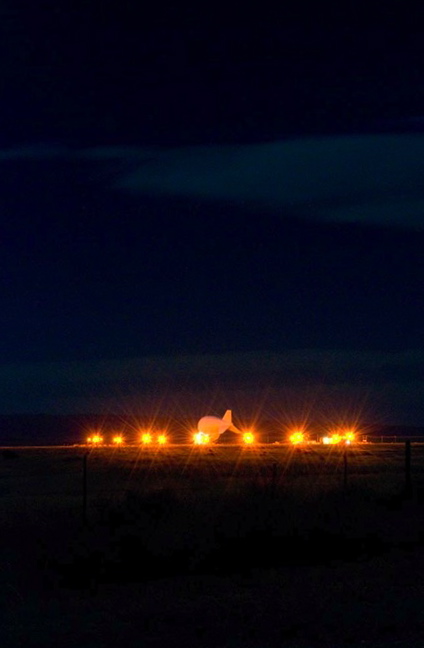
The Marfa aerostat, grounded at 2:45am
I came across it moored, at about 3am, in a blazing circle of orange halide security lamps on my way from Los Angeles to visit friends in Marfa and Terlingua. I stopped and started snapping away with my camera, but kept getting that “willies” feeling that goes along with standing on a windy, deserted Texas road in the middle of the night, taking pictures of a government surveillance aircraft that chases narcotraficantes around.
Pinto Canyon Road, West Texas, by moonlight
The Marfa aerostat is part of Far West Texas’ complex system of border monitoring technology that includes triggers on rural routes that insure government agents will be checking up on late night back road cruisers. Or so I was warned by two local joint-passing bros when I inquired as to where my friend Sasha and I might catch a glimpse of the Marfa Lights, or at least document the West Texas hills in the light of the full moon. They pointed us down Pinto Canyon Road, but told us to expect company. No Border Patrol 4x4s were waiting for us though (nor were the mysterious Marfa Lights); there were only a few wary horses on hand to monitor our activity.
I first tasted dandelion wine when I bought a bottle of it at a folksy gift shop in the Amana Colonies (yes, Amana of the appliance fame). The Amana Colonies is an Amish community dating back to 1854. It was settled by the communally living German pietists then known as The Community of True Inspiration, or The Ebenezer Society. Their tenets included avoiding military service and refusal to take an oath. The Amanas are nestled in the middle of what is now a sea of genetically modified corn and soybeans known as the Midwest, more specifically Iowa.
I had wanted something to drink at my campsite that evening. When I opened the bottle, I anticipated something more magic than what met my tongue. It was cloying yellow syrupy stuff, which resembled soft drink concentrate. I poured it out next to my tent, returning it to the earth where she could compost it. I was sure that I’d never get close to it again.
That was fifteen years ago, and now I have been drinking dandelion wine for about two years. The new stuff is stuff I’ve made myself from dandelion blossoms gathered in Chicago. I’m happy to say that it is divine. I am sure now that the colonists actually keep the good stuff in their private cabinets.
Upon mentioning “dandelion wine”, Ray Bradbury usually comes to mind. However, after I heard a radio interview with him a few years back when he passionately made a case to colonize the moon so we can ditch this trashed planet and survive as a race, I got confused. Enough said.
So the point is, I am going to tell you how to make dandelion wine. I encourage you to do this because dandelions pop up everywhere and every place. They are nearly ubiquitous pioneers in our landscapes of disturbed and deprived soils. Consumed, they are a magnificent digestive, aiding the heath and cleansing of the kidneys and liver. Amongst vitamins A, B, C and D, they have a huge amount of potassium.
As a beyond-perfect diuretic, dandelion has so much potassium that when you digest the plant, no matter how much fluid you lose, your body actually experiences a net gain of the nutrient. In other words, folks – dandelion wine is one alcohol that actually helps your liver and kidneys! Generous, sweet, overlooked dandelion…
When you notice lawns and parks spotting yellow, it’s time to gather. The general rule of thumb is to collect one gallon of flowers for each gallon of wine you want to make.
Enjoy your wandering. People will think you quaintly eccentric for foraging blossoms on your hands and knees. Note: collect blossoms (without the stem) that have just opened and are out of the path of insecticides and pesticides.
Four gallons of homemade, homegrown (last season) posole was never slurped so fast. Experienced growers shared their seeds and carefully picked through the collection, taking the most rare and unusual. The inexperienced came empty-handed and stuffed their pockets. As my friend Erik said: “Wait until they have 200 radishes to harvest and have to figure out what to do with them.”
Particularly exciting arrivals to the SEED ARCHIVE were blue lotus, mandrake and white alpine strawberries.
A public-access seed archive relies on its PUBLIC, which to me means a broad, diffuse network of folks growing seeds out and bringing them back. Completing this cycle is essential to not just the seed’s continued life but the vitality of the archive as a community resource.
Seeds require care and discipline. Many seeds can only be stored for a short period of time. Potatoes need to be grown out every year to remain viable. Lettuce seeds last only a year or two before they reach the end of their shelf-life. We can’t just stuff seed away and we can’t just grow things out willy-nilly.
Taking an informal poll here (in case any of you wish to respond, you are invited to): Why were people taking so much seed—far too much to grow and use?
The latter question came to mind as Vandana Shiva stepped up to a podium of a packed auditorium in Chicago a few days later. Here’s a picture…
Shiva comes from a farming, conservation and teaching family and as an environmental activist has a PhD in quantum physics. She is a GRANDMOTHER WARRIOR fighting Monsanto and the other four transnational corporations that control our global food supply—pushing GMO’s, toxic pesticides and herbicides affecting our seed and therefore farmers and their families, rural communities and ecosystems of plants and animals, soil quality and even us urban consumers. She uses an old form of resistance—inspiring a dedicated (read: strategized) and devoted (read heart-solid) group of people, mostly women to put their bodies on the line. Besides writing over 15 books, she has brought down the likes of Monsanto and Cargill on seeds and Coca-Cola on water rights. Shiva travels the globe extensively inserting toothpicks between our eyelids so we can see what the heck is going on. And like the toothpicks, it ain’t comfortable.
Four years ago I had the privilege of serving her on her week’s teaching residency in England. She was puffy, her breathing heavy, full of congestion. She was so unhealthy that it made me question the ability of a human, any human to hold such a large public identity and still remain whole and vital.
She looked better in Chicago, speaking about the Chipko movement of the early ’70s, an organized resistance to the destruction of forests in India. Village women organized the Chipko. It was thousands of women hugging trees that stopped the destruction, and popularized the action and use of ‘treehugging’ around the world. Chipko’s position was simple: forests support food, fuel and fodder, and stabilize soil and water. In other words, forests are integral to subsistence. That is: Ecology = Economy.
Press coverage of the Chipko movement:
Vandana Shiva also spoke about the great Bengal famine of the mid-1940s, when hundreds of thousands of Indians died due to the maldistribution of rice. Finally, women armed with broomsticks confronted the British East Indian Company to demand a lessened “tribute” of their rice crop so they could actually feed their families. Their message being: Let us keep more of the rice we grow or kill us now. Women and broomsticks, mind you. Witchy farmers, but not witches.
My favorite story about Om, the bass and drum duo of Al Cisneros and Chris Hakius—the rhythm section of now defunct drone metal icons Sleep—takes place on the back patio of Los Angeles club The Echo. It’s a cool winter night in 2007 and we’re all gathered here—hippie goners, young punks, indie rock squares—to take in a few breaths of fresh air before the band takes to the stage inside. One group stands out from the crowd: two women and a guy who are having a whale of a time, gesticulating wildly and laughing like crazy. At one point the dude approaches a hipster who’s nervously dragging on a toothpick joint. Our man offers his flask to the young fellow and a confusing exchange takes place: I can tell that he’s looking to swap quaff for toke, but for some reason he’s having trouble communicating this. I catch on about the same time the stoner does, giving up the doobie to the guy and his gal pals: They’re deaf, this happy trio of Om heads. That’s how deep the band’s sensual, mantra-like music goes.
THE WOMAN WHO KNOWS TOO MUCH A conversation with pianist-vocalist Diamanda Galas: Avenging queen of the damned, obvious musical genius and the only person alive who’s a fan of Doris Day and Vlad the Impaler
By John Payne Photography by Susanna Howe Make-up and styling by Kristofer Buckle
Originally published in Arthur No. 28 (March 2008)
“Get up off your knees, you weak bastard, and fight!” —Katzanzakis
Diamanda Galas made her solo recording debut in 1982 with The Litanies of Satan, a bloodcurdling blast of screaming, sighing, sneering, spitting sonority based on texts by the poet Charles Baudelaire. Recorded in a freezing cold basement studio in London after she’d been awake for 24 hours, Litanies is a glossolalic galaxy further perverted by insane floods of reverb, spatial delay, complex signal processing and overdubbing. Twenty-six years later, it remains quite terrifying in effect.
That initial recorded outpouring established Galas as a troubling and troublesome singer of the avant-garde and beyond, one who boasted a multi-multi-octave voice of unparalleled power and technical command along with a contemporary-classical/new-thing piano style the equal to and great leap forward past the storied prowess of your baddest dudes of the modern jazzbo scene. But all that’s just the mechanics of it; her performances have combined these vocal acrobatics with electronics and triple- and quadruple-mike techniques that’d fling the voice around in horrific battles between the Devil, God and all us poor victims – sometimes with her back to the crowd. Her topics? AIDS, rape, torture, genocide.
Galas was born in San Diego in 1955, daughter of a Turkish-Armenian father and an Armenian-Syrian mother. She grew up in a very strict and isolated kind of environment – no TV, no radio, no nothing like that. She wasn’t allowed to wear a two-piece bathing suit, couldn’t go on any dates, not until she left the house at the age of 19. So she and her brother Philip-Dimitri, a future renowned playwright, got real good at creating their own very individual worlds holed up at home, where, interestingly, they both dug the dark stuff from early on: Marquis de Sade, Friedrich Nietzsche, Antonin Artaud, and Edgar Allan Poe, especially. Diamanda’s father pushed her into piano lessons at a young age, but he forbid her to sing, ‘cause he thought singing was basically for idiots. He’d been a lounge band leader and had conducted gospel choirs, which by age 12 Diamanda had begun to accompany on piano or listened to from the top of the stairs. “Then when people would leave I would sing the music by myself, because I loved this music so much.” By age 14, she was playing with the San Diego Symphonic Orchestra.
Galas was a premed and then biochemistry student at Revelle College at UCSD. Though she became involved in the neurochemistry department at the UCSD medical school, she became aware during this time that what she really wanted to do was to use herself as a guinea pig.
“That was not an unpopular concept in the ‘70s,” she says, “and so that is what I did. This led to a complete destruction of my previous ideals and put me in the perfect place for vocal research later, although at the time I was exposed to Pasolini, Lilly, B.F. Skinner, Janov, Nietzsche and so on. But I had the uncomfortable feeling that I had no idea how to combine research with music-making until the vocal experimentation work was begun six years later.
She enjoyed her biochemistry studies in college, she wasn’t just killing time. “But I ended up spending too much time in the practice room playing the piano and singing and doing things like going into anechoic [silence] chambers and taking LSD and then trying everything with my voice, and getting into a lot of thinking that dealt with sensory deprivation, and that went with using your body as an instrument for your research, how the voice, word came out of it. If I couldn’t hear the reverberation inside, then nobody could hear me outside, and that was the most important thing to me. I didn’t want anyone to know what I was doing. I wanted to be completely free to do what I was doing. That was just an instinct.”
While Galas’ training in biochemistry enabled her to form solid views on medicine, and on music as well (“It trains you in seeing things as paradigms, seeing large situations; it influences the way you perceive things, how things work”), her experiences in school with a sado-masochistic boyfriend held equal fascination, and led to her channeling the discipline’s extremist views into her art. Early performances of her vocal experimental works were done in mental hospitals, fittingly.
“I was asked by some guys in the Living Theater, they said that was what they were going to do and I should do it, too. At that time, I was just standing with my back to an audience and I would not make a sound for maybe 10 minutes, until I felt it was kind of kicked out of me. Then I would do this for 15-20 minutes. And when I did, there were some very interesting responses. The strongest were from women, who really liked the freedom of that, the freedom of inappropriate behavior.” She laughs.
During her school years Galas had played and sang in a weird variety of bands, such as a circa-’74 combo in Pomona that included jazz critic Stanley Crouch along with Butch Morris, David Murray, Mark Dresser and several other heavies of the new-jazz thing. She also served time as an organist at a Holiday Inn lounge, doing Carpenters covers in a band with avant guitarist Henry Kaiser. Though she’d had extensive formal training on piano, Galas’ vocal techniques were from the start purely instinctual. And at some point a few years into it, she decided that it was important to develop maximum vocal power so that she could sustain long phrases, and sing without harming her vocal cords. In 1979, while Galas was still pursuing a postgrad degree in neurochemisty, Yugoslavian composer Vinko Globokar offered her the lead role as a Turkish torture victim in his opera Un Jour Comme Un Autre. In order to meet the harsh vocal demands of Globokar’s piece, she trained like a boxer, and set her goal of becoming the world heavyweight champ of the voice. Her 1980 work in Paris on the late Greek composer Ianis Xenakis’ extraordinarily complex microtonal pieces quickly sealed her reputation as perhaps the only singer physically capable of performing these works’ devilish difficulties.
The Litanies of Satan and its accompanying piece, Wild Women With Steak Knives, were deliberately titled to provoke, and when they appeared in 1982 they did generate a lot of early controversy about Galas. Wild Women was inspired by the Greek tradition in which women preside over the funerals by carrying large knives. Although Galas calls it a ritual of female empowerment, meant to inspire revenge for the dead, its use for a staged performance resulted in Galas’ interesting early notoriety as both a radical feminist and misogynist.
It was a reputation the bad bitch of new music seemed to relish. As if to further provoke reaction from both sides of the cultural divide, she begin composing her crucial Plague Mass, an eventual trilogy of late-‘80s works including Masque of the Red Death, in which she explored the AIDS epidemic by linking it to texts from Psalms and the Book of Leviticus. Today she calls Plague Mass a documentation of “the process of slow death in a hostile environment” in confrontation with “those who’ve twisted Christ’s teaching into socially sanctioned condemnation of sexual difference.” Her brother Philip died of AIDS in 1986, the year she began the work; she dedicated the trilogy to him and her friend Tom Hopkins, another close friend and AIDS victim.
Galas soldiered on with a series of confrontational and musically groundbreaking performances akin to a new Greek tragedy in defense of the displaced and diseased, whose timeless reversals of fortune were decried with the instinctive bloodlust of a frothing mad dog and the doom of a thousand dark angels. Her late-’80s work included vocal contributions to the score of Derek Jarman’s film The Last of England, which also deals with the AIDS epidemic. She also released the third installment of Plague Mass, entitled You Must Be Certain of the Devil, wherein she rails against bogus piety and homophobia.
Galas’ fame as a virtuosic performer grew of course in large part because of her reputation as a cultural/political agitator. In 1989, she was arrested while participating in a “die-in” at St. Patrick’s Catholic Cathedral in New York City, objecting to what she calls a “war against people with AIDS” by Cardinal O’Connor, who was trying to stop safe sex campaigns. Galás charged the Cardinal with complicity in the plague. In 1990 Galás performed the entire Plague Mass at the Episcopalian Cathedral of Saint John the Divine in New York City, where she doused her naked torso with blood while performing at the altar. In 1994 she performed The Masque of the Red Death in Italy, whose Christian Democratic Party formally accused her of blasphemy at the recitation in Italian of a section of Masque’s text. In the USA, Christian television shows put her alongside Ozzy Osbourne on their official lists of Satanic celebrities to be purged or blocked from the airwaves.
Galas remained brutally outspoken, calculatingly callous. In 1991’s influential Re/Search: Angry Women anthology of interviews, she ripped a few memorable zingers: “I believe childbirth is obscene. I consider it very alien . . . The myth I always aspired to was that of Artemis or Diana, the goddess of the hunt. She was a warrior and a fighter who had nothing to do with procreation”; “You’re either part of the Resistance or you’re a collaborator” [on AIDS activism]; “I pity weak men: They should be dragged out into the middle of the street, beaten, humiliated, degraded and sodomized by my friends and me just for sport. I love seeing weak men cry—my heart races.”
In all of her pieces, the vocal sound is more than simple beautiful sound, it’s an articulation of suffering – an idea that played a part in Artaud’s theatre of cruelty. The chilling 1993 Vena Cava album of solo vocal and electronic processing effects involved up to four microphones and a tape delay system; lyrics come from a text written by her late brother while enduring the mental and physical degradations of AIDS. Schrei X (1996) is a densely technique-packed 35-minute piece for solo voice, ring modulators and other electronic treatment, performed in quadraphonic sound and total darkness; it deals in sensory deprivation, rape and violence with no escape.
At times Galas seems to be seeking her fate by enacting and fulfilling her own modern Greek tragedy. Her beliefs are in part a byproduct of hearing her father tell her stories of growing up barely second-class in his own country, or worse, his friends hunted down by the Turks, literally pushed into the sea. She has a burning need to set the record straight on our shared history of atrocity. That is the material essence of recent works such as Defixiones, Will and Testament: Orders From the Dead, a solo voice and piano work based on texts related to the Armenian and Anatolian Greek massacres of 1915 and 1922. A grandly ambitious work involving extended passages from the Armenian liturgy, recitations of poetry such as Adonis’ The Desert and various other settings of Middle Eastern poets as well as Galas’ own “Birds of Death” and the gospel traditional “See That My Grave Is Kept Clean,” Defixiones is a harrowing maelstrom of Eastern vocal modes and volcanic piano explosions, as Galas intones “the world is going up in flames.”
If only to prevent devolving into a caricature of her wicked self, or perhaps to take a kind of breather (who could blame her?), by the early ‘90s Galas had begun developing the art of the “homicidal love song” in a series of song cycles, which she’s continued to write or interpret in recent years, beginning in ’94, when she and Led Zeppelin bassist John Paul Jones collaborated on The Sporting Life album (Mute), a very bent and very, very heavy set of “rock” tunes taken to epically bizarre extremes, and funny extremes as well, Galas soul-wailing with abandon while pumping a mean whorehouse piano. The song cycles include The Singer in 1992, Malediction and Prayer (1998 Asphodel) and the live La Serpenta Canta (2003 UK Mute STUMM), which scaled back from the epic proportions of her previous decade’s work to explore equally disturbing nuance in blues and gospel standards such as “I Put a Spell on You,” “Balm in Gilead/Swing Low Sweet Chariot” and “See That My Grave Is Kept Clean.” The latest in the series is the live Guilty Guilty Guilty (out in March on Mute UK).
Today, Diamanda Galas is having toast and tea in the back booth of a restaurant in breezy, sunny San Diego, not far from the waterfront. She’s a tall woman, dressed in black, as you’d expect – heavy black coat, blackest long snaky hair, blacker still eyes that don’t drill holes in my forehead but rather dart and flicker about the room, leaving singe marks across the naughahyde counter stools. She wants to go deep inside her music, to make the how of it understood, so she’s talking and talking, gesturing widely with long spindly arms, then talking some more, there’s so much to say.
Galas expresses herself in forceful and earthy and beautifully direct ways, in a melodious, cackling rasp … While she’s onstage—and probably in most of her daily interactions with people—she is quite an actress, of high, high drama and blackest, gruesomest comedy. Camp is valuable for how it speaks truths obviously, in black and white. But Diamanda’s Morticia-like character tends to stomp on mere camp. She knows too much. She is all the while shockingly human; she sips her tea, and tattoed on the fingers of her hand I see: “We are all HIV-positive.”
ARTHUR: First, tell me a little bit about what set you off on your own musical path. You must have had reasons why you needed to break all the rules.
DIAMANDA GALAS: It was the middle of the ‘70s, and I had come up as both a jazz and a classical pianist at the same time. Doing improvisation without reading first, then reading music. And then after playing classical music for a while, and classical concertos, including Cesar Franck, wonderful, wonderful, and Beethoven, and doing Fats Waller, and then doing things with some guys who had been influenced by Ornette and Ayler and stuff. I just decided that the fact is that the voice is the leader of the band, but I don’t want to be in the jazz ghetto, I don’t want to be in the new-music ghetto, I don’t want to be in any ghetto; I think I’ll just use my own name, and that’s the ghetto I’ll settle for. In the ‘70s, if you decided that you were gonna do jazz, then that meant that it had to be about music that had this swing, and I’m like, buddy, sometimes I want the music to swing, sometimes I don’t want the music to fuckin’ swing. Like, what the fuck do I care if the music swings?









 Arthur Magazine