

Tag Archives for Julian Cope
Julian Cope's KISS KROSSWORD
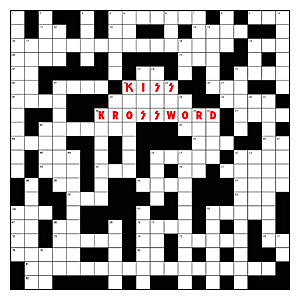
Indeed!
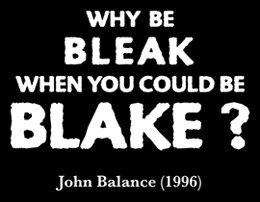
from Julian Cope’s website:
“Why Be Bleak When You Could Be Blake?” So concluded Coil’s John Balance in a 1996 letter to the Archdrude. In honour of William Blake’s 250th anniversary, Head Heritage is proud to offer this iconic and Utopian call-to-arms. Available printed in white on a high quality black t-shirt.
JULIAN COPE BUSKING TOUR AT THE CHURCHILL STATUE

TOUR OF THE YEAR: JULIAN COPE'S "JOE STRUMMER MEMORIAL BUSKING TOUR"
 JULIAN COPE / BLACK SHEEP
Joe Strummer Memorial Busking Tour
October 27th – 29th 2008 C.E.

In keeping with the theme of Julian Cope’s new album BLACK SHEEP, which advocates direct action and civil protest, the Archdrude and several of his musicians will – on Monday 27th October – embark on a 3-day-long busking tour of UK cultural centres. Accompanied by singer/guitarists Acoustika and Michael O’Sullivan, Universal Panzies leader Christophe F., and Black Sheep strategist Big Nige, Cope will commence the tour at 10 am at the site of ancient law hill Swanborough Tump in the Vale of Pewsey, and conclude on Wednesday 29th in front of the famous Carl Jung Statue in Liverpool’s Mathew Street. The entire action is dedicated to Joe Strummer, whose 1986 Clash busking tour was the inspiration. The Future is Unwritten!
Monday 27th October
Swanborough Tump (Vale of Pewsey)
Although nowadays ploughed down to barely a cropmark, this once proud law hill formerly known as Swinbeorg was a Bronze Age ancestral barrow employed for hundreds of years by local people for sorting out disputes and enforcing new legislation. It was here in 871, just two months after becoming King of Wessex, that the future King Alfred the Great met his elder brother King Aethelred I on their way to fight the invading Danes. Each swore that if the other died in battle, the dead man’s children would inherit the lands of their father King Aethelwulf.
Eddie Cochran Memorial (A4, Chippenham)
On April 16th 1960, the Ford Consul private taxi carrying Eddie Cochran and Gene Vincent from South Wales to London’s Heathrow Airport crashed at the foot of Rowden Hill, on the outskirts of Chippenham in Wiltshire, badly injuring Vincent and killing 21-year-old Cochran. As the only first generation rock’n’roller to die on English soil, the site of Cochran’s death has long been a place of pilgrimage for freaks across the world. In 1994, Cope’s youngest daughter Avalon was born just 200 yards from the crash site, in a room in the westernmost wing of Chippenham’s Greenways Hospital.
Armenian Genocide Memorial (Temple of Peace, Cardiff)
Cope’s long love affair with Armenia began in the early ‘90s with his studies of George Gurdjieff, the Biblical legends of Noah’s Ark upon Mt Ararat and his fascination for the country that embraced Christianity two decades before Ancient Rome. In 2003, Cope visited Armenia’s Tsitsernagaberd Genocide Monument, in the country’s capital Yerevan; a site dedicated to the millions who were force marched then driven into caves and suffocated by Turkish soldiers in the early 20th century. Turkey’s stubborn refusal to acknowledge its misdeeds (and its subsequent annexation of the whole of W. Armenia) have left Armenia’s psychic wounds open for a century now, which is why Cope believed that this Cardiff monument – paid for and erected by Wales Armenia Solidarity – was such an essential and symbolic place of pilgrimage on the tour.
Tuesday 28th October
Thomas Carlyle Statue (Chelsea Embankment)
The feisty Scottish essayist, Thomas Carlyle, is celebrated on this Busking Tour because of his enduring classic works, Heroes and Hero Worship and Sartor Resartus, both of which have hugely informed Cope’s trip. The first mentioned contains an astonishingly erudite overview of the life and times of Oliver Cromwell and Odin, moreover Carlyle was the first white author to give a useful and open-minded account of the life and work of the prophet Mohammed.
Wat Tyler Memorial (Blackheath)
In 1381, Wat Tyler led the Peasants’ Revolt, still one of the most extreme civil insurrections in the history of these British Isles. The revolt originated in Kent, where Tyler’s troops took Canterbury then proceeded to London, via Blackheath, which has long been associated with the insurrection on account of the famous sermon made to the army by renegade Lollard priest John Ball.
Emily Pankhurst Statue (House of Lords, Victoria Tower Gardens)
In order to represent Cope’s relentless championing of Women and Women’s Rights, there could be no heftier symbol than the matriarch and leader of Women’s Suffrage, Emily Pankhurst. Lest we forget that it is only since 1918 that women in the UK have had the right to vote.
Winston Churchill Statue (Parliament Square)
Cope felt it essential to visit Churchill’s statue, in Parliament Square, on account of his belief that it was only Churchill’s singular nature and half-American upbringing that allowed him to recognise the enormity of what would be lost in British democracy had he not continuously petitioned Parliament against the evils of Hitler’s Nazism, most especially at a time when such acts were considered only as war mongering.
Karl Marx’s Grave (Highgate Cemetery)
On this tour of centres that celebrates democracy and events ingrained in popular culture, Cope considers that it was only fitting that London’s stint should conclude at the grave of Karl Marx, the revolutionary German Jew whose philosophies and political theories lie at the very heart of modern democracy. As the words engraved upon Marx’s tomb remind us: “The philosophers have only interpreted the world in various ways – the point however is to change it.”
Wednesday 29th October
King’s Standing (nr. Birmingham)
Five days before the first pitched battle of the English Civil War, King Charles I addressed his army from atop a Bronze Age barrow that had long been used as a law hill, and was located at the foot of Birmingham’s Barr Beacon, that area of the Midlands’ primary law summit. The barrow thereafter became known as King’s Standing, and the village which grew up around it is known to this day by the same name: Kingstanding. As a long-time English Republican, Cope chose this site as the place that signified the very beginning of Charles I’s decline and, ultimately, his demise.
Site of the Peterloo Massacre (Manchester)
On August 16th, 1819, the huge crowd of 80,000 people, which had gathered in Manchester’s St. Peter’s Field to protest about the price of bread due to the unfairness of the new Corn Laws, were brutally attacked by cavalry fresh from the Battle of Waterloo who’d been sent to police the situation. With over 700 injured and 15 dead, the incident became known as the Peterloo Massacre and led to the forming of the Manchester Guardian.
CG Jung Statue (Liverpool)
Carl Jung’s statue in Liverpool has long been associated with Cope, due to his continued championing of Jung’s philosophies and the peculiar coincidence of the statue’s marble having been brought to Liverpool in the car of Donato Cinicolo, who photographed Cope for the cover of his 1984 LP FRIED. Jung famously called Liverpool ‘the Pool of Life’ just before his death in 1961.
METHINKS IT TAKES ONE TO KNOW ONE
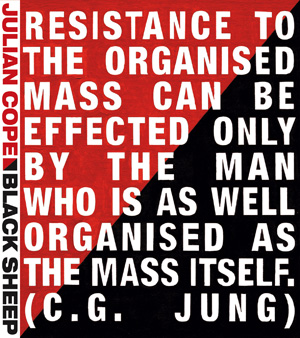
THE BLACK SHEEP’S SONG
(words and music by Julian Cope, from “Black Sheep” LP [2008])
1.
I am the black sheep of my flock,
I stand alone at field’s edge.
Out here my waking hours I spend,
Chewing a hole in the hedge.
I am the outcast of this flock.
When you are gathered together,
I spend my days tied up by a rope,
Seeking an end to my tether.
2.
Our gathering seems at their most content,
When master punishes me.
For in my difference I do remind them,
Too often of their apathy.
If you’re a white sheep, blessed are you,
And run adoring to your master.
You taste the lush green grass that fattens your lambs,
Although for them it spells disaster.
3.
To rally every black sheep is my goal,
In Visions, I see them all lamenting,
Across the world where’er a black sheep runs,
Still, plans of freedom I’m fomenting.
I am the black sheep of this flock
And I can answer to no one.
I see you are the black sheep of your flock, too,
Methinks it takes one to know one.
JULIAN COPE on Sacrificial Totem's "Hurqalya"

COPE ON METAL IN THE GUARDIAN.
Bassoons, flamenco, monks’ cowls … welcome to the new rock underground
Julian Cope explains why heavy metal, so often maligned, is at the heart of today’s rock avant-garde
Friday August 18, 2006
The Guardian
In April this year, after my half-hour stint as a guest vocalist for the US doom metal band SunnO))), I left the stage at Brussels’ Domino festival and removed my burka. Backstage, I remarked to the band’s biographer, Seldon Hunt, how open-minded heavy metallers had become: they were accepting, as festival headliners, a band without a drummer, a bass player or guitars, and with every bearded, long-haired musician among them clad in the habit of a Christian monk. Percipiently, Seldon commented that because the support acts had contained all of those ingredients (except the habits), SunnO))) considered it their duty to reject every metal cliche, replacing each of the archetypal rock instruments with Moog synthesizers, downtuned enough to bring the plaster off the theatre’s ceiling.
SunnO))) are taking metal to places you never imagined. Their music inhabits the territory that once was the preserve of meditative, ambient and experimental music alone. And they are doing it through the most critically reviled music of all. More remarkably, they are not alone. Across the world, underground scenes are using the shell of heavy metal – the volume, the grinding riffs, the imagery, the nomenclature – to test rock’n’roll perceptions and explore boundaries, all the while shamelessly subsuming other vastly different musical styles into their own work.
In a worldwide underground music scene that encompasses artists playing improvisatory music, folk, psychedelic and free jazz, metal is the common thread. You don’t hear much about this music in the mainstream press, especially in Britain, where the kingmakers of the music press have inadvertently created generations of musical whores, all doing their utmost to produce what they think the NME will want, rather than the music they want to make. But why is metal the link? Because the avant-garde musicians in the vanguard of today’s experimental underground scene grew up on it. They spent their late childhoods/early teens playing noisy computer games, watching 24-hour news of the first Gulf war and listening to grunge and metal. As they are mostly in their late 20s and early 30s, their strongest cultural landmarks are the suicide of Kurt Cobain in 1994, and, before it, the overwhelmingly loud sludge of Slayer, Megadeth and Metallica. Therefore the “inner soundtracks” of the new avant gardists are informed by grinding metal bands, just as the sound of the Velvet Underground’s Sister Ray informed that of my own punk generation. Older readers who equate the term heavy metal with the brash, stupefying 1980s anthems of Def Leppard and Bon Jovi will do well to remember that these bands are long out of the equation, having been at their height over 20 years ago.
Let’s go furthest away from metal first in our tour of the new underground, to acoustic music. In northern Portugal, the Galician separatists Sangre Cavallum accompany their often improvised songs of national identity with traditional instruments such as bagpipes, lyres, Iberian flutes and chanters, each song sung with an aching and a longing more reminiscent of Sardinia’s traditional Tenores music than anything current. We move closer to metal’s metaphor with the drum and hunting horn-led Saxon acoustic folk of Waldteufel, which conjures up an ancient atmosphere of Woden’s wild hunt careering through a dark-age forest. But the hand of metal is clear by the time we get to Wolfmangler, from Germany. Their album art may look like every other Germanic death metal trudge-o-thon, but the music of their latest record, Dwelling in a Dead Raven for the Glory of Crucified Wolves, features a six-piece line-up replete with trombonist, bassoonist, flautist and two bass players.
As slow and brooding as compost with a grudge, Wolfmangler are the bridge between pure ritual and “death folk”, a hybrid music whose best representatives are probably Austria’s Cadaverous Condition. This band began as a black metal act way back when, but have, in recent times, brought forth a delightful acoustic side that no one could have been prepared for. Indeed, the only surviving black metal element in Cadaverous Condition’s current performances is the Cookie Monster vocals of singer Wolfgang, whose delivery is performed with such a straight edge that it demands we take him entirely seriously. Once past the initial smirk of discomfort, we find ourselves a party to the hopes, fears and shattered dreams of a loathsome troll destined to live out his days under a haunted bridge awaiting the occasional victim, and singing to himself of how he dreads their piteous cries as he gnaws at their bones.
But the clear leaders on the acoustic side are an American band, Ben Chasny’s ensemble Six Organs of Admittance, who record incredibly dark gnostic meditations. Propelled by Chasny’s masterful acoustic guitar, the tumultuous clamour of Six Organs of Admittance inhabits a heathen netherworld reminiscent of the Lucifer Rising soundtrack recorded by Led Zeppelin’s Jimmy Page, their 20-minute mantras never once falling into the cod-raga of so much so-called 1960s-informed folk music.
America’s underground leads this immense musical experiment. Its gargantuan land mass and the localised nature of its media ensure that no musician can rise beyond their local throng without having first paid their dues. And it is American bands of the past – not necessarily underground bands – that inspire many of the underground artists elsewhere. In Spain, for example, Viaje A800 take inspiration from America’s biggest live act of the early 1970s, Grand Funk Railroad, as well as the proto-metal group Blue Cheer, to play a brooding, soul-based slow metal. They bring their own origins to bear by having the singer always employ his own, unique Spanish style (and taking an age in the process). Another band, the trio Orthodox, take the Spanish angle on metal even further. They have recontextualised the doom metal sound associated with the Nordic nations, and the methods of SunnO))), by dressing in the Ku Klux Klan-like cowls of the Easter parade in their home city of Seville (complete with ropes around their necks). They perform extremely long, arduous pieces accompanied by a female flamenco dancer, and separate themselves from the Wodenist, pagan traditions of the Nordic bands by appearing in press shots hailing brightly enamelled statues of the Virgin and child.
Second after America, probably, comes Japan, whose underground has inspired America’s own. (The Yoshimi of the Flaming Lips’ album Yoshimi Battles the Pink Robots is a former member of the Boredoms, and now has a group called OOIOO). Here, too, metal is at the heart of things. The prolific Acid Mothers Temple commune/band rose from the ashes of proto-metal bands such as Mainliner and High Rise. Their international success has, in turn, inspired Japan’s psychedelic ritual cult act Death Comes Along, whose free- fuzz sonic avalanches take such titles as Psychedelic Inferno, Children of the Death and Death Death Death. Led by the mysterious Crow, Death Comes Along have also modelled themselves on earlier, more politically motivated 1960s commune bands, such as Berlin’s Amon Düül – who shared living space with the Baader-Meinhof gang – and the communist agitators Les Rallizes Denudes, whose own career was forced underground after their bass player hijacked a JAL airliner and took it to North Korea in March 1970.
Politics informs much of this underground music, especially that made by musicians working in repressive social conditions. My travels through southern Armenia in 2003 put me in touch with Iran’s progressive trio Kahtmayan, whose violent marriage of krautrock, the French Zeuhl music of Magma, and early Metallica contains samples of US pilots’ radio communiqués as they prepared to attack northern Iraq. Recent pictures of these guys show them making signs of the horned god, and images of Tehran’s business centres sprayed with Kahtmayan’s own heavy metal graffiti – which all inclines me to believe the rumour that one member was recently murdered by Iran’s secret police. But I digress …
The journey from acoustic to electric brings us back to Ben Chasny, who is not just the leader of Six Organs of Admittance. He’s also the guitar player in the Santa Cruz psychedelic band Comets on Fire. Even without a real songwriter among the lot of them, Comets remain the rising stars of the underground scene – they are signed to a big independent label, Sub Pop, and even manage to get reviewed in papers like this one. They are the real thing, for shit damn sure. Commencing their career as a radical mix of Creedence Clearwater Revival, 13th Floor Elevators and Slade,they just got better. You didn’t know what they were singing about – which was possibly nothing, but what an electrifying nothing. This euphoric noise got the band signed to Sub Pop, where someone told the band’s yawping, howling singer Ethan Miller that he had to write some songs. He couldn’t, but maybe he thought he could. Mercifully for us, and luckily for Comets on Fire’s career, Ethan spewed out these efforts as a side project entitled Howlin’ Rain.
Which brings us to the brand new Comets album, Avatar. In Comets terms, it’s been an age coming, but compared to your average English rock underachiever, it’s way ahead of schedule. The production sucks, but then so does mine. Ethan’s not singing enough, but then he never did. Avatar’s only great crime is the “everything playing at once” lack of dynamics that Jim Morrison always accused Jefferson Airplane of having. Once their flavour-of-the-month status has passed, however, Comets on Fire’s continuity will return and we can look forward to 30 years of classic barbarian space travel barfed out every nine months. Lovely.
The underground is in better shape than it’s been for years – and greedy for the prizes. Today’s underground collective chant would probably go something like: “Where are we going?” “Everywhere!” “When are we going?” “Now!”
· Avatar by Comets on Fire is out now on Sub Pop. You can read Julian Cope’s writings about the rock underground at http://www.headheritage.com
Cope and Comets in London
Julian Cope, Royal Festival Hall, London
Hopping around in space
By Andy Gill
From the 27 January 2005 Independent
“Great gig, eh?” says the chap next to me at the bar, his eyes wide and glassily ecstatic as he hoists his foaming beaker. I could be wrong, but you know what? I think he may be on drugs.
If so, he has come to the right place. The Festival Hall looks as though it has been taken over by the psychedelic tribes of Europe, come to exult in the lysergic Sturm und Drang of Julian Cope’s hard-core, shamanic heavy rock. Cope is about as determinedly out of step with mainstream pop mores as it’s possible to get: his albums are available only through his website; and for much of the past few years, he has been busy with his second volume of megalithic scholarship, dealing with the prehistoric monuments of Europe.
A long-haired hippie type, Cope is in big, clumpy motorcycle boots, black bondage strides and bumflap, grey T-shirt, dark glasses and black leather hat, intermittently strumming at a Flying V and posing like crazy at the edge of the stage. Few front men straddle the roles of old-school strutting rock star and chummy man o’ the people as well as Cope. He’s the best communicator I’ve seen on stage in ages, his banter simultaneously playing up to his image and mildly debunking it, an engaging presence with the wit and timing of a stand-up comedian.
His music has a similarly heroic/self-deprecating duality about it, rooted as it is in the unreconstructed excesses of Seventies heavy rock, topped off with a dollop of speed-metal licks courtesy of the lead guitarist, Doggen, whose scary yellow make-up and fluorescent pink, yellow and black outfit makes him look like a mutant Bertie Bassett, of Liquorice Allsorts fame. At its best, it has an 18-wheeler momentum that sounds like Neu! played by Lynyrd Skynyrd and fronted by Jim Morrison. But there’s always a genial undertow of Spinal Tap absurdity about things, particularly during “Necropolis”, when Cope straps on an electric 12-string and his right-hand man, Donald Ross Skinner, picks up the yellow, double-necked guitar that has been leaning against an amplifier: it’s as if they’re deliberately trying to employ the two most needlessly over-the-top guitars ever built, in the one song.
Cope’s performance is in two sets, separated by a slot from the support band Comets on Fire. When he returns, he seems… distracted might be the word. Staggering around the stage, climbing up to the balcony, or just gazing vacantly at the audience, he’s off on his own little planet. Between songs, he drawls: “Yeaaahhh!” exultantly. I could be wrong, but you know what? I think he may be on drugs.
My suspicions are confirmed when, only a few minutes into the set, he starts asking his roadie, “How are we for time?”, then, sitting on the stage’s edge, enquires of his band, “What’s the next song? I can’t even… speak!” Realising the state he’s in, he apologises for his “momentary lapse of professionalism”, which gets a big laugh, before explaining that he’s “just entered into a new, psychedelically informed period”, starting on New Year’s Day.
Somehow, he makes it through a set comprising, in roughly equal parts, old faves such as “Reward” and “Spacehopper” and tracks from the new Citizen Cain’d album. The show climaxes with a lengthy “Reynard the Fox”, Cope going walkabout through the audience before returning to the stage for a bout of ritual scarification, clambering atop his extendable mic-stand and rocking precariously back and forth, 10 feet in the air, as a howling, juddering noise swirls about the hall. A suitably shamanic conclusion to an evening of atavistic rock ritual.
And you have to love a rock star whose parting shot, after several minutes’ standing ovation, is “Peace! Peace! Peace!… and Education!”
OLD TRICKS.
From the October 10, 2004 Sunday Times of London
Pop
Romancing the stones
Julian Cope, former rock god and pagan poet, has an oddly Establishment sideline–he’s a whizz on archeology, as his latest book proves. By Stewart Lee
Julian Cope, the former lead singer of the chart-topping 1980s pin-ups the Teardrop Explodes, is playing a secret solo show in the back room of a community arts centre in the Hampshire frontier town of Aldershot. Union Jacks flutter in all the pubs. Cope’s hair is, by some margin, the longest in the surrounding area. On stage, alone, in a floppy hat and sunglasses, he surveys the small but swollen space and modestly takes stock of the situation. “I know I’m not current,” he laughs, “and I don’t believe I’m timeless. I am in my forties, and in sight of 50. And once you’re over 50, 60’s not far away. And then you are allowed to be legendary. So I just have to keep my head down and keep working. Then I can be legendary.”
To many, the antics that have characterised Cope’s career are already the stuff of legend. He appeared on the cover of his second solo album wearing only a turtle shell, protested against the poll tax dressed as a giant baby from space and is winning new fans in America with his “ambient metal” project, LAMF. To most people, Cope admits, he is “that World Shut Your Mouth guy,” best known for the anthemic smash hit to which even Terry Wogan succumbed in 1986. But perhaps his strangest achievement is the completion of two heavyweight books on prehistoric archeology, the second of which, The Megalithic European, is published this month.
Its predecessor, 1998’s The Modern Antiquarian, a colour-coded gazetteer of British prehistoric sites, was the answer to a prayer for those of us who had spent years trekking across moors to stone circles on advice pieced together from quasi-mystical pamphlets or dry academic tomes. Stand at the centre of the Orkney mainland with The Modern Antiquarian in your hand and lost civilisations rise up around you. Now Cope has applied the same utilitarian ethic to the monuments of continental Europe. At his home in the Wiltshire countryside, within striding distance of the stone circle at Avebury, he holds forth.
“My job is to make uncool things seem cool,” he says, his foot up on a kitchen chair, like a rock star bestriding a monitor. “If you can find a way of presenting these things correctly, people will get into them. And if you can get people out of believing that stone circles are about wellington boots and anoraks, that they can be elegant, why not do it? When I put together my Scott Walker compilation album, for example, he was just thought of as a git. I am a total field worker. I get into things and go to places and see if they do it for me–and if they are going to do it for other people. Is there enough remaining above ground? Or, if the thing is underground, is it superbly underground? Is it the mother of all underground temples? Is it a hypogeum from hell? Can you go in and lose yourself?”
Initially, I’m uncertain whether Cope is using subterranean prehistoric temples as a metaphor for the 1960s balladeer Walker, or whether he is actually talking about subterranean prehistoric temples. Then I realise that it’s both at the same time. Cope in conversation doesn’t so much free-associate as make entirely unrelated ideas occupy exactly the same space. He has barged into the world of archeology with the open-minded enthusiasm of the very gentleman amateurs on whose work the science was historically built. Has he been welcomed?
“There are two types of archeologists,” he explains, putting down a toy wooden guitar he is making for his 10-year-old daughter, who wants to attend the local Hallowe’en event as Angus Young from AC/DC. “The older guys are pleased to be able to debrief to someone. They are like spies, with all this information, so they can afford to be generous. Aubrey Burl Äî who writes books with flat names like Stone Circles of the British Isles–and I get on really well. I can call him up and go, ‘Aubrey, I think I’ve found a new stone circle.’ And he goes, ‘I suppose it’s quite possible, but don’t tell my wife, because I’m too old to start visiting it now.’ If I’ve ever had a problem, it was with archeology’s middle management, which felt we should have taken more official routes.”
Invited to lecture at the British Museum in 2001, Cope chose as his subject the Norse god Odin in Christian symbolism. “I went from Odin to Christ via the various pagan precursors of Christ. The nice old guys in dicky bows at the British Museum had been saying, ‘You’re not the normal kind of person we have here, but you do it the way you want.’ So I did the lecture in full face paint and five-inch platform shoes–two nights, sold out. It was amazing.”
In The Modern Antiquarian, Cope’s analysis reflected his own performance background. Stones with quartz in them would look great glittering in the moonlight if you were a prehistoric audience on mild natural hallucinogens watching the ancient equivalent of Julian Cope. At the Lyric Hammersmith earlier this year, Cope’s own persona seemed influenced by his archeological imaginings. In psychedelic combat clothes, giant shoes and face paint, Cope became an absurd priest-clown figure and spent most of his two-hour set in the audience, declaiming over a primitive punk-metal backdrop.
“Being on stage, dealing with an audience, with hysteria, with a really barbarian art form, is the closest you get to a religious experience,” he says. “The shaman and the showman are inextricably linked. Little Richard recognised that. Jerry Lewis was damned the moment he opened his mouth. Cliff Richard and Tommy Steele, however, were never in any danger.”
The Aldershot show was supposed to be low-key, reacquainting Cope with live performance after months of writing. But with him, nothing is ever low-key. The fanatical fan base is out in force, undiluted by the less evangelical onlookers present in bigger venues. Cope is derailed by enthusiastic interjections from proprietary fans and the show lurches from one interruption to another. There’s a section of every Cope crowd that thinks he is their own private cult figure, a rock legend they can still reach out to and touch, insult or fondle at will. Tonight, guitar in hand, Cope appears happy to indulge this. However, there is a mighty 4WD in the car park, waiting to whisk him back to Wiltshire, where, one suspects, he is already planning his next adventure.
“I’m in a unique position,” he had said earlier, “but through luck, not judgment. There are people from my time, like Billy Bragg or Nick Cave, still doing everything with real dignity, but they have their feet in the officially straight world. There might be a South Bank Show on them. But me? I’m doing an ambient-metal installation in a Greek art gallery and writing about ziggurats.”
The Megalithic European is published by Element on October 18
COURTESY R. TURNER!
 Arthur Magazine