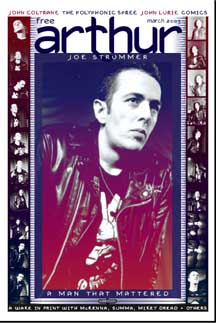
A MAN THAT MATTERED Joe Strummer was a spectacular, inspirational human being
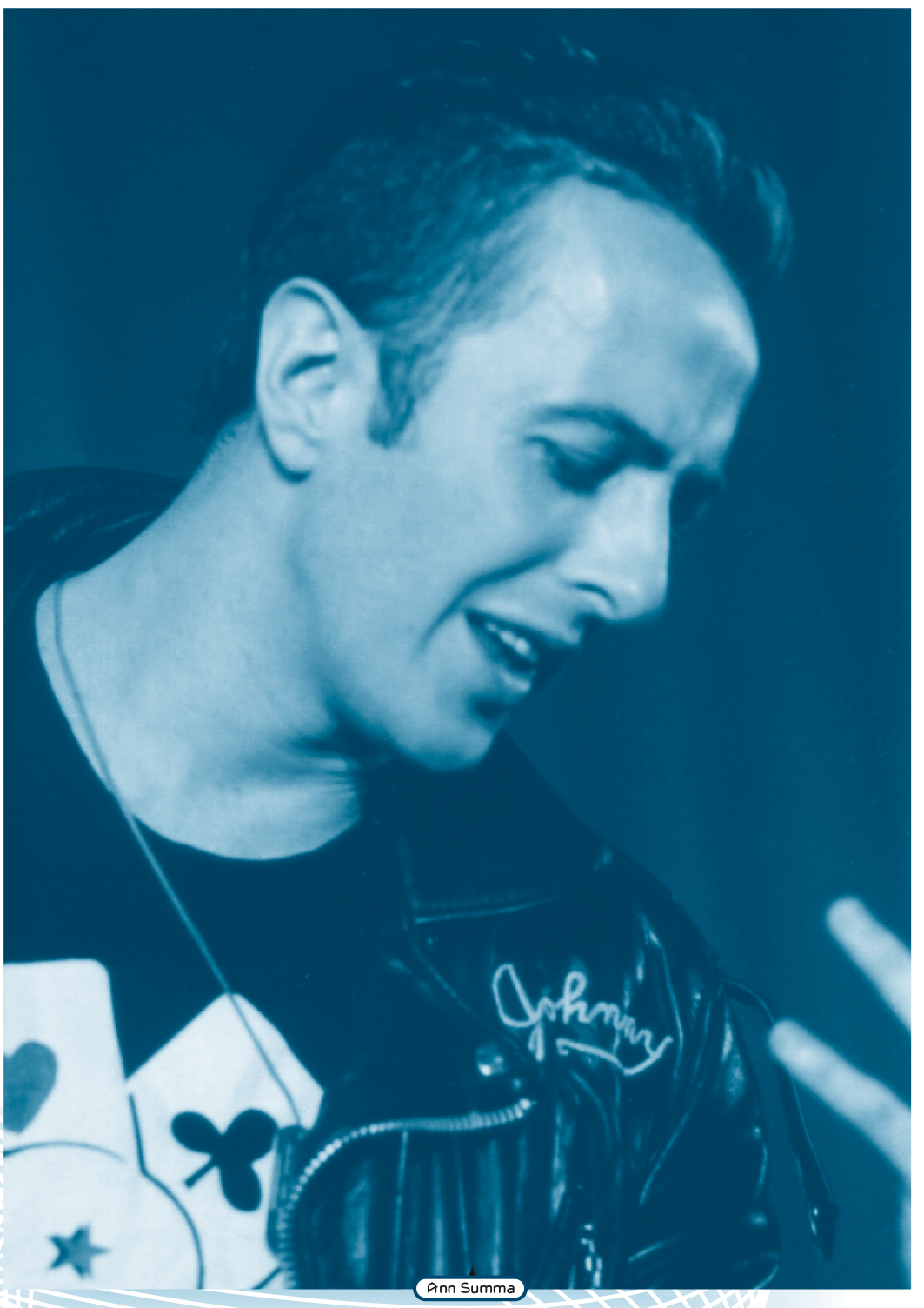
Text: Kristine McKenna Photography: Ann Summa Design: W.T. Nelson
Originally published in Arthur No. 3 (cover dated March 2003), shortly after Joe’s untimely death on December 22, 2002.
When the Clash first burst on the scene in 1977 I dismissed them for the same reason I’ve always hated U2. Their music struck me as humorless, self-important political blather that wasn’t remotely sexy or fun. Definitely not for me. Nonetheless, being a dedicated punk I had to check them out when they made their Los Angeles debut at the Santa Monica Civic on February 9th, 1979, and what I saw that night changed my mind—just a little, though. As expected, Mick Jones came off as a typical rock fop who clearly spent far too much time thinking about neckerchiefs and trousers. Joe Strummer, however, was something else. With the exception of Jerry Lee Lewis, I’d never seen anyone that furiously alive on stage. Legs pumping, racing back and forth across the stage, singing with a frantic desperation that was simultaneously fascinating and puzzling, he was an incredibly electric presence.
At the press conference following the show that night, L.A.’s ranking punk scribe, Claude Bessy, jumped up and snarled, “This isn’t a press conference—this is a depressing conference!” (Jeez, tempers always ran so high during that first incarnation of the punk scene—who knows why the hell our panties were in such a twist!) I remember that Strummer looked genuinely hurt by the comment. Mind you, he was a working class Brit so he wasn’t about to start sniffling in his sleeve, but he didn’t cop an attitude either. I was touched by how unguarded and open he was—and I was certainly impressed by the mans vigor. I wasn’t surprised when I subsequently learned that Strummer ran three marathons without having trained at all. His preparation? “Drink ten pints of beer the night before the race and don’t run a single step for at least four weeks before the race.”
That first show at the Santa Monica Civic didn’t transform me into a Clash fan, but Strummer interested me, so when the band showed up in 1981 in Manhattan, where I was living at the time, I decided to see what he was up to. The Clash had booked a nine-show engagement at Bond’s, an old department store on Times Square in Manhattan, and this turned out to be not a good idea. The place wasn’t designed to handle the crowds the band drew, and the engagement turned into a nine-day stand-off between the band and the fire marshals. I attended three nights in a row and can’t recall them ever actually making it to the stage and performing. But then, that was business as usual during the glory days of punk, when gigs were forever being shut down, aborted, abruptly canceled. This was political theater, not just music, and nobody embodied that idea more dramatically than the Clash.
Cut to June 14 of the following year and I finally saw the Clash succeed in a completing a full set at the Hollywood Palladium in Los Angeles. By then, I’d finally begun to appreciate the breadth and fearlessly experimental nature of the Clash’s music, and Strummer was at the peak of his powers as a showman at that point. The huge hall was packed, and it was as if Strummer was a maestro conducting this undulating mass of sweaty people, with the mysterious power to raise or lower the pitch at will. Boots, beer bottles and articles of clothing flew through the air, people leapt on stage, leapt back into the arms of their friends, Strummer stood at the microphone stoking the fire, and somehow managed to keep the proceedings just a hair’s breadth short of total chaos for two hours. It was a commanding display from a man who clearly knew his job and knew his audience.
Following the break-up of the Clash in 1985, Strummer charged head-on into a busy schedule of disparate projects. He acted in several independent films and composed six film soundtracks, including one—for Alex Cox’s lousy 1988 film, Walker—that was remarkably beautiful. I wrote an admiring review of the score for Musician Magazine, and a few months after it was published Strummer was passing through L.A. and he invited me to lunch in appreciation for the supportive words. We were to meet at a Thai restaurant on Sunset Boulevard, and though I was nervous on the way there, he put me at ease the minute we met. Strummer was such a genuine person that it was impossible to feel uncomfortable around him—I know it sounds corny, but he truly was a man of the people. He was funny and generous in his assessments of people, but he didn’t sugar coat things either–he had no trouble calling an asshole an asshole when it was called for. The thing that ultimately made Strummer such a spectacular human being, however, is so simple that it barely seems worth mentioning: he was interested in people. He wanted to hear your story and know what was going on in your neighborhood, he asked how you felt about things and was an empathetic listener—he paid attention! The other thing I immediately loved about him was that he was an enthusiast and a fan.
Just how big a fan he was became clear to me a few months later when he guest hosted a radio show I had at the time on KCRW. My show was at midnight on Saturday, and KCRW’s office is hard to find, so our plan was to meet behind the Foster’s Freeze at Pico and 14th at 11:00 P.M. He roared into the parking lot exactly on time in a car with four pals, and the lot of them tore into the record library at the station looking for the records on Strummer’s play list. His plan was play all the records that shaped his musical taste as a teenager in the order that he discovered them, and the show he put together was equal parts history lesson and autobiography. Included in the far-flung set were tracks by Sonny Boy Williamson, Lee Dorsey, Captain Beefheart, Bo Diddley, Hank Williams, and loads of fabulous, rare reggae and dub. His loving introduction to the Beach Boys’ “Do It Again” brought tears to my eyes. Several fans crashed the studio when they heard him on the air and realized he was in town, and he welcomed them all. It was a wonderful night. He had fun too, and as he thanked me and said goodnight, he kissed me on the cheek and I blushed.
Strummer spent the next ten years struggling to re-start his career post-Clash and stumbling repeatedly. “The only thing that got me through was sheer bloody-mindedness—I just won’t quit!,” he told me when I interviewed him in October of 2001. We were talking on the occasion of the release of his second album with his five man line-up, the Mescaleros, Global A Go-Go, which was rightfully hailed as the best work Strummer had done in years. He was happy with the record, and when I saw him perform at the Troubadour a few weeks after we spoke, he seemed happy in general.
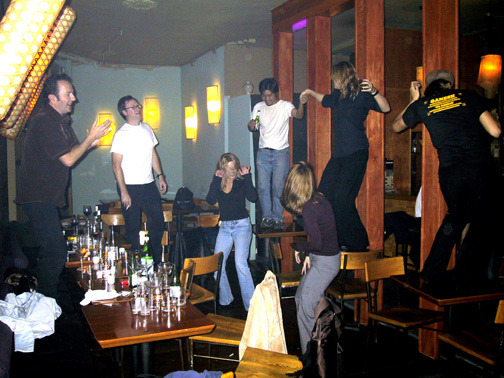
Above: Joe Strummer leads an impromptu dancing-on-the-tables moment at a restaurant in New York City, sometime in the late ’90s. (Photo courtesy Chris from Hellcat/Epitaph.)
“I’ve enjoyed my life because I’ve had to deal with all kinds of things, from failure to success to failure again,” Strummer told a journalist from Penthouse Magazine in 2000. “I don’t think there’s any point in being famous if you lose that thing of being a human being.”
That’s something that was never a danger for Strummer. During that last interview (printed below), I asked him what the great achievement of punk rock had been, and he replied, “it gave a lot of people something to do.” I loved the complete lack of self-importance in that answer, however, this isn’t to suggest that Strummer ever broke faith with punk. “Punk rock isn’t something you grow out of,” he told Penthouse. “Punk rock is like the Mafia, and once you’re made, you’re made. Punk rock is an attitude, and the essence of the attitude is ‘give us some truth.’
“And, whatever happens next is going to be bland unless you and I nause everything up,” he added. “This is our mission, to nause everything up! Get in there and nause it out, upset the apple cart, destroy the best laid plans—we have to do this! Back on the street, I say. Turn everything off in the pad and get back on the street. As long as people are still here, rock’n’roll can be great again.”
Thank you Joe for bringing us the good news.
* * * * *
The following conversation with Strummer took place in October 2001, on the eve of his final U.S. tour during the winter of 2001-2002.
Arthur: You say the great achievement of punk rock was that ‘it gave a lot of people something to do.’ What was its great failure?
Joe Strummer: That we didn’t mobilize our forces when we had them and focus our energies in a way that could’ve brought about concrete social change—trying to get a repressive law repealed, for instance. We’re stuck in a kind of horrible holding pattern now, and it seems to me that the only way to change it is if we get hipsters to stay in one place long enough to get elected. The problem is that no hipster wants to get elected.
Arthur: I saw the Clash several times during their U.S. tours of the late ‘70s and early ‘80s, and I remember the sense that something profoundly important was at stake at those shows, that they were about something much larger than pop trends. What was at stake?
Joe Strummer: In the rush of youth you assume too much—and so it should be—but we felt that the whole machine was teetering on the brink of collapse. Some amazing things went down in Britain during the ‘70s—the government decided they could disempower the unions by having a three day week, for instance. Can you imagine that? Monday morning you wake up, and suddenly there’s only a three day week, from Monday to Wednesday. There were garbage strikes, train strikes, power strikes, the lights were going out—everything seemed on the brink, and looking through youthful, excitable eyes it seemed the very future of England was at stake. Obviously, that’s very far from the feeling these days, when everything’s pretty much smugly buttoned down.
1. Narcolepsia is a new fetish noise tape label out of Portugal. The first two releases show a promising wide view of what fetid broil squirms in the contemporary noise landscape. First is someone/something called N, with a tape titled Smash My Brain I Can’t Tolerate, which is basically this Italiano dude Davide Tozzoli obsessing on fairly traditional noise moves a la M.B., Atrax Morgue, Merzbow et al. But the dedication and intent is genuine and is decent…nothing too startling or new but that’s kind of the point, the aesthetic. So be it. All you have to do is be beat, dulled and lose yrself in unrequited fantasies of erotic death. Second release is Body Count by An Innocent Young Throat-Cutter, the duo of Houston noise honcho Richard Ramirez and compatriot Isabella K. This duo has been documenting itself quite regularly through Ramirez’ Dead Audio Tapes imprint in super tiny editions. Not that this tape is going to reach that many more harsh wall noise freaks but it is a fine addition to their insane legacy.
2. Holy Crap. Screamingest, wobbliest No Wave screech of the year comes not from the bowels of New York, but from the lost tape archives of Vancouver, Canada. Tunnel Canary was an extremely raw co-ed trio whose entire previous known ouevre was some obscure cassette comp action. Now, Rundownsun has released a massive 2LP set, Jihad, collecting studio and live smeech that is some of the most pugnacious art punk you’ll ever hear. Ebra Ziron’s vocals make Lydia Lunch sound like Dean Martin in a mellow mood. Really fucking ripe! Lotsa weird bass stylings, scuzz generation from both electronics and guitar…what a pretty goddamn picture. Amazing to think this jabbering, destroyed masterpiece has been unheard for almost 30 years. Nice work. Somebody.
Talk Normal
For ass-burning contempo No Wave sludge, nothing has been in higher recent rotation than Secret Cog, the self-released debut CD Brooklyn’s Talk Normal. Andryo Ambro and Sarah Register create a feverish hybrid of Lydia’s “crying guitar,” the maniacal yodel-power of Die Kleenex, and the part of the Magic Band the Minutemen also embraced, which probably means the Urinals are a shadow influence. Regardless, the five songs here are totally wired, and just blow away the imaginary competition.
Originally published in Arthur No. 20 (January 2006)…
The Whole Enchilada
David Lynch was 27 years old and depressed. Then he started meditating…
By Kristine McKenna
In person, David Lynch bears only the vaguest resemblance to the image most people have of him. He is, of course, an artist of extreme complexity, but he’s not a weirdo, and the people who work with him adore him because he’s respectful and appreciative of their contributions to his art.
Lynch has been working under the radar on his latest film, Inland Empire, for quite a while; it commenced principal photography two years ago in Lodz, Poland, and features Polish actors Karolina Gruszka and Krzysztof Majchrzak, along with Laura Dern, Jeremy Irons, Harry Dean Stanton and Justin Theroux. It will be his first digital film, but it won’t be his last as he loves the freedom digital affords. “Film is over for me,” declares Lynch, who’s thus far handled the financing of Inland Empire, which is being produced by his longtime partner, Mary Sweeney.
I’ve been interviewing Lynch semi-regularly for 25 years now, and each time I see him I’m struck by his ability to retain the best parts of his personality; he remains an enthusiastic, open and very funny man, and he never fails to tell me something useful and inspiring. I spoke with him this past summer, ahead of his fall speaking tour of universities to promote the work of the new David Lynch Foundation for Consciousness-Based Education and World Peace…
Arthur: You’ve said in the past that your daily meditation practice is what enables you to maintain such a high level of creativity. What was going on in your life at the point when you were able to commit yourself to meditation?
David Lynch: I was 27 and I was in the middle of the first year of Eraserhead and things were going great. I had this unbelievable place to work—the stables at AFI—I had all the equipment I needed, I had people helping me, I had money to do it, and it was like a dream come true, yet I wasn’t happy. That saying ‘happiness comes from within’ started making sense to me and meditation seemed like a good way to go within. I’d always thought yogis sitting cross-legged in the woods were wasting their time, but I suddenly understood that all the rest is a waste of time. Meditation is the vehicle that takes you to the place where you can experience the unified field and that’s the only experience that lights the full brain. It’s a holistic experience and it’s not a foreign place—it’s a field of pure bliss consciousness and it’s the whole enchilada. People think they’re fully awake when they wake up in the morning but there are degrees of wakefulness, and you begin waking up more and more when you meditate, until finally one day you’re fully awake, which is the state of enlightenment. This is the potential of every human being and if you visit that unified field twice a day, every day begins to feel like a Saturday morning with your favorite breakfast, it’s sunny, and you’ve got the whole weekend ahead with all your projects that you’re looking forward to doing.
There are many types of meditation; why did you pick transcendental meditation?
I lucked into it. My sister was doing it, then one day she mentioned it to me and I don’t know why—maybe it was the sound of her voice and the time that I heard it—but bang! I said I’ve gotta have that. Transcendental Meditation is the way of the householder in that it allows you to stay in the world. Some people like the recluse way and want to go into the cave, and there are mantras that will take you right out of activity and put you into that cave. But transcendental meditation is a way of integrating these two worlds and activity is part of it. It’s like dipping a white cloth into gold dye; you dip it and that’s meditation, then you hang it on the line in sunshine and that’s activity. The sun bleaches it until it’s white again, so you dip it and hang it again, and each time you do that a little more of the gold stays in the cloth. Then one day that gold is locked in. It isn’t going anywhere no matter how violent the activity, and at that point two opposites have been united at a deep level. In the west people think yeah, like I’m really gonna give up my dental practice and go to the cave, but you don’t have to quit dentistry. Meditate before you go to work and you’ll start liking the people that come in and you’ll start getting ideas about dentistry. Maybe you’ll invent something and get into the finer points of a cavity and honing that bad boy. Things get cooler.
If you were running the world, what’s the first thing you’d do?
I’d get people going on consciousness-based education. Stress levels in children are going way up and there are so many bad side effects to stress. Kids are on drugs, they’re overweight—they are not happy campers and being a kid should be a beautiful thing. Kids take to meditation like ducks to water. The so-called knowledge we try to cram down their throats is useless and that’s why there are things like cheating—it’s all a bunch of baloney. It’s a sick, twisted, stupid world now. It’s ridiculous.
What’s America’s problem?
It’s locked in an old, ignorant way of thinking. Things are pretty low right now but lots of people are working to enliven that field of unity in world consciousness. John Lennon described meditation as “melting the iceberg,” and when that heat starts coming up some people love it, but it can be too much for some people and they fly apart. So, it’s gotta come up gently—it has been coming up pretty gently, too, but the bunch running the show here in America are working overtime in a negative way.
How did you interpret 9/11?
You don’t get something for nothing and America’s been up to a lot of nasty business for a long time. But Maharishi [Mahesh Yogi, founder of the Transcendental Meditation movement] says instead of fighting darkness you should just turn on the light, so let’s turn on the light and start having fun.
What makes you angry?
There’s an increasing amount of censorship in America and that is not a good sign. It really makes you wonder what’s going on with this country.
Is man on the road to extinguishing himself?
No. Quantum physics has verified the existence of the unified field and Vedic science understands how it emerges—in fact, Vedic science is the science of the unified field. There’s a whole bunch of trouble in this world but the way to get out of it is there; just enliven that field of unity. It sounds like magic but it’s science—it’s the real thing and the resistance to it is based on fear. But it’s not something to be afraid of—it’s us.
Your beliefs are deeply optimistic, yet many people find darkness in your work; how do you explain that?
Films and paintings reflect the world and when the world changes the art will change. We live in a world of duality but beneath it is unity. We live in a world of boundaries but beneath it it’s unbounded. Einstein said you can’t solve a problem at the level of the problem—you gotta get underneath it, and you can’t get more underneath than the unified field. So get in there and water the root then enjoy the fruit. Water that root and the tree comes up to perfection. You don’t have to worry about a single leaf if you get nourishment at that fundamental level.
1. Nite Jewel This one-woman act has been haunting nightclubs around Los Angeles and beyond this summer, dropping nocturnal transmissions and electro dust into the atmosphere. Accompanied by her bubbling synthesizer and deep tunnel beats, Nite Jewel would make the perfect house band on the mothership that’s going to take us all away from this place. myspace.com/nitejewel
2. Raymond Chandler What a different city Los Angeles would be without the mythology of Phillip Marlowe and the many shadows cast by Chandler’s noir mysteries running through its city streets. Fall’s a good time to revisit these stories of an honest man lost in a sea of corruption.
3. Avocado with poppy seeds Slice an avocado, add lemon, and roll in a generous heap of poppy seeds. Exotic.
4. Semina Culture: Wallace Berman and His Circle by Michael Duncan and Kristine McKenna (2005) You will never get tired of looking at this book. This catalogue from the 2005 traveling exhibit spans the years of mid-’50s to early-’60s beatdom, when an artistic and literary utopia formed around the mysterious figure of artist Wallace Berman and his arts and literary journal Semina. You couldn’t find it on newsstands or in bookstores; most of its few hundred copies were mailed by Berman to friends and peers. The book not only reproduces all nine issues but is a Who’s who of West Coast bohemia.
5. Walking really far Walk for two hours in any direction and see where you end up. Maybe you are missing something. Maybe you will find it.
6. Velaslavasay Panorama The North Pole is tucked right into South Los Angeles. Go and see. It’s hidden in the second floor of the beautiful Union Theater. Take yourself to the endless horizon. panoramaonview.org/
7. Flying Lotus, Los Angeles (Warp) The 17 tracks on FlyLo’s second record seem to flow without beginning or end, stacking dusty samples, sandpaper beats, and washy synths into a collage as dense and sticky as an august afternoon in Van Nuys. You’re stuck in traffic, the sun is in your eyes, a jackhammer echoes an unsteady rhythm in the distance, your radio suddenly plays all its stations at the same time. For a second it all makes some kind of sense.
8. The Late Show (1977, dir. Robert Benton) Lily Tomlin, Art Carney, a lost cat, blackmail, murder and endless hijinks, set in Los Angeles. Nutty and Noir, this Robert Altman-produced mystery features an incredibly stylish Tomlin as an aimless but charming eccentric and Carney as a cranky over-the-hill detective with one last fight In him. Don’t get the idea that this is one of those awful detective spoofs, it’s actually one of the most perfect movies you’ve never heard of, covering all genres, emotions, and hairstyles. You will laugh many times.
9. Cold brewed coffee Impress your friends with a rousing pitcher of iced coffee. You will be known throughout many wide and concentric circles for being a dark brewing lord and master of the bean. No one will know how easy it is for you with your cold brew coffee bucket. You grind a whole can of coffee with 9 cups of water and it sits for 12 hours and then you have a pitcher of low-acid coffee that tastes amazing for two weeks. Everyone will love you and want to be your friend. You can buy the cold toddy brewing kit they sell in stores or make your own. It’s off the grid.
10. The Baroque Music station on 1.fm When one’s radio breaks down, you can discover amazing things that were once hidden right under your nose. Lurking within the Classical Radio tab of that iTunes thing is an endless stream of this amazing music that restores your faith in civilization. It only occasionally loses its affirmative power when interrupted by a commercial for under-eye circles.
11. Raw vegan whipped cream Soak 1 1/2 cups of raw walnuts (or raw cashews) in water for two hours…then get rid of the water and put the nuts in a blender with 1/2 cup fresh squeezed orange juice and two tablespoons maple syrup (a few drops of almond extract optional) This recipe is from Juliano’s UnCook Book (Regan Books,1999)—good recipes, really bizarre self-portraits.
12.Griffith Observatory Despite multi-million-dollar renovations during recent years, the main attraction at Griffith is still the view of the twinkling metropolis below. Go at dusk to watch nature and culture collide to form a gold and purple ooze that stretches from the mountains to the sea. Breathtaking.
13. Sylvia Robinson “Pillow Talk” 7-inch single Found this scratchy 45 in a box at the back of a thrift store in Joshua Tree. Before masterminding Sugar Hill records, Robinson recorded music as ‘Sylvia’ and wrote this song for Al Green. He turned it down because it was too dirty so she recorded it herself and it hit number one on the charts in 1973. With breathy talk vocals, hi-hat swoosh, and sugary string and electric piano arrangements, it’s a fine specimen of the early disco sound that was forming around Philadelphia and other East Coast cities at the time, and is a naughty stepping stone between Serge Gainsbourg/Jane Birkin’s Je T’aime and Donna Summer’s Love to Love You Baby in the history of simulated orgasm on wax. The flipside sounds like it comes from an earlier, more wholesome time period but is an equally luscious track with a piano-heavy girl-group sound.
14. Jumping on a trampoline Up and then down. Do it again. Jumping cleanses your cells and lymph nodes and increases your immunity. Up with people.
15. Making your own amazing salad dressing in one minute Combine cold pressed organic olive oil (a lot), lemon, honey and stoneground mustard. This tastes better than anything you can buy. There is room for error. Salad dressing is very forgiving. Raw sage honey sweetens the deal.
16. Too Late For Tears (1949, dir. Byron Haskin) All the pleasure of knowing a dangerous femme fatale, none of the risk. 1949 Los Angeles in glorious black and white.
17. Okra If you slice a piece of okra crosswise, it reveals a circle of five perfect hearts formed from the fibers. I never loved okra, but now that I know it loves me, I’m coming around.
18. Show Cave This art gallery/performance space in the Echo Park district of Los Angeles has been forming its own hybrid aesthetic out of the goo of contemporary life in its past year of existence. Exhibitions have exciting names like Beast Heat, Glitter and Doom and Survivors of the White Plague. Show Cave also offers a stage to emerging musical talent (see #1). www.showcave.org
19. Low Motion Disco, Keep It Slow (Eskimo) In one room a synthesizer slowly throbs; in another a band rehearses outtakes from an unrecorded Royal Trux session. In a third room someone is playing records from their parents’ collection. There’s an empty bottle of purple syrup on the floor. The windows to this house are open and there’s a cool breeze that blows down from the mountains. You’re listening to these sounds mingle from down on the street. It sounds like a perfect mix that shouldn’t work at all. It’s too slow to dance to but it’s kind of funky. This is supposedly taking place in Switzerland.
Molly Frances lives in Los Angeles and makes music in Terminal Twilight.
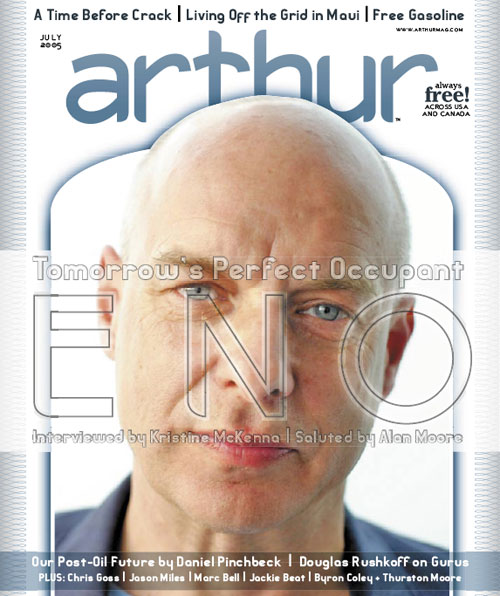
BEFORE AND AFTER SILENCE On the eve of the release of his first album of vocals songs in decades, pioneering musician-artist-thinker BRIAN ENO speaks with Kristine McKenna in a conversation as wide-ranging and profound as his singular career.
I’ve met lots of charming people in my life and Brian Eno may well be the most charming person I’ve ever met. What’s the secret of his devastating charm? It comes down to a few things. He has impeccable manners. He gives you his full, undivided attention when he speaks with you. He’s interested in everything under the sun. He has a wonderful sense of humor. Finally, and most importantly, he has an incredibly light touch. What I mean by that is that he can discuss just about anything and be genuinely involved without getting hot and bothered. Eno so relishes the process of examining things from various angles that he can’t be bothered to take it personally if you don’t agree with him. He’s fun.
Born in Suffolk, England in 1948, Eno was in art school in the early‘70s when he became a founding member of pioneering glam band, Roxy Music. He left the group in 1973 and embarked on a solo career that quickly expanded in several directions at once. Regarded as the inventor of ambient music—atmospheric washes of sound that settle in like weather and eschew the linear structure central to most music—Eno helped pioneer the use of sampling and computers in the recording studio, has contributed to more than 150 albums as producer, composer or performer, and has overseen the making of critically acclaimed records by David Bowie, U2 and Talking Heads. A visiting professor at London’s Royal College of Art since 1995, Eno has created audiovisual art installations at sites around the world since the early ’80s, and in 1983 he was a co-founder, with Anthea Norman-Taylor, of Opal Records. Five years later the co-founders married and settled in London, where they’re raising two teenage daughters. (Eno also has a 30-year-old daughter, Hannah, from a previous marriage).
One thing Eno hasn’t done for quite a while is sing, so the release of Another Day on Earth—his first record of songs in more than two decades—is something of an occasion. This was the ostensible reason we recently hooked up to chat, but as is always the case with Eno, our conversation roamed far and wide. Herewith, a few of the high points.
Arthur: What seemed desperately important to you as a young man that no longer seems quite so pressing?
Brian Eno: I’ve somewhat lost faith in art and the cultural world because I think it has no faith in itself. Culture is the most important thing we do, but it seems to me that we don’t take it seriously, and the visual arts in particular are in very dire straits at the moment. I don’t think any of it makes much difference, although there are some painters working now that I like very much. Lari Pittman, for instance, makes beautiful paintings that absolutely blow me away.
If you could own any artwork, what would you want?
There’s a room at the Museum of Modern Art that has a beautiful Rothko, two de Koonings, and a huge Monet Water Lilies. I’d be happy to have that room.
What aspect of middle-age weren’t you prepared for?
That women would find me more attractive. I’ve never thought that highly of myself so this came as a bit of a surprise. Perhaps it’s just that as you get older women are more inclined to tell you how they feel. When people are young they tend to beat around the bush a lot of the time.
How many times have you been in love?
Maybe half a dozen times.
What do you know about romantic love today that you didn’t know ten years ago?
That women are much more romantic than they care to let on—the old clichés are much truer than people care to admit. I would add, however, that notions of romance seem to become more potent for men as they age, too, and it starts to seem like more of the reason that you’d want to do it. You get into the joy of the process more as you get older and care less about the cum shot.
Why does love die?
It often happens that you love someone because they reflect you particularly well, and you basically like the person because they like you. This is a rather slender basis for building a relationship but it’s a trick people use to intrigue you—they look very interested so you think gosh, what a clever person! They’re really interested in me!
How do you explain the aversion to aging that’s an intrinsic part of western culture? Is it simply a fear of death?
I don’t think it’s fear of death so much as fear of the loss of one’s powers. For instance, I notice it in my eyesight. I hate the fact that I can’t see as well as I used to, I’m aware that I’m not seeing the detail I used to see, and I miss that visual side of my life everyday. It’s interesting that as you get older your vision treats your contemporaries better. You look at people your own age and think O.K., she looks nice, then you put your glasses on and think, good lord, do I look like that?
What’s the greatest privilege of youth?
The fact that nobody wants anything from you, you’re free to do anything and you’ve got every avenue open to you. When you’re young you have this capacity to roam, which just disappears. When you’re older either you’re not successful, and many avenues have consequently closed to you, or you are successful and there’s a huge pressure to do more of what you’ve done before. I know so many musicians who’ve told me that when they were young words just flew out of them—sometimes they didn’t even know where they came from—because when nobody cares, you don’t have all these voices in your head saying “that’s immature, you’ve been there before, we’ve heard so-and-so do that.” Because there are no critical voices in your mind it just throws out stuff. I’ve lost that freedom as far as lyric writing goes.
Your new record has a very wistful quality; were you feeling that way when you made it?
Yes, it is something of a getting older record. The other thing I hope it conveys is the idea that each day will pass as all the others have, and it will be just as amazing and disappointing as all the others have been.
The feeling you just described has to do with the fleeting and ephemeral nature of existence, and yet the work you do with the Long Now Foundation is predicated on notions of permanence and longevity.
Yes, Long Now is about thinking long term and was conceived to pose the question; if you really believed there would be people on earth 10,000 years from now, how would that affect how you live today? Most of us live as if there isn’t going to be a future, and few of us are conscious of how heavily we tread on the earth and what we leave behind. These are hard questions to ask ourselves, of course, because essentially they ask you to unpick your life. We’re born into intensely constructed lives that involve high energy consumption, the eating of expensive food—all the things I do along with everybody else I know.
We all live in varying states of denial of the fact that there are a number of converging crisis bearing down on us right now. One of them is the increasing prevalence of really nasty diseases spread by air travel—I have a theory about air travel, by the way. I think we’ve reached the peak of air travel and that it will go into decline for three reasons. One is that it will become associated with the spread of diseases — people will be unwilling to expose themselves to just to go on holiday. People will either drive somewhere or they’ll stay home. Two, there will be a few more spectacular terrorist incidents, and we all remember the effect that had on air travel last time. Three, sooner or later governments are going to have to tackle the fact that air travel is the hugest producer of pollutants we have. There’s been a big debate going on in England about a wind farm they’re thinking of building in the north of the country, and the argument for it is that it would prevent 250,000 tons of pollutants going into the air per year. That sounds good until you realize that one plane doing a London to Miami route for a year releases half a million tons of pollutants into the atmosphere per year. I’d be quite happy if there was a credible world movement against travel because communities would begin to return and people would start to rediscover where they are now. And needless to say, the romance of travel is diminished dramatically by the fact that no matter where you go there will be a Gap store.
Who makes you feel starstruck?
No stars do—it’s funny but I’ve never been impressed by those kind of celebrities. The closest I’ve come to being star struck is by the biologist Richard Dawkins. I’m so impressed by the work he’s done that when I met him I found myself wondering what I could say that would possibly be of interest to him.
What do you long for?
Discipline and some kind of routine. There always seem to be so many things going on in my life and I’m never quite prepared for any of them. Take a simple thing like collecting cuttings out of the newspaper—you’d think that would be a pretty easy thing to organize. I’m always cutting things out, and there are little stacks of clippings all around my studio, but there’s never any time to create a filing system and actually file them. In my imagined life of discipline and routine there would be 20 minutes each morning to file clippings, then half an hour for a swim, which is something I actually do manage to do most days. I just wish there was more of that structure.
What’s your idea of an important achievement?
Years ago my assistant bought a chair for a thousand pounds at a fishing lake owned by 300 fishermen, and nearly every weekend he goes there and basically meditates with a fishing rod in his hand—that’s what people are really doing when they fish. This strikes me as a great thing to achieve, probably because it speaks to my hankering for simplicity and routine. I also admire people who say ‘fuck this’ to the lot they’ve been dealt in life and demand something more for themselves. I have a nephew who has Lowe’s Syndrome and he’s got very poor eyesight and several other little things wrong with him, but this kid is so full of life, partly because my sister—his mother—told him ‘don’t accept your lot.’ She could’ve taken the attitude, ‘oh he’s disabled, he can’t do much,’ but she just sort of threw him into life. So, to make maximum use of what you’ve got is an important achievement. Take Lou Reed as a guitar player. The early records by the Velvet Underground have some of the most inspiring guitar playing I’ve ever heard, but I don’t think anyone would say Lou Reed is a great guitar player. He just knows how to use the gift he has to maximum effect.
Which song is in your mind when you think of Reed’s playing with the Velvet Underground?
“What Goes On.” I almost included a cover of the Velvet Underground song “I’m Set Free” on this record. I did rather a good version of it, too, and I will release it, but I didn’t want to make a record that was too long because I hate long records and think people don’t listen to them. I remember working on Laurie Anderson’s album Bright Red and there was a song on there that was just gorgeous, but she made it track 13 and I’ve never met anyone who’s heard it. By the time people get to track 13 they’re off somewhere else.
What’s your favorite song today?
I can never give one answer to any question, so I have a few. I spent the day digging a fish pond so I was listening to my Ipod, and I’d programmed a song into it by a Turkish singer named Belkis Akkale who has the most erotic voice I’ve ever heard. It absolutely drives me mad and my hear leaps with joy when she sings. Funnily enough, there’s a song I did with Bowie on the record Outside called “We Prick You,” which is amazing. When I heard it today I thought to myself, how on earth did we get that? I rarely listen to my old records and I must say, I was impressed. I’ve also been listening to an inspiring song by Me’Shell N’dege’Ocello called “Loyalty” that’s on a beautiful album she made called Bitter.
What was the last thing you learned?
I’m reading a fabulous book at the moment called Seeing Like a State: How Certain Schemes to Improve the Human Condition Have Failed, by a guy called James Scott. The first section of the book deals with city planning, the science of forestry, the invention of surnames, and weights and measures, and it made me realize that everything in society is built on fundamental infra-structural divisions. They’re so deeply embedded in the way we live that we’re often unaware that they’re at the core of many of the problems we wrestle with. That’s why the attempt to export free market capitalism to what was formerly the communist world hasn’t gone smoothly; there’s an intricate infrastructure of social agreements that must be in place for such things to work.
The first time I interviewed you was 25 years ago, and thinking back to that time it seems the world was a much safer and slower place. Is it simply a trick of the mind that we tend to recall the past as somehow simpler, or is the world actually picking up ever greater speed and complexity?
I don’t think it’s a trick of the mind. A few years ago the U.N. published a graph that charted various indicators of human well-being like security, equality, freedom, employment, access to clean water—all sorts of things. It was interesting to me that there is objective evidence for the incremental changes people feel, and the rather alarming conclusion they drew was that Western civilization peaked in 1976. I think it’s true that up until the early ‘80s people felt they were on an upward curve, at least in our culture. This isn’t true for every culture, but here in the West I think people believed things were getting better and globalization was a good idea. Today, most people seem to feel that the threats outnumber the promises and the dangers outnumber the freedoms.
So what are the long-term implications of this U.N. graph? That man’s on the road to extinguishing himself?
I think there’s a very good chance of that, actually, and having young children I find it absolutely alarming to contemplate what kind of world they’ll be living in when they’re my age. There have been various points in human history when people felt the end really was near, but the difference now is that we’re more powerful than we’ve ever been. Any one of us as individuals is almost as powerful as whole nations were in the past, in terms what we can handle, damage and effect. Of course, we can do good things too, but those things are less easy to achieve single-handedly. Good projects require co-operation, but you can create quite a lot of damage all by yourself.
An unfortunate shift in America’s political landscape is the fact that the will of the people no longer seems to mean much; our government does what it damn well pleases regardless of public response to their decisions.
I think that’s true. In the ‘60s people perhaps naively thought that democracy meant what it’s supposed to mean, but today, with Fox News and professional liars in politics, we’ve come to realize that democracy doesn’t mean anything really. As was evidenced in the recent U.K. elections, things aren’t quite so dire yet in England. Yes, Tony Blair was re-elected, but he won with a much reduced majority and a strong message from the people which was this: don’t fuck about with us. It became increasingly obvious to the British people that Blair had deceived them, and that the story of why we were going to war was untrue, and his re-election was essentially a vote of confidence for the Labor Party which has been a quite successful government in many ways—except for its alignment with Bush. England is basically a center-left country and I don’t think any members of the Labor Party approve of Bushism as a style. Bush is a very charismatic man, though, and I think Blair is a bit of a groupie. Obviously, Bush is an ignorant bully but he’s a confident man, and lots of people really go for that.
What’s the first thing you’d do if you were running the world?
I’m a patron of this thing called the Global Ideas Factory that was founded 15 years ago, and it’s an organization that collects ideas about how to make the world a better place. These ideas range from what to do with dog pooh to how to solve the global energy crisis, and some of these ideas are totally amazing. The first thing I’d do would be to set up an international body to examine the feasibility of some of these ideas. We simply waste the wisdom of our great thinkers—it’s amazing how little we use of human intelligence—and creating an internationally funded global ideas bank committed to actually doing something would be a way of putting a world changing culture in place.
To what degree do we inadvertently fictionalize our own past?
I’ve often thought that children should be taught how to watch television, read papers and listen to the radio, because most of our experience now is lived through media in one way or another. That’s particularly true in America where many people get most of their information about the world from television, which fictionalizes the past to a dramatic degree. That’s part of their raison d’etre, to tell us stories about the past.
Towards what end? How does it serve us to fictionalize the past?
It doesn’t serve us at all. Occasionally, for the sake of family coherence, you might tell a story that you know is a rather rosy version of events, but generally it’s imperative to maintain as accurate a grip on the past as one can manage. Very few people seem to appreciate the effort the Germans have made to not fictionalize their past, and it really pisses me off when that idiot Rumsfeld talks about old Europe as if to imply, “what do they know?” Germany has made a huge effort to face its past and come to terms with the fact that it acted absolutely abominably, and this is something America never has done and never will do. America will never ever say the Viet Nam War was a terrible mistake and what happened to the Vietnamese people was a disgrace, but young Germans talk about World War II with genuine passion and honesty.
There’s been quite an uproar about Downfall, the recent film about Hitler; many people have objected to the film on the grounds that it’s dangerous to humanize Hitler. Do you find any merit in those objections?
No, I think this is an important aspect of not fictionalizing the past. It’s a dangerous fiction to regard Hitler as a one-of-a-kind monster. I read an interesting book last year called Defying Hitler by a German historian named Sebastian Haffner, who was born in 1906 and grew up in Berlin where he watched the growth of the Nazi phenomenon. What becomes terrifyingly obvious in reading his book is how easy it is for a society to slip into barbarism. It starts very gently with all the intellectuals and clever people saying ‘bloody Hitler, what an idiot, he’s not going to last.’ All the things we’ve been saying about Bush, who was regarded as just a joke when he first appeared on the political scene. Things get worse and people start saying ‘shocking, disgraceful, we must get rid of this guy, but I’m busy right now writing a book—when it gets bad we’ll all pull together.’ But by the time it reaches that point it’s too late and there is no easy exit.
This is why I’ve started to get political in the last few years—I think we’re at the beginning of a new kind of technocratic tyranny. The manipulation of public opinion is so easy now; for evidence of that look no further than the fact that in a matter of months it was possible to convince most Americans that Saddam Hussein was responsible for the Twin Towers. It was just incredible. A key strategy in the manipulation of public opinion is to get the public excited about moral issues that don’t really matter like abortion and gay marriage. In England the issue is immigration, which is a minor problem but is something everyone feels they must have an opinion about. Governments love those issues because while everybody’s arguing about them, they’re left alone to pursue the business of world domination.
How did having children change you?
It certainly anchored me much more. I don’t like to be away from my children for too long because I hate the thought that I might miss some little part of their story. It also made me think about the future a lot more, and made me realize I had the capacity to feel absolutely unqualified love. One day a situation came up where there was some danger and I realized that without question I would’ve sacrificed my own life without even thinking about it. This came as a surprise to me because I’ve never considered myself a generous or altruistic person, and I don’t regard myself as brave in any way at all.
Do you believe in destiny?
No, but I believe that if you believe in destiny it will make a difference in what happens to you. Some people think ‘I am chosen and I’m a favored person,’ and that gives them a confidence that has the effect of making them chosen. The reverse happens as well. Some people consider themselves cursed and believe nothing will ever go right for them, and of course, nothing does.
What role does faith play in your life?
Last year I went to see Archbishop Desmond Tutu speak, and I was struck by the fact that on several occasions he made the observation, ‘you have no idea what goodness there is in people.’ This really impressed me, given that this was a guy who’d really seen some of the worst that people are capable of. He was talking about the Truth and Reconciliation Council and the great surprise of that endeavor was the incredible generosity of feeling people had, and their ability to forgive really awful things. So, I agree with Desmond Tutu’s comment, for the simple reason that I have faith in human intelligence.
Kristine McKenna is a Los Angeles-based writer. She recently co-curated Semina Culture: Wallace Berman & his Circle, a historical survey of West Coast Beat culture that opens in September at the Santa Monica Museum, accompanied by a catalogue published by D.A.P. She is presently co-producing a documentary film about the Ferus Gallery.
There was little that Harry Smith regarded as unworthy of his attention, and less that escaped his notice. “No matter where he was, Harry found the treasures of the world under his feet — heard things, saw things and tasted things nobody ever had before,” recalls Smith’s friend Harvey Bialy in American Magus, a volume of reminiscences about Smith published in 1996. “If you were with Harry you could discover something new every moment.” Smith needed a methodology for handling the mass of data he took in every day, hence the labyrinthine systems and elaborate, compartmentalizing structures that make up the through line in his far-flung body of work.
The best-known manifestation of Smith’s genius for compiling and organizing is Anthology of American Folk Music, culled from Smith’s collection of performances by obscure folk and blues artists of the early 20th century, now available as a six-CD set from Smithsonian/Folkways. Less known, but equally epic, is Mahagonny, the last and most ambitious of the 22 films Smith completed between 1946 and 1980. Smith based his four-screen, 141-minute magnum opus on Lotte Lenya’s 1953 recording of Bertolt Brecht and Kurt Weill’s 1930 opera The Rise and Fall of the City of Mahagonny, which chronicles the adventures of three Depression-era fugitives from justice who found a utopian city in a desolate patch of America. Smith’s film debuted in 1980 with six screenings at Anthology Film Archives in New York, then immediately disappeared into the chaos of Smith’s personal life. A compulsive substance abuser who lost, destroyed or gave away much of his work, Smith was a man of unusual priorities. He claimed to have remained celibate throughout his life, took terrible care of himself, and was occasionally reduced to living in flophouses — a fate that didn’t bother him at all, as long as he had money to buy books.
Through the joint efforts of the Harry Smith Archive, the Getty Research Institute and Anthology Film Archives, Mahagonny returns from oblivion with a newly restored print that screens for the first time at the Getty next Thursday. The following day, the Getty will host “Investigating Mahagonny,” a symposium featuring presentations from Gary Indiana, Jonas Mekas and Patti Smith, who appears in Smith’s film and performs at the Getty that night.
“After Harry died in 1991, this was the first project I decided had to be done,” says Rani Singh, who was Smith’s assistant at the time of his death and is now director of the Harry Smith Archive and a staff member at the Getty Research Institute. “Mahagonny is a culmination of Harry’s life’s work, combining things he’d been developing for 40 years. The seeds of everything come to fruition here, and it’s one of his biggest and most conceptually intense works,” continues Singh, who’s overseen the 1996 reissue of Anthology of American Folk Music; the publication of Think of the Self Speaking, a collection of interviews with Smith that came out in 1999; and the organization of last year’s Smith symposium at the Getty. “Hardly anyone’s seen Mahagonny, however, in part because it was so difficult to screen it.”
Among those who are familiar with the movie is filmmaker Jonas Mekas, founder of Anthology Film Archives. “Most people consider Mahagonny Harry’s most ambitious film, and it was very well-received when we screened it in 1980 — everyone considered it a masterpiece,” Mekas recalls. “But Harry was very temperamental. The last time we screened it at Anthology, he got into a fight with someone, then ran into the projection room, grabbed the gels being used for the film, ran into the street and smashed them. So that was the end of Mahagonny. Harry could behave badly, but we respected him because he was a very erudite, complex person.”
To describe Smith as complex is an understatement. Born in Portland, Oregon, in 1923, Smith was exposed to a variety of pantheistic ideas by his parents, who were Theosophists and encouraged his interest in unorthodox spiritual traditions. By the age of 15 he was recording Northwest Indian songs and rituals and compiling a dictionary of Puget Sound dialects. Following two years of anthropology studies at the University of Washington, he moved to Northern California, where, in the late ’40s, he devoted himself to painting and developed animation techniques that led to the numbered series of hand-painted films that established his reputation as an experimental filmmaker. Throughout his life Smith was involved in varying degrees with the occult, and his knowledge of Aleister Crowley’s hermetic fraternity, the OTO, deepened in San Francisco. In 1950, Smith moved to New York and began studying the cabala.
Smith had been a serious record collector since he was a child, and in 1952 Folkways Records’ Moe Asch recognized the quality of Smith’s collection and invited him to edit it down to a representative selection. More than a decade later, in 1964, Smith traveled to Anadarko, Oklahoma, to record the peyote songs of the Kiowa Indians. In the ’80s, he donated his definitive collection of paper airplanes to the Smithsonian. An authority on Highland tartans, Seminole patchwork textiles, string figures and Ukrainian Easter eggs, among many other folk artifacts, Smith spent the last years of his life at the Naropa Institute in Colorado, where he was named “shaman in residence” in 1988. During his years in Colorado, Smith maintained his residence at New York’s Chelsea Hotel, and it was there that he died in November 1991.
THE RESTORATION OF MAHAGONNY HAS BEEN NO SMALL achievement, and has required every penny of the $200,000 provided by the Warhol Foundation, the NEA and Sony Pictures. “The mode of presentation was a key issue we had to resolve,” says Michael Friend, a Sony Pictures film historian and archivist who’s been a technical adviser on the Mahagonny project. “When it was originally shown, four projectors and two projectionists who were frantically changing reels were crammed into a tiny booth. In order to be able to show the film without the acrobatics — with four matching projectors — we essentially made a 35mm print of the four 16mm frames being projected simultaneously. So now all that’s required to show the film is a single 35mm projector.”
It’s hard to estimate what it may have cost Smith to make Mahagonny; he tended to squander whatever grant moneys he received on book- and record-buying binges, drugs and so forth. He was, in fact, quite the amphetamine enthusiast during the early ’70s, when he began work on the film. His friend Debbie Freeman was on the scene at the time, and she recalls in a 1993 interview published in American Magus that “Mahagonny was made in some kind of diabolical frenzy.”
Smith confirmed as much back in 1976, in an interview he gave to A.J. Melita. “As the sort of film I make is improvised through the dictates of a diseased brain, I can never tell in which direction it’s going to jump any more than I can tell what I’m going to dream of a week from next Thursday,” declared Smith, who spent two years compiling 11 hours of footage, then cut the film based on an elaborate set of charts he made. “Mahagonny is particularly difficult,” he said. “You have to live Mahagonny — in fact, be Mahagonny — in order to work on it.”
Opening with a nighttime shot of Manhattan glittering like the Emerald City, Mahagonny is a kaleidoscopic work that juxtaposes passages of astonishing beauty with images that are difficult to parse. Much of the action takes place in the Chelsea Hotel, though the camera compulsively returns to the streets of the city, which is always out there, throbbing with life. It’s essentially a silent film, with “actors” moving in the theatrical fashion of silent film stars, and Lenya’s recording of Weill’s music further lends it the quality of a period piece — which, of course, it is. The New York City of the early ’70s wasn’t so very long ago, but it is, nonetheless, a vanished world. As we progress through the film, we watch a young girl knitting, Allen Ginsberg eating a banana, lovers kissing and quarreling. Sequences of stop-action animation give way to slow pans of intricate patterns created with glitter, colored sand, marbles, shells, candies, origami figures and painted blocks. It can be a challenge to connect the dots between Brecht-Weill’s Mahagonny and Smith’s, but it is possible once you surrender to Smith’s vocabulary of symbols.
In the midst of cutting the film in 1977, Smith told film historian P. Adams Sitney that Mahagonny was an attempt to “translate an opera into an occult experience.” Then again, Smith was a wickedly playful man who said lots of things. In a 1974 grant application submitted to the American Film Institute, Smith summarized Mahagonny as a “mathematical analysis” of Marcel Duchamp’s The Bride Stripped Bare by Her Bachelors, Even — which is akin to saying the film is a mathematical analysis of Mona Lisa’s smile. Also known as The Large Glass, The Bride is a mixed-media work that obsessed Duchamp for eight years and is often described as a study of the mechanization of sex. However, nobody’s absolutely certain of anything about that inscrutable piece.
“Harry may have said there was a connection between these two works, but I can’t see it,” says Mekas. “The only insight I could offer is that one shouldn’t try to interpret Harry’s Mahagonny by comparing it with the Brecht opera, because, as The Large Glass is shattered, Harry shattered Brecht’s original. He didn’t interpret Brecht’s opera, he transformed it. He basically used that piece of music as a launching point into a work of his own.”
Tom Crow, director of the Getty Research Institute, finds the film’s link with Duchamp less of a stretch. “Brecht’s Mahagonny is a parable of capitalism’s destructive tendencies, and Smith created a fairly literal interpretation of that, but at the same time, Mahagonny is evocative of The Large Glass in that both are about interruption and disharmony. I wouldn’t have pegged Smith as a Marxist or a Duchampian ironist, and it seems impossible to combine those two things in a single work, but Smith believed any conflict could be resolved through a visionary grasp of harmonic relationships.”
ULTIMATELY, HARMONIC RELATIONSHIPS ARE what it was all about for Smith. “I selected Mahagonny as a vehicle because the story is simple and widespread; the joyous gathering of a great number of people, the breaking of the rules of liberty and love, and consequent fall into oblivion,” Smith explained in his AFI grant application. “My photography has not been directed toward making a ‘realistic’ version of the opera, but rather toward translating the German text into a universal script based on the similarities of life and aspiration in all humans. As far as I know, the attempt to make a film for all people, whether they be Papuans or New Yorkers, has not been made so far. The final film will be just as intelligible to the Zulu, the Eskimo or the Australian Aborigine as to people of any other cultural background or age.”
Smith was convinced this was possible, and that all aspects of all visible and invisible worlds were connected. The cabala’s Tree of Life, Brecht operas, Tibetan mandalas and tankas, peyote ritual, civilizations gathering power then destroying themselves, fairy tales, tantric art, ancient alphabets, folk music, occult formulations, string figures, the past, present and future — Smith believed if you stacked them up on some giant template in the sky, you’d find the human breath rising and falling in all of them, at the same rate, forever. Such consolations of union and continuity are the gift Smith offers, and the leitmotif of his Mahagonny.



 —his first record of songs in more than two decades—is something of an occasion. This was the ostensible reason we recently hooked up to chat, but as is always the case with Eno, our conversation roamed far and wide. Herewith, a few of the high points.
 Arthur Magazine