
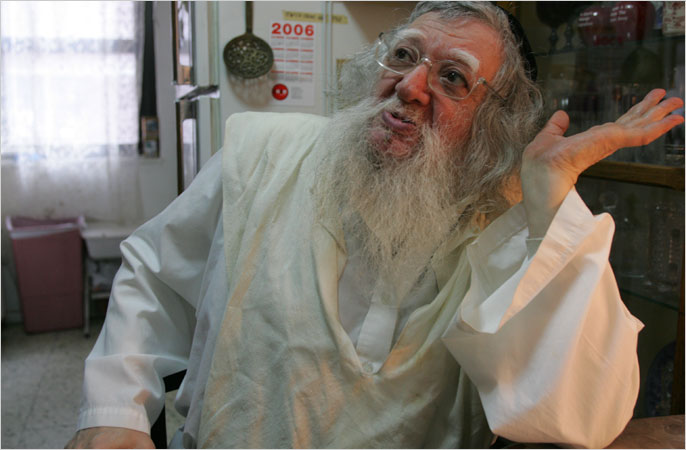
From The New York Times – March 21, 2009:
Lionel Ziprin, Mystic of the Lower East Side, Dies at 84
By WILLIAM GRIMES
“We are not after all intended to be consumed.”
So begins Lionel Ziprin’s “Sentential Metaphrastic,” a “poem in progress” of more than a thousand pages. “I reduced it to 785 pages,” Mr. Ziprin told The Jewish Quarterly in 2006. “I call it the longest and most boring poem since Milton’s ‘Paradise Lost.’ ”
Many more poems by Mr. Ziprin remain to be discovered, inscribed on spiral-bound notebooks and stuffed into a closet in his apartment on the Lower East Side of Manhattan. And that is nowhere near the half of it. Also in the apartment are the Jewish liturgical chants intoned by Mr. Ziprin’s grandfather, untold hours of sacred music that Mr. Ziprin tried for more than half a century to bring to the wider world.
This legacy now passes to his family — whether to delight or puzzle posterity, no one knows. Mr. Ziprin, a brilliant, baffling, beguiling voice of the Lower East Side and the East Village in all its phases — Jewish, hipster and hippie — died last Sunday in Manhattan. He was 84. The cause was chronic obstructive pulmonary disease, his daughter Zia Ziprin said.
For decades, Mr. Ziprin, a self-created planet, exerted a powerful gravitational attraction for poets, artists, experimental filmmakers, would-be philosophers and spiritual seekers.
He ran his apartment, on Seventh Street in the East Village, as a bohemian salon, attracting a loose collective that included the ethnomusicologist Harry Smith, the photographer Robert Frank and the jazz musician Thelonious Monk, who would drop by for meals between sets at the Five Spot. Bob Dylan paid the occasional visit.
There the art of conversation took a backseat to the art of listening to Mr. Ziprin hold forth for hours at a stretch on magic, interplanetary rhythms, angels, apparitions and Jewish history.
“He was larger than life and so far beyond a certain kind of description that I am bamboozled,” said Ira Cohen, a longtime friend. “He was much larger than a poet, though that’s hard for me to say, as a poet. He was one of the big secret heroes of the time.”
Often categorized as a beatnik, he created an artistic circle that overlapped with the worlds of jazz and beat poetry but remained distinct and apart. A poet prey to visions and hallucinations, a philosopher, a Jewish mystic with a deep understanding of the kabbalah, an enthusiastic consumer of amphetamines (legal at the time) and peyote (also legal) — he was all of these, and something else besides.
“He combined Old World mysticism and New World craziness,” said the poet Janine Vega. “He really was one of the great white magicians of the era.”
 Arthur Magazine