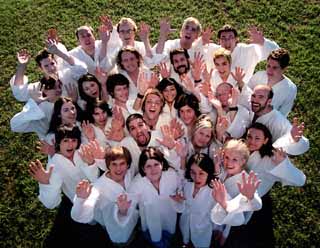
THE PSYCHEDELIC OPTIMISTIC POP CONGREGATION

From the Austin Chronicle:

Austin’s Waterloo Records
is one of the most in-store-friendly shops in the country, sporting a convenient
stage area that doubles as a listening station. Yet it can’t even hope
to contain The Polyphonic Spree,
whose 28 members would probably make the store look half-full just mulling
around. The group’s Saturday, 6pm in-store is the last one scheduled this
year. It won’t be the first improbable thing the band has pulled off in
their thrilling two-year run.

“I put this thing together
in about two and a half weeks,” says founder and leader Tim DeLaughter,
frontman for Dallas’ Tripping Daisy from 1991 until the group’s dissolution
in ’99. The Polyphonic Spree’s debut came the next summer, opening for
Grandaddy. “Chris [Penn], my friend and partner in [Dallas store] Good
Records, booked us for that show, and I didn’t even have a band. The whole
thing just started coming together. Once we got one person in, he knew
somebody, they came in, and the thing just literally grew overnight into
a band.”

What has evolved is a self-described
“choral symphonic pop band” that has regularly squeezed its way, with difficulty,
onto nightclub stages in Dallas and Austin. Their Good Records debut, The
Beginning Stages of … was recorded soon after their formation. All 28
band members (give or take a couple on maternity leave) sport white robes
onstage, and their sing-along blasts have won over even the most hardened
of cynics. Featuring piano, flute, brass, strings, theremin, and who knows
what-all, the Polyphonic Spree are the church choir of a never-never land
where the congregation has blue hair, digs psychedelic rock, and sings
at the top of their lungs without embarrassment.

“When you get that much energy
going on, with that many people on the same page, there’s a lot more going
on than just playing the songs,” says DeLaughter. “If you’ve seen it on
a night when it’s just totally on, it’s overwhelming.”

THANKS: G.SORIA, S.STERLING!

YOD CHRONICLES…

THE YA HO WA 13 INTERVIEW

By Gary Bearman

In 1988, I bought a new book called After the Acid Trip – The Ultimate Psychedelic Music Guide by Vernon Joynson. In it a music group called Ya Ho Wa 13 is described as such: “this band of Hollywood misfits reputedly made at least 9 albums for Higher Key during the ’70’s.” They are referred to as “musically
very weird? largely mellow, mystical and probably drug induced.” In addition, there are pictures of two album covers – one has five men wearing only loincloths, all with bows and arrows crouching around and on top of a Rolls Royce. The other has a very intense looking older man in a white robe with a long beard singing and banging on a kettledrum.

Once I finally got a chance to hear them, it became rapidly clear that there was something more than a little unusual going on here. Upon superficial listening, it sounded like a bunch of crazy musicians making a lot of truly wonderful and bewildering psychedelic music with this deep-voiced man talking, singing,
whistling and sometimes screaming over the top of it. And the wild bizarre things he was saying? Needless to say I was intensely curious about this

mysterious group of people
with names like Djin, Sunflower, Octavius, Pythias,


Rhythm, all with the last
name Aquarian, and their enigmatic leader Father Yod


(rhymes with road).

 I was only able to
hear a couple of reissued albums at the time since all the


originals were ludicrously
rare and expensive. For a long time I tried to find


out more information about
this group and what they were about, only to be met

by a stunning lack of information.
What scant information I did find was quite


odd, and still the group
seemed somehow cloaked in mystery.

 Then lo and behold
– the heavens opened and I was to discover in 1998 that they


released a limited edition
13-cd box set on the Japanese Captain Trip label


called God and Hair – Yahowha
Collection! Here were more pictures of Father Yod,


the band and a large group
of longhaired men, women and children that all seemed


to live together. One of
the albums covers even has Father Yod pictured with a


woman in a sexual tantric
position!

 I learned that there
were 9 original albums. The first four were released under

the name “Father Yod and
the Spirit of 76.” These were Kohoutek, Contraction,


Expansion and All or Nothing
at All. The remaining 5 were released under the


name “Ya Ho Wa 13.” These
were Yahowa 13, Savage Sons of Yahowa, Penetration: An


Aquarian Symphony, I’m Gonna
Take You Home and To the Principles for the


Children. All were released
between 1973 and 1975.

 A 10th album was released
without Father Yod in 1977, but with a lot of the


same musicians, this time
including Sky Sunlight Saxon, formerly of The Seeds.


This went under the name
“Fire, Water, Air” and was called Golden Sunrise. There


were also 3 cd’s of additional
material called Yodship, Related Singles, and

Unreleased Material.

Unfortunately for me, the
liner notes in the booklet are in Japanese. I came to


the conclusion that this
was somehow a very secretive sect that for some unknown


reason had a band as part
of it and released albums. I figured though that by


now there had to be literally
hundreds of people out there in the world who were


part of this group or children
of the group, and someone somewhere had to be


willing to tell the story.

 By a miraculous twist
of fate, I was led in my searching to an Internet


discussion group where one
of the musicians from Ya Ho Wa 13 was actually

answering questions! It
turns out this was Djin, the guitarist. I worked up the


courage to e-mail him, became
friendly and asked him some questions. He led me


to Sunflower, the bass player,
and before long I popped the question, “Would you


be willing to be interviewed?”
To my surprise they happily accepted and before


long I was put in contact
with the drummer Octavius, and much later Pythias, who


also played bass on some
of the albums. I was also introduced to Isis, one of


Father Yod’s “wives” (more
on this later). She is the family’s record keeper,


did business for the family
and wrote a book about the life of the family which


is being re-done for the
public. She was also kind enough to forward the photos

to me. Most of the entries
below by Isis are direct passages from the book.

 So what is this family?
As I began to get information back, there started to


unfold one the most incredible
stories of a band I have ever heard. It wasn’t


just about music, however,
it was a whole community/commune of people who lived


together with Father Yod
(later called Yahowha) as their spiritual leader….

Continued at: http://www.furious.com/perfect/yahowa13.html

PERCY VS. KATHERINE HARRIS

Paws for thought in Katherine Harris campaign

MIAMI, Florida (Reuters)
— Florida Secretary of State Katherine Harris, a key player in the 2000 presidential election recount battle, faces a dogged opponent in her campaign for Congress — a border collie-German shepherd mix, to be precise.


    Charter boat captain Wayne Genthner of Sarasota, Florida, said on Monday he planned
to enter the name of his dog Percy as a write-in candidate for the Republican primary ahead of the November election.


    “We hope by running a canine against a nationally known political person we can
draw attention to voter disenfranchisement and disconnect,” he said.


    Harris has set her sights on a seat in the House and is viewed as the favorite
to win in her district in the Sarasota area.


    Genthner
said he wanted to satirize what he viewed as absurdities and injustices
such as campaign finance, which he said put running for office out of reach
of ordinary people.


    Since
election rules would prevent a dog from running, Genthner said that later
this month he would send in the papers entering himself as a write-in candidate
— a person whose name does not appear on the ballot but can be inscribed
by voters. But Percy would be the name voters would write and Genthner
said he intended to act merely as “campaign manager.”

    While
his action is intended as parody, he hoped it would send a serious message.
“We want people to participate in democracy before it dies on the vine,”
said Genthner.


    The campaign
has so far cost some $600, mostly in copying fliers, said Genthner, adding
that he had taken Percy out to meet voters at events such as stock car
races.


    Percy’s
manifesto promises a tough line on crime since the dog “will personally
chase down any criminal he sees.” It notes that he “has himself never been
implicated in any sex scandal, thanks, he says, to his timely neutering.”


    Harris’s
campaign had raised some $1.7 million by the end of March and she is viewed
as likely to steam-roller her challengers in a safe Republican district.
Her campaign has taken the canine threat in good humor.


    “The
cute looking candidate, Percy the dog, has a lot of paws to shake to catch
up with our grass roots effort and huge volunteer base,” said her campaign
assistant press secretary Jessica Furst.


    Harris
became a household name, praised by Republicans and vilified by Democrats,
in November 2000 as supervisor of the hotly contested elections in Florida
that turned out to hold the keys to the White House. Bush won the White
House after a five-week legal battle over vote recounting.

THE RETURN OF PLUSH

From the Chicago Reader:

Post No Bills

By Peter Margasak

June 14, 2002

The Relentless Pursuit of Perfection

Liam Hayes looks more than a little like Bob Dylan — specifically Dylan circa Blonde on Blonde, after a shopping spree on Carnaby Street — and fans and supporters will attest to the magnitude of Hayes’s vision almost as fervently as Dylan’s did his. Yet in the past 12 years his band Plush has released just two singles and — as of February, when Fed came out on the Japanese label After Hours — two albums.

It’s not that Hayes is lazy or otherwise occupied: he works at making music every day, living frugally so he doesn’t have to take a day job. But he is by all accounts cripplingly obsessive. He spent about two years recording Fed with a cast of more than 30 musicians and engineers, spending a good six figures in the process. No label fronted the money — After Hours licensed the album only after it had been completed. At times the dense mix of blue-eyed soul, Brill Building songcraft, and Beatles-esque pop sounds like it should be called Stuffed: the confectionary arrangements always go for more where less might do. But they work for the well-written songs and not the other way around. Hayes plots his hooky melodies along strings of shimmering chords and fleshes them out with layer upon layer of brass,
strings, winds, keyboards, percussion, backup singers — yet his own clear, delicate vocals are the indisputable center of the mix.

Most of the album was recorded and mixed a year ago, but Hayes spent
another year tweaking and rerecording. Basic tracks were cut all over the
city — in traditional recording studios like Delmark’s Riverside and Steve
Albini’s Electrical Audio, with a mobile setup on a soundstage, at the
Congress Theater, and even on the roof of a south-side loft building. Hayes
hired Tom Tom MMLXXXIV (formerly
Tom Tom 84), a veteran arranger who’s

worked with the likes of Earth, Wind & Fire, Phil Collins, and the Jacksons

— to polish the brass and
string charts and recruit topflight session men

to play them. Each song
was painstakingly assembled — on tape, no

computers — from the numerous
sessions. “When it came time to mix the

album there was a stack
of tape seven feet long and three feet deep on the

floor…probably 50 reels
of tape,” says Isotope 217 bassist Matt Lux, who

played on the entire album.

“Nothing was ever settled,” says Albini. “You could be seconds away from having the mix be totally finished and then he would want to listen to alternate versions of the introduction from takes that you hadn’t listened to in nine months.” Late in the game, as the brass was being overdubbed, Hayes brought in drummer Morris Jennings — another soul and jazz pro — to rerecord basic drum tracks. “This methodology of doing it and the pace that we worked and the combination of deliberation and spontaneous choices — that complicated mosaic is what makes the personality of the record,” says Albini.

Hayes grew up in Chicago;
he attended Lincoln Park High School and the


Chicago Academy for the
Arts and then took (but never completed) a few


music classes at Roosevelt
University. He began performing sporadically

with Plush in 1990, and
in ’94 the band released a remarkable, beautifully


orchestrated single on Drag
City, the label owned by Hayes’s childhood


friend Dan Koretzky. A less
satisfying single came out on the now defunct


Flydaddy label in 1997,
and the following year Drag City released Plush’s


long-awaited debut album,
More You Becomes You — for all intents and


purposes a solo piano record.

Hayes recorded it alone partly
because his fellow musicians weren’t living


up to his standards. “I
think there’s people whom I’ve played with who are


playing at their best, and
there’s other people I’ve played with who could

play better, but who were
not self-critical enough,” he says. “That whole


environment that they’re
a product of is not self-critical enough.”


Koretzky notes that Hayes
spent eight months perfecting the cover art, done


to look like a grade-school
drawing.

When Hayes began recording
Fed, Koretzky let him use his car and his credit


cards, dispatched Drag City
employees to help him lug equipment, booked


recording sessions, and
loaned him money. He says Hayes had agreed to


license the new record to
the label, just as he had More You Becomes You.


But when Hayes told him
he wanted “a heavy five-figure” licensing fee up

front, Koretzky had to walk
away. “I knew it was probably time to think


about just buying a copy
of the record when it came out,” he says.

“This was just a record that
got out of control as far as the expense of


making it,” Hayes admits.
Neither Lux nor longtime Plush drummer Rian


Murphy has been paid or
expects to be, but Hayes had to fork over for the


hired guns and much of the
studio time. He says he spent enough of his own


money (earned in part by
playing on records by Smog and Palace and


appearing in John Cusack’s
High Fidelity) to buy a “nice shiny new car or


put a down payment on a
house,” but the rest came from friends, family, and

friends’ families.

“I am one of many people
that Liam was on the hook to while making this


record, and I’m sure that
some of this is going to come back and haunt


him,” says Albini, who eventually
extended him credit. “He wasn’t trying to


screw people, it’s just
that he was single-mindedly pursuing this record


and ignoring everything
else in his life, including his obligations. I’m


sure eventually Liam will
be even with everybody.” Lux agrees: “He doesn’t


intend to screw anybody
over, and he certainly intends to pay every cent


back. Whether that can happen
or not, I don’t know, but I’m sure if

something happened and he
got some money he would be extremely generous.”

If anyone has a right to
feel slighted it’s Murphy, who’s known Hayes since


high school and had played
in Plush for more than a decade when Jennings


was brought in. But Murphy
says he was relieved: “I was like, `Finally.’


The year before I stopped
getting calls was a year of constantly thinking,


`How much more of this can
I take?’ But at the same time, those tunes have


always knocked me out, the
vision has knocked me out, and it’s always been


fun to be a part of what’s
going on with him because he’s genuinely, like,


crazy. He’s one of those
music personalities that you read about, except

that I was in the room when
crazy things would happen. When he sent me a


copy of the CD it included
a letter that said, `It’s finished, I think.’ He


could tinker with it the
rest of his life; it could be another Smile.”

“His approach to the crudities
of the business of it are as deluded as his


approach to the music itself,”
says Albini. “He has as many misconceptions


about that as he does about
how records are made, or how bands are run, or


how one goes about conducting
an adult life. He’s equally misguided about


all of them. But the reason
people are so sympathetic to him is because


there’s a kernel of greatness,
and there’s an absolute purity in everything

about Liam. He’s not behaving
the way he does for effect, he’s behaving the


way he does because he genuinely
thinks that’s the way it should be done.”

Fed has yet to be picked
up by an American label; it’s currently available


only as an import, and the
price is accordingly steep (it lists for $25.99


at Reckless). Nonetheless,
Plush will play a record-release show — its


first Chicago show in four
years — on Friday, June 14, at Schubas. The


lineup is Hayes, Jennings,
guitarist Chris Bruce, and bassist Dave Monsey.

THANKS TO RAYDEEN


BOB AND DAVID IN "HOORAY FOR AMERICA!"

30 JUNE 2002: BOB
AND DAVID IN “HOORAY FOR AMERICA!”

From http://www.bobanddavid.com:

“MR. SHOW LIVE!

Bob and David in “Hooray
for America!!!” is coming to your town!

So what happened was…

    David
and I have been kicking around this idea for a live tour, and we finally
said, “Okay”. Why now? Because America needs us. And because we’ve got
all these new ideas for scenes, and we want to do them for you. You wanna
see ’em? We hope the answer is “bring it, bitch!”


    The show
will feature NEW SCENES and some updated CLASSICS,


    There
will be live scenes, and video pieces, and some mixed together, just like
in the show.


    ACTUAL
MR. SHOW CAST MEMBERS will be with us, a small, hi-tech, crew. We don’t
know their names yet, but that’s just because we never bothered to learn
them the whole five years we were doing the show.

    The show
just might, if you’re good, feature a guest appearance by the singing group
“Three Times One Minus One”, the Mayor of Hollywood, and various other
long dead, dear old friends from the show. Our goal is to tell a story
that will make you laugh more than you cry, teach then preach, and grab
you by the crotch until you believe in apple pie again.


    Here
are the dates and cities you must live in or move to so that we can come
to “your” town.

SAT 9/14  San Diego
California Center for the Perf. Arts @ Escondido 8:00


FRI 9/20  Washington,
DC Warner Theatre 7:30


SAT 9/21  Philadelphia,
PA Electric Factory 7:30

SUN 9/22  NYC Town
Hall 7:30


TUE 9/24  Boston, MA
The Orpheum Theatre 7:30


THU 9/26  Ann Arbor,
MI The State Theatre 7:30


FRI 9/27  Chicago,
IL The Congress Theatre 7:30


SAT 9/28  Madison,
WI The Barrymoore Theatre 7:30

SUN 9/29  Minneapolis,
MN The State Theatre 7:30


FRI 10/4  Los Angeles,
CA Royce Hall 7:30


SAT 10/5  San Francisco,
CA The Warfield Theatre 8:00


MON 10/7  Sacramento,
CA The Crest Theatre 7:30


WED 10/9  Eugene, OR
The McDonald Theatre 7:30

THU 10/10  Portland,
OR The Crystal Ballroom 7:30


FRI 10/11  Seattle,
WA The Moore Theatre 7:30


SAT 10/12  Vancouver,
BC The Vogue Theatre 7:30

WEEN TOUR DIARY

From http://www.chocodog.com/chocodog/ween/ween_new/tour_fr.html:

4/19 -Thomas Wolfe Auditorium, Asheville, NC–Usually we try and start a tour in a smallish bar or something, but this was a big ass auditorium, something like 2,000 people came out. I have no idea how we went from playing the “Be Here Now” last year (which holds 350 people), to this place. One way or another it was a pretty great way to kick off this short tour. After the show we got drunk and shot pool
at our hotel bar, which had a cover band playing lots of Skynyrd. later on, some douchebag kid knocked on my hotel room door, and said “yo dean, what was it like playing with those Nashville guys?”, like he had waited his whole life to fuckin’ ask me that stupid shit and had to knock at 3am just to hear my answer.

4/20 – Guilford College, Greensboro NC–We got to the campus in the early afternoon, it looked like
there were maybe 150 people on the whole grounds of the place—I got the
impression that rather than stick around for their spring festival, the
students all went home instead. The show was completely sold out in advance
(1,200 tickets), but this place would’ve held twice as many. In my opinion
this show suffered from what would become a common thing on this tour—
when you play college campuses there is almost always no alcohol allowed,
and no smoking cigarettes or anything else—on 4/20 no less. This only
applies to the audience obviously, we’re up there chain-smoking and drinking
the entire time, inadvertently rubbing people’s faces in it. I thought
we played very well, but after 2 hours and 15 minutes I felt like we had
left the crowd behind or something. For this reason we decided not to play
any encore—and that was unfortunately all anyone seemed to focus on after
the show ended. live and learn i guess.

4/21 – The Plex, North Charleston, SC —-This was a new venue for us, we usually play the Music Farm when
we’re in Charleston. They hooked us up with a kick-ass meal before we played,
which is a rarity on tour and much appreciated. Probably one of the best
shows that we’ve played this year except for the Columbia show. Maybe it
was the food, or maybe it just took us a couple days to get the ball rolling,
but for whatever reason everything kinda fell into place musically for
us on this night. People started throwing 20 dollar bills onstage with
requests written on them, we played a whole mess of the requests and bought
ecstasy with the cash after the show. From there we went out and spent
the night getting lap danced on X in Charleston’s seedier clubs. Actually
I’m lying—we just got on the bus and drove to Kentucky overnight. All
‘n all a great night.

4/23 – Kentucky Theater, Lexington, KY—This was our first time in Lexington and I was impressed
by how clean the city was—also, there wasn’t a soul on the street after
dark. Mick Preston and I generally will walk or drive as far as we have
to go to find a Waffle House when we’re on tour, but we ended up settling
for a Huddle House instead, which to my surprise was every bit as delicious–even
though it’s an
obvious rip-off of the real
thing, right down to the pecan waffles and scattered and smothered hash
browns and shit. This was a really cool old theater, and directly adjacent
to the concert was the Miss Gay Kentucky drag queen paegant. I don’t remember
much about this show, except I thought we played pretty solid and we hit
some bar afterwards and then some house party, and then a second trip to
the Huddle House.

4/24 – Axis, Bloomington, IN–This was our first time ever playing in Indiana, and the crowd was
ready to tear the roof off the club by the time we hit the stage. I felt
like shit thru most of this show and almost puked all over my amp during
“Doctor Rock.” This was one of three nights on the tour where I got to
watch my team (the Flyers of course) get shutout about 15 minutes before
it was time to play, and it put me
in a really bitter, fucked
up mindframe all 3 times. I was kind of thankful when Ottawa finally laid
a mercy-killing on their sorry asses. Anyway, the gig was great, it was
a fuckin sweatbox in this joint, but we gave it up punk-rock style for
Indiana.

4/25 – Univ. of Iowa Main Lounge, Iowa City, IA—This room was a big square box with carpeting—-again,
no smoking and no drinking allowed, but over 2,000 people showed up and
we played our asses off. Me, Claude, and Mick had lunch at Hamburg Inn,
which is supposed to be famous for it’s burgers and shakes or something.
After we kicked Iowa City’s ass with our rock and roll, we went out to
a bar and Mick Preston and I held the pool table for the entire night—-I
bet we must’ve won 25 consecutive games. I’m sorry I don’t have any better
tour stories from this tour, but look at where the fuck we played—Greensboro,
Bloomington, Carbondale….I mean what the fuck are we gonna do, fuck sheep
and tip cows after the gigs?

4/26 – Missouri Theater, Columbia, MO–As I mentioned before, this was pretty much the most inspired
show we’ve played in a very long
time—I really have no idea what makes one night better than any other, because I felt like ass before this show and was pretty much exhausted. It had been about 7 or 8 years since we were last in Columbia—last time was the night that the 30 minute live version of “Poopship Destroyer” on PTTB was recorded and this gig was probably better than that one. One of the highlights for me was the 15 minute version of “Never Squeal on the Pusher” that we played to close the show— Glenn took a fucking wicked theremin solo that set this whole show over the top. Other than that, we pulled out some tunes we haven’t played in a while and had an awesome time in Columbia.

4/27 – Shryock Auditorium, Southern Illinois U, Carbondale, IL—-One more show with no alcohol or
smoking for the audience—this was a really cool auditorium, unlike any other that I can remember playing—-like a U shaped theater with a balcony that wrapped from the left side of the stage to the right. We had a really strong show and finished with the best version of “Buenas Tardes Amigo” we ever did—we all basically agree that we wouldn’t give a shit if we ever played that one or “The Blarney Stone” again in this lifetime—but maybe the time off from playing it helped us get back into the heart of it. After this show we were all feelin pretty good about the tour and decided to go out—well it looked like the world was about to come to an end, the nastiest storm I’ve ever seen was developing, like gravel was blowing

off the pavement into the air. We drove thru it on the way home—about 1,000 miles. Next day we
found out that it was the tornado that killed 11 people in the mid-west—-4 died 20 miles south of Carbondale. The wrath of the Boognish strikes down the haters and non-believers.

“He told me, No, he was not on drugs. He had been hanging out at the wang ba. He said he went there almost every night.”

From The Los Angeles Times:

Dens of the Cyber Addicts

A deadly fire prompts China’s latest crackdown on seedy i-cafes filled with game-obsessed players.
‘You can’t stop us,’ one youth says.


By CHING-CHING NI, TIMES
STAFF WRITER

BEIJING — At first, Song
Yozhu thought that his 14-year-old grandson was on drugs. The boy rarely
came home. When he did show up, he was lethargic. Then, a few weeks ago,
he and a 13-year-old friend bleached their hair blond and started living
together in an empty apartment.


    “He told
me, no, he was not on drugs,” Song said. “He had been hanging out at the
wang ba. He said he went there almost every night.”


    Wang
bas are China’s 200,000 Internet cafes, the vast majority of them illegal.
To the West, they may appear to raise the prospect of free expression in
a country with an authoritarian regime, but to Chinese parents, they are
smoke-filled rooms with substandard safety conditions, nothing more than
modern-day versions of opium dens ruining their children’s lives. And,
in some cases, taking their children’s lives.

    This
month, 25 people, many of them teenagers, were killed in a blaze at a Beijing
wang ba. Chillingly, it was no accident. Song’s grandson and his friend
have confessed to setting the fire, allegedly as revenge against the owners,
who had refused to let them in.


    The government
immediately shut down every wang ba in the capital, and Chinese parents
cheered. Large cities across China took similar action.


    “I am
very happy the government closed all the Internet cafes at the moment,”
said Lu Mei, who said his 16-year-old son was forced to repeat a year of
high school because he spent too much time at the cafes. “He used to lie
to me about where he was going. I thought he was studying at school, yet
he was playing games at the Internet cafe. I was so angry, I didn’t know
what to do. I couldn’t follow him everywhere.”


    Wang
ba translates as “Net bar.” But the majority of them qualify neither as
cafes nor bars. You won’t find espresso machines or beer on tap. You will,
however, see plenty of ashtrays and breathe in lots of smoke. Some facilities
are so primitive, the only bathroom is a bucket against a wall.


    Like
those at the wang ba that burned, most owners skirt the law, operating
without a license and serving minors. China permits people younger than
18 to patronize licensed wang bas on weekends and holidays. Those younger
than 14 can enter only with an adult.


    Some
say Beijing is responsible for promoting illicit wang bas. The Communist
government is so afraid of the Internet’s power to spread antisocial activities,
it has tried to control Internet cafes by making it nearly impossible to
get a license. Instead, the move has had the opposite effect.

    The illegal
market has flourished, with fewer safety precautions. Periodic crackdowns
such as the one underway have only made the cafes more popular.


    As much
as the government is wary of the Internet, it also understands the Web’s
economic and social benefits. For example, Beijing wants to be known as
a digital city for the 2008 Olympics. That won’t be possible if the authorities
unplug all the Internet cafes.


    The state-owned
telecommunications sector also has tremendous financial interest in promoting
the use of the Internet. The question Beijing is wrestling with is how
best to control the phenomenon without killing it.


    “It’s
hard to imagine they would want to crack down on a permanent basis,” said
Dali Yang, a China specialist at the University of Chicago. “No sane Chinese
leader would want to say that. This is not an absolute issue of Internet
freedom but how to best regulate the industry.”


    Even
if the government wanted a total ban, physically it wouldn’t be possible.
The wang bas pop up easily: All you need is a few computers and a room
and you’re in business.


    Still,
this month’s fire has become a rallying point for worried parents long
eager to stamp out the illegal cafes and rein in the country’s out-of-control
cyber kids.

    Blame
what is happening on two decades of dramatic social change. China went
from being a nearly computer-illiterate nation a few years ago to one with
33 million Internet users.


    That
might seem puny compared with the 143 million signing on in the United
States. But China’s numbers are growing exponentially and are expected
to reach 100 million by mid-decade. The country soon could boast the biggest
online population on Earth.


    The more
open society of modern China has brought not only unprecedented personal
freedom but also an explosion in juvenile crime.


    In a
country that not long ago was filled with young Communists so morally upright
that they would turn a penny found on the street over to police, juvenile
delinquents now regularly make the news, mirroring their naughty counterparts
in the West.


    Contrary
to what some Westerners–and members of the Chinese Communist Party–might
expect, many young Chinese Web surfers show only minimal interest in the
Internet as a tool for information gathering or political subversion. Like
youngsters around the globe, what they really crave is computer games.
Lots of computer games.


    To them,
wang bas function as a giant video arcade. At the cafe that burned, for
example, players paid less than $2 a night for all the games they wanted.
Even those who have their own terminals find the cafes cheaper, faster
and infinitely more fun than signing on from home or school, where parents
and teachers may be around to supervise.

    This
is a generation of spoiled only children–“little emperors,” as they’re
often called. They grew up in a society without devotion to God, Mao or
sometimes even their parents. The online world of violent games serves
as a kind of surrogate faith for many.


    Some
seem to delight in their addiction.


    At Beijing
Science and Technology University, which reportedly lost nine students
in the blaze, it was standing room only last week in one undergraduate
computer room, which is still open because it is part of the school’s academic
facility, not a wang ba.


    The vast
majority of the 100 or so students there were male, and virtually all the
on-screen activities were games.


    The atmosphere
was so charged, it felt like an actual combat zone, with players linking
up in online squads and firing away as if their lives depended on it.


    “If I
don’t play for one day, I can’t concentrate on anything,” said Liang Sai,
a 19-year-old chemistry major waiting for a terminal. “If you ban all the
Internet cafes, we’ll find somewhere else to play. You can’t stop us, because
we’re hooked.”

    For the
two boys accused of setting the deadly fire, the wang ba was practically
their second home.


    Both
Song’s grandson, who because of his age has been identified only by his
last name, Song, and his accomplice, identified as Zhang, have drug-addicted
fathers now in jail, said the grandfather.


    These
aren’t spoiled children. Song’s parents divorced before he was a year old.
He hasn’t seen his mother since he was 7. He grew up with his father, who
had a string of girlfriends. Some of them used to beat the boy, his grandfather
said.


    The grandparents
once found the boy, then 2, waiting for his father on a trash pile, chewing
on rotten fruit. Early this year, when his father went to jail, the boy
went to live with his grandfather, a 67-year-old widower who uses a wheelchair.


    Zhang
basically lived on his own in his mother’s bare apartment. She was never
around. A few weeks ago, young Song moved in with him, hauling over the
TV, refrigerator and washer from his father’s house. They smoked cigarettes
and literally played with fire, twice almost burning down the apartment,
the grandfather said.


    The grandson
pretended to go to school, but classmates said they rarely saw him. When
he did show up, he behaved like a bully, borrowing money he never returned
so he could head back to the Internet cafe.

    “He has
suffered too much pain. He’s not afraid of anything,” the older Song said.


    What
the boy needed, it seemed, was hope. Sometime last year, his mother called
his grandfather to say that if he did well in school, she would find a
way to take him to the United States. The thought that his mother still
cared seemed enough to transform the delinquent into an angel.


    “His
teachers were so shocked at his progress they cried during the PTA meeting,”
the grandfather said. “But then his father got into trouble, and the boy
gave up again.”


    The wang
ba became his refuge.


    Today,
the boys remain under police detention, pending further investigation and
possibly a trial.


    Entrepreneurs
say that if Beijing seizes on the wang ba fire to toughen regulations overall,
it could deal a serious blow to legitimate cyber cafes–which already are
weak competitors of the illegal operators, partly because they tend to
be nicer, safer and more expensive.

    “Without
good and simple regulations that distinguish between good and bad Internet
cafes, it’s very hard for entrepreneurs to invest in the business,” said
Edward Zeng, the self-proclaimed founder of China’s first upscale Internet
cafe in 1996.


    His cafes
actually serve coffee and turn away minors, but he said he’s paying a price
for following the law. In the last two years, poor business has forced
him to cut his chain of about 20 shops by half, he said.


    Only
about 10% of Beijing’s estimated 2,200 Internet cafes are legitimate, because
the state makes obtaining licenses very difficult. Illegal operators thrive–they
give young Web users what they want: 24-hour service for as little as 25
cents an hour, cigarettes, even cots to crash on. This makes for cheap
entertainment, even in China. Youngsters in school uniforms are the illicit
cafes’ main clientele.


    The Chinese
press is splattered with horror stories about the tragic consequences.


    A high
school sophomore came home late from a wang ba and confronted his angry
father, according to one account. Then the teenager leaped from the family’s
seventh-floor window.


    One middle
school student had been playing for so long that he insisted he was being
abducted by aliens. His parents sent him to a mental hospital.

    Parents
have tried begging and grounding. Some have cut their children’s allowance.
No matter–the kids borrowed, stole, sold their bicycles. Anything to keep
playing.


    Some
desperate parents have hired private detectives to hunt down children who
go missing for days. Others have formed neighborhood brigades to patrol
local haunts.


    But the
games go on.


    “It’s
a great way to kill time and fill emptiness,” said Liang, the chemistry
major. “Most of us can’t afford to travel or do other things for fun. I
don’t know about the girls, but for the guys, it’s our No. 1 recreational
activity.”


    When
the girls turn up, they tend to stay in a separate part of the room reading
e-mail and chatting online. Many drown out the noise from the game-crazed
boys by downloading pop songs and listening to them on headphones.


    Liang
said he likes to play as many as seven hours a day straight, and Saturdays
are usually all-nighters. On the night of the fire, he was playing at a
nearby wang ba when the blaze illuminated the sky.

    The two
alleged arsonists apparently bickered with the owners because they had
no money to play. So the boys torched the place with gasoline, according
to their confession.


    Those
who died were trapped on the second floor of the building. The only exit
was engulfed in flames–or perhaps locked from the outside. The windows
were bolted with steel bars, a common practice for owners afraid of inspectors
and computer theft.


    Bouquets
of yellow chrysanthemums appeared last week on the curb next to the gutted
building. Reading the messages of grief left most parents shaken and determined.


    Zo Jianjune,
the mother of a 21-year-old son who lives next door to the burned cafe,
said her husband had run to the wang ba, unbolted the steel bars and saved
seven people.


    “A crackdown
is absolutely necessary,” she said. “Otherwise, there’s no telling what
else could happen.”

THE GRAND ILLUSION

The Grand Illusion: Why consciousness only exists when you look for it.

by Susan Blackmore

From New Scientist,
22 June 2002, p 26-29

„The last great mystery
of science‰; „the most baffling problem in the science of the mind‰; this
is how scientists talk about consciousness, but what if our conscious experience
is all a grand illusion?

Like most people, I used
to think of my conscious life as like a stream of experiences, passing
through my mind, one after another. But now I‚m starting to wonder, is
consciousness really like this? Could this apparently innocent assumption
be the reason we find consciousness so baffling?

Different strands of research
on the senses over the past decade suggest that the brave cognitive scientists,
psychologists and neuroscientists who dare to tackle the problem of consciousness
are chasing after the wrong thing. If consciousness seems to be a continuous
stream of rich and detailed sights, sounds, feelings and thoughts, then
I suggest this is the illusion.

First we must be clear what
is meant by the term „illusion‰. To say that consciousness is an illusion
is not to say that it doesn‚t exist, but that it is not what it seems to
be?more like a mirage or a visual illusion. And if consciousness is not
what it seems, no wonder it‚s proving such a mystery.

For the proposal „It‚s all
an illusion‰ even to be worth considering, the problem has to be serious.
And it is. We can‚t even begin to explain consciousness. Take this magazine
in front of your eyes. Right now, you are presumably having a conscious
experience of seeing the paper, the words, and the pictures. The way you
see the page is unique to you, and no one else can know exactly what it
is like for you. This is how consciousness is defined: it is your own subjective
experience.

But how do you get from a
magazine composed of atoms and molecules, to your experience of seeing
it? Real, physical objects and private experiences are such completely
different kinds of thing. How can one be related to the other? David Chalmers,
of the University of Tucson, Arizona, calls it the „Hard Problem‰. How
can the firing of brain cells produce subjective experience? It seems like
magic; water into wine.

If you are not yet feeling
perplexed (in which case I am not doing my job properly), consider another
problem. It seems that most of what goes on in the brain is not conscious.
For example, we can consciously hear a song on the car radio, while we
are not necessarily conscious of all the things we do as we‚re driving.
This leads us to make a fundamental distinction: contrasting conscious
brain processes with unconscious ones. But no one can explain what the
difference really is. Is there a special place in the brain where unconscious
things are made conscious? Are some brain cells endowed with an extra magic
something that makes what goes on in them subjective? This doesn‚t make
sense. Yet most theories of consciousness assume that there must be such
a difference, and then get stuck trying to explain or investigate it.

For example, in the currently
popular „Global Workspace‰ theory, Bernard Baars, of the Wright Institute
in Berkeley, California, equates the contents of consciousness with the
contents of working memory. But how does being „in‰ memory turn electrical
impulses into personal experiences?

Another popular line of research
is to search for the „neural correlates‰ of consciousness. Nobel Laureate,
Francis Crick, wants to pin down the brain activity that corresponds to
„the vivid picture of the world we see in front of our eyes‰. And Oxford
pharmacologist, Susan Greenfield, is looking for „the particular physical
state of the brain that always accompanies a subjective feeling‰ (New Scientist,
2 Feb, p 30). These researchers are not alone in their search. But their
attempts all founder on exactly the same mystery?how can some kinds of
brain activity be „in‰ the conscious stream, while others are not? I can‚t
see what this difference could possibly be.

Could the problem be so serious
that we need to start again at the very beginning? Could it be that, after
all, there is no stream of consciousness; no movie in the brain; no picture
of the world we see in front of our eyes? Could all this be just a grand
illusion?

You might want to protest.
You may be absolutely sure that you do have such a stream of conscious
experiences. But perhaps you have noticed this intriguing little oddity.
Imagine you are reading this magazine when suddenly you realise that the
clock is striking. You hadn’t noticed it before, but now that you have,
you know that the clock has struck four times already, and you can go on
counting. What is happening here? Were the first three „dongs‰ really unconscious
and have now been pulled out of memory and put in the stream of consciousness?
If so were the contents of the stream changed retrospectively to seem as
though you heard them at the time? Or what? You might think up some other
elaborations to make sense of it but they are unlikely to be either simple
or convincing.

A similar problem is apparent
with listening to speech. You need to hear several syllables before the
meaning of a sentence becomes unambiguous. So what was in the stream of
consciousness after one syllable? Did it switch from gobbledegook to words
half way through? It doesn’t feel like that. It feels as though you heard
a meaningful sentence as it went along. But that is impossible.

The running tap of time

Consciousness also does
funny things with time. A good example is the „cutaneous rabbit‰. If a
person‚s arm is tapped rapidly, say five times at the wrist, then twice
near the elbow and finally three times on the upper arm, they report not
a series of separate taps coming in groups, but a continuous series moving
upwards?as though a little creature were running up their arm. We might
ask how taps two to four came to be experienced some way up the forearm
when the next tap in the series had not happened yet. How did the brain
know where the next tap was going to fall?

You might try to explain
it by saying that the stream of consciousness lags a little behind, just
in case more taps are coming. Or perhaps, when the elbow tap comes, the
brain runs back in time and changes the contents of consciousness. If so,
what was really in consciousness when the third tap happened? The problem
arises only if we think that things must always be either “in” or “out”
of consciousness. Perhaps, if this apparently natural distinction is causing
so much trouble, we should abandon it.

Even deeper troubles threaten
our sense of conscious vision. You might be utterly convinced that right
now you’re seeing a vivid and detailed picture of the world in front of
your eyes, and no one can tell you otherwise. Consider, then, a few experiments.

The most challenging are
studies of „change blindness‰ (New Scientist, 18 Nov 2000, p 28). Imagine
you are asked to look at the left hand picture in the illustration below.
Then at the exact moment you move your eyes (which you do several times
a second) the picture is swapped for the one on the right. Would you notice
the difference? Most people assume that they would. But they’d be wrong.
When our eyes are still we detect changes easily, but when a change happens
during an eye movement or a blink we are change blind.

 Another way to reveal
change blindness is to present the two pictures one after the other repeatedly
on a computer screen with flashes of grey in between (for an example see
http://nivea.psycho.univ-paris5.fr/ASSChtml/kayakflick.gif). It can take
people many minutes to detect even a large object that changes colour,
or one that disappears altogether, even if it‚s right in the middle of
the picture.

What do these odd findings
mean? At the very least they challenge the textbook description that vision
is a process of building up representations in our heads of the world around
us. The idea is that as we move our eyes about, we build up an even better
picture, and this picture is what we consciously see. But these experiments
show that this way of thinking about vision has to be false. If we had
such a picture in our heads we would surely notice that something had changed,
yet we don’t. We jump to the conclusion that we‚re seeing a continuous,
detailed and rich picture. But this is an illusion.

Researchers differ in how
far they think the illusion goes. Psychologists Daniel Simons of Harvard
University and Daniel Levin of Kent State University, Ohio, suggest that
during each visual fixation our brain builds a fleeting representation
of the scene. It then extracts the gist and throws away all the details.
This gives us the feeling of continuity and richness without too much overload.

Ronald Rensink of the University
of British Columbia in Vancouver, goes a little further and claims that
we never form representations of the whole scene at all, not even during
fixations. Instead we construct what he calls „virtual representations‰
of just the object we are paying attention to. Nothing else is represented
in our heads, but we get the impression that everything is there because
a new object can always be made „just in time‰ whenever we look.

Finally, our ordinary notions
of seeing are more or less demolished by psychologists Kevin O’Regan of
the CNRS, the French national research agency in Paris, and Alva Noë
of the University of California, Santa Cruz, who first described vision
as a grand illusion. They argue that we don’t need internal representations
at all because the world is always there to be referred to. According to
their „sensorimotor theory of vision‰ seeing is not about building pictures
of the world in our heads, it‚s about what you are doing. Seeing is a way
of interacting with the world, a kind of action. What remains between eye
movements is not a picture of the world but the information needed for
further exploration. The theory is dramatically different from existing
theories of perception.

It‚s not clear who‚s right.
Perhaps all these theories are off the mark, but there is no doubt about
the basic phenomenon and its main implication. Searching for the neural
correlates of the detailed, picture in our heads is doomed because there
is no such picture.

This leaves another problem.
If we have no picture, how can we act on the things we see? This question
may seem reasonable but it hides another false assumption?that we have
to see consciously in order to act. We need only think of the tennis player
who returns a serve before consciously seeing it, to realise that this
is false, but the situation is odder than this. We probably have several
separate visual systems that do their jobs somewhat independently, rather
than one single one that produces a unified visual world.

David Milner of the University
of St Andrews, and Melvyn Goodale of the University of Western Ontario,
argue that there is one system for fast visuomotor control and a slower
system for perceiving objects. Much of their evidence comes from patients
with brain damage, such as D.F. who has a condition known as visual form
agnosia. She cannot recognise objects by sight, name simple line drawings,
or recognise or copy letters, even though she produces letters correctly
from dictation and can recognise objects by touch. She can also reach out
and grasp everyday objects (objects that she cannot recognise) with remarkable
accuracy. D.F. seems to have a visual system that guides her actions but
her perception system is damaged.

In a revealing experiment
D.F. was shown a slot set randomly at different angles. (Trends in Neurosciences,
vol 15 p 20, 1992). She could not consciously see the orientation of the
slot, and could not draw it or adjust a line to the same angle. But when
given a piece of card she could quickly and accurately line it up and post
it straight through. Experiments with normal volunteers have shown similar
kinds of dissociation, suggesting that we all have at least two separate
vision systems.

Perhaps the most obvious
conclusion is that the slow perceptual system is conscious and the fast
action system is unconscious. But then the old mystery is back. We would
have to explain the difference between conscious and unconscious systems.
Is there a magic ingredient in one? Does neural information turn into subjective
experiences just because it is processed more slowly?

Perhaps the answer here is
to admit that there is no stream of conscious experiences on which we act.
Instead, at any time a whole lot of different things are going on in our
brain at once. None of these things is either „in‰ or „out‰ of consciousness
but every so often, something happens to create what seems to have been
a unified conscious stream; an illusion of richness and continuity.

It sounds bizarre, but try
to catch yourself not being conscious. More than a hundred years ago the
psychologist William James likened introspective analysis to „trying to
turn up the gas quickly enough to see how the darkness looks.” The modern
equivalent is looking in the fridge to see whether the light is always
on. However quickly you open the door, you can never catch it out. The
same is true of consciousness. Whenever you ask yourself, „Am I conscious
now?‰ you always are.

But perhaps there is only
something there when you ask. Maybe each time you probe, a retrospective
story is concocted about what was in the stream of consciousness a moment
before, together with a „self‰ who was apparently experiencing it. Of course
there was neither a conscious self nor a stream, but it now seems as though
there was.

Perhaps a new story is concocted
whenever you bother to look. When we ask ourselves about it, it would seem
as though there‚s a stream of consciousness going on. When we don’t bother
to ask, or to look, it doesn’t, but then we don’t notice so it doesn’t
matter.

 Admitting that it‚s
all an illusion does not solve the problem of consciousness but changes
it completely. Instead of asking how neural impulses turn into conscious
experiences, we must ask how the grand illusion gets constructed. This
will prove no easy task, but unlike solving the Hard Problem it may at
least be possible.


Susan Blackmore is a psychologist,
writer and lecturer based in Bristol.

Further Reading

Consciousness Explained
by Daniel Dennett, Penguin (1993)


O‚Regan and Noë‚s ideas
will soon be debated in a special issue of Behavioral and Brain Sciences.

N.B. The current issue of
Journal of Consciousness Studies is devoted to the Grand Illusion. 
See http://www.imprint.co.uk/jcs/


This will also be published
as a book Is the Visual World a Grand Illusion? Ed. Alva Noë, Imprint
Academic, 2002.


MOLA MOLA

Ocean Sunfish

It has many names in many
languages, but the ocean sunfish vies for the title of strangest fish in
the sea. Its Latin name, Mola mola , means millstone. Recorded up to two
tons, this gentle giant inhabits all tropical and temperate seas.

The ocean sunfish (Mola mola)
is the world’s largest known bony fish (sharks and rays are cartilaginous,
not bony).  At least one estimate over 3000 lb. has been recorded
and individuals reaching 11 ft. (3 m.) from fin tip to fin tip have been
seen. It is found in all oceans in tropical and temperate climes, and is
known to eat gelatinous zooplankton (jellyfish) and probably small fishes
and algae.  In the eastern Pacific, Mola mola is normally found from
British Columbia to South America, although in El Nino events it has been
recorded as far north as Alaska.

Long dorsal and anal fins
are the mola’s principal source of locomotion — they are flapped from
side to side. The caudal fin of the ocean sunfish is quite short and acts
like a rudder.

Molas are often covered with
small parasites, and will approach drift kelp and other flotsam to recruit
small fish (which hide in and below the kelp) to remove these parasites.

"36% of Americans believe that the Bible is the word of God and is to be taken literally. 59% say they believe the events in Revelation are going to come true, and nearly one-quarter think the Bible predicted the Sept. 11 attack."

25 JUNE 2002: “36% of
Americans believe that the Bible is the word of God and is to be taken
literally. 59% say they believe the events in Revelation are going to come
true, and nearly one-quarter think the Bible predicted the Sept. 11 attack.”


From TIME
Magazine:

The Bible and the Apocalypse

The biggest book of the
summer is about the end of the world. It’s also a sign of our troubled
times


BY NANCY GIBBS

What do you watch for, when
you are watching the news? Signs that interest rates might be climbing,
maybe it’s time to refinance. Signs of global warming, maybe forget that
new SUV. Signs of new terrorist activity, maybe think twice about that
flight to Chicago.

Or signs that the world may
be coming to an end, and the last battle between good and evil is about
to unfold?

For evangelical Christians
with an interest in prophecy, the headlines always come with asterisks
pointing to scriptural footnotes. That is how Todd Strandberg reads his
paper. By day, he is fixing planes at Offutt Air Force Base in Bellevue,
Neb. But in his off-hours, he’s the webmaster at raptureready.com and the
inventor of the Rapture Index, which he calls a “Dow Jones Industrial Average
of End Time activity.” Instead of stocks, it tracks prophecies: earthquakes,
floods, plagues, crime, false prophets and economic measurements like unemployment
that add to instability and civil unrest, thereby easing the way for the
Antichrist. In other words, how close are we to the end of the world? The
index hit an all-time high of 182 on Sept. 24, as the bandwidth nearly
melted under the weight of 8 million visitors: any reading over 145, Strandberg
says, means “Fasten your seat belt.”

It’s not the end of the world,
our mothers always told us. This was helpful for putting spilled milk in
perspective, but it was also our introduction to a basic human reference
point. We seem to be born with an instinct that the end is out there somewhere.
We have a cultural impulse to imagine it˜and keep it at bay. Just as all
cultures have their creation stories, so too they have their visions of
the end, from the Bible to the Mayan millennial stories. Usually the fables
dwell in the back of the mind, or not at all, since we go about our lives
conditioned to think that however bad things get, it’s not you know what.
But there are times in human history when instinct, faith, myth and current
events work together to create a perfect storm of preoccupation. Visions
of an end point lodge in people’s minds in many forms, ranging from entertainment
to superstitious fascination to earnest belief. Now seems to be one of
those times.

The experience of last fall˜the
terrorist attacks, the anthrax deaths˜not only deepened the interest among
Christians fluent in the language of Armageddon and Apocalypse. It broadened
it as well, to an audience that had never paid much attention to the predictions
of the doomsday prophet Nostradamus, or been worried about an epic battle
that marks the end of time, or for that matter, read the Book of Revelation.
Since Sept. 11, people from cooler corners of Christianity have begun asking
questions about what the Bible has to say about how the world ends, and
preachers have answered their questions with sermons they could not have
imagined giving a year ago. And even among more secular Americans, there
were some who were primed to see an omen in the smoke of the flaming towers˜though
it had more to do with their beach reading than with their Bible studies.

That is because among the
best-selling fiction books of our times˜right up there with Tom Clancy
and Stephen King˜is a series about the End Times, written by Tim F. LaHaye
and Jerry B. Jenkins, based on the Book of Revelation. That part of the
Bible has always held its mysteries, but for millions of people the code
was broken in 1995, when LaHaye and Jenkins published Left Behind: A Novel
of the Earth’s Last Days. People who haven’t read the book and its sequels
often haven’t even heard of them, yet their success provides new evidence
that interest in the End Times is no fringe phenomenon. Only about half
of Left Behind readers are Evangelicals, which suggests there is a broader
audience of people who are having this conversation.

A TIME/CNN poll finds that
more than one-third of Americans say they are paying more attention now
to how the news might relate to the end of the world, and have talked about
what the Bible has to say on the subject. Fully 59% say they believe the
events in Revelation are going to come true, and nearly one-quarter think
the Bible predicted the Sept. 11 attack.

Some of that interest is
fueled by faith, some by fear, some by imagination, but all three are fed
by the Left Behind series. The books offer readers a vivid, violent and
utterly detailed description of just what happens to those who are left
behind on earth to fight the Antichrist after Jesus raptures, or lifts,
the faithful up to heaven. At the start of Book 1, on a 747 bound for Heathrow
from Chicago, the flight attendants suddenly find about half the seats
empty, except for the clothes and wedding rings and dental fillings of
the believers who have suddenly been swept up to heaven. Down on the ground,
cars are crashing, husbands are waking up to find only a nightgown in bed
next to them, and all children under 12 have disappeared as well. The next
nine books chronicle the tribulations suffered by those left behind and
their struggle to be saved.

The series has sold some
32 million copies˜50 million if you count the graphic novels and children’s
versions˜and sales jumped 60% after Sept. 11. Book 9, published in October,
was the best-selling novel of 2001. Evangelical pastors promote the books
as devotional reading; mainline pastors read them to find out what their
congregations are thinking, as do politicians and scholars and people whose
job it is to know what fears and hopes are settling in the back of people’s
minds in a time of deep uncertainty.

Now the 10th book, The Remnant,
is arriving in stores, a breathtaking 2.75 million hard-cover copies, and
its impact may be felt far beyond the book clubs and Bible classes. To
some evangelical readers, the Left Behind books provide more than a spiritual
guide: they are a political agenda. When they read in the papers about
the growing threats to Israel, they are not only concerned for a fellow
democratic ally in the war against terror; they are also worried about
God’s chosen people and the fate of the land where events must unfold in
a specific way for Jesus to return. That combination helps explain why
some Christian leaders have not only bonded with Jews this winter as rarely
before but have also pressed their case in the Bush White House as if their
salvation depended on it.

Walter Russell mead is sitting
in his office at the Council on Foreign Relations in midtown Manhattan
on a soft June afternoon, at work on a book that was born last September.
He published an acclaimed history of U.S. foreign policy last year and
was working on a study about building a global middle class. But he has
put that aside. Piled around him now are the Koran, a Bible, books on technology
and a stack of Left Behind books. When Mead predicts that our century will
be remembered as the Age of Apocalypse, he does not mean to suggest that
the world will soon end in a fiery holocaust. “The word apocalypse,” he
observes, “comes from a Greek word that literally means ‘lifting of the
veil.’ In an apocalyptic age, people feel that the veil of normal, secular
reality is lifting, and we can see behind the scenes, see where God and
the devil, good and evil are fighting to control the future.” To the extent
that more people in the U.S. and around the world believe history is accelerating,
that ancient prophecies are being fulfilled in real time, “it changes the
way people feel about their circumstances, and the way they act. The grays
are beginning to leak out of the way people view the world, and they’re
seeing things in more black-and-white terms.”

At the religious extremes
within Islam, that means we see more suicide bombers: if God’s judgment
is just around the corner, martyrdom has a special appeal. The more they
cast their cause as a fight against the Great Satan, the more they reinforce
the belief in some U.S. quarters that the war on terror is not one that
can ever end with a treaty or communique, only total victory or defeat.
Extremists on each side look to contemporary events as validation of their
sacred texts; each uses the others to define its view of the divine scheme.

In such a time of uncertainty,
it’s a natural human instinct to look for some good purpose in the shadows
of even the scariest events˜and for some readers the theology of the Left
Behind books provides it. Some stumbled on the series by accident, and
were hooked. Deborah Vargas, 46, of San Francisco bought her first Left
Behind book in January at a Target, looking for a good read. She got much
more than she had bargained for, especially after Sept. 11. “It was almost
a message right out of the Bible,” she says. “Something within me started
to change, and I started to question myself. What was I waiting for? A
sign?” Since then, she says, her life has been transformed, and she is
now a regular in the Left Behind chat rooms. “I want to talk about it all
the time.”

Talk to the people who were
already inclined to read omens in the headlines, and you hear their excitement,
even eagerness to see what happens next. “We sense we are very close to
something apocalyptic, but that something positive will come out of it,”
says Doron Schneider, an Evangelical based in Jerusalem. “It’s like a woman
having labor pains. A woman can feel this pain reaching its height when
the child is born˜and then doesn’t feel the pain anymore, only the joy
of the happy event.” Even the horror of Sept. 11 was experienced differently
by people primed to see God’s hand in all things. Strandberg admits that
he was “joyful” that the attacks could be a sign that the End Times were
at hand. “A lot of prophetic commentators have what I consider a phony
sadness over certain events,” he says. “In their hearts they know it means
them getting closer to their ultimate desire.”

People who were strangers
to prophecy don’t always find as much comfort there. When Dave Cheadle,
a Denver lay pastor at an inner-city ministry, sent out an Internet letter
after 9/11 suggesting that Revelation was the relevant text for understanding
what was happening, he got a huge˜and frightened˜response: “People were
asking themselves whether they were ready to die. Very sane, well-educated
people have gone back to the storm-cellar thing to make sure they have
water and freeze-dried stuff in their basements.” Some had trouble reconciling
their warm image of a merciful God with the chilling warnings they were
reading. “They’re asking people to believe that we have a God who simply
can’t wait to zap the Christian flight crew out of jets so they crash?”
asks Paul Maier, a professor of ancient history at Western Michigan University
and an author of Christian fiction, who finds in the Left Behind books
a deity he does not recognize. “You can’t believe in a God who would do
this kind of thing.”

Others, already believers,
have come away from this past winter feeling a need to change tactics,
change jobs, find a new way to get the urgent message across. Rick Scarborough,
pastor of the First Baptist Church of Pearland, Texas, a Houston suburb,
resigned his pulpit this month to put all his energy into recruiting Christians
to become politically involved. “I am mobilizing Christians and getting
more Christians to vote. I am preparing a beachhead of righteousness,”
he says. Meanwhile Wyoming state senator Carroll Miller, a popular legislator
from Big Horn County, announced his retirement from politics in part so
that he could spend more time speaking at churches and men’s clubs, helping
people come to grips with the prospect of the Second Coming. “It’s very
important that we as a Christian nation know what the Scriptures have said
about these days,” he says. “I’m putting forth my personal effort for my
own sake as well as for my family and friends.”

Miller knows people who have
prepared Bibles with the relevant passages indexed about what will occur
during the Tribulation, so that their left-behind friends and relatives
will know to prepare for the earthquakes and locusts and scorpions: when
“the sun became as black as sackcloth and the moon became as blood.” After
a while, sightings of the Antichrist come naturally: when U.N. Secretary-General
Kofi Annan tells the World Economic Forum that globalization is the best
hope to solve the world’s problems, when the forum floats the idea of a
“united nations of major religions,” when privacy is sacrificed to security,
the headlines are listed on the prophecy websites as signs that the Antichrist
is busy about his business. “He’s probably a good-looking man,” says Kelly
Sellers, who runs a decorative-stone business in Minneapolis, Minn. “I’m
sure he’s in politics right now and probably in the public eye a little
bit.” Sellers has read every Left Behind book and is waiting for the next
one˜”anxiously.” “It helped me to look at the news that’s going on about
Israel and Palestine,” which, he believes, “is just ushering in the End
Times, and it’s exciting for me.”

His sister-in-law Jodie thinks
technology is a key to hastening the End Times. “‘When Christ returns,
every eye shall see Him,'” she quotes from Revelation. Thanks to CNN and
the Internet, “we’re getting to a place where every eye could actually
behold such an event.” The books were enough to persuade Sandra Keathley,
a Boeing employee in Wichita, Kans., not to buy Microsoft’s Windows XP,
because she has heard rumors that it carries a method of tracking e-mail.
(In fact, the software had an instant-messaging bug that was later fixed.)
If the Antichrist were to come, she fears, “and you want to contact another
Christian, they could see that, trace it.”

The growing audience for
apocalyterature extends even into mainline Protestantism, a tradition that
has spent little time on fire and brimstone. “I would go for years without
anyone asking about the End Times,” says Thomas Tewell, senior minister
of the Fifth Avenue Presbyterian Church in midtown Manhattan˜hardly a hothouse
of apocalyptic fervor. “But since Sept. 11, hard-core, crusty, cynical
New York lawyers and stockbrokers who are not moved by anything are saying,
‘Is the world going to end?’, ‘Are all the events of the Bible coming true?’
They want to get right with God. I’ve never seen anything like it in my
30 years in ministry.”

There has never really been
a common religious experience in America, and that is as true as ever now:
some ministers report that these days when they announce they will be preaching
on the Apocalypse, attendance jumps at least 20%. But elsewhere church
attendance is back down to where it was before Sept. 11, and those pastors
see little sign of existential dread. Pastor Ted Haggard, who started a
church in his Colorado Springs, Colo., basement that now has 9,000 members,
attributes the surge in End Times interest to the Christian media empire
as much as anything else: “Because of the theology of our church, I don’t
think we’re close to a Second Coming,” he says. “But many of the major
Christian media outlets believe that there is fulfillment, and people respond
to that. People love gloom and doom. People love pending judgment. No.
1, they long to see Jesus, and No. 2, they look for the justice that Jesus
will bring to the earth in his Second Coming.”

Go into a seminary library,
and it’s hard to find scholarly books on apocalyptic theology; academics
tend to treat this tradition as sociology. They see End Times interest
rising and falling on waves of cataclysm and calm. Masses of people became
convinced the end was nigh when Rome was sacked in 410, when the Black
Death wiped out one-third of the population of 14th century Europe, when
the tectonic shudders of the Lisbon earthquake in 1755 caused church bells
to ring as far away as England, and certainly after 1945, when for the
first time human beings harnessed the power to bring about their total
destruction, not an act of God, but an act of mankind.

America, a country born with
a sense that divine providence was paying close attention from the start,
has always had a weakness for prophecy. With its deep religious history
but no established church, this country welcomes religious free-lancers
and entrepreneurs. Both the visionaries and the con artists have access
to the altar. It took the shocking events of the last mid-century to draw
apocalyptic thinking off the Fundamentalist margins and into the mainstream.
The rise of Hitler, a wicked man who wanted to murder the Jews, read like
a Bible story; his utter destruction, and the subsequent return of the
Jews to Israel after 2,000 years and the capture of Jerusalem’s Old City
by the Israelis in 1967, were taken by devout Christians and Jews alike
as evidence of God’s handiwork. Israel once again controlled the Temple
Mount, a site so holy to Islam and Christianity as well as Judaism that
Israeli Prime Minister Ariel Sharon’s simple act of visiting the mount
was sufficient to ignite the current Palestinian uprising. The Temple Mount
is the location of al-Aqsa Mosque, one of the holiest sites in Islam, and
is also the very place where Christians and Jews believe a new temple must
one day be rebuilt before the Messiah can come. An Australian Evangelical
once set fire to the mosque to clear the way, and to this day security
remains exceptionally tight for fear that those who take Scripture literally
might not just believe in what the prophets promised, but might also try
to help it along.

But it took something more,
a pre-eminent theological entrepreneur, to bring a wider American audience
to the apocalyptic tradition. Hal Lindsey’s The Late Great Planet Earth,
published in 1970, became the best-selling nonfiction book of its decade;
Time called Lindsey “the Jeremiah of our generation” for his detailed argument
that the end was approaching. “That’s the first book I ever read about
last days, and it changed my life,” says George Morrison, pastor of Faith
Bible Chapel in Arvada, Colo., where average Sunday-morning attendance
is 4,000. “All of a sudden, I was made aware that wow, there’s an order
to this thing.” Lindsey’s explanation of the Bible’s warnings came just
as a backlash was stirring against ’60s liberalism, an echo of the 18th
century reaction to the Enlightenment. Lindsey caught the moment that launched
a decade of evangelical resurgence, when for the first time in generations
believers organized to put their stamp on this world, rather than the next.

The election of Ronald Reagan
brought “Christian Zionism” deeper into the White House: Lindsey served
as a consultant on Middle East affairs to the Pentagon and the Israeli
government. Interior Secretary James Watt, a Pentecostalist, in discussing
environmental concerns, observed, “I don’t know how many future generations
we can count on until the Lord returns.” Secretary of Defense Caspar Weinberger
affirmed, “I have read the Book of Revelation, and, yes, I believe the
world is going to end˜by an act of God, I hope˜but every day I think time
is running out.” It was no accident that Reagan made his “evil empire”
speech at a meeting of the National Association of Evangelicals.

It never seemed to hurt that
Lindsey’s predictions passed their “sell by” date: during the Gulf War,
sales of his book jumped 83%, as people feared Saddam Hussein was rebuilding
Babylon and dragging the world to its last battle. Nowadays Lindsey sees
his early warnings being vindicated almost daily. “The Muslim terrorists
are going to strike the U.S. again and strike us hard so that we cease
to be one of the world’s great powers,” he says. “It’s not far off.” When
he wrote his best seller, he says, not many people took prophecy seriously.
“I was called a false prophet for saying there’d be a United States of
Europe back in 1970, but there is one now. People have watched this scenario
continue to come together, and that’s why so many people today are believing
we are in the midst of last days.”

Actually, the more Evangelicals
became involved in politics, the more they engaged with the world here
and now, the more interest in End Times theology drifted back into the
realm of entertainment. And many argued that was a healthy sign. Not all
Evangelicals embrace End Times theology, and some see in it a dangerous
distraction. Jesus said that when it comes to the time of judgment, “no
one knows, not even the angels in heaven, but My Father only.” In that
light, if Christians are called to put their faith in Christ, whatever
trials they face, then it undermines that trust to try to read the signs,
unlock the code, focus on what can’t be known rather than on what must
be done: heal the sick, tend the poor, spread the Gospel.

It is one thing to become
politically active to deploy that Gospel to improve people’s lives, another
to try to promote a specific religious scenario. Intercessors for America,
a 30-year-old prayer ministry, helps keep people politically connected
through e-mail alerts and telephone-prayer chains. The June 11 Prayer Alert
implored, “Lord, raise up government leaders in Israel, the United States
(and worldwide) who will not seek to ‘divide the land,’ and who would recognize
the unique significance of Jerusalem in God’s end-time purposes.” A refusal
to consider Israel’s withdrawal from any occupied territory would tend
to complicate the peace process: virtually every proposal has involved
a land-for-peace swap. Yet at the same time, “if this wave of terrorism
continues without a meaningful peace treaty soon,” predicts John Hagee,
pastor of the 17,000-member Cornerstone Church in San Antonio, Texas, “the
sparks of war will produce a third world war. And that will be the coming
of the End Times. That will be the end of the world as we know it.”

To the true believers, that
seems less a threat than the fulfillment of a promise. “If we keep our
eyes on Israel, we will know about the return of Christ,” says Oleeta Herrmann,
77, of Xenia, Ohio. “Everything that is happening˜wars, rumors of war˜in
the Middle East is happening according to Scripture.” Herrmann is a member
of the End-Time Handmaidens and Servants, a group of global missionaries
who preach the Gospel with an emphasis on End Times teachings. Sept. 11
is proof of her belief that the Second Coming of Christ is “closer than
it ever has been,” Herrmann says.

And therein lies the central
paradox in this wave of End Times interest. If you believe the end is near,
is the reaction hope, or dread? “Even though the Left Behind series has
been popular, many people still think of the End Times as negative,” wrote
Kyle Watson on his prophecy news website, AtlantaChristianWeekly.com. He
thinks believers should be excited about the end of the world. “Try viewing
prophecy and current events [as] how much closer we are to being with Christ
in heaven.”

That impulse to hope for
a good ending is one Cal Thomas, the conservative columnist, sees even
in the disciples’ questions for Jesus. He cites Bible passages in which
the Apostles press Jesus for clues about how the future unfolds. “This
is intellectual comfort food, the whole Left Behind phenomenon, because
it says to people, in a popularized way, it’s all going to pan out in the
end,” he says. “It assures them, in the midst of a general cultural breakdown
and a time of growing danger, that God is going to redeem the time.” Evangelicals
who had felt somehow left behind in secular terms, by a coarse culture
and a fear of general moral decay, welcome arguments that even the most
tragic events may be evidence of God’s larger plan. In fact, you don’t
have to be religious to be hoping for that as well.

˜With reporting by Amanda
Bower/New York, Rita Healy/ Denver, Marc Hequet/St. Paul, Tom Morton/ Casper,
Adam Pitluk/San Antonio, Matt Rees/ Jerusalem, Jeffrey Ressner/Los Angeles,
Melissa Sattley/Austin and Daniel Terdiman/San Francisco