
ABOVE: From The Last Word by writer Alexandro Jodorowsky and artists Marc Riou & Mark Vigouroux,
set to appear in Metal Hurlant #1, out in June from Humanoids Publishing. More info.

ABOVE: From The Last Word by writer Alexandro Jodorowsky and artists Marc Riou & Mark Vigouroux,
set to appear in Metal Hurlant #1, out in June from Humanoids Publishing. More info.


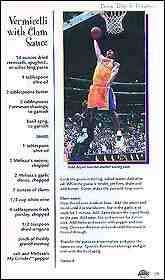
“The Lakers Are Cookin’ Again!
The Lakers Cookbook is now available by mail order! It’s full of great photos and facts on your favorite Lakers and loaded with tasty recipes from all the Lakers’ players and coaches as well as celebrity VIP’s! The cost is $20.99 plus $1.73 sales tax for California residents. Orders outside North America, please add $4.50 for shipping and handling. Proceeds benefit the Lakers Youth Foundation. The cookbook is now available at Ralphs’ stores in Southern California!”
From New Scientist magazine, vol 173 issue 2334, 16/03/2002, page 26:
Cycles of creation
Our Universe may be stuck
in an endless loop of death and rebirth. It’s an old idea, says Marcus
Chown, but the strange power of nothingness has given it a new lease
of life
WHAT happened before the
big bang? If some physicists are to be believed, the question is about
as meaningless as asking what is north of the North Pole. But others don’t
give up so easily.
According
to two cosmologists, before the big bang there was another big bang. And,
before that, another. “If we’re right,” says Neil Turok of the University
of Cambridge, “the big bang is but one in an infinite series of big bangs
stretching back into the eternal past.” And into the eternal future.
What
Turok and his colleague Paul Steinhardt of Princeton University are advocating
is a new version of an idea that dates back to the 1920s. Back then the
Russian physicist Aleksandr Friedmann, the father of the big bang idea,
realised that if the gravity of all the matter in the Universe is powerful
enough, it could stop the expansion of the cosmos and turn it around. The
Universe would then carry on contracting down to a “big crunch”. If both
expanding and re-collapsing universes are permitted, it’s a simple step
to imagine the one changing seamlessly into the other. From the big crunch
the Universe would bounce or rebound in a new big bang and the whole cycle
would begin again.
It was
a popular idea until the 1960s, when Roger Penrose and Stephen Hawking
scuppered it. Using Einstein’s general theory of relativity, which explains
gravity as a warp in space-time, they showed that the big bang must have
started in a singularity. A singularity is a point of infinite density
and temperature, and it’s a big problem for anyone taking a hard look at
the physics of the big bang. That’s because when everything in your equations
goes to infinity, the equations are meaningless. Physics breaks down.
That
doesn’t rule out a cyclic Universe. But the singularity is like an opaque
curtain, preventing a view through the big bang to earlier times. With
the singularity in the way, it makes no sense to talk about any continuous
existence. If the Universe passes through a singularity, everything gets
scrambled in the breakdown of physics. Nothing in the new universe can
be affected by what happened before, so the previous cycle might as well
not have existed. This was very discouraging, and people abandoned the
idea of a cyclic Universe.
Its rebirth
has come about because physicists are now convinced that Einstein’s theory
of gravity breaks down at the big bang. It’s all because of quantum mechanics,
which seems to impose a fundamental fuzziness on things. Quantum theory
is usually applied to particles of matter, but many physicists think it
must affect space-time too. The implication, they say, is that nothing
can collapse to a point. Instead there is a minimum size for anything.
The Universe may once have been pretty amazingly small, but it wasn’t infinitesimal,
so its temperature and density weren’t infinite. “The Universe may not,
after all, have begun in a singularity,” says Turok.
Over
the past decade or so, this idea of space-time fuzziness has encouraged
some physicists to think about what happened before the big bang. But on
its own, it doesn’t prove there was anything, or give any hints about what
that was.
Then
last year, Turok and Steinhardt came up with the first part of their new
theory. It builds on what are called brane-world scenarios, an outgrowth
of the idea that extra dimensions in space are needed to explain the fundamental
forces of nature. To explain why we experience only four of these dimensions,
physicists have come up with the peculiar idea that the matter and non-gravitational
forces of our Universe are stuck firmly to a four-dimensional island, or
“brane”, floating within a higher-dimensional space. Whereas most of the
extra space dimensions are supposed to be rolled up much smaller than an
atom, it may be that one of them is relatively large, and we simply don’t
see it because it is the exclusive realm of gravity ( New Scientist, 29
September 2001, p 26) .
“The
brane-world scenario suggests a possible explanation for the big bang,”
says Turok. Branes have their own mass, so a moving brane has an enormous
amount of kinetic energy. And if our brane collided with another brane,
this kinetic energy would be liberated, he thinks. “This could have created
the fireball of the big bang and ultimately all the matter we see in today’s
galaxies and stars”.
Turok
and Steinhardt, who developed this idea with Justin Khoury of Princeton
University and Burt Ovrut of the University of Pennsylvania, call it the
“ekpyrotic” universe, from the Greek for “born out of fire”. They have
thought through several colliding-brane scenarios, some involving three
branes. But what they’ve ended up with is a relatively simple scenario,
in which two four-dimensional branes approach each other along a fifth
dimension. Turok and his colleagues call them “boundary branes” because
they form the ultimate boundaries of the Universe.
“What
we have done is explore what would happen if one brane passes through the
other,” he says. They found that the kinetic energy of the colliding branes
is converted into heat energy within the branes when they collide with
each other, effectively conjuring real particles out of the vacuum. What’s
more, it naturally produces a Universe that is smooth on the largest scales,
but has small lumps and bumps in it to turn into galaxies and galaxy clusters.
In this
basic model, there’s still no cycle. Just a phase of approaching, empty
branes before the big bang. Then Steinhardt and Turok asked themselves,
what could pull the branes together before their collision? That something
can only be the vacuum in between them, says Turok-because there’s nothing
else there.
The vacuum,
as it turns out, changes everything. “The vacuum is like a spring between
the plates, or branes,” says Turok. Within our Universe it appears to be
generating a repulsive force-the so-called cosmological constant-which
is driving apart the galaxies. An attractive force would seem to be incompatible
with that. But it turns out that even while there is a repulsion along
the space dimensions inside each brane, there can also be an attraction
between the branes along the fifth dimension.
Turok’s
team is considering a number of possible mechanisms that might be behind
this force. One suggestion is that there is a charge imbalance between
the two branes that creates an attractive force between them. “We don’t
have a complete theory in which this could be calculated,” Turok says.
“Our scenario is more of a guide as to how things could work.”
He believes
that today, the spring is still being stretched, but in the far future
it will reach its maximum extension. Once that happens, the branes will
begin to accelerate towards each other until they collide again.
So in
the new picture, the oscillation occurs only along the fifth dimension.
It happens like this: two branes are pulled together by the vacuum, and
collide. Inside both branes a huge amount of energy is released, and the
branes expand (if you can imagine an infinite rubber sheet being stretched
out, it’s a little like that). We brane-bound creatures call this event
the big bang.
As the
branes expand and cool, matter and galaxies form. The galaxies drift apart
and age. After a while, the gently repulsive vacuum inside the branes makes
this expansion accelerate, so the galaxies fly apart faster still. The
end looks bleak.
But meanwhile
the two branes have moved apart and then been pulled back together by the
attractive vacuum in between them. They rush towards a collision once more,
and a new big bang overwhelms both universes.
So from
the perspective of someone stuck on the brane, space-time just keeps on
expanding, though the expansion is given repeated pushes by successive
bangs-that is, brane collisions. In other words, from the off-brane perspective,
we have something more like the traditional cyclic universe, yo-yoing back
and forth. Meanwhile, from the brane perspective, we have an altogether
different kind of cycle in an eternally expanding Universe.
This
overcomes another big problem with the old-style cyclic universe. In each
cycle, stars radiate heat into space, but these cyclic models involve closed
universes, so each bang is hotter than its predecessor. Looking backwards
in time, then, the cycles get progressively cooler. The inescapable conclusion
is that the cycles must have begun at some time in the past. “But simply
pushing the origin of the Universe back before the big bang is not very
aesthetically pleasing,” says Turok. “This is another reason why the cyclic
universe was seen as unsatisfactory.”
The new
cyclic universe avoids this problem. After the branes have passed through
each other, the spring of the vacuum is in compression and causes the space
of the branes to expand for a long time. That dilutes the heat from stars
so that the patch of space that experiences each new bang has essentially
the same temperature as the previous cycle. Consequently, all cycles are
the same and the universe can have oscillated for ever. “Such a universe
is more aesthetically pleasing than a big bang universe since the question
of what happened before is no longer a nagging problem,” says Turok. “The
Universe has been around for ever. There was no beginning.”
Stars,
galaxies and life may therefore have existed in previous cycles of the
Universe. But, if the cycles are all identical, wouldn’t such endless repetition
be mind-numbingly dull? Turok and Steinhardt think not, because random
events will change the details each time. You won’t get the same galaxies,
planets and people each cycle. “Just because the cycles repeat does not
mean the events in each cycle are identical,” says Turok.
More
speculatively, he points out that the extra rolled-up dimensions might
vary their sizes between cycles. The significance of this is that the fundamental
forces are suspected to be manifestations of the sizes of these extra dimensions.
“The laws of physics could change from cycle to cycle,” says Turok.
If the
physical laws can change, they might be driven ever closer to some particular
set, what physicists call an attractor. “If we are lucky, we might find
that the sizes of the extra dimensions home in on particular values,” he
says. “We might then finally have an explanation for, say, the mass of
the electron.”
Obviously,
both Turok and Steinhardt are excited by all these possibilities. Reactions
from their colleagues are more mixed. “At the moment I have an open mind
on the ekpyrotic universe and its latest oscillating version,” says Tom
Kibble of Imperial College in London. “There is no doubt an element of
hype here, but I think they are right to be excited.”
Their
most outspoken opponent is Andrei Linde of Stanford University. “This is
mostly hype,” he says. He thinks the whole model is unnecessarily complicated,
like the epicycles that medieval astronomers used to describe the orbits
of the planets in our Solar System.
But if
Steinhardt and Turok are right after all, the future is less bleak and
more dangerous than we have been told. Some cosmologists suggest that,
because the galaxies are now accelerating apart, the future holds nothing
but an ever emptier, cooler Universe. Now we have an alternative to look
forward to: an almighty surprise, one day, when we and our fellow universe
come together and collide once more in a spectacular finale. And who knows
what will emerge from the fire?
Further reading:
“The ekpyrotic universe:
colliding branes and the origin of the hot big bang” by Justin Khoury,
Burt Ovrut, Paul Steinhardt and Neil Turok, ( http://www.arxiv.org/abs/hep-th/0103239)
“From big crunch to big
bang” by Justin Khoury, Burt Ovrut, Nathan Seiberg, Paul Steinhardt and
Neil Turok ( http://www.arxiv.org/abs/hep-th/0108187)
Paul Steinhardt’s website
is at http://feynman.princeton.edu/~steinh Neil Turok’s website is at http://www.damtp.cam.ac.uk/user/ngt1000

from the NYTimes–
March 28, 2002
ROCK REVIEW | ROY WOOD
Returning After 28 Years, Leading an Army of Brass
By JON PARELES
Bigger means better to Roy Wood, the English rocker whose four shows at the Village Underground were his first New York City performances since 1974. His music has always equated blare with rock ‘n’ roll bliss.
Electric guitars rang out when he led the Move in the late 1960’s; cellos took over when he founded the Electric Light Orchestra with Jeff Lynne in 1971; and saxophones and voices buttressed Wizzard, his next band. Roy Wood’s Army, the band he brought to the Village Underground, backed him with 12 musicians,
including an eight-member horn section. Most of the band members were women. Mr. Wood looked much as he did in the 1970’s, bearded with brightly dyed long hair.
Sunday’s set was a brass-pumped retrospective of Mr. Wood’s catalog from the Move to the present. Sung in his high, nervous tenor while female backup singers gestured in sync, the songs were the work of a songwriter proclaiming his love for an imagined 1950’s paradise, full of pretty girls jiving to jukebox rock, or a man in thrall to the fearful power of women’s charms. The Move’s “Fire Brigade” calls for firemen to cool him down; a newer song, “Kiss Me Goodnight, Boadicea,” begs the ancient warrior queen to “take a break from your pillage and destruction.”
The songs often harked back to grand Phil Spector marches or a swinging rockabilly two-beat, but they weren’t pure revivals; they threw in odd key changes or skipped beats, while Mr. Wood took guitar solos that swiveled their way toward brash dissonances.
Other songs took Beatles-style pop and added extra crimps. The Army also played the Move’s psychedelic artifacts “I Can Hear the Grass Grow” and “Flowers in the Rain,” which showed Mr. Wood’s ear for plant life.
With the horns hooting away, the Army came across like a mixture of a soul revue and a Las Vegas show band, conveying a skewed nostalgia. For “Are You Ready to Rock?” Mr. Wood piled on one more element: he marched onstage playing bagpipes.
Proud of his eccentricities old and new, he had clearly decided that nothing succeeds like excess.
From http://www.weeblackskelf.co.uk/cordsuit/articles/w_drugs.htm
THE SUMMER BEFORE THE NIGHT ECSTASY BECAME ILLEGAL IN THE STATE OF TEXAS
by David Berman
MY FRIEND KYLE always had a lot of money and could get me into the expensive kind of trouble without
the trouble sticking. He didn’t mind paying for me if it meant raising hell with loyal company. We were seventeen. You only needed one reason to be friends at that age. I figured we had at least three. So we broke the law every day in every way and laughed our asses off at the fucking stupid world.
In late April we began to hear rumors about a new drug in the Metroplex. It was in the gay bars. Kids at the Arts Magnet were getting it. Certain people at certain parties had it and it was magical.
They called it X. It was supposed to make you unaccountably happy and tolerant of everyone from headbangers to rich fucks. Even “douchebags.”
Psychiatrists had been using it in therapy for years, we were told. It was legal and local product (it was still special to Texas at that time). It would make you love and accept anyone. Even yourself.
This was a complicated promise for the teenager roiling with hate and confusion. I hardly believed it. But one night Kyle pulled out some foil holding four tablets, we each swallowed two, and went to a party where a lot of people were going to be doing it.
Coming around the corner of that house, I’ll never forget the scene. Every high-school rule was being broken before me. The lions were chatting up the lambs. I saw sworn enemies talking like longtime companions; a prickly society bitch on her knees sifting white garden pebbles through her hands with
happy eyes; a brutal wrestler from my school with his arms wrapped around the trunk of a pecan tree, saying his first words to me ever, “Hi David,” sweetly, as I walked by.
I rolled my jeans up to my knees and sat at the edge of the pool. Maybe for the first time I felt like no one was going to try to push me in. The stereo was playing “Blues for Allah” instead of the customary “Eliminator.” Nearby, two linebackers were confessing how much they depended on each other “on
and off the field.” I felt myself giving in to all the kindness, not caring if it was a lie or not. By the time a hot Fort Worth Jewess sprang into in my lap and began running her fingers through my hair, I was sold.
At sunrise, I came in through the sliding glass. I woke my father and his new bride, apologized for staying out all night, and pulled a chair up beside the bed. I continued to sit there and smile down on them. I said, “I just want you to know how much I love you, Dad.” Incredibly, he did not kick my ass.
That morning was never mentioned again.
AS I SAID BEFORE, ecstasy was still legal and as such carried virtually no stigma. Kyle’s uncle kept
a jar of tablets on his desk at his car dealership. Law-abiding adults were taking them at North Dallas cocktail parties. They were even sold behind the bars like cigarettes and openly hawked on street corners downtown.
That summer, I crushed two sports cars with my homely Buick, received six speeding tickets (three in one day), two tickets for public urination, impregnated a Collin County judge’s daughter, and had a bottle of MD 20/20 broken over my head. Approximately none of it registered with me. A very real fault of the drug.
I’m going to skip the scenes of me chasing daisies and singing to stray dogs from still bulldozer cabs. I was exercising horses that summer for cash, and X hangovers were A-OK for barreling over the dull scrubland.
Sometime in August, the lawmakers in Austin finally got around to outlawing ecstasy. What a gift for the dealers! The price of ecstasy immediately quadrupled and the production costs plummeted as the manufacturers began cutting the pills with all manner of horrible stuff.
The night the law went through, I went to a concert at the Bronco Bowl and snagged two of the newly illegal pills for a dear price. I had never seen them in capsules and had no idea it was a sign they were crushing the old “legal” pills and mixing them with laxative, mannitol, low-grade speed, whatever.
Once inside, I spent a half hour wiggling my way to the front of the floor. Unfortunately, when I got there I had a big problem. Not only were the drugs not kicking in, they were causing me to have to shit real bad. Michael Stipe was singing “Moon River” (hey!) a cappella and I knew I was going to blow if I didn’t part this shoulder-to-shoulder crowd and make it to the restroom. The audience was frozen in place and dead silent as I plowed through, “Excuse me, excuse me, emergency here, please, please” ( I think
I even yelled “gangway,” such was my ambition to get through), completely stepping on the vocalist’s Ethel Merman star turn and nearly getting shhhhhed to death.
I passed the rest of the concert in a nasty stall gritting my teeth, sweating and coming to terms with what was clearly the symbolic end of a spaced-out summer.
Fifteen years on, I can honestly say I’m glad it was outlawed. After three months of its use I had lost all discretion and was prepared to trust just about anyone. Worse yet, it was turning me into a joiner. That’s not who I am. Anyway, ecstasy was not to find its true customer base until years later, when the strangely passive kids who grew up in the child protectorate of the U.S. eighties and nineties came of age, craving depersonalization. Apparently it helps them dance. They’re a very attractive lot. Have you seen them dance?
David Berman lives in Nashville. His first book, Actual Air, came out last year via Open City Press.
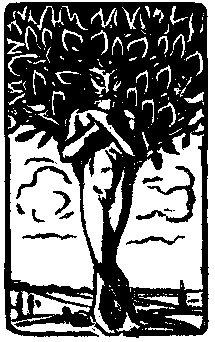
“The next title to be published by the Tartarus Press will be Nightmares of an Ether-Drinker by Jean Lorrain, translated by Brian Stableford. Lorrain was an archetypal doomed decadent of the 1890s whose chosen drug, ether, killed him horribly, though not before it had inspired him to write a series of morbid
tales which are translated and collected by Brian Stableford for the first time. It will be published in the slightly different format which we have just used for John Gale’s collection of prose poems, A Damask of the Dead. It will also have 1890’s style boards printed in two colours, and a dustjacket.”
This giant squid (measuring 8 meters or about 26 feet) was hauled up from the same area in 1996.
Giant octopus caught off New Zealand
March 28, 2002 Posted: 11:07 AM EST (1607 GMT)
WELLINGTON, New Zealand (Reuters) — Scientists have identified what they believe is the largest octopus ever seen, a four-meter (13-foot) long giant hauled from the depths near New Zealand’s remote Chatham Islands.
The dead specimen, caught in a trawler’s net, was badly damaged but it was clearly a massive animal, said National Institute of Water and Atmospheric Research (NIWA) marine biologist Steve O’Shea.
“It would easily have been four-plus meters (about 13 feet) in total length and a weight of 70-75 kilograms
(154-165 pounds), if not more — it’s a very big octopus, the size of a fully mature male giant squid.”
O’Shea had provisionally identified the specimen, caught at a depth of more than 3,000 feet (900 meters), as Haliphron Atlanticus, a bright red, jelly-like species of octopus not previously found in the South Pacific.
Juveniles of the species had been found in shallow northern waters, with adults believed to live at a depth of around 250 meters so the discovery was unusual, he said.
“It’s extremely deep, it’s extremely large, it’s the first recorded in the South Pacific, it may not even be the species we’ve attributed to it at this point in time — I’ve got a lot more work to do on it.”
People had been amazed when he relayed the details of the creature, O’Shea said.
“But down here in New Zealand, this is an area which is so poorly explored that its not surprising that we’re getting all these weird and wonderful animals.
“The frightening thing is that we are getting an animal like this newly reported in New Zealand waters today … so new and large, you’ve got to sit down and ask yourself ‘What is it we know about the deep sea environment?’,” O’Shea said.
Octopuses are one of the most diverse creatures on earth, with several hundred species worldwide and more than 40 species found in New Zealand waters alone.
The Chathams are a windswept group of islands around 530 miles (850 kilometers) east of Christchurch, home to around 800 people engaged in sheep farming and fishing.
FROM ALEXANDRA KOSTENIUK’S WEBSITE:
“I am Alexandra Kosteniuk,
a International Woman Grandmaster (WGM) (1998) and an International Master among men (IM)(2000) and a Women’s Vice World Champion (2001). I was born in the Russian city of Perm on April 23, 1984. I have been living in Moscow since 1985. Currently I study at the Russian State Academy of Physical Education. When I graduate from the Academy I will become a certified professional chess trainer. I really enjoy teaching chess, perhaps it was inherited from my dad. My dad – Konstantin Vladimirovich – was my original trainer, it was he who taught me to play chess and worked with me for several hours a day. I am very grateful to him for everything I have achieved in chess is his merit. My dad sacrificed much for me. He abandoned a very promising and brilliant career of an army officer in order to help me and to accompany me to tournaments. Strange it may seem but he doesn’t have any international degrees, but he plays chess very good. And I think he is the best trainer I’ve ever known. That’s why, if you can’t play chess or if you want to improve your skills in chess, I recommend you to apply just to my father, by the way, he gives online lessons. I also gave online lessons on ICC, but now unfortunately I don’t have time for it, because of the preparation for the regular World Chess Championship, which will take place in London(December 2003).
I improved in chess rapidly. My first great achievements came in Junior tournaments. In 1994 I became a European Champion among girls under the age of 10, and a month later shared first and second places at the World Championship under the age of 10. Later, I had the same major achievements in other age categories. There were many of such victories and I’ll show them in a table there.
In 1997, I became a Woman International Master (WIM) at the age of 13, they say that I reached this mark slightly quicker than Maya Chiburdanidze, but I don’t give much significance to that. I scored all necessary WGM norms in February of 1998 that is at the age of 13 years and 10 months but the title was officially given to me in November 1998 at the 33rd World Olympiad in Kalmykiya. There is a table of my other major achievements at International tournaments. My current ELO rating as of January 1, 2002 is 2469.
I also have many other interests but chess, I write poems (some of them are published in my book), and I like sport in all its forms. When I graduate from the Physical Education Academy, I will be only 20, that is why I hope to enter one of the best universities of the world (of course if I earn enough money for such education). I adore studying.
On the 26th of December (in Russian) and on the 15th of January (in English) my first book How I became Grandmaster at age 14 will come out. My dad and I have been working on it for almost two years, and I feel that its genre is very original. It is a manual in which I teach to play chess and at the same time I tell how I learnt to play chess starting from the age of 5. The book contains many annotated games and pictures, including colored ones. I hope that it won’t disappoint you. I think that many parents will purchase it as a present for their children. Perhaps not everyone who reads it will become a Grandmaster at the age of 14, but many readers will learn to play this most intelligent and most beautiful game in the world. Good luck!
I am eager to hear your feedback and suggestions concerning my site, which will surely be answered by me or by my assistants who administrate the site. At my site you can put questions online to an administrator on duty or discuss news at the forum of the site. You are also welcome to my fan club!
Yours truly,
Alexandra
“Want to know in details what other people think about the book by Alexandra Kosteniuk?
Attention, you chess fans! Alexandra Kosteniuks new book How I became grandmaster at the age 14 is out! On the 26th of December Alexandra’s book was published in Russian, and on the 15th of January the book was published in English. Spanish version will be published very soon.
The book features:
* How I became a Grandmaster at the age of 14
* Secrets of the Russian chess school
* My best games
* Instructive positions”
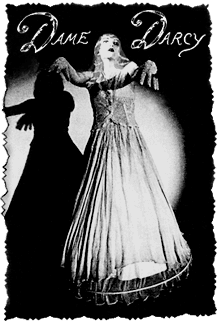
FROM DAME DARCY:
“I’ve embraced technology and it morphed like a demented changeling to inform you that my biggest solo
art exhibit since the history of time will be happening Saturday March — April 27th, 2002 at the Richard Heller Gallery in Bergamot Station, 2525 Michigan Ave, B-5a Santa Monica, CA 94040
from 5:00 7:00 pm.
Plus dont miss the wacky antics live from Gem In Eye, the new musical spectacle starring Dame Darcy and Witch Dr. TNT Victor Cretella. It’s dolls to the wall! Speaking of dolls, you’ll get to see all the latest in
paintings, dolls and Meat Cake originals from #1-#11. For those wonderful bats not in the LA area, you will soon be able to see and purchase items from the online gallery, guaranteed to increase in value, especially after I’m dead! Better act quick, I’m not getting any younger!
Love Always
Dame Darcy”
DAME DARCY – VOODOO
Exhibition Dates: March 30 – April 27, 2002
OPENING RECEPTION:
Saturday, March 30, 5:00 – 7:00pm
BERGAMOT STATION
2525 Michigan Avenue B-5a
Santa Monica, CA 90404
310-453-9191
REGULAR HOURS:
Tuesday – Saturday 11:00 – 5:00pm
24 MAR 02: ZIGGURAT THEATRE
ZIGGURAT WEBSITE:

(The ziggurat is the Babylonian
step pyramid which connects the earth with heaven.)
“Ziggurat Theatre creates
performances inspired by world myths. We celebrate our collective past
through a distinctive kind of theater that explores world culture and ritual
as a dramatic form. It is a central mission of the theatre to offer
an experience that can unite the diverse cultures of our community. We
do so by sharing and illuminating themes from classical and world mythology,
which transcend cultural boundaries and speak to our common human experience
instinctively, deeply and powerfully.”

Aquitania:
Gascon Center Theater – May & June, 2001
“Aquitania is based on characters
from the Legends of Charlemagne, a canon of stories about the French king
and his knights, narratively and thematically similar to the Arthurian
legends. For Aquitania we took from the stories four of the principle characters
the virtuous Charlemagne, Roland and Fleurdelis, and the evil Gano; and
one legend – that of an enchanted ring, and devised a story for them all.
However, we created a story, which explores the idea of time. In
Aquitania a 10-year-old girl plays a board game whose pieces are the characters
of the mythical Charlemagne legends. At the same time (or perhaps
not at the same time), Marguerite, a librarian has been summoned to a mythical
kingdom in 1930s Europe to solve a military crisis. The characters she
meets are the same characters from the board game, even though it is the
1930s. That is, they have the same names and embody the same ideals as
their Carolingian counterparts. We come to discover that Marguerite is
enacting with her new friends, the same plot that the little girl is working
out on her board game. We also ultimately learn that the little girl is
Marguerite as a child. Whether the little girl is imagining herself in
an adult conflict as she plays the game, or whether the entire affair is
a dream of the adult Marguerite, is not entirely clear. But the audience
sets off on a strange and wonderful journey much like Alice in Wonderland
or Dorothy in Oz, where the protagonist must embrace a new kind of logic.
And oh yes, I forgot to mention: Its a comedy. – Stephen Legawiec”
 Arthur Magazine