GUITAR ARMY Rock and Revolution with MC5 and the White Panther Party By John Sinclair With introduction by Michael Simmons
35th ANNIVERSARY EDITION * First time in print since 1972 * 40 additional photographs * Includes 18-track CD with rare recordings
“Guitar Army was our manual for revolt. It’s a rainbow-colored Howl, still resonating today with the singular value of idealism.” —Michael Simmons
Guitar Army is the incendiary book that proclaimed “Rock and Roll is a Weapon of Cultural Revolution” for young, revved-up readers in 1972. Author John Sinclair spearheaded the leftist revolutionary vanguard White Panther Party and managed the Detroit rock band MC5, leading them from the ferment of the Detroit riots to the Chicago Democratic Convention of 1968, where the band played minutes before police clubbed antiwar demonstrators.
In October of 1970, the FBI referred to the White Panthers as “potentially the largest and most dangerous of revolutionary organizations in the United States.” However, just three years earlier, the group’s leaders hosted a “Love-In” on Detroit’s Belle Isle, presided over by Sinclair, whom the Detroit News proclaimed “High Priest of the Detroit hippies.” In 1970 he was arrested and sentenced to 9 ½ to 10 years for giving an undercover officer two marijuana joints. Sinclair then became the most celebrated political prisoner of the original war on drugs. After 18 months in prison, John Lennon, Allen Ginsberg, Stevie Wonder, Phil Ochs, and others demanded his freedom with a televised benefit concert attended by 15,000 people. Three days later, Sinclair was released.
Guitar Army chronicles these years of revolution through Sinclair’s “street writings” and prison writings, with over 80 photographs, illustrations, concert flyers and comics from the period. This 35th anniversary edition of Guitar Army includes two dozen previously unpublished period photographs, recent writings from John Sinclair, and an introduction from Michael Simmons that leads the reader through the revolutionary times to Sinclair’s life today. Author John Sinclair is the still-charging embodiment of a dazzlingly optimistic time in which change felt necessary and possible.
A bonus CD contains rare recordings of MC5 and other Detroit-area revolutionary bands, Allen Ginsberg, Black Panther Bobby Seale on the White Panthers, and original White Panther Party meetings.
6 x 9 in, 360 pages, CD attached, ISBN 978-1-934170-007, $22.95 Pub date: May 2007
JOHN SINCLAIR HITS LOS ANGELES….
THURSDAY, APRIL 26 – DETROIT POETS SOUND OFF! – ART SHARE LA. 801 EAST 4th PLACE – LA, CA 90013 – 213-687-4278
John Sinclair will reunite with brother Motor City poetry-&-music bards M.L. Liebler and Ron Allen for an evening of high-energy music & verse at Artshare Theater in downtown LA at 8:00 pm Thursday, April 26. Sinclair’s Detroit Artists Workshop put poetry on the map in the Motor City in the 1960s. Poet-playwright Ron Allen was a founder of Horizons in Poetry, the collective that revived public poetry in Detroit in the 1970s & 80s. M.L. Liebler, leader of the Magic Poetry Band, has been a major force in the Detroit poetry movement for the 1990s and 2000s. This will be a very special reunion for all three participants and a real treat for modern poetry lovers who like some music with their verse—a rare opportunity to witness the Detroit Sound at its finest.
FRIDAY, APRIL 27 – BEYOND BAROQUE – AN HISTORIC EVENING! – THE GUITAR ARMY RE-LAUNCH PARTY, PANEL, PERFORMANCE
BEYOND BAROQUE – 681 Venice Blvd. Venice, CA 90291 – 310-822-3006 – 7:30 PM JOHN SINCLAIR and FRIENDS – GUITAR ARMY, with ADAM PARFREY, WAYNE KRAMER, DR. CHARLES MOORE, M. L. LIEBLER, PUN PLAMONDON, MICHAEL SIMMONS, a PANEL and PERFORMANCE
Also present for a panel rap will be WAYNE KRAMER (renowned solo artist & MC5 guitarist), PUN PLAMONDON (author & White Panther vet), M. L. LIEBLER (Detroit poet & poetry organizer), DR. CHARLES MOORE (divine musician), and MICHAEL SIMMONS (hyphenated revolutionary & introduction specialist).
Saturday, APRIL 28 – WAYNE KRAMER with special guest JOHN SINCLAIR HOTEL CAFE – 1623 1/2 N. Cahuenga Blvd. LA 90028 – 10 to 11 PM – http://www.hotelcafe.com Avant-Rock legend Wayne Kramer headlines and will be joined by special guest John Sinclair, along with Doug Lunn (bass), Dr. Charles Moore (trumpet), Ralph “Buzzy” Jones (saxophone), Phil Ranelin (trombone), and others.
5) TUESDAY, MAY 1 – MAYDAY! (of course!) – Official Release party for Guitar Army – Appearance & signing with John Sinclair at… La Luz de Jesus – 7 pm – 4633 Hollywood Blvd – Los Angeles, CA 90027 – (323) 666-7667 – www.laluzdejesus.com
Santiago Mutumbajoy
Yage Pinta!
latitude 05
CD
2007-03-06
Nearly 80 minutes of hypnotic, droning wild microphone field recordings of shamanic ceremonies recorded by celebrated anthropologist Michael Taussig.
“Weaving in and out of the shaman’s body, which is the same as the body of the song, these songs are the medium by which spirits are conjured, witchcraft laid to rest, and the universe put on edge. Treat them accordingly. They might change your life. They did, mine.They are sung by Santiago Mutumbajoy whom I taped with a cheap old tape-recorder at different times, mostly in 1976, when I was living with him and his wife Ambrosia. Their two room wooden house sat on a hill in the cloudforest near the town of Mocoa where the Andes drop into the Putumayo River Basin in southwest Colombia. Today their son, Luciano, carries on the practice there, while their daughter, Natividad, sustains it in neighbouring Caqueta province. For the whole night, under the influence of a hallucinogen called yagé, the healer sings his song the power of which is due not to words, lyrics or poetry. Instead it lies in the quality of the sound and the way that sound creates pictures in your mind while dissolving your body. The singing is the key to the magical power. It is that power. It is what brings the healer and the patient into the realms of the spirits that lie within and behind every visible thing.” — Michael Taussig
Proceeds from the sale of this compact disc will be go to Fundación Renacer, a Bogota, Columbia based outreach& rehabilitation organization for sexually exploited children and adolescents.
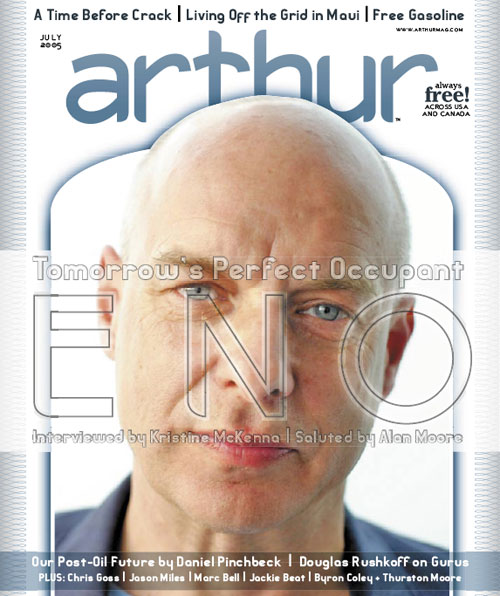
BEFORE AND AFTER SILENCE On the eve of the release of his first album of vocals songs in decades, pioneering musician-artist-thinker BRIAN ENO speaks with Kristine McKenna in a conversation as wide-ranging and profound as his singular career.
I’ve met lots of charming people in my life and Brian Eno may well be the most charming person I’ve ever met. What’s the secret of his devastating charm? It comes down to a few things. He has impeccable manners. He gives you his full, undivided attention when he speaks with you. He’s interested in everything under the sun. He has a wonderful sense of humor. Finally, and most importantly, he has an incredibly light touch. What I mean by that is that he can discuss just about anything and be genuinely involved without getting hot and bothered. Eno so relishes the process of examining things from various angles that he can’t be bothered to take it personally if you don’t agree with him. He’s fun.
Born in Suffolk, England in 1948, Eno was in art school in the early‘70s when he became a founding member of pioneering glam band, Roxy Music. He left the group in 1973 and embarked on a solo career that quickly expanded in several directions at once. Regarded as the inventor of ambient music—atmospheric washes of sound that settle in like weather and eschew the linear structure central to most music—Eno helped pioneer the use of sampling and computers in the recording studio, has contributed to more than 150 albums as producer, composer or performer, and has overseen the making of critically acclaimed records by David Bowie, U2 and Talking Heads. A visiting professor at London’s Royal College of Art since 1995, Eno has created audiovisual art installations at sites around the world since the early ’80s, and in 1983 he was a co-founder, with Anthea Norman-Taylor, of Opal Records. Five years later the co-founders married and settled in London, where they’re raising two teenage daughters. (Eno also has a 30-year-old daughter, Hannah, from a previous marriage).
One thing Eno hasn’t done for quite a while is sing, so the release of Another Day on Earth—his first record of songs in more than two decades—is something of an occasion. This was the ostensible reason we recently hooked up to chat, but as is always the case with Eno, our conversation roamed far and wide. Herewith, a few of the high points.
Arthur: What seemed desperately important to you as a young man that no longer seems quite so pressing?
Brian Eno: I’ve somewhat lost faith in art and the cultural world because I think it has no faith in itself. Culture is the most important thing we do, but it seems to me that we don’t take it seriously, and the visual arts in particular are in very dire straits at the moment. I don’t think any of it makes much difference, although there are some painters working now that I like very much. Lari Pittman, for instance, makes beautiful paintings that absolutely blow me away.
If you could own any artwork, what would you want?
There’s a room at the Museum of Modern Art that has a beautiful Rothko, two de Koonings, and a huge Monet Water Lilies. I’d be happy to have that room.
What aspect of middle-age weren’t you prepared for?
That women would find me more attractive. I’ve never thought that highly of myself so this came as a bit of a surprise. Perhaps it’s just that as you get older women are more inclined to tell you how they feel. When people are young they tend to beat around the bush a lot of the time.
How many times have you been in love?
Maybe half a dozen times.
What do you know about romantic love today that you didn’t know ten years ago?
That women are much more romantic than they care to let on—the old clichés are much truer than people care to admit. I would add, however, that notions of romance seem to become more potent for men as they age, too, and it starts to seem like more of the reason that you’d want to do it. You get into the joy of the process more as you get older and care less about the cum shot.
Why does love die?
It often happens that you love someone because they reflect you particularly well, and you basically like the person because they like you. This is a rather slender basis for building a relationship but it’s a trick people use to intrigue you—they look very interested so you think gosh, what a clever person! They’re really interested in me!
How do you explain the aversion to aging that’s an intrinsic part of western culture? Is it simply a fear of death?
I don’t think it’s fear of death so much as fear of the loss of one’s powers. For instance, I notice it in my eyesight. I hate the fact that I can’t see as well as I used to, I’m aware that I’m not seeing the detail I used to see, and I miss that visual side of my life everyday. It’s interesting that as you get older your vision treats your contemporaries better. You look at people your own age and think O.K., she looks nice, then you put your glasses on and think, good lord, do I look like that?
What’s the greatest privilege of youth?
The fact that nobody wants anything from you, you’re free to do anything and you’ve got every avenue open to you. When you’re young you have this capacity to roam, which just disappears. When you’re older either you’re not successful, and many avenues have consequently closed to you, or you are successful and there’s a huge pressure to do more of what you’ve done before. I know so many musicians who’ve told me that when they were young words just flew out of them—sometimes they didn’t even know where they came from—because when nobody cares, you don’t have all these voices in your head saying “that’s immature, you’ve been there before, we’ve heard so-and-so do that.” Because there are no critical voices in your mind it just throws out stuff. I’ve lost that freedom as far as lyric writing goes.
Your new record has a very wistful quality; were you feeling that way when you made it?
Yes, it is something of a getting older record. The other thing I hope it conveys is the idea that each day will pass as all the others have, and it will be just as amazing and disappointing as all the others have been.
The feeling you just described has to do with the fleeting and ephemeral nature of existence, and yet the work you do with the Long Now Foundation is predicated on notions of permanence and longevity.
Yes, Long Now is about thinking long term and was conceived to pose the question; if you really believed there would be people on earth 10,000 years from now, how would that affect how you live today? Most of us live as if there isn’t going to be a future, and few of us are conscious of how heavily we tread on the earth and what we leave behind. These are hard questions to ask ourselves, of course, because essentially they ask you to unpick your life. We’re born into intensely constructed lives that involve high energy consumption, the eating of expensive food—all the things I do along with everybody else I know.
We all live in varying states of denial of the fact that there are a number of converging crisis bearing down on us right now. One of them is the increasing prevalence of really nasty diseases spread by air travel—I have a theory about air travel, by the way. I think we’ve reached the peak of air travel and that it will go into decline for three reasons. One is that it will become associated with the spread of diseases — people will be unwilling to expose themselves to just to go on holiday. People will either drive somewhere or they’ll stay home. Two, there will be a few more spectacular terrorist incidents, and we all remember the effect that had on air travel last time. Three, sooner or later governments are going to have to tackle the fact that air travel is the hugest producer of pollutants we have. There’s been a big debate going on in England about a wind farm they’re thinking of building in the north of the country, and the argument for it is that it would prevent 250,000 tons of pollutants going into the air per year. That sounds good until you realize that one plane doing a London to Miami route for a year releases half a million tons of pollutants into the atmosphere per year. I’d be quite happy if there was a credible world movement against travel because communities would begin to return and people would start to rediscover where they are now. And needless to say, the romance of travel is diminished dramatically by the fact that no matter where you go there will be a Gap store.
Who makes you feel starstruck?
No stars do—it’s funny but I’ve never been impressed by those kind of celebrities. The closest I’ve come to being star struck is by the biologist Richard Dawkins. I’m so impressed by the work he’s done that when I met him I found myself wondering what I could say that would possibly be of interest to him.
What do you long for?
Discipline and some kind of routine. There always seem to be so many things going on in my life and I’m never quite prepared for any of them. Take a simple thing like collecting cuttings out of the newspaper—you’d think that would be a pretty easy thing to organize. I’m always cutting things out, and there are little stacks of clippings all around my studio, but there’s never any time to create a filing system and actually file them. In my imagined life of discipline and routine there would be 20 minutes each morning to file clippings, then half an hour for a swim, which is something I actually do manage to do most days. I just wish there was more of that structure.
What’s your idea of an important achievement?
Years ago my assistant bought a chair for a thousand pounds at a fishing lake owned by 300 fishermen, and nearly every weekend he goes there and basically meditates with a fishing rod in his hand—that’s what people are really doing when they fish. This strikes me as a great thing to achieve, probably because it speaks to my hankering for simplicity and routine. I also admire people who say ‘fuck this’ to the lot they’ve been dealt in life and demand something more for themselves. I have a nephew who has Lowe’s Syndrome and he’s got very poor eyesight and several other little things wrong with him, but this kid is so full of life, partly because my sister—his mother—told him ‘don’t accept your lot.’ She could’ve taken the attitude, ‘oh he’s disabled, he can’t do much,’ but she just sort of threw him into life. So, to make maximum use of what you’ve got is an important achievement. Take Lou Reed as a guitar player. The early records by the Velvet Underground have some of the most inspiring guitar playing I’ve ever heard, but I don’t think anyone would say Lou Reed is a great guitar player. He just knows how to use the gift he has to maximum effect.
Which song is in your mind when you think of Reed’s playing with the Velvet Underground?
“What Goes On.” I almost included a cover of the Velvet Underground song “I’m Set Free” on this record. I did rather a good version of it, too, and I will release it, but I didn’t want to make a record that was too long because I hate long records and think people don’t listen to them. I remember working on Laurie Anderson’s album Bright Red and there was a song on there that was just gorgeous, but she made it track 13 and I’ve never met anyone who’s heard it. By the time people get to track 13 they’re off somewhere else.
What’s your favorite song today?
I can never give one answer to any question, so I have a few. I spent the day digging a fish pond so I was listening to my Ipod, and I’d programmed a song into it by a Turkish singer named Belkis Akkale who has the most erotic voice I’ve ever heard. It absolutely drives me mad and my hear leaps with joy when she sings. Funnily enough, there’s a song I did with Bowie on the record Outside called “We Prick You,” which is amazing. When I heard it today I thought to myself, how on earth did we get that? I rarely listen to my old records and I must say, I was impressed. I’ve also been listening to an inspiring song by Me’Shell N’dege’Ocello called “Loyalty” that’s on a beautiful album she made called Bitter.
What was the last thing you learned?
I’m reading a fabulous book at the moment called Seeing Like a State: How Certain Schemes to Improve the Human Condition Have Failed, by a guy called James Scott. The first section of the book deals with city planning, the science of forestry, the invention of surnames, and weights and measures, and it made me realize that everything in society is built on fundamental infra-structural divisions. They’re so deeply embedded in the way we live that we’re often unaware that they’re at the core of many of the problems we wrestle with. That’s why the attempt to export free market capitalism to what was formerly the communist world hasn’t gone smoothly; there’s an intricate infrastructure of social agreements that must be in place for such things to work.
The first time I interviewed you was 25 years ago, and thinking back to that time it seems the world was a much safer and slower place. Is it simply a trick of the mind that we tend to recall the past as somehow simpler, or is the world actually picking up ever greater speed and complexity?
I don’t think it’s a trick of the mind. A few years ago the U.N. published a graph that charted various indicators of human well-being like security, equality, freedom, employment, access to clean water—all sorts of things. It was interesting to me that there is objective evidence for the incremental changes people feel, and the rather alarming conclusion they drew was that Western civilization peaked in 1976. I think it’s true that up until the early ‘80s people felt they were on an upward curve, at least in our culture. This isn’t true for every culture, but here in the West I think people believed things were getting better and globalization was a good idea. Today, most people seem to feel that the threats outnumber the promises and the dangers outnumber the freedoms.
So what are the long-term implications of this U.N. graph? That man’s on the road to extinguishing himself?
I think there’s a very good chance of that, actually, and having young children I find it absolutely alarming to contemplate what kind of world they’ll be living in when they’re my age. There have been various points in human history when people felt the end really was near, but the difference now is that we’re more powerful than we’ve ever been. Any one of us as individuals is almost as powerful as whole nations were in the past, in terms what we can handle, damage and effect. Of course, we can do good things too, but those things are less easy to achieve single-handedly. Good projects require co-operation, but you can create quite a lot of damage all by yourself.
An unfortunate shift in America’s political landscape is the fact that the will of the people no longer seems to mean much; our government does what it damn well pleases regardless of public response to their decisions.
I think that’s true. In the ‘60s people perhaps naively thought that democracy meant what it’s supposed to mean, but today, with Fox News and professional liars in politics, we’ve come to realize that democracy doesn’t mean anything really. As was evidenced in the recent U.K. elections, things aren’t quite so dire yet in England. Yes, Tony Blair was re-elected, but he won with a much reduced majority and a strong message from the people which was this: don’t fuck about with us. It became increasingly obvious to the British people that Blair had deceived them, and that the story of why we were going to war was untrue, and his re-election was essentially a vote of confidence for the Labor Party which has been a quite successful government in many ways—except for its alignment with Bush. England is basically a center-left country and I don’t think any members of the Labor Party approve of Bushism as a style. Bush is a very charismatic man, though, and I think Blair is a bit of a groupie. Obviously, Bush is an ignorant bully but he’s a confident man, and lots of people really go for that.
What’s the first thing you’d do if you were running the world?
I’m a patron of this thing called the Global Ideas Factory that was founded 15 years ago, and it’s an organization that collects ideas about how to make the world a better place. These ideas range from what to do with dog pooh to how to solve the global energy crisis, and some of these ideas are totally amazing. The first thing I’d do would be to set up an international body to examine the feasibility of some of these ideas. We simply waste the wisdom of our great thinkers—it’s amazing how little we use of human intelligence—and creating an internationally funded global ideas bank committed to actually doing something would be a way of putting a world changing culture in place.
To what degree do we inadvertently fictionalize our own past?
I’ve often thought that children should be taught how to watch television, read papers and listen to the radio, because most of our experience now is lived through media in one way or another. That’s particularly true in America where many people get most of their information about the world from television, which fictionalizes the past to a dramatic degree. That’s part of their raison d’etre, to tell us stories about the past.
Towards what end? How does it serve us to fictionalize the past?
It doesn’t serve us at all. Occasionally, for the sake of family coherence, you might tell a story that you know is a rather rosy version of events, but generally it’s imperative to maintain as accurate a grip on the past as one can manage. Very few people seem to appreciate the effort the Germans have made to not fictionalize their past, and it really pisses me off when that idiot Rumsfeld talks about old Europe as if to imply, “what do they know?” Germany has made a huge effort to face its past and come to terms with the fact that it acted absolutely abominably, and this is something America never has done and never will do. America will never ever say the Viet Nam War was a terrible mistake and what happened to the Vietnamese people was a disgrace, but young Germans talk about World War II with genuine passion and honesty.
There’s been quite an uproar about Downfall, the recent film about Hitler; many people have objected to the film on the grounds that it’s dangerous to humanize Hitler. Do you find any merit in those objections?
No, I think this is an important aspect of not fictionalizing the past. It’s a dangerous fiction to regard Hitler as a one-of-a-kind monster. I read an interesting book last year called Defying Hitler by a German historian named Sebastian Haffner, who was born in 1906 and grew up in Berlin where he watched the growth of the Nazi phenomenon. What becomes terrifyingly obvious in reading his book is how easy it is for a society to slip into barbarism. It starts very gently with all the intellectuals and clever people saying ‘bloody Hitler, what an idiot, he’s not going to last.’ All the things we’ve been saying about Bush, who was regarded as just a joke when he first appeared on the political scene. Things get worse and people start saying ‘shocking, disgraceful, we must get rid of this guy, but I’m busy right now writing a book—when it gets bad we’ll all pull together.’ But by the time it reaches that point it’s too late and there is no easy exit.
This is why I’ve started to get political in the last few years—I think we’re at the beginning of a new kind of technocratic tyranny. The manipulation of public opinion is so easy now; for evidence of that look no further than the fact that in a matter of months it was possible to convince most Americans that Saddam Hussein was responsible for the Twin Towers. It was just incredible. A key strategy in the manipulation of public opinion is to get the public excited about moral issues that don’t really matter like abortion and gay marriage. In England the issue is immigration, which is a minor problem but is something everyone feels they must have an opinion about. Governments love those issues because while everybody’s arguing about them, they’re left alone to pursue the business of world domination.
How did having children change you?
It certainly anchored me much more. I don’t like to be away from my children for too long because I hate the thought that I might miss some little part of their story. It also made me think about the future a lot more, and made me realize I had the capacity to feel absolutely unqualified love. One day a situation came up where there was some danger and I realized that without question I would’ve sacrificed my own life without even thinking about it. This came as a surprise to me because I’ve never considered myself a generous or altruistic person, and I don’t regard myself as brave in any way at all.
Do you believe in destiny?
No, but I believe that if you believe in destiny it will make a difference in what happens to you. Some people think ‘I am chosen and I’m a favored person,’ and that gives them a confidence that has the effect of making them chosen. The reverse happens as well. Some people consider themselves cursed and believe nothing will ever go right for them, and of course, nothing does.
What role does faith play in your life?
Last year I went to see Archbishop Desmond Tutu speak, and I was struck by the fact that on several occasions he made the observation, ‘you have no idea what goodness there is in people.’ This really impressed me, given that this was a guy who’d really seen some of the worst that people are capable of. He was talking about the Truth and Reconciliation Council and the great surprise of that endeavor was the incredible generosity of feeling people had, and their ability to forgive really awful things. So, I agree with Desmond Tutu’s comment, for the simple reason that I have faith in human intelligence.
Kristine McKenna is a Los Angeles-based writer. She recently co-curated Semina Culture: Wallace Berman & his Circle, a historical survey of West Coast Beat culture that opens in September at the Santa Monica Museum, accompanied by a catalogue published by D.A.P. She is presently co-producing a documentary film about the Ferus Gallery.
Ecowarriors go into battle against 4x4s – with cycle pumps From Charles Bremner and Marie Tourres in Paris
DRIVERS who park gasguzzling 4x4s overnight in Paris are receiving an unpleasant surprise in the morning: flat tyres. A gang of young activists are deflating the tyres of what they regard as anti-social urban tanks which clog the narrow streets of the Left Bank.
Claiming kinship with Greenpeace’s war on motorised “climate criminals” in Britain, the group has immobilised dozens of Range Rovers, Mercedes, Jeeps and other upmarket quatre-quatres in the well-heeled sixth and seventh arrondissements since July.
To the amazement of furious owners, the police say that it is not a crime because property is not damaged. “We have had complaints, but it is not clear that any offence is being committed,” said an officer at the sixth arrondissement.
Owners may bring a civil action against the activists, who call themselves les Dégonflés, the deflated ones, or in slang, the chickens or scaredycats. Thanks, in part, to their internet site (http://degonfle.blogg.org), which shows pictures of deflating raids, they say that they have spawned other groups in Lyon, Rouen, Geneva and even Australia.
Like the protesters in Britain, who harangue off-roading mothers on the school run, the campaigners seem driven as much by social and political animosity as concern over climate change. The leader of the group, who uses the name Sub-Warrant Officer Joker, told The Times yesterday: “We think that our action makes the owners look like wallies. We operate once a week and we try to deflate 30 per evening.”
They expel the air slowly without setting off the vehicles’ alarms, fixing open bicycle pump hoses to the tyre valves and returning later to collect their equipment. They leave a leaflet explaining their action.
“Perhaps it’s cowardly that we prefer to be anonymous, but we have received death threats,” Joker added. “That’s perfectly in keeping with the mentality of the 4×4 people who want to crush everything in their path.”
Christophe Delabre, president of the French 4×4 Federation, said: “This is an act of vandalism verging on terrorism, which could put lives in danger.” But he agreed that all sides should lobby the manufacturers over clean fuel.
justice and journalism: josh wolf on information, independence and control
monday, april 23, 4-6 pm
university of san francisco, mclaren 252
from the press release:
“After videotaping an anti-G8 protest in San Francisco, journalist and videoblogger Josh Wolf was asked by federal officials to hand over his footage. Upon refusing he was jailed. Released a few days ago, he comes to USF to talk about why he was willing to spend 7 ½ months locked up for refusing to let federal investigators mine his footage for evidence. What are the implications of his case for media makers, sources and audiences? Wolf will discuss the importance of a federal shield law and his work with Free the Media and prisonblogs.net, two organizations he started while incarcerated.”
this event is sponsored by the journalism minor, college of arts and sciences, environmental studies, gleeson library, living-learning communities, media studies department, peace and justice studies, politics department, and sociology department.
Adapted from the article, “Earth’s Natural Internet” by Paul Stamets, published in the Fall 1999 issue of Whole Earth Magazine
Mushroom growing isn’t just a rapidly expanding agribusiness; it’s also a significant tool for the restoration, replenishment and remediation of Earth’s overburdened ecosphere. Like most people, we at Fungi Perfecti are concerned about the depletion of resources, loss of habitat and release of toxic substances into the environment. We’d like to show you some of the many ways in which the cultivation of mushrooms can help to tip the scales in Nature’s favor, thereby benefiting all the inhabitants of Planet Earth.
Farmers, gardeners and scientists have long known about the importance of healthy soil. Human populations have ebbed and flowed according to the carrying capacities of their environment and the food chain it provides. But despite our long history with our environment, we know surprisingly little about the ground beneath our feet. And yet, it is the very soil upon which we depend that is in dire jeopardy. Unless we begin to understand and utilize the dynamics of soil creation, the matrix of life on this planet may begin to unravel. Genetic diversity and resilience could suffer to the point of mass extinctions, the scope of which could be comparable to the cataclysms of 60 million years ago. These extinctions appear to be underway—we are noticing only the more obvious victims.
Covering most all landmasses on the planet are huge masses of fine filaments of living cells from a kingdom barely explored. More than 8 miles of these cells, called mycelia, can permeate a cubic inch of soil. Fungal mats are now known as the largest biological entities on the planet, with some individuals covering more than 20,000 acres. Growing outwards at one quarter to two inches per day, the momentum of mycelial mass from a single mushroom species staggers the imagination. These silent mycelial tsunamis affect all biological systems upon which they are dependent. As they mature and die back, panoply of other fungi quickly come into play. Every ounce of soil does not host just one species, but literally thousands of species of fungi. Of the estimated 1–2 million species of fungi—about 150,000 species being mushrooms—we have catalogued only about 50,000, of which 14,000 have been identified with a species name. The genetic diversity of fungi is vast by design, and apparently crucial for life to continue.
Waves of mycelial networks intersect and permeate through one another. This interspersing of mycelial colonies is the foundation of soils worldwide. Although seemingly undifferentiated under the microscope, the ability of fungi to respond to natural disasters and sudden changes in the environment are a testimonial to their inherent intelligence. I believe that mycelia are Earth’s natural Internet, the essential wiring of the Gaian consciousness. The recent creation of the computer Internet is merely an extension of a successful biological model that has evolved on this planet for billions of years. The timing of the computer Internet should not be construed as a happenstance occurrence. Sharing intelligence might be the only way to save an endangered ecosystem. The planet is calling out to us. Will we listen in time? The lessons are around us. Will we learn?
Wednesdays: Pay-What-You-Can (no reservations) Thursdays: $20 Friday, Saturday and Sunday: $30
The Living Theatre has signed a 10-year lease on the 3500 sq. ft. basement of a new residential building under construction at 19-21 Clinton Street, between Houston and Stanton Streets on New York’s Lower East Side. The company should be able to move into the completed space in early 2007. Plans are to open the new Living Theatre with a new production of The Brig by Kenneth H. Brown, first presented at The Living Theatre at 14th St. and Sixth Avenue in 1963.
The Clinton Street theater will be the company’s first permanent home since the closing of The Living Theatre on Third Street at Avenue C in 1993. The decision to return to the Lower East Side reflects the company’s continuing faith in the neighborhood as a vibrant center where the needs of some of the city’s poorer people confront the ideas of the experimenters in art and politics who have settled in the area. The presence of newly arrived upscale shops and venues only underlines the political contradictions which bristle through the crowded, narrow streets
The Brig, written by a veteran who survived incarceration in a U.S. Marine Corps Brig during the 1950’s, is a chilling portrait of the brutality of military prisons. The original production was the winner of the OBIE Award for the Best Play of 1963 and Jonas Mekas’ extraordinary film of the production, The Brig, won the Leone D’Oro for Best Documentary at the Venice Film Festival the following year. The play had great impact in New York and then toured extensively in Europe until 1967.
The prominence of U.S. Military Prisons in various locations around the world at the beginning of the 21st century gives new relevance to this play. The perverse logic behind the treatment of prisoners within the martial system is made stunningly clear in Brown’s play, which was the first production staged by The Living Theatre after director Judith Malina read M.C. Richard’s as yet unpublished English translation of The Theater and its Double by Antonin Artaud, whose radical approach to articulating a theatrical relationship between cruelty and transcendence transformed The Brig into a physical experience of pain and release unlike any conventional drama. Plans are developing for a repertory program as well as musical, dance, poetry and political events. Watch for coming announcements of the projects due to flower at the our new home. We look forward to seeing you there.
On the Edge of the Future Esalen and the Evolution of American Culture Paperback $21.95 Edited by Jeffrey J. Kripal and Glenn W. Shuck
An inside look at the history and influence of New Age’s spiritual home. “Esalen is on the edge. Located in Big Sur, California, just off Highway 1, Esalen is, geographically speaking, a literal cliff, hanging rather precariously over the Pacific Ocean. The Esselen Indians used the hot mineral springs here as healing baths for centuries before the European settlers arrived. . . . Today the place is adorned with a host of lush organic gardens; mountain streams; a cliffside swimming pool; an occasional Buddha or garden goddess; the same hot springs now embedded in a striking multimillion-dollar stone, cement, and steel spa; and a small collection of meditation huts tucked away in the trees. These are grounds that both constitute the very edge of the American frontier and look due west to see the East. . . .” —from the Introduction
The renowned Esalen Institute, founded in 1962 by Stanford graduates Michael Murphy and Richard Price, was created as a place “where the body can manifest the glories of the spirit.” It offered guests a heady mixture of world mythology, hypnosis and psychic research, spiritual healing, sport mysticism, and Tantric eroticism. Among the notables who have spent time at the Institute are Abraham Maslow, Timothy Leary, Paul Tillich, Carlos Castaneda, B. F. Skinner, and former California governor Jerry Brown.
Despite its cultural significance, remarkably little has been written about Esalen itself. In On the Edge of the Future: Esalen and the Evolution of American Culture, 11 original essays, plus an afterword by co-founder Murphy, examine the Institute’s roots, the place of its beliefs in American religious history, and its influence. This lively volume will fascinate anyone interested in the history of American religion as well as those who regard this remarkable place as the epicenter of the human potential movement.
The contributors are Catherine L. Albanese, Erik Erickson, Robert Fuller, Marion S. Goldman, Wouter J. Hanegraaff, Don Hanlon Johnson, Jeffrey J. Kripal, Timothy Miller, Michael Murphy, Glenn W. Shuck, Ann Taves, and Gordon Wheeler. Jeffrey J. Kripal is J. Newton Rayzor Professor of Religious Studies and Chair of the Department of Religious Studies at Rice University. He lives in Houston, Texas.
Glenn W. Shuck is visiting professor of religion at Williams College. He lives in Williamstown, Massachusetts. Series: Religion in North America Distribution: worldwide Publication date: 6/28/2005 Format: paper 344 pages, 3 b&w photos, 2 figures, 1 index, 6 1/8 x 9 1/4 ISBN: 0-253-21759-8 ISBN-13: 978-0-253-21759-2



 from amazon.com


 Arthur Magazine