ARTHUR for everybody else.

If you are one of the 120,000+ readers who enjoys Arthur for free, please consider helping someone less fortunate to have the same privilege in 2008…

PRISONERS
In lieu of a proper education system America has instituted a special school for people of color called prison. Students learn a lot in prison, but are propagandized solely by corporate media, whose rotten message grows even more virulent in the nightmare that is life inside. As a consequence, Arthur regularly receives pleas from these captives to provide them with an untainted diversion at least.

Over two million people — one out of every 142 Americans — is now in prison. Almost 500,000 Americans are in jail for drugs-only offenses, and if they try to go to a record store or coffeehouse or nightclub to pick up a copy of Arthur, they will be shot and bit by dogs. These starving minds have got to get Arthur sent to them in a warden-approved manner, which costs thirty dollars a year. With your kind donation, Arthur will be able to give a lucky prisoner and their cellblock a free one-year subscription.
Provide a beacon for a guy who got caught today.

PUBLIC LIBRARIES
America’s public libraries are criminally underfunded. You can probably guess why. When you buy a subscription to Arthur on behalf of a public library, you help to expand the public’s consciousness while also providing vital financial support to the magazine itself, enabling it to continue its mission. Not too shabby for 30 bones.

MEDICAL MARIJUANA DISPENSARIES
Because people waiting for their medicine deserve something better to read than High Times.


Graciela Iturbide at the Getty

Mujer ángel, desierto de Sonora, México
Graciela Iturbide, 1979
Gelatin silver print

Tuesday, January 8, 2008, 7:00 p.m.
Getty Center, Harold M. Williams Auditorium
Photographer Graciela Iturbide discusses her work with Roberto Tejada, professor of visual arts at UC San Diego. This program will be conducted in Spanish with simultaneous translation into English available.

“Graciela Iturbide (born in 1942) is one of Mexico’s most accomplished and fascinating photographers. Iturbide began her career photographing everyday life in Mexico City. But, like her mentor Manuel Álvarez Bravo, she was curious about the country’s culture outside the capital. The exhibition The Goat’s Dance: Photographs by Graciela Iturbide (on view December 18, 2007–April 13, 2008 at the Getty Center) presents the stunning results of her explorations of diverse Mexican and Mexican-American groups, including indigenous communities in southern Mexico, outsider immigrant groups in East Los Angeles, and those struggling at the U.S.-Mexico border.”

Info:
http://www.getty.edu/art/exhibitions/iturbide/events.html


A Toast to Shane

bestofbbv3.jpg

Shane MacGowan of the Pogues turns 50 today. From The Guardian:

The Pogues recorded five albums together before MacGowan was sacked in 1991 because of his drinking… Over the next decade he immersed himself in a cocktail of wine, gin and tonic, long island iced tea, port and martini and put together a new band, Shane MacGowan and the Popes. He collaborated with The Jesus and Mary Chain and Nick Cave – and continued to take drugs.

His girlfriend, Victoria Mary Clarke, was once called to his house to find blood gushing from his mouth after he had tried to eat volume three of The Beach Boys’ greatest hits.

“[Shane] had become convinced that the third world war was taking place and that he, as the leader of the Irish republic, was holding a summit meeting in his kitchen between the heads of state of the world superpowers, Russia, China, America and Ireland,” she wrote in the Guardian. “In order to demonstrate the cultural inferiority of the United States, he was eating a Beach Boys album.”

“WILLPOWER TO THE PEOPLE!”: Applied Magic(k) column by the Center for Tactical Magic (Arthur 27, Nov. 2007)

WILLPOWER TO THE PEOPLE

by the Center for Tactical Magic

Art direction by Molly Frances and Mark Frohman

printed in Arthur Magazine No. 27 (November 2007)

Cognitive scientists use the term “Magical Thinking” to describe a lack of causal reasoning. According to them, the belief in superstitions, lucky charms, and rain dances often falls into this category. But the term can be applied to any situation where one makes judgments based on a cause-and-effect rationale that wouldn’t hold up under scientific scrutiny. Simply put, magical thinking is (from a cogsci perspective) the analytical by-product that occurs when your hopes, fears, desires, prejudices, and beliefs take over your decision-making.

Child psychologists often use the term slightly differently. For a child, magical thinking often refers to conditions in which the cause and the effect are disassociated. For example, the kid sees you grab a remote control from the table and hears the stereo turn on, but doesn’t yet understand that the two actions are related. It is primarily this aspect of magical thinking that stage magicians rely on when performing illusions. In feats of magical reverse engineering, a good magician will think about a desired effect to be produced, and then work backwards to plan the method. The success of the effect is then greatly enhanced by the magician’s ability to conceal the method from the audience. In essence, the magician returns the audience to a state of child-like perception where causes and effects are distant strangers. Some embrace this sense of wonderment while others resent the inflicted feelings of naiveté. Yet, it should be noted that while such magical thinking evokes a child-like sense of the world, it does not limit us to childish behavior.

It would be easy to believe that magical thinking is merely the refuge of children, magic show audiences, and the superstitious; however, we bathe in magical thinking nearly every day. Many of our decisions are based not on scientific rationale but rather on information we receive from a variety of sources – friends, cultural influences, mass media, etc. And many of these sources are in fact assemblages of conflicting truths, traditional bias, and competing agendas. When we enter a theater to watch a magician perform we expect to be deceived. But what are our expectations when we read the paper, watch the news, and listen to politicians?

Continue reading

The Center for Tactical Magic strikes again

Anarchists in the Aisles? Stores Offer Unwitting Stage

By IAN URBINA
December 24, 2007 New York Times

This is the season of frenetic shopping, but for a devious few people it’s also the season of spirited shopdropping.

Otherwise known as reverse shoplifting, shopdropping involves surreptitiously putting things in stores, rather than illegally taking them out, and the motivations vary.

Anti-consumerist artists slip replica products packaged with political messages onto shelves while religious proselytizers insert pamphlets between the pages of gay-and-lesbian readings at book stores.

Self-published authors sneak their works into the “new releases” section, while personal trainers put their business cards into weight-loss books, and aspiring professional photographers make homemade cards — their Web site address included, of course — and covertly plant them into stationery-store racks.

“Everyone else is pushing their product, so why shouldn’t we?” said Jeff Eyrich, a producer for several independent bands, who puts stacks of his bands’ CDs — marked “free” — on music racks at Starbucks whenever the cashiers look away.

Though not new, shopdropping has grown in popularity in recent years, especially as artists have gathered to swap tactics at Web sites like Shopdropping.net, and groups like the Anti-Advertising Agency, a political art collective, do training workshops open to the public.

Retailers fear the practice may annoy shoppers and raise legal or safety concerns, particularly when it involves children’s toys or trademarked products.

“Our goal at all times is to provide comfortable and distraction-free shopping,” said Bethany Zucco, a spokeswoman for Target. “We think this type of activity would certainly not contribute to that goal.” She said she did not know of any shopdropping at Target stores.

But Packard Jennings does. An artist who lives in Oakland, Calif., he said that for the last seven months he had been working on a new batch of his Anarchist action figure that he began shopdropping this week at Target and Wal-Mart stores in the San Francisco Bay Area.

“When better than Christmas to make a point about hyper-consumerism?” asked Mr. Jennings, 37, whose action figure comes with tiny accessories including a gas mask, bolt cutter, and two Molotov cocktails, and looks convincingly like any other doll on most toy-store shelves. Putting it in stores and filming people as they try to buy it as they interact with store clerks, Mr. Jennings said he hoped to show that even radical ideology gets commercialized. He said for safety reasons he retrieves the figures before customers take them home.

At Powell’s Books in Portland, Ore., religious groups have been hitting the magazines in the science section with fliers featuring Christian cartoons, while their adversaries have been moving Bibles from the religion section to the fantasy/science-fiction section.

This week an arts group in Oakland, the Center for Tactical Magic, began shopdropping neatly folded stacks of homemade T-shirts into Wal-Mart and Target stores in the San Francisco Bay Area. The shirts feature radical images and slogans like one with the faces of Karl Marx, Che Guevara and Mikhail Bakunin, a Russian anarchist. It says, “Peace on Earth. After we overthrow capitalism.”

“Our point is to put a message, not a price tag, on them,” said Aaron Gach, 33, a spokesman for the group.

Mr. Jennings’s anarchist action figure met with a befuddled reaction from a Target store manager on Wednesday in El Cerrito, Calif.

“I don’t think this is a product that we sell,” the manager said as Mr. Jennings pretended to be a customer trying to buy it. “It’s definitely antifamily, which is not what Target is about.”

One of the first reports of shopdropping was in 1989, when a group called the Barbie Liberation Organization sought to make a point about sexism in children’s toys by swapping the voice hardware of Barbie dolls with those in GI Joe figures before putting the dolls back on store shelves.

Scott Wolfson, a spokesman for the federal Consumer Product Safety Commission, said he was not sure if shopdropping was illegal but that some forms of it could raise safety concerns because the items left on store shelves might not abide by labeling requirements and federal safety standards.

Ryan Watkins-Hughes, 28, a photographer from Brooklyn, teamed up with four other artists to shopdrop canned goods with altered labels at Whole Foods stores in New York City this week. “In the holidays, people get into this head-down, plow-through-the-shopping autopilot mode,” Mr. Watkins-Hughes said “‘I got to get a dress for Cindy, get a stereo for Uncle John, go buy canned goods for the charity drive and get back home.’”

“Warhol took the can into the gallery. We bring the art to the can,” he said, adding that the labels consisted of photographs of places he had traveled combined with the can’s original bar code so that people could still buy them.

“What we do is try to inject a brief moment of wonder that helps wake them up from that rushed stupor,” he said, pausing to add, “That’s the true holiday spirit, isn’t it?”

Christopher Maag contributed reporting.

"Satire and Speculation" by Paul Krassner

“Satire and Speculation”
by Paul Krassner
December 21, 2007

A few years ago, in my last album, right after the Abu Ghraib scandal broke, I talked about how furious Senators and congressmen were, looking at such photos as a prisoner forced to wear women’s panties on his head and a naked prisoner with a dog collar attached to a leash held by a woman who is pointing at the man’s penis and laughing. Why were those legislators sputtering with such rage? Because THEY have to pay EXTRA for those services.

Now, I asked Sam Leff–given his background as an anthropologist studying and writing about the hidden rituals of American sadomasochism–for his take on the CIA’s cover-up of torture videos.

“I have been watching with fascinated horror,” he said, “as America’s S/M patterns of culture have emerged into the open in the Abu Ghraib/Gitmo Bush administration. I’ve been flashing on some clear images of the fratboy reality underlying the White House torture tape controversy.

“Picture this. Bush and Karl Rove sitting around a big plasma screen (drinking beer?) and laughing their asses off watching helpless prisoners drowning under a waterboard, or naked getting cigarette burns, or maybe having analgesic balm applied to their genitals.

“Once the existence of the tapes became known, their cover story is that they were having a big discussion about whether or not to keep or destroy the torture tapes. Like that old pervert, J. Edgar Hoover, the reality is they were getting off looking at them as sadistic porn–over and over. Perhaps sharing them with the ‘frat brothers’ of their inner circle.”

Indeed, in November 2005, Garry Trudeau was queried by Editor & Publisher about his Doonesbury strip the previous Sunday which had George Bush defending the branding of Yale University fraternity initiates with a red-hot coat-hanger in 1967, and Trudeau replied that it was “Totally fact based. Bush’s comment in panel seven is a direct quote.” He was referring to the collegiate Bush saying, “Insignificant! There’s no scarring mark physically or mentally!”

Some pledges told the Yale Daily News that their branding was preceded by a physical beating. Said one: “By that time, my body was so numb [from the beatings] that the iron felt good, like a match was being held close to my body.” Bush, who was president of the fraternity, said that the resulting wound was “only a cigarette burn.” Or maybe enhanced pledging technique.

Paul Krassner is the author of One Hand Jerking: Reports From an Investigative Satirist, and publisher of the Disneyland Memorial Orgy poster, both available at paulkrassner.com

The psychedelic secrets of Santa Claus

resurrection.jpg

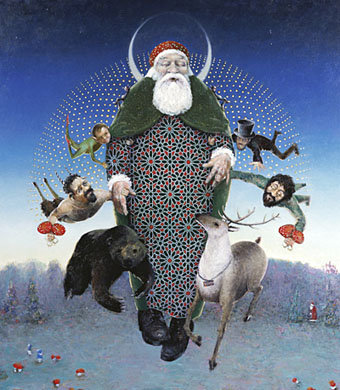
The Resurrection of Santa Claus (2000) by Jimmy Bursenos.

The psychedelic secrets of Santa Claus
by Dana Larsen, Cannabis Culture Magazine (18 Dec, 2003)

Modern Christmas traditions are based on ancient mushroom-using shamans.

Although most people see Christmas as a Christian holiday, most of the symbols and icons we associate with Christmas celebrations are actually derived from the shamanistic traditions of the tribal peoples of pre-Christian Northern Europe.

The sacred mushroom of these people was the red and white amanita muscaria mushroom, also known as “fly agaric.” These mushrooms are now commonly seen in books of fairy tales, and are usually associated with magic and fairies. This is because they contain potent hallucinogenic compounds, and were used by ancient peoples for insight and transcendental experiences.

Most of the major elements of the modern Christmas celebration, such as Santa Claus, Christmas trees, magical reindeer and the giving of gifts, are originally based upon the traditions surrounding the harvest and consumption of these most sacred mushrooms.

The world tree

These ancient peoples, including the Lapps of modern-day Finland, and the Koyak tribes of the central Russian steppes, believed in the idea of a World Tree. The World Tree was seen as a kind of cosmic axis, onto which the planes of the universe are fixed. The roots of the World Tree stretch down into the underworld, its trunk is the “middle earth” of everyday existence, and its branches reach upwards into the heavenly realm.

The amanita muscaria mushrooms grow only under certain types of trees, mostly firs and evergreens. The mushroom caps are the fruit of the larger mycelium beneath the soil which exists in a symbiotic relationship with the roots of the tree. To ancient people, these mushrooms were literally “the fruit of the tree.”

The North Star was also considered sacred, since all other stars in the sky revolved around its fixed point. They associated this “Pole Star” with the World Tree and the central axis of the universe. The top of the World Tree touched the North Star, and the spirit of the shaman would climb the metaphorical tree, thereby passing into the realm of the gods. This is the true meaning of the star on top of the modern Christmas tree, and also the reason that the super-shaman Santa makes his home at the North Pole.

Ancient peoples were amazed at how these magical mushrooms sprang from the earth without any visible seed. They considered this “virgin birth” to have been the result of the morning dew, which was seen as the semen of the deity. The silver tinsel we drape onto our modern Christmas tree represents this divine fluid.

Reindeer games

The active ingredients of the amanita mushrooms are not metabolized by the body, and so they remain active in the urine. In fact, it is safer to drink the urine of one who has consumed the mushrooms than to eat the mushrooms directly, as many of the toxic compounds are processed and eliminated on the first pass through the body.

It was common practice among ancient people to recycle the potent effects of the mushroom by drinking each other’s urine. The amanita’s ingredients can remain potent even after six passes through the human body. Some scholars argue that this is the origin of the phrase “to get pissed,” as this urine-drinking activity preceded alcohol by thousands of years.

Reindeer were the sacred animals of these semi-nomadic people, as the reindeer provided food, shelter, clothing and other necessities. Reindeer are also fond of eating the amanita mushrooms; they will seek them out, then prance about while under their influence. Often the urine of tripped-out reindeer would be consumed for its psychedelic effects.

This effect goes the other way too, as reindeer also enjoy the urine of a human, especially one who has consumed the mushrooms. In fact, reindeer will seek out human urine to drink, and some tribesmen carry sealskin containers of their own collected piss, which they use to attract stray reindeer back into the herd.

The effects of the amanita mushroom usually include sensations of size distortion and flying. The feeling of flying could account for the legends of flying reindeer, and legends of shamanic journeys included stories of winged reindeer, transporting their riders up to the highest branches of the World Tree.

Santa Claus, super shaman

Although the modern image of Santa Claus was created at least in part by the advertising department of Coca-Cola, in truth his appearance, clothing, mannerisms and companions all mark him as the reincarnation of these ancient mushroom-gathering shamans.

One of the side effects of eating amanita mushrooms is that the skin and facial features take on a flushed, ruddy glow. This is why Santa is always shown with glowing red cheeks and nose. Even Santa’s jolly “Ho, ho, ho!” is the euphoric laugh of one who has indulged in the magic fungus.

Santa also dresses like a mushroom gatherer. When it was time to go out and harvest the magical mushrooms, the ancient shamans would dress much like Santa, wearing red and white fur-trimmed coats and long black boots.

These peoples lived in dwellings made of birch and reindeer hide, called “yurts.” Somewhat similar to a teepee, the yurt’s central smokehole is often also used as an entrance. After gathering the mushrooms from under the sacred trees where they appeared, the shamans would fill their sacks and return home. Climbing down the chimney-entrances, they would share out the mushroom’s gifts with those within.

The amanita mushroom needs to be dried before being consumed; the drying process reduces the mushroom’s toxicity while increasing its potency. The shaman would guide the group in stringing the mushrooms and hanging them around the hearth-fire to dry. This tradition is echoed in the modern stringing of popcorn and other items.

The psychedelic journeys taken under the influence of the amanita were also symbolized by a stick reaching up through the smokehole in the top of the yurt. The smokehole was the portal where the spirit of the shaman exited the physical plane.

Santa’s famous magical journey, where his sleigh takes him around the whole planet in a single night, is developed from the “heavenly chariot,” used by the gods from whom Santa and other shamanic figures are descended. The chariot of Odin, Thor and even the Egyptian god Osiris is now known as the Big Dipper, which circles around the North Star in a 24-hour period.

In different versions of the ancient story, the chariot was pulled by reindeer or horses. As the animals grow exhausted, their mingled spit and blood falls to the ground, forming the amanita mushrooms.

St Nicholas and Old Nick

Saint Nicholas is a legendary figure who supposedly lived during the fourth Century. His cult spread quickly and Nicholas became the patron saint of many varied groups, including judges, pawnbrokers, criminals, merchants, sailors, bakers, travelers, the poor, and children.

Most religious historians agree that St Nicholas did not actually exist as a real person, and was instead a Christianized version of earlier Pagan gods. Nicholas’ legends were mainly created out of stories about the Teutonic god called Hold Nickar, known as Poseidon to the Greeks. This powerful sea god was known to gallop through the sky during the winter solstice, granting boons to his worshippers below.

When the Catholic Church created the character of St Nicholas, they took his name from “Nickar” and gave him Poseidon’s title of “the Sailor.” There are thousands of churches named in St Nicholas’ honor, most of which were converted from temples to Poseidon and Hold Nickar. (As the ancient pagan deities were demonized by the Christian church, Hold Nickar’s name also became associated with Satan, known as “Old Nick!”)

Local traditions were incorporated into the new Christian holidays to make them more acceptable to the new converts. To these early Christians, Saint Nicholas became a sort of “super-shaman” who was overlaid upon their own shamanic cultural practices. Many images of Saint Nicholas from these early times show him wearing red and white, or standing in front of a red background with white spots, the design of the amanita mushroom.

St Nicholas also adopted some of the qualities of the legendary “Grandmother Befana” from Italy, who filled children’s stockings with gifts. Her shrine at Bari, Italy, became a shrine to St Nicholas.

Modern world, ancient traditions

Some psychologists have discussed the “cognitive dissonance” which occurs when children are encouraged to believe in the literal existence of Santa Claus, only to have their parents’ lie revealed when they are older. By so deceiving our children we rob them of a richer heritage, for the actual origin of these ancient rituals is rooted deep in our history and our collective unconscious. By better understanding the truths within these popular celebrations, we can better understand the modern world, and our place in it.

Many people in the modern world have rejected Christmas as being too commercial, claiming that this ritual of giving is actually a celebration of materialism and greed. Yet the true spirit of this winter festival lies not in the exchange of plastic toys, but in celebrating a gift from the earth: the fruiting top of a magical mushroom, and the revelatory experiences it can provide.

Instead of perpetuating outdated and confusing holiday myths, it might be more fulfilling to return to the original source of these seasonal celebrations. How about getting back to basics and enjoying some magical mushrooms with your loved ones this solstice? What better gift can a family share than a little piece of love and enlightenment?

FURTHER LINKS AND REFERENCES:

The Hidden Meanings of Christmas, Mushrooms and Mankind, by James Arthur
Santa Claus & the Amanita Muscaria, by Jimmy Bursenos
Who put the Fly Agaric into Christmas?, Seventh International Mycological Congress, December 1999, Fungus of the Month
The Real Story of Santa, The Spore Print, Los Angeles Mycological Society, December 1998
Santa and those Reindeer: The Hallucinogenic Connection, The Physics of Christmas, by Roger Highfield
Fungi, Fairy Rings and Father Christmas, North West Fungus Group, 1998 Presidential Address, by Dr Sean Edwards
Fly Agaric, Tom Volk’s Fungus of the Month for December 1999
Father Christmas Flies on Toadstools, New Scientist, December 1986
Psycho-mycological studies of amanita: From ancient sacrament to modern phobia, by Jonathan Ott, Journal of Psychedelic Drugs; 1976
Santa is a Wildman, LA Times, Jeffrey Vallance

BOOKS WORTH READING:

Mushrooms and Mankind, by James Arthur
Soma: Divine Mushroom of Immortality, by Gordon Wasson
Mushrooms, Poisons and Panaceas, by Denis R. Benjamin