
Yearly Archives for 2007
Baltimore Shopping Network – Meditation Manifestation by Jimmy Joe Roche
Boredoms in Manchester

Drumming up an absolute storm last night; my ears are still ringing. And I need a new camera…
Studs Terkel: The world's greatest interviewer
“So where is the hope that you talked about going to spring from?”
“From young people, like I said. From their ability to organise. I believe the internet may have an even stronger influence than people have realised. Albert Einstein said that when you join an organisation – and that could be anti-war, anti-pollution, or pro the rights of lesbians and homosexuals – Einstein said that, once you join, you have more individuality, not less. Because you are another person who wants to count.”
Studs Terkel: The world’s greatest interviewer
He met everyone from Martin Luther King to Dorothy Parker, Tennessee Williams to Bob Dylan. He survived the McCarthy era to record a unique oral history of his country. Now in his nineties, the great US chronicler is still raging against George Bush, Hillary Clinton and the death of radical America
The Robert Chalmers interview
The Independent
Published: 21 October 2007
“You are God,” I tell Studs Terkel. “Re-create the world.” The writer says nothing for a couple of seconds, which is not like him. “As you seem to know,” he replies, “that’s a question I used to ask people. I think the best way I can respond is to tell you how one young kid answered it. He said: ‘I don’t want that job. That job is impossible.'”
“And these days, when you listen to the news, I imagine you can’t help thinking that boy was right. How does it feel when you’re 95 and almost every ideal you ever cherished is under threat; when your nation’s government has become less peaceful and more bloodthirsty; less equitable and more shamelessly driven by greed? What’s it like, towards the end of a lifetime devoted to civil-rights activism, to find your country led by a president more right-wing and nakedly acquisitive than any other in your memory?”
“It’s true what you say. I can’t deny it. At the same time, I once wrote a book called Hope Dies Last. I believe that. I might feel hopelessness, except for one thing: the young. I don’t mean the young as they’re portrayed in TV commercials: whores, bimbos and dummies. There are many who do not fall into those categories. The big problem is that there’s no memory of the past. Our hero is the free market. People forget how the free market fell on its face way back in the Depression. And how the nation pleaded with its government and got help. Today, all these fat CEOs say we don’t need government. And these fat boys get away with it, because of our collective Alzheimer’s, and the power of Rupert Murdoch and CNN. There is despair in this country, sure. At the same time, we are waiting.”
“For what?”
“For new voices.”
We are talking in the living-room of Terkel’s house in Chicago, near the shore of Lake Michigan. In 1996 he underwent a quadruple-bypass operation; three years ago he broke his neck when he tripped over a pile of his own books. He is physically frail to the point that the last of his beloved Romeo y Julieta cigars has long since been smoked. But age has not extinguished his mental alertness or mischievous energy. He is wearing the red-and-white gingham shirt and red cotton socks that have been his uniform since the 1950s. Terkel, who can manage a few steps using a cane, apologises repeatedly for not being strong enough to take me downtown for dry Martinis.
The word genius – grotesquely overused in most areas of the media – is not a term you hear disinterested observers use to describe an interviewer. But Terkel – a man with the wit, the longevity, but none of the compliant orthodoxy of an Alistair Cooke – has been the greatest American broadcaster of his, or any other, generation and he has done more than enough to earn it.
Over the years Martin Luther King, Billie Holiday, Tennessee Williams, Bob Dylan, Louis Armstrong and Dorothy Parker, among others, have sat where I am now, face to face with the best-loved figure in Chicago. Woody Guthrie used to stay in this house. True, that was in the days before you had to bellow at Terkel in the kind of voice that, given a calm night and a favourable wind, might be audible across the state line in Indiana. It’s ironic that a man who defines his role as “listening to what other people tell me” can’t work his hearing aids any better than he could his tape recorder, a device he could never be trusted to operate unaided.
“I realised very early on,” he says, “that the conventional way of approaching an interview was useless; that taking in a notebook full of questions, for instance, only made people feel interrogated.”
Terkel broadcast daily for the best part of 50 years on Chicago station WFMT; his last regular show was 10 years ago. He developed a discursive style of interviewing, his energies devoted to capturing the voices of what many radio presenters persist in referring to as “ordinary people”. One of his favourite films is Miracle in Milan by Vittorio de Sica, at the end of which a group of slum-dwellers suddenly levitate and soar into the clouds: it’s as good an image as any to represent Terkel’s life’s achievement.
“I set out,” he said, “to swallow the world.”
Continue reading"The visual equivalent of church bells chiming."
James Turrell turns on the light
His newest, an open-air pavilion at Pomona College, is made of light and space, which is emblematic of his art. The real work is what happens inside the viewer.
By David Pagel
21 Oct 02007 Los Angeles Times
FOR nearly 40 years, James Turrell has been making art out of little more than thin air — at least that’s how his indoor and outdoor installations feel when you give yourself over to their dazzling attractions. Think of his super-refined Minimalism as a spa for consciousness: an urbane oasis and thinking citizen’s entertainment center all rolled into one impeccably designed whole that is both elegant and spectacular.
Turrell’s newest project — and first public installation in Southern California — is what has come to be known as a “Skyspace,” a sophisticated architectural structure that doesn’t call attention to itself but humbly serves anyone who passes through it. Titled “Dividing the Light,” this open-air pavilion on the campus of his alma mater, Pomona College, goes out of its way to make whatever time you spend with it satisfying, whether you’re an enthusiastic pilgrim who has traveled far to experience Turrell’s work or a casual passerby who just happens upon it. The longer you linger, the more you experience.
During the day, its red granite benches, black granite floor, serene reflecting pool, sleek metal columns and gently curved canopy provide a relaxing escape from everyday busyness. The seemingly weightless steel canopy shades the comfortable seats and forms a frame around a big square of sky.
The magic happens at sunset, sunrise and on every hour throughout the night. Hidden LED lights illuminate the canopy from below. Turrell has programmed them to shift in intensity at twilight and dawn, depending on the season and time. This causes the sky that is visible through the nearly 16-foot-square opening to appear to be palpable — less like a distant dome sprinkled with stars and more like a velvety chunk of color close enough to reach out and touch. At night, the canopy is softly illuminated. Every hour, the lights flicker and shift, in what Turrell calls “the visual equivalent of church bells chiming.”
Every night is different, depending on the weather, the smog, your mood. What is constant is Turrell’s capacity to pull experiences of sensual refinement out of the heavens — to make down-to-earth, experience-it-for-yourself art out of light and space — and to get visitors not only interested in the subtleties of our perceptions but thrilled by the wonder of it all.
Continue readingCircuit bending this weekend in L.A.
“Like last year we having video projections and a toy raffle. We are
also having a circuit bending workshop at 1pm.This year we are having
Evil Moisture (Andy Bolus) from France play the show. The lineup is:
Evil Moisture
Xdugef
Univac
Igor Amokian
Phillip Stearns
Rocker Parlour
and
Caveat Emptor”
BEND THIS TIMES THREE
OCT 20TH 9PM
at
IL CORRAL
662 no. heliotrope dr
los angeles, ca 90004
http://ilcorral.net
http://cannedbeefrecords.com/bendthis3x

ULTIMATE REALITY by Jimmy Joe Roche and Dan Deacon – clip
Benefit for Kime TONIGHT in Echo Park

The great Robert Wyatt
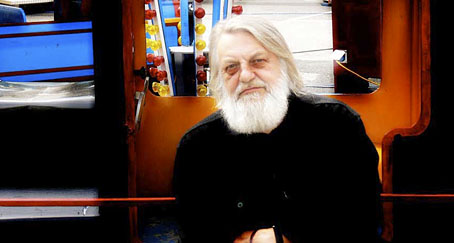
‘I was trapped into being alive’
Never one to shy away from confronting his inner demons, Robert Wyatt’s latest work is as poignant as ever. He talks to Dave Peschek
Dave Peschek
Thursday October 18, 2007
The Guardian
‘I’m a mine of misinformation,” says Robert Wyatt, wheeling his chair into the front room of the Georgian townhouse he shares with his wife, Alfreda Benge. “I’ll just invent something.”
Wyatt is eloquent, voluble, as mischievous as he is sincere. It is more than 40 years since he started making music: initially as part of the progressive Canterbury scene of the late 1960s and early 1970s; then with Soft Machine; then, nominally at least, solo. It is more than 30 years since he was rendered paraplegic after falling from a window at a party while drunk. In the meantime, he has become a national treasure. Each of his sporadic albums retains a singular sense of pop melody and the freedom and inflection of jazz; each is an event. Few musicians who have appeared on Top of the Pops (in his wheelchair) can also claim to have been profiled by the Spectator.
Before you meet Wyatt, you meet Alfie. She drives me from Market Rasen station to Louth, Lincolnshire – the first place they hit on a drive from London looking for an affordable property with a ground floor big enough to give Robert freedom of movement in his chair. Like Tom Waits and his wife, Kathleen Brennan, Robert and Alfie live in an artistic symbiosis. She often writes lyrics for him, and has provided beautifully strange and bright cover art for all his records since his solo debut in 1973. “Everyone,” says Wyatt, “should have an Alfie.”
She is fierce and warm, a Polish refugee who came to London after the war when she was seven with her mother, who now lives with them. When Wyatt met her, she was “a proper mod”, had “all the records you would expect a girl to have, but also all this hard bop jazz.” She was also, it is clear from the photos in Wyatt’s music room, luminously beautiful.
She has not had an easy time of it. Wyatt was incontinent after his paralysis – “hard to live with for a partner, that helplessness,” he says – and suffered from profound depression through the 1990s. “Me and Alfie became like strangers who just accommodated each other,” he recalls. He was “quite unable to sleep. Couldn’t lie still, revolving in the bed all night, and Alfie had to go upstairs to sleep. Wheeling up and down the corridor at 20 miles an hour, I couldn’t stop. I couldn’t write. I lost my sight, I suddenly needed glasses. It felt like dying, but that would have been a release. Physically, as it turns out, I’m very resilient. I was trapped in having to be alive.” Counselling saved him, and, in 1997, he made one of his most cohesive records, Shleep.
Continue reading“Blank in the Fill”: Dave Reeves on fluoride and suicide in North Carolina (Arthur, 2007)

“Do the Math” column originally published in Arthur No. 26
BLANK IN THE FILL by David Crosby Reeves
“For those who stubbornly seek freedom, there can be no more urgent task than to come to understand the mechanisms and practices of indoctrination.” —Chomsky
In the days of President Carter, a fluoride program went through the public schools called ‘Swish and Spit.’ First grade students were given permission slips and told to bring them back with a parent’s signature. I was a good kid then, eager to prove myself. I took my permission slip to my mother. She put it aside and didn’t sign it.
The day the ‘Swish and Spit’ program was implemented, Ms. Goldie brought out a bottle of red fluid and told everyone, ‘This is fluoride, and it tastes good.’ It looked like cherry Kool-Aid. I never got to taste it because I didn’t have my permission slip.
I was left alone while the other kids went to the sink and did the Kool-Aid. ‘Swish and Spit’ was just that. Everybody came back with red tongues like they had eaten a Slushy.
Ms. Goldie came to me, wanting to know where my slip was. I had a sense that this was one of the first tests of this new thing called School, and I was eager to be good. I wanted to drink the Kool-Aid to commune with the other kids, the kool kids, and become one with the institution.
So when I get home I told Ma, ‘I got to get this thing signed!’ ‘What is it for?’ she wanted to know. I explained that the ‘Swish and Spit’ was good for me, harmless, and probably cherry Kool-Aid.
‘What did I tell you about people coming to you with candy?’ my mom asked me. She went on about how the product was manufactured to look like candy so that I would want it, but we didn’t know what was in it.
My argument was, Sure we know what’s in it: fluoride. It makes strong teeth. But Ma wasn’t signing it because she said the government should not be giving you anything, nor should you trust them to give you anything. It sets a bad precedent. And why would a government that cares so little about your health that I can’t afford health care suddenly care so much about your teeth?
Continue reading Arthur Magazine