“Salvia divinorum is an extraordinary visionary herb. It is not a recreational drug. It produces a profoundly introspective state of awareness that is useful for meditation, contemplation, and self-reflection. Its effects are unique and cannot be compared with the effects of other drugs. The effects of Salvia do not appeal to many people (young or old). The people who are most drawn to it are both mature and philosophically minded. Beware of inaccurate information. There are many unethical vendors who try to lure naive customers by portraying the effects of Salvia as more appealing than they are. The news media often sensationalizes stories about Salvia, exaggerating its effects, risks, and popularity. Much of what has appeared in the popular press is inaccurate and misleading. Salvia is not ‘legal pot.’ It is not ‘legal acid.’ It is not a substitute for any other drug. Before trying Salvia, it is important that you know about its effects, appropriate uses, and the potential risks associated with irresponsible use.
“Do NOT use Salvia until you have read through this guide. Salvia is unique. You cannot make assumptions about its effects based on experiences you may have had with other herbs or drugs. Salvia has much to offer: fascinating psychoactive effects, sensual enhancement, magical journeys, enchantment, apparent time travel, philosophical insights, spiritual experiences, and perhaps even healing and divination. It should not be used casually. It should always be used in a thoughtful, intelligent manner, and only by responsible adults that are of sound mind and clear intent.”
Deerhoof are an adventurous art-rock ensemble from the San Francisco Bay Area whose mix of playfulness, technical facility and unpretentious musical/conceptual ambition has gained them an ever-growing (and awesomely devoted) underground following. Not long after seeing Deerhoof play a giddy early-evening set to an all-ages audience of Giant Robotniks, punk rockers, noiseheads, pop geeks, art students and awed musos, I spoke by phone with drummer-keyboardist Greg Saunier about how the band’s insistence on playing all-ages shows has been crucial—perhaps even pivotal—to their continued artistic growth and commercial success. Following is part of our conversation.
Deerhoof ‘s latest album, Friend Opportunity, is available from Kill Rock Stars; a DVD of the Courtney Naliboff-adapted ballet version of Deerhoof’s 2004 concept album Milk Man, featuring students from the K-12 North Haven Community School in Maine, is available from http://www.milkmanballet.com —Jay Babcock
Arthur: What is Deerhoof’s policy regarding playing all-ages shows?
Greg Saunier: Basically we try to play all-ages shows wherever we can. It’s not always possible. I have some friends who have bands that are 100 percent insistent, but by demanding that every show be all-ages, they sometimes go for long periods without playing any shows. Or they aren’t able to play certain cities, period. But wherever we can, we try to do it.
Why is it important?
Greg Saunier: Our music, and I think music in general, is not just for people who are a certain age or who have necessarily already experienced certain things. We aren’t trying to make music that’s meant to be an in-joke, just for people who’ve already lived through certain things or already are familiar with certain bands of the past. We try to make music that could have something to say to any kind of person—or at least any age of person. We’ve had quite a few shows where a kid and her parent will come, and both claim to be fans, which is really mind-blowing to me, and really gratifying, because I want it to feel like it’s not exclusive to a certain clique.
What were some of the shows you saw as a teenager?
Greg Saunier: I grew up in Columbia, Maryland. One of the first concerts I saw was the Police, at a basketball arena. And it occurs to me that the same is still the case—when Christina Aguilera plays a show, she plays arenas so she play all-ages every time. Within the world of pop music, it’s not even an issue. It’s only in this world of—I don’t even know what this world is, but it’s some other world where music is only associated with bars and with drinking and with people over a certain age and with a certain world-weariness already built in, a certain jaded quality. Of course that’s not everybody, and you can retain that kid-like innocence about new things in music your whole life. But I don’t even drink, so the last place I thought I’d be forging a career would be in bars! I actually don’t mind playing in bars, but if we do it’s always about trying to transcend the surroundings and the normal association with bars and what it’s there for and what it’s meant to do.
Were there shows that you wanted to see as a kid that you couldn’t because you were not of age?
This is going to make it sound like as a teenager I was completely obsessed, but actually I remember Andy Summers, the guitar player from the Police, did a solo show one time at the 9:30 Club in D.C., and it was an over-21 show. I remember just being crushed for several weeks that there was no way I was going to be able to go to this thing. I got really involved in starting to listen to classical music a lot, and classical music shows are always all-ages. That’s what I was getting fed by my parents and I gobbled it up and got a lot out of it.
That’s a good point, that classical music is not a “beer experience.”
In a way, it is another alternative music culture. I was totally dependent on either friends or my parents to get around as a teenager, and there was no place to see a concert in the town where I grew up. Any concert-going required going to D.C. or Baltimore. I felt like a rebel, honestly, in my teen and high school years because of the fact that I listened to classical music. It didn’t really make any sense to any of my friends, and I definitely felt like a real oddball. At the same time in high school, as I just barely started to get a slight awareness that there was underground rock music and punk music, I started to make friends with a few people who were into that and I identified with them in a very strange way. The hardcore scene of the early ’80s and classical music scenes obviously couldn’t seem to be more opposite, but for me and my punk rock friends, it served a very similar purpose. It was something that wasn’t already figured out for you. It wasn’t thrust upon you with the sheen of the mainstream, and the mainstream was the only other choice available to kids.
I remember hearing about this straight-edge music and I was absolutely fascinated. I was very much a late bloomer as far as understanding that there was anything called punk rock. I mean, when Minor Threat was going I was listening to Top 40, I had no idea. I later discovered another band from the area called Void, and they are actually from my hometown. They were just a hair older than I was, and looking back, I bet I knew some people who did go see them. But I was just totally entranced when my friends would describe these Minor Threat shows where kids were going there with the express intent of not drinking, and they would never say bad words and everybody was really nice to each other. I just couldn’t believe it, you know? I never experienced it firsthand, so my mental image of it is untarnished: I have a fantasy of this utopian situation where somebody put the kids in charge and they’re doing so much better than when the adults were in charge. Everybody’s getting along and it’s creative and everybody’s happy and everyone’s accepted. I think that I’ve been kind of seeking the re-creation of that fantasy ever since, you know, when I go to show or especially when we play shows. We want to create that kind of feeling.
Was that part of the original impetus when Deerhoof began?
In the beginning we were desperate to play and totally innocent of how to set up shows or tour. And we were very shy people; it was just two of us at first and then [vocalist-bassist] Satomi joined to make three, and she didn’t make the band any less shy than we already were. Basically, if another band asked us to play a show with them, we’d be like ‘Yeah!’ and be unable to sleep for the next week or something! So in the first couple years of Deerhoof we didn’t have the gumption to dictate anything or make any suggestions. We basically just followed whatever was handed to us and felt lucky if we got to play at all. But what ended up happening was we didn’t play all-ages shows, and the first several years of the band, we had no kid fans seeing us, it was all people our age or older. Satomi and I realized that there was something not satisfying about this. I don’t want to spend the rest of my life just playing in bars and having the success of the night be judged merely on how many drinks we got everybody to buy, you know? Probably in 1998 or ’99 I started to feel like this was a dead end. It wasn’t a stimulating situation, always playing with the same bands, playing the same songs to the same people just passing time in a smoky little room. My first impulse was to go back to school so I could get back into classical music. So I went to graduate school for music, and felt very frustrated there too. In both cases, it’s a mutual admiration society. It’s an ‘in’ crowd. The people who go to see Deerhoof, or the people who are studying music at music conservatory, both can have the sealed feeling where everybody’s patting each other on the back. That’s their only audience, you know? So that was a turning point for the band, too, where we felt like ‘We need to start branching out.’ And frankly, that feeling has never gone away. We have managed for the most part to be able to play all-ages shows everywhere we go, but even then it can feel … we still feel confined in some ways.
Like, why do shows always have to be so late at night? And why do they have to cost $18?
Yeah. Even when you call a show quote-unquote ‘all-ages,’ obviously if it’s late at night on a school night and it’s really expensive then no kid’s going to be able to go. So we’re always looking for something other than just the prescribed venue, or the prescribed way that we’ve been told our music is supposed to be presented. That’s the crazy thing about kids, and the many adults who have an open mind: they don’t conform to any marketing person’s concept of their target demographic characteristics. They look for something that’s cool, they look for something that strikes them a certain way, and maybe as they grow with it they figure it out in a more sophisticated way. Kids surprise adults all the time, because adults would never have guessed what kind of styles that kids would come up with. You think of clothes as the obvious example, where adults are constantly rolling their eyes: ‘What are the kids wearing nowadays?!’ But it’s the same thing with music, and it’s very exciting. And that’s another great advantage of playing all-ages shows: sometimes we can play with under-21 bands.
A couple of years ago, we played in Minneapolis, and Minneapolis is actually very difficult for all-ages shows, but there’s one venue called the Triple Rock where we have often played that will do all-ages shows early; basically, before the “real” show that they’re still going to have that night. Anyway, John has an old friend, Milo Fine, who does only free improvisation. The guy’s possibly in his 50s … real hardcore. He doesn’t do free improvisation for fun, but has for decades been cultivating this and only this and refuses to play a single note of written music period, you know? Extremely obscure, but in his tiny circle, he is sort of a legend. Basically, ultra avant-garde and not the type of music that you would normally associate with kids liking. We asked him to open for us. He was playing percussion with another guy in an improvisational duo, and we were talking before the show, and he was sure that he was just going to bomb. The place was filled with kids, and de was like, ‘This is not my normal audience, I normally play in bars.’ So he came out and played and you could hear a pin drop. The kids were just so focused, they were just totally taking it in. They didn’t judge things the same way that a mob of adults might. There were just no preconceptions. After the show he was just kind of stunned, and really really happy. And I felt so proud, too, that we had managed to put this bill together.
Oh! Here’s a story that totally illustrates how important all-ages is. We played on a tour opening for Unwound, and Unwound was one of those bands that insisted on all-ages shows. That was kind of our introduction to the whole concept. We played at the J.C. Hall, just a tiny shack of a room in Biloxi, Mississippi. There’s no stage, we just played on this linoleum floor. A lot of kids were there. There was this one 16-year-old kid who came up to our merch table after we played and he’s like, ‘I want everything, give me everything.’ It was the first time in however many years we’d had the band going where somebody had ever come up to the merch table and wanted to buy everything. Two days later, our show is in Pensacola, Florida, and not only does he show up but he’s so excited he brings his kid brother, who’s 14 and sick with the fever at the time! But they still felt that it was enough of a priority that they needed to come see this band again. We ended up keeping in touch. And that was Chris and Steve Touchton who very soon after that, decided to form their own band, XBXRX. Later, they moved out to the Bay Area and they live here now and are quite successful.
The music XBXRX make doesn’t really sound like Deerhoof—it’s their music, that somewhere deep inside he wanted to make but couldn’t find the permission anywhere in his universe to do what he really wanted to do. When you see something that’s not the mainstream shows, which are the only ones you’re allowed to go to, that’s what can inspire you to say, ‘I’m going to do my own thing, too.’ A person can do something that’s really different and creative. All these rules that I thought were there aren’t really there. [Those rules] are just from tired musicians and tired, bored marketing experts who are just going on some kind of endless rote, trying to recapture the success of last year’s successful band and think that there are all these rules of how your music’s supposed to sound and what’s going to make it sell.
You really want to make sure technically that the show can include people under 21, but once you’re there it’s like… You’d have to actually step back and say, well how would this be different if the ‘kids’ weren’t here? I really can’t tell who is above 21 and who’s are under 21 in a lot of cases. But it’s great at shows when I’m chatting to somebody who came to the show, and I can tell by looking at them that they’re quite young, and they’re telling me that they came because they’re a fan of our music and that they’ve been listening to it, and I think back to when I was at that age and what music I was listening to. And I say to myself, ‘Whatever music I was listening to, that music totally just re-wired my nervous system.’ I just know how important the music that I listened to in those years was to me. And when I think, ‘Wait, here’s a real human being standing right in front of me, for whom that music is our music!’ well you can’t imagine the overwhelming joy that I feel. You want to inspire people, you know?
Our leaders would undoubtedly be happy if we “moved on” from Iraq. They don’t want to talk about it any more: it was a dreadful blunder, and reflects little credit on any of them. Presumably this is why the question has hardly been debated in parliament. Although the majority of the public were always against the war, this was not reflected by their elected representatives. The government behaved in a way that was transparently undemocratic but the Conservatives won’t call them on it, for without their almost unanimous support the whole project couldn’t have happened.
But to conveniently forget Iraq now is to forfeit the only possible benefit the war might have: the chance to rethink the dysfunctional political system that got us into this hole. If we don’t, we risk digging a series of ever deeper holes. The Iraq adventure was justified as the planting of a beacon of democracy in the Middle East. Not only did it utterly fail at that, it also undermined our democracy. Appealing to our paranoia more than our vision, George Bush and Tony Blair obtained restrictions on freedoms that had taken centuries to evolve. They said these were necessary to ensure our security – a device used by authoritarian leaders since time immemorial.
Civil liberties never seem important until you need them. But by definition, that is the very time you won’t be able to get them, so they have to be in place in advance, like an insurance policy. In his book Defying Hitler, the historian Sebastian Hafner describes how Germany slid into nazism. At first people laughed at Hitler and played along with what seemed trivial changes in the law. For most Germans it was all rather abstract, and they were expecting things to return to normal when Hitler faded back into obscurity. Only he didn’t, and civil liberties were so compromised there was no way to stop him.
If we don’t stand up about Iraq then we tacitly sanction the next steps in this deadly experiment of democratic evangelism. Those will likely include an attack on Iran, a permanent force of occupation in Iraq (probably always the intention), the complete militarisation of the Middle East, and a revived nuclear future.
Stop the War Coalition planned a march from Trafalgar Square to Parliament Square on Monday – the day parliament resumes – to draw attention to the fact that a lot of us are still thinking about Iraq and to call for the immediate withdrawal of troops. Using an archaic law (the 1839 Metropolitan Police Act), that demonstration has now been banned. Now why would that be? Stop the War Coalition has organised dozens of such demonstrations, and as far as I know not one person has been hurt. So it can’t be public safety that’s at stake.
No, it’s the elephant in the room. This government wants to show itself as clean and new, and doesn’t want attention drawn to the elephant and the mess it has left on the carpet. So it invokes an old law, to shave a little more off the arrangements by which citizens communicate their feelings to government (a process, by the way, called democracy).
It would take courage for Gordon Brown to say: “This war was a catastrophe.” It would take even greater courage to admit that the seeds of the catastrophe were in its conception: it wasn’t a good idea badly done (the neocons’ last refuge – “Blame it all on Rumsfeld”), but a bad idea badly done. And it would take perhaps superhuman courage to say: “And now we should withdraw and pay reparations to this poor country.”
I don’t see it happening. But the demonstration will, legal or not: on Monday Tony Benn will lead us as we exercise our right to remind our representatives that, even if Iraq has slipped off their agenda, it’s still on ours. Please join us.
Old people cry, young lovers smile and cynical hipsters get confused when she’s onstage. What is Lavender Diamond’s love-and-ecology frontlady BECKY STARK up to?
By Jay Babcock, with photography by Mark Frohman & Molly Frances Originally published in Arthur No. 26/Sept 2007
Recently Becky Stark and her mother dropped in on Arthur’s Thursday social at a pub in Los Angeles. Talk about the fruit not falling far from the tree: Diane Stark, an ordained minister serving at the Unity Church of Practical Christianity in Grand Rapids, Michigan, effortlessly owned the place. At a table of Becky’s friends, she told stories about her own mother, a spiritualist who gave public lectures on metaphysics in the ‘40s and completed an unpublished book entitled “The Meaning of Love.” She talked about working as a stripper on Sunset Boulevard in the mid-1970s; about witnessing Martin Luther King, Jr. give his “I Have a Dream” speech; about her own life philosophy (“I like to act as if I’m inside a fable”); about how you should hold a loved one when she’s asleep; and, of course, about Becky being born (“She was happy to be here”). Then someone put on Link Wray and it was time for the Stark women to dance—or, as Diane put it, “have a conversation at the energetic level.”
If that doesn’t explain Becky Stark, here are some other true stories. One of the first books she read was a collection of Gandhi’s writings given to her by a friend of the family who was active in the nuclear freeze movement. She joined the League of Women Voters at age seven and in seventh grade, traveled through the Soviet Union with 13 other American kids as part of a cross-cultural exchange initiative called Peace Child. The three-week tour included a stay with 500 Soviet kids at a Young Constables youth camp on the Volka River and participation in a youth choir performance opening for American poodlerockers Skid Row at the Moscow Peace Festival in Red Square. (“Peace Child” was the title of a hit song in Russia, and Becky can still sing it on demand.) From eighth to tenth grade, Becky was the head writer, anchor and host of “Kids’ Point of View,” a weekly 20-minute television show sandwiched on UHF between the World Wrestling Federation show and Gorgeous Ladies of Wrestling. At 14, she started a local youth chapter of the National Organization of Women. As a teenager, she developed her range by studying modern and romantic opera (as well as Tin Pan Alley and other classic American pop music), but her opera singing career was ended when her body failed to develop the large lung capacity required to sing at a professional level. She studied Russian as a Comparative Lit undergrad at Brown, and dance at the Merce Cunningham Conservatory in New York City. In 2000, Time Magazine published a photograph of Stark wearing a bright yellow dress levitating in front of riot police during a protest march at the Democratic Convention. In 2003, she toured across the country with Xander Marro, performing “Birdsongs of the Bauhauroque,” an operatic fable/comedic poem involving puppetry, keyboards and costume drama. Returning to Los Angeles, Stark worked a series of comical dayjobs and started performing solo as Lavender Diamond and doing stand-up at the Improv and other comedy clubs
Over the next two years, Lavender Diamond evolved from a one-woman act into a four-piece symphonic folk-pop band featuring composer Steve Gregoropoulos on piano, Jeff Rosenberg on acoustic guitar and Stark’s boyfriend, the cartoonist Ron Rege, Jr., on drums. The band’s sadness-and-ecstasy four-song EP The Cavalry of Light was self-released in 2005. At ArthurFest that year, they played into the sun with such beauty that left many (including poet Charles Potts) teary-eyed. During the next year, as they were recording with Vetiver/Brightblack Morning Light/Devendra Banhart producer Thom Monahan, Lavender Diamond were signed by the legendary Geoff Travis to Rough Trade in Europe and then to Matador in North America.
Imagine Our Love, Lavender Diamond’s debut full-length, was released earlier this year to the kind of divided response the band has often received live. Stark’s Lavender Diamond persona is unique: think of a cosmic grade school teacher, or maybe Mary Poppins, returned to talk to you later in life, heartbroken at first to have to remind her former pupils about the importance of sharing and respect for Nature, but happy to encourage you to do better, using music, humor and imagination. When Stark sings “You broke my heart” over and over, pointing her finger directly at specific audience members, it’s a loaded—transgressive, even—move in a culture built on evading responsibility; you can see how it might not fly with every jaded urban hipster. But Lavender Diamond’s music is for the entire school, not just the kids too cool to be there. It’s pop music for peace, simple songs pitched somewhere between Linda Ronstadt, Jefferson Airplane and Yellow Submarine. Or, as Stark says, “It’s lovesongs to the world.”
Here’s part of our recent conversation.
Arthur: So many people think you’re being ironic. Does that bother you?
Becky Stark: I thought our music was simple enough for anyone to get, and so it’s kind of confounded me when people think we’re joking. Why on earth would we do that? Every time anyone asks if I’m serious about celebrating peace on earth I have to say, “Are you seriously asking me that question?” For real. I’m the weirdo? For talking about peace? In the midst of a horrific insane war? What? What have things come to that people think it’s a joke to play music that celebrates peace? I guess that in the performance of Lavender Diamond I am trying to create an antidote to the degradation of our times—it’s like we are trying to run an interference pattern. It’s pretty extreme, and maybe that’s why people think it couldn’t be sincere. I think it’s our responsibility to be understood. Maybe some people think we’re kidding because we look silly. Well, I’ll have to work on my delivery and fashions so that we are taken more seriously. Maybe I’ll have to start wearing all grey and black and frowning! Seriously…maybe we just have to be more elegant…? More sexy? We’ll keep working on it. I probably need to be more dignified and not as loopy. If we’re being misunderstood, it’s because we’re not being powerful enough or intelligent enough in our communication.
Talk about the source for the title “Imagine Our Love.”
Ron [Rege, Jr.] was reading Peace Is Every Step by Thich Nhat Hanh and came across the phrase “imagine our love” in a passage about covering the world with loving prayer. Thich Nhat Hanh is a peace activist from Vietnam who was brought to the U.S. by Martin Luther King, Jr. in an effort to end the Vietnam War. Peace Is Every Step teaches how to cultivate the strength and power of a loving heart, about love and communication. How to be a peaceful person—a warrior of peace. He talks about how the people he was with in Vietnam had to heal from the war. It is very beautiful and inspiring and heartbreaking. He’ll be at MacArthur Park in Los Angeles leading a peace walk in September. Peace is every step!
Is peace enough?
Yes. That’s the definition of peace, I think: understanding that we already have enough. Peace, by definition, is enough.
What do you think music is for?
Music is for celebration, for having a great time. Music is like touch, language and medicine: it’s for healing, for uplifting. Music is a source of strength for people in a time of trouble. Music gives people a way of expressing joy and sorrow. Music is for communicating poetry and new ways of living and being, for communicating ideas of how we can transform our world and guide it into liberation of the mind and spirit.
The whole world seems to be getting stupider a la Idiocracy‘s predictions. Have we entered a new Dark Age, and if so, how can smart people—the ones who aren’t sharks or demagogues—survive in a devolving situation?
We have to be smarter. We have to grow. We have to evolve ourselves consciously—by being part of the consciousness revolution. We have to build the understanding of the nature of consciousness until it is understood as a fact like the world being round. People have to understand the reality that all of us have power and responsibility and that everyone matters. Everyone is you. The paradox of your own individuation—how at once your life can be whole and part, like a grain of sand—is a source of great pleasure and mystery. What a glorious paradox! It is liberating to discover that your life has meaning, whether you like it or not.
It’s a good thing that our terracidal economies are coming to an end, because our ways are not sustainable. We have to build new models that work so that when the current idiotic models come crashing down, we can be ready with the new ones. An end is a beginning. We have to build the new beginning! We have to be mischievous and intelligent. We have to build templates and demonstrate how to live in a sustainable way. That way it’ll be all figured out and everyone can just copy. We have to make harmonious living delightful. And exciting. And awesome. We should make eco-amusment parks. We could have rides like “It’s a Small World After All”—but everything demonstrating harmony with nature and sustainability. The energy sources for the rides will be transparently built as attractions. We’ll have the artists and engineers create gorgeous, exciting attractions around the energy sources, so that the kids are mesmerized! We’ll have murals, laser light shows. People can come with their families and have a delightful, uplifting, exciting, healing experience that is all powered by the sun and the wind.
I think that if we put our minds to it we can figure out ways to heal our environment. Sometimes I think about public healing rituals for the earth, holistic remedies for planetary toxicity, like our toxic urban rivers. Maybe baking soda would work? The best way to treat completely toxic water is to run it through a system of plant filters. A lot of ferns. Another powerful way to filter water is to run it down a path in the shape of a figure 8—it oxygenates the water. In China, they build gigantic figure 8 sculptures in the parks. I’d love to start an eco-village community that’s built around urban river water usage. That way we can figure out how to clean our rivers and live with them again and teach everyone else to do it too.
And—also—I think the way to progress/survive is to practice radical compassion, to relate to the world in a completely non-adversarial way. It’s a waste of energy to be against anything or anyone. We have to stop wasting energy. Change our energy source. Change our relationship to nature. Change our relationship to each other. Redirect our energy source from fear to love. From limited to unlimited. Perceive no enemies and no limitations. I have a feeling that we can come up with all the solutions we need.
But aren’t some people more responsible for what’s going on than others? Like the rich and powerful, for example. They seem fundamentally different to most people.
I love the rich and the poor just the same—it’s the middle class that’s the problem! Just kidding. It is true that sometimes it is staggering to witness the way that the rich go on with lives involved in the accumulation of power. But the rich aren’t the only ones in the death grip of the paradigm of domination and control—everyone is! Well, not everyone—but a lot of people are. Time to give it up! Sure, debutante balls and Wall Street culture are weird and corrupt but your question smacks of bigotry. Everyone needs healing and needs to grow. We have to stop dividing the world! Stop it! The only way to solve the world’s problems is for everyone to work together and love each other no matter what class you come from. I have friends who are homeless and friends who are billionaires. I used to have a lot of class rage but I’ve given it up completely. I grew up in a poor family, on the wrong side of the tracks (literally—the train tracks were down the block), but I can’t stand all this bigotry. It’s a cult mentality, a false reality. So, stop it. The most beautiful and gentle soul I ever met, who taught me chess and tai chi, inherited billions of dollars when he was 21. He died of a drug overdose on the street a year later. He was so lost. I think if people would have embraced him in our community he wouldn’t have gone astray. Who knows what would’ve happened if he hadn’t died? Maybe he would’ve used his money for good. It hurts my heart, all this dividing everybody up. If you think the rich are different from everybody else, you are operating in the paradigm of domination and control just like all the other idiots! When the earth becomes so toxic nobody can live on it, the rich die too! No one escapes!
Sorry, but you made me mad with that question. Don’t pull that shit. [laughter] There’s no time to fight.
Speaking of dividing up: why aren’t Lavender Diamond playing all-ages shows? It seems like all you played on your last tour were over-21 bars and nightclubs.
We realize that our music resonates for people of all ages so we’re playing as much as possible at all-ages places. We’re organizing a tour to schools where we’ll play with the student bands and choirs. But I do like club shows, though, because you can be more wild and dark.
You once told an interviewer “dancing should be the number one priority of the nation.” But I’ve never seen people dancing at your shows!
Maybe Lavender Diamond is part of the problem! [laughter] People do dance at our shows, but not enough. These days I always wish before the shows that we were making a dance party, but it’s true that we are definitely not making a dance party. That’s why our next record is definitely a dance party record. But yes, Lavender Diamond is part of the problem until we start to make better dancing music. Maybe we need help from the DFA, or M.I.A. Or I could help them, Donna Summer style…?
Who are your favorite dancers? What are your favorite dances?
In terms of historical dancers and choreographers, I love Alvin Ailey, Martha Graham, Merce Cunningham, George Balanchine, Maria Tallchief, so many great dancers from the 20th century. Busby Berkeley! I would love to make a musical film with David Parsons’ choreography. I love Ryan Heffington. I want to do some Gene Kelly-style duets. I really love the Singing in the Rain dance, the dance from the end of Lili, and the dances from West Side Story. I love the dead doll pas-de-deux from the ballet coppelia. I love the Balanchine Firebird dance—it’s psychedelic! Twentieth century ballet is so extreme. I like folk dancing too: the polka, the waltz, the do-si-do, square dancing, all the hip-hop dance grooves. I like West African dances—they organize their dances according to ritual purpose, so there’s a marriage dance and a crop dance and death dance and so on. And in Mali they don’t differentiate between the word for language, medicine, and dance. Everyone dances, it’s like yoga—healing codes and positions for your body. It’s like the opposite of ballet. West African dance is all down and ecstatic; ballet is lifting up and is really masochistic. I like ballet but I like the folk kind, not the masochistic high art style. Although I do really love to watch the great ballerinas, with them it doesn’t seems to be about suffering but is about ecstasy. And I want to dance with Patrick Swayze! The dance from Dirty Dancing. That reminds me that tango is the best dance ever. I also like meditative dance like tai chi.
And—I love Mecca Andrews. She is my favorite dancer, she dances in our video. I can’t wait to make more dances with her. Also I love the way Miranda July dances, she’s a great dancer. I love the way my sister dances and my mom dances. I love the way Ron Rege, Jr. dances, he’s a great dancer! I love the way Maximilla [Lukacs] dances!
I guess I really love the way that everyone dances. Everybody is a great dancer!
SCREAM AT THE SKY Thurston Moore & Byron Coley talk with YOKO ONO
Photography by Eden Batki
Originally published in Arthur No. 26 (Sept. 02007)
Yoko Ono is a beauty. When we walk into the room for our interview she is stunning, vivacious, delightful and welcoming. We discover her handlers have deemed us worthy of only half an hour of access. Because our interests lie in focusing on specific, somewhat more arcane aspects of Yoko’s career, particularly those related to her access points into the avant garde of the 1950s and 60s, we are bummed about these time constraints. Yoko is an extremely significant figure in the flow of much that is radical and/or experimental in visual art and musical culture of the last half-century. Our century, the century where media, performance and multi-disciplinary expression was galvanized into wholly new alloy.
The avant garde and its attendant testing, prodding, trapping, releasing, liberating and wildly intriguing vocabulary is something that looms large in Yoko’s history. It was a driving force for her transformation as an artist, and is an exploratory philosophical stance she has embraced for well over 40 years. Her physical trajectory took her from Japan in the 1940s to America in the ’50s and ’60s. There was a momentary return to her homeland in the early ’60s, then back to America (specifically New York City). After that there’s her mid-’60s visit to London, where she meets John Lennon, and all that transpires henceforth—famous and infamous. Hers is a spectacular timeline through the counterculture of the late 20th century.
The celebrated flash notes of her life with Lennon have been obsessively documented and analyzed. Yoko’s own, autonomous history as an academic, musician, artist, filmmaker and a radical innovator in all of those fields has been perenially overshadowed in mainstream journals. It has only been within the last decade that serious consideration of Yoko’s work by above-ground culturistas has even been considered. But it remains a subject that most media-types approach with mincing trepidation and uncomfortable jokes.
When the fantastic Yes Yoko Ono exhibition (and its amazing catalogue, published by Harry N. Abrams) was realized at Japan Society in New York in 2000, art critic Michael Kimmelman reviewed it succinctly in the New York Times (October 27, 2000), detailing Yoko’s rich art lineage. He noted how Yoko established, alongside La Monte Young, the first real artist’s loft, where music and performance were united with the shock of art-as-action. This was where Yoko created works such as “Smoke Piece,” where the audience were asked to burn the art and the self-explanatory “Painting To Be Stepped On.”
Yoko’s loft is where the iconoclast George Maciunas—an amazing outsider force in his own right, who ran the AG Gallery uptown—first became entranced by Buddhist positivity with its smiling, gentle nature. This was an element he immediately grabbed and threw into the berserk counterculture soupcon he christened “Fluxus.” If there’s anything that prefigures punk rock, it’s Maciunas, Yoko and the Fluxus movement. And even more than punk, they’re the direct antecedents of No Wave, that hermetic period in New York City between 1977 and 1980, where actual rock music, regardless of sub-genre, was temporarily obliterated. Yoko spoke of how the Fluxus movement consisted mainly of a single small group of individuals, most of whom were somehow connected to the scene’s own creative process. This is basically the same script the No Wave scene followed in its day, in terms of being part of a small, consistent and almost-fully-participatory community. The biggest parallel is that both scenes, as marginalized as they were at their times, continue to be living underpinnings (or secret histories) of contemporary avant-garde activity.
Interestingly, Kimmelman blows his cover as one art critic who might fully grasp Yoko’s genius, by denouncing her musical activities. He proclaims her visual art, in retrospect, to be underappreciated. He posits her marriage to Lennon as a leap into celebrity, but one to which she absolutely brought an awareness of celebrity-as-performance. He even opines that her films are her greatest achievements (alongside her brilliant, pre-feminist performance masterwork, “Cut Piece”). But he negates these opinions by tossing out a dismisssive kneejerk comment about her music, one whose idiocy is not mitigated by its wide currency. “The music is unbearable,” he writes. “And let’s leave it at that.”
An art critic without the ability to assess musical art with the same aesthetic consciousness he applies to visual art is, to some degree, crippled. But Kimmelman’s myopia is not confined to the compartmentalized world of conventional art critics. There has been a general idea batted about that Yoko Ono’s art, particularly in its musical form, is not worth much or is some kind of cruel joke being played on the public. This idea is so foreign to our ears that it’s almost ungraspable.
Yoko’s music and her visuals have always been stunning, and not easily separable. Yoko Ono as musician, as composer, is inhabiting personae explicitly integral to her life and career as an artist. The ideas and sounds that run throughout her compositions are as filled with wonder and humor and ingenuity as her most engaging work in film, object art, et al. Indeed, her vocal concepts, inside the context of Beatles recordings—the highest profile pop music recordings in history—are astounding, not only for their organic thought-tongue individuality, but also for their ability to deliver genuinely avant-garde statements to a mainstream world.
The fact that this person is female, Japanese, an artist, and was married to John Lennon is something people are still trying to figure out. For many, it’s just a weird bit of proof that there’s a world out there (somewhere) far more fascinating than Main Street. But Yoko’s music is still regarded by the straight press and the bulk of its adherents as an anomaly, some sort of eccentric affectation. The truth is that Yoko studied and practiced traditional composition in the 1950s, while simultaneously exploring ideas of alternative notational theory. This places her right in the same class as such acknowledged transitional thinkers as John Cage, Henry Cowell and David Tudor. Yoko’s compositional work, perhaps especially the “instruction pieces,” and her sharp-edged performances, were profound by any measure. When you factor in her ethnicity and gender, it’s easy to believe her efforts were more functionally radical than those of any contemporaries. In the context of her partnership with John Lennon, we got to experience a premier avant garde artist’s attempt to unify her own process with a rock n’ roll dynamic. Which, alongside the art/music relationship of Andy Warhol and The Velvet Underground and the influence these mutually beneficial connectives have had on the modern state of art/rock, is pretty goddamn great.
Anyway, the time constraints meant we were only able able to get a small taste of Yoko’s incredible history. But with Yoko a taste is way more than a mouthful.
Shifting Targets
The Administration’s plan for Iran.
by Seymour M. Hersh October 8, 2007 New Yorker
In a series of public statements in recent months, President Bush and members of his Administration have redefined the war in Iraq, to an increasing degree, as a strategic battle between the United States and Iran. “Shia extremists, backed by Iran, are training Iraqis to carry out attacks on our forces and the Iraqi people,” Bush told the national convention of the American Legion in August. “The attacks on our bases and our troops by Iranian-supplied munitions have increased. . . . The Iranian regime must halt these actions. And, until it does, I will take actions necessary to protect our troops.” He then concluded, to applause, “I have authorized our military commanders in Iraq to confront Tehran’s murderous activities.”
The President’s position, and its corollary—that, if many of America’s problems in Iraq are the responsibility of Tehran, then the solution to them is to confront the Iranians—have taken firm hold in the Administration. This summer, the White House, pushed by the office of Vice-President Dick Cheney, requested that the Joint Chiefs of Staff redraw long-standing plans for a possible attack on Iran, according to former officials and government consultants. The focus of the plans had been a broad bombing attack, with targets including Iran’s known and suspected nuclear facilities and other military and infrastructure sites. Now the emphasis is on “surgical” strikes on Revolutionary Guard Corps facilities in Tehran and elsewhere, which, the Administration claims, have been the source of attacks on Americans in Iraq. What had been presented primarily as a counter-proliferation mission has been reconceived as counterterrorism.
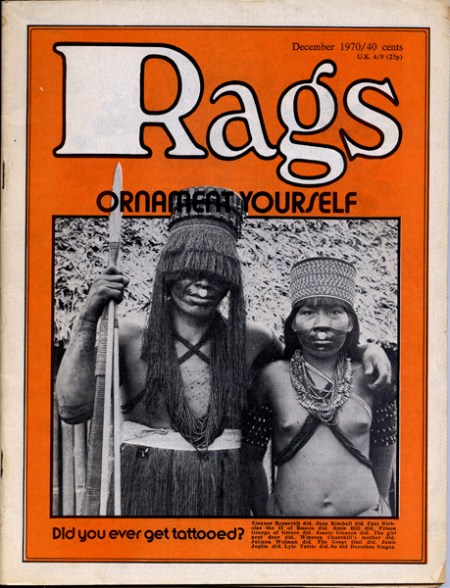
A part of the underground press movement, Rags was published for a year, 1970-71. It covered the worlds of counter-culture fashion with street fashion reports, groovy adverts and a very liberated sense of style. As far as I can tell its print run was all b/w on rag paper.
The December 1970 issue includes “Revolution” (with models acting out scenes from peoples history),”Life Amongst the Amazon Today” (on body modification in Amazonian tribes), “If God Hadn’t Wanted You To Wear a Bra He Wouldn’t Have Invented the Contour Council” (all about “the bra” with super hip writing!!) and “Raggedy Robin Raggedy Jane” (a profile of a Haight Ashbury clown couple).
The SF Diggers went to bat against the hip capitalists in SF but the innocence, creativity and DIY styles displayed in this publication, which seems to have been distributed primarily in underground boutiques, is charming nonetheless. A mystery in its masthead is the listing of “commidify your dissent” artist Barbara Kruger. That name appears as one of two art directors.
Cassandro Tondro has a blog uploading pdf’s of her collection of Rags. Check it out!




 Arthur Magazine