New Matthieu in November!

THE MUSEUM VAULTS: Excerpts from the Journal of an Expert


by Marc-Antoine Mathieu
(NBM/ComicsLit, November, 64 pages, 9×9, $14.95)

“An art assessor must evaluate the vast collections of the Louvre in an alternate Kafkaesque world where all is warehoused in an endless ever deepening succession of basement levels. Mathieu, an artist who marries Escher with Kafka, brings stinging irony to the pompousness of art history.”

"The media is now really part of the corporate establishment."

‘Redacted’ stuns Venice

Brian De Palma’s film about the rape and killing of a 14-year-old Iraqi girl by U.S. soldiers leaves festival-goers in tears.

From Reuters
August 31, 2007

VENICE — A new film about the real-life rape and killing of a 14-year-old Iraqi girl by U.S. soldiers who also murdered her family stunned the Venice festival, with shocking images that left some viewers in tears.

“Redacted”, by U.S. director Brian De Palma, is one of at least eight American films on the war in Iraq due for release in the next few months and the first of two movies on the conflict screening in Venice’s main competition.

Inspired by one of the most serious crimes committed by American soldiers in Iraq since the 2003 invasion, it is a harrowing indictment of the conflict and spares the audience no brutality to get its message across.

De Palma, 66, whose “Casualties of War” in 1989 told a similar tale of abuse by American soldiers in Vietnam, makes no secret of the goal he is hoping to achieve with the film’s images, all based on real material he found on the Internet.

“The movie is an attempt to bring the reality of what is happening in Iraq to the American people,” he told reporters after a press screening.

“The pictures are what will stop the war. One only hopes that these images will get the public incensed enough to motivate their Congressmen to vote against this war,” he said.

Abeer Qasim Hamza al-Janabi was gang raped, killed and burnt by American soldiers in Mahmudiya, south of Baghdad, in March 2006. Her parents and younger daughter were also killed.

Five soldiers have since been charged with the attack. Four of them have been given sentences of between 5 and 110 years.

Halfway between documentary and fiction, “Redacted” draws on soldiers’ home-made war videos, blogs and journals and footage posted on YouTube, reflecting changes in the way the media cover the war.

“In Vietnam, when we saw the images and the sorrow of the people we were traumatizing and killing, we saw the soldiers wounded and brought back in body bags. We see none of that in this war,” De Palma said.

“It’s all out there on the Internet, you can find it if you look for it, but it’s not in the major media. The media is now really part of the corporate establishment,” he said.

The film’s title refers to how, according to De Palma, mainstream American newspapers and television channels are failing to tell the true story of the war by keeping the most graphic images of the conflict away from public opinion.

“When I went out to find the pictures, I said (to the media) give me the pictures you can’t publish,” he said, adding that because of legal dangers he too had to “edit” the material.

“Everything that is in the movie is based on something I found that actually happened. But once I had put it in the script I would get a note from a lawyer saying you can’t use that because it’s real and we may get sued,” De Palma said.

“So I was forced to fictionalize things that were actually real.”

The film, shot in Jordan with a little known cast, ends with a series of photographs of Iraqi civilians killed and their faces blacked out for legal reasons.

“I think that’s terrible because now we have not even given the dignity of faces to this suffering people,” De Palma said.

“The great irony about Redacted is that it was redacted.”

Distributor Magnolia has planned a limited U.S. release for later this year, and the film may be easier to sell to European audiences rather than to the American public.

“This is a harrowing experience you put the audience through. It is not something you want to go to on a delightful Saturday evening but this message must be put forward and hopefully the public will respond,” De Palma said.

Assholes of the Week by Paul Krassner

*Senator Larry Craig, not only for the opening statement at his press conference–“Thank you all very much for coming out today”–but also for his silly rationalization that when he tap-danced on the shoe of an undercover cop in the adjoining stall, it was only because of his own “wide stance,” thereby breaking Rose Mary Woods’ excuse record. She testified that, while transcribing Richard Nixon’s tape, she answered a phone call, but when reaching for the stop button on the recorder, she mistakenly hit the record button next to it, [unnecessarily] keeping her foot on the pedal, resulting in the infamous 18-1/2-minute gap. When asked to replicate that position, her extremly awkward posture caused political pundits to question the validity of her explanation.

*Senator John Kerry, for not ridiculing George Bush’s 180-degree turnaround concerning the comparison between the Vietnam and Iraq wars by labeling the president a flip-flopper.

*Presidential candidate Mitt Romney, for championship pandering. Although he now wants to overturn Roe vs. Wade, when he was running for the Senate in 1994, he came out in favor of choice for women. He admitted to Mormon feminist Judith Dushku that “the Brethren” in Salt Lake City told him that he could take that position, and that in fact he probably had to, in order to win in a liberal state like Massachusetts.

*Great Assholes of the Past: The Sunday School teacher who advised one of his students to write on his penis, “What would Jesus do?” Presumably, “Jerk off” was not considered to be the correct answer.

———–

Paul Krassner is the author of “One Hand Jerking: Reports From an Investigative Satirist,” and publisher of the Disneyland Memorial Orgy poster, both available at paulkrassner.com

School of Shock

Eight states are sending autistic, mentally retarded, and emotionally troubled kids to a facility that punishes them with painful electric shocks. How many times do you have to zap a child before it’s torture?

By Jennifer Gonnerman
August 20, 2007

Rob Santana awoke terrified. He’d had that dream again, the one where silver wires ran under his shirt and into his pants, connecting to electrodes attached to his limbs and torso. Adults armed with surveillance cameras and remote-control activators watched his every move. One press of a button, and there was no telling where the shock would hit—his arm or leg or, worse, his stomach. All Rob knew was that the pain would be intense.

Every time he woke from this dream, it took him a few moments to remember that he was in his own bed, that there weren’t electrodes locked to his skin, that he wasn’t about to be shocked. It was no mystery where this recurring nightmare came from—not A Clockwork Orange or 1984, but the years he spent confined in America’s most controversial “behavior modification” facility.

In 1999, when Rob was 13, his parents sent him to the Judge Rotenberg Educational Center, located in Canton, Massachusetts, 20 miles outside Boston. The facility, which calls itself a “special needs school,” takes in all kinds of troubled kids—severely autistic, mentally retarded, schizophrenic, bipolar, emotionally disturbed—and attempts to change their behavior with a complex system of rewards and punishments, including painful electric shocks to the torso and limbs. Of the 234 current residents, about half are wired to receive shocks, including some as young as nine or ten. Nearly 60 percent come from New York, a quarter from Massachusetts, the rest from six other states and Washington, D.C. The Rotenberg Center, which has 900 employees and annual revenues exceeding $56 million, charges $220,000 a year for each student. States and school districts pick up the tab.

The Rotenberg Center is the only facility in the country that disciplines students by shocking them, a form of punishment not inflicted on serial killers or child molesters or any of the 2.2 million inmates now incarcerated in U.S. jails and prisons. Over its 36-year history, six children have died in its care, prompting numerous lawsuits and government investigations. Last year, New York state investigators filed a blistering report that made the place sound like a high school version of Abu Ghraib. Yet the program continues to thrive—in large part because no one except desperate parents, and a few state legislators, seems to care about what happens to the hundreds of kids who pass through its gates.

In Rob Santana’s case, he freely admits he was an out-of-control kid with “serious behavioral problems.” At birth he was abandoned at the hospital, traces of cocaine, heroin, and alcohol in his body. A middle-class couple adopted him out of foster care when he was 11 months old, but his troubles continued. He started fires; he got kicked out of preschool for opening the back door of a moving school bus; when he was six, he cut himself with a razor. His mother took him to specialists, who diagnosed him with a slew of psychiatric problems: attention-deficit/hyperactivity disorder, post-traumatic stress disorder, bipolar disorder, and obsessive-compulsive disorder.

Rob was at the Rotenberg Center for about three and a half years. From the start, he cursed, hollered, fought with employees. Eventually the staff obtained permission from his mother and a Massachusetts probate court to use electric shock. Rob was forced to wear a backpack containing five two-pound, battery-operated devices, each connected to an electrode attached to his skin. “I felt humiliated,” he says. “You have a bunch of wires coming out of your shirt and pants.” Rob remained hooked up to the apparatus 24 hours a day. He wore it while jogging on the treadmill and playing basketball, though it wasn’t easy to sink a jump shot with a 10-pound backpack on. When he showered, a staff member would remove his electrodes, all except the one on his arm, which he had to hold outside the shower to keep it dry. At night, Rob slept with the backpack next to him, under the gaze of a surveillance camera.

Employees shocked him for aggressive behavior, he says, but also for minor misdeeds, like yelling or cursing. Each shock lasts two seconds. “It hurts like hell,” Rob says. (The school’s staff claim it is no more painful than a bee sting; when I tried the shock, it felt like a horde of wasps attacking me all at once. Two seconds never felt so long.) On several occasions, Rob was tied facedown to a four-point restraint board and shocked over and over again by a person he couldn’t see. The constant threat of being zapped did persuade him to act less aggressively, but at a high cost. “I thought of killing myself a few times,” he says.

Rob’s mother Jo-Anne deLeon had sent him to the Rotenberg Center at the suggestion of the special-ed committee at his school district in upstate New York, which, she says, told her that the program had everything Rob needed. She believed he would receive regular psychiatric counseling—though the school does not provide this.

As the months passed, Rob’s mother became increasingly unhappy. “My whole dispute with them was, ‘When is he going to get psychiatric treatment?'” she says. “I think they had to get to the root of his problems—like why was he so angry? Why was he so destructive? I really think they needed to go in his head somehow and figure this out.” She didn’t think the shocks were helping, and in 2002 she sent a furious fax demanding that Rob’s electrodes be removed before she came up for Parents’ Day. She says she got a call the next day from the executive director, Matthew Israel, who told her, “You don’t want to stick with our treatment plan? Pick him up.” (Israel says he doesn’t remember this conversation, but adds, “If a parent doesn’t want the use of the skin shock and wants psychiatric treatment, this isn’t the right program for them.”)

Rob’s mother is not the only parent angry at the Rotenberg Center. Last year, Evelyn Nicholson sued the facility after her 17-year-old son Antwone was shocked 79 times in 18 months. Nicholson says she decided to take action after Antwone called home and told her, “Mommy, you don’t love me anymore because you let them hurt me so bad.” Rob and Antwone don’t know each other (Rob left the facility before Antwone arrived), but in some ways their stories are similar. Antwone’s birth mother was a drug addict; he was burned on an electric hot plate as an infant. Evelyn took him in as a foster child and later adopted him. The lawsuit she filed against the Rotenberg Center set off a chain of events: investigations by multiple government agencies, emotional public hearings, scrutiny by the media. Legislation to restrict or ban the use of electric shocks in such facilities has been introduced in two state legislatures. Yet not much has changed.

Rob has paid little attention to the public debate over his alma mater, though he visits its website occasionally to see which of the kids he knew are still there. After he left the center he moved back in with his parents. At first glance, he seems like any other 21-year-old: baggy Rocawear jeans, black T-shirt, powder-blue Nikes. But when asked to recount his years at the Rotenberg Center, he speaks for nearly two hours in astonishing detail, recalling names and specific events from seven or eight years earlier. When he describes his recurring nightmares, he raises both arms and rubs his forehead with his palms.

Despite spending more than three years at this behavior-modification facility, Rob still has problems controlling his behavior. In 2005, he was arrested for attempted assault and sent to jail. (This year he was arrested again, for drugs and assault.) Being locked up has given him plenty of time to reflect on his childhood, and he has gained a new perspective on the Rotenberg Center. “It’s worse than jail,” he told me. “That place is the worst place on earth.”

Long investigative piece continues here. Photo essay here.

Come out, come out, wherever you are!

elephant.jpg

In Jack Trevor Story’s excellent satirical novel, Screwrape Lettuce, the entire British police force is afflicted with permanent priapism after eating a powerful strain of aphrodisiac red lettuce. One might be forgiven for suspecting that a portion of the current Republican Party has been eating something similar when another story like the one following emerged this weekend:

Sen. Larry Craig (R-Idaho) was arrested in June at a Minnesota airport by a plainclothes police officer investigating lewd conduct complaints in a men’s public restroom, according to an arrest report obtained by Roll Call Monday afternoon.

Craig’s arrest occurred just after noon on June 11 at Minneapolis-St. Paul International Airport. On Aug. 8, he pleaded guilty to misdemeanor disorderly conduct in the Hennepin County District Court. He paid more than $500 in fines and fees, and a 10-day jail sentence was stayed. He also was given one year of probation with the court that began on Aug. 8.

A spokesman for Craig described the incident as a “he said/he said misunderstanding,” and said the office would release a fuller statement later Monday afternoon.

After he was arrested, Craig, who is married, was taken to the Airport Police Operations Center to be interviewed about the lewd conduct incident, according to the police report. At one point during the interview, Craig handed the plainclothes sergeant who arrested him a business card that identified him as a U.S. Senator and said, “What do you think about that?” the report states.

Craig had been outed as gay last year by activist blogger Michael Rogers, shortly after the Mark “Page Pesterer” Foley scandal and shortly before the Ted “Muscles and Meth” Haggard scandal. (And while we’re on the subject of sex in toilets, let’s not forget the ongoing saga of State Representative Bob Allen and his fear of black men.) Craig’s office denied the allegations, of course; maybe the red lettuce or whatever it is they’re eating also causes these persistent lapses of Republican memory cells? Anyway, Michael Rogers issued a statement about Senator Craig earlier today:

“Larry Craig should stand up and be honest with the citizens of Idaho about who he is,” said Rogers, the country’s top gay activist blogger. “Tonight is a historic opportunity for Senator Craig to run for re-election as a proud gay American. What a great turning point for one of the most conservative states in the country to be represented by an openly gay Senator.”

“Senator Craig’s situation is exacerbated by the fact that he has a voting record that is counter to the interest of lesbian and gay Americans. All too often, closeted men like Senator Craig use their voting record to hide their truth from the American people. With this news now out in the open, I call upon Senator Craig to reevaluate his votes on issues like the Federal Marriage Amendment, Don’t Ask Don’t Tell, and the Defense of Marriage Act.

“The Minnesota arrest is not a one-time occurrence,” Rogers added. “Last October, I reported on three other encounters that Senator Craig had with men – including one in a bathroom in Washington’s Union Station. What’s troubling about this is Larry Craig’s hypocrisy: he repeatedly votes against the gay community during his day job, while engaging in same-sex encounters as extra curricular activity. Now is a good time for Larry Craig to join millions of other Americans and be proud of who he is.”

On October 17, 2006, Rogers broke the story of Craig’s sexual encounters with men. Rogers independently interviewed three Craig sexual partners, two in the Pacific Northwest, and one who lives in Washington, D.C. The Washington source told Rogers that he and Sen. Craig had oral sex in two different bathrooms of Union Station, the train depot within sight of U.S. Senate Office Buildings.

Rogers said the sources each independently described something unique about the senator that could only be known to someone who had had sexual contact with him.

“Without a doubt in my mind, I am absolutely solid on the sources,” Rogers said in October. “I have come to the absolute conclusion based on multiple sourcing in multiple cities around the country. There is no doubt in my mind regarding this information.”

During debates in Congress last year about whether same-sex marriages should be legal, Sen. Craig said, “Marriage has always been defined as the union of a man and a woman, and I believe it should stay that way.”

Viewed from over the Atlantic, these occurrences are hilarious in a beyond-Daily-Show-parody kind of way and depressing in being indicative of the enormous problem much of America still has with different forms of sexuality, not least in its political class.

Here in the UK we have openly gay MPs in all parties now; they can form relationships with partners and live the way they want, they no longer have to cruise for sex in secret. More pertinently, no politician here would dream of using homophobia as a political weapon. We’re over that shit, and living like civilised human beings at last.

And really, we don’t need to invent any mysterious priapic salad to explain these recent scandals; the situation is an entirely self-created one. The problem all those little pink elephants have—and will continue to have—is that they’ve helped foster and sustain an atmosphere that makes it impossible for them to affirm their sexuality. They are—to coin a fine phrase—so far back in the closet, they’re in fucking Narnia. And as long as they stay there, they’ll keep getting caught out, in police stings and other scandals, because sexuality isn’t a choice, it’s what you are.

Bertrand Russell once said, “The people who are regarded as moral luminaries are those who forego ordinary pleasures themselves and find compensation in interfering with the pleasures of others.” He might have added that sometimes those pleasures have a way of turning against the interferers. Keep eating the lettuce, guys.

Announcing the Sundown Schoolhouse Bookclub

BOOK CLUB ~ autumn 2007 ~ PLANET OF THE HUMANS ~

~ We will meet in the dome from 7 – 10pm Thursdays from October 4th to December 6th. Each week a visitor will lead the conversation about the weekly book they have selected. Discussions and debates will go from there. Anyone may participate. Read the book* and come prepared to talk and listen. The topic this season is “Planet of the Humans”. Contact matt@fritzhaeg.com to let us know which weeks you would like to attend.

Books include: TENDING THE WILD: Native American Knowledge and the Management of California’s Natural Resources, CROWDS AND POWER , REFUGE: An Unknown History of Family and Place , THE WORLD WITHOUT US, POSSIBILITIES: Essays on Hierarchy, Rebellion, and Desire .

For a complete list of books and facilitators go here.

Revival in progress.

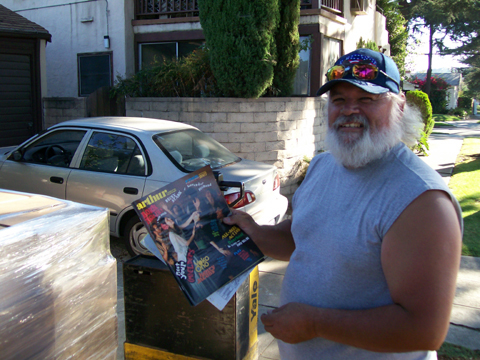
Arthur No. 26 will be available later this week.

featuring…

Old folks cry, young lovers smile and cynical hipsters get confused when she’s onstage. What is Lavender Diamond’s peace-love-and-ecology frontlady BECKY STARK up to?

Thurston Moore & Byron Coley have an audience with YOKO ONO. Discussed: the Peace industry, Fluxus, Sarah Lawrence and her life/art before Lennon. Plus: “Yoko Tanka,” a review of Ono’s recordings in tanka form. With photography by Eden Batki and a selection of vintage Ono photos.

Ever been harassed by a cop? Then you know how suicide bombers get made, says DAVE REEVES, PhD.

Columnist DOUGLAS RUSHKOFF says 9/11 CONSPIRACY THEORISTS are distracting many of our brightest minds from the ongoing horror show in plain view.

Journalist Joel Rose visits 80-year-old Zen humorist/media innovator HENRY JACOBS. Plus, an appreciation of Jacobs’ radio and TV work by filmmaker Mike Mills.

DEERHOOF dude Greg Saunier spiels on the joy of all-ages gigs. Plus photos of DC’s early punk scene, from by photographer Susie J. Horgan’s Punk Love book.

Fashion!!! Fringe knitter TINA MARRIN works off the grid in her cozy, color wonderland. Click here to download Tina’s how-to on making your own miniature knitted skunk!

Byron Coley remembers the SUN CITY GIRLS.

Columnist MOLLY FRANCES hops on Miranda July’s time machine to visit a land of seeded fruit.

Soon the State will have Hummers with cannons that can heat up people’s skin half a kilometer away. The Center for Tactical Magic has some more evolved ideas about mobilizing vehicles for change. Plus: what to do when cops really want to search your car.

New “People Are Talking” columnist Brian J. Davis on what SIMON COWELL, Secretary of Defense ROBERT GATES and KELLY CLARKSON have (respectively) been up to this summer.

PShaw’s “Strings”: full-page comics in full color.

“Bull Tongue” columnists Byron Coley & Thurston Moore review the latest emanations from the deep underground.

C &D drink beers and check out new records by Alan Vega, Magik Markers, Blues Control, Celebration, White Rainbow, Devendra Banhart, Daniel A.I.U. Higgs, Angels of Light, Wolves in the Throne Room and Marie Sioux. They also share their feelings about the Faust IV reissue and The Source: The Untold Story of Father Yod, Ya Ho Wa 13 and The Source Family book.

You can download the complete magazine as a PDF in two parts:
Part 1 (6.5mb)
Part 2 (10.6mb)

Subscribe now via PayPal and receive Arthur for a year, shipped directly to you from the printer. Or, order Arthur No. 26 direct from us. Use PAYPAL:

USA – $6 postpaid

Canada – $8 postpaid

World – $11 airmail