The decline of the magazine cover

vogue.jpg

“In the 20’s and 30’s and on into the 40’s and even 50’s and 60’s the image on a magazine cover was all important, and standing out from the competition on the shelves was regarded as fundamental to its success. Stunning ‘Poster Covers’ as they were called were fêted by every magazine from Vogue to Vanity Fair, Esquire and Harper’s Bazaar, and of course Life magazine in photographic terms.

“Over time however the ‘Poster Cover’ and its defenders in the magazine’s Art rooms began to slowly lose favor to the philosophy of ‘cover lines‘ and what would begin as a whole new direction in magazine cover design. This I think can also be seen as a sure sign of the rising influence of marketeers and advertising suits within a magazine’s boardroom and the increased marginalization of its art department’s influence. The magazine cover had become in many cases no more than a grotesquely enlarged small ad.”

Continues here.

"Bread and Puppet continues, more than 40 years on, to live an ideal of art as collective enterprise, a free or low-cost alternative voice outside the profit system."

The New York Times- August 5, 2007

Spectacle for the Heart and Soul

By HOLLAND COTTER

GLOVER, Vt.

FOR the first time in many summers the Bread and Puppet Theater will travel nine hours from northern Vermont for a New York City gig, at Lincoln Center on Wednesday evening. Then the troupe will turn around and ride back to its farm just below the Canadian border, where it will put on the same show. You can easily spot the group en route: 1963 school bus, painted sky blue, with a mountain landscape, an angel and a beaming sun on the side.

People who know of the troupe without really knowing its work tend to link it to political street theater of the 1960s, an accurate but incomplete association. Recently I’ve been thinking of the theater in a contemporary context. At a time when the art industry is awash in cash and privilege, and theater tickets routinely go for $100 or more, Bread and Puppet continues, more than 40 years on, to live an ideal of art as collective enterprise, a free or low-cost alternative voice outside the profit system.

I have another association with the troupe: Bread and Puppet gave me the single most beautiful sight I’ve ever seen in a theater. That was in 1982, in the sloping, wide-open field that is part of the theater’s farm in Glover, Vt. There the collective was presenting a two-day festival, Our Domestic Resurrection Circus, as it had done almost every summer since relocating from the Lower East Side of Manhattan in the early 1970s.

The circus, a bunch of political skits, concerts and vaudeville acts, took place in the afternoon, and it was fun. (The troupe’s Lincoln Center appearance will follow more or less this format, on a smaller scale.) Then at sunset came the pageant, a kind of morality play told in epic visual terms. During Vietnam the themes had been specific. Wrongs had a name and a solution: Stop the war. By the 1980s the issues had become many and complicated — threatened nature, global consumerism, nuclear dangers — and remedies far less sure. The 1982 pageant had an odd tone, brusque and apocalyptic. It opened with a bucolic scene: little cutout houses and trees carried onto the field, followed by puppets of dancing cows. Villagers in masks arrived, milked the cows, settled down to bed, woke up, had children who within minutes had children of their own. This was ordinary life set to haunting music: vigorous, low-church American folk hymns from the 19th-century collection “The Sacred Harp.”

Suddenly four dark puppet horses with devil riders wheeled in from afar, backed by a huge dragon. Almost without warning the devils waved black banners over the villagers, who fell to the ground, dead. The devils then piled the houses and horses together and set them alight. Good and evil alike were in flames. Moral chaos. End of story.

But not quite. As the fire burned, a half-dozen great white gulls or cranes — muslin kites carried on sticks by runners — soared up from the horizon and started flying in our direction. They came right to the flames and soared over them as if looking for signs of life. Then they circled back across the field, melting into darkness. It was fantastic. Only when they were out of sight did I see that night had fallen and stars were out. It felt like an impossible trick of stagecraft, a miracle. I had been simultaneously transported and pulled back to earth.

Continue reading

"Assholes of the Week" by Paul Krassner

*Anybody who text messages while driving, unless the message being texted is, “Hey, what’s happening? I’m in my car now, just about to crash. Please say goodbye to my family. And if I cause someone’s death beside my own, would you sincerely apologize for me….”

*ABC News anchor Charles Gibson, for introducing a propaganda piece–“A bit of a surprise today. Two long and persistent critics of the Bush administration’s handling of the war today wrote a column in the New York Times saying that after a recent eight-day visit to Iraq they find significant changes taking place”–when in reality Michael O’Hanlon and Kenneth Pollock originally supported the war even before it began (Pollack’s 2002 book was titled “The Threatening Storm: The Case for Invading Iraq”). The next day, Dick Cheney perpetuated that party lie on Larry King Taped without being challenged. Cheney also insisted that Saddam Hussein and Osama bin Laden were secretly married in Massachusetts, then adopted a Chinese baby.

*The Southern Baptist Convention and Focus on the Family, for writing this joint letter to the American Psychological Association for considering a public denunciation of any attempt by therapists to change sexual orientation: “We believe that psychologists should assist clients to develop lives that they value, even if that means they decline to identify as homosexual.” They were also concerned that such an APA policy could lead to so-called heterosexuals undergoing conversion therapy in order to return to their gay roots.

*The Israeli government, for offering an increase of a mere $20 increase in its monthly $487 stipend for Holocaust survivors to compensate for years of neglecting its 240,000 citizens who suffered through the Nazi concentration camps. Ironically, survivor groups charge that they are now treated better in Germany than in Israel.

*Retired Lt. General Philip Kensinger, for lying about when he became aware that former football star Pat Tillman’s death in Afghanistan was actually caused by friendly fire, a cover-up allowing the U.S. to portray him as a hero. Kensinger confessed that he had been brainwashed as an adolescent when he saw the Paddy Chayefsky movie, “The Americanization of Emily.”

*Pepsico, for selling its Aquafina bottled water with a drawing of mountains over the nameplate to imply that the source of the water was mountain springs, although it is actually tap water. Henceforth their bottles will be labeled P.W.S. for “public water source” or, if you prefer, “piss without sodium.”

*Capitalism, for causing profits to trump compassion–Johnson & Johnson cuts 4,800 jobs and shares rise; Unilever cuts 20,000 jobs and shares rise–while addicts to the system continue to snort the bottom line.

*Rupert Murdoch, for demonstrating so blatantly how money buys power. Be on the lookout for the new Wall Street Enquirer, featuring a cover story on the economic repercussions of Hillary Clinton’s cleavage accompanied by a life-sized photo.

*Republican Senator James Inhofe, for calling global warming a hoax.

*Anti-asshole of the week: Jeff Berkin, deputy director of the FBI’s Security Division, for replacing its hypocritical 13-year drug policy disqualifying applicants from becoming agents if they had used marijuana more than 15 times. He explained that it created problems for those who, when asked in polygraph exams, couldn’t remember how many times they had smoked pot.
——–
Paul Krassner is the author of “One Hand Jerking: Reports From an Investigative Satirist,” and publisher of the Disneyland Memorial Orgy poster, both available at paulkrassner.com.


"Workers of the world… relax!"

THE ABOLITION OF WORK
by Bob Black

No one should ever work.

Work is the source of nearly all the misery in the world. Almost any evil you’d care to name comes from working or from living in a world designed for work. In order to stop suffering, we have to stop working.

That doesn’t mean we have to stop doing things. It does mean creating a new way of life based on play; in other words, a ludic revolution. By “play” I mean also festivity, creativity, conviviality, commensality, and maybe even art. There is more to play than child’s play, as worthy as that is. I call for a collective adventure in generalized joy and freely interdependent exuberance. Play isn’t passive. Doubtless we all need a lot more time for sheer sloth and slack than we ever enjoy now, regardless of income or occupation, but once recovered from employment-induced exhaustion nearly all of us want to act.

The ludic life is totally incompatible with existing reality. So much the worse for “reality,” the gravity hole that sucks the vitality from the little in life that still distinguishes it from mere survival. Curiously — or maybe not — all the old ideologies are conservative because they believe in work. Some of them, like Marxism and most brands of anarchism, believe in work all the more fiercely because they believe in so little else.

Liberals say we should end employment discrimination. I say we should end employment. Conservatives support right-to-work laws. Following Karl Marx’s wayward son-in-law Paul Lafargue I support the right to be lazy. Leftists favor full employment. Like the surrealists — except that I’m not kidding — I favor full unemployment. Trotskyists agitate for permanent revolution. I agitate for permanent revelry. But if all the ideologues (as they do) advocate work — and not only because they plan to make other people do theirs — they are strangely reluctant to say so. They will carry on endlessly about wages, hours, working conditions, exploitation, productivity, profitability. They’ll gladly talk about anything but work itself. These experts who offer to do our thinking for us rarely share their conclusions about work, for all its saliency in the lives of all of us. Among themselves they quibble over the details. Unions and management agree that we ought to sell the time of our lives in exchange for survival, although they haggle over the price. Marxists think we should be bossed by bureaucrats. Libertarians think we should be bossed by businessmen. Feminists don’t care which form bossing takes so long as the bosses are women. Clearly these ideology-mongers have serious differences over how to divvy up the spoils of power. Just as clearly, none of them have any objection to power as such and all of them want to keep us working.

You may be wondering if I’m joking or serious. I’m joking and serious. To be ludic is not to be ludicrous. Play doesn’t have to be frivolous, although frivolity isn’t triviality; very often we ought to take frivolity seriously. I’d like life to be a game — but a game with high stakes. I want to play for keeps.

Continue reading

This Sat in L.A. – Don Bolles celebrates 51st birthday

“Bolles here. Y’all might be interested to
check out my birthday extravaganza on Saturday, August
4th, @ Thee Fractal Space Pyramid, 122 Glendale Blvd,
Los Angeles
(next door to the Bob Baker Marionette
Theater). I’m asking a $10 donation, but it’s going to
be pretty *^$%^# action-packed. First, there’s the
debut of Nora Keyes and Don Bolles FANCY SPACE PEOPLE,
with our lovely new drummer, Bionic Billy Blaze; we’re
premiering our new Dr. Bronners’ Anthem, “All One (or
none)”, and there will be soap giveaways! There’s
MAYBE a secret Germs set (if Pat wants to do it) and
definitely a set of 45 Grave “hits” performed by Thee
Snow Snake Orchestra, a band with twice as many
original 45 Grave members as the thing that’s going
around calling itself 45 Grave and that sucks. I (that
would be moi, Don Bolles) play guitar and mostly do
the vocals, Paul Roessler (Screamers, 45 Grave, Nina
Hagen Band, Twisted Roots, Nervous Gender) plays
keyboards and sings, Cayt Scandal (Civet) plays drums,
and there are some VERY groovy celebrity guests slated
to appear. And we’re opening with Court of the Crimson
King, complete with Mellotron, so attendance is
mandatory, one would imagine, for Arthur readers. I’m
DJing, as is QUIN BRAYTON, and you can bet we’ll be
playing the shit out of the good shit, alll night
long! There’s beer — even Heffeweissen — and stuff,
so come on down. And it’s okay to bring me presents. I
don’t mind, really.

Thanks, and hope to see ya there… Space Rock all
night with us!”

world wide tuning meditation

7:00 PM August 21, 2007
Damrosch Park Lincoln Center Out of Doors Festival NYC
and
Malibu Creek State Park, CA

There will at first be clouds or clusters of sounds. Eventually the clouds and clusters transform into harmonies, with common tones moving through the sound field as tuning takes place on many levels, actually and metaphorically.

The World Wide Tuning Meditation is offered in the spirit of bringing many people together through sharing a simple way of sounding and listening together. Sounding in the way proposed is open to all regardless of experience. Language is not a barrier as there are no words, only vowel sounds that are common to all.

Each person is invited to make their own private and silent dedication of intentions for this community of voices to have effect, personally and for radiating to others, out to the world.
How would you like for your sound to affect the world?

Tuning score by Pauline Oliveros

The World Wide Tuning Meditation (2007)
Begin by taking a deep breath and letting it all the way out with air sound.
Listen with your mind’s ear for a tone.
On the next breath using any vowel sound, sing the tone that you have silently perceived on one comfortable breath.
Listen to the whole field of sound the group is making.
Select a voice distant from you and tune as exactly as possible to the tone you are hearing from that voice.
Listen again to the whole field of sound the group is making.
Contribute by singing a new tone that no one else is singing.
Continue by listening then singing a tone of your own or tuning to the tone of another voice alternately.
Commentary:
Always keep the same tone for any single breath. Change to a new tone on another breath.
Listen for distant partners for tuning
Sound your new tone so that it may be heard distantly.
Communicate with as many difference voices as possible.
Sing warmly!

For more information and to commit to perform in NYC check out the Deep Listening Institute.
Sympathetic activity happening in the abandoned water tower in Malibu State Park. Info here.

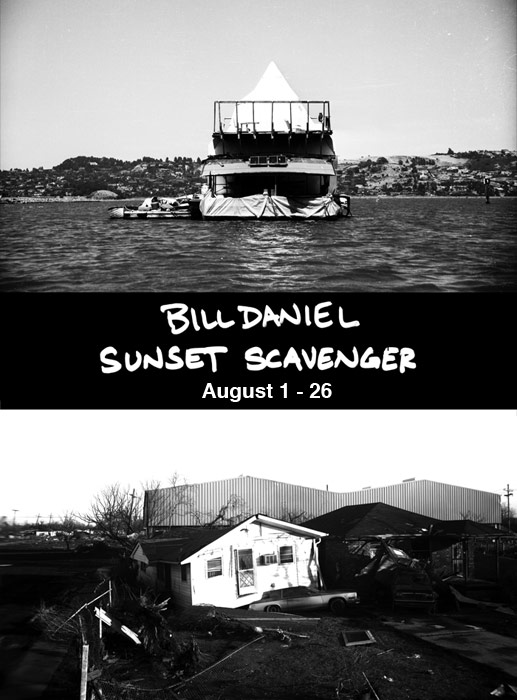
Bill Daniel opening tonight in SF

sunsetscavengeremail.jpg

Sunset Scavenger: Post-Utopia California and Post-Katrina Louisiana

Photo and video show by Bill Daniel

“Itinerant documentarian Bill Daniel mounts a show of large-scale black and white photographs juxtaposing two contrasting landscapes: the floating hippie houseboats of Marin County, California, and the wrecked landscapes of New Orleans and St. Bernard Parrish in post-Katrina Louisiana.

“Sunset Scavenger is an on-going film and photography project exploring images and themes of social and environmental collapse in the last days of the petroleum era. This show is part of Daniel’s larger project investigating marginal subcultures and their relationship with the environment. Sunset Scavenger is a supported project of Creative Capital.”

Opening: Wednesday, August 1, 7-9pm
Exhibition dates: August 1–26
Opening night sounds by Matt Davignon

RayKo Photo Center
428 Third Street
San Francisco, CA 94107
P : 415-495-3773

Easy New Orleans Iced Coffee Concentrate recipe

You need:

1 lb coffee and chicory
10 cups cool, clear water
a big ol’ bowl (no-reactive)
something to strain with
mason jars or pitcher

How to do it:
1. pour coffee into bowl
2. add two cups of water over coffee; mix until coffee is wet
3. add eight cups of water gently, so as not to disturb the coffee too much
4. cover and let sit for 12 hours
5. strain resultant mixture at least twice to get out all the grit; pour into mason jars and refrigerate

To make coffee:
Use a ratio of 1 part coffee to 3 parts milk or water. You can heat it up, but I like it iced, dude.

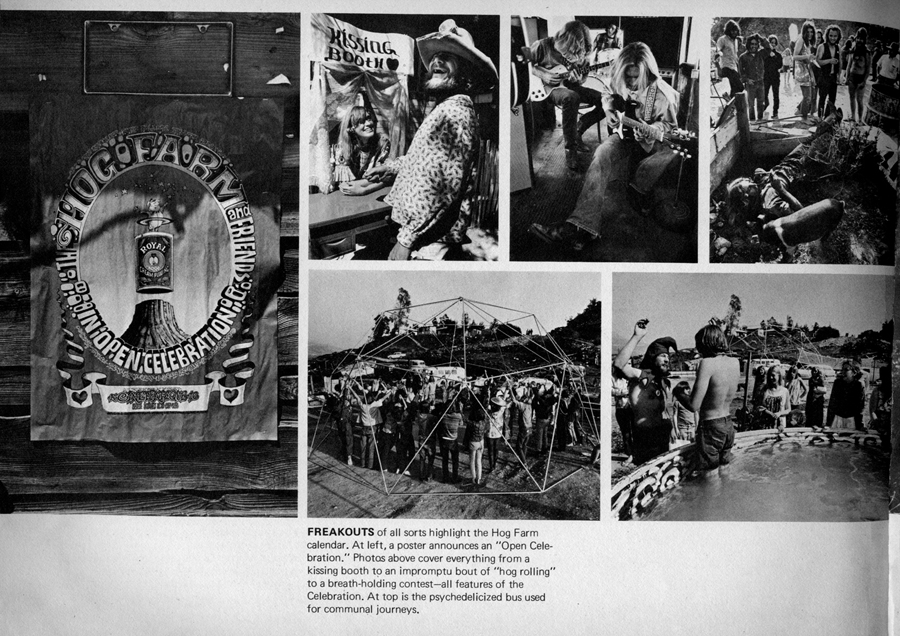
“Communes in Sunland, CA and the Past Lives of New Yorker Art Critics” by Robby Herbst

Before Peter Schjeldahl was writing reviews of old masters for the New Yorker he was a groovy sweaty features editor for Avant-Garde magazine. Avant-Garde was something like a counter culture arts review.

In this ’68 issue an unbuttoned Schjeldahl co-authored (with Neal White) an expose of a So Cal commune (in Sunland-Tujunga!) called The Hog Farm.

Pigasus was Prime Minister of this, then two year old, commune. From here, his humble sty in Sunland, one can assume that he was the very same pig that went on to seek the presidency as the 1968 nominee of the Yippie Party.

In the late 60’s Sunland-Tujunga was a wild place. The article chronicles the tussles between the commune and its neighbors. According to Schjeldahl the Valley Ranchers Association had set up an armed roadblock. Additionally “local toughs, many of them Vietnam Veterans”, known as the “Androids” would occasionally “pillage the farm.” Much of this, according to Schjeldahl, was set off by a picture published in the Voice of the Verduga Hills of Pigasus with a flag “flapping above his sty”.

Administration of the commune is on a daily rotation basis with everyone, kids included, taking a turn as “Dance Master” or “Dance Mistress.” “When you have this many people living together,” Romney (Hugh Romney the founder of the commune, aka Wavy Gravy- ed.) observes “you’ve got to dance or you step on somebody’s hand.” The Dance Master sees that things get done by someone who wants to do them.

The farm, as Romney suggests, is more than a summer camp for misfits. It is a thriving spiritual community, an experiment in utopian living. You get the idea when you attend the highpoint (literally) of the Hog Farm day, just before bedtime in the cantonment’s biggest dome. Shrouded in parachute silk and brightly lighted, the dome can be seen for miles on a smogless night. You can only guess at what the citizens of Sunland-Tujunga imagine is possibly going on inside. What is going on is this:

Inside the dome 30-odd men, women and children_lotus-squating, clad in an assortment of strange clothes. Eyes closed, hands clasped in two concentric circles, they are humming in unison_”Om.” “Om” is a loud resonant, brain-buzzing sound made by vibrating air in the sinuses. The choral hum is punctuated by improvisatory moans, pants, and clucks, it dissolves into an athletic chant: “HOG-HOG-HOG-HOG-HOG-HOG-HOG!” Then someone in a Donald Duck jersey stands and gently raises everyone, like a a circle of dominoes in reverse. Climax! All fall down. “The Circle Joke” is over, and the Hog Farmers, spent and blissful, break the circle and retire to their sleeping bags for the night.

I like the New Yorker, but I can’t help but imagine how it would be if they or Schjeldahl had such a groovy editorial position on art and culture today.

All photos by Jillian Wasser.

Priming: your subcortical brain at work.

Who’s Minding the Mind?

By BENEDICT CAREY

The New York Times – July 31, 2007

In a recent experiment, psychologists at Yale altered people’s judgments of a stranger by handing them a cup of coffee.

The study participants, college students, had no idea that their social instincts were being deliberately manipulated. On the way to the laboratory, they had bumped into a laboratory assistant, who was holding textbooks, a clipboard, papers and a cup of hot or iced coffee — and asked for a hand with the cup.

That was all it took: The students who held a cup of iced coffee rated a hypothetical person they later read about as being much colder, less social and more selfish than did their fellow students, who had momentarily held a cup of hot java.

Findings like this one, as improbable as they seem, have poured forth in psychological research over the last few years. New studies have found that people tidy up more thoroughly when there’s a faint tang of cleaning liquid in the air; they become more competitive if there’s a briefcase in sight, or more cooperative if they glimpse words like “dependable” and “support” — all without being aware of the change, or what prompted it.

Psychologists say that “priming” people in this way is not some form of hypnotism, or even subliminal seduction; rather, it’s a demonstration of how everyday sights, smells and sounds can selectively activate goals or motives that people already have.

More fundamentally, the new studies reveal a subconscious brain that is far more active, purposeful and independent than previously known. Goals, whether to eat, mate or devour an iced latte, are like neural software programs that can only be run one at a time, and the unconscious is perfectly capable of running the program it chooses.

The give and take between these unconscious choices and our rational, conscious aims can help explain some of the more mystifying realities of behavior, like how we can be generous one moment and petty the next, or act rudely at a dinner party when convinced we are emanating charm.

“When it comes to our behavior from moment to moment, the big question is, ‘What to do next?’ ” said John A. Bargh, a professor of psychology at Yale and a co-author, with Lawrence Williams, of the coffee study, which was presented at a recent psychology conference. “Well, we’re finding that we have these unconscious behavioral guidance systems that are continually furnishing suggestions through the day about what to do next, and the brain is considering and often acting on those, all before conscious awareness.”

Dr. Bargh added: “Sometimes those goals are in line with our conscious intentions and purposes, and sometimes they’re not.”

The idea of subliminal influence has a mixed reputation among scientists because of a history of advertising hype and apparent fraud. In 1957, an ad man named James Vicary claimed to have increased sales of Coca-Cola and popcorn at a movie theater in Fort Lee, N.J., by secretly flashing the words “Eat popcorn” and “Drink Coke” during the film, too quickly to be consciously noticed. But advertisers and regulators doubted his story from the beginning, and in a 1962 interview, Mr. Vicary acknowledged that he had trumped up the findings to gain attention for his business.

Later studies of products promising subliminal improvement, for things like memory and self-esteem, found no effect.

Some scientists also caution against overstating the implications of the latest research on priming unconscious goals. The new research “doesn’t prove that consciousness never does anything,” wrote Roy Baumeister, a professor of psychology at Florida State University, in an e-mail message. “It’s rather like showing you can hot-wire a car to start the ignition without keys. That’s important and potentially useful information, but it doesn’t prove that keys don’t exist or that keys are useless.”

Yet he and most in the field now agree that the evidence for psychological hot-wiring has become overwhelming. In one 2004 experiment, psychologists led by Aaron Kay, then at Stanford University and now at the University of Waterloo, had students take part in a one-on-one investment game with another, unseen player.

Half the students played while sitting at a large table, at the other end of which was a briefcase and a black leather portfolio. These students were far stingier with their money than the others, who played in an identical room, but with a backpack on the table instead.

The mere presence of the briefcase, noticed but not consciously registered, generated business-related associations and expectations, the authors argue, leading the brain to run the most appropriate goal program: compete. The students had no sense of whether they had acted selfishly or generously.

In another experiment, published in 2005, Dutch psychologists had undergraduates sit in a cubicle and fill out a questionnaire. Hidden in the room was a bucket of water with a splash of citrus-scented cleaning fluid, giving off a faint odor. After completing the questionnaire, the young men and women had a snack, a crumbly biscuit provided by laboratory staff members.

The researchers covertly filmed the snack time and found that these students cleared away crumbs three times more often than a comparison group, who had taken the same questionnaire in a room with no cleaning scent. “That is a very big effect, and they really had no idea they were doing it,” said Henk Aarts, a psychologist at Utrecht University and the senior author of the study.

The real-world evidence for these unconscious effects is clear to anyone who has ever run out to the car to avoid the rain and ended up driving too fast, or rushed off to pick up dry cleaning and returned with wine and cigarettes — but no pressed slacks.

The brain appears to use the very same neural circuits to execute an unconscious act as it does a conscious one. In a study that appeared in the journal Science in May, a team of English and French neuroscientists performed brain imaging on 18 men and women who were playing a computer game for money. The players held a handgrip and were told that the tighter they squeezed when an image of money flashed on the screen, the more of the loot they could keep.

As expected, the players squeezed harder when the image of a British pound flashed by than when the image of a penny did — regardless of whether they consciously perceived the pictures, many of which flew by subliminally. But the circuits activated in their brains were similar as well: an area called the ventral pallidum was particularly active whenever the participants responded.

“This area is located in what used to be called the reptilian brain, well below the conscious areas of the brain,” said the study’s senior author, Chris Frith, a professor in neuropsychology at University College London who wrote the book “Making Up The Mind: How the Brain Creates our Mental World.”

The results suggest a “bottom-up” decision-making process, in which the ventral pallidum is part of a circuit that first weighs the reward and decides, then interacts with the higher-level, conscious regions later, if at all, Dr. Frith said.

Scientists have spent years trying to pinpoint the exact neural regions that support conscious awareness, so far in vain. But there’s little doubt it involves the prefrontal cortex, the thin outer layer of brain tissue behind the forehead, and experiments like this one show that it can be one of the last neural areas to know when a decision is made.

This bottom-up order makes sense from an evolutionary perspective. The subcortical areas of the brain evolved first and would have had to help individuals fight, flee and scavenge well before conscious, distinctly human layers were added later in evolutionary history. In this sense, Dr. Bargh argues, unconscious goals can be seen as open-ended, adaptive agents acting on behalf of the broad, genetically encoded aims — automatic survival systems.

In several studies, researchers have also shown that, once covertly activated, an unconscious goal persists with the same determination that is evident in our conscious pursuits. Study participants primed to be cooperative are assiduous in their teamwork, for instance, helping others and sharing resources in games that last 20 minutes or longer. Ditto for those set up to be aggressive.

This may help explain how someone can show up at a party in good spirits and then for some unknown reason — the host’s loafers? the family portrait on the wall? some political comment? — turn a little sour, without realizing the change until later, when a friend remarks on it. “I was rude? Really? When?”

Mark Schaller, a psychologist at the University of British Columbia, in Vancouver, has done research showing that when self-protective instincts are primed — simply by turning down the lights in a room, for instance — white people who are normally tolerant become unconsciously more likely to detect hostility in the faces of black men with neutral expressions.

“Sometimes nonconscious effects can be bigger in sheer magnitude than conscious ones,” Dr. Schaller said, “because we can’t moderate stuff we don’t have conscious access to, and the goal stays active.”

Until it is satisfied, that is, when the program is subsequently suppressed, research suggests. In one 2006 study, for instance, researchers had Northwestern University undergraduates recall an unethical deed from their past, like betraying a friend, or a virtuous one, like returning lost property. Afterward, the students had their choice of a gift, an antiseptic wipe or a pencil; and those who had recalled bad behavior were twice as likely as the others to take the wipe. They had been primed to psychologically “cleanse” their consciences.

Once their hands were wiped, the students became less likely to agree to volunteer their time to help with a graduate school project. Their hands were clean: the unconscious goal had been satisfied and now was being suppressed, the findings suggest.

Using subtle cues for self-improvement is something like trying to tickle yourself, Dr. Bargh said: priming doesn’t work if you’re aware of it. Manipulating others, while possible, is dicey. “We know that as soon as people feel they’re being manipulated, they do the opposite; it backfires,” he said.

And researchers do not yet know how or when, exactly, unconscious drives may suddenly become conscious; or under which circumstances people are able to override hidden urges by force of will. Millions have quit smoking, for instance, and uncounted numbers have resisted darker urges to misbehave that they don’t even fully understand.

Yet the new research on priming makes it clear that we are not alone in our own consciousness. We have company, an invisible partner who has strong reactions about the world that don’t always agree with our own, but whose instincts, these studies clearly show, are at least as likely to be helpful, and attentive to others, as they are to be disruptive.