WE'RE HAVING A PARTY TO RAISE FUNDS FOR ARTHUR MAGAZINE AND YOU'RE INVITED IF YOU'RE OVER OR UNDER 21 AND HAVE 15 BUCKS!


ARTHUR BENEFIT PARTY

Wednesday, June 27, 2007 * 8pm

Silent Movie Theater
611 N. Fairfax Avenue
Los Angeles

featuring

Six Organs of Admittance
sepcial one-time-only performance with Joseph Mattson, Steve Ruecker and and Elisa Ambrogio

Ruthann Friedman
songs from legendary “astral folk goddess” (cf. galactic zoo dossier)

Entrance
full band performance!

Elisa Ambrogio (Magik Markers)
reading

Lewis MacAdams (poet)
reading

Paloma Parfrey (ex-Sharp Ease)
reading with sounds by Tamala Poljak

MC: Oliver Hall (E.S.P.S.)

Admission: $15

Advance tickets available via Ticketweb — click here to order

poster by Alia Penner

event produced by Small Town Talk

NO ALCOHOL SERVED * BRING YOUR OWN FLASK


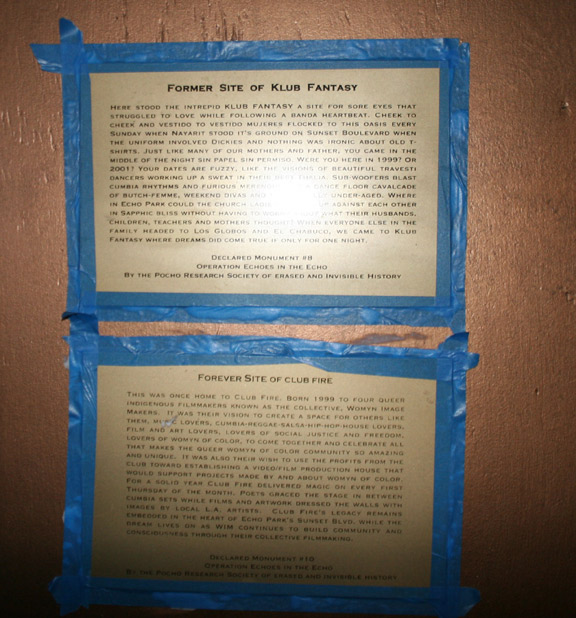
Echoes in the Echo

Erased and Invisible History About Gentrification In and Around Echo Park

Got this note from the Pocho Research Society

The Pocho Research Society (PRS) has installed “unofficial” plaques in public spaces to commemorate formerly queer Latina/o bars in the Echo Park, Silverlake and the Downtown area on June , 2007. The group operates in a clandestine fashion.

Since the longevity of the plaques at the sites is unknown, visit the following locations ASAP in order to view before they are taken down.

Site Locations:
Le Barcito, currently the Cha Cha 2375 Glendale Blvd Los Angeles, CA 90039
Klub Fantasy at the Nayarit aka The Echo 1822 W Sunset Blvd Los Angeles, CA 90026
Club Fire at the Nayariit currently The Echo 1822 W Sunset Blvd, LA , CA90026
The Score 107 W. 4th St, Downtown Los Angeles, currently Bar 107

Echoes in the Echo is a series of public interventions that will explore History and memory in and around Echo Park. This phase of the project commemorates a few of many queer Latina/o spaces that were a ‘home’ to many for periods of up to a couple of decades and have since changed ownership and now cater to a new, straighter, younger and whiter clientele. This project takes place while the city, itself, is at a crossroads in its own history. Dramatic increases in real estate prices coupled with commercially driven development projects facilitated by elected officials are two of a multitude of forces that push many working class communities out of the city “core”. Waves of new ‘immigrants’ (albeit from the Midwest) have in the process displaced longstanding cultural spaces created over several decades. Within this massive “land grab” questions like ‘where do drag queens, closeted quebradita dancers and gay cholos go once they been pushed out?’ arise. How and who defines a space? Is a space defined by its present incarnations or does its past ruthlessly resurface like dust in unswept corners?

plaq.jpg

Post-human Earth

From ScientificAmerican.com

June 17, 2007

An Earth Without People

A new way to examine humanity’s impact on the environment is to consider how the world would fare if all the people disappeared

By Steve Mirsky

It’s a common fantasy to imagine that you’re the last person left alive on earth. But what if all human beings were suddenly whisked off the planet? That premise is the starting point for The World Without Us, a new book by science writer Alan Weisman, an associate professor of journalism at the University of Arizona. In this extended thought experiment, Weisman does not specify exactly what finishes off Homo sapiens; instead he simply assumes the abrupt disappearance of our species and projects the sequence of events that would most likely occur in the years, decades and centuries afterward.

According to Weisman, large parts of our physical infrastructure would begin to crumble almost immediately. Without street cleaners and road crews, our grand boulevards and superhighways would start to crack and buckle in a matter of months. Over the following decades many houses and office buildings would collapse, but some ordinary items would resist decay for an extraordinarily long time. Stainless-steel pots, for example, could last for millennia, especially if they were buried in the weed-covered mounds that used to be our kitchens. And certain common plastics might remain intact for hundreds of thousands of years; they would not break down until microbes evolved the ability to consume them.

Scientific American editor Steve Mirsky recently interviewed Weisman to find out why he wrote the book and what lessons can be drawn from his research. Some excerpts from that interview appear on the following pages.

The Interviewee

Alan Weisman is author of five books, including the forthcoming The World Without Us (St. Martin’s Press, 2007). His work has appeared in Harpers, the New York Times Magazine, the Los Angeles Times Magazine, Discover, the Atlantic Monthly, Condé Nast Traveler, Orion and Mother Jones. Weisman has been heard on National Public Radio and Public Radio International and is a senior producer at Homelands Productions, a journalism collective that produces independent public radio documentary series. He teaches international journalism at the University of Arizona.

Q&A With Alan Weisman

If human beings were to disappear tomorrow, the magnificent skyline of Manhattan would not long survive them. Weisman describes how the concrete jungle of New York City would revert to a real forest.

“What would happen to all of our stuff if we weren’t here anymore? Could nature wipe out all of our traces? Are there some things that we’ve made that are indestructible or indelible? Could nature, for example, take New York City back to the forest that was there when Henry Hudson first saw it in 1609?

“I had a fascinating time talking to engineers and maintenance people in New York City about what it takes to hold off nature. I discovered that our huge, imposing, overwhelming infrastructures that seem so monumental and indestructible are actually these fairly fragile concepts that continue to function and exist thanks to a few human beings on whom all of us really depend. The name ‘Manhattan’ comes from an Indian term referring to hills. It used to be a very hilly island. Of course, the region was eventually flattened to have a grid of streets imposed on it. Around those hills there used to flow about 40 different streams, and there were numerous springs all over Manhattan island. What happened to all that water? There’s still just as much rainfall as ever on Manhattan, but the water has now been suppressed. It’s underground. Some of it runs through the sewage system, but a sewage system is never as efficient as nature in wicking away water. So there is a lot of groundwater rushing around underneath, trying to get out. Even on a clear, sunny day, the people who keep the subway going have to pump 13 million gallons of water away. Otherwise the tunnels will start to flood.

“There are places in Manhattan where they’re constantly fighting rising underground rivers that are corroding the tracks. You stand in these pump rooms, and you see an enormous amount of water gushing in. And down there in a little box are these pumps, pumping it away. So, say human beings disappeared tomorrow. One of the first things that would happen is that the power would go off. A lot of our power comes out of nuclear or coal-fired plants that have automatic fail-safe switches to make sure that they don’t go out of control if no humans are monitoring their systems. Once the power goes off, the pumps stop working. Once the pumps stop working, the subways start filling with water. Within 48 hours you’re going to have a lot of flooding in New York City. Some of this would be visible on the surface. You might have some sewers overflowing. Those sewers would very quickly become clogged with debris—in the beginning the innumerable plastic bags that are blowing around the city and later, if nobody is trimming the hedges in the parks, you’re going to have leaf litter clogging up the sewers.

“But what would be happening underground? Corrosion. Just think of the subway lines below Lexington Avenue. You stand there waiting for the train, and there are all these steel columns that are holding up the roof, which is really the street. These things would start to corrode and, eventually, to collapse. After a while the streets would begin cratering, which could happen within just a couple of decades. And pretty soon, some of the streets would revert to the surface rivers that we used to have in Manhattan before we built all of this stuff.

“Many of the buildings in Manhattan are anchored to bedrock. But even if they have steel beam foundations, these structures were not designed to be waterlogged all the time. So eventually buildings would start to topple and fall. And we’re bound to have some more hurricanes hitting the East Coast as climate change gives us more extreme weather. When a building would fall, it would take down a couple of others as it went, creating a clearing. Into those clearings would blow seeds from plants, and those seeds would establish themselves in the cracks in the pavement. They would already be rooting in leaf litter anyhow, but the addition of lime from powdered concrete would create a less acidic environment for various species. A city would start to develop its own little ecosystem. Every spring when the temperature would be hovering on one side or the other of freezing, new cracks would appear. Water would go down into the cracks and freeze. The cracks would widen, and seeds would blow in there. It would happen very quickly.”

How would the earth’s ecosystems change if human beings were out of the picture? Weisman says we can get a glimpse of this hypothetical world by looking at primeval pockets where humanity’s footprint has been lightest.

“To see how the world would look if humans were gone, I began going to abandoned places, places that people had left for different reasons. One of them is the last fragment of primeval forest in Europe. It’s like what you see in your mind’s eye when you’re a kid and someone is reading Grimm’s fairy tales to you: a dark, brooding forest with wolves howling and tons of moss hanging off the trees. And there is such a place. It still exists on the border between Poland and Belarus. It was a game reserve that was set aside in the 1300s by a Lithuanian duke who later became king of Poland. A series of Polish kings and then Russian czars kept it as their own private hunting ground. There was very little human impact. After World War II it became a national park. You go in there and you see these enormous trees. It doesn’t feel strange. It almost feels right. Like something feels complete in there. You see oaks and ashes nearly 150 feet tall and 10 feet in diameter, with bark furrows so deep that woodpeckers stuff pinecones in them. Besides wolves and elk, the forest is home to the last remaining wild herd of Bison bonasus, the native European buffalo.

“I also went to the Korean DMZ, the demilitarized zone. Here you have this little stretch of land—it’s about 150 miles long and 2.5 miles wide—that has two of the world’s biggest armies facing off against each other. And in between the armies is an inadvertent wildlife preserve. You see species that might be extinct if it weren’t for this one little piece of land. Sometimes you’ll hear the soldiers screaming at one another through loudspeakers or flashing their propaganda back and forth, and in the middle of all this tension you’ll see the flocks of cranes that winter there.

“But to really understand a world without humans, I realized I would have to learn what the world was like before humans evolved. So I went to Africa, the place where humans arose and the only continent where there are still huge animals roaming around. We used to have huge animals on all the other continents and on many of the islands. We had enormous creatures in North and South America—giant sloths that were even bigger than the mammoths; beavers the size of bears. It’s controversial as to what actually wiped them out, but a lot of indications point the finger at us. The extinctions on each landmass seemed to coincide with the arrival of humans. But Africa is the place where human beings and animals evolved together, and the animals there learned strategies to avoid our predation. Without humans, North America would probably become a giant deer habitat in the near term. As forests would become reestablished across the continent, eventually—in evolutionary time—larger herbivores would evolve to take advantage of all the nutrients locked up in woody species. Larger predators would evolve accordingly.”

Thinking about an earth without humans can have practical benefits. Weisman explains that his approach can shed new light on environmental problems.

“I’m not suggesting that we have to worry about human beings suddenly disappearing tomorrow, some alien death ray taking us all away. On the contrary, what I’m finding is that this way of looking at our planet—by theoretically just removing us—turns out to be so fascinating that it kind of disarms people’s fears or the terrible wave of depression that can engulf us when we read about the environmental problems that we have created and the possible disasters we may be facing in the future. Because frankly, whenever we read about those things, our concern is: Oh, my God, are we going to die? Is this going to be the end? My book eliminates that concern right at the beginning by saying the end has already taken place. For whatever reason, human beings are gone, and now we get to sit back and see what happens in our absence. It’s a delicious little way of reducing all the fear and anxiety. And looking at what would happen in our absence is another way of looking at, well, what goes on in our presence.

“For example, think about how long it would take to wipe out some of the things we have created. Some of our more formidable inventions have a longevity that we can’t even predict yet, like some of the persistent organic pollutants that began as pesticides or industrial chemicals. Or some of our plastics, which have an enormous role in our lives and an enormous presence in the environment. And nearly all of these things weren’t even here until after World War II. You begin to think there’s probably no way that we are going to have any kind of positive outcome, that we are looking at an overwhelming tide of geologic proportions that the human race has loosed on the earth. I raise one possibility toward the end of the book that humans can continue to be part of the ecosystem in a way that is much more in balance with the rest of the planet.

“It’s something that I approach by first looking at not just the horrible things that we have created that are so frightening—such as our radioactivity and pollutants, some of which may be around until the end of the planet—but also some of the beautiful things that we have done. I raise the question, Wouldn’t it be a sad loss if humanity was extirpated from the planet? What about our greatest acts of art and expression? Our most beautiful sculpture? Our finest architecture? Will there be any signs of us at all that would indicate that we were here at one point? This is the second reaction that I always get from people. At first they think, This world would be beautiful without us. But then they think, Wouldn’t it be sad not to have us here? And I don’t think it’s necessary for us to all disappear for the earth to come back to a healthier state.”

Courtesy Mark Pilkington

"It seems to me that the spiritual component exists in the theater as in no other medium."


Los Angeles Times, May 5, 2002

Drawing Inspiration from the Gods

Stephen Legawiec borrows from world myths to create uncommon productions for his Ziggurat Theatre.

By F. KATHLEEN FOLEY

Philosophers from Plato to Paglia have long acknowledged that myth is society’s building block, the barometer of a common world culture extending back to the cave. But just what place does myth have in Hollywood, where the high concept is king and humanistic considerations commonly yield to the youth demographic?

That’s an issue Stephen Legawiec, founder and artistic director of the Ziggurat Theatre, has set out to address, one production at a time.

During the past half-dozen years, the Ziggurat Theatre has made a name for itself with evocative, visually stunning productions inspired by world myths. The company’s inaugural production in 1997, “Ninshaba,” featured two Middle Eastern goddesses as central characters. “Twilight World,” mounted in 2000, was a loose adaptation of the Tereus and Procne story from Ovid’s “Metamorphosis.” In 2001, “Aquitania” employed the French legends of Charlemagne as a jumping-off point for a lighthearted meditation on time and utopianism. “Red Thread,” Ziggurat’s latest production at the Gascon Center in Culver City, opening Friday, borrows freely from a Chinese folk tale for a timely parable about a heroic female assassin who must break her new vow of pacifism to save the kingdom. Ironically, Legawiec makes a living as a television promo writer–a professional distiller of high concepts. But if by day he is a spinner of spiels, by night he’s a weaver of tales–the curiously timeless original theater pieces that he creates.

A multi-tasker with a vengeance, Legawiec has written, directed and largely designed (sets and makeup) every Ziggurat production since the company’s inception. He comes by his interdisciplinary skills naturally. The son of noted Polish violinist and composer Walter Legawiec and Eleanor Legawiec, a secretary and homemaker, Legawiec was an art major before he switched to acting–a painful transition, as it turned out.

“I went to two graduate schools for acting–first Cornell, then Rutgers,” Legawiec explains. “They both kicked me out. They thought I wasn’t any good. That was a pretty severe experience.”

Experience that later stood him in good stead. “Directing comprises so many things,” he says. “I had a design sense because of art school and a musical sense because of my father. I think that my art and music and acting backgrounds all coalesced into the raw skills that one needs for directing.”

Those skills impressed Robert Velasquez, Ziggurat’s resident costume designer, from the outset. “I like Stephen’s work because it’s so innovative,” Velasquez says. “He writes everything himself, and his work is so unique. That’s the real challenge. You can’t just pull things from costume shops. Everything must be designed.”

After his acting school debacle, Legawiec eventually teamed up with his friend Steven Leon (now a Ziggurat board member) to found the White River Theatre Festival, a Vermont theater that evolved from a summer-only venue to a six-month season. During the winter months, when the theater was dark, Legawiec lived in Boston, where he began toying in earnest with the notion of myth.

“My family is Polish,” he says. “And being a Polish Catholic, you are really steeped in ritual, because of the Mass. I thought a lot about the importance of myth and ritual in theater–an area I had never turned my attention to before.”

Legawiec used his Polish heritage as a starting point for his initial exploration. “I assumed everyone in Poland was working in myth and ritual,” he says. “Of course, that was far from the truth.”

Acting on that mistaken assumption, Legawiec wrote to the Krakow-based Teatr Stary, Poland’s leading repertory theater, explaining that he was a young American theater director interested in observing a Polish theater’s rehearsal process.

To his amazement, his inquiry was met with a firm invitation. “They were very accommodating,” he says. “They sent me the schedule for the whole year and said, ‘Come when you can.'”

Legawiec spent the winter of 1990-91 in Poland, arriving in time for the country’s first post-Communist presidential elections. “It was a very tempestuous time for the country and the theater,” he recalls. “Under the old Communist system, actors couldn’t be fired; they were employed for life. For the first time, the theater was in the position of having to fire people.”

In the midst of the political upheaval, however, the Teatr Stary remained surprisingly laid-back. Legawiec was particularly impressed with the theater’s lengthy rehearsal process. “They would rehearse something for three or four months, until it was ready to open,” he marvels. “That kind of unlimited rehearsal time was a real revelation to me.”

A more profound revelation was to follow–Legawiec’s visit to Jerzy Grotowski’s theater and archive. “I didn’t know much about Grotowski at the time. I just knew he was important,” he says. “I talked to the people who ran the archive, and they gave me Grotowski’s book, ‘Towards a Poor Theatre,’ and videotapes of his productions. That night, I slept in the theater. I read the book from cover to cover and watched the videotapes. It was a surreal experience.”

And a life-altering one. “Grotowski talked a lot about myth in his book, and it was clear that all his staged productions used ritual in a big way. Grotowski’s philosophy really had meaning for me. And I was also struck by the idea that Grotowski spent a year or so on each individual production. He had no time limit.”

Returning to his Vermont theater, Legawiec chafed at the strictures he’d formerly accepted as routine. “When I was confronted with my short little two-week rehearsal periods, I didn’t feel I could go on,” he says. “So I proposed to my non-Equity actors, ‘Give me two extra hours a week to work on a piece. Maybe we’ll perform it, maybe we won’t.'”

That venture, the Invisible Theatre Project, resulted in “The Cure,” later remounted in Los Angeles in 1998. Subtitled “A Dramatic Ceremony in One Act,” the play also marked Legawiec’s first experiment with invented language, a technique he returned to in 2001’s “A Cult of Isis.”

Although the words in Legawiec’s invented language pieces may not be intelligible, the meaning is–a distinction Ziggurat member Jenny Woo appreciates.

“When he experiments with invented language, Stephen is trying to tap into the subconscious, to express something more guttural and emotional,” Woo says. “At other times, his work is very verbal and intellectual. You have to listen to the words and really pay attention. But the invented-language pieces do the opposite. They distance people from the literal understanding so that they can merely feel.”

After his Vermont theater folded, Legawiec moved to L.A. and set out to form a new company, implementing the principles he’d developed with the Invisible Theatre Project. Actress Dana Wieluns, a charter member of Ziggurat, then known as the Gilgamesh Theatre, remembers those days.

“I responded to an ad in Back Stage West that called for actors interested in a long rehearsal process and new theatrical forms,” Wieluns says. “I remember the ad made that distinction. It was a call for actors wanting to work in the theater as opposed to film and television. That first piece, ‘Ninshaba,’ rehearsed for six months.”

In L.A., where actors routinely ditch small-theater commitments for more lucrative bookings, Legawiec’s leisurely process was a hard sell. “On that first project, we started with nine actors,” Wieluns recalls. “By the second rehearsal we were down to six, and a week later there were only three of us. The others realized they couldn’t commit for that length of time.”

What inspired such loyalty among the die-hards? “The reason I keep working with Stephen is that he’s one of the few people who embraces the theatrical,” Wieluns says. “He wants to put on stage the kinds of things that can’t be committed to film or TV. I think for Los Angeles that’s a unique thing.”

An unapologetic purist, Legawiec views the gap between theater and other media as a great divide. “It seems to me that the spiritual component exists in the theater as in no other medium,” he says. “I’ve never had a spiritual experience in the movies, the feeling that you’re part of something larger, or you are beholding the mystery of life.”

Legawiec routinely travels the world to research his plays. On a trip to China in September, he immersed himself in Chinese opera, a style that influences his staging of “Red Thread.” The play derives from an obscure folk yarn written during the Tang dynasty. Despite the antiquity of his source material, Legawiec’s updating resonates in ways he never anticipated.

“The story’s about an assassin who swears off killing just when the kingdom needs her most,” he says. “Coincidentally, the play deals with war versus pacifism during a time of crisis.”

The timing may be coincidental, but the message of “Red Thread” is as fresh as when the story was written 1,200 years ago. That’s typical of the Ziggurat Theatre, as it crosses cultural boundaries and spans generations in its own continuing saga.

Another reason why your city needs to be fabulous and groovy

Study: ‘Gay-friendly’ cities enjoy more economic prosperity
David Edwards and Josh Catone
Published: Saturday June 23, 2007

Richard Florida, a professor from George Mason University and author of the book The Rise of the Creative Class argued that the more “gay-friendly” a city is, the more economically prosperous it will be.

In his March 2007 paper “There Goes the Neighborhood,” Florida uses something he calls the “Bohemian-Gay Index” to demonstrate that “artistic, bohemian, and gay populations” have a “substantial effects on housing values across all permutations of the model and across all region sizes.” He also found that more open and “gay-friendly” areas generally support higher income levels.

(A PDF of the paper can be read at this link.)

This morning on CNN’s In the Money, Florida argued that educated kids are generally moving to the most “gay-friendly” cities after graduating from college because those cities tend to have the best job markets.

After realizing that the top 5 “gay-friendly” cities in the US — San Francisco, Seattle, Boston, Portland (Oregon), and Tampa — are also prosperous centers of technological innovation, Florida decided to do a more thorough study. The results, he said, held up for other cities as well.

“Places that were open to gay and lesbian people were also the kind of places that could attract not only smart young people, but also Indian and Chinese immigrants who come here and start a lot of high tech companies,” he said. “They were attracting people across the board, building up a talent base, and then innovating and starting these new enterprises.”

Florida said he thinks it is the open mindedness of these cities that has allowed economically successful communities to emerge, rather than prior economic success attracting open minded people.

“Places that a large gay and lesbian community gravitated to, a large group of musicians and other open minded people gravitated to. When these kind of geeky entrepreneurs became important economic growth, those were the places that accepted them, too,” he told CNN.

Video at The Raw Story.

Grass Roots Record Co. Summer Revue Tour

June 23
Alela Diane, Lee Bob Watson, Mariee Sioux, Aaron Ross, & Benjamin Oak Goodman
The Echo, Los Angeles, CA 1822 Sunset Blvd, Echo Park, CA
5pm $8 All-Ages

June 24
Alela Diane, Mariee Sioux, Lee Bob Watson, Aaron Ross, & Benjamin Oak Goodman
Steynberg Gallery, San Luis Obispo, CA 1531 Monterey Street, San Luis Obispo, CA
8pm $6 All-Ages

June 25
Alela Diane, Lee Bob Watson, Mariee Sioux, Aaron Ross, & Benjamin Oak Goodman
The Attic, Santa Cruz, CA 931 Pacific Ave, Santa Cruz, CA
7pm $10 ADV $12 Door All-Ages

June 26
Alela Diane, Mariee Sioux, Lee Bob Watson, & Aaron Ross
The Hemlock, San Francisco, CA 1131 Polk Street, San Francisco, CA
9pm $7 21+

June 27
Alela Diane, Lee Bob Watson, Mariee Sioux, Aaron Ross, & Benjamin Oak Goodman
Holocene, Portland, OR 1001 Morrison, Portland, OR
9pm $7 All-Ages

June 28
Alela Diane, Lee Bob Watson, Mariee Sioux, Aaron Ross, & Benjamin Oak Goodman
The Triple Door, Seattle, WA 216 Union Street, Seattle, WA
7pm $13 Adv $15 day of All-Ages

June 29th
In-Store Silver Platters (Queen Anne Store)
701 4th Ave N, Seattle, WA
6pm FREE

June 30 & July 1st
Alela Diane, Lee Bob Watson, Mariee Sioux, Aaron Ross, & Benjamin Oak Goodman
What You Got? Festival, Olympia, WA All-Ages

July 1st
In-Store Music Millennium
801 NW 23rd, Portland, OR
7:30pm FREE

July 11
Lee Bob Watson
Hot Summers Nights, Top of Broad Street

OPENING TOMORROW: RICK GRIFFIN retrospective in Laguna

Heart and Torch: Rick Griffin’s Transcendence, the artist’s first major retrospective and solo museum exhibition, opens on June 24, 2007. A cult figure that set the iconographic terrain for the 1960s and 1970s counterculture, in his art Griffin expressed idealism and hope along with a darker side that perfectly embodied the contradictions of the era with its mixture of hedonism, politics, and avant-garde expression.

The exhibition, which includes some 140 paintings, drawings, posters, album covers, and artifacts, surveys thirty years of Griffin’s work from the 1960s until his death in 1991. The accompanying 156-page catalogue, published in association with Gingko Press, is the first publication to address Griffin’s impact on the surf, psychedelic rock, and born-again Christian movements.

Heart and Torch is organized for Laguna Art Museum by Susan M. Anderson, and co-curated by guest curators Greg Escalante and Doug Harvey with curatorial consultant Gordon McClelland.

Griffin Lecture Series

Sunday, June 24, 2007 – 1:00pm Psychedelic Moment: The Big Five and Zap Comix in the 1960s

This panel on Griffin and San Francisco’s Haight-Ashbury features the artist’s widow and internationally respected artists who initiated the psychedelic art and underground comix movements. With Ida Griffin, Alton Kelley, Stanley Mouse, Spain Rodriguez, and Robert Williams. Moderated by Jacaeber Kastor, founder of Psychedelic Solution Gallery, New York.

Sunday, July 15, 2007 – 1:00pm Chronicles of a Subculture: Rick Griffin, Murphy, and Surfer Magazine

This panel highlights Griffin’s popular cartoon character, Murphy, featured in Surfer magazine in the 1960s, with artists and designers Art Brewer, Jim Evans, Hyatt Moore, Randy Nauert, John Van Hamersveld, and Mike Salisbury. Moderated by Steve Pezman, publisher of The Surfer’s Journal.

Sunday, August 19, 2007- Typographical Transcendence: Tales from the Griffin Vault

Carl Rohrs, artist and instructor at Cabrillo College, discusses Griffin’s unique contribution to graphic design featuring rarely seen works by the artist.
Sunday, September 16, 2007- Evangelism, Music, Art, and Visual Faith: A Confluence in the Art of Rick Griffin.

Chuck Fromm, publisher of Worship Leader magazine and patron of Griffin’s The Gospel of John, discusses the influence of the born-again Christian movement on the artist’s life and art.

Belltown Paradise/Making Their Own Plans and Spatial Justice

From an Arthur contributor:


Starting with a holistic approach to Portland’s urban space (now functioning in other cities), the City Repair Project works to address social conditions of alienations in urban environments. Their projects address neighborhoods of homeowners, renters, and the homeless alike through “Placemaking”. With a mind to cutting through city bureaucracy by stressing the values which make cities livable if not great, City Repair is committed to non-hierarchical methods of group sharing and collective space urban interventions. With ecological themes combined with gardens, cob architecture and humane environments, City Repair works with a spacial conception of the urban malaise to get deep into what others just conceive of as “social problems.” By sighting the problems of poverty, pollution, crime and stress in real designable spaces, City Repair’s civic interventions are profoundly captivating.

Spatial Justice is a concept advanced by Ava Bromberg, editor of two excellent books Belltown Paradise/Making There Own Plans and the new Spatial Justice issue of the Critical Planning Journal out of UCLA. Concepts of spatial justice work to reframe social problems in space- the territorialization allowing for an active engagement with problems as a collection of ecosystems, rather than isolated abstracted alienated concepts.

Belltown Paradise/Making There own Plans is a cool double sided book put out a few years back by the exciting Whitewalls Press (Sun Ra’s Notebooks, Prison Inventions). Along with Chicago based, man for all seasons, Brett Bloom, this book presents several projects that are working on the level of landscapes to create inclusive, creative and just places for human cohabitation. Half of the book is devoted to transformations and stories from the Belltown neighborhood of Seattle. The other half focuses on a bunch of projects: City Repair gets a work up here as do Park Fiction (a German utopian group which facilitates spaces for “collective production of desire”) and Can Masdue. Can Masdue is a part of the intriguing (and endangered) Spanish Anarchist scene and is a project affiliated with the “rurbano revolution”.

The Spatial Justice issue goes way deeper into conceptions of spatial justice-giving frameworks (starting with postmodern Marxist geographer David Harvey) to the situationist/holistic/anti-hierarchical/D.I.Y. conceptions that are inspiring analysis and action in the worlds of proactive, progressive, urban design. A slightly heavier read than Belltown Paradise, the journal has its share of write-ups of radical D.I.Y., City Repair like, spatial interventions including an essay about Camp Baltimore and a rad essay about German Bauwagon culture (think squatting industrial wasteland in improvised circus trailers). Also included are discussions of alternative ways to design villages in Palestine, to resist the occupation, and explorations of how street festival’s in Philly help to cement a sense of blackness in gentrifying neighborhoods as a force counteracting economic displacement (gentrification). A wonderful case where expressions of culture serve to mark space, creating power.

My favorite section of the book is a series of interviews with spacial thinkers who offer expansive ways to consider how it is that we occupy land across all kinds of divides, and ways that we might better live here together. Spatial Justice offers ways to think beyond the brick and mortar which binds us to the status quo.

Technical Ecstasy

Man gets sick benefits for heavy metal addiction
Published: 19th June 2007 15:12 CET

A Swedish heavy metal fan has had his musical preferences officially classified as a disability. The results of a psychological analysis enable the metal lover to supplement his income with state benefits.

Roger Tullgren, 42, from Hässleholm in southern Sweden has just started working part time as a dishwasher at a local restaurant.

Because heavy metal dominates so many aspects of his life, the Employment Service has agreed to pay part of Tullgren’s salary. His new boss meanwhile has given him a special dispensation to play loud music at work.

“I have been trying for ten years to get this classified as a handicap,” Tullgren told The Local.

“I spoke to three psychologists and they finally agreed that I needed this to avoid being discriminated against.”

Roger Tullgren first developed an interest in heavy metal when his older brother came home with a Black Sabbath album in 1971.

Since then little else has mattered for the 42-year-old, who has long black hair, a collection of tattoos and wears skull and crossbones jewelry.

The ageing rocker claims to have attended almost three hundred shows last year, often skipping work in the process.

Eventually his last employer tired of his absences and Tullgren was left jobless and reliant on welfare handouts.

But his sessions with the occupational psychologists led to a solution of sorts: Tullgren signed a piece of paper on which his heavy metal lifestyle was classified as a disability, an assessment that entitles him to a wage supplement from the job centre.

“I signed a form saying: ‘Roger feels compelled to show his heavy metal style. This puts him in a difficult situation on the labour market. Therefore he needs extra financial help’. So now I can turn up at a job interview dressed in my normal clothes and just hand the interviewers this piece of paper,” he said.

The manager at his new workplace allows him to go to concerts as long as he makes up for lost time at a later point. He is also allowed to dress as he likes and listen to heavy metal while washing up.

“But not too loud when there are guests,” he said.

The Local spoke to an occupational psychologist in Stockolm, who admitted to being baffled by the decision.

“I think it’s extremely strange. Unless there is an underlying diagnosis it is absolutely unbelievable that the job centre would pay pay out.

“If somebody has a gambling addiction, we don’t send them down to the racetrack. We try to cure the addiction, not encourage it,” he said.

Henrietta Stein, deputy employment director for the Skåne region, is also puzzled by the move; “an interest in music” is not usually sufficient to qualify for wage benefits.

“Certain cases are confidential but in general there is always a medical reason that is well-documented,” she said.

Tullgren currently plays bass and guitar in two rock bands and says that he tends to get a lot of positive reactions for daring to be himself.

“Some might say that I should grow up and learn to listen to other types of music but I can’t. Heavy metal is my lifestyle,” he said.

The War on Medical Marijuana by PAUL KRASSNER

The War on Medical Marijuana
by Paul Krassner

Anthropologists of the future will look back upon these times as incredibly barbaric. One such example is medical marijuana, which is already legal in a dozen states, yet prohibited–and trumped–by federal law.

New York and Connectictut are next in line. The New York Times recently editorialized, “Although there are other prescriptions that are designed to relieve pain and nausea and there is concern about the health effects of smoking marijuana, there are some truly ill people who find peace only that way.”

Those “other prescriptions” are aided by the pharmaceutical industry, which spent a record-breaking $155-million to lobby the government from 2005 to mid-2006. As for “concern about the health effects of smoking marijuana,” it was reported at the 2005 meeting of the International Cannabinoid Research Society that smoking marijuana–“even heavy long-term use”–does not cause cancer of the lung, upper airwaves or esophagus.

Syndicated columnist Clarence Page–referring to WAMM, the Wo/Men’s Alliance for Medical Marijuana–has written about the DEA raiding “a legitimate health co-operative that was treating more than 200 patients, some of them terminally ill, in Santa Cruz [California]. Snatching medicine out of the hands of seriously ill patients sounds like terrorism to me. In this case it was federally sponsored and taxpayer-financed.”

Founded by Valerie and Mike Corral, WAMM has been helping people dying of cancer and AIDS for 14 years. Learning that such patients could not afford the high cost of marijuana, WAMM established a communal garden where medicine is grown for patients who have a doctor’s recommendation; they may take what they need and give what they can, even if that is nothing.

The late Robert Anton Wilson, prolific countercultural author, told me, “I never thought I would become another WAMM patient. My post-polio syndrome had been a minor nuisance until then. Suddenly, two years ago, it flared up into blazing pain. My doctor recommended marijuana and named WAMM as the safest and most legal source. By then I think I was on the edge of suicide–the pain had become like a permanent abcessed tooth in the leg. Nobody can or should endure that.”

After the DEA raided WAMM’s garden and arrested its founders, outraged Santa Cruz city and county officials actually sponsored WAMM’s medical marijuana give-away on the steps of City Hall, and joined WAMM’s lawsuit against the DEA, the U.S. Attorney General and the Office of National Drug Control Policy. WAMM is considered the most likely organization to ultimately sway the Supreme Court. According to Federal Judge Jeremy Fogel, “WAMM is the gold standard of the medical marijuana movement.”

Meanwhile, WAMM is in desperate financial straits. If you can contribute to their cause, check out their fundraising site http://www.wamm.org/helpwamm.htm. Although it would be a blessing to be funded by a MacArthur grant or philanthropist George Soros, Valerie points out that, “If those of us who believe in the alternative WAMM offers unite, we can keep the vision alive. If each of us contributes as little as $5 a month, we can move political history. That’s one trip to Starbucks, and less than a movie.”

States’ rights…it’s not just for racists any more.
———
Paul Krassner compiled and edited Pot Stories For the Soul, available at paulkrassner.com.