
A promotional animation for the Spring 2008 Prada collection. Music by CocoRosie.
Monthly Archives for February 2008
Leaked emblems from the Pentagon's secret projects and organizations




Paws Test – GreenerMags
(HINT: Double click comic to load up in Full Screen)
Arthur presents TONIGHT at Family in L.A.- FREE – readings by Douglas Messerli and Pete Relic
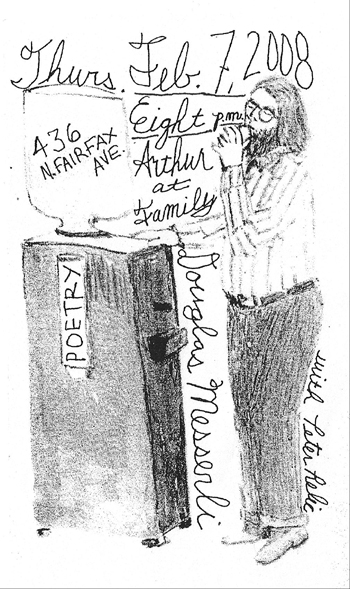
Thursday February 7, 2008
8pm
Family Bookstore
436 N. Fairfax Ave. Los Angeles, CA 90036
Arthur Magazine Presents
Acclaimed Poet and Essayist Douglas Messerli
reading with
Poet and Rap Scholar Peter Relic
Douglas Messerli is the founder, operator and editor of Green Integer Books (www.greeninteger.com), a truly awesome independent publishing company that keeps in print early novels by Knut Hamsun, poetry by Ko Un, and assorted notable writings that “may appear necessary to bring society into a slight tremolo of confusion and fright at least.” Which is not to say that joy and humor are not also part of his agenda. Messerli will be reading for the first time from his cultural memoir, My Year.
Peter Relic is an Arthur Magazine contributing editor. Tonight he will be conducting a dramatic reenactment of what happened inside the smoky and underlit boxing ring of the Cleveland Armory one winter night in 1956.
Hey man do you want to live on a planet of weeds?
Paths to Survival
by Rick Ridgeway
(first published in Patagonia’s Heart of Winter 2008 catalog)
For many wild animals, to roam means to survive. Seasonal migration between habitats is a pattern passed from generation to generation of eagles, waterfowl, elk and hundreds of other species. To locate a new place to survive and breed, the young of many species must roam far and wide. And freedom to roam often determines whether or not wild creatures can adapt to change. Even for species that do not seasonally migrate, the ability to find new mates in new places protects genetic health and diversity.
What happens when habitats are isolated by cities and highways, or fragmented by fences and fields? Since the 1960s, conservation biologists have been able to measure with increasing accuracy the minimum sizes of protected areas needed to ensure the long-term survival of all the species in a given ecozone. No surprise: Big animals need big spaces. If territories are balkanized by highways, energy development and housing, the long-term survival of large mammals – as well as the multitude of smaller creatures connected to them – is jeopardized. Imagine it this way: As writer David Quammen has noted, if you cut a beautiful, handwoven Turkish rug into 36 pieces, you don’t end up with 36 Turkish rugs. You have instead 36 worthless remnants.
That’s the first problem. The second one has come into focus only in the last few years: What happens when habitats change because of global warming? What happens when species are marooned in isolated islands of shifting habitat? Many of us followed last year’s reports from the Intergovernmental Panel on Climate Change – the most exhaustive and authoritative studies to date on the likely effects of global warming. If animals remain trapped in their habitats, the IPCC predicted, one-quarter of the earth’s plants and animals could disappear by the end of this century. Nothing like that has happened on this planet since the extinction of the dinosaurs 65 million years ago. It can be argued convincingly that nothing of this magnitude has challenged our own species in our relatively short history on this planet.
What to do? In the 1980s, Michael Soulé, a leading conservation biologist, and Arne Naess, a leading environmental thinker, were discussing the problem of fragmented habitats over breakfast in Soulé’s kitchen. This was before Bill McKibben wrote his seminal work The End of Nature, the first sounding of the tocsin on global warming, but after E. O. Wilson, Tom Lovejoy and others had defined the minimal size of protected areas needed for all wildlife in a region to survive. Soulé was staring out the window of his Santa Cruz home when an idea popped into his head: Corridors, he thought to himself.
“Reconnect the isolated patches of wildlands throughout North America,” he told Naess, “so animals can freely move and ecological fluxes are restored.”
Naess’s eyes lit up and a eureka smile crossed his face. The effort to create corridors up and down North America was launched, and at Patagonia, we picked up the theme as our annual environmental campaign in 2002-2003. For 12 months, we ran articles in our catalogs and put up displays in our stores to increase awareness for landscapes that were “Big, Wild & Connected.” Now, with global warming compressing the timetable for planetary change, we return to our earlier effort. Freedom to Roam, however, is more than a campaign – more than a one- or two-year effort to bring awareness to an important and complex environmental challenge, as we have done with issues like genetic engineering, the plight of salmon and, most recently, the plight of the oceans. Freedom to Roam is an initiative to use our resources and our communication skills, not only to bring awareness to this challenge, but to bring together environmentalists, recreationalists, ranchers, hunters and anglers, urban folk and rural folk in a commitment to the wild and to future generations who love the wild.
Our first goal is to educate all of us regarding the three great north-south corridors – “wildways” that connect existing protected areas along the Pacific Crest, the Continental Divide and the Atlantic Spine. These three wildways, in turn, connect to The Big Wild, that great arc of boreal forest north of the Trans-Canadian Highway. Second, we hope to coordinate groups already working to protect parcels within the three wildways so that, united, their voices will have more volume and influence in the governments of countries on the North American continent. (This includes ranchers and those in rural communities who live within the wildways. Without accommodating the needs and wisdom of rural residents, this initiative will not succeed.) Third, we want to inspire a broad and deep grassroots awareness of this challenge and mobilize thousands of people to venture into the wildways, to hike and climb and paddle and camp, to bear witness to the wonders of the wildlands and the wildlife within them. Finally, we plan to entreat, implore, cajole, embarrass – whatever it takes – to persuade our lawmakers to pass legislation and to allocate the resources needed to establish the corridors.
If we fail? Biologists are calling this the Sixth Mass Extinction; there have been five other such events in the last 250 million years. As with these past events, it is unlikely there will be a complete collapse of life on earth. But what will be left? Recall the “wildlife” you see in cities and suburbs: pigeons, crows, rats, cockroaches. Very adaptable species that will likely fill the vacancies left by meadowlarks, lynx, wolverine, panther, grizzly. What is left will be (again to quote Quammen) the “weed species.” It comes down to whether or not you want to live on a planet of weeds.
Bio: Rick Ridgeway has been part of the Patagonia family since the company started in the early ‘70s. Currently, he is Patagonia’s VP of Environmental Initiatives.
More info on Patagonia’s FREEDOM TO ROAM initiative
LATimes on Feb 3 Arthur Sunday Evening at McCabe's
Feb 5, 2007 Los Angeles Times
POP MUSIC REVIEW
Live: The Entrance Band
With raw psychedelic rock and Eastern and blues influences, the Entrance Band may open ears and minds.
By Sarah Tomlinson, Special to The Times
When Los Angeles-based psychedelic rock trio the Entrance Band plays a show, it’s a happening. Not only because band members take sound and style inspiration from the ’60s counterculture that coined the term, as they demonstrated during a short set Sunday at the new Arthur Magazine Sunday Evenings music series at McCabe’s in Santa Monica. But also because their music creates the feeling that something fresh and powerful is afoot. A potent mix of political mindedness — including a few conspiracy theories — and musical virtuosity, their songs throb and wail and strive to open minds.
The band, the brainchild of Baltimore transplant Guy Blakeslee, who has toured with friends Cat Power and Devendra Banhart as solo artist Entrance, features drummer Derek James and bassist Paz Lenchantin (A Perfect Circle, Zwan). While built on a raw ’60s-rock foundation, it also draws on blues and Eastern influences, creating a sound so fresh it’s almost experimental and yet so infectious it got the audience of nearly 150 up out of their seats and dancing.
The 40-plus-minute set featured a mix of new material and songs taken from Entrance’s three solo albums, including the most recent, 2006’s “Prayer of Death.” “Valium Blues” opens with a militaristic beat before fluidly moving between blues and Eastern European gypsy music. During what Blakeslee called the “topical song section of the evening,” he showed off his intense falsetto on psychedelic torch song “Pretty Baby.”
New songs written since the trio coalesced last year included “Still Be There Shorty,” a wild blues number with shamanistic vocals and a scrawling guitar solo, and joyous rocker “MLK,” which honors the legacy of Martin Luther King Jr. by urging listeners to be better, freer people.
The trio, which also plays the Silverlake Lounge the first three Thursdays in February, harks back to a time when peace and love were invoked without irony and makes a fresh argument for their power as rallying cry and musical inspiration today.
Actual BP station at Olympic and Robertson in L.A.

Trailer for BEN KATCHOR's new "musical theatre event"
HOWLIN RAIN, CB BRAND Wed night in Long Beach
HOWLIN RAIN
CB BRAND
plus more!
Wed., Feb. 6
at QUE SERA in LONG BEACH
1923 E. 7th St. * Long Beach | 562.599.6170
www.thequesera.com
9 PM / $5 / 21+
first band on at 9 pm sharp!
Vote for…LINT!

LINT by Arthur contributor Steve Aylett is on the shortlist for Spread the Word, a World Book Day poll to discover “The Book to Talk About, 2008″. Part of the poll includes online contributions. You can cast your vote here. (Not that we want to skew the results or anything…)
“I have received numerous emails and comments on this book, which doesn’t happen particularly often. All of them have said something along the lines of ‘I laughed aloud on the train’. Lint is ostensibly a biography of Jeff Lint, the best science fiction writer in the world. However, Jeff Lint is a figment of the author’s imagination. What Lint amounts to is a wry, comical parody of everything about pulp sci fi. Anyone who’s read any sci fi will find lots to laugh about. The book even features a plate section of Jeff Lint book covers – although, of course, these are fictional too. This is a rather unusual book in that it’s a fictional biography, and it has been described by SFX magazine thus in their 5 star review: “Lint is like manna from Mars, a jaw-to-the-floor comic masterpiece that will leave you giddy with excitement that it even exists… everyone holding this magazine should own two copies of Lint: one for themselves, one to fling in the face of their nearest foe.” I defy you to read a paragraph – any paragraph – and not laugh. Steve Aylett does things with words that bend your mind, and although this is comic fiction it is a rich and authoritative poke at pulp sci fi through the decades.”
 Arthur Magazine