MAY '68 WISDOM: "BARRICADES CLOSE THE STREET BUT OPEN THE WAY."

Coffee and revolution

Nicolas Sarkozy may wish it dead, but the legacy of 1968 lives on in the cafes of Paris. Agnès Poirier reveals where to get your café crème with a dash of rebelliousness

This article appeared in the Guardian on Saturday April 12 2008 on p2 of the Travel features section.

“How do you build a barricade?” a 10-year old boy asks his dad who, like me, is drinking his café crème standing at the counter of Au Petit Suisse, a cafe facing the Luxembourg Gardens. Au Petit Suisse, which has a mezzanine and a heated terrace for smokers, is as famous for being a students’ favourite since 1791 as for its raspberry tartelettes. The boy’s dad, a 40-year old man, grumbles, a pastry in his left hand, his cup in the right and his eyes fixed on the Libération newspaper spread in front of him. The boy insists. The barmaid answers in a teacherly tone: “There is nothing easier, but you can’t do it alone. You see the lamppost over there, the green bins, the cars, the phone box? You push them over and put them in a heap across the street. Cobblestones are handy too but are difficult to find these days. There is a little street though, not far, it’s still covered with pavés. I can show it to you if you want. Once you’ve managed to get one cobblestone with a lever, it’s very easy to get all the others.”

An older customer intervenes: “Forget about lampposts, they are a real pain – it’d take you ages. You see this one, at the crossroads of rue de Médicis and rue Vaugirard? I tried with a few friends to break it at its base on May 10, in 1968 – we gave up after an hour, and it’s still standing. But don’t worry; you can also use a chainsaw to cut a few trees. That’s what we did on the boul’Mich [boulevard Saint-Michel] back in 1968.” At the mention of the chainsaw, the boy looks excited. His dad wakes up from his torpor. “Le monsieur is right, my darling. This is how you build a barricade,” he says and resumes his reading. The boy asks his dad: “Do we have a chainsaw at home?” “No.” “Can we buy one?”

This vignette of Parisian life, captured early one morning near the Sorbonne, hints at the rebellious culture that still permeates parts of Paris. Today’s visitors may now find a Starbucks impudently standing at the Odéon, behind the statue of Danton, hero of the French Revolution, but they shouldn’t be deceived. Under the top layer of consumerism and bling that afflicts all European cities, there still exist, right in the heart of the Latin Quarter, many traditional haunts that are seething with argument and rebelliousness.

They offer a special reason to visit Paris this May. Forget for a moment the city’s splendid neo-classical palaces and Haussmannian avenues, and roam the same streets that staged, 40 years ago, the most theatrical of all student revolts: les événements. To quote the Situationist slogan of the time: “Sous les pavés, la plage” (underneath the cobblestones, the beach).

I meet Professor Jacques Capdevielle, who has just written a dictionary of May ’68, at Le Basile, a cafe on the corner of rue de Grenelle and rue Saint Guillaume. Standing opposite Sciences Po, the famous grande école set up in 1872 on which, 23 years later, Sydney and Beatrice Webb modelled the London School of Economics, Le Basile has always been the students’ and professors’ favourite den, the heart of political debate. It has gone through many renovations. Ten years ago, I’d ordered a croque madame (croque monsieur with an egg on top) and sat in the back room; Le Basile looked slightly dishevelled then, with its old, broken furniture – absolutely not hip. Today, vivid colours, new bistro tables and chairs, make it trendier but the students still look the same: effortlessly beautiful and emphatically serious. And they still devour les croque madames between lectures.

Capdevielle, a student in 1968, recalls how the decision to occupy Sciences Po sprang from the Sorbonne, already occupied by radical students and Guy Debord’s Situationists. “Somebody shouted: let’s occupy Sciences Po! And, almost immediately, a small group of students set forth into the streets of the Latin Quarter for rue Saint Guillaume.” They were carrying black and red flags and, on the way, enrolled an inebriated and elated clochard (a tramp) whom they placed at the front of their improvised procession. When they arrived in the main amphitheatre and declared Sciences Po occupied, its director, Jean Touchard, looked on, lost and perplexed. Ushers, in full grande école regalia, were so startled, they didn’t move an inch. “Little known is the fact that until May ’68, French universities and grandes écoles had official ushers in full frock whose job was to announce the professors’ entrance in the amphitheatres with a resounding ‘Mesdemoiselles et messieurs les étudiants, le professeur!” Capdevielle says. “All this 19th-century nonsense stopped with May ’68.”

Cafes are inextricably linked to intellectual and political life in France, and to rebellion. The French Revolution sprung from a cafe at the Palais Royal, and it was in a Parisian bistro that the socialist leader Jean Jaurès was assassinated on the eve of the First World War. Cafes are an endangered species in Paris; there were 510,000 in 1910 but only 36,000 are left. But if you avoid the tourist traps, the franchises and the chichi eateries, you can still find places where Parisians from all backgrounds, preferably standing at the counter, scoff at the latest Sarkozy stunt and argue about politics.

While Capdevielle is reminiscing about May ’68, at the next table two students are loudly discussing the political future of the centrist politician François Bayrou. Capdevielle says: “I totally disagree with those who say that today’s youth is depoliticised. The will to change the world is as vivid today as it was in 1968. The demonstrations of 1995 and 2005 proved it. Radical politics are very much alive in France. The French are as hungry as ever for political and philosophical debate. Just think of the Cafe Philo!”

In 1992, the philosopher Marc Sautet persuaded the proprietors of Café des Phares in Place de la Bastille to host a philosophy discussion every Sunday morning. The success was immediate; 100 people come every Sunday to debate the topic of the day but also to listen to visiting philosophers. The concept spread across Paris, France, Europe. There are now hundreds of “philo-cafes” around the world.

Not far from Le Basile, Le Rouquet, standing at the corner of rue des Saints-Pères and boulevard Saint Germain, looks as if it hasn’t changed since the 50s. And it hasn’t. The formica tables, worn-out red leatherette booths, black and white floor, and grumpy waiters haven’t noticed the passage of time. Only the handwriting on the menu looks contemporary. Tourists looking for Simone de Beauvoir and Jean-Paul Sartre’s ghosts often go to Café des Deux Magots further down the road, not realising that by the 1960s the couple had stopped going to this icon of Saint Germain-des-Près. “In 1968, the Café des Deux Magots was already a tourist trap for Americans,” says Capdevielle, who has lived in the Latin Quarter for 45 years. “Simone de Beauvoir came here instead, to Le Rouquet, to write in the morning and give appointments.” She would also buy books at La Hune, an independent bookshop that has been open from 10am to midnight every day since 1949, and which refuses to stock publications from the big-name publishing houses.

Debating in cafes is such an institution in Paris that celebrated radio programmes such as France Culture’s Travaux Publics, hosted by the legendary Jean Lebrun (Andrew Marr meets Melvyn Bragg), are broadcast from one of them. Travaux Publics is broadcast three evenings a week from Café El Sur on boulevard Saint Germain. Entry is free and, while sipping a café crème or a mate (the owner of the cafe is part Argentinian), M. Lebrun may ask your opinion, live: “Hey you, what do you think of France’s rekindling with Nato?”

Brasserie Balzar, at the corner of rue de la Sorbonne and rue des Écoles, has been a haven for Sorbonne readers and students, idle between lectures, since it opened its doors in 1931. The Art Deco building has aged gracefully, left unspoilt by successive owners and the waiters have not changed since I was a student at the Sorbonne 10 years ago. One is known for his intense gaze, which makes ladies of all age blush, another for knowing every Sorbonne professor by name, and another for his unrelenting grumpiness. When the restaurant group Flo started negotiations to buy the Balzar in the 90s, customers and garçons set up an association to preserve the cafe’s traditions: there were petitions, demonstrations and sit-downs protests in the street. The new owner had to give in to the activists’ demands: no change to the staff, the menu, or the worn out booths’ red leather. As I sip a coffee at Brasserie Balzar, two well-known intellectuals, one publisher and a Sorbonne professor were discussing Sarkozy’s future: “He won’t finish his mandate” says one. “How can you be so sure?” asks the other. “Because I’ve got my finger on the pulse of 2,000 students,” comes the answer.

Outside, I bump into a tall woman with dark hair, big sunglasses and a black Borsalino, and recognise Anna Karina, Jean-Luc Godard’s muse of the 60s and star of some of his best films. It’s not a coincidence; she lives in the Latin Quarter, the heart of French cinema. It has the highest concentration of art-house cinemas in the world. Le Champo, next to Brasserie Balzar, is one of them. It is also Woody Allen’s favourite. For years, it screened Orson Welles’s Trial every Tuesday at 11am. The Accatone, rue Cujas, a few cobblestones away, has a similar approach, having screened the same films by Pasolini, Eisenstein, Antonioni, Visconti and Fassbinder for the past 20 years.

Strangely, the events of May ’68 were hardly filmed by the New Wave’s young Turks; they were instead caught by still photographers and radio reporters. Film-makers were too busy demonstrating in Cannes, insisting that the festival be cancelled, and discussing how they could change the way cinema was made.

I leave the Latin Quarter wondering if the boy from Au Petit Suisse will remember what the May ’68 veteran told him when they parted – “Barricades close the street but open the way” – and whether he’s asked for a chainsaw for his birthday.

Paris

Oui, mai!
An exhibition of photographs of the student uprising in the Latin Quarter and the strike at the Renault factory, by Gérald Bloncourt, photographer for the communist newspaper L’Humanité.
· Bibliothèque Faidherbe: 18 rue Faidherbe. +1 55 25 80 20. Until May 31. Closed Sun and Mon.

La bande son de Mai 68
Time-travel back to 1968 in this replica apartment in the lobby of the town hall, done up in period décor, with period songs, TV shows, photographs, political tracts, etc. A film will be shown every Tues in May at 8pm.
· Mairie du 18e Arrondissement: 1 place Jules Joffrin. +1 53 41 18 18. May 5-June 6. Mon-Fri, 8.30am-5pm (7.30pm on Thurs), Sat, 9am-12.30pm.

Affiches Mai 68
Forty “consciousness-raising” posters that were made by Beaux-Arts students in May 68 and pasted up at night.
· Confluences, 190, bd de Charonne. +1 40 24 16 34, confluences.net. April 15-May 30. Mon-Fri, 10am-6pm.

Regards croisés sur Mai 68
A festival of films by everyone from Jean-Luc Godard to William Klein, some in English, in the Latin Quarter.
· Le Champo, 51, rue des Ecoles. +1 43 54 51 60, lechampo.com. April 30-June 30.

Regard sur mai 68: photos, musiques et voix
Photographs by Alain Quemper of national and international artists and politicians, events and daily life from the period. Soundtracks add appropriate revolutionary ambiance.
· Dorothy’s Gallery, 27 rue Keller. +1 43 57 08 51, dorothysgallery.com. April 11-June 2.

See mai-68.fr and mai-68.org for further information, details in French.

UK

All Power to the Imagination! 1968 and its Legacies
A season of events across London explores how the culture and politics of ’68 were manifested in the arts and activism. It includes film screenings at th BFI Southbank, the Barbican, Renoir and Cine Lumiere at the Institut Francais; talks and lectures in bars, theatres, libraries and churches; exhibitions.
· See 1968.org.uk for details

May 68: When Culture was Radicalised
As part of Bristol’s Festival of Ideas, films including Sympathy for the Devil and Anatomy of Violence will be screened, with related discussions.
· Watershed Media Centre, May 3-29, ideasfestival.co.uk.

Heidi Ellison

Action Techniques That Work (No. 2 in an ongoing series)

Using Tech to Track the Torch

By Matt Richtel

April 10, 2008, 5:42 pm

New York Times

The city of San Francisco played a high-stakes game of hide-and-seek on Wednesday with the Olympic torch. To keep the beleaguered flame from being stopped or snuffed out by pro-Tibet demonstrators, the city diverted the relay’s route, bypassing the densest crowds (though this also meant many assembled supporters were denied a chance to see the torch too).

Meanwhile, protesters armed with cellphones may have heightened the city’s challenge.

The protesters had deployed people across San Francisco who were tracking the torch’s whereabouts — from the waterfront warehouse where it first appeared, to the diverted path it took away from the biggest protest gatherings. Every few minutes, the pro-Tibet sympathizers were sending updates on where they believed the torch and a busload of its bearers were being redirected. Most text-enabled demonstrators were apparently subscribed to a distribution list set up by Students for a Free Tibet, using the commercial service TextMarks.

The text messengers, and their followers, seemed to know well ahead of the rest of us on the ground where the torch was going.

“It’s heading to Van Ness,” one demonstrator told me, as she scrolled down her BlackBerry. She and I, and thousands of others in a sea of red (pro-China) and green (pro-Darfur, anti-Chinese government) stood along the Embarcadero, miles from Van Ness Avenue. Most of us, myself included, still believed that the flame was heading in our direction — but the protester with the BlackBerry knew from her text updates that we would wait in vain.

The protesters told me that the goal was to determine the location of the torch in time to get a critical mass of people surrounding it, and then stop or otherwise disrupt its progress.

Despite their quick updates, the Tibet sympathizers did not seem to be able to stop the torch or surround it as planned. Perhaps that’s because they couldn’t get the help they anticipated from a sympathizer who was planted inside the torchbearers’ bus.

Marjora Carter, 41, an environmental activist from New York, had been handpicked to be a torchbearer by Coca-Cola, which sponsored her trip to San Francisco to represent the environmental community. But, unbeknownst to Coca-Cola, her sympathies lay less with the torch and more with Tibet. She was secretly carrying a six-inch Tibetan flag which, when it became her turn to carry the torch, she intended to unfurl.

She was also armed with a cellphone and hoped to give her compatriots updates about the route of the bus. But city officials were onto the idea that some of the torchbearers might be leaking information using portable devices.

“They wouldn’t allow us to use cellphones,” Ms. Carter said, explaining that she believed the officials didn’t want anyone putting the word out about the last-minute route changes. “They said, ‘Don’t do it.””

She did not pull out her cell phone. She did pull out her flag. When it was her turn to carry the torch, she pulled a small yellow flag from her sleeve. Within moments, she said, she was pulled aside by the Chinese security contingent and handed over to the San Francisco police. The police then sent her onto the sidelines, whereupon she pulled out her phone and started to text others about the flag’s whereabouts.

Whether the demonstrators’ text messaging was an effective tool is tough to determine. After all, if they wanted to know where the torch was, they could have just turned on the television, which was tracking the route live. But the cellphones and text messages did give the protesters a tool on the ground, allowing quick adjustments on their part. All afternoon, as city officials sought to move the torch through the city without confrontation, they were racing too against the speed of mobile messaging.


Peakniks.

April 6, 2008 New York Times

Duck and Cover: It’s the New Survivalism

By ALEX WILLIAMS

THE traditional face of survivalism is that of a shaggy loner in camouflage, holed up in a cabin in the wilderness and surrounded by cases of canned goods and ammunition.

It is not that of Barton M. Biggs, the former chief global strategist at Morgan Stanley. Yet in Mr. Biggs’s new book, “Wealth, War and Wisdom,” he says people should “assume the possibility of a breakdown of the civilized infrastructure.”

“Your safe haven must be self-sufficient and capable of growing some kind of food,” Mr. Biggs writes. “It should be well-stocked with seed, fertilizer, canned food, wine, medicine, clothes, etc. Think Swiss Family Robinson. Even in America and Europe there could be moments of riot and rebellion when law and order temporarily completely breaks down.”

Survivalism, it seems, is not just for survivalists anymore.

Faced with a confluence of diverse threats — a tanking economy, a housing crisis, looming environmental disasters, and a sharp spike in oil prices — people who do not consider themselves extremists are starting to discuss doomsday measures once associated with the social fringes.

They stockpile or grow food in case of a supply breakdown, or buy precious metals in case of economic collapse. Some try to take their houses off the electricity grid, or plan safe houses far away. The point is not to drop out of society, but to be prepared in case the future turns out like something out of “An Inconvenient Truth,” if not “Mad Max.”

“I’m not a gun-nut, camo-wearing skinhead. I don’t even hunt or fish,” said Bill Marcom, 53, a construction executive in Dallas.

Still, motivated by a belief that the credit crunch and a bursting housing bubble might spark widespread economic chaos — “the Greater Depression,” as he put it — Mr. Marcom began to take measures to prepare for the unknown over the last few years: buying old silver coins to use as currency; buying G.P.S. units, a satellite telephone and a hydroponic kit; and building a simple cabin in a remote West Texas desert.

“If all these planets line up and things do get really bad,” Mr. Marcom said, “those who have not prepared will be trapped in the city with thousands of other people needing food and propane and everything else.”

Interest in survivalism — in either its traditional hard-core version or a middle-class “lite” variation — functions as a leading economic indicator of social anxiety, preparedness experts said: It spikes at times of peril real (the post-Sept. 11 period) or imagined (the chaos that was supposed to follow the so-called Y2K computer bug in 2000).

At times, a degree of paranoia is officially sanctioned. In the 1950s, civil defense authorities encouraged people to build personal bomb shelters because of the nuclear threat. In 2003, the Department of Homeland Security encouraged Americans to stock up on plastic sheeting and duct tape to seal windows in case of biological or chemical attacks.

Now, however, the government, while still conducting business under a yellow terrorism alert, is no longer taking a lead role in encouraging preparedness. For some, this leaves a vacuum of reassurance, and plenty to worry about.

Esteemed economists debate whether the credit crisis could result in a complete meltdown of the financial system. A former vice president of the United States informs us that global warming could result in mass flooding, disease and starvation, perhaps even a new Ice Age.

“You just can’t help wonder if there’s a train wreck coming,” said David Anderson, 50, a database administrator in Colorado Springs who said he was moved by economic uncertainties and high energy prices, among other factors, to stockpile months’ worth of canned goods in his basement for his wife, his two young children and himself.

Popular culture also provides reinforcement, in books like “The Road,” Cormac McCarthy’s novel about a father and son journeying through a post-apocalyptic wasteland, and films like “I Am Legend,” which stars Will Smith as a survivor of a man-made virus wandering the barren streets of New York.

Middle-class survivalists can also browse among a growing number of how-to books with titles like “Dare to Prepare!” a self-published work by Holly Drennan Deyo, or “When All Hell Breaks Loose” by Cody Lundin (Gibbs Smith, 2007), which instructs readers how to dispose of bodies and dine on rats and dogs in the event of disaster.

Preparedness activity is difficult to track statistically, since people who take measures are usually highly circumspect by nature, said Jim Rawles, the editor of http://www.survivalblog.com, a preparedness Web site. Nevertheless, interest in the survivalist movement “is experiencing its largest growth since the late 1970s,” Mr. Rawles said in an e-mail, adding that traffic at his blog has more than doubled in the past 11 months, with more than 67,000 unique visitors per week. And its base is growing.

“Our core readership is still solidly conservative,” he said. “But in recent months I’ve noticed an increasing number of stridently green and left-of-center readers.”

One left-of-center environmentalist who is taking action is Alex Steffen, the executive editor of http://www.Worldchanging.com, a Web site devoted to sustainability. With only slight irony, Mr. Steffen, 40, said he and his girlfriend could serve as “poster children for the well-adjusted, urban liberal survivalist,” given that they keep a six-week cache of food and supplies in his basement in Seattle (although they polished off their bottle of doomsday whiskey at a party).

He said the chaos following Hurricane Katrina served as a wake-up call for him and others that the government might not be able to protect them in an emergency or environmental crisis.

“The ‘where do we land when climate change gets crazy?’ question seems to be an increasingly common one,” said Mr. Steffen in an e-mail message, adding that such questions have “really gone mainstream.”

Many of the new, nontraditional preparedness converts are “Peakniks,” Mr. Rawles said, referring to adherents of the “Peak Oil” theory. This concept holds that the world will soon, or has already, reached a peak in oil production, and that coming supply shortages might threaten society. While the theory is still disputed by many industry analysts and executives, it has inched toward the mainstream in the last two years, as oil prices have nearly doubled, surpassing $100 a barrel. The topic, which was the subject of a United States Department of Energy report in 2005, has attracted attention in publications like The New York Times Magazine and The Wall Street Journal, and was a primary focus of “Megadisasters: Oil Apocalypse,” a recent History Channel special.

Another book, “The Long Emergency” (Atlantic Monthly Press, 2005), by James Howard Kunstler, an author and journalist who writes about economic and environmental issues, argues that American suburbs and cities may soon lay desolate as people, starved of oil, are forced back to the land to adopt a hardscrabble, 19th-century-style agrarian life.

Such fears caused Joyce Jimerson of Bellingham, Wash., a coordinator for a recycling-composting program affiliated with Washington State University, to make her yard an “edible garden,” with fruit trees and vegetables, in case supplies are threatened by oil shortages, climate change or economic collapse. “It’s all the same ball of wax, as far as I’m concerned,” she said.

Scott Troyer, an energy consultant in Sunnyvale, Calif., said he was spurred by discussions of peak oil — “it’s not a theory,” he said — and other energy concerns to remake his suburban house in anticipation of a petroleum-starved future. Mr. Troyer, 57, installed a photovoltaic electricity system, a pellet stove and a “cool roof” to reflect the sun’s rays, among other measures.

Mr. Troyer remains cautiously optimistic that Americans can wean themselves from oil through smart engineering and careful planning. But, he said, “the doomsday scenarios will happen if people don’t prepare.”

Some middle-class preparedness converts, like Val Vontourne, a musician and paralegal in Olympia, Wash., recoil at the term “survivalist,” even as they stock their homes with food, gasoline and water.

“I think of survivalists as being an extreme case of preparedness,” said Ms. Vontourne, 44, “people who stockpile guns and weapons, anticipating extreme aggression. Whereas what I’m doing, I think of as something responsible people do.

“I now think of storing extra food, water, medicine and gasoline in the same way I think of buying health insurance and putting money in my 401k,” she said. “It just makes sense.”

Exposition Universelle, 1900

Old expositions and world’s fairs are a persistent obsession over at Coulthart Towers. Many of the 20th century manifestations of these events fashioned visions of a science fiction future made of gleaming Modernist architecture, geodesic domes and monorails. The 19th and early 20th century, by contrast, was all about weird extrapolations of historical pastiche which too our eyes look like the dreams of Winsor McCay‘s Slumberland become real for the briefest moment. What follows is a few recent posts from { feuilleton } concerning the Paris Exposition Universelle of 1900, reproduced here at the request of Monsieur Babcock. JC.

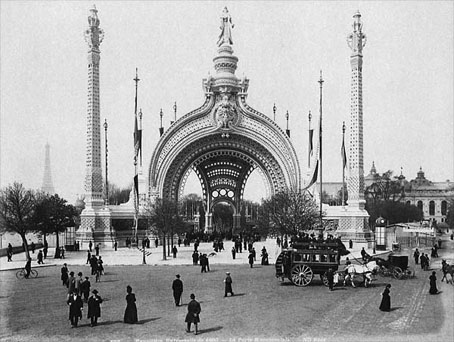
exposition1.jpg

La porte monumentale.

Was the Paris Exposition of 1900 the most gloriously excessive of them all? Judging by these photos it certainly looks it. The Eiffel Tower was built for the 1889 exposition (and was famously intended to be a temporary structure) but became the centrepiece of the 1900 fair. Wikipedia has a large plan of the entire layout and two of the halls, the Grand and Petit Palais, are still in existence and used as exhibition spaces.

exposition2.jpg

Le palais des illusions.

exposition3.jpg

La salle des fêtes.

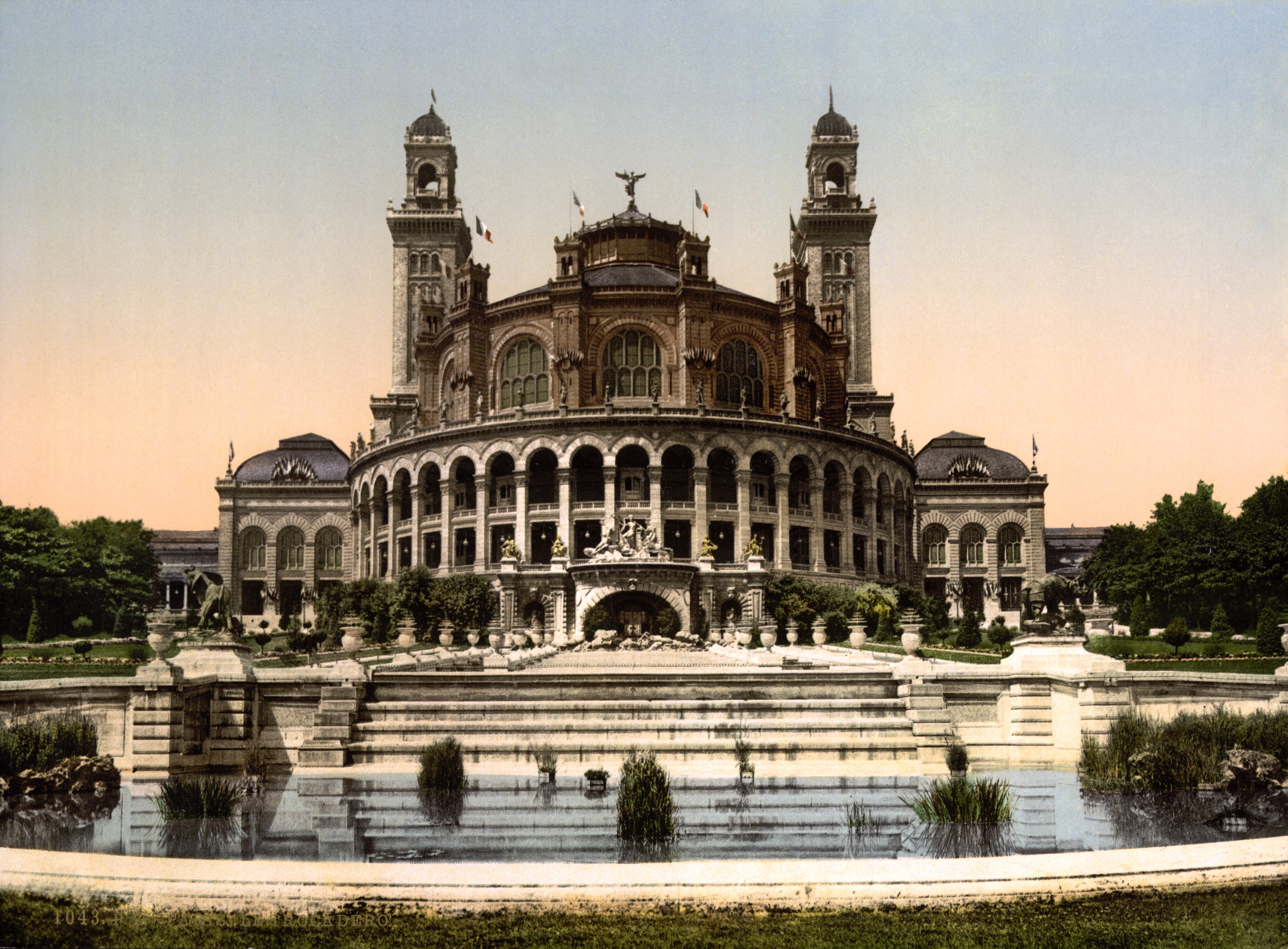
trocadero.jpg

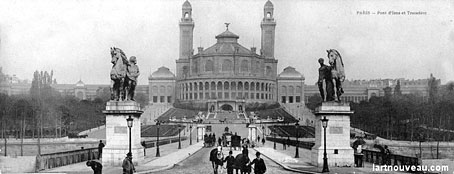
The Palais du Trocadéro was designed by Gabriel Davioud for the 1878 World’s Fair and until its demolition in the 1930s faced the Eiffel Tower across the Seine. The 1900 Exposition included the Trocadéro among its buildings which makes it one of the more unusual exposition structures, having survived several of these events and seen off many of the temporary buildings that were raised around it.

The Trocadéro was something of a heavy-handed confection, ostensibly “Moorish” in that Orientalist fashion favoured by 19th century architects. The numerous photographs of the place give it the same quality of ghostly grandeur that so many these long-demolished buildings possess; we’re able to look at a very real place which has now vanished utterly. The bridge in the picture below still stands, however, and the balcony of the Trocadéro’s replacement, the Palais de Chaillot, gives great views of the Eiffel Tower and the river.

trocadero1.jpg

bonnier1.jpg

Globe terrestre by Louis Bonnier.

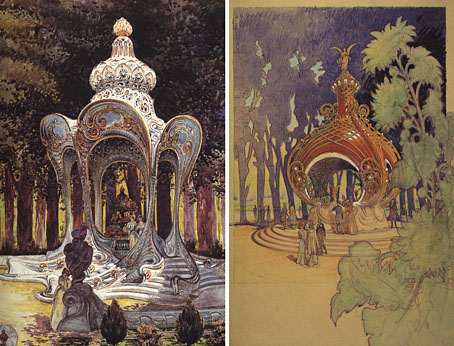
The Exposition Universelle would have been more grand/fabulous/excessive (delete as appropriate) if architect Louis Bonnier had been given free reign. The building above was intended to stand before the Palais du Trocadéro and house a huge globe which visitors could peruse from surrounding galleries. Bonnier also designed a series of kiosks (below) for different exhibitors which look more like over-sized Art Nouveau ornaments than pieces of architecture.

Three of these pictures are scanned from a book; the only site I found with examples of Bonnier’s work was this one which unfortunately spoils the pictures with enormous watermarks.

bonnier2.jpg

Exposition kiosks.

lumineux.jpg

The Palais Lumineux.

And lastly, a piece of pastiche that looks like Satine’s boudoir on the back of the elephant in Moulin Rouge. The Palais Lumineux was a work of period Chinoiserie built for the Exposition in the Champ de Mars close to the Eiffel Tower. I forget where I found this tinted view but Wikipedia has what appears to be the same photograph coloured so as to resemble a night scene.

KLAUS DINGER MOVES ON

Klaus Dinger, Drummer of Influential German Beat, Dies at 61

By BEN SISARIO
New York Times – April 4, 2008

Klaus Dinger, the drummer for the 1970s German band Neu!, whose mechanically repetitive yet buoyant beats had a wide influence in underground rock, died on March 20. He was 61.

The cause was heart failure, according to an announcement on Wednesday by his German record label, Grönland, which did not say where he died.

Mr. Dinger formed Neu!, which means New!, with the guitarist Michael Rother in Düsseldorf in 1971, after both had played in an early incarnation of the group Kraftwerk. Over three albums, the two perfected a droning, hypnotic style made up of Mr. Dinger’s simple, perpetual-motion rhythms and Mr. Rother’s fluid guitar effects.

Exemplified in songs like the 10-minute “Hallogallo,” Mr. Dinger’s beat was a steady pulse that seemed to extend rock’s most basic rhythmic patterns infinitely. The beat came to be known as Motorik, an allusion to the industrial style then prevalent among German groups. (The name Kraftwerk means power station.)

Along with records by Kraftwerk, Can, Faust and a few other groups, the original Neu! albums — “Neu!” (1972), “Neu! 2” (1973) and “Neu! ’75” (1975) — are landmarks of German experimental rock, a genre that was quickly labeled Krautrock by journalists and fans, both affectionately and derisively. (The musicians preferred the term Kosmische Musik, or cosmic music.)

Though the Neu! albums were long out of print before being reissued in 2001, they inspired countless artists, including David Bowie, Sonic Youth, Radiohead and Stereolab. The Neu! beat can also be heard in recent work by such groups as the Boredoms, from Japan.

Brian Eno, the British producer who championed Neu! and later worked with Mr. Rother, once said, “There were three great beats in the ’70s: Fela Kuti’s Afrobeat, James Brown’s funk and Klaus Dinger’s Neu! beat.”

In his student days in the 1960s, Mr. Dinger played in rock bands that he has described as influenced by the Beatles and the Kinks. He studied architecture but dropped out after three years to pursue music.

Mr. Dinger and Mr. Rother parted ways after the third Neu! album, and Mr. Dinger formed La Düsseldorf and later La! Neu? He reunited with Mr. Rother briefly in the mid-1980s and recorded an album, “Neu! 4,” that was released in 1995.

In a 1998 interview Mr. Dinger complained that he never called his beat Motorik.

“That sounds more like a machine, and it was very much a human beat,” he said. “It is essentially about life, how you have to keep moving, get on and stay in motion.”