Using common sense instead of kneejerk Econ 101 to understand what poor people face daily.

THE STING OF POVERTY

What bees and dented cars can teach about what it means to be poor – and the flaws of economics

By Drake Bennett | March 30, 2008 Boston Globe

IMAGINE GETTING A bee sting; then imagine getting six more. You are now in a position to think about what it means to be poor, according to Charles Karelis, a philosopher and former president of Colgate University.

In the community of people dedicated to analyzing poverty, one of the sharpest debates is over why some poor people act in ways that ensure their continued indigence. Compared with the middle class or the wealthy, the poor are disproportionately likely to drop out of school, to have children while in their teens, to abuse drugs, to commit crimes, to not save when extra money comes their way, to not work.

To an economist, this is irrational behavior. It might make sense for a wealthy person to quit his job, or to eschew education or develop a costly drug habit. But a poor person, having little money, would seem to have the strongest incentive to subscribe to the Puritan work ethic, since each dollar earned would be worth more to him than to someone higher on the income scale. Social conservatives have tended to argue that poor people lack the smarts or willpower to make the right choices. Social liberals have countered by blaming racial prejudice and the crippling conditions of the ghetto for denying the poor any choice in their fate. Neoconservatives have argued that antipoverty programs themselves are to blame for essentially bribing people to stay poor.

Karelis, a professor at George Washington University, has a simpler but far more radical argument to make: traditional economics just doesn’t apply to the poor. When we’re poor, Karelis argues, our economic worldview is shaped by deprivation, and we see the world around us not in terms of goods to be consumed but as problems to be alleviated. This is where the bee stings come in: A person with one bee sting is highly motivated to get it treated. But a person with multiple bee stings does not have much incentive to get one sting treated, because the others will still throb. The more of a painful or undesirable thing one has (i.e. the poorer one is) the less likely one is to do anything about any one problem. Poverty is less a matter of having few goods than having lots of problems.

Poverty and wealth, by this logic, don’t just fall along a continuum the way hot and cold or short and tall do. They are instead fundamentally different experiences, each working on the human psyche in its own way. At some point between the two, people stop thinking in terms of goods and start thinking in terms of problems, and that shift has enormous consequences. Perhaps because economists, by and large, are well-off, he suggests, they’ve failed to see the shift at all.

If Karelis is right, antipoverty initiatives championed all along the ideological spectrum are unlikely to work – from work requirements, time-limited benefits, and marriage and drug counseling to overhauling inner-city education and replacing ghettos with commercially vibrant mixed-income neighborhoods. It also means, Karelis argues, that at one level economists and poverty experts will have to reconsider scarcity, one of the most basic ideas in economics.

“It’s Econ 101 that’s to blame,” Karelis says. “It’s created this tired, phony debate about what causes poverty.”

In challenging decades of poverty research, Karelis draws on some economic data and some sociological research. But, more than that, he makes his case as a philosopher, arguing by analogy and induction. This approach means that he remains relatively unknown, even among poverty researchers. The book in which he laid out his argument, “The Persistence of Poverty: Why the Economics of the Well-Off Can’t Help the Poor,” wasn’t widely read when it was published last year.

A few, though, have taken notice, and are arguing that Karelis does have something important to say.

“There’s not much evidence in the book, and there are a lot of bold claims, but it’s great that he’s making them,” says Tyler Cowen, an economics professor at George Mason University. It “was a really great book, and it was totally neglected.”

The economist’s term for the idea Karelis takes issue with is the law of diminishing marginal utility. In brief, it means the more we have of something, the less any additional unit of that thing means to us. It undergirds, among other things, how the US government taxes people. We assume that taking $40,000 in taxes from Warren Buffett will be a lot less onerous to him than to an elementary school teacher, because he has so much more to begin with.

In many cases, Karelis says, diminishing marginal utility certainly does apply: Our seventh ice cream cone will no doubt be less pleasurable than our first. But the logic flips when we are dealing with privation rather than plenty. To understand why, he argues, we need only think about how we all deal with certain familiar situations.

If, for example, our car has several dents on it, and then we get one more, we’re far less likely to get that one fixed than if the car was pristine before. If we have a sink full of dishes, the prospect of washing a few of them is much more daunting than if there are only a few in the sink to begin with. Karelis’s name for goods that reduce or salve these sort of burdens is “relievers.”

Karelis argues that being poor is defined by having to deal with a multitude of problems: One doesn’t have enough money to pay rent or car insurance or credit card bills or day care or sometimes even food. Even if one works hard enough to pay off half of those costs, some fairly imposing ones still remain, which creates a large disincentive to bestir oneself to work at all.

“The core of the problem has not been self-discipline or a lack of opportunity,” Karelis says. “My argument is that the cause of poverty has been poverty.”

The upshot of this for policy makers, Karelis believes, is that they don’t need to fret so much about the fragility of the work ethic among the poor. In recent decades, experts and policy makers all along the ideological spectrum have worried that the more aid the government gives the poor, the less likely they are to work to provide for themselves. David Ellwood, an economist and the dean of Harvard’s John F. Kennedy School of Government, has called this “the helping conundrum.” It was this concern that drove the Clinton administration’s welfare reform efforts.

But, according to Karelis, that argument is exactly backward. Reducing the number of economic hardships that the poor have to deal with actually make them more, not less, likely to work, just as repairing most of the dents on a car makes the owner more likely to fix the last couple on his own. Simply giving the poor money with no strings attached, rather than using it, as federal and state governments do now, to try to encourage specific behaviors – food stamps to make sure money doesn’t get spent on drugs or non-necessities, education grants to encourage schooling, time limits on benefits to encourage recipients to look for work – would be just as effective, and with far less bureaucracy. (One federal measure Karelis particularly likes is the Earned Income Tax Credit, which, by subsidizing work, helps strengthen the “reliever” effect he identifies.)

Few economists are familiar with Karelis’s work, and when it’s presented to them, they tend to be skeptical of its explanatory power. If Karelis is right, we should see even more defeatist behavior than we do from the poor, says Kevin Lang, chairman of the Boston University economics department and author of “Poverty and Discrimination.” Plus, he argues, there’s little evidence that simply making poor people less poor increases their work ethic – and some evidence that it does the opposite. In the early 1970s, a large-scale study gave poor people in four cities a so-called “negative income tax,” a no-strings-attached payment based on how little money they made. The conclusion: the aid tended to discourage work.

Karelis responds that the data from that experiment is in fact quite ambiguous, and there has been debate among economists over how to interpret the results. But ultimately, he believes, the strength of his arguments is less in how they fit with the economic work that’s been done to date on poverty – much of which he is suspicious of anyway – but in how familiar they feel to all of us, rich or poor.

“The bee sting argument, or the car dent one,” he says, “I’ve never had anybody say that that isn’t true.”

Drake Bennett is the staff writer for Ideas. E-mail drbennett@globe.com.

HOLLOW EARTH RADIO


earthexploding.jpg

HOLLOW EARTH RADIO

“Our Vision
“We have two main goals. Our first emphasis is on exposing works that have yet to be unearthed or have long been dormant. We seek out content that is raw and undiscovered such as found sound from answering machine tapes scavenged from yard sales or bedroom recordings that have never seen the light of day or old gospel records found at thrift stores or stories from everyday life from people in our neighborhood, or music from bands that mostly play house shows.

“The second part of our vision is to support programs that highlight human experience. We feel that the way we consume music is becoming more and more abstract, where, for instance, it is common to buy a 99 cent song from an online music store that distances us from really becoming connected to the actual people who create the songs. We want to talk to the musicians, reveal the stories behind the artists, and learn about the actual people involved.”

How We Got Our Name
“The term Hollow Earth comes from a theory that describes an opening in the earth at the North and South Poles. From that point, there are all sorts of speculations about whether there is another world of life within the center of the Earth. The theories on who inhabits this inner realm involve fairies, leprechauns, aliens, angels, lost civilizations – the list goes on and on. We like the idea of a Hollow Earth because our educated guess would suggest that the Hollow Earth Theory is not true, but this type of theory symbolizes the many things in life that we take for granted. Scientists have made hypotheses, but does anyone really know what is in the center of our planet?

“In one way, the Hollow Earth Radio station seeks to examine these underground paranormal oddities through programs of conversations and music. We also feel this name mirrors our desire to move inward to unexplored places within ourselves.”

Mike Wolf on Carducci

SST, L.A. and all that…
by Mike Wolf
April 1st, 2008
Time Out New York

It’s rare that a book concerning music history can uproot long-held beliefs in you. By you, yeah, I mean me. More often, when you read about how and why they did it back whenever, your reactions tend more toward the, “Oh, wow, I did not know that,” and, “That’s interesting, I’ll have to look into that more,” and, “Really—Satan himself?” Joe Carducci’s Enter Naomi, which came out last year, was different. It had more of a “knock me down, pick me up by the feet and shake out a dose of the stupid that had been rattling around my brainpan” sort of effect.

Having grown up as a kid out East, and grown up the rest of the way (such as I am) in the Midwest, I had a too-typical unexamined bias against SoCal punk (all the more dumb on account of Agent Orange was my first punk show). It wasn’t that I saw the West Coast stuff as second-rate—more like I just didn’t think about it much at all beyond Black Flag and the Germs and the Urinals. In fact, looking back, I think it just intimidated me. Straight-up punk nihilism was easy to figure out—these guys were smart though.

In Enter Naomi, Carducci lays out the desperate skin-of-their-teeth’s-ass day-by-day of the early SST bands and the label itself (where he worked) in Orange County, time-slipping ahead and back to reconstruct the enthusiastic life of Naomi Petersen, a punk kid who bum-rushed her way through the door and across a testosterone minefield to become the label’s staff photographer. That Carducci is able to tell us about his late friend Naomi, the times, the bands and the label simultaneously, lovingly and often hilariously but without much nostalgia or sentimentality, is what made the book one of 2007’s musts for anyone who wonders why most music today seems dry and weak and lacking in effort and desire. It reads the way good music vibes, when you feel like you’re really getting it.

You don’t need to take my word for it, though—Carducci’s in town to read and talk tonight (Wed 2) at Other Music, at 7:30pm, for free.


Bingo was his name

From Tamala Poljak:

Hello friends,

Many of you have probably heard this sad, sad news already but our sweet BINGO, (Sarah Dale’s dog, the king of Silverlake/Sunset Junction, Pull My Daisy’s mascot, bacon eater, champion of wiener races and a lover to many… just to name a few) was hit by a car last Sunday and passed away. It’s really sad. He was an unbelievable little man who made everyone smile. I knew him since he was a little puppy. He had the best social skills of any being I know and taught me a lot about love & affection.

There will be a memorial in his honor on Sunday, April 6 at noon near the mural at the Surplus store on Hyperion and Sunset, near the Casbah. Please join us to celebrate his life, bring some flowers or some pictures or bacon…

He was magic and there will forever be a void in that space he filled.

With love,

Tamala

Silver Lake’s Top Dog
By Seven McDonald
LAWeekly – Thursday, October 28, 2004

Everybody here loves Bingo. See for yourself. That gray-haired man carrying his newspaper: “Hi! Bingo.” Those three cool rocker girls with their cell phones out: “Hey, Bingo!” That cute N.Y.-looking couple wearing blazers and holding hands, they’re all crazy for Bingo.

“He has definitely helped business,” says 30-year-old bleached blond Sarah Dale, owner of Silver Lake’s Pull My Daisy boutique and Bingo, the 12-pound dachshund.

“He’s a pied piper,” she says, eyeing Bingo, who sits in the doorway looking out. “He brings in all kinds of people.

“Dachshunds were bred for badger hunting. They’re perimeter dogs, they burrow and patrol, and he definitely likes to patrol. He guards his turf. Every morning the first thing he does is walk up and down the block and check in at all the stores. He doesn’t like skateboarders or anyone running.”

Bingo’s beat is Sunset Boulevard between Sanborn and Lucille avenues, i.e. the heart of Silver Lake. His block, which includes Casbah café, Eat Well, Flea’s Silverlake Conservatory of Music, the Cheese Store of Silver Lake and Gilly flowers, has such a small-town feel that the shop owners refer to it as “Mayberry L.A.”

Bingo takes his neighborhood so seriously he seems to have lost all interest in normal dog activities.

“We used to go to the dog park or go on hikes,” says Dale, a former Eat Well waitress, who bought her business four years ago, essentially on her credit cards.

“Now he’s sort of over dogs. He’d rather socialize and hang out around people. On my days off I’ll just drop him off at the store. That’s the way he likes it.”

Dale, who is currently single and lives in the apartment above her store, estimates that 90 percent of the people she meets out at night are acquaintances who ask her about Bingo.

“He’s way more popular than I am,” says Dale, walking out onto the sidewalk to smoke a cigarette.

Like something out of a punk rock Moss Hart script, Bingo’s impact on the neighborhood didn’t become completely clear until he got sick a few years back.

“He couldn’t be in the store for 10 days,” recalls Dale, watching a man reach down to pat Bingo on the head. “It actually got annoying. ‘Where’s Bingo?’ ‘How’s Bingo?’ People made cards; people offered to pay his medical bills. I think maybe a hundred people came in. He got so skinny in the hospital we started calling him Perry Farrell. He was very ‘comin’ down the mountain.’”

Bingo, who was named after the dog on the Cracker Jack box, isn’t actually related to the famous Jane’s Addiction singer, though there is a faint resemblance. He does in fact have a litter of rock-star pals, including Marilyn Manson, the guys from NOFX, the girls from Sleater-Kinney, drag star Jackie Beat, and Brett and Tim from the band Rancid.

“Tim Armstrong from Rancid used to have a dachshund growing up. He always comes by and says, ‘Bingo reminds me of Shatzi.’”

Does Bingo know Flea?

“No. He hasn’t met Flea yet, but the kids from the school come down all the time.”

Bingo also seems to have some sort of Lindsay Lohan/Hilary Duff–style feud going with Mr. Winkle, that weird wind-up-teddy-bear-like dog that has been on Sex and the City and the daytime-TV circuit.

“Bingo and Mr. Winkle came up together in the dog park,” explains Dale.

“We used to go there every morning. Before we had the store. Before Bingo was Bingo. Before Mr. Winkle was Mr. Winkle. They’re both small dogs; they got along very well. Winkle’s owner [Lara Regan] was like, ‘I’m gonna make a book of my dog, ’cause he’s a hootsy-flootsy alien man,’” says Dale, snidely referring to Regan’s claim that her dog, who now has a popular calendar and book line, might have come from another planet to heal this world.

“I mean, we always thought Winkle was great,” Dale continues, putting out her cigarette and going back inside.

“I mean, he’s so weird looking. But I was shocked to see how popular he became. And I was worried that Bingo might be jealous. But Bingo is a dog of the people. He’s here every day. He is in the trenches. I think Winkle has gone to a whole new level.”

Are you implying Winkle is lost?

“I think Winkle sold out, if that’s what you mean. I think we know who’s still in Silver Lake. Who’s the real indie-rock dog and who sold out to the merchandising gods.”

That said, Bingo does have his own T-shirt line, which features the announcement: “My name is Bingo and I like Bacon!” Which he does. As well as pork patties, hot dogs and, strangely, those small to-go creamers, especially from McDonald’s.

Dale claims all the money goes directly to Bingo’s vet bills and other expenses. “Basically, whatever Bingo wants Bingo gets.”

They’ve sold a thousand shirts in three years (that’s a lot of bacon), and recently Bingo fans have taken to wearing the shirts in vacation photos, which Dale posts in the back of the store. There are people wearing Bingo shirts at the Great Wall of China, the Eiffel Tower and even beside coconut-clad Polynesian dancers at a Hawaiian luau.

Dale won’t go so far as to say her Bingo shares any of Mr. Winkle’s purported healing powers, but she will admit that he seems to make people happy.

“I think for a lot of people who can’t have a dog, Bingo has become their unofficial dog. There’s a girl up the street who was studying for her finals, and she would come here every day just to see Bingo. She said it calmed her down. I feel he is a real credit to his breed.”

How do you feel about Chihuahuas?

“You know what I love? What they call Cha-Weiners. A mix between a dachshund and a Chihuahua. It’s a great-looking combo.”

Do you think Chihuahuas are out?

“Chihuahuas have been out since Yo Quiero Taco Bell.”

Any other Bingo stories?

“Well, I told you they burrow . . . It was the winter, so it was extra cold. I woke up and he had burrowed into my pajama pants. I was like, What? What? I couldn’t get him out. I was, like, to my ex-husband, ‘Derek, the dog’s in my pants.’”

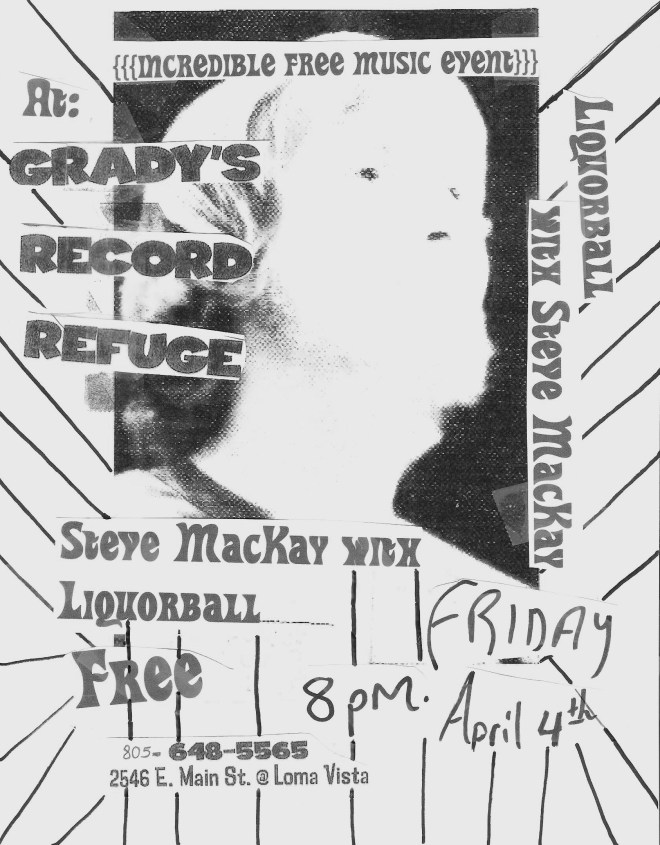
A night of rarefied energy music at Grady Runyon's record store…

WHEN: Friday, 4/4, 8-10pm
WHERE: Grady’s Record Refuge, 2546 E. Main St., Ventura, 805-648-5565
WHAT: Steve MacKay with Liquorball/Liquorball with Steve MacKay

“Yes, it’s THAT Steve MacKay. You won’t wanna miss the legendary Stooges saxophonists’ return to Grady’s Record Refuge (he played our grand opening in 2003) as he performs with San Francisco’s Liquorball for a night of rarefied energy music!

“Besides playing with the reformed Stooges, Steve MacKay has also been playing experimental music with the likes of Smegma, Radon All-Stars, and the Blues Prostitutes of late. His resume extends back to the mid-60’s and includes stints with the Violent Femmes, Snakefinger, and Commander Cody, among so many others……..once described as “San Francisco’s answer to nothing”, Liquorball’s spontaneous juggernauts of sound have been decorating the fringes of the underground for nearly 20 years. They now perform infrequently, but new recordings are rumored………..Liquorball and Steve MacKay first collaborated in 1999.

“As always, this is a FREE show……..though donations to the traveling artists will be gratefully accepted.
-GRR

“PS – you can also catch SM/LB in LA on saturday night!”
http://zeropointspace.org/

"WE ARE A REVOLUTION DISGUISED AS A THEATRE"

Arthur Magazine proudly presents
PARADISE NOW: A Collective Creation of The Living Theatre DVD

In 1968, the Living Theatre troupe returned to America with that unforgettable psychedelic mystery play based on the Kabbalah and the I Ching–PARADISE NOW. They had become a traveling commune, the not-so-secret agents of a comsic alternative. Wherever they went they turned whole cities upside down just by their presence. We would never be the same.

From THE LIVING THEATRE: ART, EXILE AND OUTRAGE by John Tytell (Grove Press, 1995):

“Doors singer Jim Morrison and poet Michael McClure actively participated in performances of Paradise Now at the [San Francisco Bay Area’s] Nourse Auditorium…. McClure brought Morrison to visit at [Lawrence] Ferlinghetti’s office. Julian [Beck, of the Living Theatre] was on and off the telephone to New York, frantically worried about the money to get the troupe back to Europe where engagements has been scheduled. Quietly, Morrison offered to assist with money.

“Morrison–who had read Artaud and Ginsberg in college–saw himself as a revolutionary figure. Agreeing that repression was the chief social evil in America and the cause of a general pathology, he was typical of the sectors of support The Living Theatre had received in America. His long improvisational song ‘When the Music’s Over’ was a basic statement of apocalypse. Another of his songs proclaims, as in Paradise Now, ‘We want the world, and we want it now.’ Morrison had seen every performance in Los Angeles and followed the company up to San Francisco.

“On the day after his visit with McClure, Jim Morrison have Julian twenty-five hundred dollars for the trip home…”

“PARADISE NOW: A Collective Creation of the Living Theatre” features rare, never-before-distributed films and revolutionary multimedia documents from The Living Theatre’s historic and influential ’68-’69 American tour. A fulminating art-meets-life installation brought to you by Arthur Magazine in collaboration with The Living Theatre and Universal Mutant, Inc.

LIMITED EDITION OF 1,000.

CLICK HERE FOR FULL DETAILS, ORDER INFO and YOUTUBE PREVIEW

New artwork by Andrew Millner

Andrew Millner: Biophilia

April 3 – May 10, 2008 at Tria Gallery

“The Poppy Economy”
2008
Lightjet print mounted on plex
42 x 118

Press release:

Tria Gallery will present Biophilia: Recent Works by Andrew Millner from April 3 through May 10, 2008. The exhibit will consist of both large-scale and mid-sized works.

In “Biophilia” (literally, attracted to the living), Andrew Millner explores in painstaking detail the wondrous contours of living things. He investigates the endless, sinuous shapes of leaves, tree and plants, reducing them to their outlines. Manet famously said, “there are no lines in nature.” This notion is belied by Millner’s exquisite work. Indeed, he sees nature exclusively in terms of lines, and his hand steadfastly follows and records the endless variety of botanical forms in his view.

Millner hand-draws his original works on a computer using a pen and an electronic tablet. Later they are printed as part of a whole garden or as a stand-alone print. The digital media allows the drawing to extend over months, and in the garden’s case, possibly years, without any set scale or date of completion. To Millner the garden is an ongoing work that can be added to indefinitely, seasonally.

Each elegant piece in “Biophilia” captures the unique form of a different species of botanica, including, among others, Cottonwood, Cherry, Magnolia, Poppy and Chamomile. As Millner states, “the closer one gets to these works, the more one can see. The tops of the trees are as visible as the bottoms; the back branches are as visible as the front. The drawing exists at no set scale, line weight or color. It is a pure act of drawing, evoking a mental map of the natural world in some of its most humble and underappreciated typologies.”

Andrew Millner received his BFA in Painting and Sculpture from the University of Michigan. His work has sold into private and corporate collections across the country. “Biophilia” at Tria Gallery will mark his tenth solo exhibition, and his first in New York City.

..

Tria Gallery specializes in contemporary painting and mixed media by established and emerging artists. In addition to artwork on exhibit, the gallery maintains an inventory of select works by its featured artists. Tria’s three directors, Carol Suchman, Paige Bart and Latifa Metheny, are committed to presenting artists with compelling bodies of work, and ones whose stories, should, in their opinion, be told.

Tria is located in the heart of Chelsea, at 547 West 27th Street, Suite 504, and is open to the public. Hours are Wednesday – Saturday, 11:00-6:00. Biophilia: Recent Works by Andrew Millner runs from April 3 through May 10, 2008. For more information please visit www.triagallerynyc.com.


How industrialism is killing the planet, Part 59

Did Your Shopping List Kill a Songbird?

By BRIDGET STUTCHBURY
March 30, 2008 New York Times

THOUGH a consumer may not be able to tell the difference, a striking red and blue Thomas the Tank Engine made in Wisconsin is not the same as one manufactured in China — the paint on the Chinese twin may contain dangerous levels of lead. In the same way, a plump red tomato from Florida is often not the same as one grown in Mexico. The imported fruits and vegetables found in our shopping carts in winter and early spring are grown with types and amounts of pesticides that would often be illegal in the United States.

In this case, the victims are North American songbirds. Bobolinks, called skunk blackbirds in some places, were once a common sight in the Eastern United States. In mating season, the male in his handsome tuxedo-like suit sings deliriously as he whirrs madly over the hayfields. Bobolink numbers have plummeted almost 50 percent in the last four decades, according to the North American Breeding Bird Survey.

The birds are being poisoned on their wintering grounds by highly toxic pesticides. Rosalind Renfrew, a biologist at the Vermont Center for Ecostudies, captured bobolinks feeding in rice fields in Bolivia and took samples of their blood to test for pesticide exposure. She found that about half of the birds had drastically reduced levels of cholinesterase, an enzyme that affects brain and nerve cells — a sign of exposure to toxic chemicals.

Since the 1980s, pesticide use has increased fivefold in Latin America as countries have expanded their production of nontraditional crops to fuel the demand for fresh produce during winter in North America and Europe. Rice farmers in the region use monocrotophos, methamidophos and carbofuran, all agricultural chemicals that are rated Class I toxins by the World Health Organization, are highly toxic to birds, and are either restricted or banned in the United States. In countries like Guatemala, Honduras and Ecuador, researchers have found that farmers spray their crops heavily and repeatedly with a chemical cocktail of dangerous pesticides.

In the mid-1990s, American biologists used satellite tracking to follow Swainson’s hawks to their wintering grounds in Argentina, where thousands of them were found dead from monocrotophos poisoning. Migratory songbirds like bobolinks, barn swallows and Eastern kingbirds are suffering mysterious population declines, and pesticides may well be to blame. A single application of a highly toxic pesticide to a field can kill seven to 25 songbirds per acre. About half the birds that researchers capture after such spraying are found to suffer from severely depressed neurological function.

Migratory birds, modern-day canaries in the coal mine, reveal an environmental problem hidden to consumers. Testing by the United States Food and Drug Administration shows that fruits and vegetables imported from Latin America are three times as likely to violate Environmental Protection Agency standards for pesticide residues as the same foods grown in the United States. Some but not all pesticide residues can be removed by washing or peeling produce, but tests by the Centers for Disease Control show that most Americans carry traces of pesticides in their blood. American consumers can discourage this poisoning by avoiding foods that are bad for the environment, bad for farmers in Latin America and, in the worst cases, bad for their own families.

What should you put on your bird-friendly grocery list? Organic coffee, for one thing. Most mass-produced coffee is grown in open fields heavily treated with fertilizers, herbicides, fungicides and insecticides. In contrast, traditional small coffee farmers grow their beans under a canopy of tropical trees, which provide shade and essential nitrogen, and fertilize their soil naturally with leaf litter. Their organic, fair-trade coffee is now available in many coffee shops and supermarkets, and it is recommended by the Audubon Society, the American Bird Conservancy and the Smithsonian Migratory Bird Center.

Organic bananas should also be on your list. Bananas are typically grown with one of the highest pesticide loads of any tropical crop. Although bananas present little risk of pesticide ingestion to the consumer, the environment where they are grown is heavily contaminated.

When it comes to nontraditional Latin American crops like melons, green beans, tomatoes, bell peppers and strawberries, it can be difficult to find any that are organically grown. We should buy these foods only if they are not imported from Latin America.

Now that spring is here, we take it for granted that the birds’ cheerful songs will fill the air when our apple trees blossom. But each year, as we continue to demand out-of-season fruits and vegetables, we ensure that fewer and fewer songbirds will return.

Bridget Stutchbury, a professor of biology at York University in Toronto, is the author of “Silence of the Songbirds.”