Return of the Bus

John Benson’s Bus

SONIC REDUCER
By Kimberly Chun
Feb 27-Mar 4, 2008 – San Francisco Bay Guardian

…Hope is in the air, and I’m feeling it, listening to Evil Wikkid Warrior’s John Benson talk about his recent troubles with the Bus, the 40-foot AC Transit behemoth he converted into a vegetable oil–swilling clean machine and mobile-as-a-dinosaur, all-ages, all-fun free underground music venue. Noise and party starters from here and away like Warhammer, Fucking Ocean, and Rubber O Cement have been playing down-low shows in the vehicle while it was parked on quiet, oft-industrial San Francisco and East Bay streets, but that all seemed to screech to a dead halt when, on Dec. 22, 2007, after a West Oakland show put on by a Benson cohort, the Bus was vandalized.

Bored neighborhood youth, Benson theorized, smashed all its glass windows, busted its solar panels, and threw bricks on top of it. “It was probably just a bunch of bored kids in the middle of the night. They saw this big thing, and it was like, ‘Duh, throw rock at big thing,'” offered Benson, who at the time was on a trip to Detroit. When he returned a few days later, the former A Minor Forest and Hale Zukas member faced compounding problems: the winter rain had flooded the exposed interior, damaging the electricity, warping the wooden floorboards, and causing the oriental rugs to molder.

Benson had planned to take the bus to Mexico to shoot a film, but that was out of the question. “The police told me that I wasn’t allowed to keep any vehicle on the street with a broken windshield and windows and they’d have to tow it,” he recalled. “But then I also wasn’t allowed to drive a vehicle with a broken windshield. It was a catch-22, and with no place to keep it, the cops visited me on a daily basis.” He also couldn’t find glass that would fit in the windshield, since most of the AC Transit fleet from back in the Bus’s day had been sold to Mexico, according to Benson, and it appeared that the only glass available would have to come from there — at more than $1,000 a piece.

Fortunately Benson’s friends and the noise community-of-sorts came together to support him. Guardian contributor George Chen threw a benefit that raised about $300, and word got out on the message board Spockmorgue that Benson needed money to repair the bus and a PayPal account was started on his behalf. Benson told me, “I did spend a lot of money on new solar panels and new skylights,” but what kept him going were the many people “e-mailing me privately, saying ‘Keep it up, John. Don’t give up. Don’t give up.’ I just got a huge amount of support from people I don’t even know.” One Boston member of the message board donated $100 simply because he said he had heard about the Bus through his friends who had performed on it and wanted to help.

An artist friend welded new metal frames to fit the vintage 1962 windshield glass that Benson discovered were the closest fit for the Bus, and after a few months of work the Bus was finally completed at the beginning of February. “It was miserable,” he remembered. “We were literally working in rain under tarps, broken glass everywhere, bleeding fingers, miserable. There was a 24-hour paint job with a lot of volunteers. Someone said it was like Fitzcarraldo — there were so many times we were burned and bloody and freezing cold in rain, trying to the get floor replaced and carpet. Definitely insane.”

Fortunately, work was completed in time for Benson to drive the mammoth vehicle down to Miami for the International Noise Festival, picking up pals and playing shows along the way. Later this spring he’ll head back to Florida to do more work on the Bus — it’s resting in Orlando in a friend’s backyard — and then drive it north for an East Coast tour. “In terms of love the bus is doing better than ever,” Bensons said happily, while eating chicken with his 12-year-old daughter, who’s also his Evil Wikkid Warrior bandmate. “Mechanically it’s just a little wrinkled.”
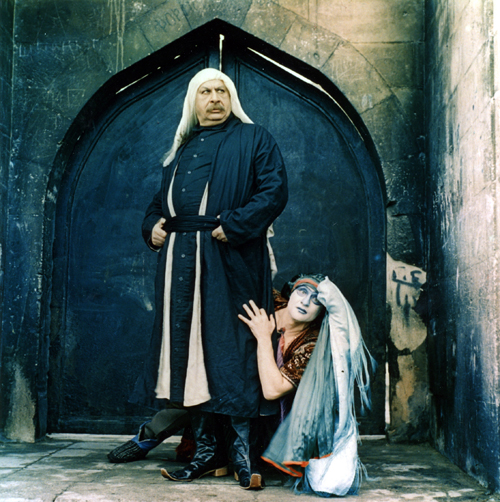
PARADJANOV double at LACMA TONIGHT (Fri)

The Films of Sergei Paradjanov | Los Angeles County Museum of Art

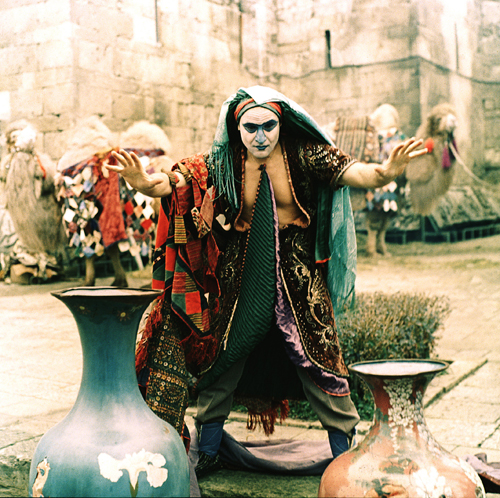
February 29 7:30 PM The Color of Pomegranates
9:20 PM The Legend of Suram Fortress

“Cursed by fate to make films within a Soviet system that condemned him as a decadent and a “surrealist.”… Paradjanov was nothing if not a catapulting folklorist, recreating the primitive pre-Soviet era as it might’ve been dreamt of in the opium-befogged skull of Omar Khayyám. There could hardly have been a more oppositive reply to Socialist Realism.” – Michael Atkinson, IFC.com

The films of Armenian painter and poet Sergei Paradjanov are joyous, colorful and musical expressions of visionary experience that revel in parable, myth and allegory. Inspired by the fables and traditions of Ukraine and the Caucasus, their delirious invention and ecstatic beauty belie a personal life marked by persistent persecution and imprisonment under the Soviet regime. Born in 1924 to Armenian parents in the Georgian capital of Tbilisi, Paradjanov studied railway engineering and music before enrolling in the Moscow Film Institute. He rose to international acclaim with 1965’s Shadows of Forgotten Ancestors. Commissioned as a straight adaptation honoring the centenary of Ukrainian writer Mikhail Kotsiubinsky and filmed amongst a Gutsul tribe, it won awards at sixteen film festivals for its stunning blend of rapturous cinematography and folkloric structure. However, it was attacked by Soviet censors for excessive “formalism” and “Ukrainian nationalism.”

Paradjanov was first incarcerated in the early 1970s in a maximum security prison. In the early 1980s, he was again arrested and imprisoned. Both times, he was falsely charged of such crimes as homosexuality, bribery and inciting suicide [????]. He later joked that he was the only filmmaker locked up under Stalin, Brezhnev and Andropov and he even teased friend Andrei Tarkovsky that “what you are lacking is a year in prison; your talent would deepen and grow more powerful.” A committee which included René Clair, Catherine Deneuve, Yves Montand, Alain Resnais and Agnès Varda was formed in hopes of repatriating the director to France Paradjanov was unable to complete a feature film between 1968’s The Color of Pomegranates and 1985’s The Legend of Suram Fortress. By his own count, he had up to twenty-four film proposals rejected by Soviet authorities. All the while, he made several hundred paintings, sculptures and collages, most of which are now housed at the museum in his honor located in the Armenian capital of Yerevan. It was inaugurated in 1991, one year after his death.

The Color of Pomegranates
February 29 | 7:30 pm
While exiled in Armenia, Paradjanov pays tribute to the life of 18th century troubadour turned archbishop Sayat Nova. Though suppressed for two years by Soviet authorities and only released in a shorter, censored version, it remains a ravishing and enigmatic masterwork considered by many as Paradjanov’s crowning achievement. “An extraordinarily beautiful film…any one of its linked tableaux is a startling combination of Byzantine flatness, Quattrocento beatifics and Islamic symmetry.” – J. Hoberman, Village Voice
1969/color/73 min. | Scr/dir: Sergei Paradjanov; w/ Sofiko Chiaureli

The Legend of Suram Fortress
February 29 | 9:20 pm
Paradjanov’s first film after his years in prison is a retelling of Georgia’s national legend about a formidable castle whose walls continuously crumble until a fortune-teller reveals its secret. “Paradjanov’s most sumptuous production…at once overplotted and oblique, Christian and pagan, archaic and postmodern.” – J. Hoberman, Village Voice
1984/color/83 min. | Scr: Vazha Gigashvili; dir: Sergei Paradjanov; w/ Veriko Andzhaparidze, Dodo Abashidze, Sofiko Chiaureli

TICKETS/INFORMATION

Tickets are $9; $6 for LACMA members, seniors (62+), and students with valid ID. Price includes both films in a double bill except where noted. Tickets to the second film on a double bill are $5.00 and are only available at the museum box office prior to the screening. Please note: Many programs sell out. Tickets are on sale now and may be purchased at the museum box office (323 857-6010). All films are subject to change and many films are unrated and may not be appropriate for younger viewers. For more information or to check current programs, call the museum box office at (323) 857-6010, visit http://www.lacma.org or subscribe to the Film Department’s e-newsletter by emailing film@lacma.org


Survey finds teenagers don't know shit.

Survey Finds Teenagers Ignorant on Basic History and Literature Questions

By SAM DILLON
Published: February 27, 2008 New York Times

Fewer than half of American teenagers who were asked basic history and literature questions in a phone survey knew when the Civil War was fought, and one in four said Columbus sailed to the New World some time after 1750, not in 1492.

The survey results, released on Tuesday, demonstrate that a significant proportion of teenagers live in “stunning ignorance” of history and literature, said the group that commissioned it, Common Core.

The organization describes itself as a new research and advocacy organization that will press for more teaching of the liberal arts in public schools.

The group says President Bush’s education law, No Child Left Behind, has impoverished public school curriculums by holding schools accountable for student scores on annual tests in reading and mathematics, but in no other subjects.

Politically, the group’s leaders are strange bedfellows. Its founding board includes Antonia Cortese, executive vice president of the American Federation of Teachers, a union that is a powerful force in the Democratic Party, and Diane Ravitch, an education professor at New York University who was assistant education secretary under the first President George Bush.

Its executive director is Lynne Munson, former deputy chairwoman of the National Endowment for the Humanities and former special assistant to Vice President Dick Cheney’s wife, Lynne.

“We’re a truly diverse group,” Mrs. Munson said. “We almost certainly vote differently, and we have varying opinions about different aspects of educational reform. But when it comes to concern that all of America’s children receive a comprehensive liberal arts and science education, we all agree.”

In the survey, 1,200 17-year-olds were called in January and asked to answer 33 multiple-choice questions about history and literature that were read aloud to them. The questions were drawn from a test that the federal government administered in 1986.

About a quarter of the teenagers were unable to correctly identify Hitler as Germany’s chancellor in World War II, instead identifying him as a munitions maker, an Austrian premier and the German kaiser.

On literature, the teenagers fared even worse. Four in 10 could pick the name of Ralph Ellison’s novel about a young man’s growing up in the South and moving to Harlem, “Invisible Man,” from a list of titles. About half knew that in the Bible Job is known for his patience in suffering. About as many said he was known for his skill as a builder, his prowess in battle or his prophetic abilities.

The history question that proved easiest asked the respondents to identify the man who declared, “I have a dream.” Ninety-seven percent correctly picked the Rev. Dr. Martin Luther King Jr.

About 8 in 10, a higher percentage than on any other literature question, knew that Harper Lee’s “To Kill a Mockingbird” is about two children affected by the conflict in their community when their father defends a black man in court.

In a joint introduction to their report, Ms. Cortese and Dr. Ravitch did not directly blame the No Child law for the dismal results but said it had led schools to focus too narrowly on reading and math, crowding time out of the school day for history, literature and other subjects.

“The nation’s education system has become obsessed with testing and basic skills because of the requirements of federal law, and that is not healthy,” Ms. Cortese and Dr. Ravitch said.

A string of studies have documented the curriculum’s narrowing since Mr. Bush signed the law in January 2002.

Last week, the Center on Education Policy, a research group in Washington that has studied the law, estimated that based on its own survey that 62 percent of school systems had added an average of three hours of math or reading instruction a week at the expense of time for social studies, art and other subjects.

TONIGHT (Mon): Ray Harryhausen, Forrest J. Ackerman and Ray Bradbury TOGETHER in Glendale

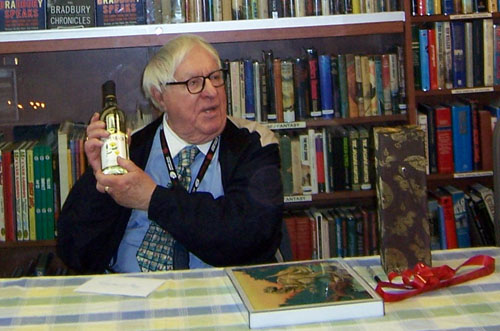
raywine.jpg

above: Ray Bradbury displays a gift bottle of dandelion wine at a previous signing.

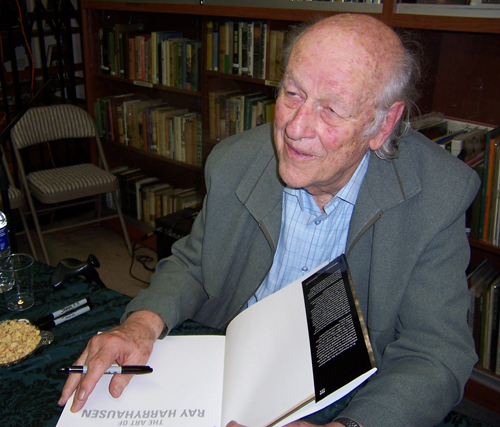
harryhausen.jpg

above: Smilin’ Ray Harryhausen at a previous signing.

From Bookfellows/Mystery and Imagination‘s announcement list email:

Monday, February 25, 7:30:

“Ray Harryhausen, Forrest Ackerman and Ray Bradbury–the three founding members of the Los Angeles Science Fiction Association–will be giving a talk, doing a Q&A, and signing books and DVDs on hand at our bookstore. This will fun and very special. Please join us in celebrating these remarkable men’s contributions to the science fiction and horror genres.

“Mr. Harryhausen, the inventor of stop-motion animation will be visiting Los Angeles from his home in London! Mr. Ackerman was Mr. Bradbury’s first agent and is credited with helping to sell Mr. Bradbury’s first book.

“We have a photo posted of the three horror/sci-fi film pioneers, whose first loves were dinosaurs and KING KONG, at their sci-fi meeting in the 1950s at Clifton’s cafeteria in downtown LA. Mr. Harryhausen’s film THE BEAST FROM 20,000 FATHOMS was inspired by Mr. Bradbury’s story THE FOGHORN. The three men are incredibly linked to each other and to the genre and have quite an anecdotal history to talk about. They blazed the trail for so many others.

“Yes, all you special effects people–please bring your models and creations to show Mr. Harryhausen. Last year, when they were brought, Mr. Harryhausen loved it!

“In respect for the energy of the three men aged 87, 87 and 91, we have agreed with the authors not to take any mail orders for this event. Sorry, NO items will be allowed to be brought into the bookstore to be signed for this event. Thanks for your understanding and respect for the authors.

“MYSTERY AND IMAGINATION is owned and operated by Malcolm and Christine Bell, who have been Los Angeles-area purveyors of Mystery, Detective, Science Fiction, Fantasy and Horror fiction since 1975.

“In recent years, under the name BOOKFELLOWS, the couple has expanded their stock to include all kinds of Fiction, Poetry, Drama, Children’s Lit, Performing Arts, Western Americana, and fine books in many non-fiction areas.

“Malcolm and Christine are members of the Antiquarian Booksellers’ Association of American and the International League of Antiquarian Booksellers; they serve on the board of Firsts Magazine, and regularly offer articles and advice to the readers of that book collecting journal.

“Our open shop, BOOKFELLOWS/MYSTERY AND IMAGINATION, is located in the Los Angeles area, at 238 N. Brand Blvd. in Glendale, California 91203, and houses over 4,000 square feet of books, ranging from scarce first editions to paperbacks.

“We welcome wantlists and happily conduct book searches. Give us a call at 818/545-0206, email us at books@mysteryandimagination.com, or, best of all, come visit us in person to browse, search for that elusive title, or just talk books.

“We’re open seven days a week!
Monday-Thursday, 10am-7pm
Friday-Saturday, 10am-8pm
Sunday, noon to 6pm”

link courtesy P. Relic!

BEAUTIFUL ACTION: WALKING TO VOTE, ON A TEXAS FREEWAY

Thousands march in Prairie View for voting rights

By HELEN ERIKSEN, Houston Chronicle
Feb. 20, 2008, 10:10AM

PRAIRIE VIEW — More than 1,000 Prairie View A&M University students and supporters marched seven miles to the polls on Tuesday to protest the lack of an early voting place on campus for the March 4 election.

Students, local leaders, civil rights activists and elected officials walked from the campus to the Waller County Courthouse in Hempstead carrying “Register to Vote” signs. The majority wore black shirts with the slogan, “It is 2008. We will vote!”

After the march, some students stood in a long line to cast their ballots on the first day of early voting, while others filled out new voter registration cards in a building across from the courthouse. Early voting ended at about 5:30 p.m. Tuesday, and some waited for five hours to vote.

Freshman Brittney Veasey, who was voting for the first time, said she took the 2 1/2 -hour journey because she believes her vote will make a difference.

“I feel like we’re making history today,” she said. “Instead of making it inconvenient, students should be encouraged to vote.”

Last week, under pressure from federal authorities, Waller County officials added three temporary polling places for early voting, ditching plans to open only one voting site in advance of the March 4 primary.

The Justice Department questioned the county’s original decision to cut early-voting sites from a half dozen throughout the county to one in Hempstead. Officials said the county could not afford equipment or staff to operate the additional sites.

Following an emergency meeting last week, the county submitted a revamped proposal to the Justice Department that included one more day of early voting on Thursday at the three new polling sites. Federal officials have 60 days to review and approve the plan, but have not raised any objections.

Debra Mergel, the county’s attorney, said one of the added polling places about a mile from the campus will have early voting from 8 a.m. to 5 p.m., Thursday through Saturday.

Mergel defended the county’s decision to have the polling place at a nearby community center rather than on campus.

“It is in a county-owned building that we have always used,” she said.

Some students had not learned about the added voting site near the campus, but Mergel said the county advertised it in the local media.

On Election Day, students can vote on campus in the University Alumni Association.

Christina Sanders, who helped organize the march and is a member of Black Youth Vote! Texas, said the county made concessions only after the Justice Department intervened and students complained.

She said the march was necessary to send a message to local officials that a lack of a voting place on campus “is unacceptable.”

The school has about 8,000 students, and officials estimate there are 3,000 registered voters among them.

State Rep. Sylvester Turner, D-Houston, called it a “gross injustice” that the county did not seek input from the minority community prior to before establishing polling sites. He said the county has a turbulent history of thwarting Prairie View students’ attempts to vote.

The controversy over voting came to a head in 2004 when students marched from the campus to the courthouse after former Waller County District Attorney Oliver Kitzman declared them ineligible to vote, claiming they did not meet state residency standards.

Meanwhile, the county is being investigated by the Texas Attorney General’s Office based on complaints by local black leaders following after the November 2006 general election. Those allegations stem from voting machine failures, inadequate staffing and long delays for voting results.

"Quilombo Country: Afrobrazilian Villages in the 21st Century" premieres this Sat in NYC


Macumba dancers spin. Santa Maria, Itapicuru.


Fancy boi dances. Santa Rosa, Itapicuru.

“Quilombo Country,” the award-winning film about Brazilian villages founded by escaped and rebel slaves, will hold its World Theatrical Premiere on Saturday, the 23rd of February [Black History Month] at 8pm at the Anthology Film Archives, 32 2nd Ave. (2nd St.) in New York City, followed by a Q&A with director Leonard Abrams.

Go to http://www.quilombofilm.com for more information, or call 212-260-7540. To reserve your ticket now, go to http://www.quilombofilm.com/ticketcart.htm.

To commemorate the event and in gratitude to our supporters, we invite all in attendance to a reception after the screening.

“Quilombo Country,” a documentary film shot in digital video, provides a portrait of rural communities in Brazil that were either founded by runaway slaves or begun from abandoned plantations. This type of community is known as a quilombo, from an Angolan word that means “encampment.” As many as 2,000 quilombos exist today.

Contrary to Brazil’s national mythology, Brazil was a brutal and deadly place for slaves. But they didn’t submit willingly. Thousands escaped, while others led political and militant movements that forced white farmers to leave. Largely unknown to the outside world, today these communities struggle to preserve a rich heritage born of resistance to oppression.

The film ranges from the Northeastern sugar-growing regions to the heart of the Amazon rainforest, raising issues of political identity, land rights, and racial and socioeconomic discrimination. Included are examples of the material culture that allow the quilombolas to survive in relative isolation, including hunting, fishing, construction and agriculture; as well as rare footage of syncretic Umbanda and Pajelança ceremonies; Tambor de Crioula, Carimbó and Boi Bumba drum and dance celebrations; and Festivals of the Mast.

“Quilombo Country” is narrated by Chuck D, the legendary poet, media commentator and leader of the iconic hip hop band Public Enemy.

“Quilombo Country” was shot in digital video and has a runtime of 73 minutes. Leonard Abrams is the producer and director.

“Persuasive, complex, and timely.”
– Southern Quarterly
“Outstanding footage of festivals and ceremonies”
– In These Times
“Winner, Best Documentary, 2007”
– Black International Cinema Berlin

http://www.quilombofilm.com