HIDDEN IN PLAIN SIGHT (Arthur Yahoo blog, 2007)

This was the first, introductory post for Arthur Magazine’s little-seen (and now erased) blog on the Yahoo Music site. Kind of a statement of purpose for Arthur circa 2007. It is a bit self-righteous/snide/grandiose, but geez, look at the dumbness that was going on. Different era now but maybe it has some resonance? I dunno. This was written for a general-ish audience (that didn’t really exist, haha) and it’s deliberately provocative. And it’s dated. But whatever. There it is. I was often exasperated by dumb stuff in the mainstream media, had trouble just ignoring it.

Hidden in Plain Sight

by Jay Babcock

I was recently asked by a newspaper reporter to comment on artists licensing their music for use in commercials. For a certain generation of fan, or music journalist, I guess, there is still some vestigial outrage over a musician playing for his supper. For these folks, selling your music to soundtrack an iTunes or VW ad is a big sell-out, a violation of some unspoken, unsigned compact between artist and fan regarding the purposes to which art can be rightly put. Few of us are surprised anymore by this casual betrayal—there’s all sorts of justifications for it, of course, and we all know it’s gonna happen anyway—but still, it stings to be reminded, once again, that nothing is sacred, not even our holy texts (cf. the Doors’ “Break On Through,” Nick Drake’s “Pink Moon”). We hate to learn that even our monastics have a price.

Get over it, says everyone under 35. Raised on the Market Knows Best principles promulgated through hip-hop, sports, celebrities, government, public education and other wings of corporate capitalism (the real winner after the failed counterculture revolution of the Sixties), most of Gen X and Gen 9-11 don’t blink once at all the formerly taboo-on-their-face money-makin’ practices that have become commonplace in today’s music industry. (There’s that word, “industry”: whenever something stops being a Mode of Expression or Field of Endeavor and becomes an Industry, you can be sure a steep decline in quality is around the corner.) For most of us, there’s simply no issue here. An artist, if they’re not a fool or some weirdo on a self-denial trip, will of course sign a deal with a record label owned by a sleazy transnational corporation, perform on tours sponsored by other sleazy corporations and the US military recruitment machine, and participate in whatever crypto-payola scams are going on right now (radio station “charity” wintertime acoustic concerts being possibly the most egregious offenders in this category) in the hopes of getting some airplay, some screentime, some press, some publicity, some tour sponsorship, some ringtone deal, some movie soundtrack deal, some videogame deal, some slot in Starbucks in-store programming and yes of course, the grand slam, at least for a “new”/”fresh”/”buzz”/”breaking” band: a TV AD DEAL. Those who fail to do so are unlucky, or unworthy, market failures, yanked offstage by the proverbial cane—held, of course, by Adam Smith’s Invisible Hand.

But isn’t there a larger question here?

What if we turn it around a bit, and ask WHY IS IT that the only way a young musician can get across to the general public these days (to the degree that one exists anymore, having been successfully niche-ized, atomized and banalified in pursuit of corporate profits, but that’s a whole ‘nother blog post…) is as wallpaper for some other product? Why is it that we can’t hear new music on the radio, or see new music performed on television? In other words, why isn’t music on its own, given its own space in the still-powerful mass media? Isn’t music good enough? Or, could it be that it’s just not profitable enough? And if the latter is the case, shouldn’t we ask why the mass media system–and our planet’s airwaves, which belong to all of us–structured in such a way that our right to meaningful, rich, sensuous, full-of-life art is increasingly denied?

What I’m saying is: artists have not failed their obligation to their art by selling out to the system. Instead, the system itself has failed the artists, and by extension, the listening public. But even as music-as-itself has been deemed insufficiently profitable, people still want to hear it…and so our nation’s finest corporate super-brains have diligently supplied us with the most efficient, state-of-the-art music industry schemes available: Fox’s “American Idol”—a quasi-industrial training film disguised as a TV game show/soap opera, an idea borrowed from the Brits—and CBS’s corporate reality show “Rock Star,” which, in its initial season, featured actual humans competing on camera to replace the dead guy in INXS, the whole affair breathlessly chronicled by the co-hosting team of Brooke Burke and Dave Navarro.

Dave Navarro: now there’s a name to conjure with. Is there any other musician in recent memory who has so thoroughly–and publicly–squandered and betrayed all of his promise, talent, credibitlity and integrity? The man who who played guitar in Jane’s Addiction–a radical, somewhat-misunderstood band unfortunately overshadowed by the Lollapalooza colossus that its singer spawned–now spends his short time on the planet doing play-by-play for a fake band of rock careerists and hosting oh-so-dangerous-by-the-numbers premiere parties for insipid “torture porn” feature films. Dave has just launched “Spread Entertainment,” which is all about his deep desire to “to use the Internet to support artists and see things that are out there that other corporate structures aren’t allowing us to see. It seems with satellite TV, the Internet, magazines—there’s almost so many options, and we’re only seeing the same five things.” A rather breathtaking statement, asking us to somehow ignore Dave’s active participation in all the aforementioned craptaculars, as well as his “work” on the execrable Camp Freddy Radio program, broadcast Saturday nights in Los Angeles.

Which rather conveniently brings us back to where we started: one of the reasons musicians, especially young ones, license their music to all comers on the TV ad front, is because they can’t get substantial radio airtime anywhere, not even self-styled “indie”/”we can play whatever we want” shows like “Camp Freddy.” And so, everyone loses.

Case in point: on Saturday night, March 3, driving downtown to see Marnie Stern play at The Smell in her first-ever L.A. gig, my radio-scanning ended, naturally, when I heard Van Halen. Happiness! Until, at the song’s conclusion, it became apparent that I’d accidentally tuned in to the dread Camp Freddy. Now, this was in the week just after Eddie had announced that, unlike Amy Winehouse, he would go back to rehab, which in turn meant the summer’s Van Halen reunion tour with Diamond Dave Lee Roth and Eddie’s 15-year-old son Wolfgang on bass, was off—suckage!—which got non-Diamond Dave, that is Dave Navarro, talking about how Eddie’s signature fingertapping guitar style, once widely imitated, was now obsolete. Which was pretty laughable, given that within a half-hour of his making that comment, Marnie Stern was finger-tapping our faces off at the Smell. (Don’t believe me? Watch her and the equally remarkable free rock drummer Zach Hill in duo performance here.)

Now, if ever there was an artist worthy of mass media coverage, of being granted access to the airwaves, of being let through the gates to those of us who, in spite of everything, still have curious, engaged ears, it’s a once-in-a-decade (or more?) talent like Marnie Stern. You want finger tapping? Well, here you go! But she doesn’t even register with Navarro and the other gatekeepers, because they’ve all been paid off. Or are lazy. Or willfully ignorant. Or compliant. Doing what they’re told, letting in what the robots tell them to: drones for hire, de facto censors of consciousness. Bow down to the new kommisars: for-hire ad agencies and marketing firms, like Deutsch LA, whose boss told the Los Angeles Times last week that “Everyone has a cool friend that exposes them to new things—the idea is that a brand can become that kind of channel.” Word to the wise: a corporation doesn’t want to be your friend. It wants your money.

Opening up the gates, or rather, ignoring them altogether, is what Arthur—the print magazine, the website, the label, the festivals, and now this Yahoo!Music blog—is all about. Arthur isn’t for hire. (Arthur’s not even for sale—the magazine is free.) Arthur is a labor of love for those of us working here—it’s not a marketing initiative, not a quest for lucre. (Some things really are more important than money.) And so, when we’re given the opportunity to do what we want, we do what we love: we champion the musicians, the artists, the thinkers out there who are doing extraordinary work, who you might dig if only somebody hipped you to them—somebody who hasn’t been paid to do the job, somebody you could trust. That’s been our aim since we started Arthur in 2002: to be a learned, enthusiastic guide to the bustling, effervescent, mindblowing, and endlessly re-generating underground–the loamy place where everything good comes from. The place that denies entry to no one.

Not even Dave Navarro.

##

THE NEW CLOWN ON THE BLOCK: Susan Carpenter joins the circus (Arthur, 2002)

…AND THEN I JOINED THE CIRCUS

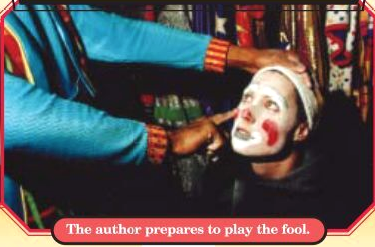
Self-described “desk-bound journalist” Susan Carpenter decided to find out firsthand and feet-first how the females of the species are transforming the 21st-century circus. Now her back hurts. Photography by Lauren Klain.

Originally published in Arthur No. 2 (January 2003). Layout by W.T. Nelson.

Xia Kemin has Ember pinned. He’s got her left leg lodged under a foot-thick gym mat while he presses her right ankle up behind her ear. Ember is crying. Kemin, the former Chinese acrobat who is her teacher, just laughs. He knows that pain is the only way Ember, a 20-year-old daycare worker and wannabe contortionist, will ever become the human pretzel she’s dreamed of.

Ember is a beginning student at San Francisco’s Circus Center, a school that teaches “anything in the air, upside down, backwards and humanly impossible” to aspiring circus performers. The Center is also my first stop before joining Ringling Brothers for a couple days as I attempt to figure out why women are still running away to join the circus–and whether they do anything more these days than sit pretty on a trapeze.

I’ve never been to the circus, not even as a child, but it’s getting harder to avoid it. Circus is everywhere, nudging itself into the public consciousness through books like Katherine Dunn’s carnivalesque Geek Love, movies such as Freaks and the neo-pagan art ritual known as Burning Man. I knew it had reached critical mass last summer when a friend from San Francisco asked if 20 of her friends could stay at my house while their gypsy caravan whirled through L.A. in a flourish of fire wands, wigs and stilts.

Circus used to mean men wrestling snakes while women in glittery unitards flew through the air in front of sticky-fingered children. That all changed when the flashy French Cirque du Soleil came to town in 1987, throwing mimes, bungee jumpers and Chinese pole dancers into the mix and attracting a more adult crowd. Circus hasn’t been the same since. Today, there are not only more circuses–and schools to train for them–but there’s also more women joining the circus, fusing their own sense of style with traditional techniques. The centuries-old art form, it seems, is finally getting a much-needed kick in the pants.

Continue reading

Interview With an Old Stooge: Kristine McKenna talks with IGGY POP about everything (Arthur, 2003)

Originally published in Arthur No. 6 (Sept. 2003), with photography by Peter G. Whitfield, on the occasion of the Stooges’ reunion as a live force.

If you’ve never read Iggy Pop’s 1982 autobiography, I Need More, do yourself a favor and go out and buy it. It’s a totally inspiring book. Talk about triumph of the will! There he was, Jim Osterberg, a slightly built, asthmatic only child growing up in a shabby mobile home in a sleepy Midwestern town during the ‘50s. The chances of his metamorphosing into a rock avatar who would channel the id of an entire generation were not good. But Jim came in with an extra hit of the life force, and that’s exactly what he did.

Perhaps I should backtrack for a moment and recap the story so far. James Newell Osterberg was born on April 21, 1947, in Muskegon, Michigan. His father, Newell Sr., was an English teacher, and his family lived in a trailer park in Ypsilanti Michigan. When he was 15 he formed his first band, the Iguanas, which is how he wound up with the stage name Iggy. He was playing drums at the time, and after three years of practice and local gigs, the Iguanas recorded a single; the year was 1965, and the song was Mona, backed with I Don’t Know Why. A short time later he joined the Prime Movers Blues Band, an experience that prompted him to head for Chicago to serve some kind of apprenticeship with real blues guys. Eight months later he’d come to the conclusion he was barking up the wrong tree, so he returned to Ann Arbor and formed the Psychedelic Stooges with Ron and Scott Asheton. They played their first gig on Halloween in 1967. 

It was then that Iggy began redefining the parameters of rock’n’ roll with a show unlike anything that had been seen before. Synthesizing elements of shamanic ritual, blues, Artaud’s Theater of Cruelty, psychedelia, and  performance art, Iggy invented a frightening and transformational form of musical theater that soared into the stratosphere. A crucial ingredient in his show was his extraordinary body — a perfectly constructed skeleton with an overlay of muscle in a wrapping of taut skin — which he deployed to maximum effect. He was also hilarious. All of Iggy’s work has been inflected with a bracing current of self-deprecating humor that makes him very easy to love. Describing himself in the early days of his career in I Need More, he says ‘got gotta’ understand that I was still like Topcat, the cartoon character. I was very lazy and happiest dozing in a garbage can.’ Who can’t relate to that?

The Stooges were extreme and definitely weren’t for everyone, but incredibly enough, they were signed to Elektra Records just a year after they debuted. The next five years were a tornado of wild gigs, drugs and escalating conflict, and at the end of 1973 Iggy quit the band. His downward spiral gathered momentum, and in 1975 he suffered a breakdown that resulted in several weeks of hospitalization. His longtime fan David Bowie helped him relocate to Berlin, got him back on his feet, and produced his first two solos albums, The Idiot, and Lust for Life.

It was shortly after that, in 1979, that I interviewed Iggy for the first time. We met in his tiny room at the now defunct Tropicana Motel, and to tell the truth, I was afraid of him — his reputation at that point was rather formidable. He surprised me, though. He came across as a somewhat reserved, well-spoken man who’d clearly thought long and hard about the world and his place in it. 

At the end of our meeting, he said ‘if I have any goal it’s to be an unchanging beacon in this world full of health foods and good vibes. I wish not to change.’ Twenty-four years later it seems safe to say he’s achieved that goal, and with his recent reunion with the Stooges he comes full circle. His new album, Skull Ring, includes four new songs written and recorded with his childhood pals from Michigan, along with six new songs by Iggy and his band of the past twelve years, the Trolls. Green Day, Peaches, and Sum 41 also turn up on the album, which was recorded in Miami where Iggy’s lived since 1999. (He moved there from New York following his divorce from his companion of 16 years, Suchi Asano Osterberg.) Miami seems to suit him; he seemed strong, focused and in excellent spirits when we spoke in late July. — Kristine McKenna

What is the source of your strength?

Whatever strength I have is probably the result of the fact that I made some good emotional investments at an early age. I went for a certain kind of music and maintained the naïve belief that I could do something wonderful in music, and that that would help me move towards what is wonderful in life. I looked like I was nuts at the time, and those beliefs caused me a lot of grief for a while, but it paid off for me big time. 

Continue reading

CUSTODIAL WORK

A long time ago when we switched servers the Arthur Magazine domain code got messed up for some reason and a lot of images on the blog stopped displaying, line breaks went awry, and so on. I knew this had happened but I’ve neglected fixing it for years as it’s quite a bit of work.

But now, here we are. I’m going through and fixing stuff by hand, one post at a time. There are over 5,300 posts.

Oh gawd.

As I go about this custodial work inevitably I’m seeing lots of stuff for the first time in a while. If you want to follow along, I’ll be sharing highlights or just stuff I find interesting on my twitter feed: https://twitter.com/jaywbabcock.

I’m still doing an email newsletter called Landline. Might be moving it to Substack soon. For now, sign-up and free archive are here: https://tinyletter.com/jaywbabcock/archive

all the best,

Jay Babcock

Tucson, Arizona

Alan Moore on Kenneth Grant

From ‘The Midian Mailer’, 1998

Beyond our Ken — A review by Alan Moore

Against the Light, A Nightside Narrative by Kenneth Grant (Starfire Publishing,
1997)

“This is a terrible defect in your outlook on life; you cannot be content with
the simplicity of reality and fact; you have to go off into a pipe-dream. ” –
Aleister Crowley, writing to Kenneth Grant, February 15th, 1945.

As fascinating and as ultimately mystifying as a giant squid in a cocktail
dress, what shall we make of Kenneth Grant? I know few occultists without at
least a passing interest in his work, and I know fewer still who would profess
to have the first idea what he is on about. What he is on. To open any Grant
text following his relatively lucid Magical Revival is to plunge into an
information soup, an overwhelming and hallucinatory bouillon of arcane fact,
mystic speculation and apparent outright fantasy, as appetising (and as
structured) as a dish of gumbo. The delicious esoteric fragments tumble past in
an incessant boil of prose, each morsel having the authentic taste of magic,
each entirely disconnected from the morsel which preceded it. Sometimes it seems
as if inferior ingredients have been included, from an unreliable source: the
occult data and the correspondences that simply fail to check out when
investigated, knowledge that appears to have been channelled rather than
researched. Doubtful transmissions from the Mauve Zone.

Spicing this delirious broth, characteristically we come across bewildering yet
urgent outbursts in which Grant repeatedly protests that the eleventh degree
ritual of the O.T.O involves no homosexual practices, or jaw-dropping accounts
of magic workings that defy all credibility, with live baboons dragged
screeching into nothingness by extra-human forces, this delivered casually,
almost as after-dinner anecdote. The onslaught of compulsive weirdness in
Grant’s work is unrelenting, filled with jumpy fast-cuts that remind one less of
text than television: H.P. Lovecraft’s House Party. Each chapter an emetic gush
of curdling chthonic biles and juices served up steaming; a hot shrapnel of
ideas, intense and indiscriminate. A shotgun full of snails and amethysts
discharged point blank into the reader’s face.

Continue reading

“THE NORTH AND SOUTH OF YOU: An Erotic Worldview” by JON HASSELL (Arthur, 2005)

Originally published in Arthur No. 18/Sept. 2005


THE NORTH AND SOUTH OF YOU
An Erotic Worldview

by Jon Hassell

“I love the East, West, North and the South of you…”
— Cole Porter, “All of You” 

A tale of two equators—one around the planet, another at the waistline—and how the present global imbalance between a “developed” (technological) North dominating an “underdeveloped” (but culturally rich) South is a projection of the imbalance between the “north of you” (head, intellect, abstraction) and the “south of you” (hips, sensuality, emotion).

Could the story be as simple as the difference in how people turn out after centuries of evolution in a cold, hostile climate versus a warm, friendly one?  And if it were, what are the chances that such a simple answer would be accepted by those whose minds have become so deeply etched with the printed circuits of language and abstraction that what is obvious on a sensual level is routinely “explained” out of existence?

Relieved of the necessity of struggle in order to stay warm, southern peoples turned toward the “art of living”: decorating experience with a surround of color and pattern and rhythm. This was in contrast to northern peoples who—in order to merely survive in the cold—had to become resourceful in the way that later became known as “technology.” A few thousand years later, this branched into communications technology—the form which had the power to change the world more than any previous development. So the northern worldview—one reflecting the cumulative psychology of struggle—was the first to be projected worldwide in the seductive new forms of mass media.

And as the science and technology paradigm became the gold standard by which the rest of the world was judged (creating the cleavage into “first” and “third worlds”), many of the life-enriching gifts of the South—the ones which are often most treasured in our personal experience—have gone deeply undervalued, appropriated, or simply, gone.

A different kind of “global warming”—an emotional one—is called for as the basis for creating an alternate scale of “market value”—one that accommodates the samba as well as the microchip, one which reflects the actual degree of pleasure and cultural enrichment brought to our lives from the South, and the south of us.

DON’T THINK ABOUT IT

The 7th annual Austin Psych Fest is coming up in May and the lineup for this three-day celebration is praiseworthy as always. A festival featuring BOMBINO, TEMPLES, GRAVEYARD, WHITE HILLS, WOODS, MOON DUO, PANDA BEAR, ACID MOTHERS TEMPLE, LIARS, DEAD MEADOW, GAP DREAM, STEVE GUNN, GREG ASHLEY, MARK MCGUIRE, THE ZOMBIES (!!!), EARTHLESS, BARDO POND, DESTRUCTION UNIT…? Get out! You and those dearest to you have no choice but to attend. Buy as many tickets as possible NOW NOW NOW via austinpsychfest.com

Here’s the latest poster with the full line-up…

APF2014-WEB

“Good Fuzz”: MATT ‘MV’ VALENTINE profiled by BYRON COLEY (Arthur, 2013)

MVsml

This piece was originally published in Arthur No. 34 (2013, sold out), with cover artwork by Arik Roper. I haven’t found a way to present the article online in a way that makes the article’s main text and its many (utterly essential) footnotes easy to read, side-by-side. So: following is the article’s main text, without footnotes. To read the article in full, with footnotes, download this free 31-page PDF. Hope this does it for ya. P.S. ESSENTIAL SIDEBAR: “More Smoke Than Folk: A few important MATT ‘MV’ VALENTINE listening experiences, assembled by Dan Ireton & Byron Coley and presented in chronological order”   — Jay

GOOD FUZZ

For over two decades, musician/head MATT VALENTINE has navigated strange, inspiring trips across myriad underground psychedelic terrains, joined by a revolving cast of fellow free travelers. Byron Coley crosses the bridge to get MV’s side of the story.

Matt Valentine aka Matthew Dell aka LunarMV, etc., is one of the more righteous freaks of our age. As a writer, guitarist, vocalist, label head, whiskey fan, and whatever else he might happen to be, Matt is one of those rare guys who is always ready to go “all in.” He is neither shy about his many accomplishments, nor unwilling to speak about them, but he is so flat-out committed to his own sci-fi-damaged version of personal history the way he’d like it to be known that he can be a tough person to interview. He loves the elliptical, the mysterious, the vaguely legendary secrets that underpin all true history, and he seems more than happy to offer wild and theoretical answers to most dull and specific questions that come his way. For this reason, among others, there are few places you can turn for objective facts about the musical/historical trajectory of Matt Valentine.

And the man clearly deserves a thorough overview.

This isn’t exactly it, but it’s a first step. Matt and I have been friends for a couple of decades. We’ve done various projects together over the years—tapes, shows, albums, tours, books, etc.—and he well knows in what high esteem I hold all of his work. To my mind, much of the popularity of the acid-folk revival was instigated by Matt and his cohort—hardcore record collectors and fans who were capable of hearing things no one else had noticed, and were eager to translate their discoveries into post-punk tongues. Few people have been as tireless in their work expanding and documenting the boundaries of underground culture over the past years, and Matt has created a vast web of friends, recordings and memories documenting his aesthetic peregrinations as well as those of his fellow travelers.

Matt, among other things, has been a tireless documentarian of his passage through space and time. The number of recordings he has released is not easily discerned, but let’s just say they are legion. What continues to mystify listeners is the fact that Matt’s sonic trajectory is constantly evolving. Unlike the many artists who bogusly claim “my latest release is by far my favorite,” Matt’s new records generally incorporate a new form-innovation/renovation/reconsideration. The guy is acutely aware of where he has been and seems dedicated to Heraclitus’s dictum about not stepping in the same river twice. Because of this, Matt’s albums (the major ones, anyway) often represent a true progression in terms of technique, interpretation and vision. That said, the new LP, Fuzzweed (Three Lobed) is a monster of sweetly-stoned tongue-form. It boils many elements of the essential, ineffable MVEE whatsis into a kind of floating vocal/way-post-Dead instrumental-puddle that will absolutely sear your brain. The first batch of copies also come with a CD that culls the best moments of the new 7-CD Zebulon residency set COM just issued. It’s weird. There are only a handful of people whose recordings I choose to follow with something like fervor. Matt is one of them. Hopefully this talk will help you to understand why.

I had hoped that Erika Elder, Matt’s partner in all things, would attend the interview as well. But she played possum at work, leaving us to blab untended from the light of afternoon into the dark of night. Hopefully, this interview will give you some idea of the depth and width of Matt Valentine’s work. It’s a vast weird place. Hello.

B: Let’s start with some basics. Where did you grow up?

M: The Hudson Valley region. I was born in Mount Kisco, NY. Lived in several towns around there, including Yonkers for a bit when I was super young.

B: Did you play music when you were a kid?

M: Yeah, but I wasn’t really in a lot of bands or anything. I started a bit when I was in high school. I was kicked out of the school band. I played alto sax. But I got booted out pretty early because I think, without really knowing anything about it yet, that I wanted to play like Ayler. I would take the melody of “When the Saints Come Marching In” and transmogrify it.

B: Was it a marching band?

M: At first, yeah. Then it became more of a concert recital band, and you had to choose whether you wanted to be in the jazz band or one of the other standard school things. The school I went to was pretty interesting because it was fairly liberal. Like, there weren’t any walls in the school. So when you didn’t have a class there was a big open space called The Commons. It was grades 9-12, and the cafeteria and the smoking section and all that stuff was in the middle. When you didn’t have a class it was a regular thing to hang out in The Common with an acoustic guitar and just play and meet people. So that’s where I first started to get hip to the idea of social communication through music. I did weird recordings at home, then the first serious band I was in was a relatively professional band.

B: Who was that?

M: That was a band I played with right out of high school called the Werefrogs. I played with two guys who were older than me, from the same school. They had graduated the year before me and had played in bands for a while. One was a drummer, the other a guitarist. They were both from the same scene at the school and they wanted a bass player. So I said, “Oh, I’ll play bass.” I think they wanted me in the band because I could hang out and I was into kinda cool music.

B: What era was this?

M: Around late ’88. We did a couple of singles.

B: What kinda stuff was it?

M: Psychedelic rock.

B: What were your models?

M: We were probably most like dudes who wanted to play like Joni Mitchell or something. It was kinda weird chords like that, but these two guys were more advanced musically and into jazz voicings and things like that. It was a trio, so of course there were obvious things like Hendrix. I was listening to WNYU a lot then. They had a program called The New Afternoon Show. I would get off this mail room job I had, and the show was on from 4:00 to 7:30 in the afternoons in the tri-state area. I would listen to that driving home, and they’d play stuff like the Road Pizza 12” and all these crazy bands who made one single and then disappeared. It was the most crazoid music I’d ever heard. It made some of the college radio stuff of that era seem incredibly straight. I really dug the stuff I heard, so I’m sure some of that stuff was in the mix as well. This was around the time when Nirvana played on that tour with the Cows at the Pyramid. I’d be going into NY to see gigs like that. And Galaxie 500 was playing at CB’s Canteen a lot, so that was in there. Of course Sonic Youth, and to some degree things like Bern Nix. I’d go see him a lot when he’d play at Roulette and the old Knitting Factory. I was starting to get into that stuff when I was in high school. Then there were some weird record stores popping up, so I’d spend time in those and pick up stuff. So the influences were classic rock, along with a few underground things.

We did a few singles and then we got signed, really quickly by this English label. I think they thought we were gonna be a grunge group or something. But they were cool. They were an independent label and had some good bands like Levitation.  It was called Ultimate Records, a weird label in Camden Town. We did three EPs with them and one LP. We did a couple of Peel Sessions. So I was kinda cutting my teeth early. We did big tours early on. We did gigs with Yo La Tengo and with Radiohead in the States. It seemed like it was a big noise pretty quickly, and I never turned back from that really. I met a lot of people through that,  and then I started playing a lot more seriously after that band dissolved.

Continue reading