Sunday was a very special day for Arthur Radio. We never thought that co-host Hairy Painter would return to Brooklyn after spending a month building Mardi Gras floats and dancing to “sissy bounce” music in Nola, but he surprised us at the station door — out of breath, suitcase in hand — right when we were about to go on. And we never thought we would be able to cram one sound engineer, one baby, five DJs, half a dozen synthesizers, and all six members of Excepter inside the Newtown Radio studio, but somehow we pulled the whole production off without a hitch. Following the release of their new double album Presidence on Paw Tracks last Tuesday, (“Presidence Day observed”), Excepter graced the Arthur airwaves with a set so on point it caused unnoticed seismic shifts beneath a 24-hour techno-rave in Istanbul. Emilie Friedlander (Visitation Rites) engaged Jon Fell Ryan in a wobbly Q&A, and Ivy Meadows and Hairy Painter piled on layer upon layer of elliptical wax to set the scene…
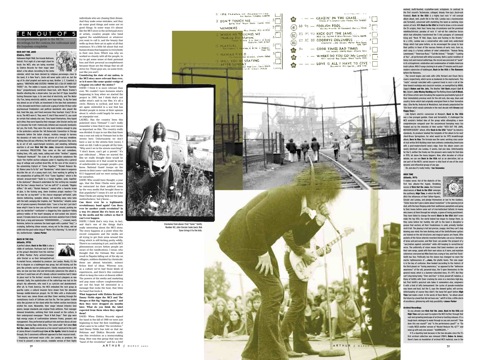
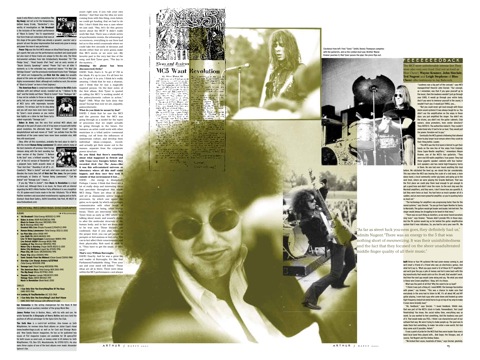
This guide was originally published in Arthur No. 9 (March 2004) as one of a set of articles on the MC5 in that issue that ran over several pages (see two of the section’s two-page, 22×17-inch spreads above.)
TEN OUT OF 5 A comprehensive guide to the MC5’s recordings, for the curious, the enthusiast and the hopeless completist by Seth “The Seth Man” Wimpfheimer, James Parker and Ian Svenonius
“If I was the mayor of San Diego, I’d give Lou the key to the city” – Michael Taft, head of the archives of the American Folk Life Center at the Library of Congress in Washington, D.C.
This past weekend the San Diego Union Tribune ran a great feature story about Lou Curtiss, patriarch of the San Diego folk scene known worldwide for his vast knowledge and appreciation of folk, blues, jazz, rhythm & blues, rock & roll, show tunes and a vast inventory of 78 rpm records. Folk Arts is the home of the Lou Curtiss Sound Library, which comprises over 90,000 hours and 90 years of vintage sound recordings.
Lou hosts Jazz Roots every Sunday night on KSDS 88.3 FM in San Diego. You can listen online at jazz88online.org. On the 2nd and 4th Tuesdays of each month, Lou hosts a “Singers Circle” at Club Kadan, a pub on the corner of Adams Avenue and 30th Street. Come down and bring your instruments, the pickin’ starts around 6 pm.
Over the course of the past 30 years, Lou has organized or booked over 50 music festivals in San Diego, including the Adams Avenue Street Fair and the Adams Avenue Roots Festival.
Lou also writes a column for the San Diego Troubadour, worth reading to find out about some of the preservation work that is going on to maintain Lou’s library.
Some of my best experiences buying records and learning about music have happened in Lou’s shop. The history of Folk Arts in San Diego has been carried forward by people like Lou and the community of singers, writers, players and musicians that surround the store. Plan a journey, I’ve always found something at Lou’s shop unexpected or that I never thought I’d see again.
Collecting the major statements from the recent wave of occupations, After the Fall is a love letter to the insurgent students and workers on California campuses. It is intended to spark excitement and discussion and we encourage students and others to use After the Fall to mobilize forces ahead of the March 4th offensive.
• 44 tabloid pages of communiques, texts and photos from across the state
• includes a two color map, timeline and pullout poster
After the Fall: Communiqués from Occupied California is now available as a pdf for download and for viewing on-line at issuu. We have also posted the original conclusion of the publication No Conclusions: When Another World is Unpopular for you to read on-line and repost widely. 10,000 copies of After the Fall, a 44 page compilation of texts that emerged from the struggles on California Campuses in the last months of 2009, were released on Valentine’s day. They have all now been distributed to various sites across California and the world and the stacks that cluttered a living room have dwindled to a few bundles to be handed out locally.
…Standing on the hill at dawn, overseeing a team of 40 Kurdish diggers, the German-born archeologist waves a hand over his discovery here, a revolution in the story of human origins. Schmidt has uncovered a vast and beautiful temple complex, a structure so ancient that it may be the very first thing human beings ever built. The site isn’t just old, it redefines old: the temple was built 11,500 years ago—a staggering 7,000 years before the Great Pyramid, and more than 6,000 years before Stonehenge first took shape. The ruins are so early that they predate villages, pottery, domesticated animals, and even agriculture—the first embers of civilization. In fact, Schmidt thinks the temple itself, built after the end of the last Ice Age by hunter-gatherers, became that ember—the spark that launched mankind toward farming, urban life, and all that followed.
Göbekli Tepe—the name in Turkish for “potbelly hill”—lays art and religion squarely at the start of that journey. After a dozen years of patient work, Schmidt has uncovered what he thinks is definitive proof that a huge ceremonial site flourished here, a “Rome of the Ice Age,” as he puts it, where hunter-gatherers met to build a complex religious community. Across the hill, he has found carved and polished circles of stone, with terrazzo flooring and double benches. All the circles feature massive T-shaped pillars that evoke the monoliths of Easter Island…
Judith Malina and Julian Beck, directors of the Living Theatre
“WE WANT THE WORLD, AND WE WANT IT NOW”
In 1968, after years of self-imposed exile in Europe, the Living Theatre triumphantly returned to America with their theatrical breakthrough “Paradise Now.”
The sensational production, involving group nudity, marijuana smoking, advocacy of a non-violent anarchist revolution, continuous interaction with the audience and something just this side of a full-on public orgy, received attention from those far outside the normal theater-going public.
Doors singer Jim Morrison and poet Michael McClure actively participated in performances of ‘Paradise Now’ at the [San Francisco Bay Area’s] Nourse Auditorium…. McClure brought Morrison to visit at [Beat poet/City Light Books founder Lawrence] Ferlinghetti’s office. Julian [Beck, of the Living Theatre} was on and off the telephone to New York, frantically worried about the money to get the troupe back to Europe where engagements has been scheduled. Quietly, Morrison offered to assist with money.
Morrison–who had read Artaud and Ginsberg in college–saw himself as a revolutionary figure. Agreeing that repression was the chief social evil in America and the cause of a general pathology, he was typical of the sectors of support The Living Theatre had received in America. [The Doors’] long improvisational song ‘When the Music’s Over’ proclaims, as in ‘Paradise Now,’ ‘We want the world, and we want it now.’ Morrison had seen every performance in Los Angeles and followed the company up to San Francisco.
“On the day after his visit with McClure, Jim Morrison gave Julian [Beck] $2,500 for the trip home…”
Two years in the making, beautifully assembled with love by Will Swofford, Arthur Magazine’s PARADISE NOW: A Collective Creation of the Living Theatre features a DVD of rare, never-before-distributed films and revolutionary multimedia documents from the production, plus two double-sided posters and a detailed 40-page booklet. This set is worth far more than $29.95, but that’s what we’re charging. We made a single edition of 1,000 in 2008. When they’re gone, they’re gone.





 Arthur Magazine