Today's Autonomedia Jubilee Saint: B. TRAVEN

B. TRAVEN

MARCH 26 — B. TRAVEN
Anarcho-adventure writer, revolutionary, true identity unknown, possibly Ret Marut of Munich Soviet fame.

ALSO ON THIS DAY:
1827 — German classical composer Ludwig von Beethoven dies, Vienna, Austria.
1892 — Great American poet Walt Whitman dies, age 72, Camden, New Jersey.
1911 — Playwright Tennessee Williams born, Columbus, Mississippi.
1930 — Beat bad-boy poet Gregory Corso born, New York City.
1953 — Dr. Jonas Salk announces polio vaccine, Pittsburgh, Pennsylvania.
1969 — German born revolutionist, writer “B. Traven” dies, Chiapas, Mexico.
1969 — John and Yoko Ono Lennon start seven day bed-in against war.

All info courtesy The 2009 Autonomedia Calendar of Jubilee Saints: Radical Heroes for the New Millennium by James Koehnline and the Autonomedia Collective

A little bit of getback

ukrbsvigilantejustice

From the March 25, 2009 – Times of London

Anti-capitalist group boasts of attack on Sir Fred Goodwin’s home
by Lindsay McIntosh in Edinburgh

An anti-capitalist group calling itself Bank Bosses Are Criminals has claimed responsibility for an attack on the home of Sir Fred Goodwin, former chief executive of the Royal Bank of Scotland (RBS).

The organisation warned of further action against other targets minutes after police were called to Sir Fred’s house in Edinburgh. Officers were alerted by an alarm, which was set off when three downstairs windows were smashed. A black Mercedes parked in the courtyard was also damaged in the attack, which happened about 4.30am.

Sir Fred, who has attracted political and public criticism for his role in the bank’s downfall and his insistence on keeping his pension, was not at home. Neighbours said that he had not been seen for weeks and it is believed that he may be overseas after taking his children out of their local private school.

His family home is in the Grange, an affluent suburb, and a large number of his fellow residents will have lost money in the financial crash. Yesterday many told The Times that they were upset by the “greed” of the man nicknamed Fred the Shred for his eagerness to cut jobs and costs. One woman in her 70s, who gave her name as Deirdre, said: “People should not go round breaking windows, but I can understand why if they have lost their jobs. It is not right, but I can understand why they would do it.

“I have an account with RBS in Marchmont. It’s not the fault of the young people who work with RBS that this has happened. I don’t understand how people can be so greedy with everything. If I won the lottery, I would just pay off my four kids’ mortgages. What can you do with that kind of money [Sir Fred’s pension pot]?”

John Llewelyn, a neighbour who is retired, said: “My wife and I are seeing an independent financial adviser together and we have suddenly realised our investments and savings have been dramatically affected, like everyone’s. We put Sir Fred in that context. He is part of the story. We can’t help feeling that way. It is upsetting.”

Mr Llewelyn said that the only other incident that he was aware of at the large, detached house was when a bunch of flowers was left in the garden and police were alerted in case it was suspicious. He said that security personnel had been parked in the area overnight regularly throughout the past year and some residents had complained that their engines could be heard turning over in the early hours. Another neighbour said that one security officer had told her that the Goodwins seemed very aloof and had not even offered them a cup of tea.

Another resident, Maggie Anderson, who was walking past the Goodwin home on her way to the shop, said she was surprised that it had not been attacked before.

There have been some protests outside the house since it emerged that Sir Fred had negotiated a £16.9 million pension package and had no intention of giving it back. Banners posted outside condemned him as a “scumbag millionaire”.

About 30 reporters and photographers congregated outside Sir Fred’s house throughout yesterday morning and motorists and passers-by slowed to stare at the house. One man in a waxed jacked suggested that the best course of action would be to “burn it to the ground”. Two scenes-of-crime officers from the Scottish Police Services Authority, uniformed officers and two detectives picked over the debris, which included three broken windows on the bottom floor of the three-storey house. One pane of the double-glazed bay window in the lounge was smashed and the other bore the imprint of a missile.

In the courtyard – which is between the Goodwin home and the neighbouring detached house, which Sir Fred also owns – the black Mercedes S600 was parked. Small cracks were visible in the rear window, front windscreen and a passenger door window. It was reported this week that RBS was still paying the insurance on his fleet of executive cars.

Joiners and glaziers were working on the property and a tow truck came to take away the car.

The pale brick property, which has a grass tennis court, triple garage and children’s play area, is equipped with a model of a Victorian streetlamp with concealed cameras. Lights and sensors are attached to a tree in the front garden. Lothian and Borders Police said that officers were acquiring CCTV footage and carrying out door-to-door inquiries in the neighbourhood.

A spokesman said: “Our inquiries are at an early stage and we are appealing for anyone with information about this incident to contact us. We are aware that an organisation claiming to be responsible for the vandalism had made contact with media outlets and this also forms part of our inquiry. The force takes very seriously any planned attack on any individual or their property.”

He said that the owner of the house had been contacted. He said that the force “routinely gives personal safety advice to members of the public and to anyone who may feel vulnerable for whatever reason” but refused to say whether Sir Fred had asked.

From the Guardian:

Around 5am, emails arrived at the offices of the Edinburgh Evening News, Press Association and other media outlets saying that Goodwin’s house “was attacked this morning” and giving the name of the street where he lives.

The email, sent from the address bankbossesarecriminals@mail.com, said: “We are angry that rich people, like him, are paying themselves a huge amount of money, and living in luxury, while ordinary people are made unemployed, destitute and homeless. This is a crime. Bank bosses should be jailed. This is just the beginning.” The emails have been sent to the police, who said they would form part of their inquiry.

Stan Lee’s writing process, by Peter Relic

Peter Relic writes:

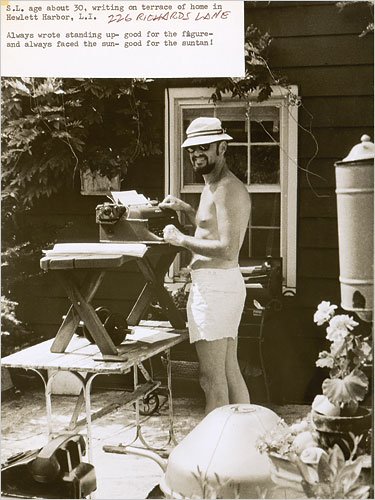
Stan Lee, aka Staggerin’ Stan Lee, is the 86-year-old writer and co-creator (with Steve Ditko and Jack Kirby) of more classic Marvel Comics characters than you can shake a Galactus-caliber prong-horn at, including Spider-Man, the Uncanny X-Man, the Fantastic Four, Iron Man, The Incredible Hulk, and the homey Doctor Strange. Last year I had the chance to meet Staggerin’ Stan at his Beverly Hills office, where, looking like a grinning, perma-tanned carny barker covered in liver spots, he sat behind a desk covered in photographs of his offspring (his comic book creations, that is, not his actual family). Preparing for the interview, I’d run across the old photograph above, of Stan standing at his typewriter in his backyard in Long Island. Figuring it might provide some insight into his process, I asked Stan about the photo, and this is what he said.

Q: Did you feel you got more power from typing standing up?

Stan Lee: I didn’t do it for power, I did it because I knew a few writers who were terribly out of shape, had potbellies. I didn’t want to get like that. So I put a bridge table on the terrace behind my house, and stacked a stool upon that, and put my portable typewriter upon that, and that was just the right height for me to type standing up. And I loved the sun, in those days I didn’t realize how dangerous it was. So I’d keep moving the typewriter a little bit so I could keep facing the sun. I worked for hours out there in the sun. My wife would have company, she’d have her friends over and they’d frolic in the yard and I would type, and they would pay absolutely no attention to me. I’m standing there trying to write and they’re talking and singing and yelling at the kids and partying and I’m enjoying it while I’m writing. It was a very strange situation but I loved it.

I had a Remington noiseless portable. It had a small carrying case. It wasn’t really noiseless, but it didn’t make as much noise as typewriters that weren’t called noiseless. When you wanted to use it you took the lid off, then there was a little knob on the side and you pushed the knob towards the back and the keys lifted so you could type. When you were finished you pushed the knob back again and then the keys went down and you closed the set.

Because of that typewriter I came closer to getting a divorce than any other time in my life. One day my wife got angry at me, I don’t remember why, and she grabbed the typewriter and threw it down and it shattered. I said to her, “If I don’t divorce you for that, there’s nothing you could ever do that will make me divorce you.”

What is wealth?

The great Robert Anton Wilson died in 2007. He should have lived to see our interesting times; he would have been amused by the current panic and hysteria and, as always, would have had some wisdom to impart. Take this thought experiment from his essay collection The Illuminati Papers, first published in 1980 and strikingly relevant today:

Dissociation of Ideas, #5

Distinguish between wealth, illth, and money.

Wealth is best conceived as all the changes in the “natural” (prehuman) environment that are to the benefit of humanity and/or other life forms. A bridge that gets you across the river without your having to stop and build a raft is wealth in this sense. So is an airport. So is the furniture in your house. Think of ten other examples.

Illth, a term coined by John Ruskin, can be conceived as all the changes in the environment that are detrimental to humanity and/or to life itself. Weaponry, then, should be classed as illth, not wealth. Think of ten other examples.

Money is neither wealth nor illth but merely tickets for the transfer of wealth or illth.

Proof: if all the money disappeared overnight, the national standard of living would not change (whatever happened to individuals in the interim); things would be back to normal as soon as the Treasury printed more tickets. But if all the real wealth and illths—all the industrial plants, natural resources, roads, communications, and “real capital” generally—were to disappear, we would be plunged back into the Stone Ages and no issue of currency would improve the situation.

Note also that for all the “real capital” to disappear, all the technical knowhow in human heads would have to vanish. No economist, to my knowledge, has tried to calculate how much of our “real capital” consists of ideas in human heads (brain power) and/or of canned ideas stored in libraries or on tape. A reasonable guess is that 90 per cent of our wealth and illth consists of such brain creations.

The Illuminati Papers is still in print and it’s filled with real wealth.

GLOMP X – Three Dimensional Comics From Finland

Jan Anderzen explores another dimension of comics.

Tommi Mutsuri, publisher and editor of the Finnish comics/art anthology, GLOMP, has asked artists to create works that would embrace a new dimension.  The book features images like the photo above, of Jan Anderzen’s comic quilt in a larger context, as well as close ups of each panel.  This tenth and final hardcover volume is available now from BoingBeing and will also be accompanied by a series of gallery exhibitions in 2009-10.

Featuring colorful and experimental art by over a dozen artists including Aapo Rapi, Amanda Vahamaki, Jan Anderzen, Janne Tervamaki, and Anna Sailamaa.   The book is limited to 1000 copies and includes an exclusive cd soundtrack.  More beautiful artwork by Tommi Mutsuri after the jump.

tommi-1

Continue reading

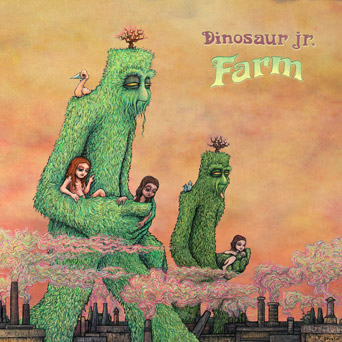
New Panda Bear Video

One of the guys from Gang Gang Dance just put up a “shit res” video for Panda Bear’s blissed-out “Take Pills” on his blog. It’s got weird reflective masks, broken computer graphics, backwards singing and insects eating candy. Sort of like if Paper Rad was remixing David Lynch. Though not as good as Paper Rad remixing Rihanna using old Alf parade commentary, as seen in the video below. (via Gorilla Vs. Bear)

HACK MONEY, HACK BANKING: Rushkoff on the economy

HACK MONEY, HACK BANKING
by Douglas Rushkoff

March 20, 2009

I’ve received a ton of great email and response from last week’s piece [“Let It Die”] on letting the banks die and letting the market go down another 70 percent. My commentary also generated some confusion, though, so I’d like to clarify and expand on a few points. (I’ll do this again on WFMU on Monday evening, when I’ll have the opportunity to take some calls and actually converse.)

First off, and I can’t stress this enough: Commerce is good. Commerce is not the problem. Monopolies are.

Except in a few rare cases, corporate charters and centralized currency were never intended to promote commerce. They were intended to prevent locals and non-chartered entities from creating and exchanging value. They are not extensions of the free market, but efforts at extracting value from the free market. Corporate monopoly charters were extended to a king’s favorite companies in return for shares. Then, no one else was allowed to do business in that industry. Centralized currency forced businesses to run their revenue through the king’s coffers. Likewise, in its current form, centralized currency is more akin to a ponzi scheme of interest rates, each borrower paying up to the banker above him.

Both of these innovations—corporate charters and centralized currency—tend towards resource exploitation rather than innovation. They are extractive in nature, not productive. And, more importantly, these particular innovations cause wealth to end up being generated through speculation rather than creation. They cause scarcity, not abundance. Over time, it becomes easier to make money by having money than by doing anything. And this was the pure, stated intent of centralized currency and banking in the early Renaissance: to keep the wealthy wealthy, in the face of a rising merchant class.

This isn’t some extremist perspective. It’s just historical fact, though largely forgotten and seemingly refuted by our collective false memory of the Renaissance’s greatness. If you’re interested in finding out more about this, or seeing the evidence on which my research is based, take a look at the best historians writing about the era: Fernand Braudel (The Wheels of Commerce: Civilization and Capitalism: 15th-18th Century, Volume 2, Univ. of California Press, 1992), Carlo M. Cipolla (Before the Industrial Revolution: European Society and Economy, 1000-1700, WW Norton, 1994) or Bernard A. Lietaer, whose book On Human Wealth used to be available for free download off his site, but doesn’t seem to be anymore. In these books, you can find out about the sustainable local economic systems of the Late Middle Ages, learn that the Black Plague actually began after mandated centralized currency had impoverished Europe, and find support of my contention that cathedrals were built with local money before the Renaissance, not Vatican money during the Renaissance.

For reasons I cannot understand, people seem to think that my explaining this phenomenon somehow means I want us to go back to a hunter-gatherer stage. Or that I long nostalgically for a return to a late-middle-ages lifestyle. Or that I am somehow renouncing my earlier enthusiasm for new technology and media.

Nothing of the kind.

The cyberpunk ethos was actually based in the very same DIY (do-it-yourself) ethos I’m espousing now. Cyberpunk was about reclaiming technology, making modifications oneself or with one’s friends, generating value from the bottom up, exchanging goods and services in an alternative economy. I’m not saying we get rid of money—only that we learn to make it ourselves, as communities. I’m not saying we get rid of banks—only that we stop outsourcing our banking to Wall Street firms that mean only to extract value from our communities.

I have always admired hackers—computer hackers and social hackers. I’m just trying to expand the range of technologies and institutions we feel ready and willing to hack. We should hack money. We should hack banking. We should hack business. This doesn’t necessarily mean hacking the dollar, which is just one kind of closed source currency. We should hack money by coding new kinds. Bank hacking has been around for a long time—it’s just that credit unions and other local or community-based bank models were driven down by the anti-competitive practice of banking conglomerates. It’s time for those institutions to be renewed, as well.

When I say it’s okay if the Dow Jones goes down another 70 percent, I’m not calling for an apocalypse. I’m calling for the re-balancing of the speculative economy. The speculative economy owns, represents and controls a disproportionate amount of money. There are simply too many investors, traders, and brokers trying to get rich off moving pieces of paper back and forth. These pieces of paper represent shares in companies (or derivatives based on the value of these shares), and trade at valuations unsustainable by real world commerce and activity. That’s why it’s a good thing, and not a bad thing, for these valuations to move back down to a level corresponding to the revenue stream of the company. This helps the company make decisions consonant with the needs of its customers and employees—its real culture—rather than people who invest from afar, with little personal human stake in its affairs.

The banking bailout is a fiasco because it is taking money from future generations to restore the lending-based economy. I believe it would be cheaper and better to use a tiny fraction of the money to actually employ people, and to educate communities in how to rebuild local economies.

This doesn’t necessarily mean the global economy has to go away—just that it be balanced by local activity. This doesn’t necessarily mean computers go away, or that we lose our internet. We can still work in big groups making really complex stuff. We can still enjoy cities and farms, Radiohead and Britney. We can still ship refrigerators from South Korea to Australia.

It’s just that this activity would be based less on the requirements of corporate debt structures than it would on actual supply and demand. It would be a much more efficient economy, by virtue of being one that would require people to create real value. I think it’s that final part that scares people so much at the mere mention of such reforms: they think the last time people actually created value was back in the Middle Ages, when folks made shoes or raised chickens.

Well, there are many different things people can do to create value for one another. And a few people can still be bankers and brokers. Just not so many of them. Maybe about 70 percent less.

Longtime Arthur columnist Douglas Rushkoff has just finished his life’s work, “Life Inc: How the world became a corporation and how to take it back,” to be published June 2, 2009 by Random House. (Pre-order info: Amazon). His talk radio show, Media Squat Radio, broadcasts Mondays 7-8pm EDT on WFMU. Streams and archived shows at www.wfmu.org and iTunes.

Previous Rushkoff columns on the economy:
“Let It Die” (arthurmag.com, March 16, 2009)
“No Money Down” (Arthur No. 31/Oct 2008)
“Riding Out the Credit Crisis” (Arthur No. 29/May 2008)