AROUND THE WORLD IN 360 MINUTES
a journey for music lovers
Please join us for a magnificent, communal music,
film and food experience! Bring as many as 5 of
your favorite records, short films or videos from
around the world, and play them! (Frequent DJ / VJ
rotation throughout the night.) It’s also a potluck,
so feel free to bring something yummy to eat or drink!
Popcorn and water are on the house!
Sunday, March 22, 2009
7:00pm – 1:00am
The Cinefamily
611 North Fairfax Avenue,
Los Angeles, California 90036
323 655 2510
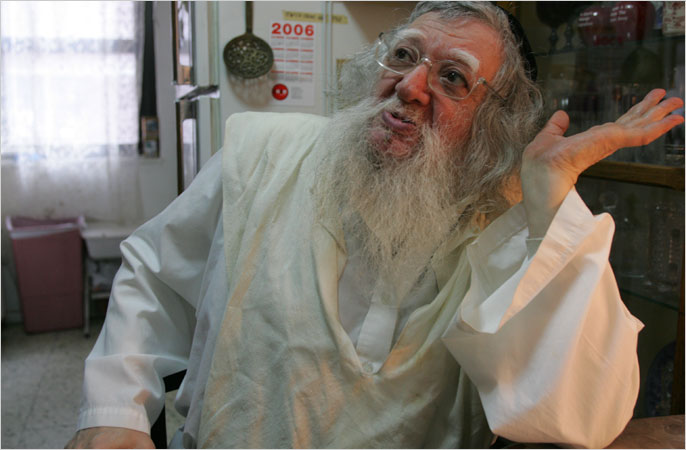
Lionel Ziprin, Mystic of the Lower East Side, Dies at 84 By WILLIAM GRIMES
“We are not after all intended to be consumed.”
So begins Lionel Ziprin’s “Sentential Metaphrastic,” a “poem in progress” of more than a thousand pages. “I reduced it to 785 pages,” Mr. Ziprin told The Jewish Quarterly in 2006. “I call it the longest and most boring poem since Milton’s ‘Paradise Lost.’ ”
Many more poems by Mr. Ziprin remain to be discovered, inscribed on spiral-bound notebooks and stuffed into a closet in his apartment on the Lower East Side of Manhattan. And that is nowhere near the half of it. Also in the apartment are the Jewish liturgical chants intoned by Mr. Ziprin’s grandfather, untold hours of sacred music that Mr. Ziprin tried for more than half a century to bring to the wider world.
This legacy now passes to his family — whether to delight or puzzle posterity, no one knows. Mr. Ziprin, a brilliant, baffling, beguiling voice of the Lower East Side and the East Village in all its phases — Jewish, hipster and hippie — died last Sunday in Manhattan. He was 84. The cause was chronic obstructive pulmonary disease, his daughter Zia Ziprin said.
For decades, Mr. Ziprin, a self-created planet, exerted a powerful gravitational attraction for poets, artists, experimental filmmakers, would-be philosophers and spiritual seekers.
He ran his apartment, on Seventh Street in the East Village, as a bohemian salon, attracting a loose collective that included the ethnomusicologist Harry Smith, the photographer Robert Frank and the jazz musician Thelonious Monk, who would drop by for meals between sets at the Five Spot. Bob Dylan paid the occasional visit.
There the art of conversation took a backseat to the art of listening to Mr. Ziprin hold forth for hours at a stretch on magic, interplanetary rhythms, angels, apparitions and Jewish history.
“He was larger than life and so far beyond a certain kind of description that I am bamboozled,” said Ira Cohen, a longtime friend. “He was much larger than a poet, though that’s hard for me to say, as a poet. He was one of the big secret heroes of the time.”
Often categorized as a beatnik, he created an artistic circle that overlapped with the worlds of jazz and beat poetry but remained distinct and apart. A poet prey to visions and hallucinations, a philosopher, a Jewish mystic with a deep understanding of the kabbalah, an enthusiastic consumer of amphetamines (legal at the time) and peyote (also legal) — he was all of these, and something else besides.
“He combined Old World mysticism and New World craziness,” said the poet Janine Vega. “He really was one of the great white magicians of the era.”
Associated Press: “March 19: Scientists sailed on Thursday to inspect an undersea volcano that has been erupting for days near Tonga, shooting smoke, steam and ash thousands of feet into the sky above the South Pacific ocean.”
Oliver Recreation Center, 1400 E. Federal St, Baltimore MD
FREE
The Baltimore Free Store – a volunteer-run organization that redistributes free and salvaged goods – is having their monthly free market at the Oliver Recreation Center. The point of the free market is the same as that of the free store: to get things from people who don’t need or want them to people who do.
Free stores and free markets have been popping up all over the country in an effort to confront America’s problems of waste, poverty, and isolation. There’s no money needed in the “free market” economy. Just give what you can, take what you need, and meet your neighbors.
“Reveries of Sleeping Beauty: Slumber and Death in Anatomical Museums, Fairground Shows, and Art”
Lecture by Kathryn A. Hoffmann, University of Hawaii at Manoa
Date & Time: Tuesday, March 24th at 7:30 PM (Doors open at 7:00) Venue: Observatory Location: 543 Union St. at Nevins / Brooklyn, NY 11215 (Gowanus) Price: Free!
This illustrated talk will follow the paths of sleeping beauties: lovely young women who lie on silk sheeted beds in glass cases in anatomical museums and fairground shows, who recline on sofas in Belgian train stations, and sometimes in the middle of streets. Often the women were nude. Sometimes they were adorned with a piece of jewelry or a bow, and sometimes they wore white dresses. One breathed gently in a glass case on a fairground verandah for nearly a century. Others lay quietly in caskets under flowers. Some were wax, some were real, some were dead, and some merely pretended to be dead. Sometimes, in the imagination of artists like the surrealist Paul Delvaux, they got up and walked about; pretty somnambulists wandering through natural history museums, arcades and streets, through modern cities and ancient Alexandria, Ephesus, and Rhodes.
Using photographs, posters, advertisements, and paintings, the talk will follow models known as “Anatomical Venuses” through one of the great wax anatomical museums of the world (La Specola in Florence) and an extraordinarily long-lived popular museum that traveled the fairground routes of Europe in the nineteenth and twentieth centuries (Pierre Spitzner’s Great Anatomical and Ethnological Museum). It will take side trips into some of the visual worlds the Venuses drew from or helped inspire, including fairground sleeping beauty acts, morgue shows, mortuary photography, reliquary displays, and art. In the paths of the sleeping beauties, it is clear that death and slumber, pedagogy and entertainment, science and reverie long shared strange borders. Continue reading →




 Arthur Magazine