

Author Archives for Jay Babcock
"BREAK UP THE CONCRETE": Chrissie Hynde, Devo and Dan from the Black Keys at Obama/Democrats benefit in Akron – Oct 17
(Not the best sound…)
(Not the best video…)
McCain-Palin's useful idiots

Jason Waller, left, in an Obama mask, and Elazbeth Waller as Gov. Sarah Palin while Senator John McCain talks in Concord, N.C., on Saturday. Photograph by Carolyn Kaster/Associated Press
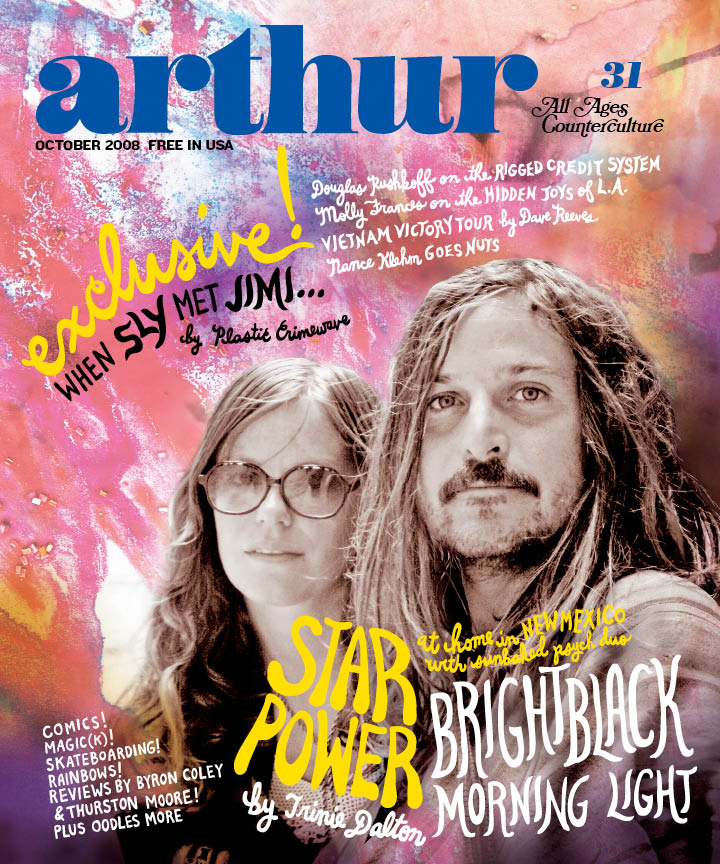
“KEEPING IT LOCAL”: Trinie Dalton visits BRIGHTBLACK MORNING LIGHT (Arthur, 2008)
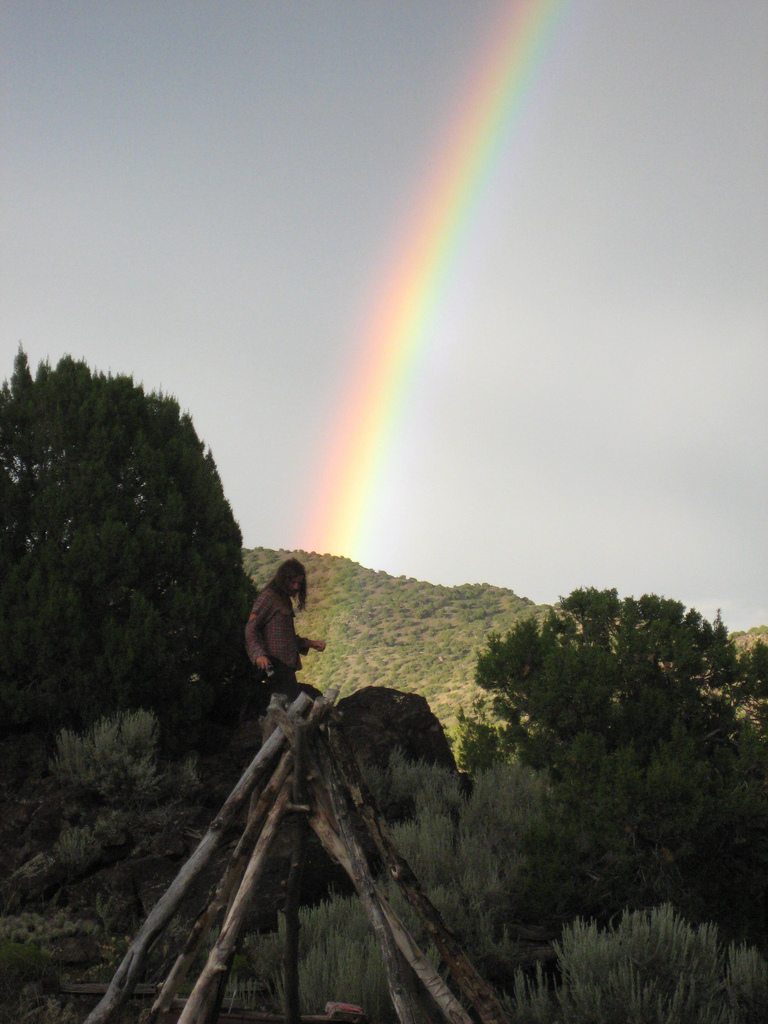
Nabob, photographed by Trinie Dalton
KEEPING IT LOCAL
Two transplants from the Heart of Dixie who went west to the land of mesas, pueblos and geodesic domes, Rachael Hughes and Nathan Shineywater have found a way to thrive beyond society’s mad dash to survive. Trinie Dalton travels to New Mexico to meet BRIGHTBLACK MORNING LIGHT, and hear their stunning new album in the pair’s natural habitat.
originally published in Arthur No. 31 (Oct 2008), with photographs by Lisa Law
Leaving Brightblack Morning Light’s northern New Mexico deep wilderness enclave, I finally get their obsession with the local AM radio. The daily monsoon moves in as I fly down the hill from their town in my red rental car. Mexican cumbia, a variation of the upbeat Colombian pop music, sounds interplanetary crackling through the fuzzy AM distance. I imagine it transmitting from some far off Mexican star, a star I’d like to visit. Crank the cumbia, see what it can do in a storm. Brightblack Morning Light’s Nabob Shineywater says AM is like Sun Ra. Yesterday morning, just after I’d arrived, we were hiking up a wash and Nabob asked, “Who are we to say Sun Ra wasn’t from another planet?”
The sky gets dark as wind kicks up. With the first lightning crackle and boom, the radio shorts and cumbia cuts out—quiet for a moment, then back up, hissing, scratched, and damaged. Have I blown the speakers? Has the radio station’s tower been struck? Each lightning bolt slicing vertically down the flat horizon causes more disruption. Nabob also mentioned that in Los Alamos, scientists recently disproved Einstein’s theory that light travels fastest. Radio waves now win that contest. Two days after the anniversary of the Pueblo Revolt of 1860—a big deal in these parts—thunder means the obliteration of human sounds. Recognizable dance beats are exchanged for something Frankenstein-ish: a live, electric orchestration so weird and marvelous it could only have been invented by Nature, the omnipresent force in this sandy region.
Continue readingRecently discovered delights in L.A. and elsewhere, by Molly Frances (Arthur, 2008)
Originally published in Arthur No. 31 (Oct 2008)
Recently Discovered Delights
by Molly Frances
1. Nite Jewel
This one-woman act has been haunting nightclubs around Los Angeles and beyond this summer, dropping nocturnal transmissions and electro dust into the atmosphere. Accompanied by her bubbling synthesizer and deep tunnel beats, Nite Jewel would make the perfect house band on the mothership that’s going to take us all away from this place. myspace.com/nitejewel
2. Raymond Chandler
What a different city Los Angeles would be without the mythology of Phillip Marlowe and the many shadows cast by Chandler’s noir mysteries running through its city streets. Fall’s a good time to revisit these stories of an honest man lost in a sea of corruption.
3. Avocado with poppy seeds
Slice an avocado, add lemon, and roll in a generous heap of poppy seeds. Exotic.
4. Semina Culture: Wallace Berman and His Circle by Michael Duncan and Kristine McKenna (2005)
You will never get tired of looking at this book. This catalogue from the 2005 traveling exhibit spans the years of mid-’50s to early-’60s beatdom, when an artistic and literary utopia formed around the mysterious figure of artist Wallace Berman and his arts and literary journal Semina. You couldn’t find it on newsstands or in bookstores; most of its few hundred copies were mailed by Berman to friends and peers. The book not only reproduces all nine issues but is a Who’s who of West Coast bohemia.
5. Walking really far
Walk for two hours in any direction and see where you end up. Maybe you are missing something. Maybe you will find it.
6. Velaslavasay Panorama
The North Pole is tucked right into South Los Angeles. Go and see. It’s hidden in the second floor of the beautiful Union Theater. Take yourself to the endless horizon. panoramaonview.org/
7. Flying Lotus, Los Angeles (Warp)
The 17 tracks on FlyLo’s second record seem to flow without beginning or end, stacking dusty samples, sandpaper beats, and washy synths into a collage as dense and sticky as an august afternoon in Van Nuys. You’re stuck in traffic, the sun is in your eyes, a jackhammer echoes an unsteady rhythm in the distance, your radio suddenly plays all its stations at the same time. For a second it all makes some kind of sense.
8. The Late Show (1977, dir. Robert Benton)
Lily Tomlin, Art Carney, a lost cat, blackmail, murder and endless hijinks, set in Los Angeles. Nutty and Noir, this Robert Altman-produced mystery features an incredibly stylish Tomlin as an aimless but charming eccentric and Carney as a cranky over-the-hill detective with one last fight In him. Don’t get the idea that this is one of those awful detective spoofs, it’s actually one of the most perfect movies you’ve never heard of, covering all genres, emotions, and hairstyles. You will laugh many times.
9. Cold brewed coffee
Impress your friends with a rousing pitcher of iced coffee. You will be known throughout many wide and concentric circles for being a dark brewing lord and master of the bean. No one will know how easy it is for you with your cold brew coffee bucket. You grind a whole can of coffee with 9 cups of water and it sits for 12 hours and then you have a pitcher of low-acid coffee that tastes amazing for two weeks. Everyone will love you and want to be your friend. You can buy the cold toddy brewing kit they sell in stores or make your own. It’s off the grid.
10. The Baroque Music station on 1.fm
When one’s radio breaks down, you can discover amazing things that were once hidden right under your nose. Lurking within the Classical Radio tab of that iTunes thing is an endless stream of this amazing music that restores your faith in civilization. It only occasionally loses its affirmative power when interrupted by a commercial for under-eye circles.
11. Raw vegan whipped cream
Soak 1 1/2 cups of raw walnuts (or raw cashews) in water for two hours…then get rid of the water and put the nuts in a blender with 1/2 cup fresh squeezed orange juice and two tablespoons maple syrup (a few drops of almond extract optional) This recipe is from Juliano’s UnCook Book (Regan Books,1999)—good recipes, really bizarre self-portraits.
12.Griffith Observatory
Despite multi-million-dollar renovations during recent years, the main attraction at Griffith is still the view of the twinkling metropolis below. Go at dusk to watch nature and culture collide to form a gold and purple ooze that stretches from the mountains to the sea. Breathtaking.
13. Sylvia Robinson “Pillow Talk” 7-inch single
Found this scratchy 45 in a box at the back of a thrift store in Joshua Tree. Before masterminding Sugar Hill records, Robinson recorded music as ‘Sylvia’ and wrote this song for Al Green. He turned it down because it was too dirty so she recorded it herself and it hit number one on the charts in 1973. With breathy talk vocals, hi-hat swoosh, and sugary string and electric piano arrangements, it’s a fine specimen of the early disco sound that was forming around Philadelphia and other East Coast cities at the time, and is a naughty stepping stone between Serge Gainsbourg/Jane Birkin’s Je T’aime and Donna Summer’s Love to Love You Baby in the history of simulated orgasm on wax. The flipside sounds like it comes from an earlier, more wholesome time period but is an equally luscious track with a piano-heavy girl-group sound.
14. Jumping on a trampoline
Up and then down. Do it again. Jumping cleanses your cells and lymph nodes and increases your immunity. Up with people.
15. Making your own amazing salad dressing in one minute
Combine cold pressed organic olive oil (a lot), lemon, honey and stoneground mustard. This tastes better than anything you can buy. There is room for error. Salad dressing is very forgiving. Raw sage honey sweetens the deal.
16. Too Late For Tears (1949, dir. Byron Haskin)
All the pleasure of knowing a dangerous femme fatale, none of the risk. 1949 Los Angeles in glorious black and white.
17. Okra
If you slice a piece of okra crosswise, it reveals a circle of five perfect hearts formed from the fibers. I never loved okra, but now that I know it loves me, I’m coming around.
18. Show Cave
This art gallery/performance space in the Echo Park district of Los Angeles has been forming its own hybrid aesthetic out of the goo of contemporary life in its past year of existence. Exhibitions have exciting names like Beast Heat, Glitter and Doom and Survivors of the White Plague. Show Cave also offers a stage to emerging musical talent (see #1). www.showcave.org
19. Low Motion Disco, Keep It Slow (Eskimo)
In one room a synthesizer slowly throbs; in another a band rehearses outtakes from an unrecorded Royal Trux session. In a third room someone is playing records from their parents’ collection. There’s an empty bottle of purple syrup on the floor. The windows to this house are open and there’s a cool breeze that blows down from the mountains. You’re listening to these sounds mingle from down on the street. It sounds like a perfect mix that shouldn’t work at all. It’s too slow to dance to but it’s kind of funky. This is supposedly taking place in Switzerland.
Molly Frances lives in Los Angeles and makes music in Terminal Twilight.
Charles Plymell and Mike Watt – "Was Poe Afraid?"
Charles Plymell and Mike Watt perform on August 9, 2008 in Philadelphia, part of the No More Bush Tour organized by Byron Coley. Plymell reads his poem “Was Poe Afraid?” Video by Laki Vazakas.
Obama in St. Louis, today
Authorities confirmed crowd of at least 100,000…

REVERSING MONOCULTURALISM
The New York Times – October 17, 2008
Its Native Tongue Facing Extinction, Arapaho Tribe Teaches the Young
By DAN FROSCH
RIVERTON, Wyo. — At 69, her eyes soft and creased with age, Alvena Oldman remembers how the teachers at St. Stephens boarding school on the Wind River Reservation would strike students with rulers if they dared to talk in their native Arapaho language.
“We were afraid to speak it,” she said. “We knew we would be punished.”
More than a half-century later, only about 200 Arapaho speakers are still alive, and tribal leaders at Wind River, Wyoming’s only Indian reservation, fear their language will not survive. As part of an intensifying effort to save that language, this tribe of 8,791, known as the Northern Arapaho, recently opened a new school where students will be taught in Arapaho. Elders and educators say they hope it will create a new generation of native speakers.
“This is a race against the clock, and we’re in the 59th minute of the last hour,” said a National Indian Education Association board member, Ryan Wilson, whom the tribe hired as a consultant to help get the school off the ground. Like other tribes, the Northern Arapaho have suffered from the legacy of Indian boarding institutions, established by the federal government in the late 1800s to “Americanize” Native American children. It was at such schools that teachers instilled the “kill the Indian, save the man” philosophy, young boys had their traditional braids shorn, and students were forbidden to speak tribal languages.
The discipline of those days was drummed into an entire generation of Northern Arapaho, and most tribal members never passed down the language. Of all the remaining fluent speakers, none are younger than 55.
That is what tribal leaders hope to change. About 22 children from pre-kindergarten through first grade started classes at the school — a rectangular one-story structure with a fresh coat of white paint and the words Hinono’ Eitiino’ Oowu’ (translation: Arapaho Language Lodge) written across its siding.
Here, set against an endless stretch of windswept plains and tufts of cottonwoods, instructors are using a state-approved curriculum to teach students exclusively in Arapaho. All costs related to the school, which has an operating budget of $340,000 a year, are paid for by the tribe and private donors. Administrators plan to add a grade each year until it comprises pre-kindergarten through 12th-grade classes.
“This environment is a complete reversal of what occurs too often in schools, where a child is ridiculed or reprimanded for speaking one’s heritage language,” said Inée Y. Slaughter, executive director of the Indigenous Language Institute, a group in Santa Fe, N.M., that works with tribes on native languages.
“I want my son to talk nothing but Arapaho to me and my grandparents,” said Kayla Howling Buffalo, who enrolled her 4-year-old son, RyLee, in the school.
Ms. Howling Buffalo, 25, said she, too, had been inspired to take Arapaho classes because her grandmother no longer has anyone to speak with and fears she is losing her first language.
Such sentiments are not uncommon on the reservation and have become more pronounced in the five years since Helen Cedar Tree, at 96 the oldest living Northern Arapaho, made an impassioned plea to the tribe’s council of elders.
“She said: ‘Look at all of you guys talking English, and you know your own language. It’s like the white man has conquered us,’ ” said Gerald Redman Sr., the chairman of the council of elders. “It was a wake-up call.”
A group of Arapaho families had sent their children to a pre-kindergarten language program for years, but it was not enough. Heeding Ms. Cedar Tree’s words, the tribe began using Arapaho dictionaries, night classes, CDs made by the tribe, and anything they could find to help resuscitate the language. In the end, “we knew in our hearts that immersion was the only way we were going to turn this around,” said Mr. Wilson, a member of the Oglala Lakota tribe.
He was referring not just to the potential for the Arapaho language’s extinction but to a host of other problems that have long plagued the vast reservation, which the tribe shares with the Eastern Shoshone.
“Language-immersion schools offer an environment that goes beyond teaching the language,” Ms. Slaughter said. “It provides a safe place where a child’s roots are nurtured, its culture honored, and its being valued.”
According to tribal statistics and the United States Attorney’s Office in Wyoming, 78 percent of household heads on the reservation are unemployed, the student dropout rate is 52 percent and crime has been rising.
Most recently, in June, three teenage girls were found dead in a low-income housing complex. The F.B.I. has not yet released autopsy results, but many tribal members think drugs or alcohol were involved. The deaths left the reservation reeling. Officials here hope that the school will herald a positive change, just as programs elsewhere have helped native youth become conversational in their tribal languages, enhancing cultural pride and participation in the process. A groundswell of language revitalization efforts has led to successful Indian immersion schools in Hawaii, Montana and New York.
Studies show that language fluency among young Indians is tied to overall academic achievement, and experts say such learning can have other positive effects.
“Language seems to be a healing force for Native American communities,” said Ellen Lutz, executive director of Cultural Survival, a group based in Cambridge, Mass., that is working with the Northern Arapaho. At a recent ceremony to celebrate the school’s opening, held in an old tribal meeting hall, three young girls sang shyly in Arapaho. Behind them, a row of elders sat quietly, their faces wizened and stoic, legs shuffling rhythmically as familiar words carried through the building.
“They are the ones who whispered it on the playground when nobody was looking,” Mr. Wilson said, referring to the elders. “If we lose that language, we lose who we are.”
Ian Mackaye public Q & As in Southern California
Click here for more info on Ian Mackaye Q&A Dates 2008. Here’s a summary:
Sun Oct 19
Riverside Art Gallery
Riverside CA
A Question and Answer Speaking Engagement. $5,
7:30 PM All-Ages Welcome
Mon Oct 20
UC San Diego Price Center
San Diego CA
A Question and Answer Speaking Engagement. $5,
7:30 PM All-Ages Welcome, click here for more info.
Tue Oct 21
UC Irvine Humanities Hall 178
Irvine CA
A Question and Answer Speaking Engagement. $5,
8:00 PM All-Ages Welcome, click here for more info.
Wed Oct 22
Ventura Library
Ventura CA
A Question and Answer Speaking Engagement. $5,
7:30 PM All-Ages Welcome, click here for more info
Wed Oct 22
Mary Pickford Auditorium
Pitzer College
Claremont CA
A Question and Answer Speaking Engagement.
THIS IS AN EARLY SHOW, 12:00 Noon, free, All-Ages Welcome.
Thu Oct 23
Sunken City Skates
San Pedro CA
A Question and Answer Speaking Engagement. $5,
7:30 Doors All-Ages Welcome
Sun Oct 26
Hollywood High School
Hollywood CA
A Question and Answer Speaking Engagement. $5
(Hollywood High students free with i.d.),
6:30doors/7pm show, All-Ages Welcome
Is the “planetary consciousness” of neotribal psytrance gatherings just window dressing for the same old hedonism?

Trance Planet
by Erik Davis
originally published in Arthur No. 31 (Oct 2008)
Idanha-a-Nova, Portugal
This August, around 25,000 people hauled their kits and caboodles down a long hot narrow road in the middle of the Portuguese nowhere to camp like migrants along the shores of a lake not far from the Spanish border. They made the trek to attend Boom, a biannual electronic dance music festival that has grown into a large and successful event that eschews corporate sponsorship and keeps its roots in the underground alive. There were all sorts of people at Boom, but the dominant vibe of the weeklong festival was neotribal: a rave-inflected millennial florescence of hippie shit like long hair, fashion exotica, hardcore psychedelia, trance dancing, healing arts, and pagan-ish New Age mysticism with an apocalyptic thrust. There were chai shops and vegan grub vendors and massage centers and drug information booths, plus four music stages that provided everything from cheesy breakbeats to live world fusion to ambient driftworks. But the core genre was psytrance, an intense and sometimes unnervingly trippy form of electronic dance music whose pulverizing, brain-synching and monotonous beats that embody a ferocious psychedelic aspiration that makes dancing at Boom as much a ritual as a party.
Continue reading Arthur Magazine