
EMMA


MYTHTYM
Compiled and edited by Trinie Dalton
Hardcover
5” x 8.5”
204 Pages
Full Color
$30.00
“Trinie Dalton has long made popular zines on variety of subjects. She brings together artists, musicians, critics, novelists and cartoonists in one gorgeous stew. MYTHTYM compiles the best work from her previous zines on Werewolves, mythical beings, and the natural world. But best of all, this volume includes an entirely new, 100-page body of work on the theme of mirrors. This new section will investigate the mirror as a symbolic object in horror stories. The metaphorical mirror within the scope of mental illnesses such as schizophrenia. The metaphysical implications of mirroring, especially in the ancient world of alchemy. Reflective surfaces. Disco. The mirror’s role in psychedelic, symmetrical art. The first mirrors to emerge in primitive cultures, and the roles they played in early mythologies. Mirrors as scrying tools. It can branch out from there, into light, rainbows, death, vampirism, magic. Not restricted legally to mirrors by any means. In fact if it were all about mirrors that would be too many mirrors.
“Contributors include: Aurel Schmidt Folkert De Jong Takeshi Murata Jim Drain Andrew Leland Aura Rosenberg Sue De Beer Leif Goldberg Matt Greene Francine Spiegel Derek McCormack Jesse Bransford Shamim Momin Amy Gerstler assume vivid astro focus David Altmejd Sammy Harkham Rachel Kushner Marnie Weber Bjorn Copeland Paper Rad
“About her zines, Trinie Dalton has said: ‘I don’t want my books to be cliquish, but at the same time I don’t see them as communal free-for-alls. Of course, many people I invite to participate are my friends, and are friends with each other, but I deliberately include not only established artists and writers but also young people who are relatively unknown in their field. The idea of introducing and contextualizing artists by hanging their art on the same wall is a fundamental one in the art world. To me, my zines are literary/art/music history anthologies, following the group-show or salon style. They’re like parties on paper, and I want to be an exquisite host.'”

“And then, he taxed all your money and gave it away to the poor!”
“Nut in Pocket”
By Nance Klehm
originally published in Arthur No. 31 (Oct 2008)
SEED TIME
Out there, out of doors, it’s between leaf and root time. It’s seed time. In autumn, plants put their efforts into reproducing themselves via seeds, both bare and covered with delicious flesh. Right now it’s time to collect these offspring—juicy apples and pears for cider, seeds to grow next year’s harvest with, and nuts and berries to make healing infusions from.
Here are some seeds to collect before winter settles in:
amaranth seeds
burdock burs
hackberry berries
juniper berries
kentucky coffeetree seeds
lamb’s quarters seeds
rose hips
queen anne’s lace
yellow dock seeds
sumac berries
hawthorn haws
aronia berries
hazelnuts
walnuts
grapes
pawpaws
persimmons
elderberries
pears and apples (for cider…)
Each of these seeds has practical medicinal uses, which you can research on your own. But if you want the full-on benefit from the plants you decide to put in your body, you have to allow the plants to help you.
Long infusions, which are like concentrates, are an easy way to allow plants to do their work on you. You don’t need to use bagged herbal tea or other plant materials from a store to make an infusion. Nor do you have to buy it in bulk. Instead, you can forage, gathering plants that grow wild in our cities.
When you collect from a plant, do it on a dry day. Try to find more than a few and collect from them in a way that won’t damage them. Don’t rip or tear; instead, make clean pinches or cuts with a knife, your fingers or some pruning shears. Take only a few leaves/seeds/fruits—no more than 10% of any individual plant—as it is important that the plant you are collecting from is allowed to thrive and regenerate itself, even if it is considered a ‘weed.’ Plants are generous by nature with what they have to offer. When you are done, thank the plant. Maybe give it a drink from your water bottle. Because that plant is going to help set your liver or blood or mental attitude right. And that is pretty generous of it.
HOT & COLD
When you return home, dry the plant material in paper bags. Drying medicinal weeds is all about allowing air to circulate around the leaves and protecting them from light. Paper bags are perfect for this as they will not trap moisture. Don’t put too much material in any single bag—remember, the air has to be allowed to circulate. I like hanging them upside down in small bundles in my dark and dry pantry, but that’s just me.
When you’re ready to make an infusion, grab a healthy (no pun intended) handful of dried herb and put it in a quart glass jar. Glass is a must—it is stable and neutral. Now pour hot water over it all, until full, and screw on the lid. You use a lid so the volatile oils stay in the brew instead of being released into the air. Of course, that aroma can be enjoyable and part of healing, and will have your home or office smelling terrific.
Let it brew for at least 30 minutes to as long as several hours. You will need to do some research here. Some plant materials have chemical compounds and minerals that require a longer steeping time to get them to release into water. Roots and bark are two examples of this, but certain leaves fit this bill too.
Also, some plants require cold water instead of hot water. Seeds and fruits, for example, require cold water. I also usually steep these longer, often setting my jar up the night before, having a nice sleep while my infusion makes itself and then waking the next day to drink it at room temperature or warming it up with a low flame (stay away from that microwave, yuck!) or even drinking it iced.
Continue reading“SIGNS OF CHANGE” DUTCH PROVO EVENT!
Friday, October 24, 2008, 6-8pm
Premiere screening of Dutch Provo Footage and book release of Richard Kempton’s PROVO: AMSTERDAM’S ANARCHIST REVOLT (Autonomedia, 2008)
This film will be shown in the larger context of Josh MacPhee and Dara Greenwald’s SIGNS OF CHANGE exhibit, a survey of ephemera from social movements ranging from the 1960s til now.
There is a suggested donation of $5.
Check it out here:
http://www.exitart.org/site/pub/exhibition_programs/signs_of_change/index.html
Location:
Exit Art, 475 10th Ave, NYC
Speakers include:
Jordan Zinovich, Lindsay Caplan, and Janna Schoenberger
About the Book:
Provo staged political and cultural interventions into the symbolic and everyday spaces of Holland from 1962-1967. In this first book-length English-language study of their history, Richard Kempton narrates the rise and fall of Provo from early Dutch “happenings” staged in 1962 to the “Death of Provo” in 1967. This is the fourth book Autonomedia has done on
Dutch social movements.
About the Video:
This compilation of Provo footage, newly translated and subtitled by Janna Schoenberger and Dennis de Lange, includes scenes from the early happenings, Dutch political life, and interviews by key members of Provo–including an interview held with Robert Jasper Grootveld on his houseboat in Amsterdam.
About the Speakers:
Jordan Zinovich has been associated with Autonomedia since 1986, and is currently a senior editor. He has been working on Provo for years, and since 1997 has been going repeatedly to Amsterdam to meet with members of Provo. He will discuss the renaissance of Provo going on today.
Lindsay Caplan is a member of the Autonomedia editorial collective, and a doctoral student at the Graduate Center, CUNY. Her research focuses on the intersection between art, aesthetics, and social action–an arena in which Provo is an essential and exciting example.
Janna Schoenberger is a doctoral student at the Graduate Center, CUNY. She received her master’s degree in Art History from Utrecht University in the Netherlands where she lived for three years. She is currently working as a translator for the upcoming exhibition “In and Out of Amsterdam 1960-1975” at the Museum of Modern Art.
Courtesy B. Tamkin!
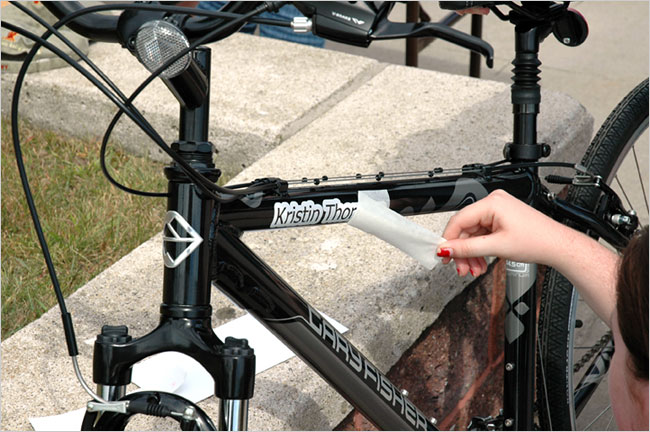
The University of New England bikes are personalized. Free or subsidized bike programs at colleges have had mixed success.
With Free Bikes, Challenging Car Culture on Campus
By KATIE ZEZIMA
The New York Times – October 20, 2008
BIDDEFORD, Me. — When Kylie Galliani started at the University of New England in August, she was given a key to her dorm, a class schedule and something more unusual: a $480 bicycle.
“I was like, ‘A free bike, no catch?’ ” Ms. Galliani, 17, a freshman from Fort Bragg, Calif., asked. “It’s really an ideal way to get around the campus.”
University administrators and students nationwide are increasingly feeling that way too.
The University of New England and Ripon College in Wisconsin are giving free bikes to freshmen who promise to leave their cars at home. Other colleges are setting up free bike sharing or rental programs, and some universities are partnering with bike shops to offer discounts on purchases.
The goal, college and university officials said, is to ease critical shortages of parking and to change the car culture that clogs campus roadways and erodes the community feel that comes with walking or biking around campus.
“We’re seeing an explosion in bike activity,” said Julian Dautremont-Smith, associate director of the Association for the Advancement of Sustainability in Higher Education, a nonprofit association of colleges and universities. “It seems like every week we hear about a new bike sharing or bike rental program.”
While many new bike programs are starting up, some are shutting down because of problems with theft and vandalism. The program at St. Mary’s College in Maryland was suspended because bikes were being vandalized.
“Ours was one that was totally based on voluntary taking care of the bike,” said Chip Jackson, a spokesman for St. Mary’s, “and I guess that was maybe a tad unwise. So the next generation of this idea will have a few more checks and balances.”
At Ripon, and the University of New England, officials say that giving students a bike of their own might encourage them to be more responsible. Ripon’s president, David C. Joyce, a competitive mountain biker, said the free bike idea came in a meeting about how to reduce cars on campus.
The college committed $50,000 to the program and plans to continue it with next year’s freshmen. Some 200 Trek mountain bikes, helmets and locks were bought, and about 180 freshmen signed up for the program. “We did it as a means of reducing the need for parking,” Dr. Joyce said, “but as we looked at it from the standpoint of fitness, health and sustainability, we realized we have the opportunity to create a change.”
The University of New England here in Biddeford had a similar problem — too many cars, not enough space and a desire to make the campus greener. So it copied the Ripon program, handing out 105 bikes in the first week of school. Because of the program, only 25 percent of freshmen brought cars with them this year, officials said, compared with 75 percent last year.
“We felt the campus could devolve to asphalt parking lots, and a lot of people didn’t want that to happen,” said Michael Daley, head of the university’s environmental council and a professor of economics.
The bikes are marked with each student’s name.
“I don’t have to fill it with gas, and it doesn’t hurt the environment,” said Kaitlyn Birwell, 18. “With a car, you need a parking permit, gas, and it breaks down. I’m a college student and don’t have the money for that.”
Michelle Provencal, 18, said she hopes her bike will help her avoid a dreaded side effect of being a college freshman. “Maybe instead of gaining the freshman 15 I’ll lose it,” Ms. Provencal said.
When Mercer University in Macon, Ga., asked for donations of old bikes, it received 60, which are being fixed up and painted orange and black, the university colors. Forty are available for weeklong rentals, and Mercer has organized mass rides to downtown Macon, about three miles away, to promote the program.
“A lot of students haven’t ridden a bike since middle school or even younger, but when they get back on it their faces light up,” said Allan J. Rene de Cotret, director of the program. “So why not leave your car parked where you live or back home with your parents and ride your bike around campus?”
Emory University has partnered with Fuji Bikes and Bicycle South, a local bike shop, to provide 50 bikes that can be rented at no charge at six spots on campus. Students can also buy Fuji bikes at a discount and receive a free helmet, lock and lights from Emory.
Students, faculty and staff can go to a rental station, show their Emory ID and check out bikes. The program plans to add 70 more bikes and four checkout points in the next year. In addition, about 150 bikes have been sold through the partnership in the past year, said Jamie Smith, who runs the program, called Bike Emory.
“We like the idea of bolstering the cycling culture here,” Mr. Smith said, “and ultimately it supports alternative transportation.”
Bikes at some campuses were treated as toys rather than transportation. Others were difficult to maintain or were not used.
“The kids weren’t taking care of the bikes, leaving them wherever instead of parking them in the bike racks,” said John Wall, a spokesman for Juniata College in Huntingdon, Pa., which eliminated its two-year-old bike-sharing program this year. “The other problem was that the bikes weren’t the greatest to begin with. They were donated by Wal-Mart, and others were rehabbed. They had also been out in the weather. It just didn’t work out.”
The elements are a concern at other universities as well. More than 150 students at the University at Buffalo signed up for a city bike-sharing program that has drop-off points on campus, but it suspends service from November to April.
“It’s hard to maintain all the bikes during winter, and usage drops dramatically,” said Jim Simon, an associate environmental educator at Buffalo.
Here at the University of New England, officials wonder what will happen when snow starts falling, but they are looking toward bike-sharing programs in cities like Copenhagen and Montreal as proof that they can work in the cold.
St. Xavier University in Chicago this month is unveiling the first computer-driven bike sharing system on a college campus.
Students can wave their ID card over a docking port. The port is attached to a rubber tube, which can be used as a lock and opened by entering an access code. Students must enter the bike’s condition before it can be unlocked. The system is used in Europe, but with credit cards.
The first 15 minutes are free, and users pay 60 cents for each additional 15 minutes, or $2.40 per hour. All 925 resident students automatically become members through their ID cards. The system was intended to be environmentally friendly, with solar panels powering the ports.
A tracking system similar to G.P.S. will keep tabs on the bikes.
“You can’t throw it in Lake Michigan,” said Paul Matthews, the university’s vice president for facilities management, “because we’ll know if you throw it in Lake Michigan.”

While McCain describes the economy as “cratering,” the Republican Party has spent more than $150,000 on his running mate’s wardrobe and hair.
Sarah Palin, billed as the populist voice for Joe Six-Pack and Soccer Moms struggling to pay the monthly bills, has been running through an average of $18,000 a week to look the part of a VeePee.
An Open Invocation
by The Center for Tactical Magic
illustration by Cassandra Chae
originally published in Arthur No. 31 (Oct 2008)
“Magic(k) works.” This declarative statement was recently hurled in our direction with a cautionary tone rather than a celebratory one. The sender of the warning was concerned that we didn’t take magic(k) seriously enough; that we were advocating its use willy-nilly like some sort of fun, new fad. But fear not. Although we don’t believe that fun and magic(k) are at odds with one another, we are nonetheless advocating its use very pointedly and with much consideration. And we are advocating its use precisely because it works.
As we’ve said in the past, one of the primary reasons why people don’t engage in magic(k) in the first place is out of a sense of dismissal. They dismiss magic(k) because they doubt it will produce results; and, they dismiss magic(k) because they fear it will produce results. Indeed, much of the bullshit that fertilizes the grand magic garden reeks of these airs of dismissal. Occult conspiracy theorists will even tell you that such bullshit is built up to protect the fruit from those who would dare set foot in the garden at all. Layers and layers of foul fluff and rotten rhetoric are woven into a formidable pile of vapid New Age-isms, Hollywood cheese, religious warnings, and occult elitism.
Continue reading
Doug Aitken: ‘sonic happening’
Featuring performances by White Rainbow, Lichens and Arp
Wednesday Oct 22, 2008 6-8pm
303 Gallery at 547 west 21st street
“the sonic happening (migration)”
In conjunction with Doug Aitken’s current exhibition, 303 Gallery is pleased to present a special viewing of Doug Aitken’s film based installation “migration”. For this event the artist has turned off the film’s soundtrack and invited the musicians Lichens, White Rainbow and Arp to create live improvisational scores set to the work.
Doug Aitken currently has concurrent installations at 303 Gallery’s two spaces. The performance, event, and ‘happening’ have been integral elements in his work. Aitken has organized ‘happenings’ in Los Angeles, New York, Basel, Manchester and Philadelphia.
In Lichens, wordless vocals are looped into curtains of drone, adding acoustic and electric guitars, percussion and other effects to create alternately thick and delicate works. Lichens has recorded and released two full-length LPs, “The Psychic Nature of Being” and “Omns”. In addition his work appears in the score of the film “migration”.
Portland-based White Rainbow, has released 7 full length albums since 2000. Creating morphing soundscapes that alternately reference minimalism, eastern prayer musics and trance ritual, White Rainbow weaves a unique web of sound meant to interact directly with its environment. He also provides the score to Aitken’s installation “to give it all away.”
Arp is the most recent project of Alexis Georgopoulos, a San Francisco-based artist, writer and musician brought up in France, Greece and the United States. As Arp, he released 2008’s “In Light”, an album recorded almost entirely live, and meant to serve as a bridge between the natural and electronic worlds.
“Migration” is included in the 55th Carnegie International exhibition “Life on Mars” where the piece is projected on the museum’s façade through January 2009. Aitken has also had solo exhibitions at the Museum of Modern Art, New York, ARC Musée d’Art Moderne de la Ville de Paris, the Serpentine Gallery, London, Kunsthalle Zurich, Switzerland, Kunsthaus Bregenz, Austria and Tokyo Opera City Art Gallery, Japan. Aitken’s newest book “99 cent Dreams” was published in 2008 by Aspen Art Museum following his solo exhibition there, and his artist’s book “Write In Jerry Brown President” will be published by the Museum of Modern Art, New York in October 2008.
303 gallery
525 west 22nd street
new york, ny 10011
t. 212 255 1121
http://www.303gallery.com
 Arthur Magazine