Here’s a scan of the cover of one of the last copies we have of Arthur No. 2, published ten years ago right about now…
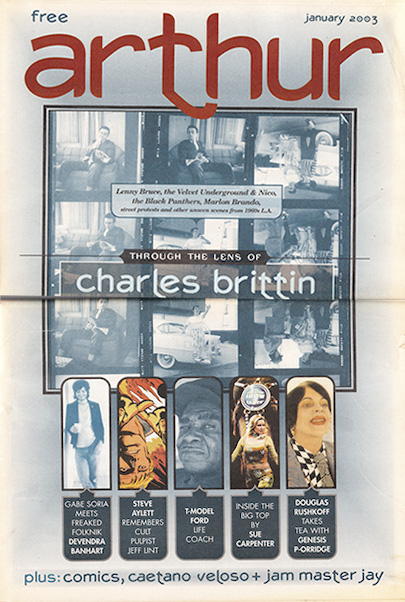
It’s a pretty weird issue of the mag — to my eyes, it doesn’t quite hang together editorially, a fault completely my own — but whatever, it might of interest to some folks ten years on. Here’s a list of the contents:
Arthur No. 2 (December 2002)
Color/black and white, 48 pages, newsprint, 11.5 x 14, quarterfold
The West Coast premiere of the Velvet Underground and the Exploding Plastic Inevitable, in 1966? Lenny Bruce and Anita O’Day waiting to score? James Baldwin, Marlon Brando, the Black Panther Party and other good-souled political activists doing what needed to be done? CHARLES BRITTIN was there, and these are his never-before-published photographs, as curated for Arthur’s readers by KRISTINE MCKENNA.
He plays guitar and he writes/sings songs like you’ve never heard. He’s also 21 and has got a certain elfish charm. Ladies and germs, DEVENDRA BANHART, as witnessed by scribe GABE SORIA and shutterbug SHAWN MORTENSEN.
Depressed? Hair falling out at age 23? Having sex with your cousin? “I know all about that stuff!” says Arthur’s new advice columnist, 78-year-old bluesperson T-MODEL FORD.
Language as incantation, the art of the cut-up, larval culture, neural re-wiring and what does it feel like to live in a post-authorship world: all in a Sunday afternoon’s teatime with visionary artist-provocateur-human GENESIS P-ORRIDGE and hotshit media theorist DOUGLAS RUSHKOFF. Photos by SHAWN MORTENSEN.
In an exclusive excerpt from his new autobiography, legendary Brazilian musician CAETANO VELOSO takes us to the political, cultural and hallucinogenic frontlines of authoritarian Brazil, 1968. It’s all here: tanks, ayahuasca, street protests, witchcraft cults, and of course, Veloso’s fellow Tropicalistas, the musicians Gilberto Gil, Gal Costa and Os Mutantes.
Self-described desk-bound journalist SUE CARPENTER finds out firsthand and feet-first how women are transforming the 21st-century circus. With photographs by LAUREN KLAIN.
Plus: Comics by Kevin Huizenga, Jordan Crane, Anders Nilsen and James Kochalka, and a drawing by Sammy Harkham.
Britwit-novelist STEVE AYLETT revisits the legend of pulp fictionist/”rogue maniac” Jeff Lint, author of One Less Bastard and creator of The Caterer
“Bull Tongue” columnists Byron Coley & Thurston Moore sort the pepper from the bugpoop in underground recordings, performance, poetry and text.
Peter “Piper” Relic remembers JAM MASTER JAY.
Some thoughts on the issue for those keeping score at home — hopefully completely accurate, but it’s ten years, and there’s probably been some memory loss, so be gentle with me if I screw something up here.
This was our second issue. The first issue had done alright. We’d printed 70,000 copies. The printer had folded them the wrong way, which while embarrassing, wasn’t catastrophic, since we’d put the logo at the top of the reverse side (don’t ask). Anyways, less than one week before we went to press with this issue, our old printer told us that our agreement with them would not be honored. They told us they wanted to get out of the quarterfold newsprint business. My partner, publisher Laris Kreslins, scrambled and found a new printer in time for us to not miss our deadline for No. 2. We abandoned the double-cover concept we’d used for Arthur No. 1, which was borrowed from the original format of Rolling Stone, and made it to press.
But finding a new printer at the last moment was only the last of many hurdles in getting this issue out. Ad sales were somewhat lower than the first issue, which, although predictable — second issues are often a harder sell than the big premiere issue, where you can count on a bit of goodwill — was somewhat dispiriting. It made us wonder if we were deluding ourselves that this Arthur thing really had a chance of working, given that it was going in the wrong direction so quickly.
On the editorial end, which I was in charge of, we’d had a major problem, beyond being completely budgetless: the Eddie Dean-penned cover feature on the photography of country music enthusiast Leon Kagarise for this issue, which had been prepared months in advance, had to be pulled near the last moment because… Well, just because. That cover feature didn’t end up running ’til Arthur No. 32, the issue that was to go to press in December 2008, but never made it due to the severe economic contraction that fall…which was the final blow to Arthur in its first incarnation. (You can read Arthur No. 32 by downloading it as a two-part PDF. Click here for info.) Something about that piece did not want to see print in Arthur.
With the Eddie Dean feature delayed to who knows when, we had nothing in hand that seemed—to me, at least—like a cover feature for the issue in front of us. In hindsight, I can see that the Douglas Rushkoff-Genesis P-Orridge conversation was cover-worthy…although we didn’t really have the right kind of photos on hand to make that a cover… And I really liked the interview and photos we’d got with this kid Devendra Banhart — it was apparently the first or second interview he’d ever done in his life—but we couldn’t make him the big cover feature, he was just starting out… So…
Enter the great veteran journalist Kristine McKenna, whose work I’d been reading since I was 14 or 15. For a golden period in the ’80s, Kristine was writing regularly for the Los Angeles Times, covering all the interesting musicians, fine artists, cartoonists, performers and art-thinkers who were there to be interviewed at the time. I devoured anything with her byline; she got the best conversations out of the most provocative people (seriously: see the two collections of her interviews published by Fantagraphics—the list of interviewees is just absurd), and her reviews of records and live performances both exposed me to work I wasn’t aware of and showed me why it was of import or at least worthy of interest. I didn’t see her byline much in the ’90s, and although I’d started writing for the LAWeekly and getting around just a bit in LA cultural circles, our paths never crossed. I wasn’t even sure she was still in L.A.
So. It wasn’t until 2000, when I was working on a feature for Mojo on Black Flag’s pre-Henry Rollins era, that I came in contact with Kristine. I am not sure who gave me her phone number, although I think it may have been Brendan Mullen (RIP). I was looking to talk to an L.A.-based music journalist who wasn’t overly involved in the hardcore scene who could offer some perspective on how Black Flag were regarded in their early days from outside. Kristine seemed like she would fit the bill. I called her, we met, she was extremely generous with her time and ideas, and we became fellow freelancer/comrades, with me of course very much in the extreme junior position. We stayed in touch. In late 2002, when I told her I’d lost the cover for Arthur’s second issue, she had an idea.
Why not cover Charles Brittin, she asked?
Charles (who has since died) was a semi-professional L.A. photographer who had spent much of his life photographing extraordinary scenes that he was involved in, the most exciting being L.A’s avant garde scene of the mid-to-late ’50s (principally around Wallace Berman and his circle) and the social activist period of the ’60s. He had tons of unpublished photos that were just incredible: Lenny Bruce in his prime, the Velvet Underground & Nico onstage in Hollywood, the Black Panthers in action, Marlon Brando at a street protest, CORE members picketing next to white supremacists… and then, Anita O’Day, and Rachel Rosenthal… Art director WT Nelson went nuts when he started seeing what Kristine had found, and with good reason.
For me, the clincher was a wide-angle photo that Charles had taken of an endless sea of marchers, many of them G.I.’s, protesting the Vietnam War on April 4, 1969, right here in Los Angeles, on Wilshire Boulevard near Virgil. Please keep in mind that his was late 2002: America was preparing to invade Iraq. Anti-war sentiment barely existed outside of the usual peacelover/refusenik circles. We decided to run this photograph as a double-page spread, as a centerfold — a de facto poster, available to anyone who wanted it, since Arthur was distributed free of charge. Maybe it would play a small part in helping inspire and encourage people to stand up to these war creeps.
It wasn’t much, we knew, but it was what was available to us. So, we went for it. That was our centerfold, and what the heck, Charles Brittin was our cover.
Thank you, Kristine McKenna!
For those interested in learning more about Charles Brittin and his work, check out Charles Brittin: West and South, a hardcover monograph edited by Kristine and others that was published on the occasion of a 2011 retrospective at the Michael Kohn Gallery.
This issue of Arthur Magazine is available from the Arthur Store for $5 while supplies last. Click here for info.



 Arthur Magazine