AVENGE BROOKLYN by Dave Reeves (Arthur, 2013)

“Let Me Finish” column by Dave Reeves

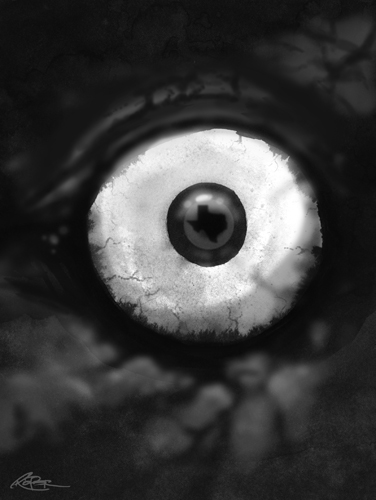
Illustration by Arik Roper

Originally published in Arthur No. 33 (Jan. 2013)


The eye of Texas is upon you, Dave.

AVENGE BROOKLYN

It was me that killed Arthur. I kill all the little joys that make life worth living.  Brooklyn. Those three Motorcycles. The Master Cleanse. Burroughs quotes an account of the black plague: “Never yet has the plague come but one has first seen a ragged, stinking boy who drank like a dog from the village well and then passed on.” I am that ragged boy, passing villages, expensive coffee brewing in my tracks. And I am still thirsty.

If you’re reading this, you are one too. Takes one to know one. Twitter dat. Now there’s three. Then it’s like rabbits. Within the day they’ll be a hundred thirty of us at the coffee shop competing to write this very article about how our presence erases “ethnic enclaves” with precision worthy of Robert Moses. Detailing the fact that within the passing of three summers of sighting Us in Echo Park the Santeria temple turned to cafe, attracting the record shop, the stench of which summoned the Thrift Stores, The Shops of Obscure Purpose and The Second Coffee Place. Cue Upscale Grocery. Wham! Yoga mats. Suddenly, Doug Aitken is Art and Chloe took your parking space in front of a restaurant so cool it doesn’t have a sign. Rents blow up faster than a Gaza Strip Club. And we can’t go home. Again. 

Which is fine. Big rents means it’s time to take the show on the road. But, this time, ragged boy is thinking, “what if we visits a well in a town that sucks, instead of killing the thing that we love?” And in the course of thinking things he hates, thought of Texas. Specifically, a little “Atlas Slouched” sort of a town where artist types claim the light is great, forgetting to mention that all there is to see in the great light are a bunch of Texans drinking beer and taking ten-pound shits. 

Ragged boy figured he could take a little sip from the well and the place would be strip malls full of people making coffee and tattooes in no time. But first the ragged boy had to work into the fabric of the place, which essentially meant that he had to, you know, buy some weed. 

First problem is people don’t have any. Turns out that the laws are so strict in Texas that people turn to other sources for their buzz like huffing gas, shotgunning beers and abusing analogue drugs with names like Giggles or Mr Greenvibes.

The analogue drugs are packaged for specious purposes like bath salts or plant food, designed to fool the FDA of the manufacturers’ intention to jump the blood-brain barrier. In the course of juking the FDA, they also sidestep any sort of lab research, leaving the testing to be done by teenagers in garages all over this land. 

I watched a guy, my age, two kids, purchase some fake drug called K2 from a case in a headshop in which also were kept those horrible things that stretch earlobes out. The man behind the counter said that this particular potion had the Border patrol guys waiting at the door in the morning shifting from foot to foot like they had to pee real bad. My friend figures if it was good enough to null the pain of government work, it was good enough for him.

I knew by the click click of the razor on the mirror and the insistent scrape that this was no cheerleader drug like salvia or that thing where you hold your breath until you pass out. No, this “plant food” was dangerous stuff, resulting in the total loss of sanity.  As a bartender,  I’ve seen what real drugs can do: blind-eyed alcoholics, weedheads dizzy and coke fiends whose jaws keep clacking long after you cut their heads off. But this plant food stuff was bananacakes. 

My “friend” was stupid, paranoid and sensitive to light. The bath salts made all of these afflictions even worse. Whatever evil force was in this powder drove him to rant about how when Texas secedes something called the “Posse from El Pusso” would attack California. He did this while trying to nail “shadow people” to the doorframe. It was horrible. We can only hope that no real plants were given this “food.”

My friend’s actions and subsequent loss of job and embarrassing himself in front of his family forced me to deduce that the ingredients removed from these drugs to make them legal are the same things that God put in the drugs to keep us sane. Stopping people from smoking Mexi-press weed with analogue drugs is like giving someone rabies so they won’t take Advil. 

Furthermore, if we damn our border patrol jocks to abuse fake drugs in order to pass a piss test, is it any wonder that there are immigrants everywhere? 

Shudder to think how many Christmas gifts have been tainted by the unwitting addition of psychedelic bath salts. How many half-eaten pets must be buried late at night by confused bloody grandmothers before someone lets these poor Texans have the weed that God (okay, it was most likely Jesus) put on earth for us to use? While I’m on the Jesus — Why would Texas bust a state mascot like Willie Nelson for smoking weed? It’s not like he’s driving the tour bus. Marijuana, like Mexicans, was native to Texas before this bunch of asshats showed up and started putting everybody in jail. This fact exonerates All, as neither The God nor The Willie Nelson I believe in are capable of mistakes, mister.

I’ll say it here in Arthur magazine, fresh from the dead, that until Texas allows the Border Patrol to use the real drugs, this ragged boy is going to hang his hat somewhere that is not Texas. Also, fuck Arizona. Good luck trying to gentrify your ethnic neighborhoods without me.


Dave Reeves has an article in this month’s Man of the World Magazine and an article about him in the Russian Travel magazine Mir. He spends his days working on movie drivel, gets fired or quits, it’s hard to say, and then works on other movies. The cycle repeats itself until the magazine industry comes back from the dead. Also, Dave is working on the perfect lamb vindaloo, jogging and listening to WFMU.

Arik Roper is an illustrator and designer who lives in New York. He creates record covers, screenprinted posters, animation, comics, and other vehicles of visual flight. arikroper.com

Stewart Voegtlin on Waylon Jennings’ exquisite replica of eternity (Arthur, 2013)

Originally published in Arthur No. 33 (Jan. 2013)

EXQUISITE REPLICA OF ETERNITY

Waking Waylon Jennings’ Dreaming My Dreams

By Stewart Voegtlin

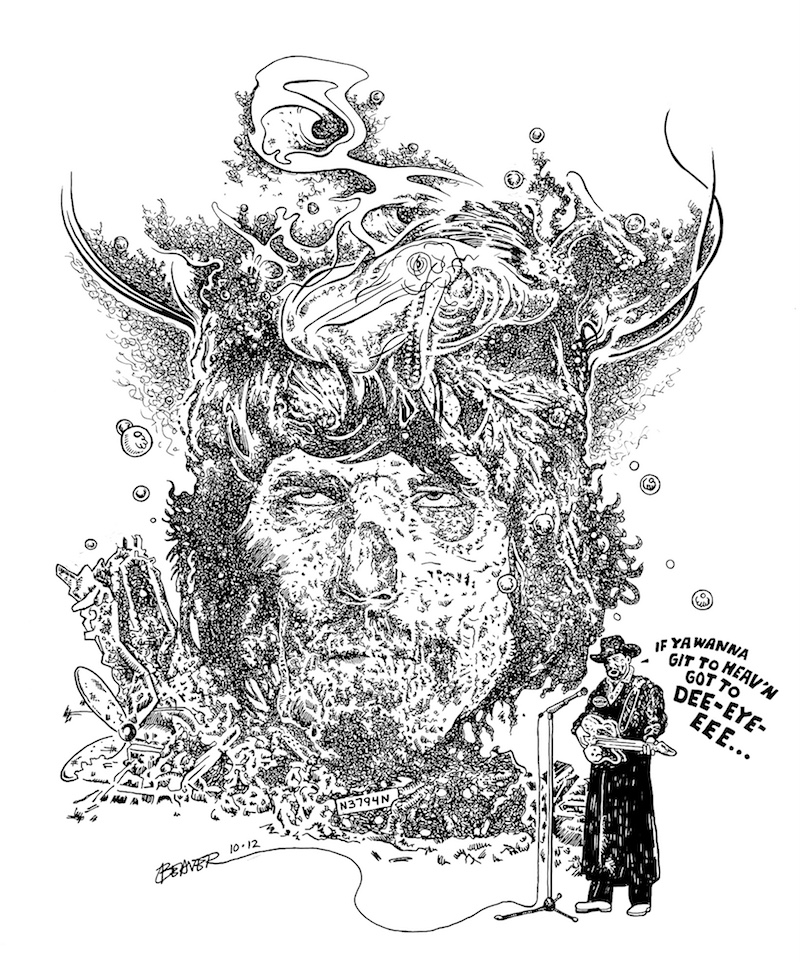
Illustration by Beaver


“The Day the Music Died”—not just the name of Don McLean’s too long song that refused to climax. It’s also a co-descriptive term referring to the aviation accident that took three of rock ‘n’ roll’s biggest names—Buddy Holly, Ritchie Valens, J.P. “Big Bopper” Richardson—and magnified them until they became analogous with—and even eclipsed—the music they made. Littlefield, Texas’ Waylon Arnold Jennings, then playing bass in Holly’s band, was supposed to have been on that flight. He gave up his seat to the Big Bopper, and settled for second-rate travel in a makeshift tourbus with Holly’s guitarist, Tommy Allsup, who’d lost his seat on the doomed plane to Ritchie Valens in a coin toss.

In its most savage—and strangely sacred—way, the accident mimes an offering to some cosmic god who rejected it, and sent it careening back to earth engulfed in flame. Take a look at the Civil Aeronautics Board’s crash site photo. Wreckage resembles one of Robert Rauschenberg’s early combines: an abracadabra of Americana—ambiguous machinery compacted and deconstructed into a monolith of hyper-meaning, conveying less and more than the sum of its parts, even with nary a corpse in the frame. A wheel. A wing. A barely identifiable frame of fuselage. All there amongst Iowan Albert Juhl’s snow-covered cornfield, a barbed-wire fence keeping it clear of the plain—separate, contained: an art installation to the everlasting gone awry.

Incapable of being quarantined, however, was the guilt Jennings walled himself up in the tragedy’s aftermath. Before the plane left the ground, Holly reportedly told Jennings he hoped his “ol’ bus would freeze up.” “Well, I hope your ol’ plane crashes,” Jennings responded. Illogically, but understandably, Jennings took sole responsibility for the crash. It’s so much salt thrown over the shoulder, but it makes great superstitious sense, especially since, in Jennings’ mind, those seven words worked up a hex heavy enough to take the lives of four men and Holly’s unborn child, as the tragic news caused his wife to miscarry. But the music, it never died. Jennings and Allsup even completed the midwestern tour, two men spreading song amongst a bottomlessly black sky bereft of its three stars.

And still the music kept on. Throughout the amphetamines and the cocaine and the drinking. Throughout the invention and reinvention. From rockabilly to “Outlaw Country” and all its trappings: big black hat and somber clothes, beard long as days spent in saddle, a voice drink and smoke ravaged carrying on about campfire yarns concerning women loved, men reckoned with, and the Almighty above watching it all transpire from eternal dusk to dawn. Sixteen years after Holly’s charter crashed, Jennings made what was arguably his finest record—and perhaps the finest of the “Outlaw Country” subgenre—Dreaming My Dreams. This compendium of the conscious unconscious harkened back to country music’s so-called “Big Bang,” the Bristol Sessions in 1927, and roared on far ahead to a future that saw this generation’s Sam Phillips—Rick Rubin—-coax Johnny Cash into songs sparer than those that tossed and turned throughout Dreaming My Dreams, and woke as grizzled fable, larger than the legends that wrote, played, and recorded them.

Continue reading

THE STUFF THAT SURROUNDS YOU: Mimi Zeiger talks with artist SHIRLEY TSE (Arthur, 2003)

Originally published in Arthur No. 3 (March 2003)

THE STUFF THAT SURROUNDS YOU

In the work of artist SHIRLEY TSE, plastic aspires to more than Pop. Mimi Zeiger reports. 


Uber glossy, chicer-than-thou, magazine Wallpaper subtitles itself “the stuff that surrounds you.” The lifestyle porn peddler advocates a world filled with things: Palms, Karim Rashid baubles and Prada shoes. Anything. Any high-end object from the precious to the perverse to fill the vacuum of consumer culture. 

But what is all that stuff that surrounds you? Embraces you? Suffocates you? Artist Shirley Tse looks around and sees plastic. She sees that injected-molded form used to shape your iBook or Oral B, the packaging that surrounds the products: it’s the miracle of plastic that fills the vacuum surrounding us these days. In the translucent, bubble-pack Styrofoam between the box and the object lies the impetus for her artistic vision. 

“It is symbolic of our culture,” says Tse of packaging. “When you see a computer, you don’t even think about the box. You don’t think about what it takes to move that product from its origin to your house. Looking at the box makes you think about the process.” 

Rather than aspiring to package lifestyle, Tse’s most recent sculpture, Shelf Life, 2002, is life-sized packaging. Strangely beautiful, it is a 20-foot wide synthetic iceberg lodged in the second floor galleries of the California College of Arts and Crafts (CCAC) in San Francisco, seemingly filling the room to eye level with white polystyrene. There’s so much Styrofoam that prior to the show’s opening, Tse–the Capp Street Project Visiting Artist at the CCAC Wattis Institute–is jokingly apprehensive about how people will react to the piece. 

“It is a lot of Styrofoam,” she laughs. “Being here in San Francisco, with the tradition of radicalism, I have this nightmare that people are going to picket outside the gallery. They’ll boycott my show because of the amount of Styrofoam used.”

Like a three-chord pop song, Tse’s work seems simple enough for anyone to put together (given enough packaging material from stereo components), but its artistry comes in the handling of the few elements. Her earlier work is on a slightly smaller scale: sculptures made of polystyrene sheets, hand-routed into elaborate topographies. The scale of the artwork invites the viewer to make comparisons to things out in the world of culture, pop and plain. 

“I’ve been told it looks like a model for something bigger; it looks like a spaceship; it looks like a city,” explains Tse. “Which is fine, but I don’t want this piece to stop as a representation of something else. At some point I want my viewer to stop and look at the piece and go, “Oh, it’s just foam, it’s not a city.””

Complexity-in-simplicity is a truism in modern and contemporary art discourse: it’s why paint dribbled by Jackson Pollock is an artwork and paint dribbled by a two-year-old is a mess. In Pop Art, it’s why a Campbell’s soup can gets elevated to artistic status. For Tse, this duality is inherent in plastic: the simplicity spells out all sorts of arty questions. 

“I love how plastic embraces the paradox of a lot of things,” she explains “It’s soft, but hard; it’s surface and structure. It is something so ubiquitous and at the same time so alien. We live with it, but say things like ‘that’s phony.’ Plastic asks all these questions about originality.” 

In Tse’s hands, plastic aspires to more than pop. Despite its alien material, the work Shelf Life is desirously physical. The claustrophobic entry, where Styrofoam surrounds you on three sides, is relieved by a small set of steps. The short flight finishes on a foam plateau. From this vantage point, with your head nearly touching the gallery air conditioning vents and track lighting, what had seemed so stifling now stretches out into a landscape. The block is carved into organic shapes and marked with surface totems. 

“Is landscape really that natural anymore? It’s not,” Tse asks and then emphatically answers. “Even the landscape that we do see these days, like national parks, are totally manipulated. I can’t tell you when the packaging begins and when the landscape ends. The two things are going on at the same time.” 

Walking across the polymer landscape, Calvin Klein-minimalism gives way to something weirder. Seamier. The material properties come to life. White Styrofoam gets dirty. It gives under the weight of heels and toes, leaving small divots behind. The edges crumble and Shelf Life makes noises, high feedback squeaks and lower-toned groans as it adjusts to pressure.

Nestled in the foam terrain are three fiberglass tubs – fleshy peach with lip-gloss sheen. A fourth tub is set in the end of Styrofoam jetty that juts out into the empty area of the gallery space. They are decidedly unnatural and they seem to mimic beauty products. It’s appropriate that the vacuum-formed tubs were fabricated at Warner Brothers Studio Facilities, the heart of the Hollywood culture industry

Two of the tubs are lined in “memory foam.” The material akin to the sponges used to apply make-up is used in the piece because it holds an impression–place a foot on it and the print remains in the foam for a several seconds. Other tubs bring to mind the hedonistic high times of Jacuzzi baths. Sensuous curves fit the body. Climbing all the way into the tub, there is something sinister in the way that the plastic supports your spine and provides cubbyholes for arms and feet. This is vacuum-packed, human-sized packaging. Hot tub luxury is transformed into a disposable womb or tomb.

As frightening as it is to find yourself ensconced in plastic like a GI Joe or Barbie, Tse sees the work as liberating rather than confining. 

“At the end of the day, when I ask myself why my interest in plastic is sustained, it has a lot to do with plastic itself and its history and all that, but it is also an entry to the world for me. It has allowed me to slice through the layers and see what is going on the world. It’s a navigational tool: a way to open up.”

Without evoking fist-raising slogans, Tse’s work asks the uneasy question: Are we packaging our own existence? The confines of the shiny fiberglass sarcophagus make clear what really is the stuff that surrounds us: “brand new trash” as Tse likes to call it. The artist wrestles with her own position as a consumer and producer in the world of plastic. 

“The whole issue of recycling and the environmental aspects of the work is a complicated one for me. On the one hand, I do recycle material, but on the other hand I buy new material,” she says. “It’s a moral issue. When I ask myself these hard questions, I ask “Is it necessary?” And yes, I think it is necessary precisely because I want to use this material that makes up so much of our culture. Part of the environmental issue is that the plastic is used once and then thrown away, but as artwork, hopefully it won’t get thrown away, so it isn’t consumed in the way we usually use Styrofoam.”

Tse grew up in Hong Kong and now lives in Los Angeles. The artwork she makes fills the gap between these two polar existences: supply and demand. 

“Sometimes you see artwork from someone from outside the United States, and you can tell that that’s a Latin or Korean artist because the work references something in their cultural heritage. I don’t think that there is anything that jumps out from my work and says that I’m Chinese or from Hong Kong, necessarily,” she reflects. “It is all about it, just not directly. There is the whole issue of commodity, artificially, synthetic exchange and movement–all coming from the place I grew up in.”

For Tse, the stuff that surrounds her and her cultural heritage are one and the same. It is plastic: malleable and rigid, beautiful and artificial.

DON’T BLAME THE MESSENGER (Editorial, Arthur No. 5, July 2003)

Originally published in Arthur No. 5 (July 2003)


DON’T BLAME THE MESSENGER

…To rage in sound this valiant despair

Doom and gloom as each a splendid pair

To rage in sound the valiant despair

Play your gloom axe Stephen O’Malley

Sub bass ringing the sides of the valley

Sub bass climbing up each last ditch and combe

Greg Anderson purvey a sonic doom…

Don’t blame the messenger of gloom,

Don’t blame the messenger of doom,

For this be the Ragmarockingest aeion

In stillness O’Malley and Anderson play on… play on… play on…

– text by Julian Cope for “My Wall” by SUNN0)))

When we started working on this issue, the war was still on. (Oh we know it wasn’t a war, it was an invasion. And yes I know the war isn’t over yet, that  it’s only just shifted into a traumatic transition-to-imperial rule period.) We’d just finished the last issue as the USUKFOXMSNBCAOL forces had begun to roll across the desert, embarking on an epic fool’s errand that we‘ll all be paying for the rest of our lives. We decided to do what we could as soon as possible: to publish an issue of Arthur as powerful as we could muster to confront, or at least examine, the United States’ newest, and most dangerous yet, lurches towards imperial power abroad and a weird kind of proto/crypto-fascist rule at home.

“Imperialist,” “empire,” “fascist”: these are strong words, and I assure you, they are not used lightly here. But what other words describe where we are now? America is simply continuing to expand its military presence across the globe—now we are not just in Germany (100,000 troops, 58 years after the end of World War II), or South Korea (40,000 troops, more than four decades after the Korean War’s conclusion), or Japan, or the Philippines, or Puerto Rico, or Afghanistan, now we are in the heart of the Middle East. We are acting as empires do: expanding outward, identifying pockets of resistance, stamping them out and replacing them with puppetish local governments who operate under the watchful eye of centurions who report back to the seat of Empire.

And at home? I walk out my front door and find that an American flag has been placed on my (rented) front walk by a local realtor, advertising his services. I drive to Vons for some groceries and almost every vehicle has an American flag stickered on it. “United we stand, divided we fall” warbles some mawkish Up With People choir on the Vons PA; when I complain to the store’s manager, she looks at me like I’m a madman, or worse, a Muslim. I come home and there’s a letter from a Dreamworks promosexual about the success of country dipshit singer Darryl Worley’s call to arms, “Have You Forgotten,” an execrable song that advocates the slaughter of innocent Iraqis in revenge for the September 11 attacks they had nothing to do with. (Note: This song was #1 on the country charts for six straight weeks.) In the weeks since, with the exception of wise old Senator Robert Byrd and some brave mainstream media commentators (take a bow, Paul Krugman, James Wolcott and Robert Sheer!), there’s been such a wave of unrelenting propaganda and willful disinformation and just plain misdirection by both the government and the media that many of us who know something has gone terribly wrong are finding ourselves disheartened, isolated and depressed. We return to our various recreational and business and creative pursuits in a (totally understandable!) ostrich-like effort to forget what has happened and what is happening and what is gonna happen next. 

We are in a trance-state. A trance State.

So,  naturally, people started asking, Are you still planning to do that anti-Bush issue of Arthur? We said, Hell fucking yes. You’re in the worst danger when you don’t think you’re even in danger. Better to leave the light on, so you can at least see what is happening. When crazy talk has become accepted common sense, when a powerful elite’s delusion has become the consensus reality, that’s when dissidents have to speak up, or at least speak with each other. An historical example of this, and the primary inspiration for this specific issue of Arthur, is the ferociously satirical work that German collagist/artist John Heartfield did for the AIZ paper in the late ‘20s and ‘30s, warning against Hitler’s ascent from early on. Heartfield was not just right–he didn’t just see something awful coming that way–he did something about it. This is crucial. Heartfield didn’t curse the darkness–he cursed Hitler. 

We want to try and do the same. This issue is a collective curse against the folly of empire, against those who advocate it and those who profit from it. It’s a curse against the Bush Administration and its media mandarins and apologists. It’s a curse against the willful ignorance and docility of so many Americans. And it’s (hopefully) a call, an inspiration, to all righteous free-thinking individuals to simply do what you can to shut this shit down. Do what you’re best at! But do it in such a way that at a minimum, it causes no harm. 

Think about the consequences of all of your actions. 

Re-align your life the best you can. 

And remember that you are NOT alone. 

Because if there’s one thing we’ve learned doing Arthur, it’s how un-alone we are. Know that this whole enterprise is ad-hoc, put together by both friends and strangers on the basis of trust. It’s entirely financed by our loyal, beneficent advertisers, by some unbelievably generous donors and, well, by Laris’ and my personal credit cards. It’s created by a talented, as-yet-salary-less staff and a loose coalition of brilliant, as-yet-unpaid contributors. It’s distributed—by hand!—by a guerrilla network of wonderfully dedicated, as-yet-uncompensated volunteers, spread across North America. Arthur’s success is, in short, a model of a different way of doing things: of people engage in mutual aid and good faith and goodwill, all in the service of freethinking, at-length-if-necessary, full-on free expression. Isn’t that what being human amongst other humans should be about? It doesn’t have to be about endless exploitation and bottomless greed and an unending quest for power/control and the rule of the jungle. This may sound banal, but seriously: if more of us just tried harder, more of the time, this can be a better world.

And if the world doesn’t get better? Well, at least we did our damnedest.

Jay Babcock

Los Angeles

May 29, 2003

THIS MAGAZINE COULD BE YOUR LIFE (Editorial, Arthur No. 9, March 2004)

Originally published in Arthur No. 9 (March 2004)

This Magazine Could Be Your Life

We’d like to give a warm public welcome and a hearty hurrah to author Daniel Pinchbeck, cartoonist Ben Katchor and publisher/cartoonist Tom Devlin, who are all joining the Arthur team starting with this issue. 

Like every single person associated with Arthur, from those listed from top to bottom on the masthead to the right, to those with bylines and credits in the magazine, to the 120-plus folks who distribute 40,000 copies of Arthur across North America every two months, these gentlemen are working for Arthur for close to nothing. They could be doing something else. They’re not. They’re putting their time and energy where their heart is. 

This is not something unusual: there have always been people like this. Just look at this issue of Arthur, with its true stories about pirate radio operators, kinetic sculpture racers and revolutionary rock n rollers: like most issues of Arthur, its pages are devoted to people who have placed love over gold, in their art and in their craft and in their work and in their lives. 

None of them—none of us—are perfect (except maybe T-Model). And sometimes, we at Arthur sing in a key we simply can’t quite reach, as we try to build something that is a little less compromised, a little less oriented toward greed, a little more loving and open. Basically, we’re trying to do a magazine that reflects and embodies a set of ideals that run absolutely counter to the mainstream culture, which is more diseased, corrupt, demonstrably insane and world-destructive by the day. The funny part, though, the part they (and you know who “they” is) never tell you, is this: once you opt out of that terminal culture, you opt in to something much more fun. It’s not too hard to leave all that bullshit behind—if Laris and I can do it, believe me, anyone can. 

That said: Arthur needs all the help we can get. Integrity shouldn’t mean involuntary poverty: everyone needs to eat, even the starving artist. So, thank you to all of you who have already helped Arthur to its early success. And for those of you who want to play a bigger role, who want to put a little more of your money where your heart is, please buy a subscription, or a T-shirt, or support our honorable advertisers. We can make this work—for everyone.

All best,

Jay Babcock

editor

BROTHER FROM THIS PLANET: An interview with homegrown psychedelic genius John Terlesky aka Brother JT, by Jay Babcock (Arthur, 2004)

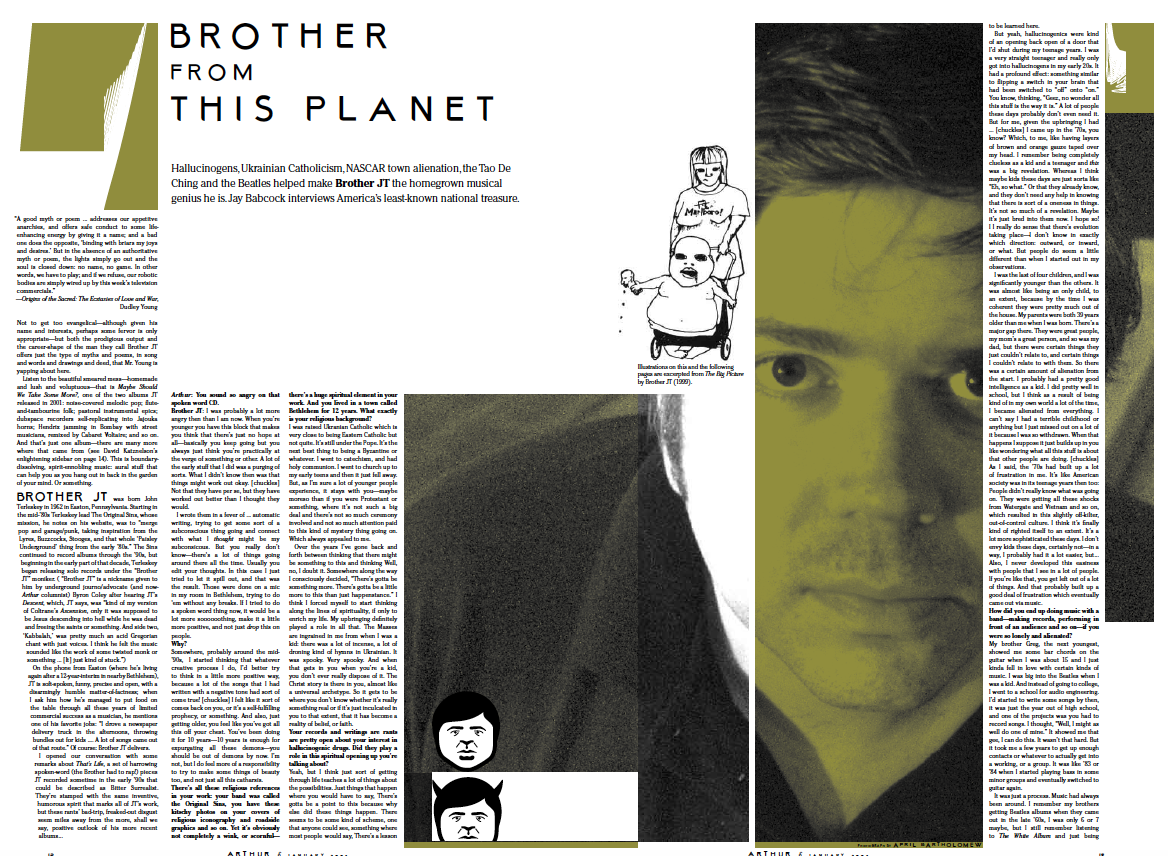
Originally published in Arthur No. 8 (January, 2004). Art direction by W.T. Nelson

BROTHER FROM THIS PLANET

Hallucinogens, Ukrainian Catholicism, Nascar town alienation and the Beatles helped make BROTHER JT the homegrown musical genius he is. Jay Babcock interviews America’s least-known national treasure.

Don’t miss the sidebar: David Katznelson explores the Brother JT discography


“A good myth or poem…addresses our appetitive anarchies, and offers safe conduct to some life-enhancing energy by giving it a name; and a bad one does the opposite, ‘binding with briars my joys and desires.’ But in the absence of an authoritative myth or poem, the lights simply go out and the soul is closed down: no name, no game. In other words, we have to play; and if we refuse, our robotic bodies are simply wired up by this week’s television commercials.” — Origins of the Sacred: The Ecstasies of Love and War, Dudley Young

Not to get too evangelical—although given his name and interests, perhaps some fervor is only appropriate—but both the prodigious output and the career-shape of the man they call Brother JT offers just the type of myths and poems, in song and words and drawings and deed, that Mr. Young is yapping about here. 

Listen to the beautiful smeared mess—homemade and lush and voluptuous—that is Maybe Should We Take Some More?, one of the two albums JT released in 2001: noise-covered melodic pop; flute-and-tambourine folk; pastoral instrumental epics; dubspace recorders self-replicating into Jajouka horns; Hendrix jamming in Bombay with street musicians, remixed by Cabaret Voltaire; and so on. And that’s just one album—there are many more where that came from (see David Katznelson’s excellent sidebar). This is boundary-dissolving, spirit-ennobling music: aural stuff that can help you as you hang out in back in the garden of your mind.

Brother JT was born John Terlesky in 1962 in Easton, Pennsylvania. Starting in the mid-‘80s Terleskey lead The Original Sins, whose mission, he notes on his website, was to “ merge pop and garage/punk, taking inspiration from the Lyres, Buzzcocks, Stooges, and that whole ‘Paisley Underground’ thing from the early ’80’s.” The Sins continued to record albums through the ‘90s, but beginning in the early part of that decade, Terlesky began to releasing solo records under the “Brother JT” moniker. ( “Brother JT” is a nickname given to him by underground journo/advocate (and now-Arthur columnist) Byron Coley after hearing JT’s Descent, which, JT says, was “kind of my version of Coltrane’s Ascension, only it was supposed to be Jesus descending into hell while he was dead and freeing the saints or something. And side 2, ‘Kabbalah,’ was pretty much an acid Gregorian chant with just voices. I think he felt the music sounded like the work of some twisted monk or something…just kind of stuck.”)

On the phone from Easton (where he’s living again after a 12-year-interim in nearby Bethlehem), JT is soft-spoken, funny, precise and open, with a disarmingly humble matter-of-factness; when I ask him how he’s managed to put food on the table through all these years of limited commercial success as a musician, he mentions one of his favorite jobs: “I drove a newspaper delivery truck in the afternoons, throwing bundles out for kids …. A lot of songs came out of that route.” Of course: Brother JT delivers.

I opened our conversation with some remarks about That’s Life, a set of harrowing spoken-word (the Brother had to rap!) pieces JT recorded sometime in the early ‘90s that could be described as Bitter Surrealist. They’re stamped with the same inventive, humorous spirit that marks all of JT’s work, but these rants’ bad-trip, freaked-out disgust seem miles away from the more, shall we say, positive outlook of his recent albums…


Arthur: You sound so angry on that spoken word CD.

Brother JT: I was probably a lot more angry then than I am now. When you’re younger you have this block that makes you think that there’s just no hope at all–basically you keep going but you always just think you’re practically at the verge of something or other. A lot of the early stuff that I did was a purging of sorts. What I didn’t know then was that things might work out okay. [chuckles] Not that they have per se, but they have worked out better than I thought they would. 

I wrote them in a fever of… automatic writing, trying to get some sort of a subconscious thing going and connect with what I thought might be my subconsicous. But you really don’t know–there‘s a lot of things going around there all the time. Usually you edit your thoughts. In this case I just tried to let it spill out, and that was the result. Those were done on a mic in my room in Bethlehem, trying to do em without any breaks. If I tried to do a spoken word thing now, it would be a lot more soooooothing, make it a little more positive, and not just drop this on people. 

Why?

Somewhere, probably around the mid-’90s,  I started thinking that whatever creative process I do, I’d better try to think in a little more positive way, because a lot of the songs that I had written with a negative tone had sort of come true! [chuckles] I felt like it sort of comes back on you, or it’s a self-fulfilling prophecy, or something. And also, just getting older, you feel like you’ve got all this off your chest. You’ve been doing it for ten years–ten years is enough for expurgating all these demons–you should be out of demons by now. I’m not, but I do feel more of a responsibility to try to make some things of beauty too, and not just all this catharsis. 

There’s all these religious references in your work: your band was called the Original Sins, you have these kitschy photos on your covers of religious iconography and roadside graphics and son. Yet it’s obviously not completely a wink, or scornful—there’s a huge spiritual element in your work. And you lived in a town called Bethlehem for 12 years.  What exactly is your religious background?

I was raised Ukranian Catholic which is very close to being Eastern Catholic but not quite. It’s still under the Pope. It’s the next best thing to being a Byzantine or whatever. I went to catechism, and had holy communion. I went to church up to my early teens, and then it just fell away. But, as I’m sure a lot of younger people experience, it stays with you–maybe moreso than if you were Protestant or something, where it’s not such a big deal and there’s not so much ceremony involved and not so much attention paid to this kind of mystery thing going on. Which always appealed to me. 

Over the years I’ve gone back and forth between thinking that there might be something to this and thinking Well, no, I doubt it. Somewhere along the way I consciously decided, There’s gotta be something more. There’s gotta be a little more to this than just happenstance. I think I forced myself to start thinking along the lines of spirituality, if only to enrich my life. My upbringing definitely played a role in all that. The masses are ingrained in me from when I was a kid: there was a lot of incense, a lot of droning kind of hymns in Ukrainian. It was spooky. Very spooky. And when that gets in you when you’re a kid, you don’t ever really dispose of it. The Christ story is there in you, almost like a universal archetype. So it gets to be where you don’t know whether it’s really something real or if it’s just inculcated in you to that extent, that it has become a reality of belief, or faith.

Your records and writings are rants are pretty open about your interest in hallucinogenic drugs. Did they play a role in this spiritual opening up you’re talking about?

Yeah, but I think just sort of getting through life teaches a lot of things about the possibilities. Just things that happen where you would have to say, There’s gotta be a point to this because why else did these things happen. There seems to be some kind of scheme, one that anyone could see, something where most people would say, There’s a lesson to be learned here. 

But yeah, hallucinogenics were kind of an opening back open of a door that I’d shut during my teenage years. I was a very straight teenager, and really only got into hallucinogens in my early 20s. It had a profound effect: something similar to flipping a switch in your brain that had been switched to ‘off’ onto ‘on.’ You know, thinking, ‘Geez, no wonder all this stuff is the way it is.’ A lot of people these days probably don’t even need it. But for me, given the upbringing I had… [chuckles] I came up in the ‘70s, you know? Which, to me, like having layers of brown and orange gauze taped over my head. I remember being completely clueless as a kid and a teenager and THIS was a big revelation. Whereas I think maybe kids these days are just sorta like Eh, so what. Or that they already know, and they don’t need any help in knowing that there is sort of a oneness in things. It’s not so much of a revelation. Maybe just bred into them now. I hope so! I I really do sense that there’s evolution taking place–I don’t know in exactly which direction: outward, or inward, or what. But people do seem a little different than when I started out in my observations.

Continue reading

Avant Garde, a Force for Good: at the peak of his popularity, JOHN COLTRANE went for something deeper (Ashley Kahn, Arthur, 2003)

Originally published in Arthur No. 3 (March, 2003)

Avant Garde, a Force for Good

At the peak of his popularity, JOHN COLTRANE went for something deeper.

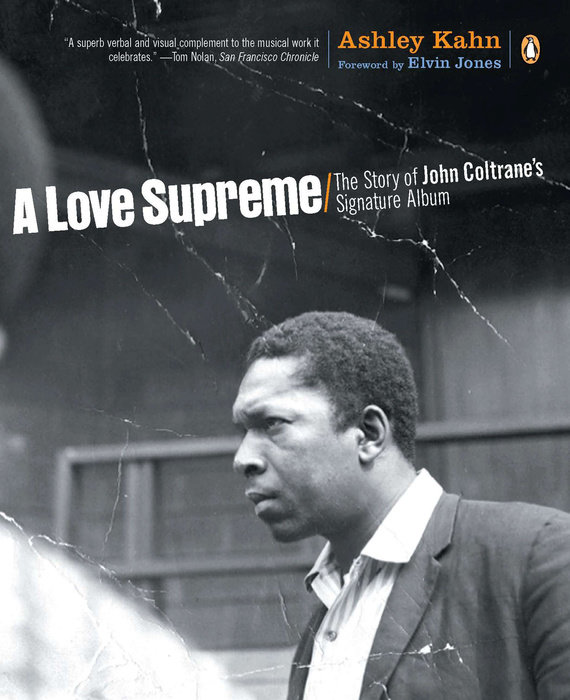
by Ashley Kahn

Excerpted from A Love Supreme: The Story of John Coltrane’s Signature Album by Ashley Kahn. Copyright (c) Ashley Kahn, 2002. Reprinted by arrangement with Viking, a member of Penguin Putnam, Inc. 


Perhaps it was a four-year itch.

Not that John Coltrane planned his career turns with any exactitude, but the timeline of his most creative period does imply a certain regularity: one year bursting with diverse activity and unsettled exploration—1957, 1961—followed by three of relatively focused progress. By that schedule, 1965 promised another creative eruption.

On cue—while the sound of A Love Supreme threaded its way into the cultural tapestry—Coltrane again accelerated his experimental drive in contexts large and small, in the process testing the bonds that held his core group together. Before the year was out, the reign of the Classic Quartet would come to a close, and Coltrane would front a new band and a new sound.

The signs of his future direction were already present in the Love Supreme sessions. Coltrane’s measured key-hopping on “Acknowledgement” presaged a harmonic approach in his playing bordering on—and soon embracing—a passionate atonality. His penchant for chanting would resurface on recordings like “Om”; his love of poetry on the album cover of Kulu Se Mama. His explicitly hymnlike titles became an unbroken theme among the many tracks recorded in 1965—”Dear Lord,” “Welcome,” “The Father, the Son and the Holy Ghost”—and their meditative sonority a looser reflection of that on A Love Supreme.

A Love Supreme also left its trace in the extended, suitelike compositions Coltrane brought into the studio throughout 1965. He even chose the title “Suite” for a five-part work with sectional names again suggesting spiritual focus–“Prayer and Meditation: Day,” “Peace and After,” “Affirmation.” The album Meditations (and the later release First Meditations, among the final sessions with the Classic Quartet) furthered Coltrane’s trend to multisectioned constructions presented in continuous performance. Meditations also elicited questions as to whether he was consciously following in his own footsteps. Coltrane’s response leaned more to the spiritual than the musical, as he saw his current efforts as points along the same continuum:

“Once you become aware of this force for unity in life, you can’t ever forget it. It becomes part of everything you do. In that respect, [Meditations] is an extension of A Love Supreme, since my conception of that force keeps changing shape. My goal of meditating on this through music, however, remains the same. And that is to uplift people, as much as I can. To inspire them to realize more and more of their capacities for living meaningful lives.”

As Alice [Coltrane] noted, “From A Love Supreme onward, we were seeing a progression toward higher spiritual realization, higher spiritual development.”

Continue reading

CAETANO VELOSO on Brazil, 1968: Tanks, street protests, music, witchcraft cults…and a strange hallucinogenic drink from the Amazon (Arthur, 2003)

Originally published in Arthur No. 2 (January, 2003)


DIVINE, MARVELOUS

Tropicalista Caetano Veloso remembers authoritarian Brazil, 1968: tanks, hallucinogens, music, street protests, literacy campaigns, witchcraft cults and TV variety shows

Caetano Veloso, now 60 years old, is widely recognized as one of the most important and innovative pop musicians of the 20th century. As a young musician coming of age in the right-wing military dictatorship that was Brazil of the late 1960s, Veloso co-founded the Tropicalia movement, a collective of Bahian artists, poets and performers that included the musicians Os Mutantes, Gal Costa, Tom Ze and Veloso’s closest friend, the musician Gilberto Gil. The Tropicalistas, as they called themselves, were dedicated to making a fundamentally new and rule-less music out of traditional Brazilian pop and the radical new rock n roll arriving from England and America. In this excerpt from Tropical Truth: A Story Of Music and Revolution In Brazil, his new memoir of the period, Veloso details how the cultural movement was overtaken by the political developments of the day—and how a strange hallucinogenic drink from the Amazon opened personal artistic and intellectual vistas for him and other Tropicalistas…


Carlos Marques, a young Carioca journalist who had gone to the Amazon region to report a story, brought back for Gil [Gilberto Gil] a bottle of something he said was an indigenous sacred drink that produced dazzling visions and heightened states of consciousness. Gil took some on the same day that he was supposed to fly to Rio to pick up Nara, his two-year-old daughter, and bring her back to São Paulo. He says that when he arrived at the Santos Dumont airport, he came upon a group of military officers who were there to inaugurate some exhibition connected with the air force. The changes in perception caused by the drug were just starting to take effect, and he arrived back in São Paulo saying that he’d become aware of extraordinary things in the presence of those officers. It was as though he had understood in that moment the true meaning of our destiny as a people under authoritarian oppression, and at the same time he could see himself as an individual, alone, carefully carrying his small daughter, but also able to feel—beyond his fears and political inclinations—a love for the world in all its manifestations, including the military oppressors.

The 1964 coup—which the military dates to March 31 but which really happened on April 1, the day of fools—had caught me precisely at the moment when I felt ready for a politically responsible and socially useful action.

Continue reading

PLAYING TO THE FORGOTTEN: Why Johnny Cash went to Folsom Prison to make a live record, by Michael Streissguth (Arthur, 2004)

Originally published in Arthur No. 12 (September, 2004)…

PLAYING TO THE FORGOTTEN

Why JOHNNY CASH went to Folsom Prison to make a live record, as told by Michael Streissguth. Photography by Jim Marshall

Excerpted from Johnny Cash at Folsom Prison: The Making of a Masterpiece by Michael Streissguth. Copyight © 2004 by Michael Streissguth. Reprinted with permission of Da Capo Press.


You’re starting fresh. We don’t even care what you’ve done. You act like a man here, we treat you like a man. You get stupid with us, we get stupid back. And if you don’t understand what that means, that means if you want to start fighting with us, then we’re going to start fighting back with you. And we’ll kick your ass. 

—Folsom Prison guard to newly-arrived Folsom inmates. 

Although Jimmie Rodgers uttered grizzly murder ballads in the 1920s and dozens of others had before and after him, very few artists of Johnny Cash’s stature recorded hit songs in the 1950s with lyrics as brazenly violent as I shot a man in Reno/Just to watch him die. Nor did any artist sound as if he or she could have pulled off the bloody deed. The Kingston Trio won a country and western Grammy in 1958 for “Tom Dooley,” yet few could imagine the well-scrubbed young men arriving late for dinner, much less stabbing “her with my knife”; and the honey-voiced Jim Reeves scored a hit with the treacherous “Partners” in 1959, but Gentleman Jim was the song’s Voice of God narrator, well distanced from the gory scene in a miner’s cabin. Cash’s gallows baritone, though, suggested that its owner just might gun down a man—even worse, a woman—and enjoy watching him—or her—squirm. 

“Folsom’s” homicidal line and its interpreter’s sawed-off shotgun delivery birthed a half century of myth, convincing many Americans that the rangy, dark-eyed man from Arkansas had done hard time for shooting a man when he had merely stewed in jail a few nights after alcohol and pill binges. But the myth endured. His audiences clung to it and over the years, Cash came to realize that trading on the myth—his tight association with the criminal world—stirred his audience’s imaginations and pocket books. Nobody bought the myth more willingly than prisoners. “After ‘Folsom Prison Blues,’ the prisoners felt kinda like I was one of them,” said Cash. “I’d get letters from them, some asking for me to come and play.” 

Cash and the Tennessee Two first responded to a striped invitation in 1957, agreeing to play Huntsville State Prison in Texas. At the time, nobody with a top ten hit even considered performing inside prison walls, much less reading a prisoner’s letter. But Cash went ahead with the pioneering show, and although nobody remembers any fanfare around the date, they do remember a soggy day, a makeshift stage, shorted electric guitar and amps, Johnny picking and singing with no mic (and no Luther Perkins on guitar), and dozens of happy, happy men. “By doing a prison concert, we were letting inmates know that somewhere out there in the free world was somebody who cared for them as human beings,” said Cash, years later. 

From Huntsville, Cash courted a long-standing relationship with San Quentin State Prison, California’s oldest and one of its most notorious. When Cash first brought his show to San Quentin on New Year’s Day, 1958, a young man in the crowd convicted for a botched robbery attempt glimpsed his own future. Merle Haggard, who’d been sent up in 1957 for a three-year ride, sat spellbound by Luther’s picking and Cash’s showmanship and demeanor: “He was supposed to be there to sing songs, but it seemed like it didn’t matter whether he was able to sing or not. He was just mesmerizing.” The day inspired Haggard, who would know his own extraordinary career in country music. He channeled the gift of country music tradition from Cash that day, just as Cash had inherited it from the Louvin Brothers on the WMPS radio of his childhood and Ernest Tubb and Jimmie Rodgers and others, but Haggard’s recollection of the show also illustrates what Cash was delivering en masse to the prisoners: diversion, inspiration, solidarity. “There was a connection there,” continued Haggard, “an identification. This was somebody singing a song about your personal life. Even the people who weren’t fans of Johnny Cash—it was a mixture of people, all races were fans by the end of the show.” 

Over the next ten years, Cash logged some 30 prison shows, forgoing compensation but developing a hardened anti-prison sentiment. He witnessed the ravages of prison life in his audience, read about them in letters from prisoners, and heard about them from Rev. Floyd Gressett, Cash’s pastor in California, who frequently counseled imprisoned men. An image of life wasted by incarceration, now based on observation rather than a movie, took form in Cash’s mind. 

Continue reading

“Let her give you the inner woman who is so lacking in you”: Jodorowsky on learning from Ejo Takata and Leonora Carrington in late-Sixties Mexico City (Arthur, 2008)

Originally published in Arthur No. 30 (July 2008). Art direction by Yasmin Khan and Michael Worthington.


Top: Scene from Pénélope (1957), a play by Leonora Carrington staged by Jodorowsky in Mexico City, with set design and costumes designed by Carrington. Bottom: Jodorowsky, as seen in a still from his film El Topo (1970)

THE SOMA OF MADNESS

Seeking wisdom in late-Sixties Mexico City, filmmaker ALEJANDRO JODOROWSKY found several unusual masters. In this exclusive excerpt from his new book, The Spiritual Journey of Alejandro Jodorowsky (translated by Joseph Rowe), he discusses his encounters with the Japanese Zen monk Ejo Takata and the Surrealist artist Leonora Carrington


I was raised by a merchant father. All the wisdom he had to offer me could be summed up in two proverbs: “Buy low and sell high” and “Don’t believe in anything.” I had no teacher from whom I could learn to love myself, others, and life. From adolescence on, driven by the thirst of an explorer lost in the desert, I sought a master who could show me that there was some meaning in my useless existence. A voracious reader of literature, I found only self-absorbed and pretentious meanderings there. A very cynical phrase by Marcel Duchamp led me to flee that sterile world: “There is no finality; we construct from tautology and arrive at nothing.”

I sought consolation in books of Eastern philosophy, holding for dear life onto the notion of enlightenment or awakening. I learned that Shakyamuni Buddha awoke while meditating under a tree. According to his disciples, the holy man perceived the deepest truth by ceasing to preoccupy himself with the question of his survival after death. Twenty-eight generations later, in China, Bodhidharma sat in silence for nine years in front of a stone wall until he discovered in his consciousness that fathomless emptiness, like a pure blue sky, in which neither truth nor illusion can be distinguished. . . . The longing to free myself from the terror of dying, of being nothing, of knowing nothing, had dragged me implacably into a quest for this mythic awakening.  Striving for silence, I ceased to be so attached to my ideas. To further this goal, I wrote all of my beliefs in a notebook, then burned it. After this, requiring calm in my intimate relationships, I shunned the vulnerability of any sort of self-abandon, always setting up aloof relationships with women, thereby protecting my individualism behind panes of ice. When I met Ejo Takata, my first true master, I wanted him to guide me to enlightenment by purifying my mind of the last illusions I had not yet succeeded in uprooting. I saw myself as conqueror of both mind and heart.

“Feelings no longer dominate me. Empty mind, empty heart.”When I solemnly proclaimed these words before my Japanese teacher, he burst into laughter, which was quite disconcerting. Then he answered: “Empty mind, empty heart—intellectual raving! Empty mind, full heart: That is how it should be.”

**

Born in Kobe in 1928, Ejo Takata began to practice Zen at the age of nine in the monastery of Horyuji, under the direction of Roshi Heikisoken, the head authority of the Rinzai school. Later, at Kamakura, he entered the Shofukuji Monastery founded in 1195 by Yosai,† the first monk to bring Chinese Zen Buddhism to Japan. There, he became a disciple of Mumon Yamada of the Soto school. The life of these monks aspiring to enlightenment was very hard. Always living in groups, deprived of intimacy or privacy, they ate little and poorly, worked hard, and meditated constantly. Every act of daily life—from how they slept to how they defecated—adhered to a strict ritual.

After living in this way for 30 years, in 1967 Ejo Takata decided that the times were changing. It was useless to preserve a tradition by remaining closed up in a monastery. He decided to leave Shofukuji and encounter the world. His determination led him to embark for the United States, for he desired to know why so many hippies were interested in Zen. He was received with great honor in a modern monastery in California. A few days later, he fled this place with only his monk’s robes and twenty dollars in his pocket. He reached a major highway and began to hitchhike, communicating mostly with gestures, because he spoke little English. A truck carrying oranges picked him up. Ejo began to meditate on the odor of the fruit, with no idea where he was going. He fell asleep. When he woke up, he found himself in the immense city that is the capital of Mexico.

Ejo Takata

By a series of coincidences, I had the chance to meet this master. Seeing that he was homeless, I offered him my house, inviting him to transform it into a zendo. There, the monk found his first honest students: actors, painters, university students, martial arts practitioners, poets, and so forth. They were all convinced that through meditation they would find enlightenment: the secret of eternal life which transcends that of the ephemeral flesh. It was not long before we realized that Zen meditation was no game. To sit very still for hours, striving to empty our mind, enduring pains in our legs and back, and overwhelmed by boredom was a heroic undertaking.

When Ejo Takata first visited my house in order to choose the right space for his teaching, I showed him my large library proudly. I had been surrounded by books since childhood, and I loved them as much as I loved my cats. I had a sizeable collection of books on Zen—in English, Italian, French, and Spanish—but the monk glanced at them only briefly. Opening his fan, he moved it rapidly to cool himself. Then he left the room without a word. My face darkened with embarrassment. With this gesture, he was showing me that my erudition was nothing but a disguise for my lack of true knowledge. Words may show the way to truth, but they are not the truth. “When you’ve caught the fish, you don’t need the net anymore.”

**

Time passed. Thanks to the support of the Japanese embassy, Ejo was able to set up a small zendo in the university quarter of Mexico City. For five years, I arose each morning at six o’clock to drive for at least an hour through heavy traffic in order to arrive at the zendo for two meditation sessions of 40 minutes each. Yet it became clear to me that my path in life was not that of a monk. My ambitions were becoming centered on the theater. Nevertheless, Ejo Takata’s teachings—to be instead of to seem, to live simply, to practice the teaching instead of merely reciting it, and knowing that the words we use to describe the world are not the world—had profoundly changed my vision of what theater should be. In my upcoming production, a theatrical version of Nietzsche’s Zarathustra, I had stripped the stage of its usual décor, including even curtains and ropes, and had the walls painted white. Defying censorship, the actors and actresses undressed completely on stage after reciting lines from the Gospel of Thomas: “The disciples asked him: ‘When will you be revealed, and when will we be able to see you?‘ And Jesus said: ‘When you shed your clothing without shame, and when you take your jewels and cast them under your feet and trample them like little children, then will you be able to contemplate the Son of the Living One and have no more fear.’”

Ejo proposed that the two of us meet once a week at midnight—he chose this dark hour because it is symbolically the beginning of the new day’s conception. We engaged in conversations which literally began in the darkness and ended with the light of dawn. 

Continue reading