Peter Relic on the “sound consciousness” of Joe Higgs’ reggae classic, Life of Contradiction (Arthur, 2008)

Contradictory Victory: Bigging Up Joe Higgs’ Reggae Classic “Life Of Contradiction”

by Peter Relic

Posted Apr 3, 2008 on the Arthur blog at Yahoo


The first thing that grabs you is the title: Life Of Contradiction. In the roots reggae world where Rastafarianism ruled, righteousness and preachy absolutism—and even Rasta’s red-gold-green primary color scheme—all seem to insist that there is one true way to do things, one true way that things should be. Thematic subtlety, and the admission of the validity of alternate viewpoints, are pretty thin on the ground (though to be fair, such single-mindedness is one of reggae’s greatest sources of strength).

Simply put, contradiction doesn’t spring to mind when listing the music’s top topics. As a result, Joe Higgs’ 1975 album Life Of Contradiction, newly and impeccably reissued by the ever-attentive Pressure Sounds label, is an LP whose nuanced vision makes it stand out within the pantheon of reggae classics.

Higgs was a music biz veteran by the time he recorded Life Of Contradiction for Chris Blackwell’s Island Records label in 1972 (its release was delayed a further three years until rights reverted to Higgs, who issued himself it in Jamaica and the U.K). As a youth in the early 1960s, Higgs and Roy Wilson formed the r&b duo Higgs & Wilson, voicing numerous hits for Edward Seaga’s WIRL label, including the shining gospel number “The Robe.” The duo went on to record Higgs’ superlative compositions for the likes of Coxsone Dodd and Duke Reid, including “There’s A Reward,” a track Higgs would re-record a decade later for Life Of Contradiction. But in the time-lapse between those two renditions, Higgs made a crucial contribution to Jamaican music, one that sealed his status as a primary architect of the island’s best-loved act.

“The Wailers weren’t singers until I taught them,” Higgs is quoted as saying in Reggae: The Rough Guide, referring to his time mentoring the then-green group in the kitchen of his Trench Town home.

“It took me years to teach Bob Marley what sound consciousness was about, it took me years to teach the Wailers.” The claim could be considered self-aggrandizing were it not for the fact that Higgs alone was qualified to take the place of Bunny Livingston when Bunny preferred chilling in Jamaica to joining the Wailers on a 1972 U.S. tour. And, of course, the splendid evidence of this album.

Continue reading

“There’s More to the Song Than Meets the Ear” by Jay Babcock (Arthur, 2007)

There’s More To The Song Than Meets The Ear

by Jay Babcock

Posted Thu Nov 1, 2007 in Arthur’s blog on Yahoo


“You proved to the world what can happen with a little bit of love and understanding and SOUNDS.” – Jimi Hendrix at Woodstock at the peaceful three-day festival’s close

Following up the earlier post on the subject, a few more reflections on Radiohead’s In Rainbows end run around the existing music industry…

There’s a good case to be made that music is humanity’s oldest form of communication, its earliest artform. For the tens of thousands of years that homo sap has wandered the planet, always in groups, sitting round campfires every night, music has been present only when three things were present: performer, listener and peace. Outside of the solitary performer-listener—call him the Lone Whistler—music was necessarily a social, peaceful activity—an occasional but integral part of the sound of being alive in the world. It was something that even seemed trans-human, in that animals made sounds that sounded like music to us (birdsongs, doghowl choirs, etc). The songs could be old, or new, or both, but they only existed in one moment: the here-and-now. They grounded us with each other.

If this sounds too abstract, try this thought experiment. Imagine if machinery suddenly stopped working—the grid goes down, batteries don’t work, oil’s stopped up. We’re back in the Paleolithic. Where and when would you hear music? You’d only hear it in-person. That is the way we humans have successfully lived for 99% of our history on this planet. It turns out you really did have to be there. You wouldn’t encounter music otherwise.

Furthermore, in this scenario, which likely obtained across the 100,000 years of human history, and which is still present in some surviving first people cultures on Earth, music accompanied times of peace. Yes, there is music that accompanies combat or suffering—warsongs, field labor songs—but Music seems to be a quality of human culture that flows most and fullest and most pleasantly in peacefulness—in that existential moment of fundamental non-aggression between performer and listener. We break bread together, we smoke together, we reason together, we goof together, and we make music together.

For all of this time, then, there was more to music than meets the ear. But the communication technology manufacturing revolution of the last 150 years has changed everything. The transmission of sound across time (through recording playback machines) and space (through electric communication—telephone, radio, internet, etc.) is the new norm. It is the way music is experienced by most humans, most of the time. And with it comes a detachment from the here-and-now, a detachment from the act of music’s production itself, and of course some kind of detachment from other humans altogether. Music used to shorten the space between us. Today, most of the time, for most of us, music actually widens the gap.

Music is no longer an emblem of peace, something we pretty much only encounter when in peace with others. We now encounter it everywhere, all the time, as a disembodied fact. This lessens our incentive to be in peace with each other, and in peace with our environment—music is no longer one of the sweet rewards for having found a way to get along with each other. In food terms, we’ve traded organic sweets for industrial sugar. The result is the same: cavities. Society rots as we enjoy a second-hand lifestyle of cheap highs.

The coming end of the global music industry’s physical infrastructure, hastened by Radiohead’s recent selfish action, which will only make it even harder for our best musicians to do their work, needs to be seen in this moral, or at least historical, context. Does music as free, disembodied computer file close the gap between humans—and between humans and their environment—or does it further widen it? Does it bring Music any closer to the temple of peace? Doubtful. The so-called digital revolution is not just killing the music industry—it’s killing Music herself, by reducing and degrading our experiences with her, by removing almost all of the social, physical and analog aspects of music that have been so historically beneficial to human well-being. Her grace lost, her gifts abused and cheapened, Music does survive, here and there. But you’re less likely than ever to encounter her essence. What have we lost? Well, you’ll know when you feel it—and I bet you won’t be alone with your iPod when it happens.


Jay Babcock is editor/owner of Arthur Magazine.

“A twilight world of magick without a New Age sugar-coating, and darkness without Goth cliches”: John Coulthart on a particular variety of recent British electronic music (Arthur, 2007)

An Invitation to the Electric Seance

by John Coulthart

Posted Dec 14, 2007 on the Arthur blog at Yahoo


At precisely 20:02 on the 20th February, 2002 (20/02, 2002 in the UK date system), nine people gathered at the banks of the River Thames where it passes the Greenwich Observatory at 00 longitude, the world’s Prime Meridian. They were there to perform “a mass for palindromic time,” “to celebrate and to devastate, to perform an act of chronological terrorism, strike a blow to the heart of the Great Wyrm time” as one of the participants, Mark Pilkington, described it. If use of the word “terrorism” seems ill-advised it should perhaps be remembered that the Greenwich Observatory was the site of a genuine bomb attack by a French anarchist in 1894, an event which inspired Joseph Conrad’s 1907 novel, The Secret Agent.

The 2002 ritual is one of the more striking manifestations of a largely unobserved current of inspiration running through the margins of British electronic music in recent years. A loose network of musicians have been following similar paths of interest or obsession, paths that frequently end up in places where ritual, magick and paranormal occurrence are the spur for musical invention. Themes and reference points include weird tales and ghost story writers (especially some of the names that influenced HP Lovecraft), psychogeography (or the physical examination of the psychic qualities of our cities), renegade science, and nostalgia for half-remembered (or mis-remembered) films and television, typically science fiction and horror. These groups are eager to use their work to lift the veil on the mundane and shine a light into occluded zones. What they’re delving into might be called “occulture” (for want of a better term), “occult” meaning hidden, and it’s with hidden, forgotten or secret arts that occulture concerns itself.

Continue reading

THE SUMMIT AWAITS: Peter Relic on Ellen Allien’s “BoogyBytes, Vol. o4” (Arthur, 2008)

RUNNING WITH THE ALLIEN

A New Mix Of Beats To Make You Run For The Hills

by Peter Relic

Posted April 28, 2008 in Arthur’s blog on Yahoo


In 2006 LCD Soundsystem released 45:33, a Nike-sponsored iTunes download specifically designed to last the length of a workout. Its headphone-friendly beats projected an arcing ebb-and-flow fully compatible with, say, hauling ass in a perspiration-wicking outfit on your programmable treadmill. Not that James Murphy ever used it for that purpose.

In its conception and execution, 45:33 implied the creation of a micro-genre: dance music made for working out instead of for the dancefloor. Of course, maybe the genre already existed. What, you never heard of maximum impact minimal techno? Intelligent disassociative cardiocentric endorphin house?

Anyway, the good news for iPod-addicted workout junkies is that the best runner’s soundtrack since 45:33 is upon us: BoogyBytes, Vol.04 mixed by Berlin beat moll Ellen Allien. Even if the iPod still behaves way too much like a wonky Intellivision controller. And nothing will ever beat having someone drive alongside you blasting the Chariots Of Fire theme out their car window.

The running time of Allien’s mix is 1:06:08, a full ligament stretch longer than LCD’s aerobic festivities. While Allien’s mix comes with no particular designation for ideal use, the accompanying one-sheet states: “The bass drum is not set into the foreground as it is not intended to dominate the feelings of the listener.” It’s cerebral listening (what Berlin techno isn’t?) but Allien’s selections all originate from some inner charge, rather than being barrages of external force. Kinda like if a cheerleading squad did their routines sotto voce.

I took the mix for a test run on a five-mile stretch of the Josephine Saddle towards Strawberry Peak in the Angeles Crest Forest–one of those places that L.A. haters would be gutted to learn is only a 20-minute drive from Hollywood.

The initial quarter mile is a hopscotch scrabble across the bed of a waterfall-fed stream. The static and breathy Kraut-talk of Agf’s “Liniendicke” comes first in the mix. No beats yet. It’s as the trail proper picks up that the pulse of Vera’s “In The Nook” kicks in. The path is über-narrow, the ascent equally steep. A take-off tone crescendos into a steady ponging pulse. The music demands a steady stride and soon I’ve gained enough elevation to be afforded a view. What began as an overcast morning is breaking up, sunlight flaring purplish green tints across the scrubby chaparral. Gorgeous. A few minutes of running later I’m navigating a crumbly ledge dropping off to a dark rocky pool hundreds of feet below as the byte-diced voice in Sozadams’ “Eyes Forlon” quips “What kind of sh*t is that?” Excellent question.

Running downhill can be tougher than going up, but when the trails drops off to cross the stream the momentary respite is welcome. Then the uphill begins again. This is the second, more gradual half of the climb. Nevertheless as the circuitous path spools upward it’s hard to get a sense of distance gained. Long minutes pass. Lizards skitter underfoot. Goldenbush blooms multiply. Hamstrings announce their stress. The chant “Music is improper!” (from the Friendly People track of the same name) brings some well-timed comic relief.

With its black oaks and snowy peaks, the Angeles Crest offers a wonderfully varied landscape. A little bit Andes, a little bit Appalachia. The blinkered darkness of Sascha Funke’s “Double Checked” shares a seam with the pep-club handclaps of “Withdrawl” by Gaiser. As in nature so goes the mix, its diversity maintaining a strong sense of congruity. Now running close to the hour mark, I’m hoping the percussive pops I’m hearing are coming from my headphones and not my kneecap. When I finally see the top of the tree-line, I’m convinced that the mountain top is around the next switchback.

Of course it isn’t. Before me stands a cliff wall cross-hatched by the fading path. Nevertheless this is the last push, the summit awaits, and the bass-line from Kassem Mosse’s “A1” insists put your back into it!

At the top, hikers rest atop a concrete obelisk. Finally I reach them. The last track, Little Dragon’s “Twice,” arrives with optimum timing. It’s a gorgeous piano ballad to begin with, but Allien has twerked out a new beat-free intro to the song, an unadorned wash of sculpted tones. As it fills my head I spy a thread-thin trail extension. I scramble up. Another minute and I’ve got to be close to 5000 feet elevation. There’s no one here, nowhere left to go. The temperature drops precipitously as a cold mist whips away all visibility. A moment later the fog passes. A gorgeous panorama is revealed, rays of ragged light shifting across the dozen interlocking vales below. It’s gotta be more sublime any light show in any nightclub ever. Little Dragon’s Yukimi Nagano sings her weary but soul-refreshing hymn, repurposed here by Ellen Allien as a reminder: Live to run another day.

Peter Relic is a poet, journalist, trombonist and contributing editor to Arthur Magazine.

Richard Hawley’s Shepherd’s Pie, with Henderson’s Relish (Arthur, 2005)

COME ON IN MY KITCHEN

by Richard Hawley

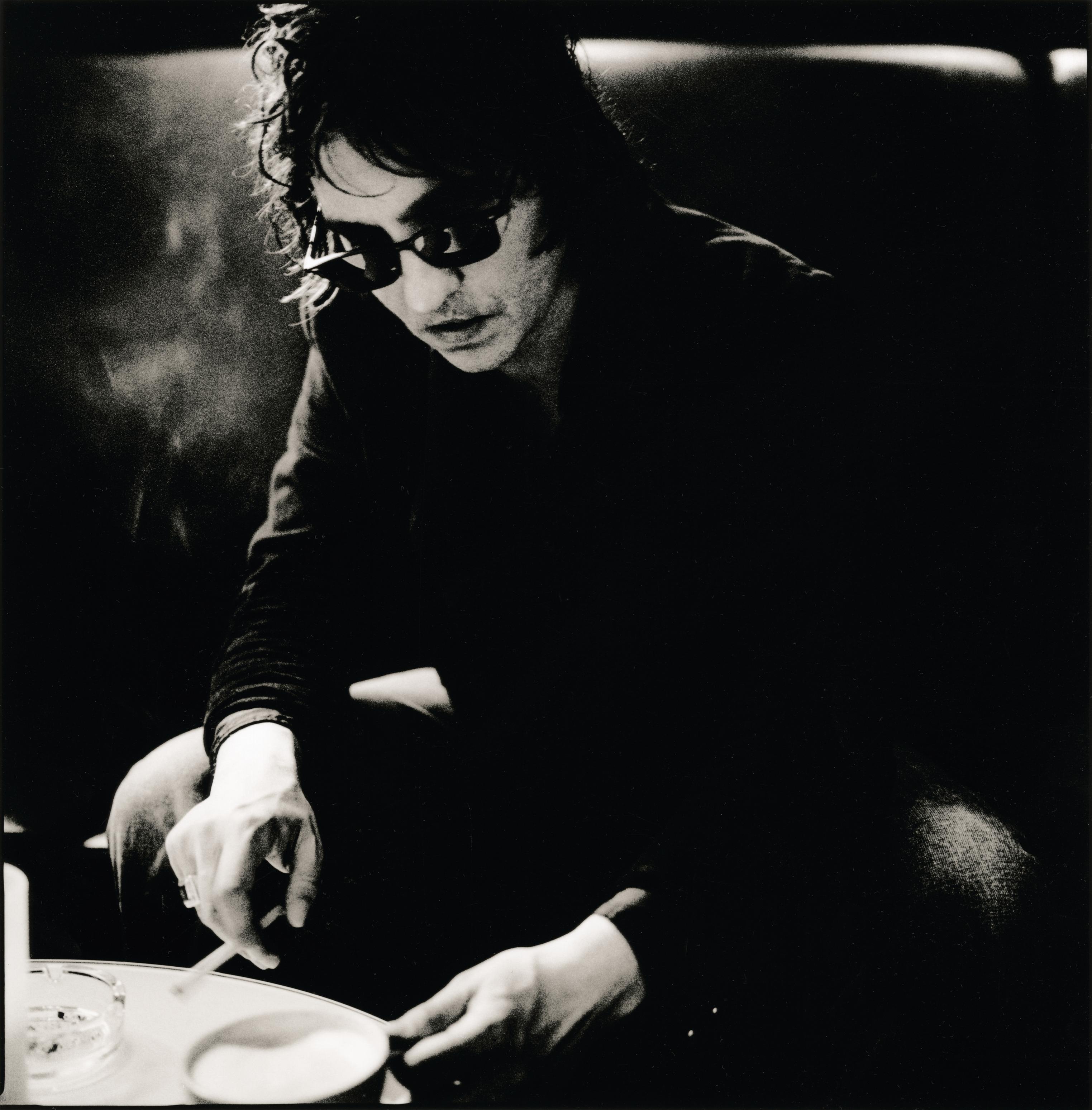
photo by Anton Corbijn

Originally published in Arthur No. 18 (Sept. 2005)


Every time I listen to a Richard Hawley album, I see a late-night TV mail order commercial advertising one of those greatest hits cds by a long-gone-pop country crossover artist, or Neil Diamond, or Sinatra or some other smooth-for-the-ladies-and-blue-for-the-gents crooner/operator with a bag full of hits that just keep scrolling, , every fourth title being performed in a vaselined alcoholic cloud haze. Of course the proudly English Hawley is of the here and now, not in some distant UHF-for-mobile-home-seniors past, but his golden grained croon, accompanied by strings, organ and the kind of beautifully reverbed guitar figures Chris Isaak used to budget for, is the kind of thing I bet  my grandparents would dig too. Hawley’s latest is Coles Corner, out this autumn on Mute, and it’s another slow burner of languid, sentimental-romantic  music about Sunday afternoons by the seaside and Sunday evenings at the bar (or, I guess, pub): those times and places where people—of all ages—love, lose and laugh again, often to music like this. (Jay Babcock)

Richard Hawley: I used to be in a band called Longpigs in the mid/late ‘90s. We got on the U2 tour ‘round USA which was boss and got to play Giants Stadium and all that. That all went fine, even though we were probably getting a bit too recreational. You can go a bit mad on the back of a tour bus with only yourselves for company. Anyway, we were pretty glad when the tour was coming to an end and heading back to Britain to see our families. It didn’t work out quite as straightforward as that, though, as we got offered the Echo and the Bunnymen tour of USA at the last minute. They are one of my all-time favourite bands—Mac is a lovely bloke and Will Sargeant is one of the all-time great guitarists. So we stayed and did that tour—and another immediately after, with Oasis. It ended up we were touring the States for two and a half years, only going home about four times.

The whole thing ended up being really destructive and we were all mindless gibbering wrecks when we went home to our loved ones. I got back to Sheffield, out of my mind on drugs and drink and burnt out and bewildered at finally being home. I couldn’t believe I was there—even though I could see all my home town sites: the pubs, the shops, etc.—I was living in a blur. 

I arrived at our house completely numb. When I got in, our lass had cooked tea (that’s dinner to you Americans): shepherd’s pie, with green beans and gravy. I sat down at the table and poured Henderson’s (we call it Hendo’s) all over the food and took a mouth full. As soon as I tasted it I began to cry and couldn’t stop. Henderson’s is made in Sheffield—we have it on everything—everyone does—right since we were kids. But you only get it in Sheffield, nowhere else, so as soon as I tasted it I knew I was home—finally.

I dedicated my first mini-album to Henderson’s cus I feel like they helped save me—well, and because its a condiment for life —everyone in Sheffield has their Christmas pictures when they are kids, all sat round the table for Christmas dinner, and always there’s a bottle of Henderson’s in the middle of the table.

My highest accolade so far is Henderson’s making a special edition ‘Richard Hawley’s Henderson’s.’ When he saw it, my Dad said, “Now you’ve made it, lad.”

4 large carrots

2 onions

20oz potatoes

2 tablespoons chives

4.5 oz. mince meat (or TVP)

Vegetable stock

salt/pepper to taste

Henderson’s relish

Pre heat the oven to 400 degrees F.

Boil the potatoes and mash them. Slice and boil the carrots. Dice the onions and lightly fry. Add the mince to the onions in the frying pan then add vegetable stock or gravy. Simmer for five mins. Add chives and salt/pepper.

In a large oven proof dish, add the onion/mince mixture. Top this first with a thick layer of carrots, and finally with the mashed potatoes.

Bake for 30 mins until the potatoes are browned.

Serve with steamed broccoli, broad beans or your favorite vegetables. Finally, and most importantly, coat with Henderson’s Relish (unfortunately only available via mail order from their factory in Sheffield; info at www.hendersonsrelish.com)

PLAYING DEAD: Ed Halter on how protest is entering the (video) game of war — plus, a brief history of video games and the Pentagon (Arthur, 2006)

Playing Dead

How protest is entering the (video) game of war

by Ed Halter

Illustration by Geoff McFetridge

Art direction by Yasmin Khan and Michael Worthington

Originally published in Arthur No. 23 (July 2006)


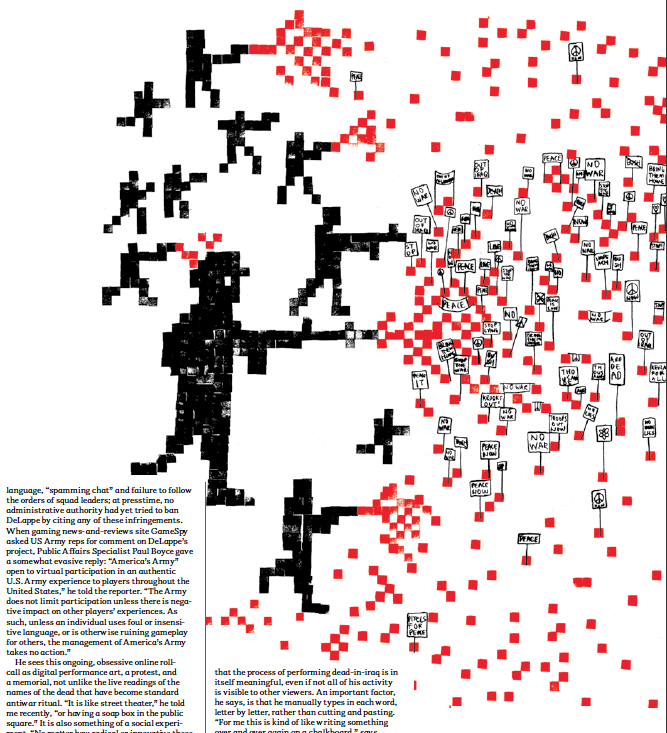
Like millions of others around the world, Joseph DeLappe spends multiple hours each week logged into online multiplayer games. His current game of choice is America’s Army, the squad-based tactical shooter produced and promoted by the real US Army as a tool for PR and recruitment efforts. America’s Army has been available for free download from AmericasArmy.com since July 4, 2002, and in its three-plus years of existence has developed a devoted global following; if nothing else, it has successfully enhanced the Army’s brand by associating it with something engaging, cutting-edge and youth-friendly. Millions of users who might not otherwise have a personal connection to the American military have found one through playing the game: they’ve gone on missions based on realistic contemporary scenarios, learned to fight together using official Army protocol and rules of engagement, and even had the chance to play alongside real US soldiers, who signal their participation via exclusive insignia worn by their online characters. While deadly and chaotic wars in Iraq and Afghanistan fill the headlines and TV screens, with reports as intimately gruesome as HBO’s Baghdad ER, America’s Army has provided a counter-image of the military that is as idealized as a textbook, as thrilling as a Hollywood movie, and as addictive as any commercial video game around. It is a paradoxical media object, mirroring its eponymous nation’s own divided consciousness: a game that celebrates realism through a carefully constructed fantasy that omits more than it reveals. In America’s Army, characters don’t end up with brain damage, missing limbs or post-traumatic stress disorder, or have to deal with an administration that sent them to a war that most back home don’t support, and then slashed their veteran’s benefits to boot—because none of that would be any fun at all, compared to the high-adrenaline, deep-strategy game-time of make-believe battle.

DeLappe, however, chooses to play the game rather differently than most. His virtual warfighter—whom he has named “dead-in-iraq”—logs onto America’s Army and simply stands there and does nothing. DeLappe nevertheless takes part in the game in other ways. Drawing from publicly available rosters of US casualties in Iraq, DeLappe types out the names of killed servicemembers into the game’s text message chat window, entering one name per line. For example, during one of DeLappe’s missions of virtual conscientious objection, some fellow America’s Army players saw this appear in their text message scroll as they organized for battle:

[US Army] dead-in-iraq messaged: JONATHAN LEE GIFFOR, 20, MARINES, MAR 23, 2003

[US Army] dead-in-iraq messaged: JOSE ANGEL GARIBAY, 21, MARINES, MAR 23, 2003

[US Army] dead-in-iraq messaged: DAVID KEITH FRIBLEY, 26, MARINES, MAR 23, 2003

If his dead-in-iraq character gets killed in battle or is voted off the server by fellow gamers (a procedure typically employed with players who aren’t taking the game seriously and thereby inhibiting others), DeLappe logs back on at another time and continues where he left off. He started this text recitation in March 2006, and by the middle of May had typed out the names of over 350 war casualties. He’s inputting the names chronologically, from the first casualty onward, and intends to type out a complete naming of the military dead. DeLappe says he will continue this online memorial until there are no more names to memorialize—in other words, until the war stops producing American corpses in uniform (and at the time of writing this article, that means he has more than 2100 names to go). So DeLappe has found his own way to play America’s Army, creating an experience that owes less to Quake than it does to the Quakers.

Continue reading

If a band rocks in the woods, will anyone hear them?: Brian J. Barr on PEARLS AND BRASS (Arthur, 2006)

SONS OF NAZARETH

How blues rock thunder chooglers Pearls & Brass found their sound in rural Pennsylvania.

by Brian J. Barr

Photography by Maria Tessa Sciarrino

Originally published in Arthur No. 21 (March, 2006)


I.

Pennsylvania is a gentle state, its curving hills blanketed by lush maple, oak and chestnut trees whose leaves all turn to a dazzling spectrum of red, orange and yellow each year around October. Over the past several million years the glacial run-off carved deep river valleys into the land, and in the mid-state region left the soil flat and fertile enough for farms and high school football fields. Outside the concrete sprawl of Pittsburgh and Philadelphia (the port cities bookending the southern region) Pennsylvania is pock-marked by countless factory and agricultural towns, nearly all long past their economic peak.

Pearls and Brass hail from Nazareth, Pennsylvania, a rural nowhere of about 6.000 situated near the New Jersey border, a mile from the Appalachian Trail that stretches from Maine to Georgia. The Martin Guitar factory, maker of acoustic guitars, is in Nazareth; so, too, is the Nazareth Speedway. But like most rural Pennsylvania towns, Nazareth is desperately non-descript; its smallness is its defining characteristic.  

“Nazareth was your typical small, working class town,” says Randy Huth, Pearls and Brass’ guitarist and vocalist. “Not a whole lot going on, y’know. But that pretty much made us do our thing.”

Alumni of Nazareth High School, the members of Pearls and Brass (Huth plus Josh Martin, drums; Joel Winter, bass vocals) come off as sincere and plainspoken guys whose roots run deep through their town. Together, they play a bluesy power trio rock that has as much to do with Skip James as it does Blue Cheer; loud, melodic, eerie and crammed with enough riffs to dizzy Tony Iommi or Matt Pike. It’s as if they successfully boiled down the basics of the blues, cranked the volume and carried on the tradition of early Black Sabbath and The Groundhogs. Not to mention they narrowly avoided a case of blue-collar ennui by investing in the healing powers of rock n roll.

If we are to ascribe a myth to Pearls and Brass, it will be one of “local boys make good” romanticism. One imagines Pearls and Brass as the Cobainesque outcasts of Nazareth High, taking refuge in their record collections and loud guitars. We picture them drinking whiskey and smoking grass in a parked car out in the middle of the woods on Friday nights while their classmates cheered on the home team. Most likely they’re holding down low-paying jobs to afford their vices; bagging groceries at Giant Food or bussing tables at De Nisi’s Family Restaurant, whatever teenagers do to get by in these places, the weary townships of rural America. 

If we were to ascribe such a myth it wouldn’t be far from the truth. Huth, Martin and Winter went to school, smoked grass, worked shitty jobs, went for long walks alone in the woods, playing guitar. Individually they’ve spent their post-high school years either in-and-out of college, or employed at labor-intensive, low-wage jobs. As a band, they’ve released a single little-heard album on a tiny label—2003’s Pearls and Brass, on Doppelganger—which may have sold in the low triple digits. They’ve never toured for more than two weeks. 

And yet, despite this relative isolation and obscurity, Pearls and Brass scored a gig at February, 2005’s Slint-curated All Tomorrow’s Parties festival at Camber Sands, recorded a new album in California with Fucking Champs’ Tim Green, and have found a higher profile home at indie label Drag City—all the result of a single right-place, right-time event. 

Continue reading

Dungen’s Popcorn in 16/4 (Arthur, 2005)

Come On In My Kitchen

Dungen’s Popcorn in 16/4

Originally published in Arthur No. 18 (Sept. 2005)


Dungen is a prodigiously talented twentysomething Swede called Gustav Ejstes, whose sunnily melodic psychedelic delight rock, much heralded in the music press when his album Ta Det Lungt was available only as an expensive import (see Arthur No. 14, Jan 05), is finally getting a proper American release late this summer via the kind hand of Kemado, who’ve changed nothing—every lyric is still Swedish, every tune is still universal—and added something (a disc full of bonus tracks). Here’s Gustav’s recipe for popcorn—something familiar, something added…

Gustav Ejstes of Dungen: I used to be called the king of pop. Not to be confused with Mr. Jackson’s title in the ’80s music press. This refers to the art of making good-tasting popcorn. It is probably the ultimate snack, but could also be the most delicious substitute for a well-made meal. 

The thing is, my skills as a Swedish chef are a bit limited. I have never been interested in learning and that has led to experiments with the  interesting vegetable corn. Did the Indians discover it first? Is it healthy or not? 

I think it is. I have survived for days by only eating popcorn. And now you all say: making popcorn is the easiest thing to do. Well, if you choose to use microwaved popcorn maybe, but if your only tools are a pot, oven, oil and salt, it suddenly gets a little bit more complicated. The secrets behind my well-tasting popcorns are olive oil and herbal salt.

Everyone knows the basic recipe for making it, but here are a few tricks that you can pick up that will help you avoiding some of the classic mistakes: for instance, half of them stays un-popped, or all of it gets burned.

Fill the bottom of the pot with popcorn and drench them in virgin olive oil and add some herbal salt. Herbal salt is made from pure certified organic ingredients. I use the Herbamare brand, which is based on Swiss naturopath Alfred Vogel’s formula: it’s made up of sea salt, celery stalk, celery leaves, leeks, watercress, garden cress, onions, chives, parsley, lovage, garlic, basil, marjoram, rosemary, thyme and kelp. 

Electric stove: Start out at high heat. When they start to pop, lower the heat to medium. Wait until there is four seconds between the pops, take off the lid and add some more herbal salt, put on the lid and your favorite record and shake the pot in 16/4 beat and then take it off the stove and call your friends. It’s time to eat.

Gas stove: Start out with full temperature, but since gas gets hot quicker, make sure you turn off the heat as fast as you hear the corns begin their dance inside of the pot. When using a gas oven it is even more important that you shake the pot in 16/4 beat to your favorite record, otherwise the popcorns gets as burned as Swedes on an Asian holiday.