I lived here nearly 5 years before I could meet the middle western day with anything approaching Dignity. It’s a place that lets you understand why the Bible is the way it is: Proud people cannot live here.
The land’s too flat. Ugly, sullen and big it pounds men down past humbleness. They Stoop at 35 possibly cringing from the heavy and terrible sky. In country like this there Can be no God but Jahweh.
In the mills and refineries of its south side Chicago passes its natural gas in flames Bouncing like bunsens from stacks a hundred feet high. The stench stabs at your eyeballs. The whole sky green and yellow backdrop for the skeleton steel of a bombed-out town.
Remember the movies in grammar school? The goggled men doing strong things in Showers of steel-spark? The dark screen cracking light and the furnace door opening with a Blast of orange like a sunset? Or an orange?
It was photographed by a fairy, thrilled as a girl, or a Nazi who wished there were people Behind that door (hence the remote beauty), but Sievers, whose old man spent most of his life in there, Remembers a “nigger in a red T-shirt pissing into black sand.”
It was 5 years until I could afford to recognise the ferocity. Friends helped me. Then I put some Love into my house. Finally I found some quiet lakes and a farm where they let me shoot pheasant.
Standing in the boat one night I watched the lake go absolutely flat. Smaller than raindrops, and only Here and there, the feeding rings of fish were visible 100 yards away – and the Blue Gill caught that afternoon Lifted from its northern lake like a tropical! Jewel in its ear Belly gold so bright you’d swear he had a Light in there. His colour faded with his life. A small green fish…
All things considered, it’s a gentle and undemanding planet, even here. Far gentler Here than any of a dozen other places. The trouble is always and only with what we build on top of it.
There’s nobody else to blame. You can’t fix it and you can’t make it go away. It does no good appealing To some ill-invented Thunderer Brooding over some unimaginable crag.
It’s ours. Right down to the last small hinge it all depends for its existence Only and utterly upon our sufferance.
Driving back I saw Chicago rising in its gases and I knew again that never will the Man be made to stand against this pitiless, unparallel monstrosity. It Snuffles on the beach of its Great Lake like a blind, red, rhinoceros. It’s already running us down.
You can’t fix it. You can’t make it go away. I don’t know what you’re going to do about it. But I know what I’m going to do about it. I’m just going to walk away from it. Maybe A small part of it will die if I’m not around
ONE MORE TRICKSTER GONE Late-Night Thoughts on R.L. BURNSIDE & the Indestructible Beat of the Blues By Eddie Dean
You have to meet your heroes whenever you can, so I accosted Shelby Foote a decade ago as he was leaving the men’s room at the Smithsonian in Washington, DC.
The 80-year-old author of The Civil War: A Narrative, rightfully called our American Iliad, was minutes from delivering a lecture to a packed auditorium, and he was in hurry to get to the podium. I wanted to give him a story I’d written about an obscure country-music rebel named Jimmy Arnold.
Hailing from southwest Virginia, Arnold had transformed himself from a shy skinny mountain kid into a bluegrass-biker outlaw of Orson Wellesian proportions. He tattooed himself from head to foot like a Celt warrior of old (including a panther on his cheek, a lion on his forehead, and Christ on his throat) and recorded a sui generis concept album about the Lost Cause, Southern Soul, before dying at age 41 of heart failure. I figured Foote would be interested to know that Civil War buffs came in all shapes and sizes.
I didn’t want to battle the post-lecture autograph crowd, so I figured now was the time for the hand-off. He took the package graciously, and I never expected to hear from him again.
Several months later, though, came his reply, in the same dip-pen cursive scrawl that he’d written 500 words a day for more than 20 years to finish his masterpiece. He thanked me for the story and the cassette of Southern Soul I’d included, “both of which made me deeply regret not having seen him [perform] live while he was still with us. Pretty soon, I fear, we’re going to run out of people like him & we’ll be much poorer for the loss.”
His words came to my mind when I heard that R.L Burnside had died in September.
R.L. was another hero of mine, and we’re running out of people like him. He was a trickster figure right out of Southern folklore, full of mischief and uncommon mettle. His signature, “Well, well, well,” was at once bemused and menacing, an open declaration of war against easy sentimentality and crap romanticism.
R.L was a realist, and as such took it as his beholden duty to tell the truth as he saw it. The witness to disaster—his own and those around him—must do something more than simply mourn. He’s got to testify. And must not only endure, as Faulkner put it, he must prevail. R.L. had his own way of saying it: “Hanging in like a dirty shirt.” It was an art that arose out of sheer stubbornness as much as anything else. He took the shit that life threw at him and tossed it right back, again and again and again.
When I got word of R.L’s death, it hit extra hard, because Shelby Foote had died only a few weeks before. I recalled our second, (and final, exchange. I’d written a brief reply of gratitude to his thank-you note, telling him that I rated Skip James higher than Robert Johnson as the ultimate bluesman. I knew he was a Johnson fan all the way, which his post-card reply confirmed. I also threw in a mention that John Keats was my favorite poet, and he agreed, adding, “Keats is my man too, I only wish he’d lived to be nearly 80 like Robert Browning.”
Thinking of these two old lions now gone, these two neighbors (they lived just 40 miles apart, Shelby in south Memphis, and R.L in north Mississippi hill country) of a South long dead and gone, it hit me that R.L. was the Browning of the blues, a late bloomer who gained more power and force with time, that rare musician who burns brighter as the years go on.
The late writer and record producer Robert Palmer “rediscovered” R.L. in the early ‘90s and his liner notes to the Fat Possum classic, Too Bad Jim, bears repeating for its insight into R.L’s love of chaos as a philosophy of life:
“One of the most productive album sessions began on a rainy Sunday afternoon with a rapid-fire sequence of disasters. A bass literally fell apart, a drum kit broke into pieces and finally a heavy glass door fell out of its frame for no good reason and was prevented from smashing the recording board only through the timely intervention of the producer’s skull. Far from being deterred, R.L. was positively beaming. He seemed to enjoy these incidents immensely, and by the time we’d cleared away all the damage he was in an inspired mood, ready to rock.”
As good as Too Bad Jim is, A Ass Pocket of Whiskey is better. Recorded two years later with the Jon Spencer Blues Explosion in a rented hunting lodge, it is, among other things, the hardest-rocking album ever made by a 70-year-old. It has been described as a party record, which it is, in the same way that the Stooges’ Funhouse is a party record. Even here, instead of grandstanding and showboating like every other elderly bluesman has done at one time or another (and you can’t blame a single one), R.L. will have none of it. He is a conduit, a cosmic joker talking trash and invoking the chaos of the universe. The band doesn’t let him down.
A few years after Ass Pocket of Whiskey made R.L. a sensation on the underground rock circuit, I went to see him at his home in the hill country near Holly Springs, MS. It was early January, in between tours, and he was nursing a cold. Even so, he was cordial and full of good cheer, as he must have been with a hundred other journalists who tracked him down in his final glory years.
Inside his small brick house, a dozen or so family members and hangers-on were crowded around the TV set, watching the western Tombstone starring Kurt Russell on cable. Nobody paid any attention to either myself or R.L. as he ambled back to the kitchen to make me a drink. They had seen this interview scenario many times before, whereas movies like Tombstone held up to repeated showings.
R.L, sank into a couch in ante room off the kitchen, and I took a seat opposite. He was tired, he needed the rest.
After a while, a party of young musicians came through the front door. It was the North Mississippi All-Stars, here to pick up R.L.’s son Garry in their van. Garry was playing with them that night at a show in nearby Oxford. The bandleader, Luther Dickinson, ended up into the back room where we sat talking. He’s a young dude with long hair and a quick smile, and, when he saw R.L., his smile got bigger and he went over to say hello.
Luther seemed to sense R.L.’s fatigue, and he knelt down so he could listen better to what he was saying. All I could hear of their conversation was a lot of ‘Yes sir’s” on the part of Luther and a lot of chuckling from R.L. I am no stranger to Southern ways, and I could understand that Luther was a well-brought up young man, but this was something much more than mere respect for your elders.
It was a beautiful scene, the young acolyte at the feet of the sage, paying tribute and also gleaning the kind of sustenance that can’t be found in guitar instruction manuals. I will always remember the glow that came over R.L’s haggard face as he bantered with another of his sons, this one adopted, who will carry on his ways, to not merely endure, but to prevail: Hanging in like a dirty shirt.
“Freeman House is a former commercial salmon fisher who has been involved with a community-based watershed restoration effort in northern California for more than 25 years. He is a co-founder of the Mattole Salmon Group and the Mattole Restoration Council. His book, Totem Salmon: Life Lessons from Another Species received the best nonfiction award from the San Francisco Bay Area Book Reviewers Association and the American Academy of Arts and Letters’ Harold D. Vursell Memorial Award for quality of prose. He lives with his family in northern California.”
That’s the biographical note for Freeman House on the Lannan Foundation website. We would add that earlier in his life, Freeman edited Innerspace, a mid-1960s independent press magazine for the nascent psychedelic community; presided over the marriage of Abbie and Anita Hoffman at Central Park on June 10, 1967; and was a member of both New York City’s Group Image and the San Francisco Diggers.
The Case For The Watershed As An Organizing Principle
by Freeman House
[I’ve rarely given a talk in circumstances more alien to my life experience. This talk was presented a roomful of county and state bureaucrats charged with implementing a five-county wetlands protection and restoration effort. The five counties were the southwestern-most part of California, stretching from Santa Barbara to San Diego, a part of the state that makes me feel like I’m in a foreign country. As if to accentuate the weirdness, the luncheon was held at Sea World, a theme park in San Diego.]
I’ve had quite a bit of time to puzzle about what qualifies me to be here. I feel a little like a visiting diplomat or more accurately, an anthropologist dropping into a whole other culture. Up in the backwoods of northern California, where I come from, we tend to think of ourselves as living in Alta California. Los Angeles and San Diego seem like another place, although they shouldn’t, considering that the voters around here determine a lot of what goes on in the state of California. Which is where I live regardless of the fact that it’s much easier for me and my comrades to think of ourselves as part of the Klamath Province.
I have worked at watershed restoration for 20 years, but in a drainage where there are no dams, and where there are still three species of a wild salmon population holding on. An eighth of the land base is managed benignly by the federal government as the King Range National Conservation Area, another eighth not so benignly by corporate timber interests, and the rest is held either in ranches or private smallholdings. It has a human population density of less than ten folks per square mile. Not too many similarities. And most of the people in this room probably know more about wetlands biology than I do.
Since it was a book I wrote that inspired the organizers to invite me and the book, Totem Salmon, is mainly about attempts to invoke a new (or rather very old) kind of community identity that lives within the constraints and opportunities of the place it finds itself, that’s what I’ll go ahead and talk about.
It could be my best credentials for being here today is the fact that I was born in Orange County. The earliest memories are of my first five years spent at my grandparents’ home in Anaheim, pre-Disneyland. Set in the middle of town, I had two acres to run in haphazardly planted to oranges and lemons and avocados, and for a long time that Edenic space was my model for paradise. Each weekend, we’d drive in my grandfather’s 1935 Buick sedan for maybe ten minutes to a local farm to buy our week’s supply of eggs and milk and vegetables. When we extended our drive to visit Aunt Florence in Pomona, we drove through 60 unbroken miles of commercial orange groves, another image of paradise. I’m revealing my age when I tell you that the air was wonderful, the light incredible.
Since then, I’ve learned something about the settlement of contemporary Anaheim. The existence of Anaheim is entirely dependent on 19th-century amateur efforts in social and physical engineering. Hard as it may be to believe when trying to find the freeway exits to Anaheim today, it was largely settled in the 1860s by polyglot groups of urban utopians who had few of the skills required for the kinds of agriculturally-based communitarian paradigms they were pursuing.
One thing was clear to all of them, however, and that was that their dreams were dependent on importing water to the arid lands they hoped would support them. One of the groups, composed mainly of German mechanics in San Francisco, collectively purchased 1,165 acres sight unseen, subdivided it into 20-acre farmsteads and appointed a certain Mr. Hansen to supervise the construction of a ditch seven miles long. That ditch diverted water from the Santa Ana River along with 450 miles of subsidiary ditches that delivered the precious water to each parcel. Thus the name of the place: Ana for the river on which their venture depended plus heim, German for home. The work was done with picks and shovels by local Mexican-Americans, and was finished in three years, during which time no one of the blue-collar workers laid eyes on their future paradise. Each of them was supporting the effort to the tune of about eight dollars a week, a considerable sum in the late 1850s.
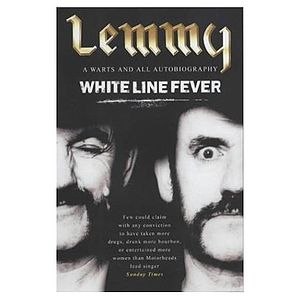
Leminiscences James Parker on the autobiography of Mr. Kilmister
Reviewed: White Line Fever by Lemmy Kilmister with Janiss Garza (Citadel Trade) 320 pages, $14.95
When I was at an English boarding school in the Seventies, a sweatless boy among sweatless boys, all of us with scuffed shins and hard little minds, there was a brief craze for fainting. It swept through the school like some hot new type of dance. Chapel was the place for it: eight o’clock in the morning, leaky grey light, prayers humming their moth-wings, and the pale unbreakfasted boys would sigh and slump from their pews, one after another, in mild reversals of boy-energy. Low blood sugar had something to do with it—we were scandalously, I would say almost criminally underfed—but you couldn’t doubt the narcotic properties of the prayers themselves. There was this Marian chant from the 15th century which we would do from time to time: the Litany Of Loreto. A real trance-inducer. “Mystical rose!…PRAY for us…Tower of David!… PRAY for us… Tower of Ivory!… PRAY for us”—and so on, repeating and building in pounding, swaying dactyls until the brain cuts out. Years later I heard this rhythm again, in the same call-and-response measure, on a re-release of Hawkwind’s live album Space Ritual—“Time we left… (This world today!)… Brain police… (Not far behind!)… Trying to make you… (Lose your mind!)” Bastards! I smelled again stale pieties of incense, and felt a draught upon my knees as if I were in short trousers.
But this is all by the by, and only slenderly related to my theme, which is the new book White Line Fever, by Lemmy with Janiss Garza. Lemmy was of course in Hawkwind, playing his bass, and for a while he was the best thing about them—Space Ritual is dark hippy wreckage anyway, a huge crude monomanic bummer with drums dolefuly thrashing and vocals following sax following guitar following bass through riff after drug-blind riff. Quite impressive, in other words, but one wearies of the mindfuck. One wearies of Bob Calvert sneering “Sonic attack—in your dist-rict!” through metallic sinuses, the seedy psychedelic warlordism of it. Only the steady, earthy rumble of Lemmy’s bass keeps you listening. I love his sound on this record—surging, human, refusing the pull of outer space and the gnawings of paranoia. It’s not the definitive Lemmy sound, not the tremendous slobbering chordal attack he perfected in Motorhead, but it’s full of personality. In the midst of the Hawkzone, it’s comforting. Lemmy is very funny about Hawkwind in White Line Fever, about DikMik’s fit-inducing sound machines and Dave Brock’s regular delusion that he’d bitten his own tongue off, or his habit of leaning out of his car to shout “Spank! Spank! Spank!” at passing schoolgirls; “Hello girls! Spanky-spanky!” About Nik Turner—“one of those moral, self-righteous assholes, as only Virgos can be”—Lemmy is candidly bitchy, which is even better. Only prolonged night-after-night exposure to Turner’s farmyard sax-playing, his bleats and clucks and moos, could have distilled this weary disenchantment: “He was holding the saxophone and capering–he was a great caperer, Nikky.” Or (my favorite line in the whole book) “He’d get drunk as a cunt on wine.”
I’d like to know precisely how White Line Fever was written, the mechanics of authorship as it were. Behind every book like this is a very interesting sub-book, which is the story of the hack and his or her subject, and how they got it together, how long it took, and how they suffered mutually, etc. White Line Fever smells of Lemmy in his quarters, his LA apartment with the curtains drawn against the late afternoon and the walls prickling with WW2 memorabilia, and the great man filling ashtrays and bullshitting away, forgetting names, remembering dates, swirling through anecdotal loops, mumbling and thinking and chuckling. Nine-tenths of it is unmistakably Lemmy’s speaking voice, the voice of a roughened but still elegant old-school raconteur: “But back to Robbo. I’d known him for years—we met under a table at Dingwalls.” Lemmy’s memories—his Lemmories or Leminiscences—have a patchy, refracted fog-and-strobe quality, which is just as it should be. It gives them depth; early in the book we get a prismatic flash of the Beatles at the Cavern, playing odd-shaped guitars, telling jokes and “eating cheese rolls while singing” and headbutting hecklers. They sound as violent as the Marx Brothers. “Hard men,” says Lemmy, and goes on to disparage the Rolling Stones: “Fair enough, the Stones made great records, but they were always shit on stage, whereas the Beatles were the gear.” The gear! Later on we are granted a piercing glimpse of Sid Vicious, “this fucking bundle of pipe cleaners in a pair of tennis shoes,” taking on a huge Maltese bouncer. Now and again the prose turns professional, breaking into jauntily anonymous as-told-to-ese—“We only had a fortnight to record Overkill, our second album and first for Bronze. Considering our checkered recording history, however, it was a world of time for us”—but that’s just Ms. Garza doing her job, getting the facts in. By and large the Lemmy ramble flows phlegmy and untainted. “I did die once—well the band thought I had, at least. But I hadn’t. The whole thing started when we were going home from a gig in the van. This guy, John the Bog, was our driver—actually, he died, about two years after this incident, come to think of it…”
While our attention is distracted by Iraq Take time to object to some of the other wars The American empire is fighting concurrently as well, such as The war in The Philippines, the war in Columbia, The war in Korea, the war in Afghanistan, The war in Israel, the war in Pakistan, The war in Yemen, the war on Terror, The war on poverty, the war on drugs, The war on The Bill of Rights, The war on common sense itself.
The war of America against the world Can’t be about anything grander than The president’s pathology and popularity.
Not since King Lear have speakers of English been mislead By a leader so completely ‘round the bend. Power is dangerous enough in the hands of ordinary plodders. In the hands of the crazy and uneducated The danger expands exponentially.
The last time Congress declared war was 1941. 62 years later the siege mentality still rules.
The 18th century supposition behind the Separation of Powers, ie Congress shall have the power to declare war; The president shall be the commander in chief of the armed forces Presupposed that a declaration of war would precede Any armed forces to command
Since we devolved to a permanent military With the president as the commander We have perpetual war With Congress towed along like the tail of a kite.
Someday we’ll lift the siege and see The pitiful men behind the curtains pulling strings.
Consumer Imperialism
1 In 1946 the Truman Administration cobbled together policy That will guide America and the United States into a grave: Stimulate domestic consumption and search for foreign markets.
World War Two propelled Americans across the world Destroying their distinguished isolation And Woodrow Wilson’s doctrine of self determination of nations, Putting Hershey Bars and atom bombs along with GI Joes Into the world word bank Along with the great American coinage, OK.
OK can mean anything from yes to you are on your own. OK, if that’s the way you want it, OK with me.
It might have been OK if they’d confined domestic consumption to The simple facts of warm clothes, adequate housing, and nutritious meals, The need for which food stamp Americans have in common with everybody else. “One third of the nation is ill fed, ill clothed, ill housed,” FDR declaimed seventy years ago. It’s still true for radically different reasons one depression later.
In 1946 the American people were hungry to forget The Great Depression With its soup lines, dust bowls and railroaded hobos As the speculated roaring of the twenties simpered out into The savage thirties whine.
The exact point in the relationship between Dying early to save the system money and Working to consume yourself to death efficiently Hasn’t quite been worked completely out to policy maker’s actuarial satisfaction.
Americans stood 19th century Maytag frugality on its head: Build it well and make it last, Darn your socks, grind your wheat, make your own soap, Do without until you can afford it, Into a plastic credit card throw away civilization Destroying the environment on the side as a Mildly regrettable cost of doing business Symbolized by the shopping cart in the trough with Wal-Mart’s predatory criminal labor and retail practices.
2 In the old days prior to 1946, except for Mexico, Louisiana, Oregon and the Indians, The United States government had confined its actual imperialism To the Roosevelt Doctrine’s annual obligatory invasion of Latin America
With a few cruel Hawaiian exceptions such as when their empire of ironic slaughter Was taken to the limit in Aguinaldo’s Philippines Led by Teddy Roosevelt’s “secret” admiration of the British Empire
Who goaded American into building a navy Sufficiently enormous eventually to make the basket catch Of the British Empire’s bases and other falling stock in the Atlantic Charter.
Post 1946 when imperialism became the way of life Colonial wars piled up in the history books alongside Syngman Rhee’s Korea, Hoh Chi Minh’s Viet Nam, Salvadore Allende’s Chile, And Saddam Hussein’s broken Babylon.
Some of the secret history rarely gets recited in public Like General Eisenhower’s perpetual overthrow by his CIA Army of Governments in Guatemala, Iran, Cuba, The Congo, Indonesia and Vietnam.
“It’s about jobs,” George Bush the 1st gesticulated nervously When asked to rationalize the Gulf War he’d goaded The allies into reestablishing the British Empire’s toehold on the oily Emirate of Kuwait.
The United States military has been under siege Real or imagined, Sometimes both; never neither, Since the bombing of Pearl Harbor– Sixty plus years of the war that never stops.
It’s what these southern kleptocrats desire Under siege like the Confederates Where they lost the battles and built the shrines The basis (es) of their military theocracy preys upon.
Semi-Colon half an asshole Powell used to claim with a straight face that The exit strategy is the most important aspect of Colonial War. There is no exit from Consumer Imperialism.
Consumer Imperialism, World War 3.1
World War 3.1 was a knife fight at 20,000 feet. Have your will up to date.
Never lose sight of the fact that the “faith based initiative” Which took out the twin towers of the World Trade Center Was carried out by trainees of the CIA once removed Unleashing a relentless wave of video military fascism.
Win the war on terrorism by training counter terrorists To terrorize other people in a war on abstract nouns. Government by sarcasm is an unfit substitute for self rule. Help wanted: somebody to shovel the horseshit off the information superhighway. . With each side referring to the other side as evil It makes one wonder if both sides are right. Evil is that which has power over you. God doesn’t take sides; that’s what makes God God. Human beings have no faith in their own story, So they drag in God as the author of Their Christian and Moslem shenanigans.
Flying hijacked commercial airliners into the World Trade Center and Pentagon Was a reckless act of freedom Rather than an attack on it or democracy as claimed by the unelected President Bush who obtained office by judicial fraud, Hardly an unimpeachable spokesman for Democracy.
There was no attack on The Samuel J. Tilden New York Public Library or The Statue of Liberty. That would have been an attack on Freedom and Democracy.
The world trade towers were a symbol all right: A symbol of the Rockefeller brothers’ capacity To manipulate the public policy of the New York and New Jersey Port Authorities into Rescuing some of their down in the mouth real estate At the lower end of Manhattan.
The attack was on World Trade and Consumer Imperialism.
The design competition will create a monument to the victims. How about creating a world trade system that is fair to all participants? Now that would be an enduring monument.
War is now perpetual when it used to be punctuated by peace. America is a winner’s tragedy; freedom destroyed in a pitiful exercise to save it.
Et Tu Bruté?
There’s nothing left of Caesar except a salad and a haircut. Klipschutz
Caesar, Julius, who Killed half the able bodied of France To bring those reluctant frogs Into a Roman pond
Who bridged the Rhein near Speyer In ten short days Without an environmental impact statement Or German permission.
Comilitones, he intoned, I have crossed the Rubicon. Cut the Gordian Knot As Alexander did. Cut the umbilical cord Across his mother’s belly Up out from down under her narrow birth canal. This is the way to the Cesarean section.
Not everybody born by the knife Can grow up to be both The Queen of Bithnyia And the Emperor of Rome.
My fellow toddlers it is still Government by assassination. We can’t avoid the history of The Meiji Restoration and Eisenhower’s CIA. Brutus honey, is that you?
American presidents elected every twenty years since Lincoln In zero years to match their accomplishments Have either been assassinated or the attempt was made: Garfield, McKinley, Harding, Roosevelt, Kennedy, Reagan. Among these august dead did the living Have even half a chance?
What if Bush the younger Brought into office by black robes In the year of double zeros Would take a silver bullet To match the silver spoon He’s been porking out in The public lunch box with.
If some Shakespearean character in a play would say: “Bush should be assassinated To meet the rhythm test of history,” She’d be making an observation Not a threat.
Pity and terror are the Draino of literature According to Aristotle and Herb Ruhm. Therefor, making war on terror is an infringement On poet’s rights.
Bring me the chicken Caesar Hold the haircut.
Terror is half our stuff. What’s next, A war on pity?
The Rocket’s Red Glare
The empire can be managed to a soft landing Or it can be kicked apart By the idiots who rule it and their intended victims.
The second half of the war on Iraq Suggests the American empire will Fight colonial wars ad infinitum Until they exhaust themselves.
Knowing this doesn’t knock me out with happiness But it would save protesters a lot of time If they can agree it’s the inevitable Fate of empires Who imagine they’re immune to history While merely being ignorant of it.
Originally published in Arthur No. 1 (October, 2002)
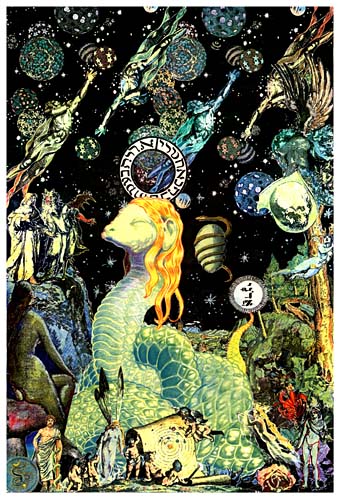
“The Garden of Magic; or, the Powers and Thrones Approach the Bridge” by Alan Moore (1994)
Fellowship of the Vine An interview with shamanic psychonaut-author Daniel Pinchbeck
Daniel Pinchbeck is a New York-based writer and journalist who co-founded the literary magazine Open City in the early ‘90s. The son of the writer Joyce Johnson (a member of the Beat Generation and author of Minor Characters) and the painter Peter Pinchbeck, Pinchbeck has been on a passionate intellectual quest for the last years that has taken him across Nepal, India, Mexico, the Amazon and West Africa, writing pieces on art, psychedelics, and altered states of consciousness for Rolling Stone, The Village Voice, Wired, Salon, and The New York Times Magazine, among others. His new book, Breaking Open the Head: A Psychedelic Journey Into the Heart of Contemporary Shamanism (Broadway), is an account of that quest, blending cultural history, personal narrative, and metaphysical speculation. The original interview was conducted by Joseph Durwin on the eve of Breaking Open the Head’s publication; there’s been some slight futzing of the text by Arthur’s editor.
Arthur: In your book, you talk about exploring many of the same hallucinogenic drugs—LSD, magic mushrooms, ayahuasca—that postwar Westerm bohemians like the Beats and the Hippies were interested in. How does your quest compare to those of people like William Burroughs, Allen Ginsberg, Ken Kesey and Timothy Leary? Daniel Pinchbeck: The Beats were working by instinct and intuition. They realized that modern society had become a horror show, and that their task was to begin to uncover, in Allen Ginsberg’s words, “a lost knowledge or a lost consciousness.” They took that process as far as they could in the context of their times and their individual personalities.
I believe that my approach—and my book—is more scientific and analytic, because that is the task of the “counterculture” in our time. Perhaps I am the only person who feels this way, but I see a clear goal ahead. This goal is a direct legacy of the counterculture —but it is actually hundreds, if not many thousands, of years older than that. In fact, it is the mission that we must somehow accomplish. Think of it as a secret raid to be carried out deep behind enemy lines, despite incredible odds, and with no possibility of failure.
The Beats and the Hippies saw through the abrasive insanity gnawing at the soul of America–this warmongering, money-mad, climate-destroying monstrosity, which is now casting a dreadful shadow across the planet. Where the Beats acted intuitively, from the heart, we now have the necessary knowledge to put together a new paradigm that is simultaneously political, ecological, spiritual, and far more scientifically accurate than the out-dated Newtonian-Darwinian model which is propping up the doom-spiraling status quo. The psychedelic experience supports the physicist David Bohm’s vision of a “holographic universe,” which is also identical to the alchemical perspective of “As above, so below.” We now have the tools to reinstate the archaic cosmological perspective on a firm scientific basis. Once that sinks in, it becomes obvious that the true goal of human existence is psychic and spiritual development, and the entire thrust of the capitalist system is a samsaric delusion that is keeping humanity from recovering its birthright.
Perhaps there is a reason that humanity has been frantically seeking to develop a “global brain” through the Internet, cell phones, and satellites: I suspect that a moment will come when complete social transformation becomes not only possible, but inevitable. That moment may be sooner than we think.
What were the circumstances that led to pursuing the experiences you relate in your book? I first tried mushrooms and LSD in college–as many people do—and my experiences left me intrigued but puzzled. It seemed extraordinary that such vast alternative dimensions of consciousness could be revealed with such shocking immediacy. And it was equally extraordinary that the mainstream culture didn’t find this a worthy subject of discussion or thought. After college, I put psychedelics aside to enter the “real world.” When I hit my late twenties, I began to feel increasingly desolate and despairing. I was lucky enough to be connected to the New York media world, the art world, and the literary world, but all these scenes began to seem unbearably empty to me. I realized that I needed to know for myself if there was a spiritual dimension to existence–I really thought that I might literally go insane or prefer to die without access to some form of deeper knowledge. I didn’t think a bit of yoga was going to do the trick. At a bookstore, I heard about iboga, an African tribal psychedelic plant used in Gabon and the Congo that is said to show initiates the African spirit world. Most people just take it once in their lives–it lasts for thirty hours. I got an assignment to go to Africa and go through the initiation, and that was where my quest began.
Originally published in Arthur No. 1 (Oct. 2002), with a full-page illustration by Geoff McFetridge. In the photo above, ACC holds his copy of Arthur No. 1, with that page showing.
FAMOUS ARTHUR: Arthur C. Clarke Paul Moody enters the sci-fi court of King Arthur
Androgynous aliens searching the galaxy for the nine billion names of God; mysterious unmanned spaceships drifting Marie Celeste-like into the solar system; vast black monoliths discovered under the surface of the moon..it’s all in a day’s work for Arthur C. Clarke.
The author of more than seventy novels and the undisputed Godfather of science fiction, he’s also—to a generation brought up on his long-running UK TV series, The Mysterious World Of…—the monstrodomo of the unknown. Add the fact that’s he’s lived in self-imposed exile in Sri Lanka since 1956, became a guru to the entire US space program in the 1960s and has attracted visits from even the likes of ill-fated Rolling Stone Brian Jones in the search for answers to the reason why we’re here, and you’ve got a mystery wrapped in an enigma signed with a question mark. Religious cults have been born from less.
Yet meeting this good natured sci- fi Colonel Kurtz takes you into an even stranger world. Picture the scene as a Hollywood pitch: you’re standing in a quiet residential street in Cinnamon Gardens, the most exclusive district of Colombo, capital of Sri Lanka. Vast palm trees sway in the 90-degree heat haze. A cloud of bats flies overhead on its daily vigil toward the sunset. Suddenly a ten foot grille slides open and you’re walking into the private residence of one of the most reclusive figures on the planet.
Yet it’s all true. As you go up the stairs of his palatial headquarters you begin to realize you’ve entered a one-man orchestrated nerve-center. This is a far cry from the days when Clarke owned the first television set in Sri Lanka. Banks of computers drone harmoniously; fax machines buzz with communications from all corners of the globe (the telecommunications bills rarely drop below $1000 a month). Signed pictures of everyone from Neil Armstrong to Elizabeth Taylor to the Pope line the walls, amid vast blown-up NASA Moonscapes, whilst a vast floor to ceiling bookcase at one end of the room is filled entirely with hardback first editions of Clarke’s novels.
The overall effect is like entering the inner sanctum of a benign, hyper-active Bond villain. Prodigious isn’t the word for Clarke. He claims to have 102 projects on the go at any one time, and in this setting, aided by a host of assistants, it’s hard to disbelieve him. On top of all this, a wall-sized TV screen is beaming footage of Clarke appearing as a hologram at the Playboy Mansion last year. Standing on a dais addressing an invited crowd of NASA dignitaries, octogenarian swingers and luminescent blank-eyed Playboy bunnies, Clarke delivers a speech as a shimmering, golden, light projection. The effect is much like seeing Kirk and Spock mid-dematerialization on the USS Enterprise. Except Clarke really is going where no man has been before.
As you’d imagine, he’s pleased with it.
“You are watching history!” he booms by way of introduction, gesturing at the screen. Wheelchair bound due to the debilitating effects of post-polio syndrome, nonetheless he wheels himself forward at high speed wrapped in a batik sarong.
Dizzying Heights How do the four humble critters that are Animal Collective make such wildly beautiful and beguiling sounds? By Trinie Dalton
Photography by Susanna Howe
As pathetic as this sounds, I originally started listening to Animal Collective because they were an “animal band,” and I make a point of hearing all new animal bands because I’m obsessed with animals. There are so many animal bands these days, especially lupine ones: Wolf Eyes, Wolf Parade, Wolfmother…I figure anyone who names their band after animals must like animals too, so we have something in common, and maybe they’re also into classic animal bands, like The Animals and The Turtles. So far, this theory for checking out new bands has worked, and I like most animal bands. But Animal Collective are by far the best. They’re King of the Jungle.
This is an especially lame confession because the members of Animal Collective barely even like having a name; they’d much prefer to be individuals who come together in various combos and in various locations to make intriguingly titled albums, like Danse Manatee, Campfire Songs, or Here Comes the Indian, sans band name. That’s one refreshing thing about Animal Collective: they aren’t glory hogs. In animal terms, they’re like prairie dogs, bees, or penguins—humble critters that understand the definition of teamwork. In the beginning, Animal Collective often wore masks and costumes hiding their individual identities, and they’ve always used nicknames to keep alive the secret society element of what they do: Dave Portner is Avey Tare, Brian Weitz is Geologist, Josh Dibbs is Deakin, and Noah Lennox is Panda Bear. Having a band name is too traditional, they say; they only have one because record labels have told them that listeners need to identify the group as a cohesive, named unit.
Which is important, because Animal Collective are one of those rare bands who sound completely different live and on record. Sung Tongs, their last full-length album, is infused with psychedelic wall-of-sound production, Brian Wilson-style. Sung Tongs is so classic it gives me chills. I imagine Sung Tongs on the cover of that Arthur issue 50 years from now featuring the best albums of the past century. The cool part is, I’ll recall how I nearly went deaf hearing tweaky live versions of harmonious tunes like “Leaf House” and “Kids On Holiday.” On headphones, certain Animal Collective songs sound sleepy and hypnotic, while live those same songs make the club’s floor vibrate from heavy bass and guitar distortion. Hearing Animal Collective live is nearly my favorite pastime. Recently, while living in Berlin, I was so dying to see them that I almost flew hundreds of miles to southern France to catch their gig. Getting a grip, I reminded myself that this was a little extreme, not to mention expensive. Each show is different, though: live versions of songs render them unrecognizable or mutate into new songs, so you can’t say, I’ll just stay home and listen to the album.
Feels, Animal Collective’s new release, is heavily injected with sentiment without being sappy. Dedicated to such lofty romantic themes as Love, Purple (the color of passion) and (they say) “synchronicity, or connections between people,” Feels is highly emotive. As opposed to Sung Tongs’ choral vocal layerings and druggy nods to Smiley Smile, Feels contains fewer vocal harmonies but compensates with an abundance of rock-out moments balanced by a “warm hum” of instruments. I can’t wait to see these songs performed live, since the instrumentation on Feels is so elusive. This new record also further distinguishes Animal Collective from the Freakfolk bands they’ve sometimes been lumped together with. I never thought they sounded even remotely folky; Feels instead sounds a lot more influenced by their early inspirations, My Bloody Valentine and Pavement.
Animal Collective are childhood friends. Noah and Josh met in second grade in their hometown, Baltimore. In 1996, Josh hooked up with Brian and Dave, who were also high school buddies from Maryland. They all hung out sporadically throughout college, and by 2000, they were all living in New York, where they recorded and released Spirit They’re Gone, Spirit They’ve Vanished, which gave them their first taste of success. Since then, they’ve made several albums and started a record label, Paw Tracks, home to artists like Ariel Pink and The Peppermints. Prospect Hummer, their last record, is testament to all the European touring they’ve done; they met and recruited Vashti Bunyan in England for vocals on it. Three of the band left New York years ago—Noah for Lisbon, Brian for D.C., and Dave for Europe—so Animal Collective functions via satellite, in a way, until they convene for recording sessions and tours. Even interviewing them was a feat—I received four separate phone calls from around the world—although I really enjoyed it because Animal Collective were so friendly. Each man spoke highly of the others, discussing how the group sound has evolved instead of geeking out on who plays what. They gave uncannily similar answers, and Brian confessed that Animal Collective may know each other “too well.” I had this feeling before, but I know it now—Animal Collective are four best friends committed to experimenting and having fun.
Arthur: What are your ideas about collectives? Animal Collective’s lineup is constantly changing, so your aesthetic is extremely dynamic. Live, for instance, you always play new songs instead of the songs from the album you’re touring for. Josh (Deakin): The word “collective” is oddly touchy for us because it has a certain political air. The idea of calling ourselves a collective was for our own state of mind. We weren’t thinking of it in a broader sense. We’re a fairly exclusive collective. There are people are in our lives that we work with who we consider part of it, in a way, but we aren’t a collective in the big sense. We’ve known each other since we were kids, and really enjoy doing this together. We don’t want to just form a regular band where it’s like “he plays guitar, he plays bass, and I sing.” We came up with the idea in college, when we couldn’t always all work together. Originally, our records had their own titles without band names attached. It’s this idea of creating an environment where you’re not wed to specific habits. Habit contributes to complacency. We wanted to allow for as much change and development as possible. My perception of collectives is that there is some kind of collective consciousness that is an element for us, but mostly we’re strong individuals who have different ideas and like to share them with each other.
So Righteous to Love Devendra Banhart is here and he plays folk music. Trinie Dalton finds out where he’s coming from.Photographs by Melanie Pullen.
A few months ago I hiked high on mushrooms in the Redwoods, and Devendra Banhart’s first album served as my bridge between fantasy and reality. His music isn’t about tripping out on drugs—I’m not belittling it that way—but its soothing quality makes one feel peaceful in any state of mind. As I interviewed him over the phone in late February about a myriad of topics, Devendra often returned to talking about folk music’s universality, about how one of its most noble purposes is to make listeners feel comfortable.
Hearing 23-year-old Devendra talk like this reminded me of how closely related late-1960s psychedelic rock bands were, in spirit and sense of idealism, to the folk singers Devendra loves so much from the same period: their considerations for listening to and hearing music were at the forefront of their playing. But Devendra’s tastes extend into the present, and there appears to be just as many neo-psychedelic musicians playing today as there are neo-folk rockers. Is it due to the current abominable political state? I don’t know. I didn’t care to discuss politics with Devendra because I was more fascinated by his reverence for nature—by his belief that music can bring one closer to not only self-understanding but also learning about one’s place in the environment, whether it be forested or urban.
Devendra’s new album Rejoicing in the Hands cultivates this respect for life under the auspices of yet another new hybrid-Banhart sound, this time combining old-time blues with the troubadour-ish balladry, psychedelic rock and acoustic guitar traditions of folk. The sound of this record is both familiar and absolutely unique, although Banhart’s singing does gets compared in the press to Marc Bolan’s and Billie Holiday’s to an unfortunate, almost annoying degree. Rejoicing in the Hands is perhaps his best work—it’s hard to say that, cuz they’re all so great—in that the guitar playing achieves more complexity, at times becoming as strong a force as the vocals. Not that his first two releases, 2002’s Oh Me Oh My album (Young God), and 2003’s The Black Babies EP (Young God), didn’t feature some fantastic guitar sounds, but until Rejoicing, I’d heard Devendra’s guitar as more a complement to his vocals than having its own individual drive.
I figured this increased guitar-playing skill must mean his shows are getting better and better, so I started our talk by asking him about performing live. His speaking voice became more melodic and animated when he talked of things he felt passionately about. When he began to talk about his favorite types of venues to play, things got interesting…
Arthur: You prefer to play galleries and churches… Trinie Dalton: I try…I don’t entirely like playing rock clubs and bars because it doesn’t lend itself too well to the kind of music we’re playing. When I play a church, the acoustics are so wonderful. You have to play an environment that suits what you’re doing, and churches are built to have incredible acoustics. Some Aztec churches, the acoustics are built so wildly, they’re so psychedelically manipulative, that if you clap into a certain passageway, it responds like the sound of a sacred bird that the Aztecs worshipped. They really thought about it. It makes sense for people who play non-electric music, or quieter music to play in a place that augments that instead of in a place that drowns it completely out. Those people that are used to dealing with 8000 amps and four drum sets, the whole building [a rock club] is built to suck in the sound.
It gives your music a richer sound, or has a more spiritual atmosphere or something…or there’s more than just sound going on, with the other senses too. There’s a vibe.
I think of your music as a mixture of folk and psychedelic. I read up on your big influences, but you didn’t mention psychedelic bands, more of the folky psychedelic rock, like Incredible String Band, Fairport Convention. Do you listen to that kind of music? I really do. “Psychedelic,” to me, just means a sharp awareness of your surroundings, and a heightened aesthetic sense, and a sensitivity…it’s like this ultra-sensual state. Psychedelic words bring out that state in objects that might be considered mundane. Usually they’re in nature, because usually you’re not going to find psychedelic qualities in a stapler, you know? But a tree, you feel it. It’s like a magic spell, or alchemy, using certain words to bring out the psychedelic life and energy, the core, god’s vein, the blood of the gods.
Back to the music, I’m so easily influenced and affected by music. I love Incredible String Band. But I’m not as big a fan of them as I am Clive Palmer, the guy who started them. He played on the first record. The real song to me, on that one, is Clive’s song… “You know my ____ friends/ Singing baby…” [starts singing it] I like Robin Williamson’s solo records, they’re incredible, and I like Mike Heron’s solo records. It’s unbelievable to think that they’re both fucking Scientologists now. Some of these records are just getting re-released, so they won’t just be available on bootleg anymore. Like Clive’s Original Band, and Clive’s Famous Jug Band. As far as British psychedelic stuff, Fairport Convention has never been too psychedelic, they’re more like rock-folk. Then there’s Trader Horne…Currently, I’ve been getting into more current psychedelic stuff, via my friend, Steve Krakow, who goes by the name Plastic Crimewave. He has a magazine devoted to all things psychedelic, that he hand draws and hand writes, called Galactic Zoo Dossier. He also has a band called Plastic Crimewave…he’s a scholar of the psychedelic ways, he’s an incredible person. It’s a good road to go down. A band that I recently saw that was the awesomest epitome of bar psychedelia, is Comets on Fire, they get everybody grooving.







 Arthur Magazine