Thomas Pynchon's South Bay Years

From Robby Herbst:

Anyone who’s been to Manhattan Beach anytime in the last 20 years or so will likely find little in common with Gordita Beach — the fictional locale of Thomas Pynchon’s universe, thought to be based on the beachfront community south of Los Angeles — but the few landmarks that remain are helpfully pointed out in these two pieces below.

Gordita Beach is the setting of Pynchon’s new stoner-noir, Inherent Vice, and also makes a brief appearance in Vineland, his 1990 novel set amidst the schizophrenics, hippies and rednecks of the Northern California redwoods. Though his whereabouts have usually been unknown over the course of his career, the famously reclusive writer lived in Manhattan Beach in 1969-70 while he was writing Gravity’s Rainbow, and in keeping with his near invisibility beyond the bookshelf, there’s little trace left of his presence, or the enclave of “paranoid dope-smokers, surfers and ‘stewardii'” of Inherent Vice.

The Daily Breeze did a compare and contrast piece on modern-day Manhattan and Gordita Beaches in its August 8, 2009 edition: Surprise! Most of the good bookstores are gone, it’s all overrun with horrible lawyers, the landmarks have been plastered over with Oliver Garden-inspired facades and hardly anybody remembers that one of the most significant literary works of the late 20th Century was written there:

But around the South Bay, the response has been more muted. Over the past few years the beach cities have lost their best independent bookstores – such as Either/Or Bookstore in Hermosa Beach, where Pynchon was alleged to be a customer – and Manhattan Beach has been slow to claim Pynchon as a local author.

“Manhattan Beach has a way of shoveling under that kind of countercultural history,” said Frost, whose extensive report on Pynchon’s local ties can be found at http://www.tinyurl.com/macb29. “He occupied a time in history that doesn’t get recorded very well in the South Bay.”

You can read the Breeze piece by clicking here or keep scrolling down to the bottom of our post.

For a more in-depth look at Pynchon’s South Bay years, we’ll refer you to the Garrison Frost history that The Breeze is talking about, originally published in 1999 in his journal of South Bay ephemera, The Aesthetic. Several amusing tidbits:

First and foremost, though, Pynchon was a writer, according to Hall. He was known to lock himself up in his apartment for days and weeks at a time while writing “Gravity’s Rainbow,” often going so far as to block out the windows with towels.

Guy recalled that, while doing research for the book, Pynchon translated an entire book of Russian history using only an English/Russian dictionary.

Perhaps the most interesting tale that Hall has regarding Pynchon is of their last meeting. It was around 1975 and he hadn’t seen the author since the two chatted at the counter at El Tarasco a couple of years earlier. By chance, Hall found himself back in Manhattan Beach and met Pynchon on the sidewalk near the Fractured Cow.

“I was walking down the street and he was walking toward me,” Hall said. “Our paths crossed right in front of a pay phone, our eyes met and we recognized each other. I asked how he was and at that moment the telephone rang. He looked at me and looked at the phone, then turned around and ran down the street, and I never saw him again.”

Click here to keep reading “Thomas Pynchon and the South Bay” at The Aesthetic’s website. And if you haven’t gotten a copy of Inherent Vice yet, Amazon’s currently offering a free download of the first chapter as PDF.

Read “Fictionalized Manhattan Beach comes to life in Pynchon novel” from The Daily Breeze after the jump …

Continue reading
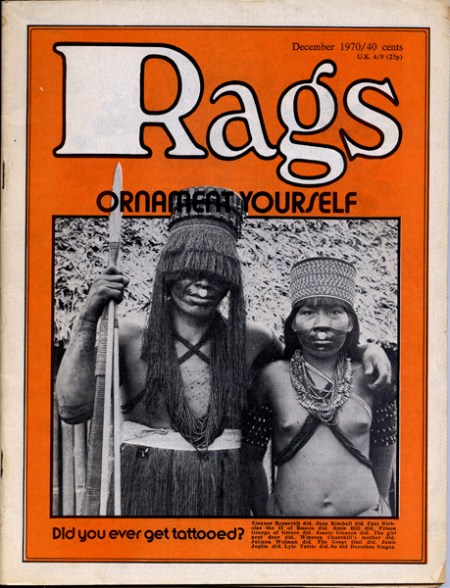
Rags Magazine: An Underground Style Mag from 1970

A part of the underground press movement, Rags was published for a year, 1970-71. It covered the worlds of counter-culture fashion with street fashion reports, groovy adverts and a very liberated sense of style. As far as I can tell its print run was all b/w on rag paper.

The December 1970 issue includes “Revolution” (with models acting out scenes from peoples history),”Life Amongst the Amazon Today” (on body modification in Amazonian tribes), “If God Hadn’t Wanted You To Wear a Bra He Wouldn’t Have Invented the Contour Council” (all about “the bra” with super hip writing!!) and “Raggedy Robin Raggedy Jane” (a profile of a Haight Ashbury clown couple).

The SF Diggers went to bat against the hip capitalists in SF but the innocence, creativity and DIY styles displayed in this publication, which seems to have been distributed primarily in underground boutiques, is charming nonetheless. A mystery in its masthead is the listing of “commidify your dissent” artist Barbara Kruger. That name appears as one of two art directors.

Cassandro Tondro has a blog uploading pdf’s of her collection of Rags. Check it out!

White House Manual Details How to Deal With Protesters

By Peter Baker
Washington Post Staff Writer
Wednesday, August 22, 2007; A02

Not that they’re worried or anything. But the White House evidently leaves little to chance when it comes to protests within eyesight of the president. As in, it doesn’t want any.

A White House manual that came to light recently gives presidential advance staffers extensive instructions in the art of “deterring potential protestors” from President Bush’s public appearances around the country.

Among other things, any event must be open only to those with tickets tightly controlled by organizers. Those entering must be screened in case they are hiding secret signs. Any anti-Bush demonstrators who manage to get in anyway should be shouted down by “rally squads” stationed in strategic locations. And if that does not work, they should be thrown out.

But that does not mean the White House is against dissent — just so long as the president does not see it. In fact, the manual outlines a specific system for those who disagree with the president to voice their views. It directs the White House advance staff to ask local police “to designate a protest area where demonstrators can be placed, preferably not in the view of the event site or motorcade route.”

The “Presidential Advance Manual,” dated October 2002 with the stamp “Sensitive — Do Not Copy,” was released under subpoena to the American Civil Liberties Union as part of a lawsuit filed on behalf of two people arrested for refusing to cover their anti-Bush T-shirts at a Fourth of July speech at the West Virginia State Capitol in 2004. The techniques described have become familiar over the 6 1/2 years of Bush’s presidency, but the manual makes it clear how organized the anti-protest policy really is.

The lawsuit was filed by Jeffery and Nicole Rank, who attended the Charleston event wearing shirts with the word “Bush” crossed out on the front; the back of his shirt said “Regime Change Starts at Home,” while hers said “Love America, Hate Bush.” Members of the White House event staff told them to cover their shirts or leave, according to the lawsuit. They refused and were arrested, handcuffed and briefly jailed before local authorities dropped the charges and apologized. The federal government settled the First Amendment case last week for $80,000, but with no admission of wrongdoing.

The manual demonstrates “that the White House has a policy of excluding and/or attempting to squelch dissenting viewpoints from presidential events,” said ACLU lawyer Jonathan Miller. “Individuals should have the right to express their opinion to the president, even if it’s not a favorable one.”

White House spokesman Tony Fratto said that he could not discuss the manual because it is an issue in two other lawsuits.

The manual offers advance staffers and volunteers who help set up presidential events guidelines for assembling crowds. Those invited into a VIP section on or near the stage, for instance, must be ” extremely supportive of the Administration,” it says. While the Secret Service screens audiences only for possible threats, the manual says, volunteers should examine people before they reach security checkpoints and look out for signs. Make sure to look for “folded cloth signs,” it advises.

To counter any demonstrators who do get in, advance teams are told to create “rally squads” of volunteers with large hand-held signs, placards or banners with “favorable messages.” Squads should be placed in strategic locations and “at least one squad should be ‘roaming’ throughout the perimeter of the event to look for potential problems,” the manual says.

“These squads should be instructed always to look for demonstrators,” it says. “The rally squad’s task is to use their signs and banners as shields between the demonstrators and the main press platform. If the demonstrators are yelling, rally squads can begin and lead supportive chants to drown out the protestors (USA!, USA!, USA!). As a last resort, security should remove the demonstrators from the event site.”

Advance teams are advised not to worry if protesters are not visible to the president or cameras: “If it is determined that the media will not see or hear them and that they pose no potential disruption to the event, they can be ignored. On the other hand, if the group is carrying signs, trying to shout down the President, or has the potential to cause some greater disruption to the event, action needs to be taken immediately to minimize the demonstrator’s effect.”

The manual adds in bold type: “Remember — avoid physical contact with demonstrators! Most often, the demonstrators want a physical confrontation. Do not fall into their trap!” And it suggests that advance staff should “decide if the solution would cause more negative publicity than if the demonstrators were simply left alone.”

The staff at the West Virginia event may have missed that line.

courtesy of Marc Herbst

“Children of the Sun: German and California Proto Hippies” by Robby Herbst

It’s fig season in California. Those sweet tree warts are beginning to sag with the weight of their sugars. True bliss for urban and rural foragers alike. The season reminds me of these folks…

Natural music and vine ripe watermelon with Gypsy Boots and his talented friends on a summer day in Hollywood,1948. Gypsy Boots and his pals would often travel over 500 miles just to pick and eat some fresh figs.

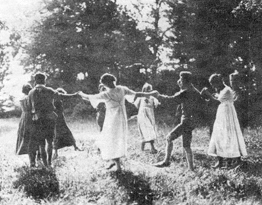
Seven of California’s “Nature Boys” in Topanga Canyon, August 1948. They were the first generation of Americans to adopt the “naturemensch” philosophy and image, living in the mountains and sleeping in caves and trees, sometimes as many as fifteen of them at a time. All had visited and some were employed at “The Etropheon” where John Richter gave his inspiring lectures about raw foods and natural living.

This magnificently illustrated book chronicles the philosophy, lifestyle and dissemination of Lebensreform, (Life Reform – “neither communism nor capitalism, but land reform”). In reaction to industrialization, from Hermann Hesse and the artist Fidus wanderings through pre-WW1 Germany in edenic bliss to Bill Pester going natural in a Palm Springs canyon. Pester, a German born immigrant, was counted in the 1920 census as one of the 24 members of the Cahuilla tribe.

[image missing]

Bill Pester at his palm log cabin in Palm Canyon, 1917; note palm blossom walking sticks leaning on left side of the door.

Man was intended to live in a state of nature. All man’s troubles, sickness, anxieties and discontent come from a departure from nature. I would advise you to go back to nature, if you want to be cured; give up your extravagant habits, your high-priced hotel life, quit taking medicine and discharge your doctor. -Bill Pester

Image by Fidus

cs7.jpg

Wandervogel means “migrant birds/free spirits.”

“Communes in Sunland, CA and the Past Lives of New Yorker Art Critics” by Robby Herbst

Before Peter Schjeldahl was writing reviews of old masters for the New Yorker he was a groovy sweaty features editor for Avant-Garde magazine. Avant-Garde was something like a counter culture arts review.

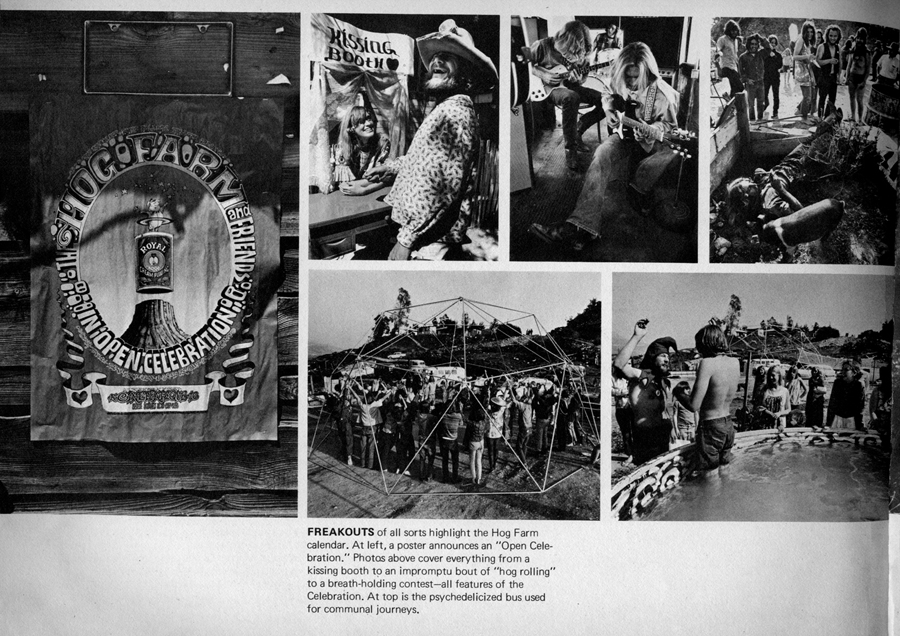
In this ’68 issue an unbuttoned Schjeldahl co-authored (with Neal White) an expose of a So Cal commune (in Sunland-Tujunga!) called The Hog Farm.

Pigasus was Prime Minister of this, then two year old, commune. From here, his humble sty in Sunland, one can assume that he was the very same pig that went on to seek the presidency as the 1968 nominee of the Yippie Party.

In the late 60’s Sunland-Tujunga was a wild place. The article chronicles the tussles between the commune and its neighbors. According to Schjeldahl the Valley Ranchers Association had set up an armed roadblock. Additionally “local toughs, many of them Vietnam Veterans”, known as the “Androids” would occasionally “pillage the farm.” Much of this, according to Schjeldahl, was set off by a picture published in the Voice of the Verduga Hills of Pigasus with a flag “flapping above his sty”.

Administration of the commune is on a daily rotation basis with everyone, kids included, taking a turn as “Dance Master” or “Dance Mistress.” “When you have this many people living together,” Romney (Hugh Romney the founder of the commune, aka Wavy Gravy- ed.) observes “you’ve got to dance or you step on somebody’s hand.” The Dance Master sees that things get done by someone who wants to do them.

The farm, as Romney suggests, is more than a summer camp for misfits. It is a thriving spiritual community, an experiment in utopian living. You get the idea when you attend the highpoint (literally) of the Hog Farm day, just before bedtime in the cantonment’s biggest dome. Shrouded in parachute silk and brightly lighted, the dome can be seen for miles on a smogless night. You can only guess at what the citizens of Sunland-Tujunga imagine is possibly going on inside. What is going on is this:

Inside the dome 30-odd men, women and children_lotus-squating, clad in an assortment of strange clothes. Eyes closed, hands clasped in two concentric circles, they are humming in unison_”Om.” “Om” is a loud resonant, brain-buzzing sound made by vibrating air in the sinuses. The choral hum is punctuated by improvisatory moans, pants, and clucks, it dissolves into an athletic chant: “HOG-HOG-HOG-HOG-HOG-HOG-HOG!” Then someone in a Donald Duck jersey stands and gently raises everyone, like a a circle of dominoes in reverse. Climax! All fall down. “The Circle Joke” is over, and the Hog Farmers, spent and blissful, break the circle and retire to their sleeping bags for the night.

I like the New Yorker, but I can’t help but imagine how it would be if they or Schjeldahl had such a groovy editorial position on art and culture today.

All photos by Jillian Wasser.

RADICAL SOFTWARE MAGAZINE

from Robby Herbst: “I just found that the entire contents of this 70’s era radical technology magazine is online in all its glory- technotopian manifestos and cool ass mcluhan/nam june paik/ant farm/usco – driven graphics.”


from the <a href="Radical Software website:

“The historic video magazine Radical Software was started by Beryl Korot, Phyllis Gershuny, and Ira Schneider and first appeared in Spring of 1970, soon after low-cost portable video equipment became available to artists and other potential videomakers. Though scholarly works on video art history often refer to Radical Software, there are few places where scholars can review its contents. Individual copies are rare, and few complete collections exist. This Web site makes it freely available and searchable on the Internet.”

Street Signs and Solar Ovens: Socialcraft in Los Angeles

October 22 – December 31 , 2006
Gallery 3

A revolutionary exhibition featuring artwork created with social activism as its inspiration. Dubbed “socialcraft”, the objects on display are examples of unique artworks utilized by communities and individuals in their quest for social change. Street Signs and Solar Ovens will feature protest art meant for public display such as hand-crafted demonstration signs, posters, t-shirts, as well as examples of instruments for socially-conscious living such as eco-friendly appliances.

Curated by Marc and Robby Herbst, of the Journal of Aesthetics and Protest editorial collective (Cara Baldwin, Marc Herbst, Robby Herbst, Christina Ulke). CAFAM also is collaborating with institutions including the Center for the Study of Political Graphics and the Center for the Preservation of Democracy.

Featured artists include Edith Abeyta, Steven Anderson, Lisa Anne Auerbach, Mike Blockstein, CARACEN, Chris Burnett, C.I.C.L.E., Code Pink, Center for the Preservation of Democracy, Center for the Study of Political Graphics, Sandra de la Loza, Sam Durant, Eric Einem, Karl Erickson, Fallen Fruit, Finishing School, Gaian Mind, Fritz Haeg, Evan Holloway, L.A. Commons, Laura Howe, Karen Lofgren, Kelly Marie Martin, Matrushka, Jennifer Murphy, Nico of Teocintli, Christopher Nyerges, Path to Freedom, Sheila Pinkel, Oliver Ressler and David Thorne, Oscar Sanchez, The Arroyo Arts Collective, The Phantom Street Artist, The South Central Farm Support Committee, Christina Ulke, Votan, Allison Wiese.