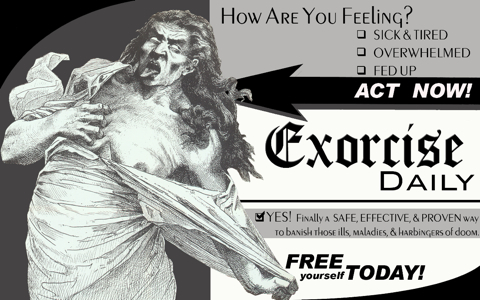
EXORCISE DAILY! (Arthur, 2008)

Vanishing Act
by the Center for Tactical Magic

from the “Applied Magic(k)” column in Arthur No. 32 (Dec 2008)

One of the oldest themes in magic(k) is that of death and resurrection. Recurring in the origin stories of numerous religions, death and resurrection also played an important role in the initiation ceremonies of early shamans across the globe. By first descending into the depths of sickness, disease, and even death itself a Siberian shaman would make allegiances with spirit allies who could be called upon to help the living. But in order to do so, the shaman would have to survive the ordeal and return to life before s/he could act as an intermediary.

Anthropologists have observed similar tendencies in shamanic initiation throughout geographically divergent cultures. Although the story of Jesus Christ is perhaps our society’s most familiar example, scholars of world religion are quick to point out that many aspects of the Christ story are reflected in earlier religious beliefs surrounding such deities as Osiris, Dionysus, and Mithras to name but a few of the more notable, regional examples. However, the list of dying-and-rising gods numbers well into the dozens and extends across the world map to include the likes of Quetzalcoatl (Aztec), Odin (Norse), Ishtar (Mesopotamia), Julunggul (Aboriginal Australian), and Travolta (Hollywood).

While Tarantino’s resurrection of Travolta might not qualify him as a “god” worthy of the aforementioned pantheon, themes of death and resurrection have long played out on the stages of popular culture and entertainment. Early performers in Native America and in ancient Egypt would amaze audiences by bringing animals back to life. While in India, fakirs performing the famed “basket trick” would stuff a child into a woven container before perforating the basket (and presumably the child) with multiple swords, only to reveal a short moment later that the child was still alive and well. More recently, magicians P.T. Selbit and Horace Goldin might not have the popular name recognition today that they once shared in the 1920’s; however, one would be hard-pressed to find someone who doesn’t recognize their famed (and misogynistic) illusion: sawing a woman in half.

A resurrection routine in theatrical magic often takes one of several forms: a transposition (in which the assistant disappears from one place and reappears somewhere else), a transformation (in which the assistant appears to change into something or someone else), or a restoration (in which the assistant is returned to normal after first being subjected to some sort of ghoulish sadism). A vanish on the other hand (in which the assistant simply disappears) is seldom used for a resurrection act because the audience is left ill-at-ease wondering what happened to the body after the magician stabbed, shot, burned, or cut it.

More commonly, vanishes are employed as a metaphorical reminder for the ephemeral and illusory nature of life. Coin vanishes are among the more familiar tricks in a conjurer’s repertoire, and audiences seem to have no trouble relating to the disappearance of money even when it happens inexplicably before their very eyes. Thurston, the great Vaudeville magician and master Mason, took the vanishing act a step further by introducing the “the vanishing Arabian steed” followed a few years later by “the vanishing automobile” along with its passengers. More than simply illustrating the technological trajectory of transportation, Thurston’s vanishes demonstrated to his audience that coins, cars, or other symbols of material wealth possess a value that is not lasting. Later magicians failed to recognize the potential for multiple levels of symbolic relevance and focused only on scale as a determining factor for their illusions by vanishing elephants and water buffalo.

However, the same cannot be said for David Copperfield’s famed vanishing of the Statue of Liberty. With 1984 looming and Ronald Reagan busy conjuring his own “voodoo economics” the disappearance of Lady Liberty probably should have spooked audiences more than it did. Clearly more prophetic than Thurston’s vanishing horse, Copperfield’s vanishing Liberty should have been regarded not as prime time entertainment but as a dire warning of politics to come. If treated as an omen, we can at least take comfort in the fact that Copperfield’s illusion is ultimately a restoration and not simply a vanish. If so, and the mystical vision holds true, we can expect the return of our civil liberties, cell phone privacy, and perhaps even the freeing of those who have been disappeared by government contracted “extraordinary rendition” aircraft and in the CIA-operated secret prisons abroad.

In stage magic, vanishes may rely on a range of methods to achieve the desired effect. The use of mirrors, trap doors, secret compartments, and doubles might be used to restore an assistant to a healthy state. While politics also utilizes no short supply of ruses, deceptions, and misdirections, it takes much more to return to a healthy state. Although we witnessed the vanishing of George Bush from the White House in January of 1993, we were left dumbstruck when a second George Bush reappeared in the Oval Office in 2001. Unlike the shamanic ascension from the underworld that affords mysterious new powers for helping treat the ailments of others, this hellish return was accompanied by two wars, an exploding national debt, a devastating economic crash, and mysterious new powers for government surveillance and the executive branch.

Thankfully the curtain call has come for that sad act. The stage has been reset and we are now eagerly awaiting the next Bush vanishing act from the halls of government. Hopefully this time it’s a permanent disappearance. And perhaps when the curtain goes up on this next act we’ll witness the resurrection of the long-dead spirit of democracy that has recently begun haunting our hopes and dreams again.

Undoubtedly, politicians and governments will continue to perform much as they have in the past. Yet, the mass mobilization around the Obama campaign has given the audience new clues in determining the outcome of the show. The close of the Obama/McCain election represented a political shift in more ways than one. For the first time in eight years (if not longer), people poured into the streets not to protest an act of government but to celebrate one. The jubilation went far beyond party politics because the triumph went not only to the Democrats. People could feel their own political power. Whether or not Obama lives up to his campaign promises and our highest expectations remains to be seen; yet, the real victory here is the empowerment of the grassroots to accomplish a major political mission. Hopefully, the next eight years brings the political utopian equivalent of unicorns and demons sharing the last slice of birthday cake under a shimmering rainbow. But if it doesn’t, we now have a road map for organizing that doesn’t just look like another weekend march with placards and puppets in the financial district of a major metropolis. On the contrary, the mobilization around Obama was widespread, sustained, contextual, and media-savvy. It utilized multiple outreach strategies, creative tactics, and a model of fundraising that accumulated millions of small donations into a mega-fund for manifesting a collective vision. And now that we see what we can accomplish, there’s no reason why we should stop there. The show must go on – locally, nationally, globally. Or else we may find ourselves sitting once again in a dark theater awaiting the resurrection of our political nightmares.

Print this out: HELPFUL “EXORCISE DAILY” PDF

HOW TO HEX A CORPORATION : Applied Magic(k) column (Arthur, 2008)

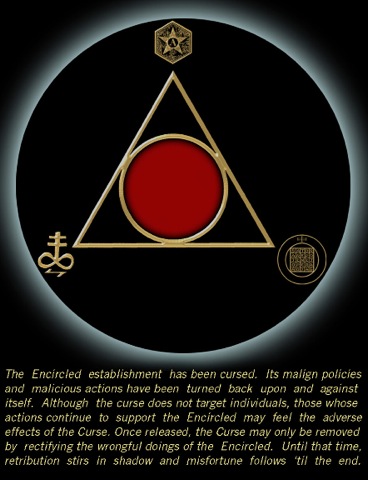
Above: A CTM-designed sticker, easily adaptable for re-use by you.

APPLIED MAGIC(K): Hex Files
by the Center for Tactical Magic

Originally published in Arthur No. 30 (July 2008)

The Center for Tactical Magic is no stranger to controversy. Even when we’re not actively setting out to conjure a bit of mischief, the imps often make the effort to conjure us. Since our projects frequently trespass into different cultural territories, it’s not uncommon to encounter an occasional cold reception or heated debate. Typically, these center around what the Center is or isn’t. Activists? Occultists? Conjurers? Tricksters? Contemporary artists? Martial artists? Con artists? Most of the time we feel that these debates are more productive for everyone when we stay out of them and let folks figure things out on their own. However, we recently received some paradoxical antagonisms via email regarding one of our distribution projects and thought it might be helpful to clarify a few misunderstandings.

To begin, the project in question is a curse. It is a curse in the form of a sticker that is specifically designed to target corporations, institutions, agencies, and the like. And the ire that we raised from two different people couldn’t be more divergent. The first, a self-proclaimed “activist” wrote:

I like a lot of what you guys do, but some of it doesn’t seem very productive. I mean, curses? I just read your article in Arthur about the difference between “magical thinking” and “wishful thinking” and then you suggest “cursing” people in power? This seems hypocritical and/or delusional. I’m open to different people’s spiritual viewpoints, and I don’t mean any offense, but I don’t really see how a curse can be as effective as a protest or a petition.

The second critic, a self-proclaimed “Wiccan High Priestess” wrote:

I have long-admired the Center for Tactical Magic for your innovative interpretations of ancient magickal wisdom. However, I am deeply disturbed and taken aback by your “Diagrammatic Hex.” This curse clearly defies the Wiccan rede: “That ye hurt none, do what thou wilt.” Further, it beckons doom. “That which ye sendeth out, shall returneth three-fold!” This hex you have devised is of the darkest magick, and can only reap darkness in return. It is not only dangerous for you, but irresponsible towards those who would follow you down the Left-hand path to their own demise.

Before we directly address either of the aforementioned concerns, we should set the stage with a short history lesson. The origin of curses is ill-defined; yet, it’s certain that we find hexes, whammies, jinxes, the “evil eye” and all sorts of maleficia in cultures spanning time and geography. More often than not, curses have been cast over personal disputes, vindictive rages, and petty jealousies. However, there have also been instances where curses have been deployed in collective struggles.

In the Middle Ages, the peasant class had no easy avenue of representation through which they could air grievances against their feudal lords. So somewhere between total subjugation and full-scale revolt, curses became a tactic of dissent. By discretely attaching hexes to the property of the feudal lord, the ruling authorities could be made aware of the growing social distemper. While the nobility might be quick to dismiss the hexes as mere foolishness, the laborers of the manor, who belonged to the “superstitious” peasant class, could be relied upon to take the hexes a bit more seriously (and perhaps melodramatically). And unless the feudal lord took steps to remove the curse, the manor and the fief would slip into a dysfunctional mess. Of course, the way to remove the curse would involve rectifying any prevailing injustices.

It’s not too difficult to imagine that similar dramas were no doubt enacted hundreds of years later on plantations across the colonized globe. A bit of well-placed Hoodoo or Voodoo could serve to amplify the collective concerns of house slaves and field slaves alike. Even if the plantation owner took little heed of the “mumbo-jumbo” the workers would certainly make a fuss until things were set right.

Based on these precedents, as well as on our contemporary context of corporate neo-feudalism and wage-slavery, it seemed only fitting that we should revive and update this bit of mojo. As such, we suggest that the modern sticker-hex might produce several positive results:

Continue reading

MAGIC(K) IN THE STREETS: Applied Magic(k) column by the Center for Tactical Magic (Arthur, 2008)

An Open Invocation
by The Center for Tactical Magic

illustration by Cassandra Chae

originally published in Arthur No. 31 (Oct 2008)

“Magic(k) works.” This declarative statement was recently hurled in our direction with a cautionary tone rather than a celebratory one. The sender of the warning was concerned that we didn’t take magic(k) seriously enough; that we were advocating its use willy-nilly like some sort of fun, new fad. But fear not. Although we don’t believe that fun and magic(k) are at odds with one another, we are nonetheless advocating its use very pointedly and with much consideration. And we are advocating its use precisely because it works.

As we’ve said in the past, one of the primary reasons why people don’t engage in magic(k) in the first place is out of a sense of dismissal. They dismiss magic(k) because they doubt it will produce results; and, they dismiss magic(k) because they fear it will produce results. Indeed, much of the bullshit that fertilizes the grand magic garden reeks of these airs of dismissal. Occult conspiracy theorists will even tell you that such bullshit is built up to protect the fruit from those who would dare set foot in the garden at all. Layers and layers of foul fluff and rotten rhetoric are woven into a formidable pile of vapid New Age-isms, Hollywood cheese, religious warnings, and occult elitism.

Continue reading

COMMUNICATING WITH PLANTS

“Applied Magic(k)” – a column by the Center for Tactical Magic

from Arthur Magazine No. 29/May 2008

THE ROOTS OF CULTURE

“What kind of times are they, when talk about trees is almost a crime because it implies silence about so many horrors?” —Bertolt Brecht (To Those Born Later)

Most people have an appreciation for plants and make an effort to occasionally hike among them, repose in their shade or even co-habitate with them. And while it’s safe to say that we recognize plants’ value and usefulness, it’s also a fair assessment to state that the plant kingdom is frequently taken for granted. When we’re not trampling it, cutting it down, or eating it, we’re usually ignoring it altogether.

Perhaps that’s why the vast majority of modern people who encounter the idea of human/plant communication—or “psychobotany,” as we prefer to call it—find it strange. But it’s equally strange that this viewpoint has become normalized. After all, anthropologists largely agree that people have been attempting communication with the plant kingdom for as long as there have been plants and people. So why is it considered “abnormal” to attempt communication with plants today? And what can we hope to accomplish by entering into such a conversation in the first place?

From engendered grudges and evolutionary angst to theological quibbles and accusations of entrapment, the story of Adam and Eve in the Garden of Eden has certainly been fertile ground for all sorts of controversy. But surely there’s an upside. At the very least the Bible has given us a glimpse of Utopia: proto-hippies living blissfully in a magic garden. In one corner of paradise they receive vitality from the Tree of Life; in another they gain consciousness of self after sampling the forbidden fruit from the Tree of Knowledge.

Continue reading

“WILLPOWER TO THE PEOPLE!”: Applied Magic(k) column by the Center for Tactical Magic (Arthur 27, Nov. 2007)

WILLPOWER TO THE PEOPLE

by the Center for Tactical Magic

Art direction by Molly Frances and Mark Frohman

printed in Arthur Magazine No. 27 (November 2007)

Cognitive scientists use the term “Magical Thinking” to describe a lack of causal reasoning. According to them, the belief in superstitions, lucky charms, and rain dances often falls into this category. But the term can be applied to any situation where one makes judgments based on a cause-and-effect rationale that wouldn’t hold up under scientific scrutiny. Simply put, magical thinking is (from a cogsci perspective) the analytical by-product that occurs when your hopes, fears, desires, prejudices, and beliefs take over your decision-making.

Child psychologists often use the term slightly differently. For a child, magical thinking often refers to conditions in which the cause and the effect are disassociated. For example, the kid sees you grab a remote control from the table and hears the stereo turn on, but doesn’t yet understand that the two actions are related. It is primarily this aspect of magical thinking that stage magicians rely on when performing illusions. In feats of magical reverse engineering, a good magician will think about a desired effect to be produced, and then work backwards to plan the method. The success of the effect is then greatly enhanced by the magician’s ability to conceal the method from the audience. In essence, the magician returns the audience to a state of child-like perception where causes and effects are distant strangers. Some embrace this sense of wonderment while others resent the inflicted feelings of naiveté. Yet, it should be noted that while such magical thinking evokes a child-like sense of the world, it does not limit us to childish behavior.

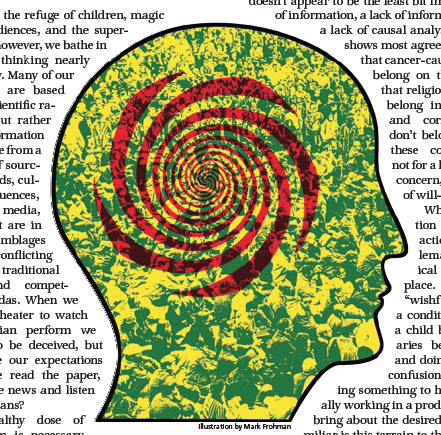
It would be easy to believe that magical thinking is merely the refuge of children, magic show audiences, and the superstitious; however, we bathe in magical thinking nearly every day. Many of our decisions are based not on scientific rationale but rather on information we receive from a variety of sources – friends, cultural influences, mass media, etc. And many of these sources are in fact assemblages of conflicting truths, traditional bias, and competing agendas. When we enter a theater to watch a magician perform we expect to be deceived. But what are our expectations when we read the paper, watch the news, and listen to politicians?

Continue reading

REGARDING GHOSTS.

CALLING ALL GHOSTS
by The Center for Tactical Magic

Originally published in the “Applied Magic(k)” column in Arthur Magazine No. 25/Winter 02006

Ghosts are unwieldy subjects to contend with. It’s as if their ephemeral nature predisposes them to be barely tangible topics of research. The vast majority of evidence used to support the existence of ghosts is subjective: first-hand reports and eyewitness accounts. Despite the fact that forensic science, cultural geography, physics, and parapsychology all suggest that any given area is inscribed with the residue of that area’s history, the hard data on hauntings remains inconclusive.

To make matters hazier, the definitions of ghosts often swirl together with religious beliefs and philosophical assumptions. For example, if we define ghosts as being the spirits of the departed, we are stating clearly that we believe in life-after-death and some notion that separates body and spirit. Whether this notion is Cartesian dualism, Egyptian ka, Polynesian mana, or the yin-world spirits of Taoism, the assertion is that the individual is not indivisible. At the very least we are forced to accept the idea that the self is multiplicitous.

This shouldn’t be such a leap. At any given moment a person can be characterized by many different activities that s/he engages in: mechanic, musician, anarchist, lover, gardener, cyclist, etc. A person doesn’t think of him/herself as a mechanic when s/he’s in the garden, although s/he also doesn’t stop being a mechanic. We are many things to many people in many spheres of activity – simultaneously. But still we remain ourselves. On the most basic level, we live multiplicitous lives every day.

And when we go to sleep at night, it doesn’t end there. Our dreams continue to embroil us in action-adventures that would surely leave us breathless and exhausted if it weren’t for the simple fact that our bodies barely participate in all of the fun. If there is any sort of universal logic that can be applied as a subjective proof for the insubstantiation of the self, it is the simple fact that we all dream, whether we remember it in the morning or not.

To be clear, dreams don’t prove that ghosts are real. Nor does it prove that ghosts are the spirits of dead people. Rather, the travels we undertake when our eyes are closed simply suggest that a meaningful disembodied existence can occur. Even if we dismiss dreams (and ghosts) as immaterial and inconsequential, anyone who has ever experienced a nightmare won’t deny the fact that these visions can cause acute physical and psychological sensations in our waking lives.

But what are ghosts exactly? The incorporeal dead hanging out amongst the living? Reflected light? Psychosis? Atmospheric anomalies? Holographic messages from the future? Alien lifeforms? Osama’s latest WMD (Weapon of Mental Distortion)? Whatever they are, ghosts, like magic(k), pop up, in one form or another, in nearly every culture on the planet, and have been described in legends, myths, and stories throughout history. A popular Chinese attitude towards ghosts is voiced in the age-old expression, “If you believe it, there will be, but if you don’t, there will not.” According to legend, the saying was penned by a scholar named Zhuxi (Song Dynasty, 960 – 1279). Now Zhuxi was such a strict non-believer that he decided to write an essay about the non-existence of ghosts. But, lo and behold!—a ghost showed up to convince him otherwise. The ghost made such a lucid argument, that Zhuxi was forced to reconsider his thesis. In fact, it’s actually the ghost that is credited with authoring the aforementioned expression, and Zhuxi merely wrote it down.

Whether we believe in ghosts as actual paranormal phenomena, or as manifestations of mass cultural imagination, we can agree on some fundamental characteristics of ghosts. For starters, it’s significant to note that many such manifestations consistently take the form of people, or exhibit seemingly conscious behaviors. This could be similar to looking skyward and seeing faces in the clouds; however, there’s one major exception. When we let our minds drift in the cumulo-nimbus we also tend to see things like bears in bathtubs, and inverted Lay-Z-Boys. And we don’t hear ghastly tales of glowing gaseous forms resembling anything quite so banal, or cute and cartoony. Instead, we are most often presented with accounts of haunting encounters that evoke horror, sorrow, fear, anger, remorse, passion, and purpose. Ghosts emerge from the shadows; from dark corners; from forgotten and abandoned recesses. Regardless of whether or not these phantoms are psychological projections or external paranormal phenomena, it’s clear that our collective response to these apparitions is apprehension, angst, and anxiety.

Generally speaking, there are two dominant types of ghost stories: lost love, and grave injustices. The “lost love” category encompasses all of those apparitions who wait endlessly for lovers to return, or visit their living loved ones for comfort, counsel, and last condolences. In the second category, the vast majority of ghost stories hover around a central theme of grave injustices yet to be rectified. Murder. Torture. Betrayal. The plight of this sort of phantom is one of paradox; it seeks to rest in peace, yet refuses to quit the struggle until things have been set right. While the crimes of the past still linger at the site of a haunting, the ghost’s job is to make sure we, the living, don’t ignore it. Their refusal to let injustices be forgotten manifests in a form of spiritual civil disobedience. From silent vigils to shrieks and moans to outright property destruction, these ghosts are paranormal protestors bearing witness to a world gone woefully awry. In their quest for peace, the phantoms that haunt us defy the laws of the material world in acts of otherworldly anarchism. Offering spiritual resistance to the complicit affairs of everyday life, these insurgent souls have little regard for the rules and boundaries that restrict the world of the living.

They defy even gravity itself. Moving through gates and walls, no barrier restricts their attempts to resolve the inequities that torment them—and consequently us. After all, it is the apathy of the living that drives them to disturb the peace, because they cannot rest until the conflict is, once-and-for-all, addressed and resolved. There is no moving on. Not until unsavory events are properly put to rest.

It’s this kind of dissenting spirit that needs to be channeled today. Even Senator Specter (R-PA), whose position on most policies is rather ghoulish, could not sit idly by when faced with the recent legislation surrounding Guantanamo Bay detainees. Like all hauntings, the degree of uncanniness is quite remarkable. It’s only too fitting that the Chairman of the Senate Judiciary Committee be named Specter. And perhaps even more appropriate that he should take issue with the United States’ recent dissolution of habeas corpus (meaning quite literally “(You should) have the body”). Dating back as far as 1305, and included in Article 1 of the U.S. Constitution, habeas corpus is one of the oldest and most celebrated guarantees of personal liberty. It grants individuals the right to question their detainment and challenge the government on the legality of their imprisonment. By killing habeas corpus, the clock on civil liberties is set back more than seven centuries to a time when judicial courts were simply a king and his dungeons. No wonder Mr. Specter is voicing his disapproval.

The haunting of society by the ghosts of our collective past resonates within a present that continues to manifest grave injustices. Generation after generation, the abuse of power materializes in a reoccurring nightmare, claiming countless victims—collateral damage in a battle to maintain hegemony. Doomed to repeat the tragedies of the ages, these lost souls insinuate their desires and anxieties into the world of the living. Each step of the way, these energies inform our thoughts, our dreams, our actions—indeed, every aspect of our existence. Ghosts are an unsettling reminder that the crimes of the past have not yet been resolved. Refusing to quietly fade from consciousness, they demand that their howls be heeded. The residues of injustice permeate the physical, psychological, and parapsychological landscape, inscribing the present with desperate warnings and demands for reconciliation.

Perhaps it’s time for the living to start paying attention to the stirring in the shadows. These aberrations in space, time, and freedom remain inscribed in mind, spirit, and social body, awaiting their release through the discovery and recovery of our own self-determining forces. Can the righteous spirits of the past truly join forces with the living to achieve peace and justice? If you believe it, there will be, but if you don’t, there will not.

EXERCISES
Through methods of divination, channeling, investigation, experimentation, and active engagement, we can invoke those that seem most experienced in dealing with past inequities—ghosts. Here are a few experiments in magic(k) to get you started. As always, please let us know how it goes by emailing to: goodluck at tacticalmagic dot org

1. Summoning ancestral spirits for guidance and inspiration is an age-old practice re-popularized in the ’70s through Milton Bradley’s mass production of the Ouija board. But you don’t need to jump on eBay to get a piece of the action. Make your own walkie-talkie to the spirit world by covering any smooth surface with the letters of the alphabet, numbers 0-10, and the words, “yes,” “no,” “unclear” and “goodbye.” Use another object that glides easily over the surface as your planchette, or pointer. A shot glass, serving spoon, or cell phone will work okay. A generic board will likely attract a general audience. For the best results, craft your set-up with a righteous spirit in mind using items and symbols that the spirit might find appealing. If, for example, you wanted the counsel of Nathan Hale, draw the board on a copy of the Patriot Act. For Harriet Tubman, try replacing the planchette with a broken handcuff. Grab a few friends, dim the lights, and place your fingertips lightly on the planchette. Then, invite the spirits, and begin your supernatural conspiring.

2. The problem with ghosts is not that they won’t shut up, but rather that it took death to get them to speak up in the first place. Is it fear of death that keeps us from voicing our dissatisfaction with the world of the living? Or fear of life? Fortunately, there’s no need to wait for that last breath to start haunting places. Form your own ghost mob and venture out to haunt sites of known social injustices. Banks, police stations, recruitment centers, and chain stores are but a few potential targets. From large-scale occupations by friends in Halloween gore to quiet insertions of tape recorded whispers and groans, a ghost mob can embody suppressed fears and desires whilst banishing the specters of social control.

3. Encounters with ghosts are said to increase during times of social crises and the post-trauma periods immediately following. Most notably, research suggests that more people see ghosts (or at least report them) in wartime and during post-war transitions. If this assessment is accurate, we should expect a barrage of ghost sightings related to Katrina, Afghanistan and Iraq. We are sincerely interested in studying this trend. If you have had paranormal experiences that you feel are related to social crises, please let us know by emailing us at: socialhauntings at tacticalmagic dot org

ABOUT THE AUTHOR: The Center for Tactical Magic is a moderate international think tank dedicated to the research, development and deployment of all types of magic in the service of positive social transformation. To find out more, check out tacticalmagic.org