¡Verde Terlingua! part three

¡Verde Terlingua!
Life off the grid in a wild West Texas border town
Words and photos by Daniel Chamberlin

In April of 2009, Arthur contributing editor Daniel Chamberlin got down with the DIY homesteaders and off-the-grid outsiders of Far West Texas at the first annual Terlingua Green Scene. Find part one “No Winners, Only Survivors” by clicking here.

Part Three: The Warmth of the Sun

TerlinguaGreen1_229

Now go out and get yourself some thick black frames / With the glass so dark they won’t even know your name


John Wells is a sixtysomething contractor, photographer and sculptor from New York, and a self-described press whore. He’s got a blog, The Field Lab, chronicling the last year and a half of his life, building a compound north of Terlingua on a plot of land surrounded by mountains and canyons. He’s been profiled by Make Magazine and his website’s been BoingBoinged, so he’s a celebrity by Terlingua standards. It doesn’t hurt that he’s remarkably photogenic with an epic beard, and reflective sunglasses under a sun-bleached straw cowboy hat.

He smokes cigarettes while standing around jawing with some portly good ol’ boy-types who are bitching about Obama and what they fear will be an increase in property taxes. Wells’ primary reason for leaving his giant house in upstate New York was an aversion to such expenses. Out here he pays about $100 in property taxes per year for his 128-square-foot hut and 40 acres of pristine Chihuahuan desert.

They’re gathered around Wells’ solar cooker, a giant wooden contraption lined with reflective panels that amplifies solar rays, directing them today onto a chicken sitting in a glass dish. It’ll be ready for sampling in two or three hours at about 210 degrees, though some heavy clouds may delay dinnertime. “Clouds are not your friend when you’re solar cooking,” he says.

TerlinguaGreen1_202


John Wells’ solar-heated chicken shack.


Wells uses the cooker out on his compound—it’s officially known as The Southwest Texas Alternative Energy and Sustainable Living Field Laboratory—for baking most of his meals, which range from heated up cans of vegetables to home-baked bread and lasagna. He invites me to swing by and check it out tomorrow afternoon, and then rejoins the conversation with his buddies, which has turned to aquaponics, or the use of fish tanks to fertilize and irrigate the greenhouse he’s building right now. For the fish in the tanks he’s considering catfish or tilapia, as they’d also make for good eating.

“There’s full systems you can buy for $5000,” he says, “but of course I found a YouTube video, some guy who built one with $20 in materials and his fish are there and his plants are growing. And so I’m gonna try one little setup of that, see how it works.”

He plans to live in the greenhouse once it’s set up. I ask him what he wants to grow and he talks about marijuana and meth. He’s kidding, but I’m also curious about what seems like a lack of meth-heads out here. They’re a staple in the California deserts, half-toothless burnouts in torn-up sleeveless T-shirts, often seen riding to and fro from their toxic trailer labs on ATVs and dirt bikes.

“It’s mostly just drunks down here,” he says. ” I haven’t seen anybody with any really rotten teeth—except for if they’ve never been to a dentist.”

Continue reading

¡Verde Terlingua! part two

¡Verde Terlingua!
Life off the grid in a wild West Texas border town
Words and photos by Daniel Chamberlin

In April of 2009, Arthur contributing editor Daniel Chamberlin got down with the DIY homesteaders and off-the-grid outsiders of Far West Texas at the first annual Terlingua Green Scene. Find part one “No Winners, Only Survivors” by clicking here.

Part Two: Hot Tubs and Poop Buckets

TerlinguaGreen1_240


Shannon Carter and her sunflower hat.


Green Scene organizers Shannon Carter and Mark Kneeskern—both somewhere in their 30s—met in Terlingua seven years ago. Carter grew up in Baytown, a city located on the humid coastal plains east of Houston, home to several massive petrochemical industrial complexes. She recalls the year that the river behind her house caught on fire and their family had to be evacuated. In high school she got involved with Future Farmers of America, where she worked with calves, pigs, chickens, turkeys and lambs.

After two years at the community college in Baytown, Shannon moved to Alpine, one of the two small towns north of Terlingua—Marathon being the other one—that offer the last chance for ranchers, hunters and hikers to patronize anything resembling fast-food franchises or fully-stocked grocery stores before heading out into the West Texas wilderness. She tells me she wanted to get as far from Houston as she could while still paying in-state tuition, and Alpine’s Sul Ross University satisfied those requirements. She graduated with a bachelor’s degree in Animal Health Management and Wildlife Biology. She tried grad school for a minute, but soon dropped out and moved to Terlingua in the spring of 1999.

“I’ve lived lots of beautiful places,” Shannon says, and happily recounts an adventure-job-circuit C.V. that includes six seasons of sea kayaking in the Virgin Islands, four seasons as a river guide in Colorado and a year in Moab.

“But none of those places compare to the solitude and vastness of this desert,” she says.

Mark Kneeskern hails from Audubon, Iowa where he had what sounds like a fairly idyllic childhood, adventuring on the East Nishnabotna River and roaming the pastures around his parent’s farm. He got a BFA from a state university that he decries as “worthless.”

DSC_0078


Mark Kneeskern handles Green Scene traffic control.


Mark first came to Terlingua to visit a friend who was working in the Chisos Mountains, the high country of Big Bend National Park. They hiked and camped and Mark got to see a bear. His friend took him on a tour of the local drinking holes and they had what he describes as “crazy times” that left him “shook up.” He moved to Terlingua three years later to become a river guide.

“Terlingua is a hard place to live,” says Mark. “No running water or electricity on most properties. Flush toilets are rare. At first, these factors seem like obstacles, but when you get used to things, you realize that ‘simple’ is the best and happiest way to live. You learn to make it work if you have the will. When it’s nice, it’s paradise. When it’s not nice, it really is a living hell.”

Continue reading

¡VERDE TERLINGUA! part one by DANIEL CHAMBERLIN

¡Verde Terlingua!
Life off the grid in a wild West Texas border town
Words and photos by Daniel Chamberlin

In April of 2009, Arthur contributing editor Daniel Chamberlin got down with the DIY homesteaders and off-the-grid outsiders of Far West Texas at the first annual Terlingua Green Scene.

Part One: No Winners, Only Survivors

DSC_0046


The entrance to Terlingua’s community garden.


The tiny settlement of Terlingua lays in the Big Bend country of Far West Texas, just north of the Rio Grande, a place that remains one of the most remote areas of the continental United States. In the interest of continuing to lessen the town’s ecological impact, in April of 2009 a group of local homesteaders and off-the-grid-types organized the first Terlingua Green Scene, a conference of sustainable living strategies, including demonstrations of cob house construction, solar cooking and desert farming. The events took place in and around the town’s thriving community garden, a refuge for vegetables, sunflowers and other plants that would otherwise quickly expire in the arid Chihuahuan desert climate. A sculpture of St. Francis of Assisi, created by a Vietnam vet named Spider and painted by local folk music icon Collie Ryan, looks on from a small ridge just to the west.

TerlinguaGreen1_102


The beneficent gaze of Spider and Collie Ryan’s St. Francis.


The Green Scene organizers’ aim — at least in part — is to strengthen community ties as well as to establish Terlingua as a hub of homesteading and DIY sustainability, and to give the town’s other legacies a run for their money: Terlingua has been a footnoted way-station in tales of smugglers heading from Mexico into the United States from the days of candellaria wax and sotol cactus moonshine up to the modern era of cocaine, heroin, marijuana and migrant workers. It’s also known for an annual chili cook-off that attracts thousands of Budweiser-swilling “chiliheads;” as a retreat for the Texas country and folk music scene; and of course there’s the world-class river rafting, mountain biking, birding and hiking of Big Bend National Park — over 800,000 acres of mountains, deserts, bears, antelope and alpine forests whose boundary is 10 miles to the east.

Continue reading

Chambo's Internet Activity Pages for November 16, 2009

leonids-1833-village-lg


Leonid meteor shower, Marfa, Texas 2008


• ON DARK SKIES AND FALLING STARS
The last time we wrote about a meteor shower here at Arthur, we lived in the middle of the sprawling, light-polluted metropolis of Los Angeles, where the only meteor-like streaks in the sky were the tracer bullets being exchanged between LAPD choppers and some of our gang-banging neighbors. Now we live in Marfa, Texas where we’ll be taking in the Leonid meteor shower — at its peak tomorrow night (that’s November 17) — as it rains across the dark skies of the Trans Pecos from the comfort of our back yard, frosty session brew in hand. Ahhh. Click here and a nerd will tell you where to look for the meteors. [Bad Astronomy/Discover]

• IT WAS HARVEST TIME AGAIN

Speaking of California, it was around this time last year that Arthur columnist Dave Reeves and I were … uh … “camping” on a nearly-destitute drug farm in Northern California. The paranoia, the backwoods misogyny, the nightly “who has the most bullets” shooting contests with the meth-head farmers over the hill … oh the memories. You can read all about it in his story — and look at my pretty, pretty pot pictures on my photo blog — from last year. But did you know that most people don’t have this type of extremely sketched out paranoid experience up on the pot farms? Redheaded Blackbelt writes about some of the less psychotic aspects of growing and trimming with “How long until you earn a million with marijuana and other things you can learn online,” a great jumping-off point for a variety of weed-head shop-talk blogs. And don’t miss the Redhead’s more recent posts, like the one about the time he accidentally sent his kid to school with a memory stick full of marijuana porn. Lotsa nice otter photos there too. [Redheaded Blackbelt]

• BEERS, STEERS AND AFGOOEY SUPER KUSH

Speaking of high quality marijuana, that’s one of the few things that the failed state of California has going for it these days, what with the quasi-decriminalization and all, and it’s definitely something it can hold over the weak produce and harsh sentences here in Texas. Though maybe not for long, as even mainstream Texas magazines are starting to get in line with long-standing Lone Star marijuanauts from Willie Nelson to Gibby Haynes, or at least that’s sure what this “Texas High Ways” (wokka wokka) article from the October Texas Monthly sounds like. [Texas Monthly]

• SPEAKING OF DARK STARS AND FALLING SKIES

We still get email about “Uncle Skullfucker’s Band,” my memoir of spending my high school years as a closet Deadhead, a lot of it looking for pointers on the noisier inheritors of their heavy improvisational legacy, or as Ethan “Howlin Rain/Comets on Fire” Miller put it in a follow-up article, you can listen to a lot of Dead and never “[mistake] it for Fushitsusha, ya know?”

lenningrad2

As it happens, audioblog Mutant Sounds just put this thing up that is more or less the ideal entry point for noise-heads that want to “get” the Dead: It’s the Leningrad Psychedelic Blues Machine doing a 21-minute cover of the Dead’s long-form psychedelic masterpiece, “Dark Star.” The Leningrad Psychedelic Blues Machine, of course, is a Japanese noise-blitz apocalypse supergroup including members of Acid Mothers Temple, High Rise, Mainliner and Zeni Geva, and their version is expectedly rough, rugged and raw in what sounds like a tribute to the best of the crackly, fuzzed-out late ’60s audience recordings out there. [Mutant Sounds]

• WHO WANTS A BODY MASSAGE?

Sorry for the long absence. Shortly after arriving here in Texas our pal Lil’ Earl sent us this GI Joe PSAs video from way back in 2006 and it’s pretty much the only thing we look at when we turn the internet on. “Porkchop sandwiches!

Heavy "Primal Dead" from October 12, 1968

19681011

In keeping with the Grateful Dead thread that happily resurfaces every so often here on Arthur, I’m offering up one of the heaviest bootlegs in my collection: A soundboard recording of October 12, 1968 at the Avalon Ballroom in San Francisco. It’s a show that came up in our “Listen to the Dead” story from 2005, and it’s my favorite single-disc representation of how monstrously weird this band used to be. Legendary taper Dick “Picks” Latvala is quoted on Deadlists saying that this is among his favorite performances, calling it “primal Dead.”

It’s a short show by Dead standards — just about 80 minutes — comprised entirely of CRUSHING jams. No folky “Sugar Magnolia” sing-a-long first set, not much noodly Phish bullshit and almost no sign of the gentle rainbow twirly groovin’ bear nonsense. Instead it’s near ambient passages that slowly gather speed and intensity before exploding into massive psychedelic earthquakes of rhythm that leave aftershocks of cosmic guitar lines shimmering through the air. This is the fearsome and messy STEAL YOUR FACE sound that people who compare the Dead to Royal Trux or Comets on Fire are talking about. A Dead show where you can see why Greg Ginn and the Black Flag dudes were into these guys.

Check the annotated setlist below. FYI the “>” is taper shorthand for songs joined together by “a defined jam or contiguous transition” so you get the idea how loose things get:

Set One (1) [0:23] % (2) [0:37] ; Dark Star [14:53] > Saint Stephen [4:51] > The Eleven [9:58] > Death Don’t Have No Mercy [7:#52] ; (3) [0:31]

Set Two Cryptical Envelopment [#1:28] > Drums [0:10] > The Other One [7:08] > Cryptical Envelopment [8:30] > New Potato Caboose [3:28] > Jam [3:11] > Drums (4) [1:35] > Jam (5) [7:12] > Feedback [7:15#]

A couple notes: Some Deadheads like to talk about how maybe Jimi Hendrix was hanging out in the wings during the show. As rumor has it he snubbed the band’s invite to check ’em out the night before — there was this girl and she had some acid and yadda yadda — and so they failed to invite him on to jam or something. Who knows if it’s true, but like the shows these guys played with the Allman Bros later in the ’70s, it’s fun to imagine such a ridiculous gathering of guitar avatars in one place.

People also complain about somebody who is just cold goin’ bananas with some kinda wood-stick percussion thing on “Dark Star,” all “ritzy-rit-ritzy-rit” outta rhythm with the rest of the band from time to time. Whoever it is walks up to a mic at some point and it gets really annoying in the front of your speakers for about 25 seconds but then it fades out, so just chill about that. It’s also a show where beloved keyboard slob Pigpen is not on stage — probably off getting wasted with Janis or something. Good for him!

You can stream the show over at Archive.org, or download it by clicking below.

The Grateful Dead – Avalon Ballroom, San Francisco, CA – 1968-10-12 (320kbps)

More Dead on Arthur after the jump …

Continue reading

New Riders' Marmaduke, RIP

New Riders of the Purple Sage, live at Fillmore East, April 29, 1971. Click here for the setlist, or to download the whole thing as MP3s


Dilettantes dabbling in the genre of country music have always had a hard time, from hippies like Gram Parsons to his modern day alt-country hipster inheritors. There’s almost always an inevitable anxiety over class privileges and the fetishization of working class experience by cultural elites. That combines with the classic rural versus urban divide and adds up to an awkward night sitting in a bar in Silver Lake listening to delicate, good-looking dudes in fancy vintage Western shirts singing about CB radios and old pickup trucks. It’s airless tribute at best, unaware cowboy drag at worst.

John “Marmaduke” Dawson was the lead singer and main songwriter for The New Riders of the Purple Sage, the best of the hippie country bands that emerged from the West Coast psychedelic rock and rustic folk scenes, and one of the only bands — along with Commander Cody, Doug Sahm and Asleep At The Wheel [thanks for reminding me, Michael!] — that managed to merge roper with doper without apologies to either camp. He died on Tuesday in San Miguel de Allende, Mexico, where he’d been teaching English as part of the city’s established community of American expatriates. He was 64, and stomach cancer was the culprit.

Travel to Mexico is the subject of one of the New Riders best-known songs, “Henry.” Marmaduke often dedicated live performances of the song to anyone in the audience who “smuggles dope for a living,” and given that most of the New Riders best shows were during the early ’70s opening for the Grateful Dead, there were no doubt plenty of audience members who appreciated such recognition.

“Henry” is about the titular drug runner on his way down to Acapulco to find out why all the marijuana has stopped flowing to the United States. After navigating a series of twisty mountain roads, he finds his supplier’s farm and proceeds to get thoroughly obliterated on freshly trimmed crops. The song is about the drive back, as told from the perspective of an unnamed passenger, who is continually beseeching the seriously faded Henry to keep the brakes on as they careen through the mountain passes.

It’s a song that, like so many New Riders tunes, conveys a distinctly hippie experience using the language of country music. The band was an outgrowth of Jerry Garcia’s pre-Dead unit, the wacky bluegrass band Mother McCree’s Uptown Jug Champions. The Dead did plenty of country-leaning material, but Garcia still wanted an outlet for his pedal steel licks, and thus the New Riders of the Purple Sage came to be.

Continue reading

Dance Floor Drones: Black Meteoric Star

Russom debuts Black Meteoric Star tracks with Assume Vivid Astro Focus at Paris’ Super Festival in April, 2008 (part 2 below)


Former Arthur cover co-star Gavin Russom has new music coming out next week on DFA. He’s recording as Black Meteoric Star, and while the tunes are still rife with droning synthesizers — a la his essential Days of Mars work with Delia Gonzalez — he’s going for more of a dance floor vibe this time. Specifically, BMS is his exploration into acid house. He expands on that a bit in this 2008 interview with the UK’s Fact magazine:

“Later I became very interested in the thematic elements of early Detroit and Chicago electronic music and the cultural environments that surrounded the Warehouse. Of particular interest was the way that a piece of music technology (specifically the Roland TB-303) generated an entire musical aesthetic because of its characteristics and its limitations. The post-apocalyptic vision of a new society, armed with electronic technology, emerging from the post industrial wasteland resonated with my own political ideals, my experiences growing up in Providence and my interest in the post-WWI European avant-garde who had similar ideas.

“Of course I always come back to the fact that it’s simply interesting and powerful psychedelic music.”

The self-titled album’s out on June 9, but you can get a preview via Tim Sweeney’s “Beats In Space” radio broadcast from back in April. Russom opens with 30 minutes of BMS material, before going into a lovely DJ set including plenty of drones plus crusty voodoo folk-rock from Exuma and Archie Shepp’s “Monkey Blues.” Download the whole 90 minute podcast over at Beats In Space.

• More info on DFA’s MySpace page: http://www.myspace.com/dfarecords

• Trinie Dalton interviewed Delia & Gavin for Arthur 21/March 2006, copies of which are still available in the Arthur Store. Click here to commence browsing.

• Assume Vivid Astro Focus made a sweet video for Delia & Gavin’s “Relevee”, which we posted back in April of 2008. Check it out by clicking here.

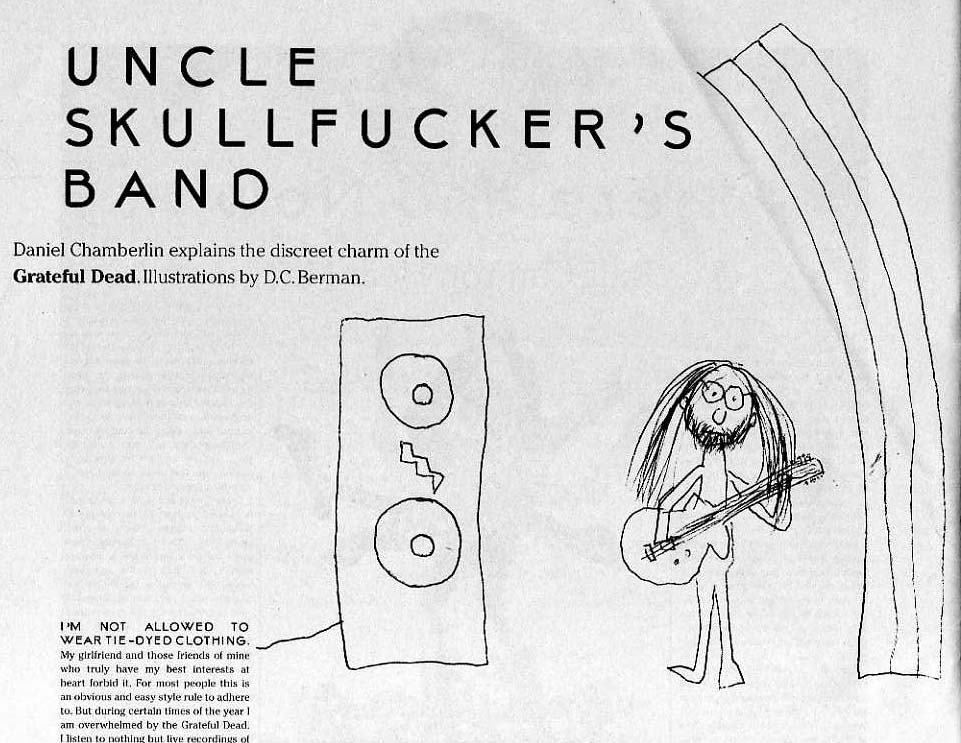
Uncle Skullfucker’s Band: Daniel Chamberlin explains the discreet charm of the Grateful Dead, with artwork by David Berman (Arthur, 2004)

Originally published in Arthur No. 11 (July 2004)

Daniel Chamberlin explains the discreet charm of the Grateful Dead. Illustrations by D.C. Berman.

I’M NOT ALLOWED TO WEAR TIE-DYED CLOTHING. My girlfriend and those friends of mine who truly have my best interests at heart forbid it. For most people this is an obvious and easy style rule to adhere to. But during certain times of the year I am overwhelmed by the Grateful Dead. I listen to nothing but live recordings of Dead concerts while immersing myself in books detailing the minutiae of their 30-year career. I search through David Dodd’s “Annotated Grateful Dead Lyric Archive,” reading up on the roots of “Fennario,” a made-up world of timber forests and treacherous marshland mentioned in two of my favorite songs, “Dire Wolf” and “Peggy-O.” Judging from the number of Dead recordings in my collection one can draw an easy conclusion that I am a certifiable Deadhead.

This is a problem because alongside New Age or contemporary country, “Grateful Dead” is a genre of music with acknowledged questionable merits. This has something to do with the schizophrenic quality of said music: the May 14, 1974 “Dark Star” performed in Missoula, Montana sounds like “In A Silent Way” as interpreted by Sonic Youth but nearly every performance of “Lazy Lightnin’” sounds like coke-snorting yuppies getting funky in tie-dyed Izods. The Dead toured with both Love and Waylon Jennings in the ‘70s but were collaborating with Bruce Hornsby and Joan Osborne by the ‘90s. I hear their influence on classic Meat Puppets and latter-day Boredoms albums, but their official inheritors are cornball bands like The String Cheese Incident and Phish. They count among their fans legions of Hell’s Angels as well as Tipper and Al Gore. There are a lot of ways to listen to the Grateful Dead. As legendary concert promoter and longtime Dead booster Bill Graham once put it, “They’re not the best at what they do, they’re the only ones that do what they do.”

Mostly though, the Dead’s bad reputation is due to their fans. My latent Deadheadism causes my girlfriend to worry that at a certain point of saturation, she’ll come home from work to find me reeking of patchouli oil, clad in vibrant pajama bottoms and a tank top decorated with capering bears, my dilated pupils being the only reason I haven’t yet found something to juggle. “Fukengrüven, sister!” I’ll say as she comes through the door.

My most recent Grateful Dead binge kicked off when Islamic militants decapitated Nicholas Berg on the Internet. Oh yeah. No more NPR for me. Instead, a free-falling relapse into this December 26, 1969 Dead show at Southern Methodist University. Drummer Bill Kreutzmann is late getting to the venue, so Jerry Garcia and Bob Weir lay down this sublime acoustic set of murder ballads and old Christian folk songs that they refer to as “sacred numbers.” It’s the only known recording of their version of “Gathering Flowers for the Master’s Bouquet,” which is really something to be excited about for a closet Deadhead like me. The show provides a wonderful escape—the Dead always seem so detached from reality and that’s exactly what I’m looking for.

I was looking for a similar kind of escape in 1991 while en route to my first Grateful Dead show. I wanted to see if the Deadheads might offer a more organic, hedonistic alternative to the existentialist discomfort of my central Indiana high school experience.

Continue reading

How to Get Into the Grateful Dead (Arthur, 2005)

LISTEN TO THE DEAD

Originally published in Arthur No. 18 (Sept 2005)

Dear Arthur,
Okay, so a lot of people in Arthur have been coming out of the Deadhead closet lately [cf. “Uncle Skullfucker’s Band”, Arthur No. 11]. Someone, maybe Bastet, maybe someone else, should put out a mix CD or two of some of the Dead’s material that might be most likely to impress the contemporary drone/noise/psych/improv and/or free(k) folk scene(s). I have enjoyed a very small percentage of the G.D. that I have heard, and have been unwilling to delve through the catalog in search of the gems. I am willing to give them the benefit of the doubt, and would like to hear a carefully selected mix made by discerning ears. Example: Garcia solo piece on Zabriskie Point soundtrack.
Rick Swan
via email

Dear Rick,
There are over 2,800 Grateful Dead shows available for free download at archive.org, and depending on who you talk to at least a half-dozen studio albums worth checking out. That’s a lot of music to sort through, even if you can get your hands on most of it without laying down any cash. We convened a conclave of reconstructed Deadheads in order to help you and any other greenhorn seekers of the Dead find your way around. The Knights present for this meeting were:

Geologist, a member of Animal Collective, that incredible international post-hippie string band.
N. Shineywater, of Alabama’s creamiest slow-folk practitioners, Brightblack Morning Light. It is worth nothing that Brightblack’s cover of “Brokedown Palace” with Will Oldham on vocals makes us weep.
Ethan Miller, of the mighty Comets on Fire.
Daniel Chamberlin, a contributing editor at Arthur, and the author of “Uncle Skullfucker’s Band” (Arthur No. 11) about life as a closet Deadhead.
Denise DiVitto & Brant Bjork: Owner-operators of Duna Records, which releases records by Mr. Bjork (co-founder of Kyuss) and other worthy artists. Two mellow souls who hang in the desert.
Erik Davis, Arthur contributor, native Californian and the author of Techgnosis: Myth, Magic and Mysticism in the Age of Information.
Barry Smolin, the host of the essential “The Music Never Stops” Dead showcase on Los Angeles’s KPFK, 90.7 FM.
Michael Simmons, a contributing editor to Arthur.
The Seth Man, a/k/a The Seth Man, editor of FUZ and author of “The Book of Seth” on Julian Cope’s website.

PART ONE

GEOLOGIST (Animal Collective)
The birth of my father was a mistake; an unplanned pregnancy in the 1950s. As a result, his brothers, and my cousins, are much older. During the ’80s, my cousin Adam was my idol. I was in grade school, he was in high school and later went to college in Athens, GA. The guy was all about “rock & roll.” He had Live…Like A Suicide by Guns N’ Roses on vinyl in 1986. He predicted the worldwide stardom of REM and the B-52’s as far back as I can remember. But his first musical love was, and as far as I know, still is The Grateful Dead. By the end of the ’80s he had been to over 100 shows.

As I got older and began to hunger for more music than what was being fed to me on MTV, I of course turned to him. Like any true Deadhead, my cousin immediately pushed me towards their live material. His Dead collection was just a box of tapes with dates written on them; I don’t really remember seeing any albums. It is to this aspect of the Dead’s output that I would direct any new fan. I listen to the ’66-’74 era, pretty much exclusively. An easy place to start is the live albums released during this period, specifically Live/Dead (from ’69) and Europe ’72. The former has my all-time favorite Dead jam, “Dark Star” into “St. Stephen,” and the latter contains my second favorite, “China Cat Sunflower” into “I Know You Rider” (affectionately known to Dead fans as “China Rider”). In addition, there is a killer CD release of a Fillmore East show from 2/11/69, which has some of the same tunes. And for 1974, the Winterland shows from February of that year totally rule, even though you have to endure the awful background singing of Donna Godchaux.

I certainly don’t mean to discount the worth of their studio albums, because there is no denying the greatness of Anthem Of The Sun, Aoxomoxoa and American Beauty. I love them all and listen to them frequently, but I still lean towards the live stuff. The reason for this is simply “good times.” I recently got into an argument at a bar about whether or not you can give credit to someone for nothing more than “good times.” I say you totally can. Why not? Isn’t that pretty much what most of us want on a day-to-day basis? I was fortunate enough to see the Dead on one of their last tours in 1994. I was 15 years old, and had moved from Philly to Baltimore, where I was in the early stages of becoming best friends with the dudes I still consider my closest friends in the world. At the time, however, I dearly missed my old friends from middle school. They managed to get tickets to the Dead show at the Philly Spectrum, and my parents, being the wonderful folks they are, let me skip school for three days and hop on the train to catch the show. Jerry may have been old and forgotten some lyrics here and there, but man, good times were had by all. I’ve never since been in an environment as positive as that concert. As people who are passionate about music, especially music that is outside of the mainstream, we sometimes get caught up in our own brand of snobbery. But when I catch myself acting like a dick, I try and think back to that night wandering around the burrito stands and hacky-sack circles in that parking lot. If people continue to care about the music we make and continue to come see us play, I really hope our parking lots will look and feel like that one day. Good times.

N. SHINEYWATER (Brightblack Morning Light)
Early-era Dead songs resonate with me, so I would maybe dig a collection of songs featuring Pig Pen. The first recording I heard by Grateful Dead also served as a successful backdrop to a good time. It involved my native Alabama woods, an old Jeep chasing another old Jeep through the mud, and the constant doobie. The friend of mine who was driving the jeep let The Dead’s American Beauty repeat over and over … Somehow a very long early-version of the song “Dark Star” appeared on the homemade cassette, and when this came on we had just taken a doobie break. One friendly sister starting throwing mud at me so I threw mud back at her and the next thing I saw was this dancing grey mud flying and hitting smiling bodies of friends.

One time this same Jeep-friend has to drive across the country in a new Ford van. He happened to know he was going to be using reefer along the way. The van had only one sticker, plain in style, that read, “GOOD OL” really large, followed very small by “GRATEFUL DEAD.” It wasn’t the kind with little orange bears; it was red, white and blue. He chose this plain sticker to avoid attracting the Man. Yet he knew that he wanted to share his love of Grateful Dead music. It was a risk he didn’t mind taking.

Later in life he led a Greenpeace effort to successfully lower himself and a few others over the side of the Mitsubishi building in Oregon with banners that read, “BOYCOTT MITSUBISHI, MITSUBISHI DESTROYS RAINFORESTS.” The last I heard of him he became a river guide.

ETHAN MILLER (Comets On Fire)
First off, I also loved that article by Daniel Chamberlin in the July 2004 Arthur also and found it very inspiring to try and track down the more extreme avant-garde Dead stuff that the author of that piece talks about being fooled that it was Dead C. or Sonic Youth or whatever.

Continue reading

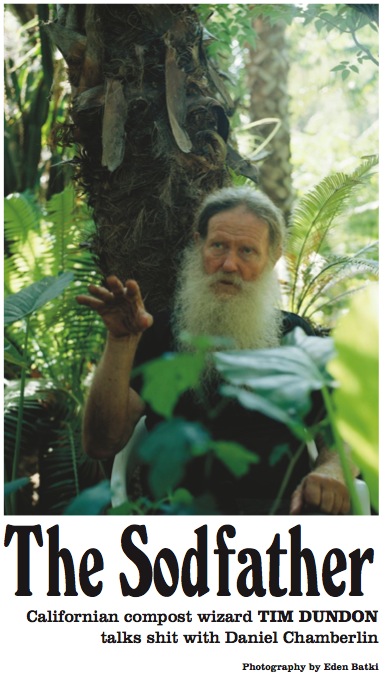
THE SODFATHER: Californian compost wizard TIM DUNDON — text by Daniel Chamberlin, photos by Eden Batki (Arthur, 2007)

The Sodfather
Californian compost wizard TIM DUNDON talks shit with Daniel Chamberlin.

Photography by Eden Batki

Originally published in Arthur No. 27 (Dec 2007)

Original design by Molly Frances and Mark Frohman.

Find bonus Sodfather photos by Chamberlin at Into The Green.

Alchemists are often characterized in modern times as bumbling would-be wizards at best, greedy charlatans at worst. They’re portrayed as fumbling hopelessly in cluttered laboratories, unenlightened madmen trying to turn lead into gold. The reality is more complex, of course.

Alchemists were up to plenty of things, many of them having to do with relating to the natural world—and understanding its processes of transformation and transmutation—in philosophical and spiritual dimensions that transcended traditional religious thinking, both Christian and pagan, and preceded modern scientific thought. The whole “lead into gold” thing was but the most lucrative of the alchemical —or hermetic—practices in the eyes of the monarchs and rulers. Alchemy’s material prima as Peter Lamborn Wilson writes in the recent collection Green Hermeticism: Alchemy and Ecology, “can be found ‘on any dung hill.’ Hermeticism changes shit into gold.” It’s an image memorably realized in Alejandro Jodorowsky’s 1973 film The Holy Mountain wherein the thief character takes a dump in a fancy bucket, and Jodorowsky, playing an alchemist, distills those fresh turds into a hefty chunk of golden bling.

Such fantastical processes are well known to dirt-worshipping gardening sage Tim Dundon, the beneficent caretaker of California’s most famous compost pile and the kindly warden of the tropical forest that has fruited from its rich humus. It’s here that Dundon, a scientist-poet in the truest hermetic sense, finds hope and salvation in the transformation of death into life—of rotting organic matter into nutrient-rich soil—that takes place daily in the fecund jungle he maintains on his one-acre yard.

The botanical odyssey of Dundon, the self-proclaimed “guru of doo-doo” and the man whose mammoth compost pile once covered a football-field-sized lot, begins in 1967 with a marijuana shortage. Like any good gardening story, it encompasses Hollywood producers, fires, suicide, PCP injection, a nude Quaker iconoclast, standoffs with city officials and a violent pet coyote.

Continue reading