DAILY MAGPIE – February 21st – "Sound. Light. Migrations" at MILLS COLLEGE

soundlight2

If you have a love for mind-bending experimental electronic music and euphoria-inducing light shows of swirling color, or if your copy of “A Rainbow in Curved Air” is worn down from being  played more times than you could possibly count, consider yourself one lucky duck! This is your chance to see analog electronic music pioneer Pauline Oliveros collaborate live with visual composer and light manipulator Tony Martin in their piece Sound. Light. Migrations for Mills Music Festival 2009, followed in the same night by the wizard of the minimalist movement Terry Riley, woodwinds jazz maestro Roscoe Mitchell and Jean Jeanrenaud of the Kronos Quartnet. Hoo-boy! California, here I come!

Time & Date: Saturday, February 21st – 8PM
Venue: MILLS COLLEGE (Oakland, CA)
Location: Mills College Concert Hall / 5000 MacArthur Blvd. / Oakland, CA 94613 (More info & directions here)
Price: $20 regular admission / $12 for seniors and alumnae, free for Mills College students (Purchase tickets here)

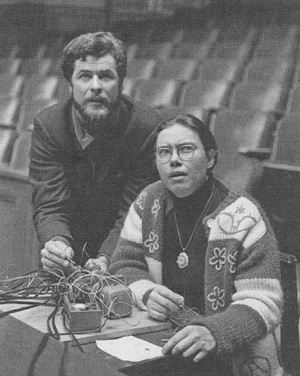
(Above: Tony Martin and Pauline Oliveros at Mills College in 1966)

ALSO – on the following evening …

Continue reading

"My relationship with the ninja was interesting on a couple of different levels."

Alison Levy is a curator, writer and a blogger at the 2012 apocalypse fan-fiction forum Reality Sandwich. She’s posted a great interview with Arthur columnist Aaron Gach, of The Center for Tactical Magic. Check it out here.

In the midst of all the New Age therapy-speak in the comments — e.g. “i was the canvas i was doing the painting on, it was a shamanic abstract x-pressionist personal human sculpture” — “sonofman” jumps in to direct the RSers over here to Arthur to check out some of the Center for Tactical Magic’s contributions. Thanks, sonofman. Here’s a quick digest of the Center’s “Applied Magic(k)” columns, for your consideration:

Vanishing Act, from Arthur 32/December 2008

An Open Invocation, from Arthur 31/October 2008

The Roots of Culture, from Arthur 29/May 2008

Will Power To The People! from Arthur 27/November 2007

Calling All Ghosts, from Arthur 25/Winter 2006

BONUS: The Center for Tactical Magic at Psychobotany at Echo Park’s Machine Project, May 2007

Read an excerpt from the interview–in which Aaron explains what he learned from private eyes, ninjas and magicians–after the jump.

Continue reading

GRANT MORRISON on religion, holistic consciousness and contact/upgrade with the timeless supermind

From a new interview with Arthur No. 12 cover star GRANT MORRISON, over at Newsarama:

“I think religion per se, is a ghastly blight on the progress of the human species towards the stars. At the same time, it, or something like it, has been an undeniable source of comfort, meaning and hope for the majority of poor bastards who have ever lived on Earth, so I’m not trying to write it off completely. I just wish that more people were educated to a standard where they could understand what religion is and how it works. Yes, it got us through the night for a while, but ultimately, it’s one of those ugly, stupid arse–over–backwards things we could probably do without now, here on the Planet of the Apes.

“Religion is to spirituality what porn is to sex. It’s what the Hollywood 3–act story template is to real creative writing.

“Religion creates a structure which places ‘special,’ privileged people (priests) between ordinary people and the divine, as if there could even be any separation: as if every moment, every thought, every action was not already an expression of dynamic ‘divinity’ at work.

“As I’ve said before, the solid world is just the part of heaven we’re privileged to touch and play with. You don’t need a priest or a holy man to talk to ‘god’ on your behalf–just close your eyes and say hello. ‘god’ is no more, no less, than the sum total of all matter, all energy, all consciousness, as experienced or conceptualized from a timeless perspective where everything ever seems to present all at once. ‘God’ is in everything, all the time and can be found there by looking carefully. The entire universe, including the scary, evil bits, is a thought ‘God’ is thinking, right now.

“As far as I can figure it out from my own reading and my own experience of how the spiritual world works, Jesus was, as they say, way cool: a man who achieved a state of consciousness, which nowadays would get him a diagnosis of temporal lobe epilepsy (in the days of the Emperor Tiberius, he was crucified for his ideas; today he’d be laughed at, mocked or medicated).

This ‘holistic’ mode of consciousness…announces itself as a heartbreaking connection, a oneness, with everything that exists… There are a ton of meditation techniques which can take you to this place. I don’t see it as anything supernatural or religious, in fact, I think it’s nothing more than a developmental level of human consciousness, like the ability to see perspective – which children of 4 cannot do but children of 6 can.

“Everyone who’s familiar with this upgrade will tell you the same thing: it feels as if ‘alien’ or ‘angelic’ voices – far more intelligent, coherent and kindly than the voices you normally hear in your head – are explaining the structure of time and space and your place in it.

“This identification with a timeless supermind containing and resolving within itself all possible thoughts and contradictions, is what many people, unsurprisingly, mistake for an encounter with ‘God.’ However, given that this totality must logically include and resolve all possible thoughts and concepts, it can also be interpreted as an actual encounter with God, so I’m not here to give anyone a hard time over interpretation.

“Some people have the experience and believe the God of their particular culture has chosen them personally to have a chat with. These people may become born–again Christians, fundamentalist Muslims, devotees of Shiva, or misunderstood lunatics.

“Some ‘contactees’ interpret the voices they hear erroneously as communications from an otherworldly, alien intelligence, hence the proliferation of ‘abduction’ accounts in recent decades, which share most of their basic details with similar accounts, from earlier centuries, of people being taken away by ‘fairies’ or ‘little people.’

“Some, who like to describe themselves as magicians, will recognize the ‘alien’ voice as the ‘Holy Guardian Angel.’

“In timeless, spaceless consciousness, the singular human mind blurs into a direct experience of the totality of all consciousness that has ever been or will ever be. It feels like talking with God but I see that as an aspect of science, not religion.

“As Peter Barnes wrote in ‘The Ruling Class’, ‘I know I must be God because when I pray to Him, I find I’m talking to myself.'”


MAGIC(K) IN THE STREETS: Applied Magic(k) column by the Center for Tactical Magic (Arthur, 2008)

An Open Invocation
by The Center for Tactical Magic

illustration by Cassandra Chae

originally published in Arthur No. 31 (Oct 2008)

“Magic(k) works.” This declarative statement was recently hurled in our direction with a cautionary tone rather than a celebratory one. The sender of the warning was concerned that we didn’t take magic(k) seriously enough; that we were advocating its use willy-nilly like some sort of fun, new fad. But fear not. Although we don’t believe that fun and magic(k) are at odds with one another, we are nonetheless advocating its use very pointedly and with much consideration. And we are advocating its use precisely because it works.

As we’ve said in the past, one of the primary reasons why people don’t engage in magic(k) in the first place is out of a sense of dismissal. They dismiss magic(k) because they doubt it will produce results; and, they dismiss magic(k) because they fear it will produce results. Indeed, much of the bullshit that fertilizes the grand magic garden reeks of these airs of dismissal. Occult conspiracy theorists will even tell you that such bullshit is built up to protect the fruit from those who would dare set foot in the garden at all. Layers and layers of foul fluff and rotten rhetoric are woven into a formidable pile of vapid New Age-isms, Hollywood cheese, religious warnings, and occult elitism.

Continue reading

Thomas Pynchon on power, outlaws, disappearing, the internet, Control and real capital-M Magic

Thomas Pynchon’s 1997 introduction to Jim Dodge’s Stone Junction:

If we accept the notion that using power against the powerless is wrong, a clear enough set of corollaries begins to emerge. We become able to distinguish, as populations (thought not always their rulers) have usually been able to do, between outlaws and evil-doers, between outlawry and sin. Not much analysis is needed, because it is something we can sense in all its dead-serious immediacy. “But all they are are bandits,” the rulers whine indignantly, “motivated only by greed.” Sure. Except that, having long known the difference between theft and restoration, we understand the terms of the deal whereby outlaws, as agents of the poor, being more skilled and knowledgeable in the arts of karmic readjustment, may charge no worse that an agent’s fee, small enough to be acceptable to their clients, ample enough to cover the risks they have to take, and we always end up loving these folks, we cheer for Rob Roy, Jesse James, John Dillinger, at a level of passion usually reserved for sports affiliation.

Stone Junction is an outlaw epic for our own late era of corrupted romance and defective honor, with its own set of sleazy usurpers and Jacobitoid persistences — though the reader who’s expecting eighties nostalgia or, have mercy, some even earlier-type romp through the pleasures of drugs, sex and rock and roll, should be warned that lurking herein, representing the bleaker interests of that consensus ever throbbing along despite and apart from all the fun and pleased to call itself “Reality,” are to be found some mighty evil contract personnel, who produce some disagreeably mortal plot developments. One of the book’s manifold graces is its author’s choice never to dance away into wishful gobbledygook, remaining, rather, conscientiously grounded in our world as given, where, as Pam Tilli, in a slightly different context, reminds us, Destiny turns on a dime.

The other day in the street I heard a policeman in a police car, requesting over his loudspeaker that a civilian car blocking his way move aside and let him past, all the while addressing the drive of the car personally, by name. I was amazed at this, though people I tried to share it with only shrugged, assuming that of course the driver’s name (along with height, weight and date of birth) had been obtained from the Motor Vehicle Department via satellite, as soon as the offending car’s license number had been tapped into the terminal — so what?

Stone Junction was first published in 1989, toward the end of an era still innocent, in its way, of the cyberworld just ahead about to exponentially explode upon it. To be sure, there were already plenty of computers around then, but they were not quite so connected together as they were shortly to become. Data available these days to anybody were accessible then only to the Authorized, who didn’t always know what they had or what to do with it. There was still room to wiggle — the Web was primitive country, inhabited only by a few rugged pioneers, half loco and wise to the smallest details of their terrain. Honor prevailed, laws were unwritten, outlaws, as yet undefinable, were few. The question had only begun to arise of how to avoid, or, preferably, escape altogether, the threat, indeed promise, of control without mercy that lay in wait down the comely vistas of freedom that computer-folk were imagining then — a question we are still asking. Where can you jump in the rig and head for any more — who’s out there to grant us asylum? If we stay put, what is left to us that is not in some way tainted, coopted, and colonized, by the forces of Control, usually digital in nature? Does anybody know the way to William Gibson’s “Republic of Desire?” Would they tell if they knew? So forth.

You will notice in Stone Junction, along with its gifts of prophecy, a consistent celebration of those areas of life that tend to remain cash-propelled and thus mostly beyond the reach of the digital. It may be nearly the only example of a consciously analog Novel. Writers since have been obliged to acknowledge and deal with the ubiquitous cyber-realities that come more and more to set, and at quite a finely chopped-up scale too, the terms of our lives, not to mention calling into question the very traditions of a single author and a story that proceeds one piece after another — a situation Jim Dodge back then must have seen coming down the freeway, because the novel, ever contrarian, keeps its faith in the persistence of at least a niche market — who knows, maybe even a deep human need — for modalities of life whose value lies in their having resisted and gone the other way, against the digital storm — that are likely, therefore, to include pursuits more honorable that otherwise.

One popular method of resistance was always just to keep moving — seeking, not a place to hide out, secure and fixed, but a state of dynamic ambiguity about where one might be any given moment, along the lines of Heisenberg’s uncertainty principle. Modern digital machines, however, managed quickly enough to focus the blurred ellipsoid of human freedom even more narrowly than Planck’s Constant allows.

Equally difficult for those who might wish to proceed through life anonymously and without trace has been the continuing assault against the once-reliable refuge of the cash or non-plastic economy. There was a time not so long ago you could stroll down any major American avenue, collecting anonymous bank checks, get on some post office line, and send amounts in the range “hefty to whopping” anywhere, even overseas, no problem. Now it’s down to $750 a pop, and shrinking. All to catch those Drug Dealers of course, nothing to do with the grim, simplex desire for more information, more control, lying at the heart of most exertions of power, whatever governmental or corporate (if that’s a distinction you believe in).

You look at Windows 95 blooming on to the screen, and you think, Magic. But those who understand the system down to molecular level, nothing magical remains — all is revealed as simple repetitive drudgery, what we might even denounce as a squandering of precious operating time, were it not for Technology’s discovery of how to tap into velocity situation prevailing down at the smaller scales — Nnggyyyyow-w-w! like the Interstate down there! — and leave all the kazillions of brainless petty chores to their speedy new little devices.

Stone Junction‘s allegiance, however, is to the other kind of magic, the real stuff — long-practiced, all-out, contrary-to-fact, capital M Magic, not as adventitious spectacle, but as a pursued enterprise, in this very world we’re stuck with, continuing to give off readings — analog indications — of being abroad and at work, somewhere out in it.

The fatal temptation for a fiction writer who must accept the presence, often a necessity, of magic in his own work, is to solve difficulties of plot, character and — more often than is generally suspected — taste, by conveniently flourishing some prop, some ad hoc amulet or drug, that will just take care of each problem as it arises. Fortunately for us here, Jim Dodge, by the terms of his calling, cannot indulge in that particular luxury. Magic is in fact hard and honorable work, and cannot be deployed at whim, not without consequences. A good deal of Daniel Pearce’s character growth comes by way of learning the business and earning the powers — making Stone Junction a sort of magician’s Bildungsroman — in which teachers, more or less unorthodox in their methods, appear to Daniel one by one, each with particular skills to pass along, all linked in an organization known as AMO, the Alliance of Magicians and Outlaws, a proto-Web that tends to connect more by way of pay phones, mail drops and ESP than linked terminals, over overseen by the enigmatic, not quite all-powerful Volta.

Through all this meanwhile runs a second plotline — a whodunit, in which Daniel must solve the uncompromisingly earthly question of who murdered his mother, Annalee Pearce, in an alleyway in Livermore, California when he was fourteen, complete with multiple suspects, false trails, the identity of the killer not revealed till the final pages. The story traverses a map of some moral intricacy, sure-footed as Chandler, providing twists as elegant as Agatha Christie, as all the while Daniel’s education proceeds.

Will Bill Weber teaches meditation, fishing, waiting. Mott Stocker teaches Dope, its production and enjoyment. Ace safecracker Willie Clinton (yep) instructs the boy in how to get past all kinds of locks and alarms, rendering him thus semipermeable to certain protected parts of the world, setting him on his path to total dematerialization. For a while Daniel teams up with poker wizard Bad Bobby Sloane, roving the American highways in search of opportunities to risk capital in ways that cannot be officially controlled, climaxing in a legendary Lo-ball confrontation with the cheerfully louche Guido Caramba, in a literary poker passage as classic as it is funny, and in its appreciative devotion to a game where the moral stakes are so high, ranking up there with comparable parts of Kawabata’s The Master of Go.

The shape-shifting genius Jean Bluer teaches Daniel the arts of disguise — another illicit skill, given it’s already forbidden to impersonate policemen, doctors, lawyers, financial advisors, and who knows what all besides, as if someday all varieties of disguise will be statutory offences, including Impersonating an Ordinary Citizen. At last Daniel comes circling back to Volta, by now also one of his prime suspects in Annalee’s death, who teaches him the final secret of Invisibility. None of your secular Wellsian tricks with refractive indices and blood pigmentation here, but rather the well-known and time-honored arts of ceasing to be material.

At last Daniel is ready to set off on the metaphysical Quest all these teachers have been preparing him for, which now swiftly unfolds as an elaborate technocaper, with a mysterious and otherworldly six-pound Diamond as its target. Too early in those days for keyboard dramas, emergency downloads, and cyber-fugues to relentless countdowns at the corner of the screen, the technology Daniel goes up against is mostly of analog sort — optical surveillance, strain-gauge sensor grids and thermostatic alarms — his nondigital responses to which include nerve gas, plastique, and invisibility.

He takes the Diamond, and then the Diamond takes him. For it turns out to be a gateway to elsewhere, and Daniel’s life’s tale an account of the incarnation of a god, not the usual sort that ends up bringing aid and comfort to earthly powers, but that favorite of writers, the incorruptible wiseguy known to anthropologists as the Trickster, to working alchemists as Hermes, to card-players everywhere as the Joker. We don’t learn this till the end of the story, by which point, knowing Daniel as we’ve come to, we are free to take it literally as a real transfiguration, or as a metaphor of spiritual enlightenment, or as a description of Daniel’s unusually exalted state of mind as he prepares to cross, forever, the stone junction between Above and Below — by this point, all of these possibilities have become equally true, for we have been along on one of those indispensable literary journeys, taken nearly as far as Daniel — through it is for him to slip along across the last borderline, into what Wittgenstein once supposed cannot be spoken of, and upon which, as Eliphas Levi advised us — after “To know, to will, to dare” as the last and greatest of the rules of Magic — we must keep silent.


ENDARKENMENT MANIFESTO by Peter Lamborn Wilson aka Hakim Bey (Arthur, 2008)

From ARTHUR MAGAZINE No. 29 (May 2008): Peter Lamborn Wilson’s half-serious proposal for a political movement to uphold and propagate the ideals of Green Hermeticism. Wilson sometimes uses the pen name ‘Hakim Bey.’ He is the author of the Temporary Autonomous Zone concept and manifesto, which, for better or worse, was the original inspiration for the Burning Man festival..

THE ENDARKENMENT MANIFESTO

At least half the year belongs to Endarkenment. Enlightenment is only a special case of Endarkenment—and it has nights of its own.

**

During the day democracy waxes, indiscriminately illuminating all and sundry. But shadowless noon belongs to Pan. And night imposes a “radical aristocracy” in which things shine solely by their own luminescence, or not at all.

**

Obfuscatory, reactionary and superstitious, Endarkenment offers jobs for trolls and sylphs, witches and warlocks. Perhaps only superstition can re-enchant Nature. People who fear and desire nymphs and fauns will think twice before polluting streams or clear-cutting forests.

**

Electricity banished shadows—but shadows are “shades,” souls, the souls of light itself. Even divine light, when it loses its organic and secret darkness, becomes a form of pollution. In prison cells electric lights are never doused; light becomes oppression and source of disease.

**

Superstitions may be untrue but based on deeper truth—that earth is a living being. Science may be true, i.e. effective, while based on a deeper untruth—that matter is dead.

**

The peasants attacking Dr. Frankenstein’s tower with their torches and scythes were the shock troops of Endarkenment, our luddite militia. The original historical Luddites smashed mechanical looms, ancestors of the computer.

**

“Neolithic conservatism” (Paul Goodman’s definition of anarchism) positions itself outside the ponderous inevitability of separation and sameness. Every caveman a Prince Kropotkin, every cavewoman Mrs. Nietzsche. Our Phalanstery would be lit by candles and our Passions avowed via messenger pigeons and hot-air balloons.

**

Imagine what science might be like to day if the State and Kapital had never emerged. Romantic Science proposes an empiricism devoid of disastrous splits between consciousness and Nature; thus it prolongates Neolithic alchemy as if separation and alienation had never occurred: science for life not money, health not war, pleasure not efficiency; Novalis’s “poeticization of science.”

**

Of course technology itself is haunted—a ghost for every machine. The myth of Progress stars its own cast of ghouls and efreets. Consciously or unconsciously (what difference would it make?) we all know we live in techno-dystopia, but we accept it with the deterministic fatalism of beaten serfs, as if it were virtual Natural Law.

**

Technology mimics and thus belittles the miracles of magic. Rationalism has its own Popes and droning litanies, but the spell they cast is one of disenchantment. Or rather: all magic has migrated into money, all power into a technology of titanic totality, a violence against life that stuns and disheartens.

**

Hence the universal fear/desire for the End of the World (or for some world anyway). For the poor Christian Moslem Jewish saps duped by fundamentalist nihilism the Last Day is both horrorshow and Rapture, just as for secular Yuppies global warming is a symbol of terror and meaninglessness and simultaneously a rapturous vision of post-Catastrophe Hobbit-like local-sustainable solar-powered gemutlichkeit. Thus the technopathocracy comes equipped with its own built-in escape-valve fantasy: the Ragnarok of technology itself and the sudden catastrophic restoration of meaning. In fact Capital can capitalize on its own huge unpopularity by commoditizing hope for its End. That’s what the smug shits call a win/win situation.

**

Winter Solstice (Chaos Day in Chinese folklore) is one of Endarkenment’s official holidays, along with Samhain or Halloween, Winter’s first day.

**

Endarkenment stands socially for the Cro-Magnon or “Atlantaean” complex—anarchist because prior to the State—for horticulture and gathering against agriculture and industry—for the right to hunt as against the usurpation of commons by lord or State. Electricity and internal combustion should be turned off along with all States and corporations and their cult of Mammon and Moloch.

**

Despite our ultimate aim we’re willing to step back bit by bit. We might be willing to accept steam power or hydraulics. The last agreeable year for us was 1941, the ideal is about 10,000 BC, but we’re not purists. Endarkenment is a form of impurism, of mixture and shadow.

**

Endarkenment envisages a medicine advanced as it might have been if money and the State had never appeared, medicine for earth, animals and humans, based on Nature, not on promethean technology. Endarkenment is not impressed by medicine that prolongs “life span” by adding several years in a hospital bed hooked up to tubes and glued to daytime TV, all at the expense of every penny ever saved by the patient (lit. “sufferer”) plus huge debts for children and heirs. We’re not impressed by gene therapy and plastic surgery for obscene superrich post humans. We prefer an empirical extension of “medieval superstitions” of Old Wives and herbalists, a rectified Paracelsan peoples’ medicine as proposed by Ivan Illich in his book on demedicalization of society. (Illich as Catholic anarchist we consider an Endarkenment saint of some sort.) (Endarkenment is somewhat like “Tory anarchism,” a phrase I’ve seen used earliest in Max Beehbohm and most lately by John Mitchell.) (Other saints: William Blake, William Morris, A.K. Coomaraswamy, John Cowper Powys, Marie Laveau, King Farouk…)

**

Politically Endarkenment proposes anarcho-monarchism, in effect somewhat like Scandinavian monarcho-socialism but more radical, with highly symbolic but powerless monarchs and lots of good ritual, combined with Proudhonian anarcho-federalism and Mutualism. Georges Sorel (author of Reflections on Violence) had some anarcho-monarchist disciples in the Cercle Proudhon (1910-1914) with whom we feel a certain affinity. Endarkenment favors most separatisms and secessions; many small states are better than a few big ones. We’re especially interested in the break-up of the American Empire.

**

Endarkenment also feels some critical admiration for Col. Qadhaffi’s Green Book, and for the Bonnot Gang (Stirnerite Nietzschean bank robbers). In Islamdom it favors “medieval accretions” like sufism and Ismailism against all crypto-modernist hyperorthodoxy and politics of resentment. We also admire the martyred Iranian Shiite/Sufi socialist Ali Shariati, who was praised by Massignon and Foucault.

**

Culturally Endarkenment aims at extreme neo-Romanticism and will therefore be accused of fascism by its enemies on the Left. The answer to this is that (1) we’re anarchists and federalists adamantly opposed to all authoritarian centralisms whether Left or Right. (2) We favor all races, we love both difference and solidarity, not sameness and separation. (3) We reject the myth of Progress and technology—all cultural Futurism—all plans no matter their ideological origin—all uniformity—all conformity whether to organized religion or secular rationalism with its market democracy and endless war.

**

Endarkenists “believe in magic” and so must wage their guerrilla through magic rather than compete with the State’s monopoly of techno-violence. Giordano Bruno’s Image Magic is our secret weapon. Projective hieroglyphic hermeneutics. Action at a distance through manipulation of symbols carried out dramaturgically via acts of Poetic Terrorism, surrealist sabotage, Bakunin’s “creative destruction”—but also destructive creativity, invention of hermetico-critical objects, heiroglyphic projections of word/image “spells”—by which more is meant (always) than mere “political art”—rather a magical art with actual dire or beneficial results. Our enemies on the Right might call this political pornography and they’d be (as usual) right. Porn has a measurable physiopsychological effect. We’re looking for something like it, definitely, only bigger, and more like Artaud than Brecht—but not to be mistaken for “Absolute Art” or any other platonic purism—rather an empirical strategic “situationist” art, outside all mass media, truly underground, as befits Endarkenment, like a loosely structured “rhizomatic” Tong or freemasonic conspiracy.

**

The Dark has its own lights or “photisms” as Henry Corbin called them, literally as entoptic/hypnagogic phosphene-like phenomena, and figuratively (or imaginally) as Paracelsan Nature spirits, or in Blakean terms, inner lights. Enlightenment has its shadows, Endarkenment has its Illuminati; and there are no ideas but in persons (in theologic terms, angels). According to legend the Byzantines were busy discussing “the sex of angels” while the Ottomans were besieging the walls of Constantinople. Was this the height of Endarkenment? We share that obsession.

Jan. 1, 2008


U.S. Senate hit by ghost mob

CALLING ALL GHOSTS
by The Center for Tactical Magic

Originally published in the “Applied Magic(k)” column in Arthur Magazine No. 25/Winter 02006

Ghosts are unwieldy subjects to contend with. It’s as if their ephemeral nature predisposes them to be barely tangible topics of research. The vast majority of evidence used to support the existence of ghosts is subjective: first-hand reports and eyewitness accounts. Despite the fact that forensic science, cultural geography, physics, and parapsychology all suggest that any given area is inscribed with the residue of that area’s history, the hard data on hauntings remains inconclusive.

To make matters hazier, the definitions of ghosts often swirl together with religious beliefs and philosophical assumptions. For example, if we define ghosts as being the spirits of the departed, we are stating clearly that we believe in life-after-death and some notion that separates body and spirit. Whether this notion is Cartesian dualism, Egyptian ka, Polynesian mana, or the yin-world spirits of Taoism, the assertion is that the individual is not indivisible. At the very least we are forced to accept the idea that the self is multiplicitous.

This shouldn’t be such a leap. At any given moment a person can be characterized by many different activities that s/he engages in: mechanic, musician, anarchist, lover, gardener, cyclist, etc. A person doesn’t think of him/herself as a mechanic when s/he’s in the garden, although s/he also doesn’t stop being a mechanic. We are many things to many people in many spheres of activity – simultaneously. But still we remain ourselves. On the most basic level, we live multiplicitous lives every day.

And when we go to sleep at night, it doesn’t end there. Our dreams continue to embroil us in action-adventures that would surely leave us breathless and exhausted if it weren’t for the simple fact that our bodies barely participate in all of the fun. If there is any sort of universal logic that can be applied as a subjective proof for the insubstantiation of the self, it is the simple fact that we all dream, whether we remember it in the morning or not.

To be clear, dreams don’t prove that ghosts are real. Nor does it prove that ghosts are the spirits of dead people. Rather, the travels we undertake when our eyes are closed simply suggest that a meaningful disembodied existence can occur. Even if we dismiss dreams (and ghosts) as immaterial and inconsequential, anyone who has ever experienced a nightmare won’t deny the fact that these visions can cause acute physical and psychological sensations in our waking lives.

But what are ghosts exactly? The incorporeal dead hanging out amongst the living? Reflected light? Psychosis? Atmospheric anomalies? Holographic messages from the future? Alien lifeforms? Osama’s latest WMD (Weapon of Mental Distortion)? Whatever they are, ghosts, like magic(k), pop up, in one form or another, in nearly every culture on the planet, and have been described in legends, myths, and stories throughout history. A popular Chinese attitude towards ghosts is voiced in the age-old expression, “If you believe it, there will be, but if you don’t, there will not.” According to legend, the saying was penned by a scholar named Zhuxi (Song Dynasty, 960 – 1279). Now Zhuxi was such a strict non-believer that he decided to write an essay about the non-existence of ghosts. But, lo and behold!—a ghost showed up to convince him otherwise. The ghost made such a lucid argument, that Zhuxi was forced to reconsider his thesis. In fact, it’s actually the ghost that is credited with authoring the aforementioned expression, and Zhuxi merely wrote it down.

Whether we believe in ghosts as actual paranormal phenomena, or as manifestations of mass cultural imagination, we can agree on some fundamental characteristics of ghosts. For starters, it’s significant to note that many such manifestations consistently take the form of people, or exhibit seemingly conscious behaviors. This could be similar to looking skyward and seeing faces in the clouds; however, there’s one major exception. When we let our minds drift in the cumulo-nimbus we also tend to see things like bears in bathtubs, and inverted Lay-Z-Boys. And we don’t hear ghastly tales of glowing gaseous forms resembling anything quite so banal, or cute and cartoony. Instead, we are most often presented with accounts of haunting encounters that evoke horror, sorrow, fear, anger, remorse, passion, and purpose. Ghosts emerge from the shadows; from dark corners; from forgotten and abandoned recesses. Regardless of whether or not these phantoms are psychological projections or external paranormal phenomena, it’s clear that our collective response to these apparitions is apprehension, angst, and anxiety.

Generally speaking, there are two dominant types of ghost stories: lost love, and grave injustices. The “lost love” category encompasses all of those apparitions who wait endlessly for lovers to return, or visit their living loved ones for comfort, counsel, and last condolences. In the second category, the vast majority of ghost stories hover around a central theme of grave injustices yet to be rectified. Murder. Torture. Betrayal. The plight of this sort of phantom is one of paradox; it seeks to rest in peace, yet refuses to quit the struggle until things have been set right. While the crimes of the past still linger at the site of a haunting, the ghost’s job is to make sure we, the living, don’t ignore it. Their refusal to let injustices be forgotten manifests in a form of spiritual civil disobedience. From silent vigils to shrieks and moans to outright property destruction, these ghosts are paranormal protestors bearing witness to a world gone woefully awry. In their quest for peace, the phantoms that haunt us defy the laws of the material world in acts of otherworldly anarchism. Offering spiritual resistance to the complicit affairs of everyday life, these insurgent souls have little regard for the rules and boundaries that restrict the world of the living.

They defy even gravity itself. Moving through gates and walls, no barrier restricts their attempts to resolve the inequities that torment them—and consequently us. After all, it is the apathy of the living that drives them to disturb the peace, because they cannot rest until the conflict is, once-and-for-all, addressed and resolved. There is no moving on. Not until unsavory events are properly put to rest.

It’s this kind of dissenting spirit that needs to be channeled today. Even Senator Specter (R-PA), whose position on most policies is rather ghoulish, could not sit idly by when faced with the recent legislation surrounding Guantanamo Bay detainees. Like all hauntings, the degree of uncanniness is quite remarkable. It’s only too fitting that the Chairman of the Senate Judiciary Committee be named Specter. And perhaps even more appropriate that he should take issue with the United States’ recent dissolution of habeas corpus (meaning quite literally “(You should) have the body”). Dating back as far as 1305, and included in Article 1 of the U.S. Constitution, habeas corpus is one of the oldest and most celebrated guarantees of personal liberty. It grants individuals the right to question their detainment and challenge the government on the legality of their imprisonment. By killing habeas corpus, the clock on civil liberties is set back more than seven centuries to a time when judicial courts were simply a king and his dungeons. No wonder Mr. Specter is voicing his disapproval.

The haunting of society by the ghosts of our collective past resonates within a present that continues to manifest grave injustices. Generation after generation, the abuse of power materializes in a reoccurring nightmare, claiming countless victims—collateral damage in a battle to maintain hegemony. Doomed to repeat the tragedies of the ages, these lost souls insinuate their desires and anxieties into the world of the living. Each step of the way, these energies inform our thoughts, our dreams, our actions—indeed, every aspect of our existence. Ghosts are an unsettling reminder that the crimes of the past have not yet been resolved. Refusing to quietly fade from consciousness, they demand that their howls be heeded. The residues of injustice permeate the physical, psychological, and parapsychological landscape, inscribing the present with desperate warnings and demands for reconciliation.

Perhaps it’s time for the living to start paying attention to the stirring in the shadows. These aberrations in space, time, and freedom remain inscribed in mind, spirit, and social body, awaiting their release through the discovery and recovery of our own self-determining forces. Can the righteous spirits of the past truly join forces with the living to achieve peace and justice? If you believe it, there will be, but if you don’t, there will not.

EXERCISES
Through methods of divination, channeling, investigation, experimentation, and active engagement, we can invoke those that seem most experienced in dealing with past inequities—ghosts. Here are a few experiments in magic(k) to get you started. As always, please let us know how it goes by emailing to: goodluck at tacticalmagic dot org

1. Summoning ancestral spirits for guidance and inspiration is an age-old practice re-popularized in the ’70s through Milton Bradley’s mass production of the Ouija board. But you don’t need to jump on eBay to get a piece of the action. Make your own walkie-talkie to the spirit world by covering any smooth surface with the letters of the alphabet, numbers 0-10, and the words, “yes,” “no,” “unclear” and “goodbye.” Use another object that glides easily over the surface as your planchette, or pointer. A shot glass, serving spoon, or cell phone will work okay. A generic board will likely attract a general audience. For the best results, craft your set-up with a righteous spirit in mind using items and symbols that the spirit might find appealing. If, for example, you wanted the counsel of Nathan Hale, draw the board on a copy of the Patriot Act. For Harriet Tubman, try replacing the planchette with a broken handcuff. Grab a few friends, dim the lights, and place your fingertips lightly on the planchette. Then, invite the spirits, and begin your supernatural conspiring.

2. The problem with ghosts is not that they won’t shut up, but rather that it took death to get them to speak up in the first place. Is it fear of death that keeps us from voicing our dissatisfaction with the world of the living? Or fear of life? Fortunately, there’s no need to wait for that last breath to start haunting places. Form your own ghost mob and venture out to haunt sites of known social injustices. Banks, police stations, recruitment centers, and chain stores are but a few potential targets. From large-scale occupations by friends in Halloween gore to quiet insertions of tape recorded whispers and groans, a ghost mob can embody suppressed fears and desires whilst banishing the specters of social control.

3. Encounters with ghosts are said to increase during times of social crises and the post-trauma periods immediately following. Most notably, research suggests that more people see ghosts (or at least report them) in wartime and during post-war transitions. If this assessment is accurate, we should expect a barrage of ghost sightings related to Katrina, Afghanistan and Iraq. We are sincerely interested in studying this trend. If you have had paranormal experiences that you feel are related to social crises, please let us know by emailing us at: socialhauntings at tacticalmagic dot org

ABOUT THE AUTHOR: The Center for Tactical Magic is a moderate international think tank dedicated to the research, development and deployment of all types of magic in the service of positive social transformation. To find out more, check out tacticalmagic.org

William Burroughs on…Led Zeppelin! (Crawdaddy, 1975)

Rock Magic: Jimmy Page, Led Zeppelin, And a search for the elusive Stairway to Heaven by William Burroughs, Crawdaddy Magazine, June 1975.

When I was first asked to write an article on the Led Zeppelin group, to be based on attending a concert and talking with Jimmy Page, I was not sure I could do it, not being sufficiently knowledgeable about music to attempt anything in the way of musical criticism or even evaluation. I decided simply to attend the concert and talk with Jimmy Page and let the article develop. If you consider any set of data without a preconceived viewpoint, then a viewpoint will emerge from the data.

My first impression was of the audience. As we streamed through one security line after another–a river of youth looking curiously like a single organism: one well-behaved clean-looking middle-class kid. The security guards seemed to be cool and well-trained, ushering gate-crashers out with a minimum of fuss. We were channeled smoothly into our seats in the thirteenth row. Over a relaxed dinner before the concert, a Crawdaddy companion had said he had a feeling that something bad could happen at this concert. I pointed out that it always can when you get that many people together–like bullfights where you buy a straw hat at the door to protect you from bottles and other missiles. I was displacing possible danger to a Mexican border town where the matador barely escaped with his life and several spectators were killed. It’s known as “clearing the path.”

So there we sat, I decline earplugs; I am used to loud drum and horn music from Morocco, and it always has, if skillfully performed, an exhilarating and energizing effect on me. As the performance got underway I experienced this musical exhilaration, which was all the more pleasant for being easily controlled, and I knew then that nothing bad was going to happen. This was a safe and friendly area–but at the same time highly charged. There was a palpable interchange of energy between the performers and the audience which was never frantic or jagged. The special effects were handled well and not overdone.

A few special effects are much better than too many. I can see the laser beams cutting dry ice smoke, which drew an appreciative cheer from the audience. Jimmy Page’s number with the broken guitar strings came across with a real impact, as did John Bonham’s drum solo and the lyrics delivered with unfailing vitality by Robert Plant. The performers were doing their best, and it was very good. The last number, “Stairway to Heaven”, where the audience lit matches and there was a scattering of sparklers here and there, found the audience well-behaved and joyous, creating the atmosphere of a high school Christmas play. All in all a good show; neither low nor insipid. Leaving the concert hall was like getting off a jet plane.

I summarized my impressions after the concert in a few notes to serve as a basis for my talk with Jimmy Page. “The essential ingredient for any successful rock group is energy–the ability to give out energy, to receive energy from the audience and to give it back to the audience. A rock concert is in fact a rite involving the evocation and transmutation of energy. Rock stars may be compared to priests, a theme that was treated in Peter Watkins’ film ‘Privilege’. In that film a rock star was manipulated by reactionary forces to set up a state religion; this scenario seems unlikely, I think a rock group singing political slogans would leave its audience at the door.

“The Led Zeppelin show depends heavily on volume, repetition and drums. It bears some resemblance to the trance music found in Morocco, which is magical in origin and purpose–that is, concerned with the evocation and control of spiritual forces. In Morocco, musicians are also magicians. Gnaoua music is used to drive out evil spirits. The music of Joujouka evokes the God Pan, Pan God of Panic, representing the real magical forces that sweep away the spurious. It is to be remembered that the origin of all the arts–music, painting and writing–is magical and evocative; and that magic is always used to obtain some definite result. In the Led Zeppelin concert, the result aimed at would seem to be the creation of energy in the performers and in the audience. For such magic to succeed, it must tap the sources of magical energy, and this can be dangerous.”

Continue reading