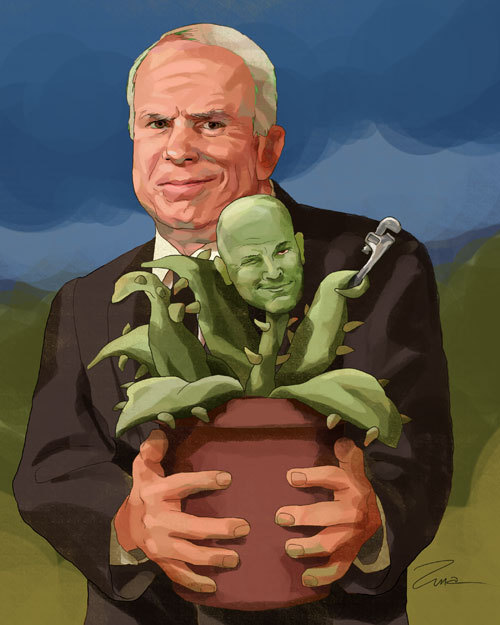
"McCain's Garden" by Zina Saunders

joe-the-plant.jpg

“If you’ve been following the Joe the Plumber story over the past 24 hours, it turns out that he’s not a licensed plumber and apparently makes about $40K a year, so is in no position to buy a business pulling in $250-280K net per year.

“The McCain campaign may not have planted him as a seed, but they certainly are cultivating him.”


NATURE WORKS

October 17, 2008, 12:09 pm – New York Times

A ‘Dose of Nature’ for Attention Problems
Can nature walks help kids with A.D.H.D.?
by Chris Cummins for The New York Times

Parents of children with attention deficit problems are always looking for new strategies to help their children cope. An interesting new study suggests that spending time in nature may help.

A small study conducted at the University of Illinois at Urbana-Champaign looked at how the environment influenced a child’s concentration skills. The researchers evaluated 17 children with attention deficit hyperactivity disorder, who all took part in three 20-minute walks in a park, a residential neighborhood and a downtown area.

After each walk, the children were given a standard test called Digit Span Backwards, in which a series of numbers are said aloud and the child recites them backwards. The test is a useful measure of attention and concentration because practice doesn’t improve the score. The order of the walks varied for all the children, and the tester wasn’t aware of which walk the child had just taken.

The study, published in the August issue of The Journal of Attention Disorders, found that children were able to focus better after the “green” walks compared to walks in other settings.

Although the study is small, the data support several earlier studies suggesting that natural settings influence psychological health. In 2004, a survey of parents of 450 children found that “green” outdoor activities reduced A.D.H.D. symptoms more than activities in other settings.

“What this particular study tells us is that the physical environment matters,” said Frances E. Kuo, director of the university’s Landscape and Human Health Laboratory. “We don’t know what it is about the park, exactly — the greenness or lack of buildings — that seems to improve attention.”

Dr. Kuo noted that the study used tight controls to make sure that the walks were identical except for the environment. Who the child was with, noise levels, the length of time, the time of day and whether the child was on medication stayed constant.

“If we kept everything else the same, and we just changed the environment, we still saw a measurable difference in children’s symptoms,” Dr. Kuo said. “And that’s completely new. No one has done a study looking at a child in different environments, in a controlled comparison where everything else is the same.”

Dr. Kuo said more children were initially involved in the study, but logistical problems like weather changes, late arrivals or changes in medication made it difficult to maintain tight control, leaving the study with just 17 children from which to draw conclusions.

Despite the small size, the study is important because it involves an objective test of attention and doesn’t rely on children’s or parents’ impressions. During the walks, all of the children were unmedicated — participants who normally took medications to control their A.D.H.D. symptoms stayed off the drugs on the days of the walks.

The researchers found that a “dose of nature” worked as well or better than a dose of medication on the child’s ability to concentrate. What’s not clear is how long the nature effect can last.

Dr. Kuo said that while there are “hints” exposure to green outdoor settings offers a benefit, the science isn’t advanced enough to give parents a strict formula.

“We can’t say for sure, ‘two hours of outdoor play will get you this many days of good behavior,’ but we can say it’s worth trying,” she said. “We can say that as little as 20 minutes of outdoor exposure could potentially buy you an afternoon or a couple of hours to get homework done.”

Dr. Kuo said it’s notable that parents themselves consistently report benefits for their children from green settings.

“One reason we believe this is that if the effect were short-lived, we don’t think that parents would have so consistently observed it,” she said. “But they do. They report it over and over.”


Oct 17: DEVO, CHRISSIE HYNDE (just added!) and THE BLACK KEYS play Ohio benefit for Democrats

devobama2.gif

The three music sensations that made Akron, Ohio famous join together for the first time in the important battleground state.

In the middle of an arts revitalization movement, Akron plays host to the music legends who are coming home to show their support for presidential candidate Barack Obama.

After 30 years away from Ohio, DEVO organized this effort.

The show happens Friday, October 17, 2008 8pm at the Akron Civic Theatre.

Twenty electoral votes are up for grabs in the swing state, and winning Ohio could play a pivotal role in winning the upcoming presidential election. With John McCain’s campaign recently pulling out of Michigan in an effort to place more resources in states such as Ohio, band members have been persuaded to show their support through a dual act.

“Ohio is where we need to be,” said Mark Mothersbaugh, DEVO co-founder and frontman. “We hope to make an impact with this concert, and raise consciousness to what’s happened in Ohio in the past eight years. I think that Barack Obama and Joe Biden are our only hope. That’s why we are here.”

The founding members of DEVO sprang from Akron in the 1970s at a time when the city was in a severe recession and dealing with the after-effects of a failed war.

The Black Keys, a new addition to the ticket, have been a rising sensation in Akron throughout the past decade, also a time of national economic hardships and an on-going war.

All proceeds will benefit the Summit County Democratic Party.

A limited number of tickets are on sale now at the Akron Civic Theatre Box Office by calling 330.253.2488 or visiting akroncivic.com. Reserved seats are available for $25, $35 and $50. A limited number of V.I.P. tickets, which include a post show reception with the bands, are available for $150.


Why Loneliness Feels Cold and Sins Feel Dirty

http://www.sciam.com/article.cfm?id=metaphors-of-the-mind

Mind Matters – September 25, 2008 – Scientific American

Metaphors of the Mind: Why Loneliness Feels Cold and Sins Feel Dirty
A social psychologist explains how abstract concepts can create physical feelings

Chen-Bo Zhong is an assistant professor at the Rotman School of Management at the University of Toronto. In recent years, he’s explored a wide variety of topics, from the benefits of relying on the unconscious to generate creative insights to the reasons people often use temperature metaphors (“icy stares,” “cold shoulders,” and so on) when describing acts of social rejection. Mind Matters editor Jonah Lehrer chats with Zhong about his latest research.

LEHRER: You recently demonstrated that being socially excluded from a group can make people feel colder, so that they believe a room is colder and prefer warm drinks and snacks, such as hot coffee and soup. What made you interested in this line of research?

ZHONG: I came across this popular 1970s song on YouTube called Lonely This Christmas written by Nicky Chinn and Mike Chapman. It goes, “It’ll be lonely this Christmas, lonely and cold, it’ll be cold so cold, without you to hold.” It just occurred to me that maybe what the song describes is more than a metaphor but a real psychological connection between loneliness and coldness. Indeed, my collaborator Geoffrey Leonardelli [a professor of organizational behavior at the University of Toronto] and I found that people not only use coldness-related terms to describe social rejection (for example, “cold shoulder”), but also experience rejection as physical coldness: feeling cold becomes an integral part of our experience of being socially isolated. This research is consistent with recent theories on embodied cognition as well as general research on the connection between mind and body.

LEHRER: What are some other examples of how seemingly abstract thoughts, such as feeling excluded, can have physical manifestations?

ZHONG: Another example would be the relation between morality and physical cleanliness. In my early work “Washing Away Your Sins: Threatened Morality and Physical Cleansing” in collaboration with Katie Liljenquist [a professor of organizational behavior at Brigham Young University], we discussed how metaphors such as “dirty hands” or “clean records” may have a psychological basis such that people make sense of morality through physical cleanliness.

When people’s moral self image is threatened, as when they think about their own unethical past behaviors, people literally experience the need to engage in physical cleansing, as if the moral stain is literally physical dirt. We tested this idea in multiple studies and showed that when reminded of their past moral transgressions, people were more likely to think about cleansing-related words such as “wash” and “soap”, expressed stronger preference for cleansing products (for instance, a soap bar), and were also more likely to accept an antiseptic wipe as a free gift (rather than a pencil with equal value).

Further, physical cleansing may actually be effective in mentally getting rid of moral sins. In another study, in which participants who recalled unethical behaviors were either given a chance to cleanse their hands or not, we found that washing hands not only assuaged moral emotions such as guilt and regret but also reduced participants’ willingness to engage in prosocial behaviors such as volunteering Thus physical washing can actually wash away sins. Perhaps this effect is why most world religions practice some form of washing rituals to purify souls. We should be cautious, however, knowing that if our sins are so easily “washed away” we might not be as motivated to engage in actual compensatory behaviors to make up for our mistakes.

LEHRER: Your most recent paper looks at the relation between unconscious thought and creativity. What did you find?

ZHONG: In collaboration with Ap Dijksterhuis [a psychologist at Radboud University in Nijmegen, the Netherlands] and Adam Galinsky [a professor of managment at Northwestern University] found that unconscious thought (such as being distracted while still holding a goal in mind) can facilitate the search for creative solutions. These creative solutions may not be consciously recognizable, however. This research was motivated by early psychological research on the “incubation effect,” a hypothesis that a period of inattention can facilitate problem solving. Henri Poincare, for example, described how he was unable to solve an arithmetic problem after a long period of deliberation and only found the solution appear suddenly into consciousness after thinking about something else.

Despite abundant lay observations, empirical research often had troubles replicating the incubation effect in the lab. We suggest that part of the reason may be that even when unconscious thought generates creative solutions, these solutions still need to be transferred into the consciousness. Thus, the lack of empirical support for incubation may not be due to unconscious thought but to the transferring of unconscious solutions to the conscious. Using printing as an analogy: when a printer is not printing calculations of a program properly, it is not always because the program is not working. Instead, the connection between the program and the printer may be severed. Indeed, we found that after a period of unconscious thought, solutions to creative problems were unconsciously activated but participants were not able to consciously express those solutions. This finding suggests that the generation of creative solutions by unconscious thought and the transferring of these solutions to the conscious may be determined by different factors. We are following up this work in our future research.

LEHRER: Does this suggest that taking pills that increase our ability to consciously focus might interfere with creativity?

ZHONG: Not necessarily, for two reasons. First, there is no doubt that unconscious processes may be most active during sleep but they can also be active while people consciously focus on something—just not the problem you hope to resolve. In our study, we manipulated unconscious thought by distracting participants from the task at hand and focusing them on a different, very cognitive demanding task. Thus, to harness the benefits of unconscious thought, one does not need to lose conscious focus. The key is to focus on an unrelated task while still keeping the goal of resolving the original problem. Second, it partially depends on the complexity of the problem. As it turns out in our research and other work by Dijksterhuis, consciously focusing on a problem is more effective than distraction when the problem does not involve remote connections. The advantages of unconscious thought are most prominent when resolving difficult problems that involve weak associations.

LEHRER: A recent paper of yours looked at the power of “negational racial identity” to influence votes. You showed that making Asian and Latino voters think about race in negational terms (thinking of themselves as “non-white”) made them more likely to vote for Obama than Asian and Latino voters who were primed to think about their identity in affirmational terms (being Asian or Latino). You conclude that “negational identity is a meaningful source of social identity” and that “whether one thinks about ‘who one is’ versus ‘who one is not’ has far-reaching impact for real-world decisions.” What are some other examples of “negational identity” at work? And what does this suggest about how people develop an identity?

ZHONG: Another example of negational identity would be the 2004 presidential Democratic primary, people who were once supporters of unsuccessful Democratic candidates such as Howard Dean and John Edwards, united over their common lack of support for the current president, George W. Bush (for instance, “anybody but Bush”) in the general election. Likewise, during my graduate study, I saw a Midwest talk radio show advertise itself on billboards with a slogan, “Liberals Hate It!” In both cases people focused on who they were not more than who they were.

The development of identity is a fluid process. Although people certainly differ in how they view themselves, their identity can also be primed or manipulated. The manipulation of the “non-white” identity in my recent article with Adam Galinsky [at Northwestern] and Miguel Unzueta [a professor of organizational behavior at UCLA] is one such example. Whether people see themselves through the affirmational or negational lens has significant social consequences, even though such effects may not be consciously noticed. Affirmational identity tends to assimilate people to their in-group and drive in-group favoritism. Negational identity, on the hand, defines individuals by contrasting individuals to a common non-membership. It may create a broad basis for building a coalition, uniting all who do not belong to the same group. In the meantime, however, it may increase hostility towards the common out-group. By highlighting the fluidity of identity and how easily it can be manipulated by campaigns, advertisements, and speeches, we hope to increase the likelihood that voters will consider specific issues rather than simply relying on group categories.


SIT WITH THIS REALITY

F.e.y PRESENTS:

Diane Cluck & Anders Griffin

Malcolm Rollick

The Unwin-Dunraven Literary Ecclesia

October 29, 2008: 7pm

Donations Appreciated

8335 NW Whitney Ave
Portland, OR 97217

Just over the Saint Johns Bridge, and in the thick of Oregon’s temperate rainforest exists an apocalyptic opposite-igloo designed and built by f.e.y founders Tigerlilly Holyoak and Larissa Hammond. This “igloo” reflects the current state of the forest. Trees are suffocated by invasive ivy causing them to lean at impressive angles and eventually crash to the ground. Spiders build their webs again and again, seemingly undeterred by the surrounding destruction. It’s a beautiful forest that demands reverence for all it has lost and all it still offers.

f.e.y invites you to sit with this reality; to listen to the prophecies of The Unwin-Dunraven Literary Ecclesia and musical un-resolutions of Malcolm Rollick and Diane Cluck. Show goers are encouraged to bring their own art for display on scattered boards or, perhaps, to bury in the ground.

http://www.myspace.com/feyvenue

http://www.myspace.com/dianecluck

http://www.malcolmrollick.com

http://www.unwin-dunraven.org


Calculating the economic value of forests

Story from BBC NEWS:
http://news.bbc.co.uk/go/pr/fr/-/2/hi/science/nature/7662565.stm

Nature loss ‘dwarfs bank crisis’

By Richard Black
Environment correspondent, BBC News website, Barcelona

The global economy is losing more money from the disappearance of forests than through the current banking crisis, according to an EU-commissioned study.

It puts the annual cost of forest loss at between $2 trillion and $5 trillion.

The figure comes from adding the value of the various services that forests perform, such as providing clean water and absorbing carbon dioxide.

The study, headed by a Deutsche Bank economist, parallels the Stern Review into the economics of climate change.

It has been discussed during many sessions here at the World Conservation Congress.

Some conservationists see it as a new way of persuading policymakers to fund nature protection rather than allowing the decline in ecosystems and species, highlighted in the release on Monday of the Red List of Threatened Species, to continue.

Speaking to BBC News on the fringes of the congress, study leader Pavan Sukhdev emphasised that the cost of natural decline dwarfs losses on the financial markets.

“It’s not only greater but it’s also continuous, it’s been happening every year, year after year,” he told BBC News.

“So whereas Wall Street by various calculations has to date lost, within the financial sector, $1-$1.5 trillion, the reality is that at today’s rate we are losing natural capital at least between $2-$5 trillion every year.”

The review that Mr Sukhdev leads, The Economics of Ecosystems and Biodiversity (Teeb), was initiated by Germany under its recent EU presidency, with the European Commission providing funding.

The first phase concluded in May when the team released its finding that forest decline could be costing about 7% of global GDP. The second phase will expand the scope to other natural systems.

Key to understanding his conclusions is that as forests decline, nature stops providing services which it used to provide essentially for free.

So the human economy either has to provide them instead, perhaps through building reservoirs, building facilities to sequester carbon dioxide, or farming foods that were once naturally available.

Or we have to do without them; either way, there is a financial cost.

The Teeb calculations show that the cost falls disproportionately on the poor, because a greater part of their livelihood depends directly on the forest, especially in tropical regions.

The greatest cost to western nations would initially come through losing a natural absorber of the most important greenhouse gas.

Just as the Stern Review brought the economics of climate change into the political arena and helped politicians see the consequences of their policy choices, many in the conservation community believe the Teeb review will lay open the economic consequences of halting or not halting the slide in biodiversity.

“The numbers in the Stern Review enabled politicians to wake up to reality,” said Andrew Mitchell, director of the Global Canopy Programme, an organisation concerned with directing financial resources into forest preservation.

“Teeb will do the same for the value of nature, and show the risks we run by not valuing it adequately.”

A number of nations, businesses and global organisations are beginning to direct funds into forest conservation, and there are signs of a trade in natural ecosystems developing, analogous to the carbon trade, although it is clearly very early days.

Some have ethical concerns over the valuing of nature purely in terms of the services it provides humanity; but the counter-argument is that decades of trying to halt biodiversity decline by arguing for the intrinsic worth of nature have not worked, so something different must be tried.

Whether Mr Sukhdev’s arguments will find political traction in an era of financial constraint is an open question, even though many of the governments that would presumably be called on to fund forest protection are the ones directly or indirectly paying for the review.

But, he said, governments and businesses are getting the point.

“Times have changed. Almost three years ago, even two years ago, their eyes would glaze over.

“Today, when I say this, they listen. In fact I get questions asked – so how do you calculate this, how can we monetize it, what can we do about it, why don’t you speak with so and so politician or such and such business.”

The aim is to complete the Teeb review by the middle of 2010, the date by which governments are committed under the Convention of Biological Diversity to have begun slowing the rate of biodiversity loss.

courtesy Will Swofford!