Mark Lakeman of City Repair Project
on
Returning Power to Neighborhoods
Saturday, October 6, 2-4:30pm @ LACE
6522 Hollywood Boulevard, Los Angeles, CA 90028

Mark Lakeman of City Repair Project
on
Returning Power to Neighborhoods
Saturday, October 6, 2-4:30pm @ LACE
6522 Hollywood Boulevard, Los Angeles, CA 90028
Shifting Targets
The Administration’s plan for Iran.
by Seymour M. Hersh October 8, 2007 New Yorker
In a series of public statements in recent months, President Bush and members of his Administration have redefined the war in Iraq, to an increasing degree, as a strategic battle between the United States and Iran. “Shia extremists, backed by Iran, are training Iraqis to carry out attacks on our forces and the Iraqi people,” Bush told the national convention of the American Legion in August. “The attacks on our bases and our troops by Iranian-supplied munitions have increased. . . . The Iranian regime must halt these actions. And, until it does, I will take actions necessary to protect our troops.” He then concluded, to applause, “I have authorized our military commanders in Iraq to confront Tehran’s murderous activities.”
The President’s position, and its corollary—that, if many of America’s problems in Iraq are the responsibility of Tehran, then the solution to them is to confront the Iranians—have taken firm hold in the Administration. This summer, the White House, pushed by the office of Vice-President Dick Cheney, requested that the Joint Chiefs of Staff redraw long-standing plans for a possible attack on Iran, according to former officials and government consultants. The focus of the plans had been a broad bombing attack, with targets including Iran’s known and suspected nuclear facilities and other military and infrastructure sites. Now the emphasis is on “surgical” strikes on Revolutionary Guard Corps facilities in Tehran and elsewhere, which, the Administration claims, have been the source of attacks on Americans in Iraq. What had been presented primarily as a counter-proliferation mission has been reconceived as counterterrorism.
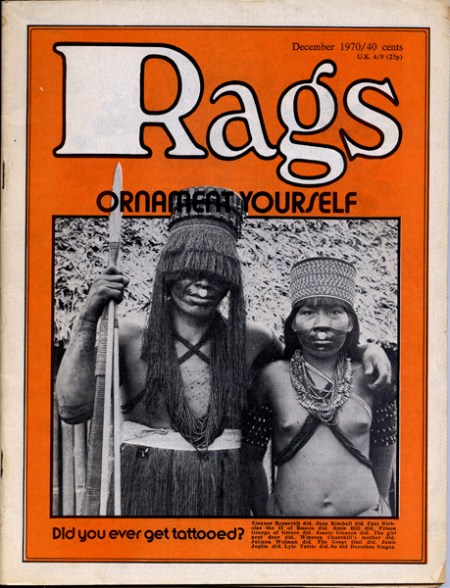
A part of the underground press movement, Rags was published for a year, 1970-71. It covered the worlds of counter-culture fashion with street fashion reports, groovy adverts and a very liberated sense of style. As far as I can tell its print run was all b/w on rag paper.
The December 1970 issue includes “Revolution” (with models acting out scenes from peoples history),”Life Amongst the Amazon Today” (on body modification in Amazonian tribes), “If God Hadn’t Wanted You To Wear a Bra He Wouldn’t Have Invented the Contour Council” (all about “the bra” with super hip writing!!) and “Raggedy Robin Raggedy Jane” (a profile of a Haight Ashbury clown couple).
The SF Diggers went to bat against the hip capitalists in SF but the innocence, creativity and DIY styles displayed in this publication, which seems to have been distributed primarily in underground boutiques, is charming nonetheless. A mystery in its masthead is the listing of “commidify your dissent” artist Barbara Kruger. That name appears as one of two art directors.
Cassandro Tondro has a blog uploading pdf’s of her collection of Rags. Check it out!

If you are one of our 120,000+ readers who enjoys Arthur for free, please consider giving others the same privilege. Announcing our online drive to provide one-year subscriptions to Arthur for everybody else…
PRISONERS
In lieu of a proper education system America has instituted a special school for people of color called prison. Students learn a lot in prison, but are propagandized solely by corporate media, whose rotten message grows even more virulent in the nightmare that is life inside. As a consequence, Arthur regularly receives pleas from these captives to provide them with an untainted diversion at least.
Over two million people – one out of every 142 Americans – is now in prison. Almost 500,000 Americans are in jail for drugs-only offenses, and if they try to go to a record store or coffeehouse or nightclub to pick up a copy of Arthur, they will be shot and bit by dogs. These starving minds have got to get Arthur sent to them in a warden-approved manner, which costs thirty dollars a year. With your kind donation, Arthur will be able to give a lucky prisoner and their cellblock a free one-year subscription. Provide a beacon for a guy who got caught today.
PUBLIC LIBRARIES
America’s public libraries are criminally underfunded. You can probably guess why. When you buy a subscription to Arthur on behalf of a public library, you help to expand the public’s consciousness while also providing vital financial support to the magazine itself, enabling it to continue its mission. Not too shabby for 30 bones!
MEDICAL MARIJUANA DISPENSARIES
Because people waiting for their medicine need something to read.
You know these guys… they’re the ones responsponsible for “Patriotism!” Anyone watch Transformers or play America’s Army or go to some military sponsored event? Well the flacks responsible for foisting this garbage on your imagination have offices too, and they’re willing to work with you if you have got the right stuff.
On the West Coast you can find all of the armed forces public affairs liasons and propagandists (including army outreach who proudly serves as a center of influence on the West coast with direct links to the motion picture entertainment industry ) convieniently located in one building in the heart of Westwood at 10880 Wilshire Boulevard Suite 1250 Los Angeles, California 90024-4101.
Stop by for a visit to see what kind of magic you can make.
By Daniel Ellsberg
September 26, 2007 (Text of a speech delivered September 20, 2007)
Editor’s Note: Daniel Ellsberg, the former Defense Department analyst who leaked the secret Pentagon Papers history of the Vietnam War, offered insights into the looming war with Iran and the loss of liberty in the United States at an American University symposium on Sept. 20.
Below is an edited transcript of Ellsberg’s remarkable speech:
I think nothing has higher priority than averting an attack on Iran, which I think will be accompanied by a further change in our way of governing here that in effect will convert us into what I would call a police state.
If there’s another 9/11 under this regime … it means that they switch on full extent all the apparatus of a police state that has been patiently constructed, largely secretly at first but eventually leaked out and known and accepted by the Democratic people in Congress, by the Republicans and so forth.
Will there be anything left for NSA to increase its surveillance of us? … They may be to the limit of their technical capability now, or they may not. But if they’re not now they will be after another 9/11.
And I would say after the Iranian retaliation to an American attack on Iran, you will then see an increased attack on Iran – an escalation – which will be also accompanied by a total suppression of dissent in this country, including detention camps.
It’s a little hard for me to distinguish the two contingencies; they could come together. Another 9/11 or an Iranian attack in which Iran’s reaction against Israel, against our shipping, against our troops in Iraq above all, possibly in this country, will justify the full panoply of measures that have been prepared now, legitimized, and to some extent written into law. …
This is an unusual gang, even for Republicans. [But] I think that the successors to this regime are not likely to roll back the assault on the Constitution. They will take advantage of it, they will exploit it.
Will Hillary Clinton as president decide to turn off NSA after the last five years of illegal surveillance? Will she deprive her administration her ability to protect United States citizens from possible terrorism by blinding herself and deafening herself to all that NSA can provide? I don’t think so.
Unless this somehow, by a change in our political climate, of a radical change, unless this gets rolled back in the next year or two before a new administration comes in – and there’s no move to do this at this point – unless that happens I don’t see it happening under the next administration, whether Republican or Democratic.
The Next Coup
Let me simplify this and not just to be rhetorical: A coup has occurred. I woke up the other day realizing, coming out of sleep, that a coup has occurred. It’s not just a question that a coup lies ahead with the next 9/11. That’s the next coup, that completes the first.
The last five years have seen a steady assault on every fundamental of our Constitution, … what the rest of the world looked at for the last 200 years as a model and experiment to the rest of the world – in checks and balances, limited government, Bill of Rights, individual rights protected from majority infringement by the Congress, an independent judiciary, the possibility of impeachment.
There have been violations of these principles by many presidents before. Most of the specific things that Bush has done in the way of illegal surveillance and other matters were done under my boss Lyndon Johnson in the Vietnam War: the use of CIA, FBI, NSA against Americans.
I could go through a list going back before this century to Lincoln’s suspension of habeas corpus in the Civil War, and before that the Alien and Sedition Acts in the 18th century. I think that none of those presidents were in fact what I would call quite precisely the current administration: domestic enemies of the Constitution.
I think that none of these presidents with all their violations, which were impeachable had they been found out at the time and in nearly every case their violations were not found out until they were out of office so we didn’t have the exact challenge that we have today.
That was true with the first term of Nixon and certainly of Johnson, Kennedy and others. They were impeachable, they weren’t found out in time, but I think it was not their intention to in the crisis situations that they felt justified their actions, to change our form of government.
It is increasingly clear with each new book and each new leak that comes out, that Richard Cheney and his now chief of staff David Addington have had precisely that in mind since at least the early 70s. Not just since 1992, not since 2001, but have believed in Executive government, single-branch government under an Executive president – elected or not – with unrestrained powers. They did not believe in restraint.
When I say this I’m not saying they are traitors. I don’t think they have in mind allegiance to some foreign power or have a desire to help a foreign power. I believe they have in their own minds a love of this country and what they think is best for this country – but what they think is best is directly and consciously at odds with what the Founders of this country and Constitution thought.
They believe we need a different kind of government now, an Executive government essentially, rule by decree, which is what we’re getting with signing statements. Signing statements are talked about as line-item vetoes which is one [way] of describing them which are unconstitutional in themselves, but in other ways are just saying the president says “I decide what I enforce. I decide what the law is. I legislate.”
It’s [the same] with the military commissions, courts that are under the entire control of the Executive Branch, essentially of the president. A concentration of legislative, judicial, and executive powers in one branch, which is precisely what the Founders meant to avert, and tried to avert and did avert to the best of their ability in the Constitution.
Founders Had It Right
Now I’m appealing to that as a crisis right now not just because it is a break in tradition but because I believe in my heart and from my experience that on this point the Founders had it right.
It’s not just “our way of doing things” – it was a crucial perception on the corruption of power to anybody including Americans. On procedures and institutions that might possibly keep that power under control because the alternative was what we have just seen, wars like Vietnam, wars like Iraq, wars like the one coming.
That brings me to the second point. This Executive Branch, under specifically Bush and Cheney, despite opposition from most of the rest of the branch, even of the cabinet, clearly intends a war against Iran which even by imperialist standards, standards in other words which were accepted not only by nearly everyone in the Executive Branch but most of the leaders in Congress. The interests of the empire, the need for hegemony, our right to control and our need to control the oil of the Middle East and many other places. That is consensual in our establishment. …
But even by those standards, an attack on Iran is insane. And I say that quietly, I don’t mean it to be heard as rhetoric. Of course it’s not only aggression and a violation of international law, a supreme international crime, but it is by imperial standards, insane in terms of the consequences.
Does that make it impossible? No, it obviously doesn’t, it doesn’t even make it unlikely.
That is because two things come together that with the acceptance for various reasons of the Congress – Democrats and Republicans – and the public and the media, we have freed the White House – the president and the vice president – from virtually any restraint by Congress, courts, media, public, whatever.
And on the other hand, the people who have this unrestrained power are crazy. Not entirely, but they have crazy beliefs.
And the question is what then, what can we do about this? We are heading towards an insane operation. It is not certain. It is likely. … I want to try to be realistic myself here, to encourage us to do what we must do, what is needed to be done with the full recognition of the reality. Nothing is impossible.
What I’m talking about in the way of a police state, in the way of an attack on Iran is not certain. Nothing is certain, actually. However, I think it is probable, more likely than not, that in the next 15, 16 months of this administration we will see an attack on Iran. Probably. Whatever we do.
And … we will not succeed in moving Congress probably, and Congress probably will not stop the president from doing this. And that’s where we’re heading. That’s a very ugly, ugly prospect.
However, I think it’s up to us to work to increase that small perhaps – anyway not large – possibility and probability to avert this within the next 15 months, aside from the effort that we have to make for the rest of our lives.
Restoring the Republic
Getting back the constitutional government and improving it will take a long time. And I think if we don’t get started now, it won’t be started under the next administration.
Getting out of Iraq will take a long time. Averting Iran and averting a further coup in the face of a 9/11, another attack, is for right now, it can’t be put off. It will take a kind of political and moral courage of which we have seen very little…
We have a really unusual concentration here and in this audience, of people who have in fact changed their lives, changed their position, lost their friends to a large extent, risked and experienced being called terrible names, “traitor,” “weak on terrorism” – names that politicians will do anything to avoid being called.
How do we get more people in the government and in the public at large to change their lives now in a crisis in a critical way? How do we get Nancy Pelosi and Harry Reid for example? What kinds of pressures, what kinds of influences can be brought to bear to get Congress to do their jobs? It isn’t just doing their jobs. Getting them to obey their oaths of office.
I took an oath many times, an oath of office as a Marine lieutenant, as an official in the Defense Department, as an official in the State Department as a Foreign Service officer. A number of times I took an oath of office which is the same oath office taken by every member of Congress and every official in the United States and every officer in the United States armed services.
And that oath is not to a Commander in Chief, which is not mentioned. It is not to a fuehrer. It is not even to superior officers. The oath is precisely to protect and uphold the Constitution of the United States.
Now that is an oath I violated every day for years in the Defense Department without realizing it when I kept my mouth shut when I knew the public was being lied into a war as they were lied into Iraq, as they are being lied into war in Iran.
I knew that I had the documents that proved it, and I did not put it out then. I was not obeying my oath which I eventually came to do.
I’ve often said that Lt. Ehren Watada – who still faces trial for refusing to obey orders to deploy to Iraq which he correctly perceives to be an unconstitutional and aggressive war – is the single officer in the United States armed services who is taking seriously in upholding his oath.
The president is clearly violating that oath, of course. Everybody under him who understands what is going on and there are myriad, are violating their oaths. And that’s the standard that I think we should be asking of people.
Congressional Courage
On the Democratic side, on the political side, I think we should be demanding of our Democratic leaders in the House and Senate – and frankly of the Republicans – that it is not their highest single absolute priority to be reelected or to maintain a Democratic majority so that Pelosi can still be Speaker of the House and Reid can be in the Senate, or to increase that majority.
I’m not going to say that for politicians they should ignore that, or that they should do something else entirely, or that they should not worry about that.
Of course that will be and should be a major concern of theirs, but they’re acting like it’s their sole concern. Which is business as usual. “We have a majority, let’s not lose it, let’s keep it. Let’s keep those chairmanships.” Exactly what have those chairmanships done for us to save the Constitution in the last couple of years?
I am shocked by the Republicans today that I read in the Washington Post who yesterday threatened a filibuster if we … get back habeas corpus. The ruling out of habeas corpus with the help of the Democrats did not get us back to George the First it got us back to before King John 700 years ago in terms of counter-revolution.
We need some way, and Ann Wright has one way, of sitting in, in Conyers office and getting arrested. Ray McGovern has been getting arrested, pushed out the other day for saying the simple words “swear him in” when it came to testimony.
I think we’ve got to somehow get home to them [in Congress] that this is the time for them to uphold the oath, to preserve the Constitution, which is worth struggling for in part because it’s only with the power that the Constitution gives Congress responding to the public, only with that can we protect the world from mad men in power in the White House who intend an attack on Iran.
And the current generation of American generals and others who realize that this will be a catastrophe have not shown themselves – they might be people who in their past lives risked their bodies and their lives in Vietnam or elsewhere, like [Colin] Powell, and would not risk their career or their relation with the president to the slightest degree.
That has to change. And it’s the example of people like those up here who somehow brought home to our representatives that they as humans and as citizens have the power to do likewise and find in themselves the courage to protect this country and protect the world. Thank you.
Daniel Ellsberg is author of Secrets: A Memoir of Vietnam and the Pentagon Papers.
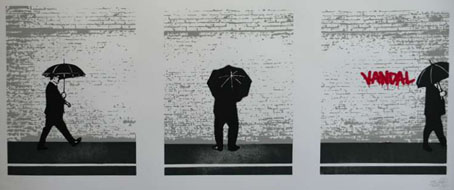
Vandal by Nick Walker.
Germaine Greer
Monday September 24, 2007
The Guardian
Thirty-five years ago I bought a dilapidated house in North Kensington, London. One of the reasons I bought it was that it sported a magnificent graffito. In those days, graffiti were usually texts, some of them, it was said, written by the poet Christopher Logue. This one spelt out, in foot-high block capitals, the undeniable truth that “Boredom is counter-revolutionary”. When the house was done up, the graffito disappeared. Over the years, the neighbourhood lost all its graffiti one by one, as the pestiferous warren of flats and bedsits was regentrified. The wall that had the one word “Scream” written its full length was repainted, and the grim prediction “This too will burn” was removed from a pillar under the Westway.
Aerosol art is not the same thing at all. Although Banksy is as likely to be arrested as the defacers of those days, what he does is jokey, wry, fundamentally civilised. In a message that’s been sloshed up by a couple of four-inch brushes loaded with red and black gloss paint rather than sprayed through a stencil, you see not good humour and self-deprecation, but honest-to-goodness grief and rage.
For months I thought about restoring my graffito, maybe cleaning the new cream stone-textured paint from off the letters or even painting them again; but eventually I realised that for the owner of a house to scribble on it is just pathetic and downright disrespectful, like Foxtons the estate agent having the name Foxtons painted on the side of its fleet of Minis in graffito script. You’ve got to be working full-tilt, hanging head downward off a motorway bridge with your mates holding you by the feet, writing . . . what? Probably your tag in blocky letters outlined in contrasting trim. Nearly all graffiti are just annoying, but you have to put up with the millions of naff ones if you want the occasional brilliant one. A great graffito is not simply an arresting design; it is a once-in-a-lifetime coincidence of work, place and space. Would anyone now dare to sandblast the murals of loyalists and republicans from the walls of Belfast? Now old IRA wall paintings are being touched up and recycled with messages in Arabic signifying solidarity for the Palestinians. And Banksy has done his best work on the West Bank Barrier.
Most aerosol art, like most other art, is feeble and bad. If bad art was a crime, some of our most respected citizens would have been banged up years ago. Wall art, whether brilliant or ordinary, is a crime so serious that it is to be treated with zero tolerance: fortunes are spent in tackling the graffiti scourge; in Berlin low-flying aircraft are used to scan the streets with infra-red cameras to catch the spray painters at work. Oceans of highly toxic solvents are being sluiced over walls and hoardings to wash the paint into the sewers and eventually into the water table. Wildly illiberal proposals are coming from all quarters: possession of spray paint and selling of spray paint will become crimes; taggers will have their driving licences withdrawn and be fined huge amounts on the spot. In England two young men known in art as Krek and Mers, who haven’t done a graffito in two years, have been sent to prison for 12 months and 15 months respectively – though one of them was due to start an art course at university, his mother had offered to pay for the damage, and 500 people signed a Facebook petition. Needless to say, making an example of them will be the opposite of a deterrent; tagging is now heroic protest. Expect to see the names Krek and Mers on every railway bridge.
Graffiti cost Londoners £100m a year, and the country as a whole more than a billion, we are told; what is actually costing is not the art, which is free, but its destruction. The engine driving this colossal expenditure is Encams, mastermind of the Keep Britain Tidy Campaign, which implores us not to drop litter or chewing gum, dump cars or rubbish, make lots of noise, or leave our dogs’ shit on the pavement. Major mess-makers they leave well alone. Apparently graffiti and fly-posting can fill people with a feeling of unease or fear, because they associate both with crime. As fear of crime is already way out of proportion to the actual incidence of crime, loathing of graffiti must be equally, if not more irrational. We should not pander to it.
Walls don’t look much better after their graffiti have been washed off than they did before, so we might as well stop doing it. In environmental terms, the washing-off makes a worse mess than the painting ever did. The wall-painters themselves will paint over each other’s work, especially if they consider it feeble. A far less costly option is for us all to make our own stencils giving the defacers marks out of 10, to remind the artists that there are people out there who have eyes to see, and as much right to say what they think as the artists. The work then becomes a palimpsest, a dialogue between artists and public. Most tags deserve the single-word comment “prat”.
Whether at Lascaux 17,000 years ago or in Western Arnhem Land 50,000 years ago, art began on a wall. If the sandblasters had been around in either place, we would have lost a precious inheritance.
For a regular dose of great street art, check Wooster Collective.

