

Category Archives for Uncategorized
"Better Living Through Technology" Foibles No. 43
From the September 9, 2007 Los Angeles Times:
Press 1 if you hate talking to a device
David Lazarus
Consumer Confidential
As the man generally regarded as the father of the automated switchboard, Peter Theis knows he has a lot to answer for.
“I’m the guy who did it, yeah,” 70-year-old Theis said. “I am ultimately to blame. I’m Dr. Frankenstein.”
It’s a bit more complicated than that, of course. The technology that many consumers believe serves no purpose but to prevent them from reaching a living, breathing service rep is in fact an electronic stew of a variety of systems.
But it was Theis who, in the early 1970s, cobbled together the nuts and bolts of what’s known today as interactive voice response, which is what allows a computer to respond to touch tones or spoken words with seemingly endless corridors of automated options.
“When I invented it, I knew this would be huge,” he told me. “My goal was to improve the efficiency of call centers. I never thought that people would misapply the technology.”
I’ve been wrestling with automated switchboards as I try to set up phone service, TV service, Internet service and every other service for our new house in Los Angeles (a.k.a. the money sponge).
Time Warner Cable’s machine hung up on me no fewer than three times before I finally got through to a human being who could answer a few questions.
Verizon’s automated switchboard pummeled me with about a dozen questions before connecting me to a real person, who then asked me to repeat the exact same information.
And for a textbook example of how automated switchboards can be so bamboozling that callers may hang up in frustration before getting anywhere close to a human being, try dialing the L.A. city clerk’s office at (213) 978-1133.
Don’t you just love how virtually every recorded message begins with a warning that the menu has recently changed, so don’t do anything until you sit through the whole spiel? Or how the system is invariably programmed to not offer access to an honest-to-goodness service rep until the very end of the process?
So what dark corner of hell is responsible for this diabolical technology? That would be Cedar Rapids, Iowa.
This is where engineers at what was known as the Collins radio division of Rockwell International — today it’s part of a company called Aspect Software — faced a challenge from Continental Airlines to come up with some way for passengers’ calls to be more efficiently funneled to reservation agents.
Continental reportedly first brought its request to AT&T in 1972. The telephone giant said it would take at least eight years to build such a system. So Continental went instead to Collins, which did the work in just two.
What the engineers at Collins came up with was a system called automatic call distribution, which places calls in a queue and routes them to particular destinations. Collins’ system is what makes call centers in India and elsewhere possible. It’s the backbone of the modern automated switchboard.
“It really revolutionized the industry,” said Gary Barnett, chief technology officer of Aspect Software, which has grown into a leading provider of both automatic call distribution (ACD) and interactive voice response (IVR) systems. “ACD is about getting you to the right person to talk to.”
Before Collins’ breakthrough, Barnett said, more primitive systems existed to route calls to company reps, but they did little if anything to streamline the process or improve a caller’s experience.
“The significance of ACD is that it was much more intelligent about calls when they came in,” Barnett said. “It could also glean information about you as a caller from data in the back-office system.”
Although ACD set the stage for automated switchboards, it was IVR — the interactive “face” of such systems — that created the electronic black holes that all too often define consumers’ experiences with the technology.
A recent call-center industry survey found that one of the things people hate most about automated switchboards, aside from deliberately being kept from reaching a human being, is having to repeat the same information, first to the machine and then to the service rep.
A quarter of all consumers who were asked to repeat themselves as a result of using an automated switchboard say they’ll do less business with the company, the survey found.
I told Theis, the inventor of interactive voice response, how displeased many people were with his creation. He said it was not his fault. Instead blame the companies that use automated switchboards to hinder, not help, communication with customers.
“These companies are flat-out saying they don’t give a damn about callers,” Theis said. “That’s just plain wrong.”
His company, ConServIT in Lindenhurst, Ill., is trying to remedy this with new technology that’s designed to make automated switchboards sound more lifelike. But Theis isn’t optimistic that companies want to make things easier for consumers.
Just the opposite, in fact.
“I don’t see things getting any better,” Theis said. “It’s corporate arrogance.”
He added wistfully: “This wasn’t what I intended.”
ACID MOTHERS GURU GURU "Psychedelic Navigator US tour 2007" hits the West Coast


Acid Mothers Guru Guru :
Mani Neumeier : dr. vo (from Guru Guru)
Tsuyama Atsushi : b. vo (from Acid Mothers Temple)
Kawabata Makoto : g. vo (from Acid Mothers Temple, Gong)
Sep. 09 (sun) @ Doug Fir Lounge PORTLAND. OR
http://www.dougfirlounge.com
Sep. 10 (mon) @ Bottom of The Hill SAN FRANCISCO. CA
http://www.bottomofthehill.com
Sep. 11 (tue) @ Troubadour LOS ANGELES. CA
http://www.troubadour.com
Sep. 12 (wed) @ Casbah SAN DIEGO. CA
http://www.thecasbah.com
“The 1st album Psychedelic Navigation will be released by Important Records (US) soon”
FAKING EVERYTHING: new corporate bullshit/payola methods.
Download This: YouTube Phenom Has a Big Secret
Singer Marié Digby Isn’t Quite What She Appears
By ETHAN SMITH and PETER LATTMAN
September 6, 2007; Page A1
WALL STREET JOURNAL
A 24-year-old singer and guitarist named Marié Digby has been hailed as proof that the Internet is transforming the world of entertainment.
What her legions of fans don’t realize, however, is that Ms. Digby’s career demonstrates something else: that traditional media conglomerates are going to new lengths to take advantage of the Internet’s ability to generate word-of-mouth buzz.
Ms. Digby’s simple, homemade music videos of her performing popular songs have been viewed more than 2.3 million times on YouTube. Her acoustic-guitar rendition of the R&B hit “Umbrella” has been featured on MTV’s program “The Hills” and is played regularly on radio stations in Los Angeles, Sacramento and Portland, Ore. Capping the frenzy, a press release last week from Walt Disney Co.’s Hollywood Records label declared: “Breakthrough YouTube Phenomenon Marié Digby Signs With Hollywood Records.”
What the release failed to mention is that Hollywood Records signed Ms. Digby in 2005, 18 months before she became a YouTube phenomenon. Hollywood Records helped devise her Internet strategy, consulted with her on the type of songs she chose to post, and distributed a high-quality studio recording of “Umbrella” to iTunes and radio stations.
In an Aug. 16 blog posting on her MySpace page, Ms. Digby wrote: “I NEVER in a million years thought that doing my little video of Umbrella in my living room would lead to this . tv shows, itunes, etc !!!”
Ms. Digby’s MySpace and YouTube pages don’t mention Hollywood Records. Until last week, a box marked “Type of Label” on her MySpace Music page said, “None.” After inquiries from The Wall Street Journal, the entry was changed to “Major,” though the label still is not named.
The artist and her label say there’s nothing untoward about the campaign. In interviews, Ms. Digby and executives at the company describe her three-month string of successes as part of a lengthy process of laying the groundwork for the upcoming release of her debut album.
Ms. Digby says she doesn’t mention her record label on her Web sites because “I didn’t feel like it was something that was going to make people like me.”
Feigning Amateur Status
Ms. Digby certainly isn’t the first professional to feign amateur status on YouTube. Last year, “LonelyGirl15” was revealed to be a 19-year-old actress, working with filmmakers represented by the Creative Artists Agency.
The fact that a big company supported Ms. Digby’s ruse reflects how dearly media giants want in on the viral revolution that’s changing how young consumers learn about new entertainment — even if it means a tiny bit of sleight-of-hand. It also reflects how difficult it is for new recording artists to get noticed now that young fans are paying more attention to Web sites such as Google Inc.’s YouTube and News Corp.’s MySpace than to traditional media like commercial radio.
“There are significant challenges in breaking new artists now, but there are also amazing opportunities,” says Ken Bunt, Hollywood Records’ senior vice president for marketing who helped devise Ms. Digby’s campaign. “People get so mired in the difficulties they don’t say, ‘What opportunities does online present?’ This is a great example of an opportunity.”
Though all involved say that Hollywood Records’ role in her online rise has been limited, label executives say they did nothing to discourage Ms. Digby from conveying the impression that she had stumbled into the spotlight. Ms. Digby says she chose the songs. Hollywood Records bought the Apple Inc. laptop computer and software that Ms. Digby — who lives with her parents in Los Angeles’s upscale Brentwood neighborhood — used to post her YouTube videos. Her version of “Umbrella” that is being sold at Apple’s iTunes Store is a high-quality studio recording made in June by Hollywood Records, which also made it available to radio stations.
Ms. Digby, whose exotic looks reflect her Japanese and Irish heritage, began writing songs as a high-school student and set off in search of a music career during her freshman year at the University of California, Berkeley. She says she found herself flying back to Los Angeles almost every week to play solo gigs at open-microphone nights at clubs. At age 19, she left Berkeley and concentrated full-time on music.
While Ms. Digby won regular bookings at nightclubs, things didn’t begin to click until a chance encounter with Barry Krost, a music manager whose past clients have included Cat Stevens. He took her on as a client and in early 2005 secured her a publishing deal with Rondor Music, a publisher that is part of Vivendi SA’s Universal Music Group.
In late 2005, Ron Moss, Rondor’s executive vice president, connected Ms. Digby to a Hollywood Records executive named Allison Hamamura, who was immediately taken with the singer. Before the year was out, Hollywood Records had signed Ms. Digby. Since then, the label has worked with the singer on her debut album of original songs. The album was produced by Tom Rothrock, who also recorded a recent hit record by British singer James Blunt.
Once the album was completed late last year, Ms. Digby and her label began looking for ways to gain visibility. “I was coming out of nowhere,” Ms. Digby says. “I wanted to find a way to get some exposure.”
That’s when the idea of posting simple videos of cover songs came up. “No one’s going to be searching for Marié Digby, because no one knows who she is,” Mr. Bunt, the Hollywood Records senior vice president, reasoned. So she posted covers of hits by Nelly Furtado and Maroon 5, among others, so that users searching for those artists’ songs would stumble on hers instead. Her version of Rihanna’s “Umbrella” proved a nearly instant hit.
The Lucky Nobody
As Ms. Digby’s star rose, other media outlets played along. When Los Angeles adult-contemporary station KYSR-FM, which calls itself “Star 98.7,” interviewed Ms. Digby in July, she and the disc jockey discussed her surprising success. “We kind of found her on YouTube,” the DJ, known as Valentine, said. Playing the lucky nobody, Ms. Digby said: “I’m usually the listener calling in, you know, just hoping that I’m going to be the one to get that last ticket to the Star Lounge with [pop star] John Mayer!” The station’s programming executives now acknowledge they had booked Ms. Digby’s appearance through Hollywood Records, and were soon collaborating with the label to sell “Umbrella” as a single on iTunes.
“We did discover this artist through YouTube,” says KYSR Program Director Charese Fruge. The DJ couldn’t be reached for comment.
“I don’t think we need a television show to find talent in America,” crowed NBC late-night talk show host Carson Daly, introducing a performance by Ms. Digby last month. “We have the Internet.” Mr. Daly’s music booker, Diana Miller, says she booked the singer through Hollywood Records’ public-relations department.
At the show’s taping, Ms. Digby gave a backstage interview that was posted online by NBC. “I just did this YouTube video two months ago and never, ever imagined that it would actually get me on TV or radio or anything like that,” she said. “I just did it in my living room and it blew up first on YouTube and then I guess it got to Star 98.7 and then Carson Daly found me so that’s why I’m here.”
Most of Ms. Digby’s new fans seem pleased to believe that they discovered an underground sensation. A YouTube user posting a message in response to a cover of Linkin Park’s “What I’ve Done” wrote, “you truely have talent! get urself out there…if u really wanted im positive u could land some sick record deals!! id buy a CD 4 sure!”
At a concert last week at a Los Angeles nightclub called the Hotel Cafe, Ms. Digby played to a sold-out crowd of young fans. Even with the club’s handful of tables reserved for Hollywood Records executives and their guests, Ms. Digby continued to play the ingénue. Introducing “Umbrella,” Ms. Digby told the audience: “I just turned on my little iMovie, and here I am!”
Punk photgrapher Susie J. Horgan, featured in Arthur 26, in NYC this weekend

“Punk Love is a unique document of the birth of the early Washington, DC, punk movement. At once intimate and authentic, definitive and iconic, Susie J. Horgan’s largely unpublished photographs of such hardcore legends as Minor Threat, S.O.A., and the Teen Idles reflect the fun, honesty, and integrity of a movement whose optimism still resonates today and remain an exceptional contribution to the history of punk.
“Susie J. Horgan’s images were taken as a friend and participant on the music scene, rather than as a journalist, and remain an exceptional contribution to the history of punk.”
9/8 – 9/9 (11am-7pm)
Tompkins Square Park
330 E 10th Street
New York, NY
Howl Festival–a celebration of the East Village music/art/poetry scene, past and present. http://www.howlfestival.com
“All day Saturday and Sunday I [Susie] will be pushing my wares (Punk Love books and Prints) in Tompkins Square Park from 11am-7pm. Also, Saturday night I have a Signing party at Rapture Cafe, a really cool bookstore/cafe/performance place http://www.rapturecafe.com. Then I hussle over to Crash Mansion to sit on a punk panel at 8pm. I’m back in the park early Sunday morning peddling Punk Love once again.”
9/8 Saturday Night (7pm)
Book Signing/Party
Rapture Cafe
200 Avenue A
New York, NY
(212)228-1177
9/8 Saturday Night (8pm)
Punk Panel
Crash Mansion
199 Bowery
New York, NY
(212)982-0740
Right On!!!
Getting ready to rock. An anarcho trailer encouraging folks to come to Minneapolis for the pReNC Labor Day weekend 2007 – to prepare for the Rep. Nat. Conv. Sept 1-4 2008.
http://www.nornc.org
Somatic Movement Arts Festival

Learn to deepen Presence, Sensation, Inner Spaciousness, Fluid Strength, and Ease of Movement. Amplify your body’s intelligence and awareness to stimulate creativity and performance ability. Explore how somatic experiencing awakens your inner world for a more profound connection with the performing environment and the world at large. For workshop descriptions, dates and times go to the Schedule page. Go to the Registration Page to sign up.
Los Angeles, Sept 18-23, 2007
Celebrating Conscious Embodiment in Performance
MAGNIFICENT BASTARDS | THE ART OF WAR

New works by Karl Erickson and Andrew Falkowski
September 8 – October 13, 2007
High Energy Constructs, Chinatown LA

Not your typical anti-authority, anti-war perspective, this exhibition is a considered response, reflecting arbitrary and insufficient answers to the untenable power struggles that envelope us all. The absurdity of our historical moment cries out for a reaction. But when has art ever produced an appropriate response to war? Guernica, a hallmark of cultural resistance, didn’t stop a civil war, it didn’t stop Franco and it didn’t stop fascism’s ascendancy in Spain and beyond. Leon Golub didn’t do a goddamn thing to change the torture in South America. Perhaps the complaint is misplaced….So what if art is limited? The Magnificent Bastards describe a mood: the angst and hapless bewilderment of an entire generation. Arrogant? Accurate? Okay! The Art of War is that expression: If you can’t stop’em, describe’em.
Say “No” to 2257
Did I say that gay Americans won’t have to sneak around in the future thanks to the internet? Maybe I spoke too soon. Via Manhunt.
The federal government is proposing regulations that would effectively kill adult social-networking sites. This is being done under the guise of fighting child pornography. You have until September 10 to object to these regulations. It’s easy to do and essential. A sample e-mail comment is at the bottom of this page. Please forward this information to your friends!
What’s the Deal?
The Department of Justice is proposing regulations to implement a federal law designed to combat child pornography, known as Section 2257. The law was first enacted in 1998 and was amended in 2006 and significantly expanded to include regulation of the Internet.
While many of the regulations pertain to companies that produce adult entertainment magazines and videos (and are extremely burdensome), they would also affect anyone who uses an adult social-networking site. Here’s how:
The regulations would require the people running a site to get and maintain personal information from every user (that means you) who posts a “sexually explicit” photo, including your photo ID (driver’s license, passport, or military ID).
• The regulations would allow the Attorney General to conduct warrantless searches at will on the sites’ records, including your personal information.
• There are few safeguards over what the FBI can do with the information it obtains.
• If a site operator fails to comply with the regulations, he or she would face a prison sentence of up to 5 years.
• Obviously, none of this has anything to do with child pornography. Instead, it is a blatant attempt to end the ability of consenting adults to use adult social-networking sites to meet other people for sex. Obviously, if these regulations go into effect, they will kill this industry.
What You Can Do
The Department of Justice has published these proposed regulations and the public has until September 10 to comment on them.
We need to generate thousands of comments objecting to the proposed regulations – and it’s easy to do via e-mail. Just follow the instructions below.
Why We’re Involved
The National Gay and Lesbian Task Force, Inc. is involved in this fight because we believe sexual freedom is a fundamental human right and we don’t think the government has any place in relations between consenting adults. These regulations are part of our government’s hypocritical and punitive views about sex, sexuality, and reproductive rights. All of this – from abstinence-only sex education programs to the elimination of funding for accurate and explicit HIV prevention programs – fall hardest on gay, lesbian, bisexual and transgender people.
Take Action Now
Here is a sample letter with the e-mail address you need to send it to (Admin.ceos@usdoj.gov) and the subject you must include in the subject line of your e-mail (Section 2257 Docket No. CRM 104).
Sample Letter
To: Admin.ceos@usdoj.gov
Re: Section 2257 Docket No. CRM 104
To the U.S. Department of Justice:
I am writing to object to the proposed “Section 2257” regulations.
These regulations are complicated and burdensome on legitimate businesses, and have very little to do with protecting children and minors from pornography. Their reach — particularly into adult social-networking internet services — is overbroad, unnecessary, and would allow the federal government to search and seize personal records of adult consumers without a warrant; a clear violation privacy and constitutional rights.
Specifically, I object to the following provisions:
1. The regulations (18 § 2257(b)(1) and (c)) would force adult social-networking services to obtain and maintain personal information about their users, including the user’s photo ID (driver’s license, passport, or military ID). (I must note that the sites already require users to affirm that they are over 18 years of age.) Many sites have tens of thousands of users and it is simply not possible for them to do this. Moreover, many people who use these sites want to maintain their privacy, for any number of reasons, including the sad fact that they might face discrimination and/or violence if others found out they were using these sites. It is still legal in 31 states to discriminate against someone who is gay or bisexual, and in 41 states if the person is transgender. The combination of the recordkeeping requirements and many users’ fears about providing such information will kill the entire industry.
All of this is overkill given that adult social networking sites were not identified as a problem in the production, distribution and downloading of child pornography in the Department of Justice’s own report on “Child Pornography on the Internet” (May 2006).
2. The regulations (18 § 2257(g) and under 28 C.F.R. § 75.5) would allow the Attorney General to conduct unannounced warrantless searches at will on the sites’ records, including reviewing and presumably seizing the personal information on site users. This is an egregious abuse of government authority, an unwarranted invasion of privacy and, in my opinion, a violation of the Fourth Amendment of the U.S. Constitution.
3. The regulations (28 C.F.R. § 75.5(4)) provide insufficient safeguards over what the government can do with the information it obtains through its searches. This, by itself, has a chilling effect on the ability of people to engage in constitutionally protected activities. As noted above, this is particularly dangerous for gay, lesbian, bisexual and transgender people.
Let me be clear: I believe children need to be protected from coercion into pornography and it is important for the federal government to do all that it can to insure those protections. Sadly, many of the provisions of the proposed 2257 regulations do nothing to address child pornography, but instead are clearly aiming at destroying an industry and ending a legal and valuable way for adults to meet one another.
Sincerely,
(your name)
Opening Reception of Ira Cohen Photoworks at CerealArt Philadelphia
CEREALART Project Room presents
Ira Cohen Photoworks
An exhibition of back-lit transparency works “From The Mylar Chamber” series
and “The Naga” Photographs.
September 7 - November 10, 2007
Opening Reception: Friday September 7th, 6 - 9pm.
149 North 3rd Street, Philadelphia PA
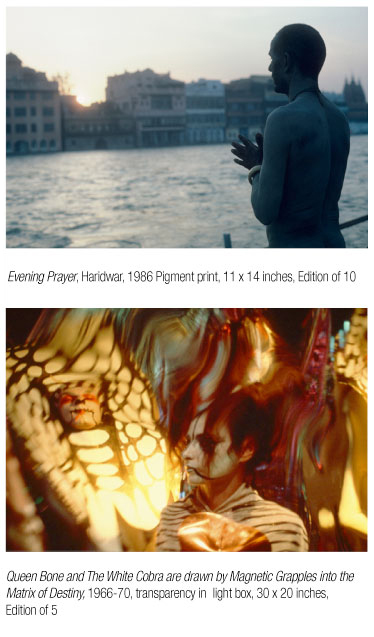
The Cerealart Project Room presents an exhibition of photoworks by poet, photographer, and filmmaker, Ira Cohen.
The exhibition includes five 20 x 30 inch backlit transparencies, from his legendary series "From the Mylar Chamber" which have been celebrated internationally for more than 38 years, displayed in lightboxes, and twenty-two 11 x 14 inch pigment prints from Cohen’s two trips to the Kumhb Mela in India in 1977 and 1986.
Mr. Cohen’s began working in the 1960’s when he built a room in his New York loft lined with large panels of Mylar plastic, a sort of bendable mirror that causes images to crackle and swirl in hypnotic, sometimes beautiful patterns. After a few years experimenting with the technique in photographs, he invited his friends from the downtown scene — like Beverly Grant, Vali Myers, Jim Hendrix, William Burroughs, Angus MacLise and Tony Conrad to have their photos taken. This body of work is known as “Works from the Mylar Chamber”. Two examples of these works are currently included in the Whitney Museum’s “Summer of Love” exhibition. “It’s like going on an ecstatic journey to another planet, full of magical beings, animals and plants,” Cohen said. “It’s a hallucinatory, almost trance-inducing experience.”
For more images and a complete press release please visit www.cerealart.com.
For more infomation please contact Shiya Mangel, 215-627-5060 or shiya@cerealart.com
Exhibition presented with the support of The Ira Cohen Akashic Project (www.iracohen.org) and Saturnalia NYC (www.saturnalianyc.com).
CEREALART 149 North 3rd Street, Philadelphia PA 19106 T. 215.627.5060 / E. info@cerealart.com / www.cerealart.com

