Some notes on a scandal by John Coulthart.
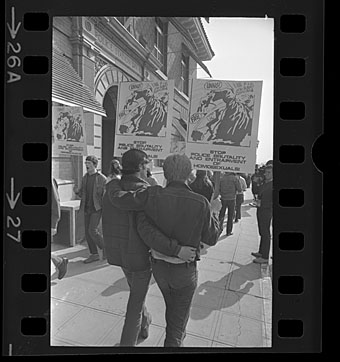
Members of the Gay Liberation Front picketing a
police station in Hollywood, California, 1971.
One of the more notable things about the fallout from Senator Larry Craig’s tap-dancing antics has been the way the affair put a spotlight on a world of clandestine liaisons which a small but often vocal portion of the American populace doesn’t want to know about and wishes would go away forever. What many news reports managed to miss amid the wailing and rending of garments was the significant point that the only societies whose members feel a persistent need for furtive sexual encounters are those that proscribe those encounters and make gay people feel ashamed–or afraid of the repercussions–of their actions.
A number of reports felt the need to explain for readers or viewers unskilled in cultural anthropology how men seeking sex communicate with each other in the restrooms of the nation. ABC News ran a story last week with the title, “Secret Signals: How Gay Men Cruise For Sex“, as though all gay men are the same and we’re all just counting the seconds until our next toilet encounter. (And I see today they’ve finally changed the title to “How Some Men Cruise For Sex”.) What this and other reports lacked in their elaboration of secret signals was any question as to why men would be compelled to go to these lengths in the first place.
Historically, all persecuted groups have sought a way to identify their members without drawing undue attention to themselves, and the lexicon of ambivalent loitering–toe-tapping or otherwise–was evolved by gay men out of necessity, not choice. When you’re part of a minority that outwardly resembles the majority, finding others like yourself presents a problem. When that majority wants to imprison you for loving the wrong gender, as was the case in Europe and the US until very recently–and is still the case in much of the Middle East, Africa and Asia–you can’t exactly walk around in a t-shirt saying “I’m not gay but my boyfriend is.” Hence the need for secret signals, sly glances and out-of-the-way trysts. In this at least, gay men have been no different to early Christians, or to the Catholics in Protestant England who were persecuted to such an extent that “priest holes” were built into many Catholic houses to give local priests a hiding place when fleeing angry Protestant mobs. (The irony of the persecuted becoming future persecutors needs no undue elaboration here.)
Marginal groups of any stripe bond through shared slang and identifying signals. Criminal gangs in 19th century London used “cant” and backslang so they could talk among themselves without fear of their schemes being revealed through eavesdropping. Tradespeople used similar cant expressions of their own and, sure enough, gay men in the capital evolved their own version of cant, partly so as to be able to gossip about other men in public but mostly as a means of extending mutual solidarity. Polari, as the slang was called, spread from gay haunts into the world of backstage theatre and eventually found its way into the wider culture, giving us terms such as “drag” (which originally meant any kind of clothing) and “rough trade”, trade in Polari being a term for sex. The word “naff” is now a commonly-used piece of English slang meaning “crap” or “useless”, common enough even for Princess Anne who once told photographers to “naff off”. I wonder if anyone informed her that “naff” was a Polari acronym for someone you wouldn’t want to have sex with: Not Available For Fucking.
Public toilets in Polari were known as tearooms or cottages, and the word “cottaging” is still a common one among British gay men. Senator Craig’s alleged tearoom encounter with a NAFF police officer lifted the lid for many appalled Republicans on a world which their own attitudes had helped create. In the days when gay sex was a crime or could have severe repercussions, anyone loitering in a public toilet was obviously there to do more than wash their hands, hence the popularity of such places for random encounters. So too with other all-male places such as saunas or bathhouses. As long as society made it difficult for men to have sex with men, gay men had to find their own spaces to meet. Senator Craig continues to protest his innocence but has he stopped to consider during the past few days that maybe–just maybe–the reason restrooms are policed has some connection with attitudes that push gay people to the margins of society, attitudes that his voting record has helped sustain?
Whether they know it or not, closeted men of Senator Craig’s generation who look for sex in toilets are living out an anachronism, acting as though it’s still the 1950s and they have to sneak around out of sight of wives or workmates or voters. This has never been a safe or convenient way of finding sex. John Rechy’s The Sexual Outlaw, a 1977 study of cruising in Los Angeles in the early Seventies, recounts in detail a period within recent memory when police persecution of gay Americans was persistent and often violent. There was more cruising in those days because there were fewer bars and what bars there were often sustained harassing police raids. Away from the big cities, furtive and desperate loitering was all that many men would have known.
None of the young gay men I know today would dream of looking for sex in a public toilet; they meet new guys through MySpace or Facebook, on dating sites like Gay.com or via gay groups at university. If they’re old enough they can go to bars or clubs. Suggesting to a gay guy below a certain age that they ought to go looking for sex in a park or toilet would inspire the same bewildered reaction as you’d receive from a straight guy if you suggested he should go kerb-crawling for hookers at the weekend.
Some gay men do still enjoy cottaging, of course–ask George Michael–not least for the thrill of possibly being caught. The Spartacus International Gay Guide lists cruising sites for travellers and is updated every year; there are many online equivalents of this. For guys with a fetish for married bisexual men (more common than you might think) random sex in public places is a good way to meet the object of your desire. But that’s all it is today, a fetish, just like dressing in rubber or being peed on in a bathtub. Men of Senator Craig’s generation who were unable to fully acknowledge their sexuality find themselves repeating the impulses of a conflicted and miserable youth, often filled with shame and guilt but unable to prevent their actions all the same. It’s quite probable that in twenty years time this kind of activity in Europe and America will be increasingly rare, passing into history just as Polari has passed from use as the need for a secret slang diminished. There’ll still be guys wanting a quick random encounter but why do that in the uncomfortable confines of a toilet stall with a risk of arrest when you can relax in somebody’s home or hotel room?
The other striking feature of the Craig business has been the way it fits a pattern in which Republicans make all the mistakes that plagued the decadent later years of the last Conservative administration in Britain. Thatcher’s regime in the Eighties was just as intolerant as the current GOP (lesbian daughters or no) so the Conservatives looked equally foolish during the outing of Harvey Proctor, Tory MP for Basildon and a man happy to pander to racists and homophobes in his public pronouncements until he was revealed to enjoy spanking sessions with black rent boys.
When John Major was handed Thatcher’s poisoned chalice following her sacking as PM in 1990, he announced a half-baked “Back to Basics” morality campaign for the UK. His moral drive was undermined immediately by a series of scandals involving Conservative MPs who were either having adulterous affairs, siring illegitimate children or taking bribes from lobbyists. Worst of all was the case of Stephen Milligan MP, found dead from auto-erotic asphyxia while tied to his kitchen table dressed in woman’s stockings. The spectacle of the party of morality trying to dictate to the nation while its MPs were behaving like characters in a bed-hopping farce was too much; “Back to Basics” collapsed and the whole sorry episode did much to further reduce the government’s already seriously eroded credibility.
The Blair administration has suffered far less from this kind of sexual damage. Blair’s Labour Party was the first to have openly gay MPs and it was their example, and the consequent indifference of the public to their sexual orientation, which led the way for other MPs–Conservatives included–to declare themselves. It’s often said that where America leads, Britain follows, but this once-homophobic nation has managed to shed its public intolerance far quicker and with considerably less fuss than the United States.
The lesson for Republicans–if they’re capable of learning any lessons by this point–is that lawmakers who don’t have to live a lie are less likely to bring the party into disrepute in airport toilets. But the intractable problem is that it’s impossible to have a party with openly gay members who are then required to vote against the interests of people like themselves, assuming anyone in a Republican state would vote for an openly gay candidate in the first place. Conservatives in Britain recognise now that the homophobic debates of the past are over, the country has moved on and there are more pressing matters to attend to. Much of America is stuck at the place Britain was circa 1982, with those on the right in thrall to the tiny percentage of the population who find their moral precepts by cherry-picking Leviticus.
Senator Larry Craig exemplifies the dilemma: repeatedly accused of gay activity but unable to ever admit anything, especially after his anti-gay voting record. He claims his tearoom signals were misinterpreted and seems now to have changed his mind about his resignation. Maybe the quantum superposition he exists in–gay or not? resigned or not?–isn’t the dithering of a man in a state of panic, maybe he’s simply large, like Walt Whitman, and contains multitudes.
And speaking of America’s greatest gay poet, Whitman himself struggled with his sexuality for many years until he was able to write in Starting from Paumanok:
I will sing the song of companionship,
I will show what alone must finally compact these,
I believe these are to found their own ideal of manly love,
indicating it in me,
I will therefore let flame from me the burning fires that were
threatening to consume me,
I will lift what has too long kept down those smouldering fires,
I will give them complete abandonment,
I will write the evangel-poem of comrades and of love,
For who but I should understand love with all its sorrow and joy?
And who but I should be the poet of comrades?
Not for the first time, politicians might learn something from poets.



