War as a perversion of sex.

“War is a perversion of sex. You only have to look at things like the language of war, any of these excitable young American pilots coming back from bombing Libya, and they’re saying: ‘Yeah, we shot our missiles right up their back door.’ Homoerotic. They will also, just before they attack somewhere, generally launch a sort of propaganda campaign saying the enemy is a homosexual… They have to make him into a woman. The Ayatollah Khomeini: ‘Oh yeah, he likes little boys,’ that’s what we were saying just before we bombed the shit out of Iran, or were going to, or that Colonel Gadaffi: ‘He dresses up as a woman,’ this was the CIA rumor put around just before we bombed Tripoli…there’s a lot of connections between war and eroticism.” — Alan Moore interview, 2002

Friday, February 4, 2005 Posted: 11:02 AM EST (1602 GMT)

WASHINGTON (CNN) — A three-star Marine general who said it was “fun to shoot some people” should have chosen his words more carefully, the Marine Corps commandant said Thursday.
Lt. Gen. James Mattis, who commanded Marine expeditions in Afghanistan and Iraq, made the comments Tuesday during a panel discussion in San Diego, California.
“Actually it’s quite fun to fight them, you know. It’s a hell of a hoot,” Mattis said, prompting laughter from some military members in the audience. “It’s fun to shoot some people…You go into Afghanistan, you got guys who slap women around for five years because they didn’t wear a veil. You know, guys like that ain’t got no manhood left anyway. So it’s a hell of a lot of fun to shoot them.

Mattis’ press office has not yet responded to a request to answer questions about his comments.

However, the Marine commandant, Gen. Michael Hagee, defended Mattis, calling him “one of this country’s bravest and most experienced military leaders.”

Penance for his Pentagon work…

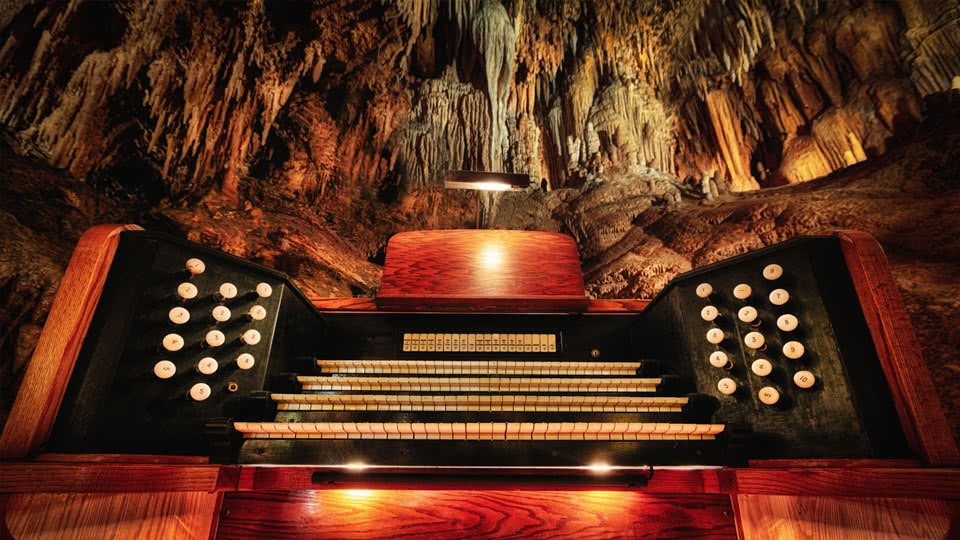
“Located in the Cathedral, the Great Stalacpipe Organ is the world’s largest musical instrument.
Stalactites covering 3 1/2 acres of the surrounding caverns produce tones of symphonic quality when electronically tapped by rubber-tipped mallets. This most unique, one-of-a-kind instrument was invented in 1954 by Mr. Leland W. Sprinkle of Springfield, Virginia, a mathematician and electronic scientist at the Pentagon. He began his monumental 3 year project by searching the vast chambers of the caverns selecting stalactites to precisely match a musical scale. Electronic mallets were wired throughout the caverns and connected to a large four-manual console. When a key is depressed, a tone occurs as the rubber-tipped plunger strikes the stalactite tuned to concert pitch.
“Today, the organ is played by activating an automated system which works in a manner similar to a child’s music box. The organ is also fully capable of being played manually from the console, as Leland Sprinkle did for many years.”

COURTESY PETER R.!

Spiritualism and art…

The Spiritual in Art: Abstract Painting, 1890-1985
Edited by Maurice Tuchman

Around 1910, groups of artists moved away from representational art toward abstraction, preferring symbolism. They made an effort to draw upon deeper and more varied levels of meaning, the most pervasive being spiritualism. This book demonstrates that the genesis and development of abstract art were inextricably tied to spiritual ideas current in Europe in the late 19th and early 20th centuries. Sixteen essays explore such topics as music, romanticism, mysticism, and the occult and their relationship to abstract art. Among the many artists discussed are Kandinsky, Munch, Redon, Arp, Klee, O’Keeffe, Mondrian, and Marsden Hartley.

1986, 436 pages, 523 illustrations (122 in full color), 10 1/2 x 10 1/2 inches.
Paper, ISBN: 0875871305

Paradise on earth.

From Robert Fripp’s online diary:

In this morning’s e-box, a letter from Jason Elliot. Jason is the author of An Unexpected Light, on his journeying in Afghanistan. We [recently] discussed a building Jason has discovered in Persia (ie Iran) while researching his current book.

“A note on the theme of the monument I mentioned.

“This ‘discovery’, along with one or two others, fills me with a private kind of excitement, but I am not at all sure who I may be able to usefully share it with, or to what purpose.

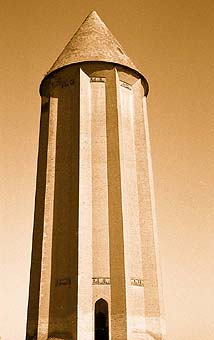
“But in brief: in northern Iran stands a celebrated tower, built entirely from brick and dating from the twelfth century, which commemorates the rule of a local monarch. It is generally thought of as a sort of folly, and indeed rather resembles an English one, though it is far more ancient and generally held up as an architectural marvel and something of an anomaly, if not a work of genius. I attach a photo I took. But that is about all, conventionally. It is publicly accessible but, being empty inside, is not used for anything at present.

“However… even from the exterior, the configuration of the structure reveals an advanced understanding of acoustics. At a distinct point about twenty metres from the entrance, one’s voice is unmistakably reflected to one’s ears, as though amplified, in a most disturbing (to me!) fashion; and inside – well, yes, it’s empty, but what an emptiness! I’d often wondered, from a distance as it were, what the place might have been for. And last year, when I was visiting for the second time, out of curiosity I sang the lines from La Boheme when Rodolfo seizes Mimi’s freezing hand in the darkness… and it knocked my socks off.

“The sound generated was truly extraordinary. I might have been Pavarotti. My voice was taken upwards, swirled around, and returned, resonant and purified. I was with two friends; we froze on the spot. I had never heard such sound. It is very hard to describe; a real voice would have sounded heavenly. It really went into our bones, and left us stunned. Nothing I have heard came close to it. The latest digital mixer couldn’t have done a more sublime job. It dawned on me then that such acoustic genius could not have been accidentally created, and I am convinced that the building was used for musical sessions long ago. There is nothing inside but a circular stone platform at the base, where people used to sit; and suddenly it took on new meaning.

“So, my experience there confirms what I have encountered in writing about Iran and aspects of Persian culture; namely that in essence Persian music is all connected with the idea of Paradise and its intimations here on Earth; and they knew how to make you feel you’ve died and gone to Heaven. Until recently there was no such thing as ‘popular’ Persian music as this was confined to the (formerly) royal and intellectual elite. But to mention the very word ‘music’ is problematic in the sense of what music is designed to achieve, since we are mostly trained to think of music as a sort of recreation.

“Iranian music and poetry are closely allied; purely instrumental music is very specific, and, traditionally at least, all melodies are associated with the different seasons, human temperaments, and times of day or night. A kind of mathematical correspondence links these genres. You could say that in traditional music there are three fundamental variations: orderly melodic progressions; single note-centred music that orbits as it were around a single source and eventually returns to it; and astonishingly complex rythmic or arhythmic compositions designed to overwhelm the mind by their intensity. If I had another lifetime I would investigate the geometry of these tonal systems. Until virtually yesterday I believed there was only one: ie european diatonic…

“But the goal is all the same: to coax the soul into a state of longing for the Real.

“And it strikes me as likely that the building in question was used as a musical forum. The only comparable site I know personally is Thoronet Abbey near Provence, which demonstrates exceptional resonance. Such things are seldom accidental; but the European dimension has been competently investigated already.

“There is another structure in Isfahan where the elaborate, hollowed out spaces in the walls have been put forward as resonating chambers, again for royal musical sessions. The point is that the people of the era knew what they were doing.

“I am sure one day the tower’s acoustic/harmonic properties will be rediscovered, and people will flock there. But not quite yet. Meantime, everyone from Caruso to Sting can eat their hearts out because for a moment I sounded better than all of them………”

"It was the house that changed me from the cheerleader to the hippie."

Frank Zappa’s notorious home in Laurel Canyon goes up for sale after 30 years. Alice Cooper, Eric Burdon, John Mayall, Pamela Des Barres, and members of the Mothers of Invention remember the days.

The Rock and Roll Treehouse
by Jack Boulware

It‚Äôs 1968, at the Laurel Canyon Country Store in the Hollywood hills. Drummer Ansley Dunbar meets a 15-year-old hippie chick named Pattie and asks if she wants to go to a party at Frank Zappa?جø¬?s house. They pull into a driveway of an old log cabin. People are wandering in and out of an enormous 70-foot living room. In the basement, musicians take turns bowling on a Day-Glo painted bowling alley. The adjoining guest house sports a duck pond and two trees growing out of the living room. Couples are huddled in artificial caves built into the hillside. Someone tells her the cabin was once the house of movie cowboy Tom Mix, and that Harry Houdini used to live across the street. Pattie looks around at the outrageously dressed girls, taking care of a baby named Moon Unit, and the cute young guys playing guitars, and realizes she‚Äôs inside the epicenter of the Laurel Canyon music scene.

“Mick Jagger was there,” she now recalls. “A couple guys from the Animals. Mark Lindsay from Paul Revere and the Raiders. Alice Cooper. Janis Joplin. Roger McGuinn and Mike Clarke from the Byrds. Brian McLain and Arthur Lee, who were in Love. Another band in L.A. called the Seeds. Andy Summers. Sam Andrew was there, from Big Brother. John Mayall. Mick Taylor—he was the only one my age.”

Pattie O’Neal pauses to think back. “The Cowsills, the prototype wholesome family? One or two of the older Cowsill guys were there,” she says. “They were really stoned, they looked terrible!”

In the late 60s, this house was the premier stop of Los Angeles rock and roll. After 35 years, the log cabin is long gone, but amazingly, the treehouse is newly renovated and on the real estate market. For a cool $2.4 million someone can own a slightly fuzzy slice of history.

As a caretaker gives me a tour, pointing out such erroneous information as the spot where gunfighter Wyatt Earp supposedly died, I am reminded of the Hollywood dance between fact and rumor. It isn?جø¬?t unusual for an address to have a rich lineage. Every third house seems to be once owned by somebody with screen credits, even if it was only the second unit director on ‚ÄúLand of the Pharoahs.‚Äù The Canyon is singular in this regard. Since the 1920s, the nouveau riche have scurried up into the hills to hide, from Bugsy Siegel to W.C. Fields, Robert Mitchum, Robert Heinlein, Harry Houdini, and current celebrities like Julian Lennon and Julianne Moore. It‚Äôs quiet, woodsy, and less than a mile from Sunset Boulevard.

But 2401 Laurel Canyon Boulevard in particular has retained an unusual fondness. According to Tom Mix historian Boyd Magers, the log cabin was constructed back in 1915, as a masculine retreat for wealthy men to escape their women and smoke and drink in peace. Its highlight was an 80-foot living room, with floor-to-ceiling stone fireplace. Tom Mix lived here briefly, a fun-loving movie cowboy who for a time cashed Hollywood’s biggest checks. After Mix moved to Beverly Hills, the cabin was rented for several decades.

As the 1960s washed over Los Angeles, the ripple of fuck-you new money began seeping into the canyon, young people with record contracts and reefer smirks. When architect Robert Byrd needed a place to live between marriages, his son Gary helped him build a small house just behind the Tom Mix log cabin, then vacant. Gary Byrd recalls when clearing the property, the father and son discovered “one of the Barrymore kids” living inside a shack. The following year, a communal family of weirdos moved into the cabin and treehouse, centered around two underground hipsters named Vito Paluekas and Carl Franzoni, organizers of freeform dance troupes at clubs along Sunset Strip. The dancers wore freaky clothing, and flopped and pogoed alongside bands like the Byrds and the Mothers of Invention.

One night a young Pamela Des Barres followed the so-called “Zappa dancers” to a party at the Log Cabin. In those days, Franzoni was known as Captain Fuck. “He wanted to fuck everybody,” remembers Des Barres, now the elder spokeswoman of rock groupies. “He had this long tongue, and wore a cape with a big “F” on the back. He was standing in the doorway, with big pink curlers clamped in his pubic hair.”

“We had dances there,” says Carl Franzoni, still chasing young girls in northern California. “We had lots of rehearsals.” He adds slyly, “It was a fuck scene, too.”

In 1967 the Zappa dancers split their rent with staff from the hippie publication The Oracle. Retired journalist John Bilby recalls at least 36 people living and partying at the Log Cabin and treehouse, including the band Fraternity of Man. “Tim Leary was definitely there, George Harrison and Ravi Shankar were there,” Bilby says. “The psychedelics that were being taken. They were fucking right out there on the grounds, a thousand miles from civilization.”

In the spring of 1968, The Oracle moved out, and Frank Zappa moved in, fresh from an extended gig in New York. His bizarre, satirical synthesis of Spike Jones and Edgar Varese, combined with a guitar virtuosity and serious business acumen, attracted a parade of curious visitors like Paul Butterfield, Eric Clapton, and Jimi Hendrix. Among Zappa’s many projects was producing the GTOs, a band made up of groupies hanging around the cabin.

“We were sitting in the living room,” remembers Des Barres. “I remember Frank telling us ‘You should be a band. How would you girls like to be in a band?’ He sat us down in the basement. We made lists of the rock stars we wanted to meet, and wrote the album down there.”

One house guest was John Mayall, who had just broken up the Bluesbreakers and was taking in the Los Angeles scene. The strange-looking GTO girls made a lasting impression. “Obviously flamboyant comes to mind,” Mayall chuckles. “Quite a shock to see for a person visiting from England.” Mayall recovered sufficiently to record songs both about Zappa’s cabin and the rigors of venereal disease.

Between guests, Zappa held auditions for his Bizarre and Straight record labels. One band from Phoenix, Alice Cooper, had been turned down by every record company and was going nowhere in a hurry. Fortunately, Cooper was dating Zappa‚Äôs babysitter, and so Zappa agreed to hear Cooper‚Äôs band at the cabin at 7 o’clock.

“We were so excited we got there at seven in the morning,” says Cooper. “We set up in the living room and started playing our set. Frank came down the stairs with a cup of coffee, and he goes, ‘What the hell are you doing?’ You said seven. ‘Seven at NIGHT.’ So he listened to about four songs and he’s, ‘Okay okay, you’re signed, I’ll sign you.’”

A young guitarist named Bill Harkleroad, aka Zoot Horn Rollo, showed up to audition for Captain Beefheart, and saw members of the Stones, the Who, the Mothers, studio musicians and about 25 others all wandering about. ‚ÄúWithin a few minutes I’m in a jam session with Frank, Don Vliet, Mick Jagger, Art Tripp,‚Äù says Harkleroad. ‚ÄúFrank and Don were my rock world heroes.‚Äù He was so nervous he could only play a few notes.

Alice Cooper recalls another Jagger visit, when the Stone showed up inebriated with girlfriend Marianne Faithfull, and the straight-edge Zappa kicked them both out of the house.

“I was sitting there, just a kid hanging out to record,” says Cooper. “And I went, ‘Frank Zappa just threw Mick Jagger out of his house—because he’s drunk.’ To me, thats so far in another universe that I couldnt even believe it.”

One of Zappa’s canyon neighbors was Eric Burdon, whose first memory of the house concerns borrowing a motorcycle from Jimmy Carl Black of the Mothers of Invention. Black threw in a bonus: a few lines of speed. Burdon says, “I was so stoned that I was heading north on Pacific Coast Highway before I remembered you have to put gas in the machine, and I ran out of gas and was stranded. I spent the night on the beach, freezing cold. I got back and saw Jimmy and he said, “Good stuff?”

The word was out: Laurel Canyon was where it was at. Groovy scenes blossomed at the homes of Joni Mitchell, the Byrds, the Monkees, Mama Cass. Passers-by gawked at the Log Cabin out of car windows. “It was omnipresent,” says former Mothers drummer Denny Bruce. “If you lived in the valley and came into Hollywood, you’re coming over Laurel Canyon, so every jerk from the valley—‘Heyyy mannn, there’s Frank Zappa’s pad.’”

Tired of the attention, the Zappas moved out after just six months. Log Cabin parties continued with new tenants. But the canyon was experiencing a seismic shift in music and drugs du jour. Along with ‘70s blue-jean millionaires like Fleetwood Mac and the Eagles came an underbelly of junkies and squatters. The Cabin and treehouse scene grew creepy. “They were kind of rave parties,” recalls DJ Rodney Bingenheimer. “Weird black lights, stuff like that. People were stoned and out of it.”

The darkness coalesced on Halloween morning 1981, when the Log Cabin mysteriously caught fire. Some said it started from a banjo player’s cigarette, other claimed it was a drug lab explosion. As helicopters hovered over the blaze, police roped off the property and a crowd watched it burn to the ground. Only the treehouse was saved. Some, like Pamela Des Barres, poked through the rubble. Others simply drove past, like Alice Cooper, not wanting to think about it.

When music producer Bob Crosby rented the property in 1984, he discovered drums and drumsticks stuffed into the cabin’s still standing fireplace chimney. “Down in the basement, one of the walls had signatures from the Stones, Eric Burdon and the Animals, John Sebastian and the Loving Spoonful,” he says. Hundreds of people still dropped by each Halloween, expecting a raging party. Crosby said no parties, and raised his family.

In 1999 the property was purchased by Mike Slarve, owner of a fleet of rock tour buses, and manager of Black Sabbath drummer Bill Ward. Slarve has spent the past three years renovating the treehouse and grounds, and has seen dozens of characters wandering over to tell their stories. Between Captain Fuck, Harry Houdini, and the Manson Family, Slarve has heard just about everything. ‚ÄúYou don‚Äôt know if they’re completely insane or they‚Äôre telling the truth,‚Äù he says. ‚ÄúIt kind of lights up everybody‚Äôs imagination.‚Äù

Pattie O’Neal now lives a block from the treehouse, and drives by each day on her way home. “It’s so bizarre,” she says. “I don’t think a day goes by that I don’t turn there and think about it. It was the house that changed me from the cheerleader to the hippie.”

(First published in Mojo magazine)

SOUND MIRRORS.

“Sound Mirrors or reflectors were first built in the 1920’s as an early warning system that listened for the sound of airplane engines. A concrete bowl shaped reflector focused the sound waves onto a microphone at the focus of the bowl in much the same way that a satellite dish works with radio waves. Many different sizes and types were tried in an attempt to get that vital early warning of attack by enemy planes, but the system was rendered obsolete by the advent of Radar.
“The pictures above were taken at various times and locations, mostly on the South Kent Coast.”

COURTESY JOHN C>!

Not knowing your rights.

From the Jan 31, 2005 USA TODAY:

U.S. students say press freedoms go too far
By Greg Toppo, USA TODAY

One in three U.S. high school students say the press ought to be more restricted, and even more say the government should approve newspaper stories before readers see them, according to a survey being released today.

The survey of 112,003 students finds that 36% believe newspapers should get “government approval” of stories before publishing; 51% say they should be able to publish freely; 13% have no opinion.

Asked whether the press enjoys “too much freedom,” not enough or about the right amount, 32% say “too much,” and 37% say it has the right amount. Ten percent say it has too little.

The survey of First Amendment rights was commissioned by the John S. and James L. Knight Foundation and conducted last spring by the University of Connecticut. It also questioned 327 principals and 7,889 teachers.

The findings aren’t surprising to Jack Dvorak, director of the High School Journalism Institute at Indiana University in Bloomington. “Even professional journalists are often unaware of a lot of the freedoms that might be associated with the First Amendment,” he says.

The survey “confirms what a lot of people who are interested in this area have known for a long time,” he says: Kids aren’t learning enough about the First Amendment in history, civics or English classes. It also tracks closely with recent findings of adults’ attitudes.

“It’s part of our Constitution, so this should be part of a formal education,” says Dvorak, who has worked with student journalists since 1968.

Although a large majority of students surveyed say musicians and others should be allowed to express “unpopular opinions,” 74% say people shouldn’t be able to burn or deface an American flag as a political statement; 75% mistakenly believe it is illegal.

The U.S. Supreme Court in 1989 ruled that burning or defacing a flag is protected free speech. Congress has debated flag-burning amendments regularly since then; none has passed both the House and Senate.