
Preview of Metallic Spheres, a new album from The Orb featuring David Gilmour, out October 12…
Category Archives for Uncategorized
October 3 Autonomedia Jubilee Saint — Woody Guthrie

OCTOBER 3 — WOODY GUTHRIE
American folk singer, composer, rebel free spirit.
Woody Guthrie, “Ranger’s Command.” One of two surviving film clips of Guthrie performing.
ALSO ON OCTOBER 3 IN HISTORY…
1226 — Pantheistic social revolutionary Francis of Assisi dies, Assisi, Italy.
1838 — Chief Black Hawk, Native American leader, dies.
1896 — British socialist designer William Morris dies, Kelmscott House.
1900 — American novelist Thomas Wolfe born, Asheville, North Carolina.
1925 — American writer Gore Vidal born, West Point, New York.
1967 — Radical American folk singer Woody Guthrie dies, New York City.
The Yellow Bittern, the Life and Times of Liam Clancy
Ian Nagoski writes:
THE YELLOW BITTERN, a new feature documentary from Alan Gilsenan, is an intimate, confessional yet highly cinematic film charts the remarkable rise to fame of the Clancy Brothers and Tommy Makem from their small-town beginnings in County Tipperary in Ireland to the folk hey-day of Greenwich Village in the Sixties where they absorbed black musical influences and out-sold the Beatles. But these devil-may-care Irish actors (as they were then) were, in turn, to influence a host of artists from Bob Dylan and Pete Seeger to The Pogues. But this darkly revealing portrait also goes behind the mask of the performer and delves into the psyche of Liam Clancy and his troubled personal life where the excesses of rock-and-roll found their way in to the world of folk.
Find out more at liamclancyfilm.com/
SOME SIMES FOR YOU
A few drawings by Sidney Sime (1867-1941), from a much larger selection posted by the generous folk over at Golden Age Comic Book Stories…
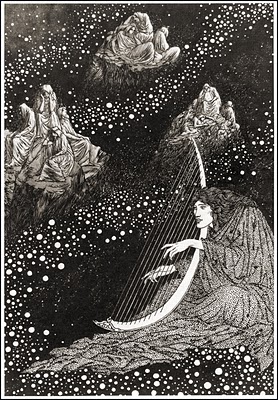

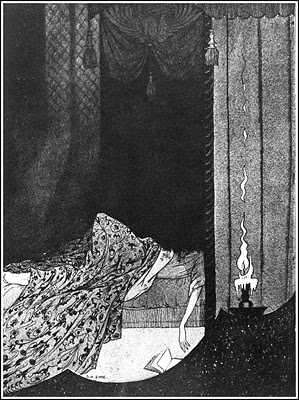
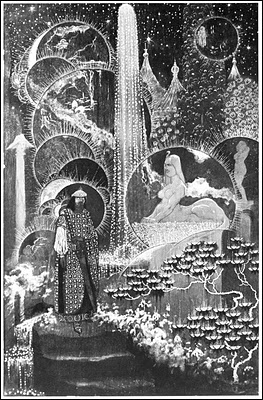
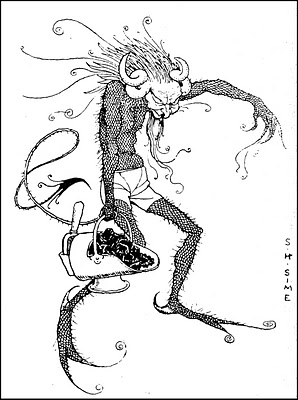
*** EPIC ***
This video just surfaced. “Why the Fly” 10 minutes, live in Frankfurt, 2001 by Masters of Reality in that special Chris Goss-Joshua Homme-Nick Oliveri formation
New partytime hook-filled rock 'n' roll music: NOBUNNY


Download: “Motorhead With Me” — Nobunny
[audio:http://www.arthurmag.com/magpie/wp-content/uploads/2010/09/Nobunny-MotorHead-With-Me.mp3%5D
This here song is on the new, insta-classic Nobunny album First Blood, from the great Goner Records of Memphis, Tennessee. [Note: Looks like Goner is down for Gonerfest, try Midheaven instead.] It’s also the B-side to a new 7-inch from Hozac Records of Chicago, whose hype text from for this is so good/accurate that it’s pointless to write our own. Here it is:
Just as the rest of the modern world is warming up to the fuzzy pop nightmare of Nobunny’s debut LP, we’ve got the follow-up 7″ with two brand new songs that will bring back that virginal feeling “down there” and reinstate your faith in humanity. Sunshine Ramones pop run through a Kim Fowley diarrhea daydream that will have you mesmerized by it’s simplicity, and won over before the end of the chorus on the first side. Two more stone-cold classic Nobunny songs that’ll stick with you through the hard times and with laden with hooks so infectious that you’ll have to have them surgically removed from your brain.
NEW PSYCHEDELIC CANTINA ROCK MUSIC: The Growlers

Download: “Underneath Our Palms” – The Growlers
[audio:http://www.arthurmag.com/magpie/wp-content/uploads/2010/09/09-Underneath-Our-Palms.mp3%5D
This is a song off the brand new 10-track Hot Tropics EP from Long Beach, California’s The Growlers, a surf/bodega/cantina garage-rock band fronted by a bleached moptop (or was that a wig??) para-poet. Cool sound, intriguing lyrics, great vibe…DIG IT!
Fantômas!

REIGN IN BLOOD
The secret mark that French pulp villain Fantômas left on the 20th Century
By Erik Morse
Early in 1911 popular French publishing house Fayard released the first of 32 monthly serial novels of Marcel Allain and Pierre Souvestre’s Fantômas. Subtitled ‘A Shadow on the Guillotine,’ this ultra-violent pulp tale recounted the exploits of the eponymous master villain as he reined blood and magick upon the boulevards of Paris. Pursued by police inspector, Juve, and his journalist sidekick, Jerome Fandor, Fantômas slaughters members of French high-society indiscriminately before stealing away with their wealth and, often, their very identities—in his travels between the Dordogne and Paris, Fantômas dispatches the Marquise de Langrune, her steward Dollon, Lord Beltham, Princess Sonia Danidoff, the famed actor Valgrand and a passenger liner full of travelers en route to South America. When Fantômas, alias Etienne Rambert, alias Gurn, is apprehended by Juve at Lady Beltham’s villa, he is brought to trial at the Palais de Justice, found guilty of murder and condemned to the guillotine. However with the aid of his mistress, Fantômas steals away from his Santé prison cell and fills the vacancy with an unsuspecting look-a-like who is left to the blade. When Juve discovers the ruse, he proclaims, “Curses! Fantômas has escaped! Fantômas is free! He had an innocent man executed in his place! Fantômas! I tell you, Fantômas is alive.”
Within months of its February debut, the Fantômas serial became a pop smash with the reading public, profiting no doubt from the French public’s unquenchable thirst for violence, mayhem and pulp. At 65 centimes a copy, sales for each volume reached easily into the hundreds of thousands. American poet and Fantômas enthusiast John Ashbery contends that the real success of the serial was its transcendence of class, education and sex, from “Countesses and concierges; poets and proletarians; Cubists, nascent Dadaists, soon-to-be-Surrealists. Everyone who could read, and even those who could not, shivered at posters of a masked man in impeccable evening clothes, dagger in hand, looming over Paris like a somber Gulliver, contemplating hideous misdeeds from which no citizen was safe.” Such was the popular reaction to the Fayard publication, Marcel Allain would later recall, with some hyperbole, “The adventures of Fantômas have surpassed those of the Bible.”
Nearly a hundred years later, we can see the frightening metastasis of the master of crime’s “brand”—from his beginnings amongst the Right Bank sophisticates who released him upon the world, to the marauding gangs plundering and murdering in his name, to the sacrificial cults who would congregate at the witching hour to reenact his sins. His transgressions—bold, fiendish and inexplicable—were the narratives of nightmares. Fantômas captured the imagination of his admirers and extended his influence through the artistic genealogies of Europe, leaving a catechism of excess, debauchery and violence to a brood as varied as Pablo Picasso, Andre Breton, Jean Cocteau, Georges Bataille, Alain Robbe-Grillet, James Joyce, Guillaume Apollinaire, Robert Desnos, Jean Marais, Alain Resnais, René Magritte, Francois Truffaut and the Mike Patton-Buzz Osbourne-Trevor Dunn-Dave Lombardo art-rock superband of the same name. In their major contributions to the century, the words and deeds of France’s supreme villain pullulate still more revolutionary achievements and still darker crimes.
Here, in this extended fait-diver, is the unedited, uncensored and untold history of the criminal of the century…
This article continues, for 9,500 more words, in Arthur No. 28 (March 2008)
From Chico, California…
I lucked into seeing a singer-songwriter-guitarist named Erin Lizardo perform a set of quietly enchanting songs last fall in a small pizzeria/coffeehouse in Chico, California, where she lives. Here’s a video she’s made since then.
More: erinlizardo.com
LOOKING FOR MUSHROOMS by Bruce Conner (1967)

From The Sound of Eye:
Looking for Mushrooms
Director: Bruce Conner
Year: 1967
Time: 13 mins
Music: Terry Riley
Expecting a nuclear disaster, Conner moved down to Mexico in 1962, where he spent his time looking for mushrooms with Timothy Leary. Later, Conner added footage of similar hunts in Frisco and in 1997 he decided to set it against a 1968 Terry Riley soundtrack. The result is a strange combination of typical ’60s psychedelic editing with what might appear to be a road movie interested in exotic landscapes. A classic of American avant film.
Download available from The Sound of Eye
 Arthur Magazine