KARIN AND ALIASS ARRIVE IN OAK RIDGE…

11 JULY 2002: KARIN AND
ALIASS ARRIVE IN OAK RIDGE…

Karin Bolender and her donkey
Aliass,


a member of the American
Council of Spotted Asses Inc.,


visited the American Museum
of Science and Energy


Tuesday on their two-day
stop in Oak Ridge.

Quest
brings artist/writer to OR


by Beverly Majors

Oak Ridger staff

Karin Bolender and her friend,
Aliass, stopped in Oak Ridge Tuesday and could be seen Wednesday traveling
toward the Museum of Appalachia in their quest for imagination.

Bolender and Aliass, a donkey,
started their quest in Oxford, Miss., the home of William Faulkner, and
will end their journey in about three weeks in Roanoke, Va.

Bolender said she started
her “literary pilgrimage” after the Sept. 11 terrorist attack on the World
Trade Center. She is a writer who lived about an hour outside of New York
but worked inside the city. On Sept. 9, she had decided to move to Portland,
Ore., and was in the Badlands of Nebraska when she heard about the attack.

She calls her pilgrimage
“an urgent manifestation of the imagination.” and said she has learned
a lot about people and, along with Aliass, has helped open up some people’s
imaginations. She said she has had to turn down invitations from people
wanting to give her a place to sleep.

In Oak Ridge she has visited
the American Museum of Science and Energy and the International Friendship
Bell. She said she decided to stop here because of her interests in the
“historical aspects of Oak Ridge.”

She said she learned of Oak
Ridge from her grandfather, who flew over the “Secret City that was not
on any maps” during the early World War II years while he was in the military.

Bolender said her next stop
will be Knoxville, home to two of her favorite authors, James Agee and
Cormack McCarthy.

“I plan to cross the border
at Bristol,” she said. “I have only three more weeks because Aliass is
due to foal.”

HOW CORPORATE AMERICA SUPPORTS SPAM.

10 JULY 2002: HOW CORPORATE
AMERICA SUPPORTS SPAM.

From the New
York Times
:

“Brightmail says the volume
of spam it encounters has almost tripled in the last nine months
. The
company adds that 12 to 15 percent of total e-mail traffic is spam; a year
ago, that figure was closer to 7 percent. Brightmail, which maintains a
network of In boxes to attract spam, now records 140,000 spam attacks a
day, each potentially involving thousands of messages, if not millions.

Statistics like these are
supported by anecdotal evidence from computer users, who report that they
are seeing more unwanted e-mail every time they log on. Hounded by spam,
some computer users have simply abandoned e-mail addresses…

Ideally, consumer advocates
want the spam equivalent of the 1991 federal Telephone Consumer Protection
Act, which prohibited prerecorded telemarketing calls and junk faxes. The
trade commission was also given power to enforce the legislation.

A broad anti-spam law has
been approved in Europe. On May 30, the European Parliament passed a ban
on unsolicited commercial messaging. Electronic marketing can be aimed
only at consumers who have given prior consent.

In contrast, more than a
dozen spam-related bills have been introduced in Congress over the last
two years, and most of them have languished. Of the handful that have made
progress, the most recent is the Controlling the Assault of Non-Solicited
Pornography and Marketing act (a contorted title that yields the acronym
Can Spam), which was unanimously approved by the Senate Commerce Committee
last month. The Can Spam bill would, among other things, let the F.T.C.
impose civil fines up to $10 per unlawful message, require valid “remove
me” options on all e-mail and authorize state attorneys general to bring
lawsuits.

Now it must be voted upon
by the full Senate, and two other independent spam bills are moving slowly
through the House of Representatives. But interest groups are lobbying
to tone down the strongest aspects of spam legislation.

Those lobbyists are not
spammers. They are some of the country’s largest corporations and commercial
associations: Citicorp, Charles Schwab, Procter & Gamble, the National
Retail Federation, the Securities Industry Association and the American
Insurance Association. The groups argue that many of the bills would unfairly
restrict e-mail marketing and put electronic commerce at a disadvantage.

“We would like the bill narrowed
so only pornographic, fraudulent and deceptive spam are targeted,” said
John Savercool, the vice president of federal affairs for the American
Insurance Association. “We think that is where the consumer angst is.”

But Senator Conrad Burns
of Montana, a Republican sponsor of the Can Spam bill, says that consumer
frustration goes beyond pornography and fraud. “I get enough applications
for credit cards, offers to consolidate my debt and advertising for Viagra
in my mailbox,” he said. “I don’t need it on my computer too.”

Walter Benjamin on the flâneur

09 JULY 2002: Walter
Benjamin on the flâneur

FROM “FRAGMENTS
OF THE PASSENGWERK”
:

“There was the pedestrian
who wedged himself into the crowd, but there was also the flâneur
who demanded elbow room and was unwilling to forego the life of the gentleman
of leisure. His leisurely appearance as a personality is his protest against
the division of labour which makes people into specialists. it was also
his protest against their industriousness. Around 1840 it was briefly fashionable
to take turtles for a walk in the arcades. the flâneurs liked to
have the turtles set the pace for them.” 1938

“The street becomes a dwelling
for the flâneur; he is as much at home among the facades of houses
as a citizen is in his four walls. To him the shiny, enamelled signs of
businesses are at least as good a wall ornament as an oil painting is to
the bourgeois in his salon. The walls are the desk against which he presses
his notebooks; news-stands are his libraries and the terraces of cafés
are the balconies from which he looks down on his household after his work
is done.”1938

“The crowd was the veil from
behind which the the familiar city as phantasmagoria beckoned to the flâneur.
In it, the city was now landscape, now a room. And both of these went into
the construction of the department store, which made use of flânerie
itself in order to sell goods. The department store was the flâneur’s
final coup. As flâneurs, the intelligensia came into the market place.
As they thought, to observe it – but in reality it was already to find
a buyer. In this intermediary stage…they took the form of the bohème;.
To the uncertainty of their economic position corresponded the uncertainty
of their political function.” 1935

“These writings were socially
dubious, too. The long series of eccentric or simple, attractive or severe
figures which the physiology presented to the public in character sketches
had one thing in common: they were harmless and of perfect bonhomie. Such
a view of one’s fellow man was so remote from experience that there were
bound to be uncommonly weighty motives for it. The reason was an uneasiness
of a special sort. People had to adapt themselves to a new and rather strange
situation, one that is peculiar to big cities. Simmel has felicitously
formulated what was involved here. ‘Someone who sees without hearing is
much more uneasy than someone who hears without seeing. In this there is
something characteristic of the sociology of the big city. Interpersonal
relationships in big cities are distinguished by a marked preponderance
of the activity of the eye over the activity of the ear. The main reason
for this is the public means of transportation. Before the development
of buses, railroads and trams in the nineteenth century, people had never
been in a position of having to look at one another for long minutes or
even hours without speaking to one another’.”1938

“On his peregrinations the
man of the crowd lands at a late hour in a department store where there
are still many customers. He moves about like someone who knows his way
around the place…If the arcade is the classical form of the intérieur,
which is how the flâneur sees the street, the department store is
the form of the intérieur’s decay. The bazaar is the last hangout
of the flâneur. if in the beginning the street had become an intérieur
for him, now this intérieur turned into a street, and he roamed
through the labyrinth of merchandise as he had once roamed through the
labyrinth of the city…The flâneur is someone abandoned in the crowd.
in this he shares the situation of the commodity.”1938

THANKS TO JOHN C.!

JANIS IAN ON MUSICIANS AND THE INTERNET

THE INTERNET DEBACLE – AN ALTERNATIVE VIEW

Originally written for Performing
Songwriter Magazine
, May 2002

* Shortly after this article
was turned in, Michael Greene resigned as president of NARAS.


 “The Internet, and downloading, are here to stay… Anyone who thinks otherwise should prepare themselves to end up on the slagheap of history.” (Janis Ian during a live European
radio interview, 9-1-98)   *Please see author’s note at end!

When I research an article,
I normally send 30 or so emails to friends and acquaintances asking for
opinions and anecdotes. I usually receive 10-20 in reply. But not so on
this subject!

I sent 36 emails requesting
opinions and facts on free music downloading from the Net. I stated that
I planned to adopt the viewpoint of devil’s advocate: free Internet downloads
are good for the music industry and its artists.

I’ve received, to date, over
300 replies, every single one from someone legitimately “in the music business.”

What’s more interesting than
the emails are the phone calls. I don’t know anyone at NARAS (home of the
Grammy Awards), and I know Hilary Rosen (head of rhe Recording Industry
Association of America, or RIAA) only vaguely. Yet within 24 hours of sending
my original email, I’d received two messages from Rosen and four from NARAS
requesting that I call to “discuss the article.”

Huh. Didn’t know I was that
widely read.

Ms. Rosen, to be fair, stressed
that she was only interested in presenting RIAA’s side of the issue, and
was kind enough to send me a fair amount of statistics and documentation,
including a number of focus group studies RIAA had run on the matter.

However, the problem with
focus groups is the same problem anthropologists have when studying peoples
in the field – the moment the anthropologist’s presence is known, everything
changes. Hundreds of scientific studies have shown that any experimental
group wants to please the examiner. For focus groups, this is particularly
true. Coffee and donuts are the least of the pay-offs.

The NARAS people were a bit
more pushy. They told me downloads were “destroying sales”, “ruining the
music industry”, and “costing you money”.

Costing me money? I don’t
pretend to be an expert on intellectual property law, but I do know one
thing. If a music industry executive claims I should agree with their agenda
because it will make me more money, I put my hand on my wallet?and check
it after they leave, just to make sure nothing’s missing.

Am I suspicious of all this
hysteria? You bet. Do I think the issue has been badly handled? Absolutely.
Am I concerned about losing friends, opportunities, my 10th Grammy nomination
by publishing this article? Yeah. I am. But sometimes things are just wrong,
and when they’re that wrong, they have to be addressed.

The premise of all this ballyhoo
is that the industry (and its artists) are being harmed by free downloading.

Nonsense. Let’s take it from
my personal experience. My site (www.janisian.com ) gets an average of
75,000 hits a year. Not bad for someone whose last hit record was in 1975….

[CONTINUED AT JANIS
IAN’S WEBSITE
.]

THANKS TO J. LEWIS!

GOVERNMENT-LICENSED RIGHT-WING PROPAGANDA.

                  
June 30, 2002

                  
Commentary / Edward Monks: The end of                  
fairness: Right-wing commentators have a
                  
virtual monopoly when it comes to talk                  
radio programming
                  
By EDWARD MONKS

                  
For The Register-Guard

                  ONCE UPON A TIME, in a country that now seems
                 
far away, radio and television broadcasters had an


obligation to operate in the public interest. That


generally accepted principle was reflected in a rule


known as the Fairness Doctrine.

                  
The rule, formally adopted by the Federal Communications

                  
Commission in 1949, required all broadcasters to devote a


reasonable amount of time to the discussion of controversial


matters of public interest. It further required broadcasters to air


contrasting points of view regarding those matters. The Fairness


Doctrine arose from the idea embedded in the First Amendment that


the wide dissemination of information from diverse and even

                  
antagonistic sources is essential to the public welfare and to a


healthy democracy.

                  
The FCC is mandated by federal law to grant broadcasting licenses


in such a way that the airwaves are used in the “public


convenience, interest or necessity.” The U.S. Supreme Court in


1969 unanimously upheld the constitutionality of the Fairness

                  
Doctrine, expressing the view that the airwaves were a “public


trust” and that “fairness” required that the public trust accurately


reflect opposing views.

                  
However, by 1987 the Fairness Doctrine was gone – repealed by


the FCC, to which President Reagan had appointed the majority of


commissioners.

                  
That same year, Congress codified the doctrine in a bill that


required the FCC to enforce it. President Reagan vetoed that bill,


saying the Fairness Doctrine was “inconsistent with the tradition of


independent journalism.” Thus, the Fairness Doctrine came to an


end both as a concept and a rule.

                  
Talk radio shows how profoundly the FCC’s repeal of the Fairness

                  
Doctrine has affected political discourse. In recent years almost all


nationally syndicated political talk radio hosts on commercial


stations have openly identified themselves as conservative,


Republican, or both: Rush Limbaugh, Michael Medved, Michael


Reagen, Bob Grant, Ken Hamblin, Pat Buchanan, Oliver North,


Robert Dornan, Gordon Liddy, Sean Hannity, Michael Savage, et al.

                  
The spectrum of opinion on national political commercial talk radio


shows ranges from extreme right wing to very extreme right wing –


there is virtually nothing else.

                  
On local stations, an occasional nonsyndicated moderate or liberal


may sneak through the cracks, but there are relatively few such


exceptions. This domination of the airwaves by a single political

                  
perspective clearly would not have been permissible under the


Fairness Doctrine.

                  
Eugene is fairly representative. There are two local commercial


political talk and news radio stations: KUGN, owned by Cumulus


Broadcasting, the country’s second largest radio broadcasting


company, and KPNW, owned by Clear Channel Communications,

                  
the largest such company.

                  
KUGN’s line-up has three highly partisan conservative Republicans –


Lars Larson (who is regionally syndicated), Michael Savage and


Michael Medved (both of whom are nationally syndicated), covering


a nine-hour block each weekday from 1 p.m. until 10 p.m. Each host


is unambiguous in his commitment to advancing the interests and

                  
policies of the Republican party, and unrelenting in his highly


personalized denunciation of Democrats and virtually all Democratic


Party policy initiatives. That’s 45 hours a week.

                  
For two hours each weekday morning, KUGN has just added


nationally syndicated host Bill O’Reilly. Although he occasionally


criticizes a Republican for something other than being insufficiently

                  
conservative, O’Reilly is clear in his basic conservative viewpoint.


His columns are listed on the Townhall.com web site, created by


the strongly conservative Heritage Foundation. That’s 55 hours of


political talk on KUGN each week by conservatives and Republicans.


No KUGN air time is programmed for a Democratic or liberal political


talk show host.

                  
KPNW carries popular conservative Rush Limbaugh for three hours


each weekday, and Michael Reagan, the conservative son of the


former president, for two hours, for a total of 25 hours per week.

                  
Thus, between the two stations, there are 80 hours per week,


more than 4,000 hours per year, programmed for Republican and


conservative hosts of political talk radio, with not so much as a

                  
second programmed for a Democratic or liberal perspective.

                  
For anyone old enough to remember 15 years earlier when the


Fairness Doctrine applied, it is a breathtakingly remarkable change


– made even more remarkable by the fact that the hosts whose


views are given this virtual monopoly of political expression spend


a great deal of time talking about “the liberal media.”

                  
Political opinions expressed on talk radio are approaching the level


of uniformity that would normally be achieved only in a totalitarian


society, where government commissars or party propaganda


ministers enforce the acceptable view with threats of violence.


There is nothing fair, balanced or democratic about it. Yet the


almost complete right wing Republican domination of political talk

                  
radio in this country has been accomplished without guns or


gulags. Let’s see how it happened.

                  
As late as 1974, the FCC was still reporting that “we regard strict


adherence to the Fairness Doctrine as the single most important


requirement of operation in the public interest – the sine qua non


for grant for renewal of license.” That view had been ratified by the

                  
U.S. Supreme Court, which wrote In glowing terms in 1969 of the


people’s right to a free exchange of opposing views on the public


airwaves:

                  
“But the people as a whole retain their interest in free speech by


radio and their collective right to have the medium function


consistently with the ends and purposes of the First Amendment. It

                  
is the right of the viewers and listeners, not the right of the


broadcasters, which is paramount,” the court said. “Congress need


not stand idly by and permit those with licenses to ignore the


problems which beset the people or to exclude from the airwaves


anything but their own views of fundamental questions.”

                  
Through 1980, the FCC, the majority in Congress and the U. S.

                  
Supreme Court all supported the Fairness Doctrine. It was the


efforts of an interesting collection of conservative Republicans (with


some assistance from liberals such Sen. William Proxmire, a


Wisconsin Democrat, and well-respected journalists such as Fred


Friendly) that came together to quickly kill it.

                  
The position of the FCC dramatically changed when President

                  
Reagan appointed Mark Fowler as chairman in 1981. Fowler was a


lawyer who had worked on Reagan’s campaign, and who


specialized in representing broadcasters. Before his nomination,


which was well received by the broadcast industry, Fowler had


been a critic of the Fairness Doctrine. As FCC chairman, Fowler


made clear his opinion that “the perception of broadcasters as

                  
community trustees should be replaced by a view of broadcasters


as marketplace participants.” He quickly put in motion of series of

                  
events leading to two court cases that eased the way for repeal of


the Fairness Doctrine six years later.

                  
At almost the same time, Sen. Bob Packwood, R-Ore., who became


chairman of the Commerce Committee when Republicans took

                  
control of the Senate in 1981, began holding hearings designed to


produce “evidence” that the Fairness Doctrine did not function as


intended.

                  
Packwood also established the Freedom of Expression Foundation,


described by its president, Craig Smith, long associated with

                  
Republican causes, as a “foundation which would coordinate the


repeal effort using non-public funds, and which could provide


lobbyists, editorialists and other opinion leaders with needed


arguments and evidence.”

                  
Major contributors to the foundation included the major broadcast


networks, as well as Philip Morris, Anheuser-Busch, AT&T and

                  
TimesMirror.

                  
Packwood and the foundation argued that the Fairness Doctrine


chilled or limited speech because broadcasters became reluctant to


carry opinion-oriented broadcasts out of fear that many


organizations or individuals would demand the opportunity to


respond. The argument, which appealed to some liberals such as

                  
Proxmire, thus held that the doctrine, in practice, decreased the


diversity of opinion expressed on public airwaves.

                  
In 1985, the FCC formally adopted the views advanced by


Packwood and the foundation, issuing what was termed a


“Fairness Report,” which contained a “finding” that the Fairness


Doctrine in actuality “inhibited” broadcasters and that it “disserves

                  
the interest of the public in obtaining access to diverse viewpoints.”


Congress, and much of the rest of the country, remained


unconvinced.

                  
Shortly thereafter, in a 2-1 decision in 1986, the U.S. Court of


Appeals for the District of Columbia upheld a new FCC rule refusing


to apply the Fairness Doctrine to teletext (the language appearing

                  
at the bottom of a television screen). The two-judge majority


decided that Congress had not made the Fairness Doctrine a


binding statutory obligation despite statutory language supporting


that inference. The two judges were well-known conservatives


Antonin Scalia and Robert Bork, each thereafter nominated to the


U.S. Supreme Court by President Reagan. Their ruling became the

                  
beginning of the end for the Fairness Doctrine.

                  
The next year, 1987, in the case Meredith Corp. vs. FCC, the FCC


set itself up to lose in such a way as to make repeal of the Fairness


Doctrine as easy as possible. The opinion of the District of Columbia


Court of Appeals took note of the commission’s intention to


undercut the Fairness Doctrine:

                  
“Here, however, the Commission itself has already largely


undermined the legitimacy of its own rule. The FCC has issued a


formal report that eviscerates the rationale for its regulations. The


agency has deliberately cast grave legal doubt on the fairness


doctrine. …”

                  
The court was essentially compelled to send the case back to the

                  
FCC for further proceedings, and the commission used that


opportunity to repeal the Fairness Doctrine. Although there have


been several congressional attempts to revive the doctrine,


Reagan’s veto and the stated opposition of his successor, George


Bush, were successful in preventing that.

                  
It is difficult to underestimate the consequences of repeal of the

                  
Fairness Doctrine on the American political system. In 1994, when


Republicans gained majorities in both chambers of Congress, Newt


Gingrich, soon to become speaker of the House, described the


voting as “the first talk radio election.”

                  
Although it is not susceptible to direct proof, it seems clear to me


that if in communities throughout the United States Al Gore had

                  
been the beneficiary of thousands of hours of supportive talk show


commentary and George W. Bush the victim of thousands of hours


of relentless personal and policy attack, the vote would have been


such that not even the U.S. Supreme Court could have made Bush


president.

                  
Broadcasters’ choice to present conservative views is not purely

                  
about attracting the largest number of listeners. Broadcasters and


their national advertisers tend to be wealthy corporations and


entities, operated and owned by wealthy individuals. Virtually all


national talk show hosts advocate a reduction or elimination of


taxes affecting the wealthy. They vigorously argue for a reduction


in income taxes, abolition of the estate tax and reduction or

                  
elimination of the capital gains tax – positions directly consistent


with the financial interests of broadcasters and advertisers.

                  
Imagine a popular liberal host who argued for a more steeply


graduated income tax, an increase in the tax rate for the largest


estates and an increase in the capital gains tax rate.

                  
Broadcasters and advertisers have no interest in such a host, no

                  
matter how large the audience, because of the host’s ability to


influence the political climate in a way that broadcasters and


advertisers ultimately find to be economically unfavorable.

                  
Hence we wind up with a distortion of a true market system in


which only conservatives compete for audience share. Whether the


theory is that listeners listen to hear views they agree with, or

                  
views they disagree with, in a purely market driven arena,


broadcasters would currently be scrambling to find liberal or


progressive talk show hosts. They are not.

                  
The beneficiaries of the talk show monopoly are not content.


Immediately after he became House speaker, Newt Gingrich led the


Republican battle to eliminate federal funding for the Corporation

                  
for Public Broadcasting, which, free of some commercial


considerations, had broadcast a wider spectrum of opinion.


Although not fully successful, that campaign led to a decrease in


federal funding for the CPB, a greater reliance on corporate


“sponsors” and a drift toward programming acceptable to


conservatives.

                  
No reasonable person can claim that the repeal of the Fairness


Doctrine has led to a wider diversity of views – to a “warming” of


speech, as the FCC, the Freedom of Expression Foundation and


others had predicted.

                  
Perhaps it should not be a surprise that the acts of President


Reagan, Reagan’s FCC appointments, Sen. Packwood, Justice Scalia

                  
and failed Supreme Court nominee Bork and the first President


Bush should combine to ultimately produce, in my town, a 4,000


hour to zero yearly advantage for Republican propaganda over the


Democratic opposition.Nor should we overlook the Orwellian irony


that the efforts of an organization calling itself the Freedom of


Expression Foundation helped result in so limited a range of public

                  
expression of views.

                  
Perhaps the current president, aware that the repeal of the


Fairness Doctrine had the opposite effect of what was publicly


predicted by his predecessors and aware that a monopoly on public


expression is inconsistent with a democratic tradition, will direct his


administration to reinstate the Fairness Doctrine. What about that

                  
cold day in hell?

                  
Edward Monks is a Eugene attorney.


COURTESY: J. LEWIS!

OF EMPEROR RUDOLPH II, JOHN DEE AND RABBI LOEW…

From the New York Times:

A Mad Emperor Meets His Match

By RICHARD EDER

THE BOOK OF SPLENDOR

By Frances Sherwood

348 pages. Norton. $25.95.

Stout, vain, self-willed
and under a lowering psychotic melancholia, the Emperor


Rudolph II dismisses his
trusted manservant Vaclav from the imperial bedroom. He


swaddles himself in cream
silk and ermine, lifts a razor and inflicts a delicate


cut on his wrist.

“Vaclav,” he screams immediately.
“Do you not see, you knave, I am bleeding to


death?” Successively then,
in the rhythm of the clockwork figures that circle


atop one of Prague’s Old
Town towers, Rudolph’s doctor, courtiers and guards


troop in, followed by the
clergy, heads of guilds, leading citizens and Maisel,


the emperor’s wealthy court
Jew.

Why the flirtatious dabble
at suicide? It is an act of petulance. As one Prague


resident remarks later:
“The emperor is so afraid of dying, he tried to get it


over by killing himself.”
Capricious as a kitten, frightening as a panther,


Rudolph instantly switches
from petulance to autocratic mania.

Two eminent English alchemists
˜ one, Queen Elizabeth’s legendary John Dee ˜


will be sent for to prepare,
on pain of death, an eternal-life elixir. As


backup, Rudolph commands
Prague’s likewise legendary Rabbi Loew to devise, on


pain of the destruction
of the Jewish quarter and its inhabitants, an


immortality spell.

The clouds of imperial madness
give way, for the tiniest of moments, to a patch


of mad lucidity. How will
he tell, the emperor wonders, whether the remedies


have worked? “How will I
know that I will live forever? What if I live and then


I die? What then?”

“What then?” would make a
splendid title for Frances Sherwood’s historical novel


˜ a confining category for
such a freely expansive book ˜ set at the start of


the 17th century. Her choice,
though, “The Book of Splendor,” is not just a


title but truth in labeling.

How the author presents Rudolph,
and what she does with him, is by turns a


fiction, an essay and a
Punch-and-Judy show about the comedy, the aberrance and


the futility of power. About
its humanity, too, in a way: the tyrant as infant.


Conceive a Nativity scene
with Herod burbling in the manger.

If this were all, “Splendor”
would be a chilly gem: a portrait of the rarefied

atmosphere at power’s heights
(Hradcany Castle, in this case, set on a bluff


above the town) and of the
oxygen-starved delusions they breed. The author has


surrounded her lethal imperial
child, though, with a quirkily humane


counterpoint.

There is the astronomer Tycho
Brahe ˜ the savant likewise as child, but an


endearing one ˜ and Johannes
Kepler, his disciple and mentor a posteriori. He


instructs Brahe’s theories,
that is, by taking them further. There is Vaclav,


who turns out to be something
more and better than a servant, and Kirakos, the


court doctor, who is also
something more ˜ an Ottoman spy ˜ and then more and

better than that. Ms. Sherwood’s
characters don’t just possess qualities; they


propagate them.

The main counterpoint to
the castle, though ˜ the heart and a dose of demonic


cackle to “Splendor’s” brain
˜ lies in the town below, specifically in the


Judenstadt or ghetto. Here,
in alternating and converging chapters, is the story


of Rochel, the beautiful
and restless bride of Zev the shoemaker. For a while we


may wonder: another “Fiddler
on the Roof”? Forget it: heartwarming it may be but


only to provide forging
temperature for an armored spine and spark-spitting


medulla.

Rochel is an orphan; worse
than that she is illegitimate and the product of


rape; worse yet, the rapist
was not a Jew but a Cossack. Only the prophetic love


of Rabbi Loew and his wife,
Perl, win her a grudging acceptance by the community


and marriage to a fussy,
loving, but, at that point, unloved older man. She is a


free spirit confined. “I
have entered the forest of the dead,” she exclaims when


she sees Zev’s dark dwelling,
hung with tanned hides.

But the ghetto is in danger,
not just from the emperor’s threat but also from


whispers of pogrom from
the town. So Rabbi Loew ˜ a real figure to whom a legend


has attached ˜ goes down
to the river bank and fashions a golem, traditionally

meant to do household chores
and defend the community.

As prescribed, Yossel is
a giant, though a gentle, loving one (until the end)


and beautiful. He and Rochel
exchange glances. “A delicious tingle started at


her heels, spread upward,
and the tips of her fingers sizzled like a water


bubble in a frying pan.”
Then come caresses, then much more. Ms. Sherwood writes


with quiet but arousing
eroticism; no small achievement for a coupling of maid


and mud.

Yossel’s true strength is
an innocent intelligence. Accompanying the rabbi, he


stymies the emperor’s pogrom
threat by devising community life insurance. Each

Jew, he tells Rudolph, will
uniquely possess one secret word in the eternal-life


spell that is being prepared
for him.

There is a violent and exuberant
climax that enmeshes the castle with the


ghetto. There are heroic
deaths and a variety of ingeniously encouraging


individual endings. The
main ending is stunning: as Yossel tragically blossoms,


we realize, Rudolph has
been receding all the while into golemlike mud. Rochel


grows old and wise. She
writes books. Her face, by Ms. Sherwood’s description,


resembles her own jacket
photograph. Why shouldn’t an author have her personal


golem, particularly when
she uses it so well?

As noted, “Splendor” is based
on history. But Ms. Sherwood, author of


“Vindication,” a treatment
of the early English feminist Mary Wollstonecraft, is


the rare writer whose work
goes far beyond what we think of as historical


novels.

Instead of history’s retrospective
certainty ˜ this is how it was ˜ Ms. Sherwood


projects her readers, as
if by time machine, back into a place where everything


is still to be discovered.
We do not feel that her characters are keeping


appointments. Rather than
moving confidently backward out of the clarity of Now,


we move uncertainly forward
from a foggy Then. We are only truly in the past

when we feel lost in it.

WATER PUPPETRY

Water Puppets of Vietnam Are Making a Comeback

By DAVID THURBER, ASSOCIATED PRESS

HANOI, Vietnam — A grinning tiger splashes through the water, grabs a duck from a helpless farmer and
races up a palm tree 20 feet away, its prey dangling from its mouth.


    The audience roars at the antics–controlled by puppeteers standing thigh-deep in water
behind a bamboo screen. Long underwater poles and ropes transmit the complex
motions to the colorful hand-carved puppets–including dancing maidens,
smoke-belching dragons and fish that pull lazy fishermen into the deep.


    Vietnam’s unique water puppets have been portraying the foibles of rural life for
nearly 1,000 years. They are among many traditional Vietnamese performing
arts that nearly faded away during decades of war and communist revolution,
but have now found new audiences. About a dozen water puppet troupes are
currently performing, mostly in villages in northern Vietnam’s Red River
Delta. Most of the puppeteers are farmers who devote long hours to practice
but perform for free.

    Water
puppet shows originally were performed in rice paddies or ponds when farm
work allowed, either after spring planting or harvesting.


    The performances
intersperse vignettes of life in a farming village with legends about Vietnam’s
creation, magical turtles and brave kings. In many, the humans are outfoxed
by nature, to the delight of generations of rural Vietnamese.


    Water
puppetry nearly disappeared during the decades of wars against France and
the United States, poverty and communist revolution.


    After
the Vietnam War ended in 1975, Communist authorities believed that traditional
culture and festivals were backward and frivolous in a time of extreme
poverty and political upheaval. That policy began shifting in the mid-1980s
as Vietnam introduced economic reforms that ended its failed experiment
in collectivized agriculture and a centralized command economy.


    The government
now officially encourages many traditional arts in an effort to forge a
national cultural identity, and this year plans to ask UNESCO to designate
water puppetry as part of the world’s cultural heritage.


    In theaters
in Hanoi and Ho Chi Minh City, water puppet performances are packed every
night with foreign tourists. But the art form’s future is less certain
in its countryside roots, where it faces growing competition from TV, pop
music and the allure of private enterprise.

THE PSYCHEDELIC OPTIMISTIC POP CONGREGATION

From the Austin Chronicle:

Austin’s Waterloo Records
is one of the most in-store-friendly shops in the country, sporting a convenient
stage area that doubles as a listening station. Yet it can’t even hope
to contain The Polyphonic Spree,
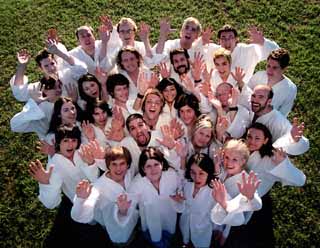
whose 28 members would probably make the store look half-full just mulling
around. The group’s Saturday, 6pm in-store is the last one scheduled this
year. It won’t be the first improbable thing the band has pulled off in
their thrilling two-year run.

“I put this thing together
in about two and a half weeks,” says founder and leader Tim DeLaughter,
frontman for Dallas’ Tripping Daisy from 1991 until the group’s dissolution
in ’99. The Polyphonic Spree’s debut came the next summer, opening for
Grandaddy. “Chris [Penn], my friend and partner in [Dallas store] Good
Records, booked us for that show, and I didn’t even have a band. The whole
thing just started coming together. Once we got one person in, he knew
somebody, they came in, and the thing just literally grew overnight into
a band.”

What has evolved is a self-described
“choral symphonic pop band” that has regularly squeezed its way, with difficulty,
onto nightclub stages in Dallas and Austin. Their Good Records debut, The
Beginning Stages of … was recorded soon after their formation. All 28
band members (give or take a couple on maternity leave) sport white robes
onstage, and their sing-along blasts have won over even the most hardened
of cynics. Featuring piano, flute, brass, strings, theremin, and who knows
what-all, the Polyphonic Spree are the church choir of a never-never land
where the congregation has blue hair, digs psychedelic rock, and sings
at the top of their lungs without embarrassment.

“When you get that much energy
going on, with that many people on the same page, there’s a lot more going
on than just playing the songs,” says DeLaughter. “If you’ve seen it on
a night when it’s just totally on, it’s overwhelming.”

THANKS: G.SORIA, S.STERLING!

YOD CHRONICLES…

THE YA HO WA 13 INTERVIEW

By Gary Bearman

In 1988, I bought a new book called After the Acid Trip – The Ultimate Psychedelic Music Guide by Vernon Joynson. In it a music group called Ya Ho Wa 13 is described as such: “this band of Hollywood misfits reputedly made at least 9 albums for Higher Key during the ’70’s.” They are referred to as “musically
very weird? largely mellow, mystical and probably drug induced.” In addition, there are pictures of two album covers – one has five men wearing only loincloths, all with bows and arrows crouching around and on top of a Rolls Royce. The other has a very intense looking older man in a white robe with a long beard singing and banging on a kettledrum.

Once I finally got a chance to hear them, it became rapidly clear that there was something more than a little unusual going on here. Upon superficial listening, it sounded like a bunch of crazy musicians making a lot of truly wonderful and bewildering psychedelic music with this deep-voiced man talking, singing,
whistling and sometimes screaming over the top of it. And the wild bizarre things he was saying? Needless to say I was intensely curious about this

mysterious group of people
with names like Djin, Sunflower, Octavius, Pythias,


Rhythm, all with the last
name Aquarian, and their enigmatic leader Father Yod


(rhymes with road).

 I was only able to
hear a couple of reissued albums at the time since all the


originals were ludicrously
rare and expensive. For a long time I tried to find


out more information about
this group and what they were about, only to be met

by a stunning lack of information.
What scant information I did find was quite


odd, and still the group
seemed somehow cloaked in mystery.

 Then lo and behold
– the heavens opened and I was to discover in 1998 that they


released a limited edition
13-cd box set on the Japanese Captain Trip label


called God and Hair – Yahowha
Collection! Here were more pictures of Father Yod,


the band and a large group
of longhaired men, women and children that all seemed


to live together. One of
the albums covers even has Father Yod pictured with a


woman in a sexual tantric
position!

 I learned that there
were 9 original albums. The first four were released under

the name “Father Yod and
the Spirit of 76.” These were Kohoutek, Contraction,


Expansion and All or Nothing
at All. The remaining 5 were released under the


name “Ya Ho Wa 13.” These
were Yahowa 13, Savage Sons of Yahowa, Penetration: An


Aquarian Symphony, I’m Gonna
Take You Home and To the Principles for the


Children. All were released
between 1973 and 1975.

 A 10th album was released
without Father Yod in 1977, but with a lot of the


same musicians, this time
including Sky Sunlight Saxon, formerly of The Seeds.


This went under the name
“Fire, Water, Air” and was called Golden Sunrise. There


were also 3 cd’s of additional
material called Yodship, Related Singles, and

Unreleased Material.

Unfortunately for me, the
liner notes in the booklet are in Japanese. I came to


the conclusion that this
was somehow a very secretive sect that for some unknown


reason had a band as part
of it and released albums. I figured though that by


now there had to be literally
hundreds of people out there in the world who were


part of this group or children
of the group, and someone somewhere had to be


willing to tell the story.

 By a miraculous twist
of fate, I was led in my searching to an Internet


discussion group where one
of the musicians from Ya Ho Wa 13 was actually

answering questions! It
turns out this was Djin, the guitarist. I worked up the


courage to e-mail him, became
friendly and asked him some questions. He led me


to Sunflower, the bass player,
and before long I popped the question, “Would you


be willing to be interviewed?”
To my surprise they happily accepted and before


long I was put in contact
with the drummer Octavius, and much later Pythias, who


also played bass on some
of the albums. I was also introduced to Isis, one of


Father Yod’s “wives” (more
on this later). She is the family’s record keeper,


did business for the family
and wrote a book about the life of the family which


is being re-done for the
public. She was also kind enough to forward the photos

to me. Most of the entries
below by Isis are direct passages from the book.

 So what is this family?
As I began to get information back, there started to


unfold one the most incredible
stories of a band I have ever heard. It wasn’t


just about music, however,
it was a whole community/commune of people who lived


together with Father Yod
(later called Yahowha) as their spiritual leader….

Continued at: http://www.furious.com/perfect/yahowa13.html

PERCY VS. KATHERINE HARRIS

Paws for thought in Katherine Harris campaign

MIAMI, Florida (Reuters)
— Florida Secretary of State Katherine Harris, a key player in the 2000 presidential election recount battle, faces a dogged opponent in her campaign for Congress — a border collie-German shepherd mix, to be precise.


    Charter boat captain Wayne Genthner of Sarasota, Florida, said on Monday he planned
to enter the name of his dog Percy as a write-in candidate for the Republican primary ahead of the November election.


    “We hope by running a canine against a nationally known political person we can
draw attention to voter disenfranchisement and disconnect,” he said.


    Harris has set her sights on a seat in the House and is viewed as the favorite
to win in her district in the Sarasota area.


    Genthner
said he wanted to satirize what he viewed as absurdities and injustices
such as campaign finance, which he said put running for office out of reach
of ordinary people.


    Since
election rules would prevent a dog from running, Genthner said that later
this month he would send in the papers entering himself as a write-in candidate
— a person whose name does not appear on the ballot but can be inscribed
by voters. But Percy would be the name voters would write and Genthner
said he intended to act merely as “campaign manager.”

    While
his action is intended as parody, he hoped it would send a serious message.
“We want people to participate in democracy before it dies on the vine,”
said Genthner.


    The campaign
has so far cost some $600, mostly in copying fliers, said Genthner, adding
that he had taken Percy out to meet voters at events such as stock car
races.


    Percy’s
manifesto promises a tough line on crime since the dog “will personally
chase down any criminal he sees.” It notes that he “has himself never been
implicated in any sex scandal, thanks, he says, to his timely neutering.”


    Harris’s
campaign had raised some $1.7 million by the end of March and she is viewed
as likely to steam-roller her challengers in a safe Republican district.
Her campaign has taken the canine threat in good humor.


    “The
cute looking candidate, Percy the dog, has a lot of paws to shake to catch
up with our grass roots effort and huge volunteer base,” said her campaign
assistant press secretary Jessica Furst.


    Harris
became a household name, praised by Republicans and vilified by Democrats,
in November 2000 as supervisor of the hotly contested elections in Florida
that turned out to hold the keys to the White House. Bush won the White
House after a five-week legal battle over vote recounting.