

http://www.photographarecruiter.com/

http://www.photographarecruiter.com/
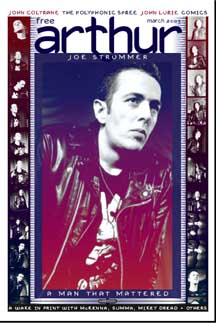
We’ve got 50 copies left of Arthur No. 3 (cover date March 2003, pub’d February, 2003). This one’s from the original incarnation (read: best) of Arthur—the pages are gigantic (11×17) and the paper is reasonably high-quality newsprint. Some color, some b/w. We’re selling our remaining stock for $5 each over at the Arthur Store.
Notes on this issue…
Joe Strummer died on December 22, 2002. His death received some notice, of course, but since he’d left us in the period between Thanksgiving and the New Year—when glossy music and culture magazines are basically shut down—real coverage of his passing, and the life that he lived, didn’t happen in the pop culture magazines of record. Big-budget American publications like Rolling Stone, Spin and Blender had already finished their January 2003 issues, so major features couldn’t fit in there without major expense (pulled features, pulped magazines, etc.); and by the time their February 2003 issues rolled around, the news of Joe’s passing would be (to their market-minds) “stale,” and thus to be deserving of only an obligatory page or two. Which is absurd for someone of Joe’s stature, his body of work, and commitment to The Cause.
At Arthur, we decided to pull the cover feature that we had in progress. Working together, with no editorial budget, the budding Arthur gang was able to put together something of substance very quickly, and get it out to the people, for free, in mass quantities (50,000 copies), within weeks of Joe’s passing.
Our wake for Joe Strummer would not have happened without journalist/archivist Kristine McKenna. She had a recent, lengthy (3800 words), and yes, poignant conversation with Joe on tape—a really great conversation, of course (this IS Kristine McKenna, after all) that the LAWeekly had used just a bit from in a feature earlier in the year. Kristine had witnessed The Clash at the top of their game, so she could offer some real historical perspective. And, crucially, Kristine knew that her friend, the L.A. photographer Ann Summa, had a trove of gorgeous photographs of Joe, few of which had ever been published. And Kristine got us permission to reprint a Clash-related page from Slash, the crucial late-’70s underground L.A. magazine. Meanwhile, my old colleague Carter Van Pelt, a reggae enthusiast, offered a new interview about Joe that he conducted with Mikey Dread.
Soon we had reports from all over. People were picking up multiple copies of the magazine and redistributing it. The golden centerfold of Ann Summa photo of Joe (worked on with a great deal of care and attention by Arthur’s brilliant art director, W.T. Nelson) was being torn out of the magazine and posted on record store walls, in dorm rooms, in clubs. There are other strong pieces in this issue—the John Coltrane book excerpt, especially—but it’s Joe’s issue. As it should be.
Here’s how the contents page read:
JOE STRUMMER, 1952-2002
Arthur holds a wake in print for a man who mattered. In addition to stunning photographs by Ann Summa and excerpts of back-in-the-day Clash coverage from Slash magazine, we present reflections on Joe by Kristine McKenna; a lengthy, poignant interview with Joe from 2001 by McKenna; a consideration by Carter Van Pelt of the Clash’s embrace of reggae, featuring insights from Clash collaborator Mikey Dread; and a brief on Joe’s legacy: a forest in the Isle of Skye.
At the height of both his popularity and his artistic powers, JOHN COLTRANE went for something deeper. An exclusive, chapter-length excerpt from A Love Supreme: The Story of John Coltrane’s Signature Album by Ashley Kahn.
The intrepid Gabe Soria connects with every single member of THE POLYPHONIC SPREE, the cheeriest 24-person pop symphony on the planet, in addition to chatting at length with Spree leader Tim DeLaughter about the “c” word, the Spree’s next move, and the sadness that remains. Portrait by Paul Pope.
“ASK JOHN LURIE”: He may be in self-described “hermit mode” but this longtime Lounge Lizard is eager to lend a helping hand to his fellow man. And woman too.
In the work of artist SHIRLEY TSE, plastic aspires to more than Pop. Mimi Zeiger reports.
COMICS by Sammy Harkham, Jordan Crane, Johnny Ryan, Sam Henderson, Marc Bell and Ron Rege Jr.
Byron Coley & Thurston Moore review underground music, film and texts.
And more more more
Arthur No. 3 is available from the Arthur Store.
Another piece by Iain Sinclair, this one regarding his friend, the late visionary author J.G. Ballard (wiki).
From today’s The Guardian, on the occasion of the new Ballard exhibition at the London Gagosian…

PAUL DELVAUX: Le canapé bleu, 1967 (Oil on canvas/55 1/8 x 70 7/8 inches)
Crash: JG Ballard’s artistic legacy
Shortly before JG Ballard’s death last year, Iain Sinclair made a pilgrimage to the author’s Shepperton semi, a shrine to his surreal tastes and happy family life. A new exhibition of his favourite paintings and of art work he has inspired honours this distinctive vision
Coming away from the official path, on a walk from the mouth of the Thames to Oxford in October 2008, I diverted through Shepperton. Light rain misted my spectacles. An uncertain detour was blocked by a two-tonne Jaguar saloon, white and racing green: XJ MOTOR SERVICES. The upstream settlement has evident 21st-century loot, as well as Edwardian weekend villas and chalets. There is a blue plaque to the literary giant they choose to commemorate: THOMAS LOVE PEACOCK LIVED HERE, 1823-1866. Modernist white cubes with big windows are attracted by reflections of light on water. Natural metaphors for unnatural liquidity in a time of recession.
I head for the station. That’s where JG Ballard met me when I visited him. I never saw the inside of his house. We drove to a riverside pub and sat under whirring fans. I wondered why, after his great success with Empire of the Sun, he didn’t relocate to one of those balconied, sharp-angled properties that were so attractive to the convalescing architects and blocked advertising men who populate his books. Foolish thought. Ballard was a working writer, first and last; the where of it was not to be disturbed. Fixed routines served him well; so many hours, so many words. Breakfast. Times crossword. Desk overlooking a natural garden. Stroll to the shops to observe the erotic rhythms of consumerism. Lunch standing up with The World at One on the radio. Back to the study. Forty-minute constitutional down to the river. TV chill-out meditation: Hawaii Five-O and The Rockford Files rather than Kenneth Clark.
The interior landscape of the suburban semi was a mirage. The more you studied it, the cannier the decision to settle the family in Shepperton, all those years ago, appeared. It was far enough out of London to limit the pests, the time-devourers. When journalists gained access they were mesmerised by the reproduction Delvaux canvases propped on the floor, the aluminium palm tree, the lounger in the front room; dutifully they repeated the standard questions about surrealism and how The Drowned World was saturated in Max Ernst. The house in Old Charlton Road was a premature installation; a stage set designed to confirm the expectations of awed pilgrims. But it was also a home in which the widowed author brought up three children who are always laughing in family snapshots.
Ballard may be the first serious novelist whose oeuvre is most widely represented in books of interviews. And whose future belongs as much in white-walled warehouse galleries as the diminishing shelves of public libraries. He was so generous to those who found his phone number, so direct: he rehearsed polished routines – and always agreed, with unfailing courtesy, that the world was indeed a pale Xerox made in homage to the manifold of his fiction. A late moralist, he practised undeceived reportage, not prophecy: closer to Orwell than HG Wells. Closer to Orson Welles than to either. Closer to Hitchcock. Take out the moving figures on staircases that go nowhere and stick with hollow architecture that co-authors subversive drama.
CHRIS BURDEN: L.A.P.D. Uniform (1994, Fabric, leather, wood, metal and plastic
88 x 72 x 6 inches Ed. of 30)
Spurning critical theory, Ballard joined his near-namesake Baudrillard as the hot topic for air-miles academics. Off-highway universities, indistinguishable from hospitals or hotels, approve infinite theses. A hall of mirrors in which students, who have lost the habit of literature, recognise, in the Shepperton master’s exquisitely calibrated prose, intimations of a hybrid form capable of processing autopsy reports and invasion politics into accidental poetry. The incantatory manifesto, “What I Believe”, deploys Ballard’s favourite device, the list, as he curates a museum of affinities: “I believe in Max Ernst, Delvaux, Dalí, Titian, / Goya, Leonardo, Vermeer, Chirico, Magritte, / Redon, Dürer, Tanguy, the Facteur Cheval, / the Watts Towers, Böcklin, Francis Bacon, and all the invisible artists / within the psychiatric institutions of the planet.”
It was almost dark when I got there, after walking down a street occupied by Indian restaurants, Chinese takeaways, charity and novelty shops. A man spotted me as I lined up the shot.
“A writer bloke is supposed to live in that house. We’ve been out here 25 years and I’ve never set eyes on him, tell the truth. But he’s on the box….”
Read on at The Guardian
Wikipedia: Chris Morris
From the archives…

Here’s a nice follow-on from the Raoul Vaneigem interview, posted earlier this week: British author/poet/journalist Iain Sinclair on what he’s discovered through the years from “motiveless walking” in London. From the Telegraph:
In London, from the first, I walked. As a film student, newly arrived in the early Sixties, I copied the poet John Clare on his feverish escape from Matthew Allen’s asylum in Epping Forest, when he navigated by lying down to sleep with his head to the north. Skull as compass: all the secret fluids and internal memory-oceans aligned by force of desire. Clare returned, as he thought, to Mary, his first love, his muse; to his heart-place, Helpston, beyond Peterborough, on the edge of the dark fens. My drag was cinema, Bergman seasons in Hampstead, Howard Hawks in Stockwell. Or art: the astonishing Francis Bacon gathering at the old Tate, at Millbank, former prison and panopticon. Bacon’s melting apes were robed like cardinals. Naked men, stitched from photographs, wrestled in glass cages.
Motiveless walking processed the unanchored images that infiltrated dreams of the shadow-belt on either side of the Northern Line. I lodged in West Norwood, a house on a hill, like the one I had left behind in Wales. I wandered through mysterious suburbs to the rooms above the butcher’s shop in Electric Avenue, Brixton, where the school was based. Street markets, I discovered, were a significant part of the substance of this place. Walking was a means of editing a city of free-floating fragments. I composed, privately, epic poems conflating the gilded Byzantium of W.B. Yeats with the slap and strut of Mickey Spillane’s California. London was an impossible relativity of historical periods and superimposed topographies.
After Dublin, where I enjoyed four years of apprentice exile, I came to Hackney: perched, settled, stayed. The modestly impoverished zone had the virtue of being unknown, even to itself. Submerging into a novel territory, as a casual labourer, I found both time and means to pursue my obsession with alignments, reforgotten writers, lost rivers, Hawksmoor churches, crime clusters. Street signs and spray-can slogans were a code to be broken. I had no idea, back then, that rogue Parisian intellectuals had already branded these strategies and given them a provocative title: psychogeography.
30 years later, assembling a collection of essays on London, which I called Lights Out for the Territory (after Mark Twain), I realised that, unconsciously, I had been operating, all along, as a disenfranchised psychogeographer. I stalked a defining urban narrative by sleepwalking through downriver reaches, sniffing after faded traces of Thomas De Quincey – and challenging the post-architectural infill of Docklands, the empty hubris of the Millennium Dome, with ritual expeditions that doubled as curses. Compulsive digressions disavowed the bullet-point banalities of developers and promoters. I wrote about pit bulls and satellite dishes. I attended the funeral of that mythical east London gangster Ronnie Kray: the godfather of the ghosted memoir, of mendacious boasts disguised as confessions. The pulp model for self-serving political autobiographies. I looked down on the glittering Thames from Lord Archer’s penthouse. London was revealed as a city of hidden connections and weird coincidences.
I had stumbled on a model for future projects: the walk as a narrative, as a moving film made from static images. This was a method of preparing the writer for an act of occult possession: in the way that William Blake was captured by the spirit of John Milton in the form of a star striking his heel. Considerations of the present Olympic Park in the Lower Lea Valley would begin by employing the Lights Out for the Territory template…
Read on at the Telegraph…
Promo short for forthcoming Roky Erickson & Okkervil River album, shot at Toy Joy in Austin, Texas…
Wikipedia:
Roky Erickson
13th Floor Elevators
Definitive 13th Floor Elevators biography, published 2008 by Process:

Definitive 13th Floor Elevators ten-CD boxset, released 2009 by International Artists:
And, just for kicks, here’s Jason Pierce of Spiritualized and Spacemen 3, wearing his Roky shirt on the cover of Arthur in 2008:

from: http://www.newscientist.com/
Müller told New Scientist. “It’s as if the black hole is like a mirror.”
The last year has been rough, but we’ll try to face the new dawn more regularly. See how it goes, and we’ll deal with some older stuff amidst the newer stuff. Can’t be helped. Thanks.

1. I guess it’s beyond the point of convincing anyone that some of the best music/sounds is happening on small cassette labels, but once in a while something gets slapped in the tape deck that just utterly, completely nails you to the underpinnings of heavens dripping maw. Such an experience is to be had by anyone lucky enough to grab hold of if only goodnight, the first cassette on the Wagtail label by Eastern Massachusetts improv/noise/strange-string shaman-femme Ashley Paul. Ms. Paul has been on the hot tongues of local noise lovers for a few years now and has gotten some recognition through her collaborations with the amazing Rel Records imprint. This cassette is really, really stirring and odd and affecting with high-frequency vox (which may or may not be ACTUAL vocals, but the mystic air conjured by reed-tongue) that call to mind early Connie Berg (Mars) interacting with bowed percussion and dislocated guitar sex. Cool as it gets. Get it.
2. Recent times appear to have been busy for Ed Sanders (above), one of the heroes of this century and the last. Amidst rumblings of a vast archival reissue series of material recorded by Ed’s band the Fugs, there is also a new Fugs album due sometime soon, and a slew of printed material already in hand. Poems for New Orleans (North Atlantic Books) came out in ’08, but only recently came to our attention. The book is full of Sanders’ beautiful verse, inspired by a trip to the city, which lead to intense reading about its history, and imaginings of chance encounters that might have been. Thus, the book’s a mix of investigative poetry (a school of thought Sanders founded), pure conjecture, and his own special lyricism. Great stuff, tying together near-ancient history with the catastrophes of Katrina and much else. Here’s a brief sample of the poem, “Echoes of Heraclitus”:
A helicopter flew me away
I wound up in Utah
where I am waiting for Jesus
or anybody
to help me home.
Also new to us is America, A History in Verse: The 20th Century Volumes 1-5 (Blake Route Press). The first three volumes of this massive, detailed ride through the American consciousness were published by Black Sparrow Books, but following the retirement of the legendary publisher, John Martin, there was no one around to actualize the words. Thus, the full set is available as pdf files on CD. And hideous as this format feels (we spend way too much time on screen already), the work is fantastic. Here’s a short piece from Volume 5:
The Oklahoma City Bombing
April 19
Timothy McVeigh
looked like someone who could have been a NASCAR driver
or a retired quarterback
Close cut hair
White eyes of blue a Gulf War vet
and bursting from a sliver of the small town ethos
that allowed grumbling gun nuts
& gummint-haters
to exist without much hassle
It would be delightful if someone would turn these last two volumes into actual books as well, but for now, this will have to do. Ed was also the main subject of a recent show hosted by an amazing gallery/printing shop in Brooklyn called The Arm. They hosted a brief show of his many glyph-based artworks from the last half a century, and while the show has ceased to exist, The Arm’s Dan Morris is working on a portfolio reprinting several of Ed’s most eye-commandeering efforts. There are also a few loose sheets of this work available. And they are guaranteed to make yr brain very hot.
Anyway, we await finding a copy of Ed’s new poetry collection from Coffee House Press, and the soon-due Fugs CD as well. ‘Til then—keep grope alive.

3. One dude who has been on the UK underground noise cassette scene as long as Ashtray Navigations’ Phil Todd is Joincey. Haven’t really heard to much from Joincey in a while but he has this new thing now called My Carapace Is Leaking and the first thing we’ve heard by “them” is a split cassette with Swiss-Swedish double bass improvisor Nina De Heney on the Rayon Records label from Lyon, France. Joincey, or My Carapace Is Leaking, also employs bass action, though unlike De Heney’s more raw, organic scrape and touch (which is ruling), it is more of a skin-melting lather. And it is completely great. A wonderful split by these two, and anyone who has followed Joincey through the years with Wagstaff, Inca Eyeball, Coits, Stuckometer, and his amazing Face Like A Smacked Arse label will desperately want this.
4. Another great set of releases has appeared from Mondo Macabro, who seem to have a truly insane grasp of international exploitation films. The third volume of their Bollywood Horror series pairs two films from the Ramsay Brothers studio, Mahakaa and Tahkana, which combine tons of bad vibes, dance numbers and surreal juxtapositions of elements – I mean, who knew Nightmare on Elm Street was lacking a gay Michael Jackson character? Not us. But now we do.
We also understand, from seeing Akio Jissoji’s Marquis De Sade’s Prosperities of Vice, that it would have been a bad idea to create a criminal theater based on the works of De Sade in Japan during the 1920s. As to whether it’d be a good idea now, we can only guess. But watching how the bad idea actually was is a great visual treat. Weird to think this same director did the Ultra Man movies!

5. Great Dividing, the Australian label that kicked in the front door of our o-brain with the posthumous 3 Toed Sloth LP (which for better and/or worse is as close as we can get to contempo Feedtime action as it features almighty Feedtime drum-jesus, Tom), has issued a cassette comp, A Range of Greatdividing, which has some primo Sloth as well as other Oz dementia like the top-notch Shoptoprockers. Primal, guitar scrawl with dirty-hair free-chug moves that proves Oz still the sexiest dirtbarge ‘neath the meridian.
Directly from the band publicist of the band who got it directly from the band:
SHARE YOUR BIKINI KILL STORIES
Bikini Kill has set up an official archive online:
http://bikinikillarchive.wordpress.com/
We are collecting stories of how people got into the band/shows they saw/memories/testimonials etc.
It would be awesome if you wanted to contribute. It doesn’t have to be fancy or well-worded, we’d just like you to leave a record of your experience and get an idea of what Bikini Kill means to you. Maybe it’s your reaction to a song we wrote, something weird that happened at one of our shows, a personal anecdote or just WHATEVER. Send yr story to bkillarchive@gmail.com and we will post it or just leave a comment somewhere on the site. You can also send us images to post.
Please help us spread the word. To document the history (or herstory) of the band it is necessary to include an oral history from “the fans”. We say fans for lack of a better word–a more expansive term would be inclusive of friends, peers, comrades, co-conspirators and imply participation rather than an audience separate from the band–which is what we hope to achieve with this interactive approach.
Also, if you have video/film footage of the band, please contact us, Thanks!

 Arthur Magazine